On This Page
Problem: Jensen's Inequality in Statistical Thermodynamics of Ideal Gases
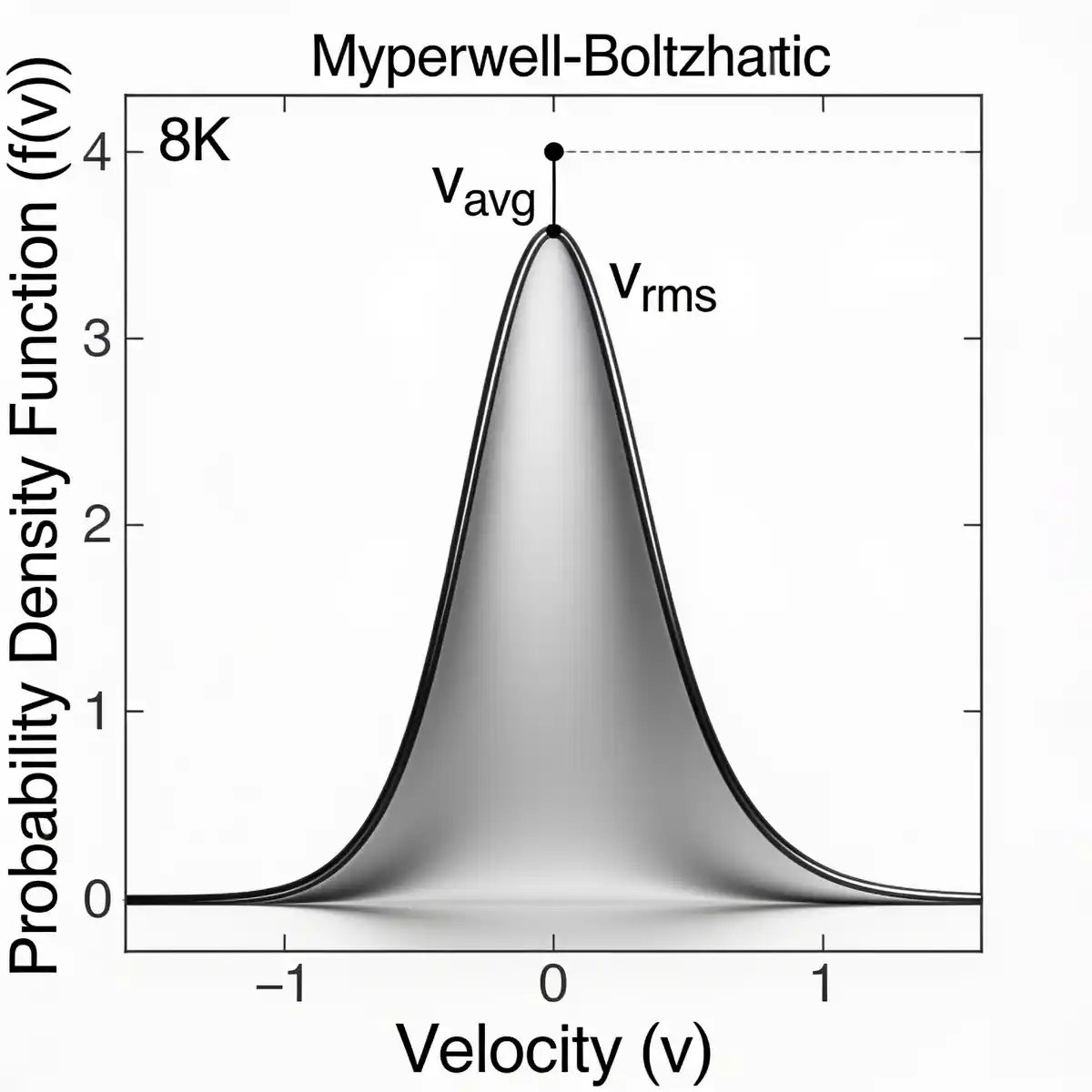
In the study of kinetic theory and statistical mechanics, the velocities of gas molecules are not uniform. Instead, they follow a probability distribution, such as the Maxwell-Boltzmann distribution. Because the velocities are distributed, we characterize the gas using various statistical moments. Two critical measures of molecular speed are the average speed ##v_{\text{avg}}## and the root-mean-square speed ##v_{\text{rms}}##.
Jensen's Inequality provides a powerful framework for relating the mean of a function of a random variable to the function of the mean of that variable.
**Statement of the Problem:**
Jensen's inequality states that for any convex function ##\phi(x)## and a random variable ##X##:
where ##E[\cdot]## denotes the expected value (mean).
(a) Identify why the function ##\phi(v) = v^2## is convex for ##v \ge 0##.
(b) Use Jensen's inequality to prove that the root-mean-square speed ##v_{\text{rms}} = \sqrt{\langle v^2 \rangle}## is always greater than or equal to the average speed ##v_{\text{avg}} = \langle v \rangle##.
---
Worked Solution & Step-by-Step Explanation
Part (a): Establishing Convexity
A function ##\phi(v)## is classified as convex on an interval if its second derivative is non-negative throughout that interval. This geometric property ensures that the chord joining any two points on the graph of the function lies above or on the graph itself.
1. **Define the function:**
##\phi(v) = v^2##
2. **First Derivative:**
Applying the power rule, we find the rate of change:
##\phi'(v) = \dfrac{d}{dv}(v^2) = 2v##
3. **Second Derivative:**
Differentiating once more gives the concavity:
##\phi''(v) = \dfrac{d}{dv}(2v) = 2##
4. **Conclusion:**
Since ##\phi''(v) = 2##, and ##2 > 0## for all ##v \in \mathbb{R}##, the function is strictly convex. This satisfies the condition required to apply Jensen's Inequality.
---
Part (b): Proving the Speed Relationship
We apply the inequality to the molecular speed ##v##, treating it as our random variable.
1. **Substitution into Jensen's Inequality:**
Substitute ##\phi(v) = v^2## into the inequality ##\phi(E[v]) \le E[\phi(v)]##:
2. **Mapping to Physics Notation:**
In statistical mechanics, the expected value ##E[v]## corresponds to the average speed, denoted as ##\langle v \rangle##. Similarly, the expected value of the squared speed ##E[v^2]## is the mean square speed, denoted as ##\langle v^2 \rangle##.
3. **Algebraic Manipulation:**
Since speed is a non-negative scalar quantity (##v \ge 0##), the average speed ##\langle v \rangle## is also non-negative. We may take the square root of both sides without reversing the inequality:
4. **Definition Application:**
By definition, ##v_{\text{avg}} = \langle v \rangle## and ##v_{\text{rms}} = \sqrt{\langle v^2 \rangle}##. Substituting these yields:
---
Summary Table of Statistical Definitions
| Symbol | Physical Meaning | Mathematical Definition | ||
|---|---|---|---|---|
| :--- | :--- | :--- | ||
| ##v_{\text{avg}}## | Average Speed | ##\int v f(v) dv## | ||
| ##v_{\text{rms}}## | Root-Mean-Square Speed | ##\sqrt{\int v^2 f(v) dv}## | ||
| ##\phi(v)## | Convex Function | ##\phi''(v) \ge 0## |
* **Mathematical Rigor:** The inequality ##v_{\text{rms}} \ge v_{\text{avg}}## is a direct consequence of the convexity of the square function.
* **Equality Condition:** Equality (##v_{\text{rms}} = v_{\text{avg}}##) holds if and only if the variance of the speed is zero, meaning every molecule in the gas has the exact same velocity.
* **Physical Meaning:** In any real gas distribution, molecules possess a spread of velocities, which guarantees that ##v_{\text{rms}} > v_{\text{avg}}##.
RESOURCES
- Jensen's force and the statistical mechanics of cortical ... - Naturenature.comOct 23, 2019 ... Jensen's force and the statistical mechanics of cortical asynchronous states ... inequality in probability theory– and that occurs owing to…
- Variation on the theme of Jarzynski's inequality - arXivarxiv.orgJan 4, 2026 ... ... statistical thermodynamics. In this paper, we study a weaker ... inequality, which can be formally obtained from the Jarzynski…
- Jensen's inequality - Wikipediaen.wikipedia.orgIn mathematics, Jensen's inequality, named after the Danish mathematician Johan Jensen, relates the value of a convex function of an integral to the ...
- Non-equilibrium Thermodynamics Results Seemingly from Nothingblog.alexalemi.comSep 16, 2022 ... The proof of which is straightforward given that l o g is concave and Jensen's inequality, see my other blog…
- Accepted Paper: Variation on the theme of Jarzynski's inequalityjournals.aps.org1 day ago ... ... statistical thermodynamics. In this paper, we study a weaker ... inequality, which can be formally obtained from the Jarzynski…
- Jensen's Inequality for returns on short positionsquant.stackexchange.comAug 9, 2019 ... In a nutshell, this is the "variance drag" problem. The mechanics of how you short something matter, and it's relevant…
- The Variance Drain and Jensen's Inequality - IDEAS/RePEcideas.repec.org... Jensen's Inequality. The ”defect” in Jensen's Inequality ... "Virtual volatility," Physica A: Statistical Mechanics and its Applications, Elsevier, vol.
- [Q] Is there a proof/intuitive reason why E(X^2) will always be greater ...reddit.comApr 10, 2020 ... Basically Jensen's inequality generalizes the statement that the secant line of a convex function lies above the graph of the…
- Jensen-Detrended Cross-Correlation function for non-stationary ...sciencedirect.comPhysica A: Statistical Mechanics and its Applications · Volume 654, 15 ... Based on Jensen's inequality and variance, the Jensen-variance information has ...
- Convexity, Jensen's inequality and benefits of noisy mechanical ...pmc.ncbi.nlm.nih.govOther issues are statistical in nature ... Jensen's inequality has important considerations in engineering, information theory and thermodynamics.
- Thermodynamic paths to Jensen's inequality - AIP Publishingpubs.aip.orgArithmetic and Geometric Mean,'' Phys. Lett. A 67, 1 ~1978!. 3P. T. Landsberg, Thermodynamics and Statistical Mechanics ~Oxford.
- Thermodynamic skewness relation from detailed fluctuation theoremlink.aps.orgNonequilibrium statistical mechanics. Article Text. Introduction ... using a technique based on Jensen's inequality. Alternatively, we also show ...
- Information theoretical interpretation of Free Energy - MathOverflowmathoverflow.netSep 8, 2024 ... In statistical mechanics, free energy is related to the logarithm of the partition function and tracks the system's progress toward…
- Revisions of the Phenomenological and Statistical Statements of the ...pmc.ncbi.nlm.nih.govProposition 2 specifies the structure of allowed thermodynamic processes by using the Inequality of Heat and Temperature Proportions inspired by Eudoxus of ...
- Quantum Jarzynski Equality in Open Quantum Systems from the ...link.aps.orgAug 7, 2020 ... Nonequilibrium statistical mechanics · Quantum correlations in ... Applying Jensen's inequality to Eq. (7) , and using the equivalence ...




0 Comments