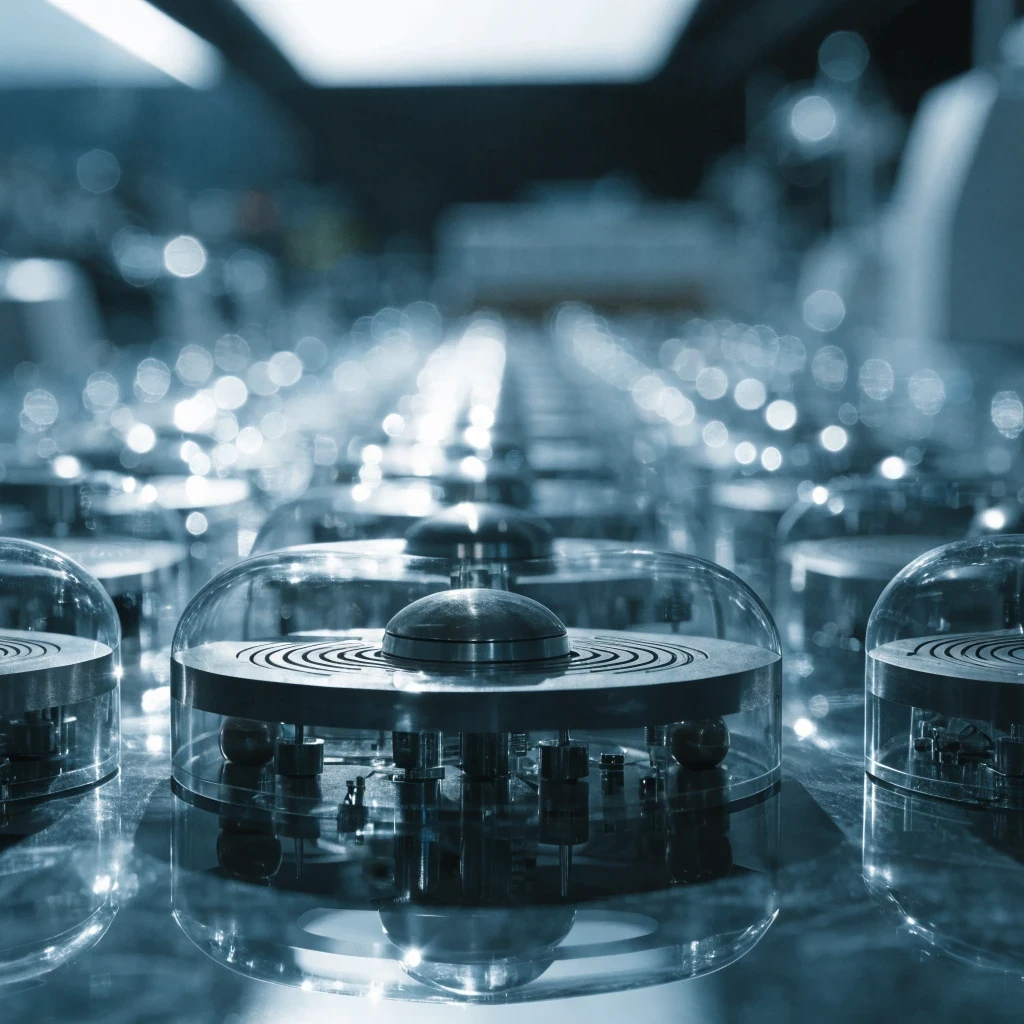
Mechanical vibration is moving from the background of computing hardware to the centre of a serious scientific question: can information be stored, manipulated, and preserved in resonant motion rather than in magnetic orientation? The idea sounds deceptively simple. A tiny structure can vibrate at selected frequencies, phases, or amplitudes, allowing those mechanical states to represent data. Yet beneath that simplicity lies a demanding collision between quantum physics, materials engineering, thermal noise, and device architecture.
Phonon-based memory would not merely replace one physical object with another. It would redefine what a memory state is. Magnetic memory uses collective electron-spin configurations, while a mechanical device encodes information in quantized lattice vibrations or engineered resonator modes. The attraction is powerful: mechanical systems can offer long-lived resonances, strong interaction with light and electrical signals, and unusually direct access to coherent motion. The obstacles are equally severe, especially heat, damping, fabrication variability, and reliable nanoscale control.
The decisive question is therefore not whether vibrations can carry information—they plainly can—but whether they can do so with the endurance, density, speed, scalability, and energy efficiency required by future computing. This analysis examines mechanical resonators, quantum information, and phonons versus spins, separating genuine technological promise from the careless claim that every unconventional memory platform is automatically superior.
On This Page

What phonon-based memory actually stores
“Phonon memory” is often presented as though a single vibration simply stands for one or zero. That description is too crude. In a solid, a phonon is a quantized excitation of a collective vibrational mode: many atoms oscillate in an organised pattern. In an engineered resonator, the stored state may be the number of phonons, the oscillation phase, the mode frequency, or a carefully defined superposition of states. Each choice creates a different memory architecture.
Mechanical information storage therefore sits between classical and quantum descriptions. A classical resonator can preserve a waveform or frequency for a measurable interval, whereas a quantum resonator can encode a state such as ##n## phonons or a superposition of vibrational occupations. The distinction matters because quantum information is destroyed not only by energy loss but also by phase-randomising interactions. A mechanically quiet device is not automatically a quantum memory.
Resonance, amplitude, and phase as information carriers
A resonator behaves like a highly selective oscillator. Its preferred angular frequency is determined by effective stiffness and effective mass, while its quality factor measures how slowly energy leaks away. In the simplest approximation, increasing stiffness raises the resonance frequency, whereas increasing mass lowers it. Fabrication can exploit this relationship to create arrays of distinct mechanical channels rather than a single binary switch.
Calculation 1 — estimating a resonator frequency. Consider an effective mass of ##m_{\mathrm{eff}}=10^{-15}\,\mathrm{kg}## and stiffness ##k=1\,\mathrm{N\,m^{-1}}##. The angular resonance frequency is ##\omega_0=\sqrt{\dfrac{k}{m_{\mathrm{eff}}}}##. Substitution gives ##\omega_0=\sqrt{10^{15}}\approx3.16\times10^7\,\mathrm{rad\,s^{-1}}##, so ##f_0=\dfrac{\omega_0}{2\pi}\approx5.03\,\mathrm{MHz}##.
Amplitude-based encoding is easy to measure but vulnerable to attenuation and nonlinear distortion. Frequency-based encoding can be more robust against moderate amplitude loss, yet it requires precise discrimination between neighbouring modes. Phase-based encoding is especially attractive for coherent quantum operations because relative phase carries computational meaning. The engineering rule is uncompromising: a proposed state must be distinguishable, reproducible, and stable under the exact noise present in its environment.
Why phonons are more than “sound at small scale”
Macroscopic sound is a collective wave involving enormous numbers of quanta. A phonon is the quantum description of an allowed vibrational mode, much as a photon describes an electromagnetic mode. This does not mean every vibrating object is automatically a useful quantum device. Quantisation becomes technologically relevant only when the mode can be cooled, isolated, controlled, and measured before environmental interactions erase its state.
The most compelling feature of phonons is their capacity to connect otherwise incompatible systems. Strain can couple mechanical motion to superconducting circuits, semiconductor defects, quantum dots, spins, and optical cavities. A mechanical mode may therefore act as a translator or temporary buffer between microwave and optical information. That interface function could prove more valuable than direct competition with established magnetic storage.
Mechanical modes also provide a rich design vocabulary. Geometry can tune frequencies, localisation, coupling strength, and participation in the surrounding material. Phononic band gaps can suppress the escape of vibrational energy, while suspended structures can reduce clamping losses. These techniques do not abolish dissipation, but they allow engineers to shape where energy travels—a degree of control that is central to any serious memory proposal.
How mechanical memory differs from electron-spin memory
Magnetic memory stores information through magnetic moments, which arise primarily from electron spin and orbital motion. In a conventional magnetic element, stable orientations represent logical states, and an energy barrier protects those states from accidental reversal. Non-volatility is the decisive advantage: once written, the information can remain without continuous power. Any phonon platform seeking replacement status must confront this strength directly.
Mechanical memory uses displacement and motion rather than magnetisation. Its state is linked to a mechanical potential, an oscillatory trajectory, or a phonon population. The distinction changes both the opportunities and the failure modes. Vibrations can couple efficiently to electrical and optical fields, but they are also naturally exposed to thermal agitation and structural damping. A resonator may be exquisitely coherent in one environment and uselessly noisy in another.
Energy landscapes, dissipation, and retention
For a harmonic mechanical mode, the energy grows with both amplitude and frequency. The stored energy can be written as a sum of kinetic and potential contributions, each oscillating during a cycle. In a real device, friction-like mechanisms remove energy, and the resonator’s quality factor determines how many cycles it completes before its stored energy substantially decays.
Calculation 2 — estimating mechanical storage energy. Let a resonator have effective mass ##m=2\times10^{-15}\,\mathrm{kg}##, angular frequency ##\omega=2\pi\times10^8\,\mathrm{rad\,s^{-1}}##, and peak displacement ##x_0=10^{-12}\,\mathrm{m}##. Its maximum potential energy is ##E=\dfrac{1}{2}m\omega^2x_0^2##. Therefore ##E\approx\dfrac{1}{2}(2\times10^{-15})(6.28\times10^8)^2(10^{-12})^2\approx3.95\times10^{-22}\,\mathrm{J}##.
That energy is only an idealised classical estimate, but it exposes a central trade-off. Greater amplitude improves readout margin, yet it can trigger nonlinear behaviour or consume more write energy. Smaller amplitudes reduce disturbance but make the state harder to distinguish from thermal motion. Magnetic memory solves this problem through robust energy barriers; phonon memory must solve it through confinement, cooling, feedback, or error correction.
Non-volatility versus coherent transience
Magnetic memory is designed to preserve a state after the writing field disappears. A mechanical oscillator, by contrast, normally needs a continuing physical condition—stored energy, a bistable potential, or an engineered metastable state—to maintain its information. A freely ringing resonator is therefore not inherently non-volatile. It is better understood as a dynamic memory or coherent buffer unless its architecture explicitly creates long-term state retention.
This distinction is not a weakness in every application. Quantum processors often need temporary storage, synchronisation, and state transfer rather than archival memory. A phonon mode that preserves phase for a useful interval may be extraordinarily valuable even if it cannot retain data overnight. In low-power logic, a mechanical switch could also exploit sharp nonlinear thresholds, converting small control signals into robust mechanical states.
The bold conclusion is that phonons should not be judged by a single “replacement” test. They may lose to magnetic memory in dense, non-volatile mass storage while winning in specialised interfaces, cryogenic control, frequency-selective processing, or quantum buffering. Technology does not advance by forcing every platform into one universal role; it advances by assigning each physical mechanism the task it performs best.
Can mechanical resonators preserve quantum information?
Quantum information is unusually demanding because a useful state must retain both populations and phase relationships. Mechanical resonators are appealing candidates because their modes can be engineered, coupled, and measured with precision. They can also possess high quality factors, meaning low energy dissipation over many oscillation cycles. But coherence is not identical to a high quality factor, and this distinction must govern every credible claim.
A resonator interacts with its environment through supports, surfaces, defects, electrical fields, radiation, and thermal phonons. Each pathway can remove energy or reveal partial information about the state. Once the environment acquires which-state information, quantum coherence diminishes. The practical objective is consequently not just a large ##Q## value but a long coherence time relative to the duration of writing, processing, and readout operations.
Quality factor, lifetime, and the quantum limit
For a lightly damped oscillator, the quality factor is approximately the ratio of stored energy to energy lost per radian, with several equivalent definitions depending on convention. A higher ##Q## generally implies a narrower resonance and a longer energy-decay time. Yet material loss and coupling loss can behave differently, so an apparently impressive resonance measurement may not translate into a protected information lifetime.
Calculation 3 — converting quality factor into an energy-decay time. For a resonator with ##f_0=100\,\mathrm{MHz}## and ##Q=10^6##, the angular frequency is ##\omega_0=2\pi f_0##. Using the approximate energy lifetime ##\tau_E=\dfrac{Q}{\omega_0}## gives ##\tau_E=\dfrac{10^6}{2\pi(10^8)}\approx1.59\times10^{-3}\,\mathrm{s}##. The amplitude lifetime is different by a factor of approximately two, illustrating why decay conventions must be stated.
At low temperatures, reducing thermal occupation can place a mechanical mode near its ground state, but cooling alone is insufficient. The mode must also be isolated from fluctuating forces and measured without injecting excessive back-action. Quantum-limited amplification, cryogenic microwave circuits, optomechanical readout, and carefully designed control pulses are therefore part of the memory system, not optional accessories.
Hybrid devices may be the real breakthrough
Mechanical resonators rarely operate in isolation. Their most promising role is as hybrid infrastructure. A superconducting circuit can couple to a piezoelectric mechanical mode; an optical cavity can exchange information through radiation pressure; a spin defect can interact with local strain. The resonator becomes a mediator, storing an excitation temporarily while translating it between physical languages.
This mediation can address a major problem in quantum computing: different hardware platforms excel at different tasks but do not naturally communicate. Microwave systems are powerful for control, optical photons are attractive for networking, and solid-state spins can offer compact, addressable states. Phonons occupy a strategically useful middle ground because strain interacts with charge, spin, and electromagnetic fields through distinct coupling mechanisms.
However, hybridisation introduces new loss channels. Every interface can broaden the resonance, add heating, or create calibration drift. The correct benchmark is not the number of couplings demonstrated in a laboratory but the end-to-end fidelity of a complete transfer. A phonon memory becomes technologically meaningful only when it stores and returns information with fewer errors and less energy than the alternatives available for that task.
We Also Published
What must be solved before adoption
The phrase “future device” conceals the hardest part of the problem: integration. A resonator that performs beautifully in a controlled experiment may be incompatible with wafer-scale manufacturing, room-temperature operation, conventional control electronics, or the heat budget of a dense processor. Mechanical memory must compete not only with magnetic physics but also with decades of industrial optimisation surrounding semiconductor and storage technologies.
Success will require a complete systems argument. Engineers must show how states are written, isolated, read, refreshed if necessary, corrected when corrupted, and connected to the rest of the machine. They must quantify energy per operation, area per bit, retention time, bandwidth, endurance, fabrication tolerance, and operating temperature. Without those measurements, “phonon-based memory” remains an intriguing physical possibility rather than a device platform.
Thermal noise and information reliability
Thermal noise is the most obvious adversary. At temperature ##T##, a mode of frequency ##f## has an average thermal occupation governed by Bose–Einstein statistics. When the thermal energy scale greatly exceeds the mode quantum, many phonons populate the resonator and obscure a low-amplitude signal. Cooling, raising the frequency, increasing the signal contrast, or using collective encoding can improve distinguishability.
Calculation 4 — estimating thermal phonon occupation. For ##f=5\,\mathrm{GHz}## and ##T=20\,\mathrm{mK}##, the mean occupation is ##\bar{n}=\dfrac{1}{\exp(hf/k_BT)-1}##. Using ##h=6.626\times10^{-34}\,\mathrm{J\,s}## and ##k_B=1.381\times10^{-23}\,\mathrm{J\,K^{-1}}## gives ##hf/k_BT\approx12##, so ##\bar{n}\approx\dfrac{1}{e^{12}-1}\approx6.1\times10^{-6}##. Near-ground-state operation is therefore plausible in this illustrative regime.
Room-temperature operation is much more difficult at comparable frequencies because thermal occupation rises sharply. This does not make ambient mechanical devices impossible; classical resonant logic can tolerate different noise conditions than quantum memories. It does mean that claims must identify the intended regime. A low-power room-temperature resonator, a cryogenic quantum buffer, and a long-term archival memory are three separate engineering propositions.
Manufacturing, readout, and architecture
Nanoscale mechanical structures are sensitive to thickness, stress, surface roughness, contamination, and anchor geometry. Tiny variations shift resonance frequencies and alter coupling. An array containing thousands or millions of elements would require calibration strategies that do not overwhelm the energy and time savings promised by the platform. Uniformity is not a cosmetic manufacturing concern; it directly determines whether neighbouring states remain distinguishable.
Readout presents a second bottleneck. Optical interrogation can be sensitive but may require lasers, photodetectors, and thermal management. Electrical or piezoelectric readout integrates more naturally with circuits but can introduce capacitance, dielectric loss, and back-action. Magnetic sensors offer their own complexity. The best architecture may consequently be hybrid, using mechanical motion internally while translating the state into an electronic or photonic signal at the interface.
Calculation 5 — estimating the energy scale of one phonon. At ##f=5\,\mathrm{GHz}##, one phonon carries ##E_{\mathrm{ph}}=hf##. Substitution gives ##E_{\mathrm{ph}}=(6.626\times10^{-34})(5\times10^9)\approx3.31\times10^{-24}\,\mathrm{J}##. This is an exceptionally small energy, but the total system cost includes control pulses, amplification, refrigeration, wiring, and error correction. Device efficiency must therefore be measured at the system boundary.
The likely future is not a dramatic overnight substitution of magnetic memory. Mechanical resonators are better positioned as selective instruments: quantum memories, signal processors, frequency filters, transducers, neuromorphic elements, and low-power switches. If researchers can combine long coherence with manufacturable geometry and economical readout, phonons may become a foundational layer in hybrid computing. If they cannot, magnetic and semiconductor memories will remain dominant—and rightly so.
From our network :
- Analyzing Trump Deportation Numbers Insights Into The 2026 Immigration Crackdown
- 98% of Global MBA Programs Now Prefer GRE Over GMAT Focus EditionExplore why 98% of global MBA programs now prefer the GRE over GMAT Focus. Learn about the shorter GRE format, verbal logic importance, and strategic versatility for students.
- Trump Political Strategy How Geopolitical Stunts Serve As Media Diversions
- Mastering DB2 LUW v12 Tables: A Comprehensive Technical GuideComprehensive guide on DB2 LUW v12 tables. Explore CREATE TABLE syntax, BLU Acceleration, range partitioning, data types, and security features for IBM DB2 LUW v12.
- 10 Physics Numerical Problems with Solutions for IIT JEEPrepare for IIT JEE with 10 physics numerical problems, complete with detailed solutions and conceptual explanations. Ideal for mastering kinematics, thermodynamics, electromagnetism, and optics.
- AI-Powered 'Precision Diagnostic' Replaces Standard GRE Score ReportsDiscover the new GRE Precision Diagnostic. Learn how AI-powered behavioral analytics and time-to-solve tracking are replacing standard GRE score reports to empower students.
- EV 2.0: The Solid-State Battery Breakthrough and Global Factory ExpansionDiscover the impact of the Solid-State Battery Breakthrough on the EV market. Learn about CATL and BYD stock growth, global factory expansion in Europe, and the future of EV 2.0 technology.
- Mastering DB2 12.1 Instance Design: A Technical Deep Dive into Modern Database ArchitectureComprehensive guide to DB2 12.1 Instance Design. Explore architectural components, HADR setup, buffer pool tuning, and security policies for IBM DB2 12.1. Includes 10 functional SQL and Shell samples.
- Vite 6/7 'Cold Start' Regression in Massive Module GraphsIn-depth analysis of Vite 6/7 cold start regressions in massive module graphs. Learn about barrel file issues, pre-bundling optimizations, and how to improve Vite dev server performance.
RESOURCES
- Chiral spin-phonon bound states and spin-spin interactions with ...link.aps.orgApr 27, 2022 ... This work provides a promising platform for phonon-based quantum information processing and quantum simulation. Figure 1; Figure 2; Figure 3
- Hybrid spin-phonon architecture for scalable solid-state quantum ...nature.comNov 13, 2025 ... Quantum ground state and single-phonon control of a mechanical resonator. ... Splitting phonons: Building a platform for linear mechanical quantum ...
- Toward high-fidelity quantum information processing ... - APS Journalslink.aps.orgWe analyze the implementation of high-fidelity, phonon-mediated gate operations and quantum simulation schemes for spin qubits associated with silicon vacancy ...
- A phononic interface between a superconducting quantum ... - Naturenature.comAug 4, 2021 ... After that, we introduce designs for mechanical cavities that achieve strong phonon-spin coupling and efficient quantum state transfer through a ...
- Quantum Computing Modalities: Acoustic (Phononic) Quantum ...postquantum.com... mechanical vibrations – phonons – to store and process quantum information ... In the longer term, if phonon-based memories or interconnects significantly ...
- Engineers couple single phonon to single atomic spin - Phys.orgphys.orgMay 10, 2026 ... That combination of long lifetime and compact size makes phonons especially promising as quantum information carriers, or interconnects that ...
- Thin Film Lithium Niobate on Diamond (LiNDa) platform for Efficient ...nano-optics.seas.harvard.edurealizing phonon-based quantum information processing systems. ... Rabl, Toward high-fidelity quantum information processing and quantum simulation with spin ...
- Ultracoherent Gigahertz Diamond Spin-Mechanical Lamb Wave ...pubs.acs.orgAug 22, 2024 ... Mechanical vibrations or phonons play a special role in quantum information platforms. Phonons can mediate coherent interactions between ...
- Purcell-enhanced spin-phonon coupling with a single color-centerarxiv.orgMay 27, 2026 ... ... spin-based quantum memories with superconducting qubits [undefas] . ... quantum networks [undefat] and distributed quantum information ...
- Phononic integrated circuitry and spin–orbit interaction of ... - PMCpmc.ncbi.nlm.nih.govJun 21, 2019 ... ... based hybrid quantum systems and quantum memories. ... Quantum ground state and single-phonon control of a mechanical resonator.



0 Comments