
On This Page
Understanding the Mathematical Foundation
Discrete rounding up to a multiple is a transformation that maps a continuous or discrete input to a specific set of allowed values. It relies on a base multiplier to define the interval of the resulting step function.
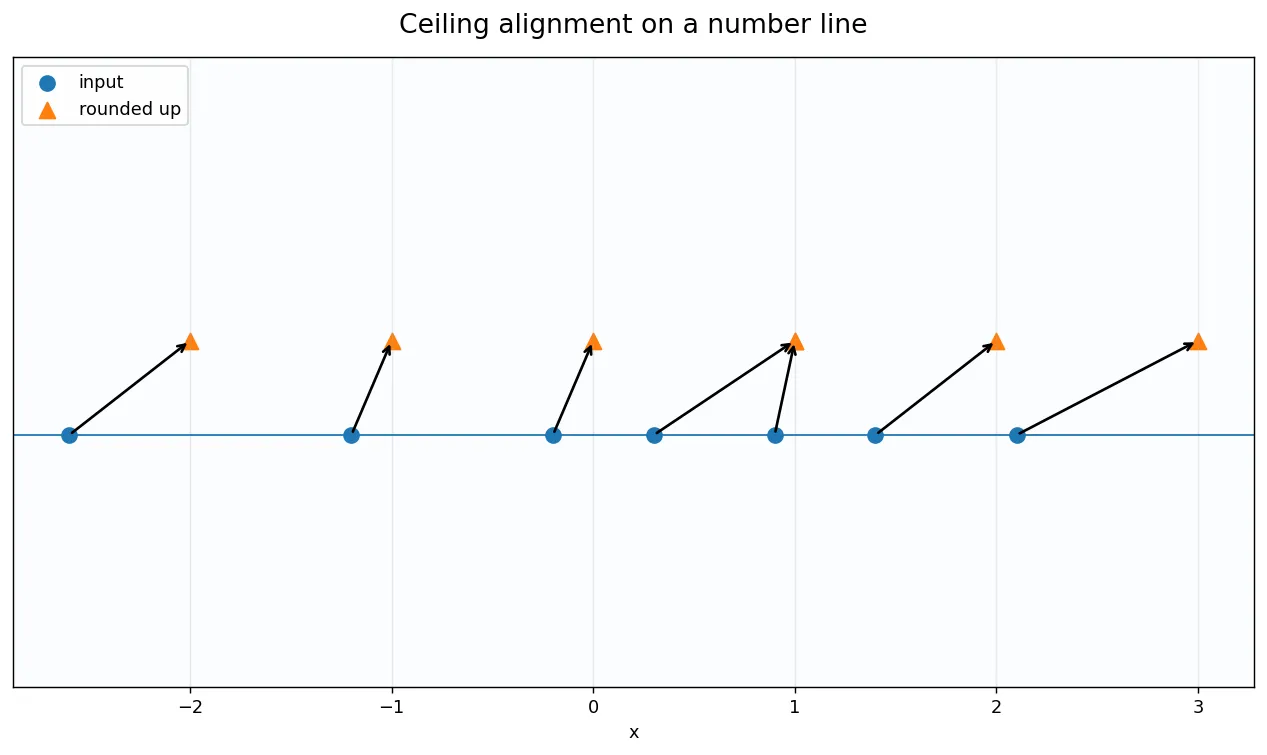
The operation ensures that the output is always greater than or equal to the input value provided. By using a fixed multiple, mathematicians can create predictable gaps between possible results in any given numerical sequence or data set.
This specific rounding method differs from standard rounding because it never decreases the original value. It creates a ceiling effect that is strictly tied to the magnitude of the multiplier chosen for the specific calculation.
In formal notation, the function is expressed using the ceiling operator to determine the next whole step. This ensures that even the smallest fractional increase over a multiple leads to the next higher interval.
Understanding this logic is essential for fields requiring precise boundary definitions and interval management. It serves as a bridge between continuous real numbers and the structured requirements of discrete systems and digital hardware.
The Ceiling Function Mechanism
The ceiling function, denoted as ##\lceil x \rceil##, is the primary engine behind rounding up to a multiple. It identifies the smallest integer that is not less than the input value passed into it.
When we divide a number ##x## by a multiple ##m##, we determine how many "steps" of size ##m## fit into ##x##. The ceiling function then rounds this fractional count up to the next whole integer.
Multiplying this result back by the original base ##m## restores the scale to the desired multiple. This two-step process effectively "snaps" the original value to the nearest available ceiling on the defined grid.
This formula is robust and handles various types of numeric inputs with mathematical precision. It ensures that if ##x## is already a multiple of ##m##, the function returns the original value without any change.
The behavior of this function can be visualized as a staircase or a step function. Each step has a height and width equal to the multiplier ##m##, creating a very predictable pattern of output.
As the input increases, the output remains constant until the input crosses a threshold of the next multiple. At that exact point, the output jumps immediately to the next level of the defined sequence.
This behavior is critical in systems where values must be quantized into specific buckets. It prevents the existence of intermediate values that might violate the rules of the underlying system or data structure.
The step function nature of this rounding logic makes it ideal for resource allocation. It guarantees that the allocated amount is always sufficient to hold the required data while maintaining strict alignment.
Mathematically, this represents a transformation from a continuous domain to a discrete range. It simplifies complex variables into manageable, uniform blocks that are easier for algorithms to process and store efficiently.
Practical Applications in Computing
In the realm of computer science, discrete rounding up to a multiple is not just a theory. It is a practical necessity used daily in low-level programming and system architecture for various optimization tasks.
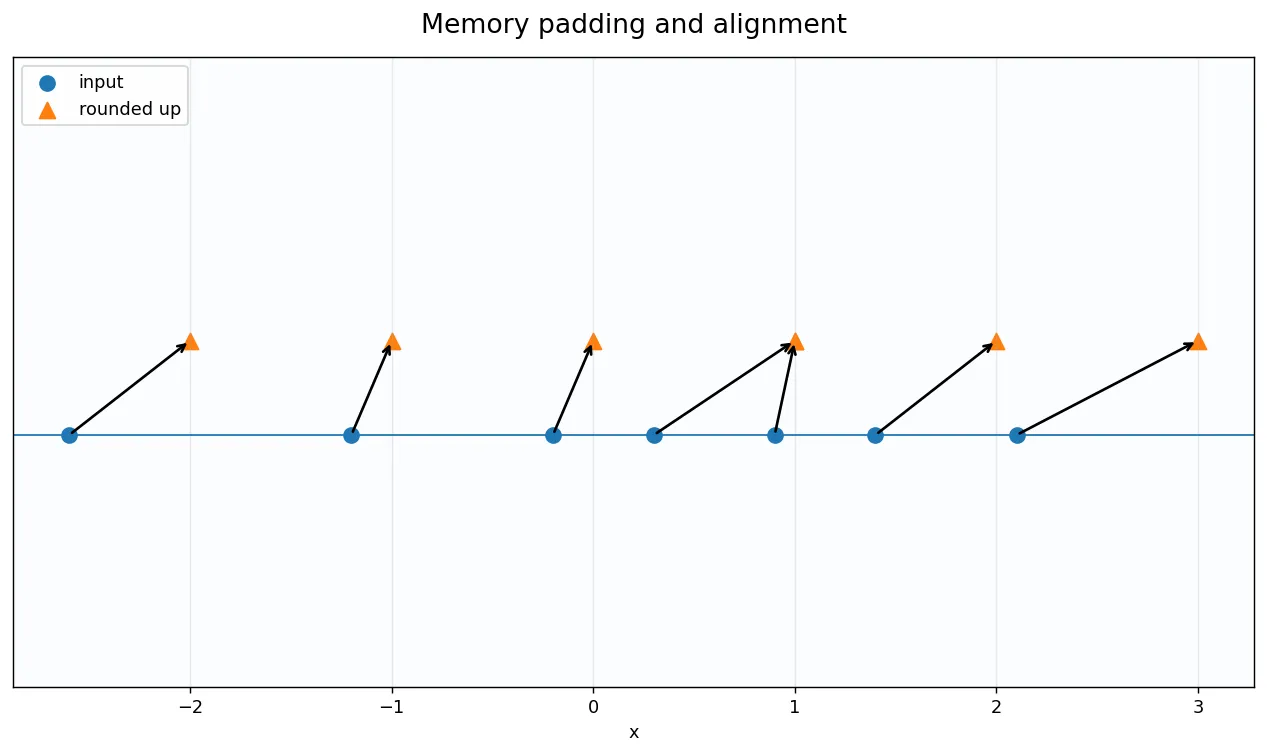
Software engineers use this logic to ensure that data structures are organized efficiently within hardware constraints. It helps in maintaining the integrity of data access patterns and improving overall system performance during execution.
Without this rounding logic, many computing systems would suffer from inefficiency and errors. It provides a standardized way to handle varying data sizes while respecting the rigid boundaries of physical hardware components.
From graphics rendering to file system management, the application of this function is nearly universal. It allows developers to create software that interacts seamlessly with the underlying hardware and memory subsystems.
By rounding up to a multiple, systems can avoid the complexities of handling partial blocks. This simplification leads to cleaner code and more reliable software behavior across different computing platforms and environments.
Memory Alignment and Padding
Memory alignment is perhaps the most common use case for discrete rounding up to a multiple. Modern processors are designed to access memory most efficiently when data starts at specific address boundaries.
If a data structure is not aligned to a multiple of the word size, performance can degrade significantly. Compilers use the rounding function to pad structures so they fit perfectly into these memory slots.
For example, if a system requires 8-byte alignment, a 12-byte object will be rounded up to 16 bytes. This ensures that the next object in memory also starts at a valid, aligned address.
This padding might seem wasteful of space, but the trade-off for speed is usually worth it. It prevents the CPU from having to perform multiple memory fetches for a single piece of data.
The formula ##f(x) = m \cdot \text{ceil}(x/m)## is thus embedded in the logic of memory allocators. It ensures that every requested block of memory meets the alignment requirements of the hardware.
Grid and UI Layout Constraints
User interface design frequently employs discrete rounding to maintain visual consistency. When dragging elements on a screen, designers often want them to "snap" to a predefined grid for a cleaner look.
If a grid has a cell size of 20 pixels, any element position will be rounded to the nearest 20. This prevents elements from being placed at awkward coordinates like 21 or 39 pixels.
We Also Published
In responsive web design, rounding up to a multiple can help in calculating container widths. It ensures that columns fit perfectly within a row without leaving unsightly gaps or causing overflow issues.
This logic is also applied in coordinate systems for digital maps and tile-based games. It allows the engine to quickly determine which tile or sector a specific coordinate belongs to during rendering.
By forcing values to a grid, developers create a more intuitive and structured experience for the user. It simplifies the math involved in collision detection and layout calculations across different screen resolutions.
Computational Implementation and Efficiency
Implementing discrete rounding up to a multiple can be done through various programmatic methods. While the mathematical formula is straightforward, developers often seek the most efficient way to execute it in code.
Standard libraries in most programming languages provide a ceiling function that can be used directly. However, the overhead of floating-point division can sometimes be a concern in high-performance computing scenarios.
Choosing the right implementation depends on the specific constraints of the target environment. Factors like processor architecture, language features, and the nature of the input data all play a role.
In many cases, the goal is to achieve the rounding result using only integer arithmetic. This avoids the precision issues and performance costs associated with converting numbers to floating-point and back.
Efficient implementation is particularly important in real-time systems where these calculations happen millions of times per second. Every saved cycle contributes to the overall responsiveness and throughput of the software system.
Bitwise Optimization for Power of Two
When the multiplier ##m## is a power of two, bitwise operations can be used for extreme efficiency. This is a common trick used by systems programmers to avoid expensive division and multiplication.
The expression ##(x + m - 1) \& \sim(m - 1)## achieves the same result as the ceiling function. It works by adding a specific offset and then masking out the lower bits of the value.
This method is significantly faster than using the standard floating-point ceiling function on most CPUs. It leverages the binary nature of computers to perform the rounding in just a few cycles.
Because powers of two are so common in hardware (like 4KB memory pages), this optimization is widely used. It is a staple technique in kernel development and high-performance graphics programming.
Understanding this bitwise shortcut allows developers to write code that is both elegant and fast. It demonstrates how mathematical properties can be exploited to match the underlying logic of digital hardware.
Handling Negative Values and Edge Cases
Rounding negative values up to a multiple requires careful consideration of the mathematical definition. Depending on the context, "up" might mean toward zero or toward positive infinity in the number line.
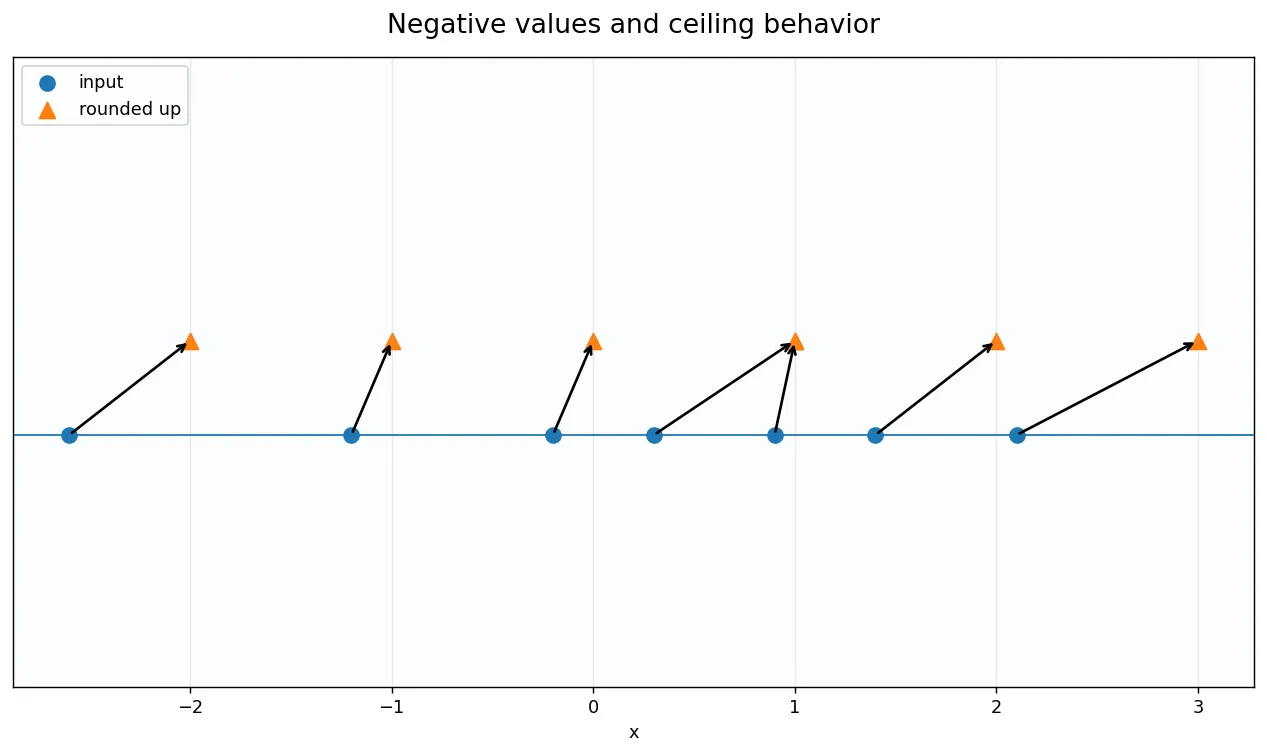
The standard ceiling function moves toward positive infinity, which is the behavior usually expected. However, some applications might require rounding toward zero, which is effectively a truncation of the value.
Edge cases, such as when the input is zero or already a multiple, must be handled correctly. The formula ##f(x) = m \cdot \lceil x/m \rceil## naturally handles these cases by returning the input.
Programmers must also be wary of integer overflow when adding offsets during the rounding process. If ##x## is very large, adding ##m-1## might exceed the maximum value allowed by the data type.
Testing with various inputs, including negative numbers and maximum integers, is essential for robust implementation. It ensures that the rounding logic remains reliable across the entire range of possible data values.
Comparative Analysis with Other Rounding Methods
Discrete rounding up to a multiple is one of several ways to quantize numerical data. Comparing it to other methods like floor rounding or nearest-neighbor rounding highlights its unique benefits and drawbacks.
While rounding to the smallest multiple greater than or equal to the input is common in statistics, rounding up is preferred in allocation. This is because "up" ensures that the capacity is never less than the actual requirement of the data.
Each rounding strategy serves a different purpose in mathematics and engineering. Choosing the wrong one can lead to bugs, such as buffer overflows or misaligned graphical elements in an interface.
The choice of rounding method often dictates the logic of the entire surrounding algorithm. It affects how boundaries are checked, how loops are iterated, and how data is indexed in memory.
By analyzing these methods side-by-side, practitioners can better understand when to apply each one. This knowledge leads to more informed architectural decisions in software design and mathematical modeling projects.
Differences from Standard Ceiling Functions
A standard ceiling function only rounds to the nearest whole integer, which is essentially a multiple of one. Discrete rounding up to a multiple generalizes this concept to any base value.
While ##\text{ceil}(x)## is useful for simple counts, it lacks the flexibility needed for alignment. The multiple ##m## allows the user to define the granularity of the rounding based on specific needs.
In many contexts, simply using a standard ceiling is insufficient because the resulting integer might not fit the grid. The multiplication by ##m## is what restores the value to the correct discrete scale.
The relationship between the two is linear, but the scale factor changes the behavior significantly. This makes the "round up to multiple" function a more powerful tool for structural organization than basic ceiling.
Thus, while they share a common logical root, their applications and outcomes are distinct. The multiple-based approach provides the necessary control for complex engineering tasks that involve non-unit intervals.
Comparison with Truncation and Floor Multiples
Truncation and floor multiples move values downward, which is the opposite of the ceiling-based approach. These methods are used when the goal is to find the largest multiple that fits within a value.
Floor rounding is common in pagination logic, where you need to know which page a specific item starts on. However, it is unsuitable for allocation where you need to accommodate the entire item.
Using a floor function instead of a ceiling function would result in ##f(x) = m \cdot \lfloor x/m \rfloor##. This would round 12 down to 10 if ##m = 5##, which might cause data loss if 12 units were needed.
The choice between floor and ceiling often depends on whether you are measuring "capacity" or "index." Capacity usually requires rounding up, while indexing often relies on rounding down to the start of a block.
Understanding these distinctions is crucial for preventing "off-by-one" errors in programming. Selecting the correct discrete rounding method ensures that the logic aligns perfectly with the physical or virtual requirements of the task.
From our network :
- Analyzing Trump Deportation Numbers Insights Into The 2026 Immigration Crackdown
- Mastering DB2 LUW v12 Tables: A Comprehensive Technical GuideComprehensive guide on DB2 LUW v12 tables. Explore CREATE TABLE syntax, BLU Acceleration, range partitioning, data types, and security features for IBM DB2 LUW v12.
- Trump Political Strategy How Geopolitical Stunts Serve As Media Diversions
- 98% of Global MBA Programs Now Prefer GRE Over GMAT Focus EditionExplore why 98% of global MBA programs now prefer the GRE over GMAT Focus. Learn about the shorter GRE format, verbal logic importance, and strategic versatility for students.
- Vite 6/7 'Cold Start' Regression in Massive Module GraphsIn-depth analysis of Vite 6/7 cold start regressions in massive module graphs. Learn about barrel file issues, pre-bundling optimizations, and how to improve Vite dev server performance.
- EV 2.0: The Solid-State Battery Breakthrough and Global Factory ExpansionDiscover the impact of the Solid-State Battery Breakthrough on the EV market. Learn about CATL and BYD stock growth, global factory expansion in Europe, and the future of EV 2.0 technology.
- 10 Physics Numerical Problems with Solutions for IIT JEEPrepare for IIT JEE with 10 physics numerical problems, complete with detailed solutions and conceptual explanations. Ideal for mastering kinematics, thermodynamics, electromagnetism, and optics.
- Mastering DB2 12.1 Instance Design: A Technical Deep Dive into Modern Database ArchitectureComprehensive guide to DB2 12.1 Instance Design. Explore architectural components, HADR setup, buffer pool tuning, and security policies for IBM DB2 12.1. Includes 10 functional SQL and Shell samples.
- AI-Powered 'Precision Diagnostic' Replaces Standard GRE Score ReportsDiscover the new GRE Precision Diagnostic. Learn how AI-powered behavioral analytics and time-to-solve tracking are replacing standard GRE score reports to empower students.
RESOURCES
- Assistance Please: Rounding non-discrete #'s of people : r/askmath
- Frequently Asked Questions Regarding the FinCEN Currency ...
- Multiple imputation of discrete and continuous data by ... - PubMed
- Rounding - Wikipedia
- Auction Formats | Federal Communications Commission
- Single-round QuikChange PCR for engineering multiple site ...
- Multiple imputation of discrete and continuous data by fully ...
- Competitive Analysis for Discrete Multiple Online Rental Problems
- Mixing discrete probability distributions - The ryg blog
- Standard way to round integer down to nearest multiple of 4
- Color Atlas of Canine Cutaneous Round Cell Tumors - MSPCA-Angell
- Round Cells | Veterian Key
- Vertebral Hemangioma - Radsource
- Multiple imputation of discrete and continuous data by fully ...
- Solved: How to randomly round an integer to a number at base 5


0 Comments