Neutron stars represent one of the most extraordinary endpoints in the life cycle of a massive star, forming when a stellar core exhausts its nuclear fuel and succumbs to gravity in a fraction of a second. The resulting object compresses more mass than the Sun into a sphere roughly twenty kilometers across, creating densities that defy everyday intuition and challenge the limits of known physics. Understanding how these remnants arise requires tracing the violent sequence of core collapse, neutronization, and supernova detonation that transforms an iron core into a compact stellar corpse.
What makes neutron stars so compelling is not merely their density but the exotic physical regimes they host. Their interiors likely contain superfluid neutrons, superconducting protons, and possibly quark matter, while their surfaces sustain magnetic fields trillions of times stronger than Earth's. Astronomers detect these objects through pulsar timing, X-ray emission from accreting binaries, and gravitational-wave signatures, each channel revealing a different layer of their structure. This explainer walks through the formation pathway and the observational fingerprints that confirm the theoretical picture.
Beyond their formation, neutron stars serve as natural laboratories for testing extreme physics that cannot be reproduced on Earth. The equation of state governing matter at nuclear densities remains one of the great unsolved problems in astrophysics, and every new pulsar or merger event refines our constraints. By examining the collapse mechanism, the internal structure, and the observable phenomena, we gain a coherent view of why these city-sized spheres rank among the densest objects known to science.
On This Page
- The Physics of Core Collapse in Massive Stars
- Density, Pressure, and the Equation of State
- Observational Signatures of Neutron Stars
- Magnetic Fields and Extreme Electrodynamics
- Binary Mergers and Gravitational Waves
- Cooling, Evolution, and the Equation of State Frontier
- Why Neutron Stars Matter for Modern Astrophysics
The Physics of Core Collapse in Massive Stars
Massive stars above roughly eight solar masses evolve through successive fusion stages, building an onion-like structure of lighter to heavier elements until an inert iron core forms at the center. Because iron fusion consumes rather than releases energy, the core can no longer support itself against gravity, and collapse begins once it exceeds the Chandrasekhar mass limit of approximately ##[1.4\,M_\odot]##. The infall accelerates to a substantial fraction of the speed of light within milliseconds.

Onset and Dynamics of Gravitational Instability
The collapse proceeds in free fall until nuclear densities are reached, at which point the strong force stiffens the equation of state and halts further compression. The inner core rebounds, launching a shock wave outward that initially stalls against the infalling envelope. Neutrino heating revives this shock, and the ensuing explosion disperses the outer layers while leaving the compact remnant behind.
The energy budget of this process is staggering, with roughly ##[10^{46}## joules released predominantly in neutrinos over a few seconds. This neutrino luminosity exceeds the optical output of the entire observable universe during the burst. The delicate balance between neutrino heating and cooling determines whether the explosion succeeds or the star collapses directly into a black hole.
Neutronization and the Birth of the Remnant
During collapse, electrons are captured by protons through inverse beta decay, converting the core into a neutron-rich medium and releasing a flood of electron neutrinos. This neutronization process is what ultimately gives the remnant its name and its composition. The trapped neutrinos diffuse outward slowly, carrying away the gravitational binding energy that stabilizes the newly formed object.
The equation governing the degenerate pressure of neutrons can be approximated by the non-relativistic relation:
Here ##[n_n]## denotes neutron number density and ##[m_n]## the neutron mass, showing how pressure rises steeply with density. This degeneracy pressure, supplemented by repulsive nuclear forces, resists further collapse and defines the stable configuration of the neutron star.

Density, Pressure, and the Equation of State
The defining characteristic of a neutron star is its density, which reaches values around ##[10^{17}## kilograms per cubic meter at the core, comparable to the density of an atomic nucleus. At such compression, ordinary atomic structure dissolves entirely, leaving a fluid of neutrons with a thin crust of nuclei and degenerate electrons. The equation of state linking pressure to density governs the star's mass-radius relationship.
Degeneracy Pressure and Nuclear Forces
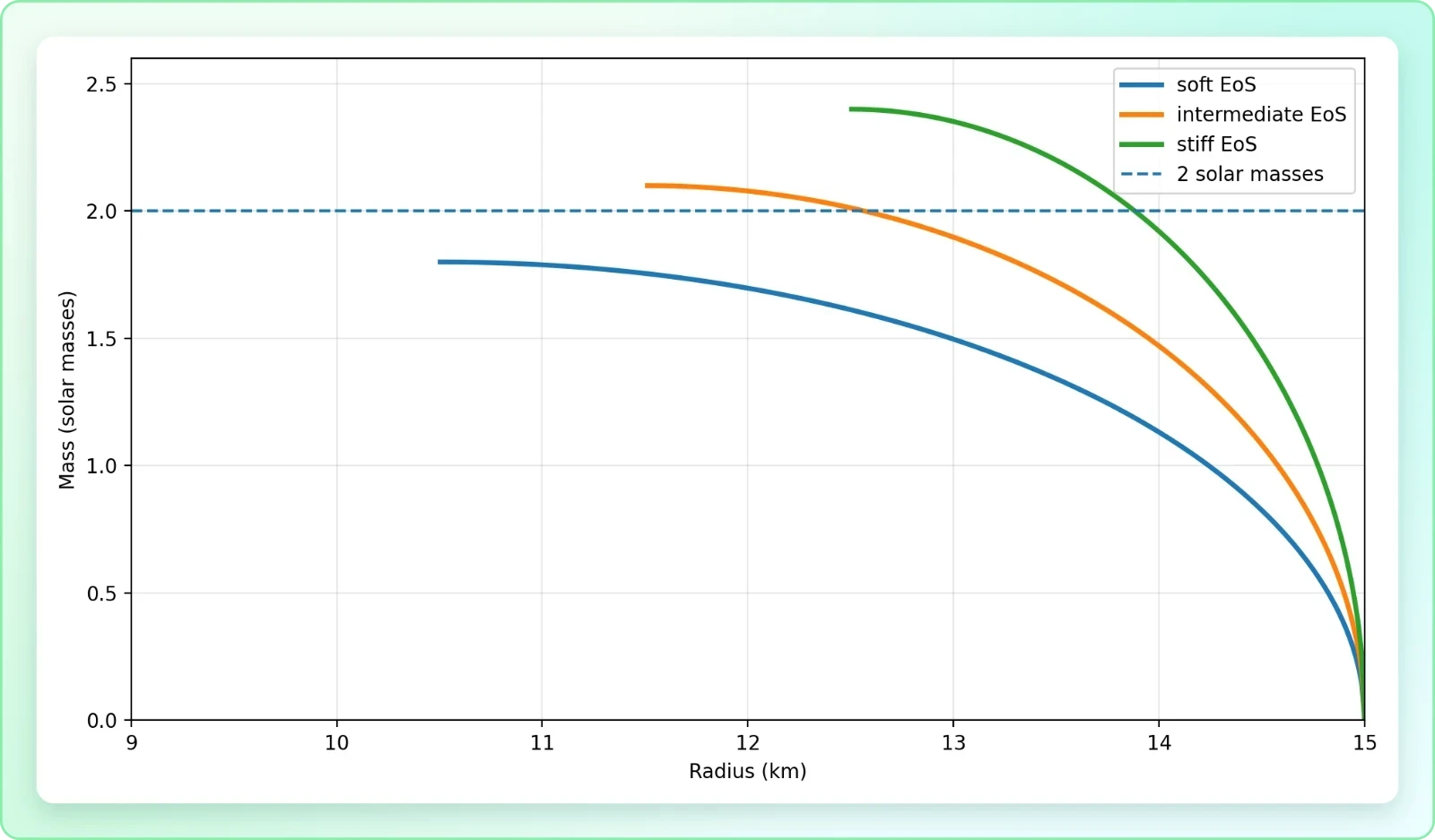
Neutron degeneracy pressure alone cannot support a star above roughly ##[0.7\,M_\odot]##, so repulsive components of the strong nuclear force provide the additional stiffness required. These interactions are poorly constrained at high density, producing a family of candidate equations of state. Observations of massive pulsars near ##[2\,M_\odot]## already rule out the softest models.
The hydrostatic equilibrium condition for a spherically symmetric star follows the Tolman-Oppenheimer-Volkoff equation:
This general-relativistic generalization of Newtonian hydrostatics shows how pressure itself gravitates, tightening the maximum mass limit. Solving it with a chosen equation of state yields the mass-radius curve that observers compare against pulsar measurements.
Internal Stratification
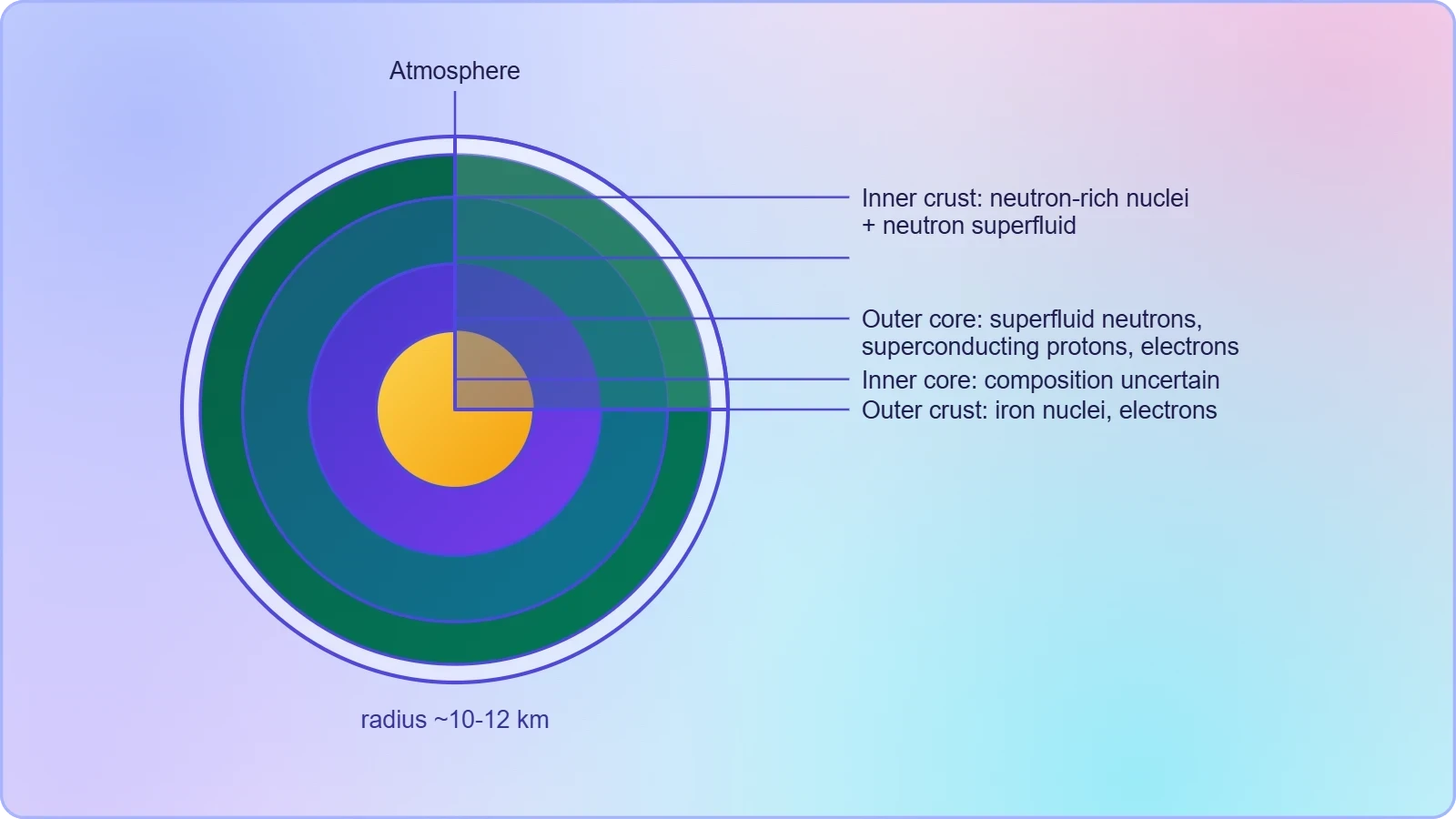
A neutron star's interior is layered like an exotic confection, with an outer crust of iron nuclei and a inner crust of neutron-rich nuclei immersed in a neutron superfluid. The outer core hosts superfluid neutrons, superconducting protons, and degenerate electrons, while the innermost region may harbor hyperons or quark matter. Each layer contributes distinct signatures to cooling and oscillation spectra.
Estimating the average density is straightforward from mass and radius, yielding a useful benchmark:
This value, roughly ##[2.3\times10^{14}## times the density of water, illustrates why neutron stars are routinely described as city-sized atomic nuclei. The comparison underscores the extreme compression achieved during collapse.
Observational Signatures of Neutron Stars
Neutron stars announce their presence through several distinct channels, each probing different physical processes. Pulsars reveal rapid rotation and strong magnetic fields through periodic radio emission, while accreting systems shine brightly in X-rays as infalling matter releases gravitational energy. Gravitational-wave detectors now capture the mergers of binary neutron stars, opening a multi-messenger window into their properties.
Pulsars and Magnetic Fields
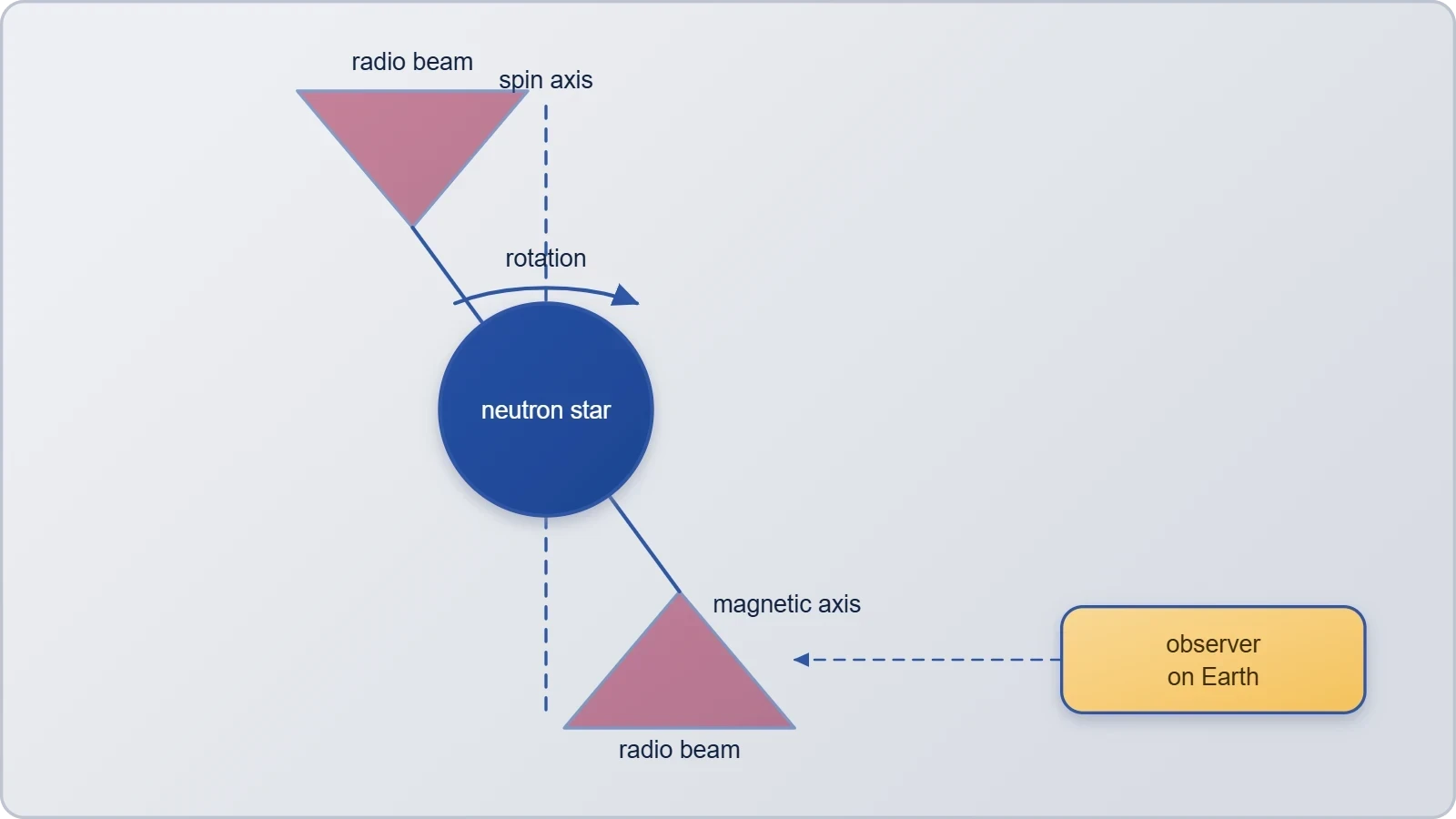
Pulsars are rapidly rotating, highly magnetized neutron stars whose beams of radiation sweep past Earth like a cosmic lighthouse. Their spin periods range from milliseconds to several seconds, and their slow spin-down provides a measure of magnetic field strength. The magnetic dipole radiation luminosity scales as the fourth power of angular frequency, linking rotation to field decay.
The spin-down luminosity is expressed as:
Here ##[B]## is the surface magnetic field, ##[R]## the stellar radius, and ##[\Omega]## the angular frequency. Measuring ##[\dot{E}## from timing observations allows astronomers to infer magnetic fields of ##[10^{8}## to ##[10^{15}## gauss, far beyond any terrestrial laboratory.
Accretion and X-ray Binaries
When a neutron star orbits a companion star, it can draw material through an accretion disk, heating the infalling gas to millions of kelvin and producing intense X-ray emission. These systems reveal the stellar radius through pulse-profile modeling and thermonuclear bursts on the surface. Some accreting neutron stars spin up to millisecond periods, becoming recycled pulsars.
Thermonuclear bursts occur when accumulated hydrogen and helium ignite in a runaway reaction, briefly outshining the entire accretion luminosity. The burst recurrence time and energetics constrain the composition and temperature of the surface layers. Such observations complement radio timing in building a complete portrait of the neutron star.
Magnetic Fields and Extreme Electrodynamics
Neutron stars host the strongest magnetic fields known in the universe, with magnetars reaching ##[10^{15}## gauss, a quadrillion times Earth's field. These fields dominate the dynamics of the stellar exterior, channeling charged particles along field lines and powering intense high-energy emission. The electrodynamics of magnetospheres couples rotation, field structure, and plasma physics in ways still actively researched.
Magnetars and Field Decay
Magnetars are a subclass of neutron stars whose enormous fields power persistent X-ray emission and occasional giant flares. The field decays through resistive processes in the crust, releasing magnetic energy that heats the interior and drives surface activity. Observations of flare energetics and spin-down rates constrain the field strength and crustal conductivity.
The magnetic energy stored in the stellar interior can be estimated as:
For ##[B = 10^{15}## gauss and ##[R = 10## kilometers, this yields roughly ##[10^{40}## joules, sufficient to power observed outbursts over years. The comparison with rotational energy highlights the dominant role of magnetic fields in magnetar phenomenology.

Pulsar Wind Nebulae
Young pulsars inject relativistic winds of electrons and positrons into their surroundings, inflating pulsar wind nebulae visible in radio and X-rays. The Crab Nebula is the archetype, powered by a pulsar spinning thirty times per second. These nebulae trace the spin-down energy budget and the acceleration of particles to TeV energies.
The termination shock where the wind meets the surrounding medium marks a transition from cold, relativistic flow to a hot, emitting plasma. Modeling the synchrotron spectrum of the nebula constrains the injected particle distribution and magnetic field geometry. Such studies connect the neutron star to its supernova remnant environment.
Binary Mergers and Gravitational Waves
The merger of two neutron stars produces one of the most energetic events in the cosmos, releasing gravitational waves and driving a kilonova visible across electromagnetic bands. The landmark GW170817 detection confirmed that such mergers forge heavy elements through rapid neutron capture. These events provide unique constraints on the equation of state and the nature of ultra-dense matter.
Tidal Deformability and Equation of State
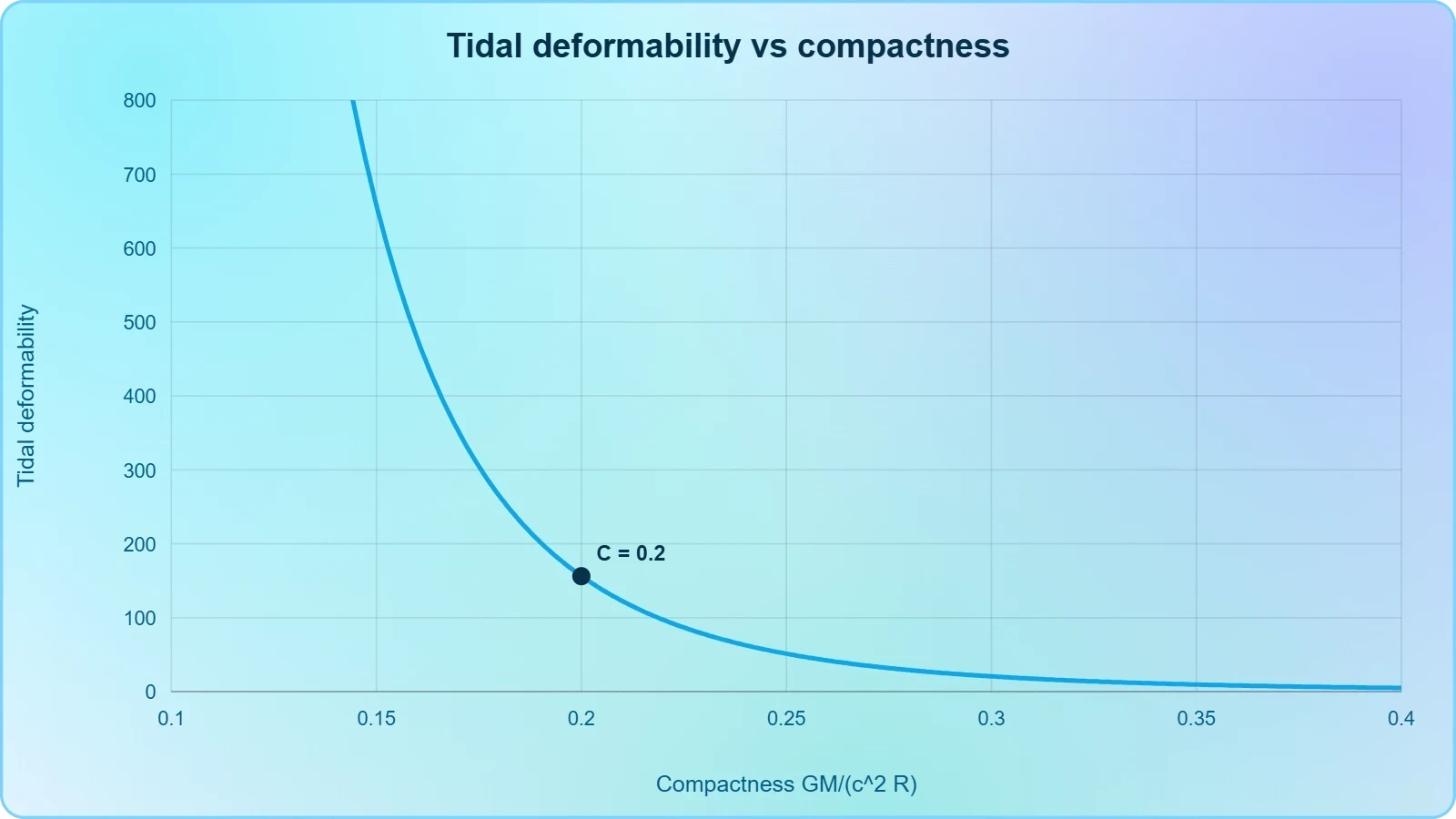
During the inspiral, each neutron star is tidally deformed by its companion, and the magnitude of this deformation depends sensitively on internal structure. The gravitational-wave signal encodes the tidal deformability parameter, which is small for stiff equations of state and larger for soft ones. Measuring it therefore discriminates among candidate models.
The dimensionless tidal deformability is defined as:
Here ##[k_2]## is the second Love number, and the strong dependence on the compactness ##[GM/(c^2R)]## makes ##[\Lambda]## a sensitive probe. The GW170817 measurement of ##[\Lambda \lesssim 800]## already excluded very soft equations of state.
Kilonovae and Heavy Element Nucleosynthesis
Material ejected during a merger undergoes rapid neutron capture, synthesizing elements heavier than iron, including gold and platinum. The radioactive decay of these freshly forged nuclei powers a kilonova that fades over days to weeks. Spectroscopic identification of strontium in GW170817's kilonova confirmed this nucleosynthesis pathway.
The mass ejected depends on the equation of state and the mass ratio of the binary, linking merger outcomes to fundamental stellar properties. Future detections with improved sensitivity will map this connection across a population of events. Each merger thus contributes to both astrophysics and nuclear physics.
We Also Published
Cooling, Evolution, and the Equation of State Frontier
After formation, a neutron star cools primarily through neutrino emission in its first minutes, then through photon emission from the surface over millions of years. The cooling curve depends on the composition of the interior and the efficiency of neutrino processes, making it a probe of dense matter physics. Observations of thermal X-rays from isolated neutron stars trace this cooling history.
Neutrino Cooling Processes
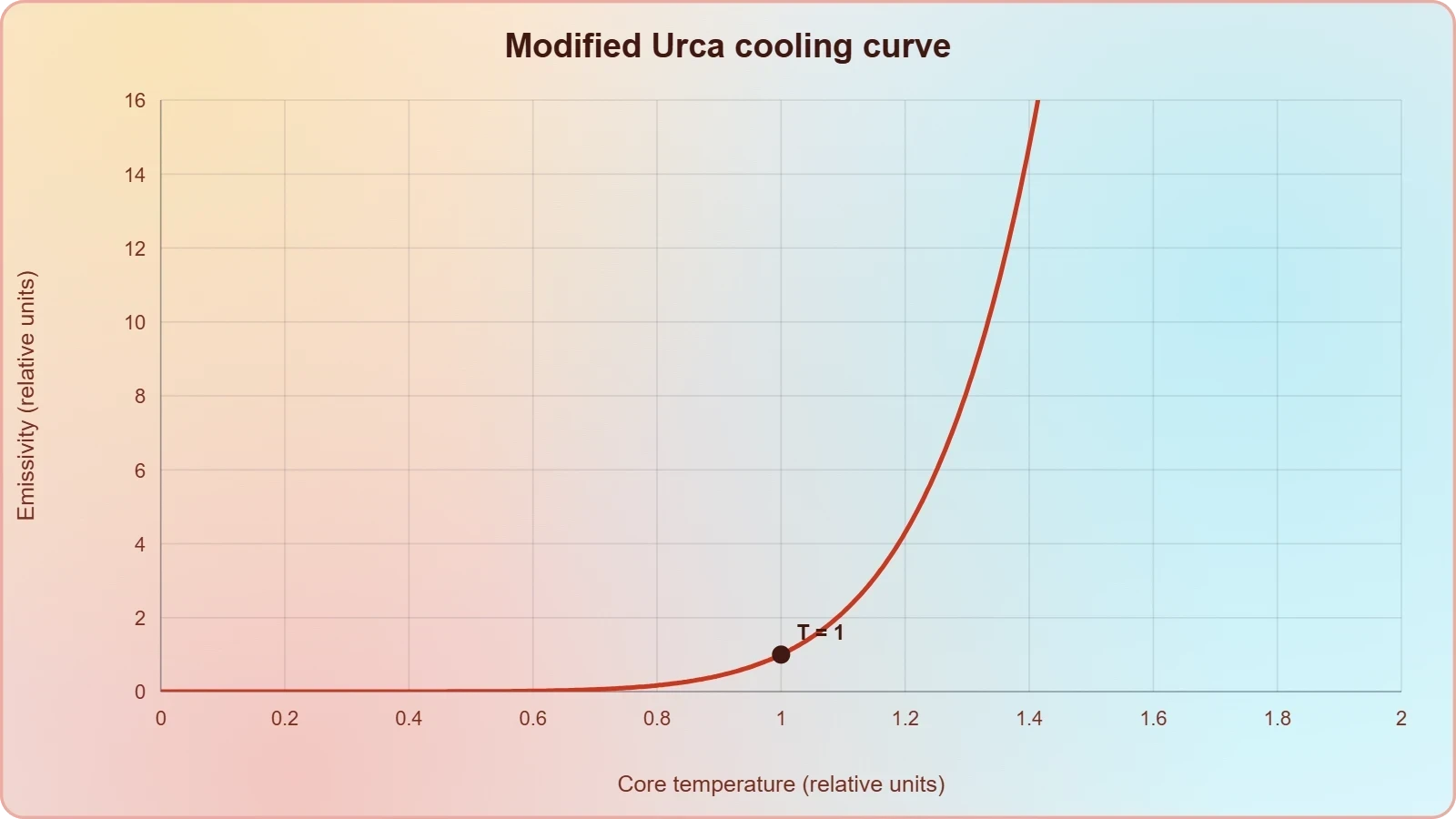
The dominant cooling channels include the modified Urca process and, in superfluid regions, Cooper-pair breaking and formation. Each process has a characteristic temperature dependence, so the observed cooling rate reveals which mechanisms operate. Young neutron stars cool rapidly, while older ones settle into a slow photon-cooling regime.
The modified Urca emissivity scales approximately as:
This steep temperature dependence means small changes in core temperature produce large changes in neutrino luminosity. Comparing predicted cooling curves with observed surface temperatures of known-age neutron stars tests the underlying microphysics.
Constraining the Equation of State
The equation of state remains the central unknown, with candidate models ranging from soft to stiff depending on the treatment of nuclear interactions and exotic components. Combining mass measurements, radius estimates, tidal deformability, and cooling data progressively narrows the allowed region. Future observatories promise tighter constraints through precise radius measurements.
Each new pulsar mass measurement, particularly those near or above two solar masses, eliminates softer models that cannot support such objects. Radius determinations from X-ray pulse-profile modeling provide complementary information. Together, these observations are converging on a preferred equation of state.
Why Neutron Stars Matter for Modern Astrophysics
Neutron stars occupy a unique position at the intersection of astrophysics, nuclear physics, and gravitational physics, making them indispensable laboratories for testing fundamental theories. Their extreme conditions cannot be replicated on Earth, so observations serve as the only empirical window into matter at nuclear density. Every new measurement refines our understanding of the strong force and general relativity.
Testing General Relativity
Binary pulsars provide precision tests of general relativity through measurements of orbital decay from gravitational-wave emission, a result that earned the 1993 Nobel Prize. The double pulsar system J0737-3039 offers even tighter constraints on alternative theories of gravity. These tests confirm Einstein's predictions to remarkable accuracy in the strong-field regime.
The orbital period decay rate from gravitational radiation is given by:
Comparing this prediction with observed timing residuals tests general relativity to better than one part in a thousand. Such precision makes binary pulsars among the most stringent tests of gravitational theory available.
Connecting to Supernovae and Element Formation
Neutron stars are the compact remnants of core-collapse supernovae, and their properties reflect the explosion mechanism and progenitor structure. The heavy elements dispersed by these explosions and by neutron star mergers enrich the cosmos, seeding subsequent generations of stars and planets. Understanding neutron stars thus illuminates the chemical evolution of galaxies.
The connection between neutron star formation and supernova nucleosynthesis links stellar death to the building blocks of life. Elements such as oxygen, silicon, and iron owe their abundance to massive star evolution, while gold and platinum trace merger events. This narrative ties the smallest stellar remnants to the largest cosmic questions.
From our network :
- Mastering DB2 12.1 Instance Design: A Technical Deep Dive into Modern Database ArchitectureComprehensive guide to DB2 12.1 Instance Design. Explore architectural components, HADR setup, buffer pool tuning, and security policies for IBM DB2 12.1. Includes 10 functional SQL and Shell samples.
- 98% of Global MBA Programs Now Prefer GRE Over GMAT Focus EditionExplore why 98% of global MBA programs now prefer the GRE over GMAT Focus. Learn about the shorter GRE format, verbal logic importance, and strategic versatility for students.
- Vite 6/7 'Cold Start' Regression in Massive Module GraphsIn-depth analysis of Vite 6/7 cold start regressions in massive module graphs. Learn about barrel file issues, pre-bundling optimizations, and how to improve Vite dev server performance.
- EV 2.0: The Solid-State Battery Breakthrough and Global Factory ExpansionDiscover the impact of the Solid-State Battery Breakthrough on the EV market. Learn about CATL and BYD stock growth, global factory expansion in Europe, and the future of EV 2.0 technology.
- Trump Political Strategy How Geopolitical Stunts Serve As Media Diversions
- 10 Physics Numerical Problems with Solutions for IIT JEEPrepare for IIT JEE with 10 physics numerical problems, complete with detailed solutions and conceptual explanations. Ideal for mastering kinematics, thermodynamics, electromagnetism, and optics.
- Mastering DB2 LUW v12 Tables: A Comprehensive Technical GuideComprehensive guide on DB2 LUW v12 tables. Explore CREATE TABLE syntax, BLU Acceleration, range partitioning, data types, and security features for IBM DB2 LUW v12.
- AI-Powered 'Precision Diagnostic' Replaces Standard GRE Score ReportsDiscover the new GRE Precision Diagnostic. Learn how AI-powered behavioral analytics and time-to-solve tracking are replacing standard GRE score reports to empower students.
- Analyzing Trump Deportation Numbers Insights Into The 2026 Immigration Crackdown
RESOURCES
- Neutron star - Wikipediaen.wikipedia.org1 Formation · 2 Properties. 2.1 Equation of state; 2.2 Density and pressure · 3 Structure · 4 Radiation. 4.1 Pulsars; 4.2 Non-pulsating neutron…
- The cosmic merger rate density of compact objects: impact of star ...ui.adsabs.harvard.edu... neutron star binary (BHNS), and binary neutron star (BNS) mergers, exploring the main sources of uncertainty: star formation rate (SFR) density, metallicity ...
- Neutron star | Definition, Size, Density, Temperature, & Factsbritannica.comOct 22, 2026 ... Most investigators believe that neutron stars are formed by supernova explosions in which the collapse of the central core of…
- Prompt black hole formation in binary neutron star mergerslink.aps.orgJan 2, 2025 ... Our theoretical understanding of QCD, the fundamental theory of matter, at these densities is very limited, which makes observations of…
- impact of star formation, metallicity, initial mass function and binary ...arxiv.orgSep 8, 2020 ... ... neutron star binary (BHNS) and binary neutron star (BNS) mergers, exploring the main sources of uncertainty: star formation rate…
- Neutron Stars Rip Each Other Apart to Form Black Hole - NASA SVSsvs.gsfc.nasa.gov... neutron stars colliding, merging and forming a black hole. A neutron star is the ... Neutron stars possess incredible density, but their surfaces…
- A systematic study of binary neutron star merger rate density history ...arxiv.orgJul 5, 2025 ... Measuring the merger rate density history of binary neutron stars (BNS) can greatly aid in understanding the history of heavy…
- Constraining common envelope evolution in binary neutron star ...academic.oup.comConstraining common envelope evolution in binary neutron star formation with combined galactic and gravitational-wave observations ... density and the ...
- Center Will Focus on Neutron Star Modeling in 'Gravitational Wave ...newscenter.lbl.govAug 17, 2020 ... This rendering shows the density of matter in the aftermath of two merged neutron stars, resulting in the formation of…
- Evolutionary tracks of binary neutron star progenitors across cosmic ...aanda.orgWe show that the distribution of time delays between stellar formation and binary neutron star ... density calculation are explained in Sect. 2. With…
- Revealing the high-density equation of state through binary neutron ...journals.aps.orgJul 1, 2014 ... ... formation in a binary neutron star merger). In turn, this allows for an empirical determination of the maximum mass…
- Black hole–neutron star and binary neutron star mergers from ...aanda.orgFor comparison, we also estimated the MRD of BNSs and BHNSs formed from early Pop. II stars. In this case, we adopted the star…
- Neutron stars - University of Maryland, Astronomypages.astro.umd.eduNeutron star formation; Neutron star internal structure; Neutron star thermal ... When the density exceeds the nuclear density 2.8x10^14 g/cm^3 by a ...
- Neutron Stars and White Dwarfs | Center for Astrophysicscfa.harvard.eduThe combination of intense gravity, high temperature, and extreme density makes neutron stars like nothing we can produce on Earth. ... formation of stars…
- Martyna Chruslinska -- personal websitewwwmpa.mpa-garching.mpg.de... formation of a merging double neutron star system. To simulate this ... star formation rate density at different metallicities and time (or redshift).