On This Page
Introduction to the Nearest Integer Function
The nearest integer function is a mathematical operation that takes a real number as input and returns the integer closest to it. This process is essential in various fields, ranging from everyday financial transactions to advanced computational algorithms used in physics.
Precision in numerical representation often requires converting floating-point values into discrete integers for simplified analysis. The nearest integer function serves as the primary mechanism for this conversion, ensuring that the resulting value retains the maximum possible proximity to the original.
While the concept of rounding seems intuitive, it involves rigorous logical frameworks to handle various decimal values. Unlike floor or ceiling functions, which move in a single direction, this function evaluates the distance to the surrounding integers before making a choice.
In technical literature, this function is frequently denoted as ##\text{nint}(x)## or sometimes represented using square brackets. Understanding its behavior is crucial for anyone working with data sets where rounding might significantly impact the final results or totals.
This lesson explores the mechanics of the function, focusing specifically on how it handles the "halfway" cases. We will examine the standard definitions, the logic behind tie-breaking rules, and the practical implications of these mathematical choices.
Formal Definition and Notation
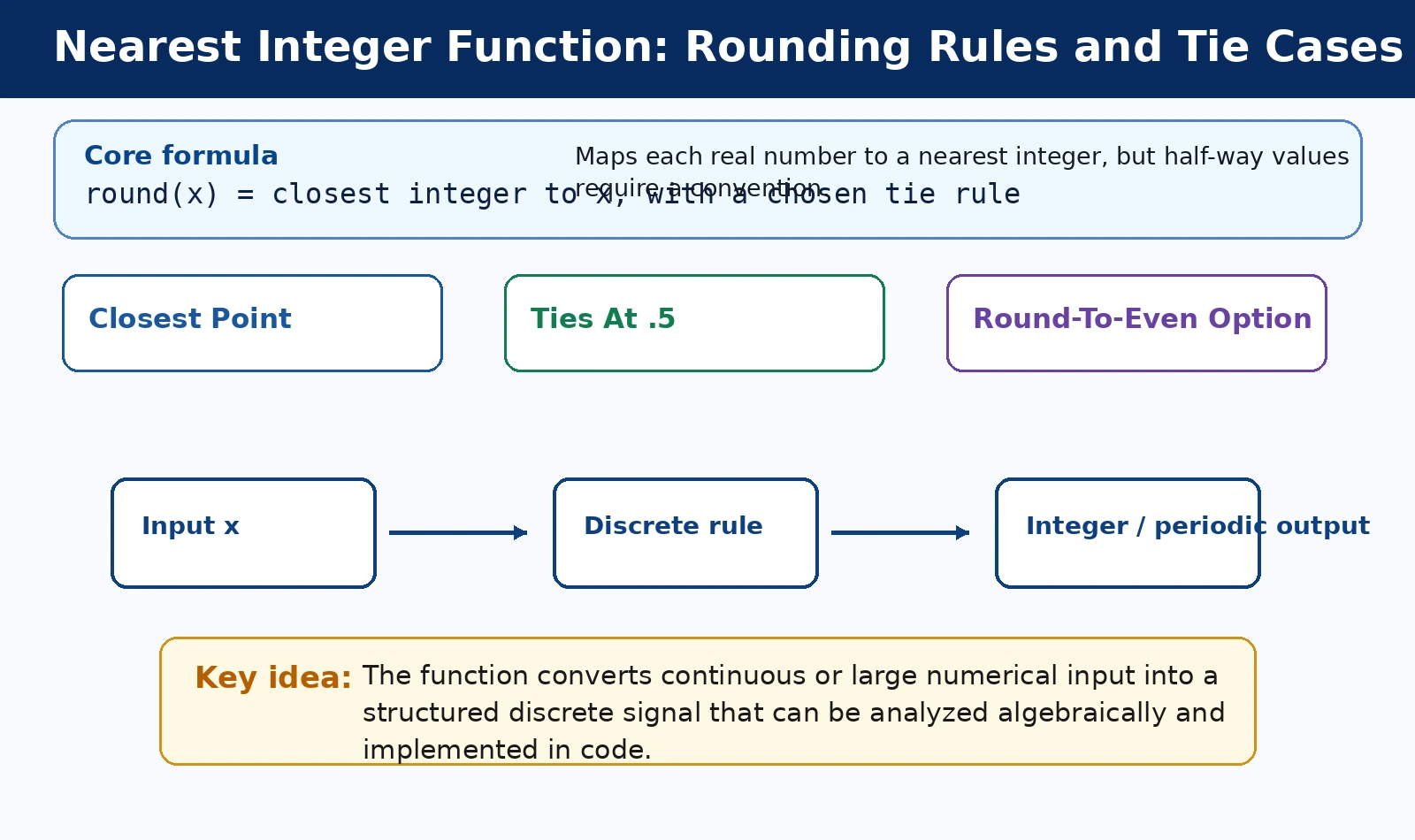
The nearest integer function, denoted as ##\text{nint}(x)##, is formally defined as the integer ##n## that minimizes the absolute difference ##|x - n|##. This definition ensures that the output is always the whole number with the smallest distance to the input.
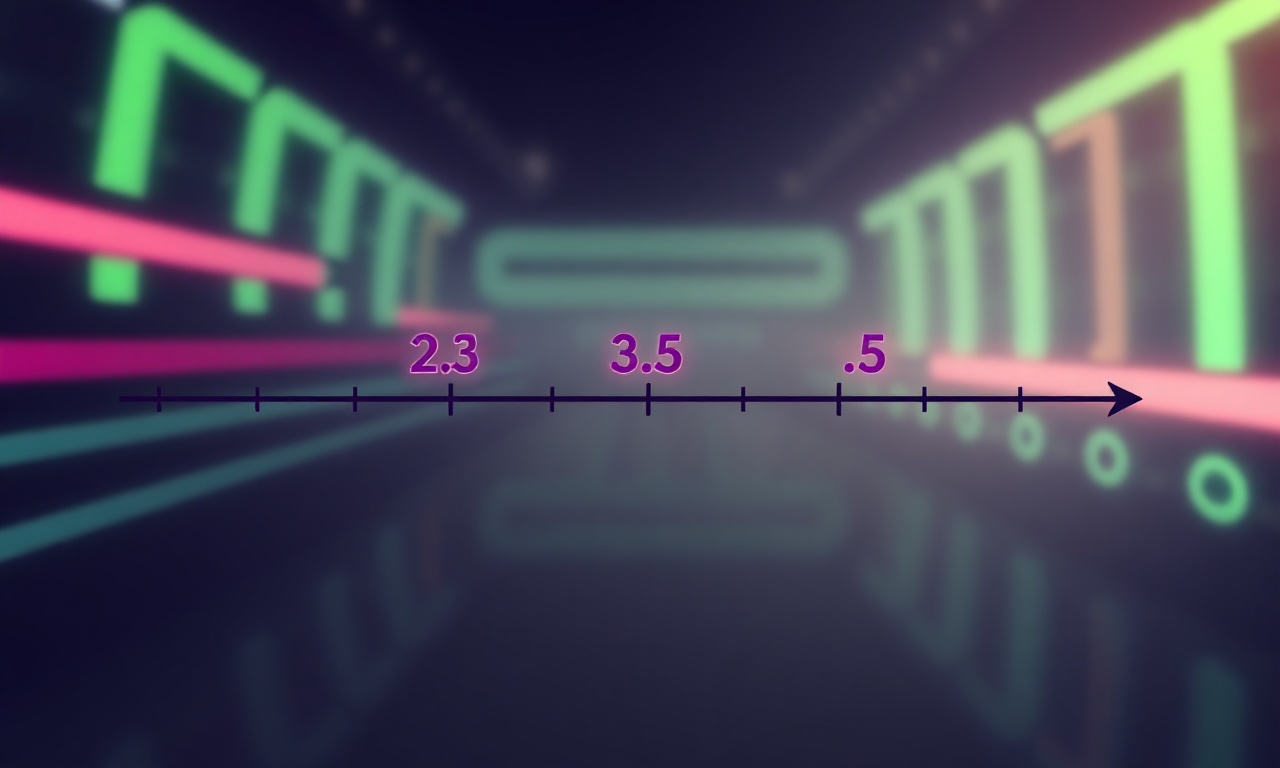
For most real numbers, this choice is unique and unambiguous because the input is strictly closer to one integer than any other. For example, the value 2.3 is clearly closer to 2 than it is to 3.
Mathematically, the function can be visualized as a step function that changes its value at the midpoints between integers. These midpoints represent the threshold where the function must decide which direction to move to maintain its "nearest" property.
In formal set theory, the function maps the set of real numbers ##\mathbb{R}## to the set of integers ##\mathbb{Z}##. This mapping is surjective but not injective, as multiple real numbers will always map to the same resulting integer.
Advanced notations may use the round function syntax found in programming languages like Python or C++. Regardless of the notation, the core objective remains the same: reducing precision while maintaining the highest level of numerical accuracy.
Comparison with Floor and Ceiling Functions
The nearest integer function is distinct from the floor function, which always rounds down to the nearest integer. While the floor of 2.7 is 2, the nearest integer function correctly identifies 3 as the closer whole number.
Similarly, the ceiling function always rounds up to the nearest integer, regardless of the decimal portion. Using the ceiling function on 2.1 would result in 3, whereas the nearest integer function would result in 2.
The primary difference lies in the directional bias inherent in floor and ceiling operations. Floor functions always introduce a negative bias in sums, while ceiling functions introduce a positive bias, potentially skewing large-scale statistical data.
The nearest integer function aims to be unbiased by selecting the integer based on proximity rather than direction. This makes it a more versatile tool for general-purpose rounding where preserving the mean of a dataset is a priority.
Understanding these differences is vital for software developers and mathematicians who must choose the right tool for specific tasks. Selecting the wrong function can lead to significant errors in financial modeling or engineering simulations.
Understanding the Tie-Breaking Rule (Bankers' Rounding)
The most complex aspect of the nearest integer function occurs when a number is exactly halfway between two integers, such as 2.5 or 3.5. These instances require a tie-breaking rule to determine the final output consistently.
One of the most common and mathematically sound tie-breaking methods is known as "round half to even," or bankers' rounding. In this system, the function rounds the midpoint to the nearest even integer rather than always rounding up.
This rule is designed to eliminate the upward bias that occurs when midpoints are consistently rounded in one direction. By alternating between rounding up and rounding down, the cumulative error in a large sum tends toward zero.
Bankers' rounding is the default standard in many international systems, including the IEEE 754 floating-point standard used by modern processors. It ensures that statistical calculations remain balanced across large-scale data processing tasks.
In this section, we will delve into the logic of why this specific rule is preferred over others. We will also see how it applies to various numbers to illustrate its practical effect on numerical outcomes.
Why Round to Even?
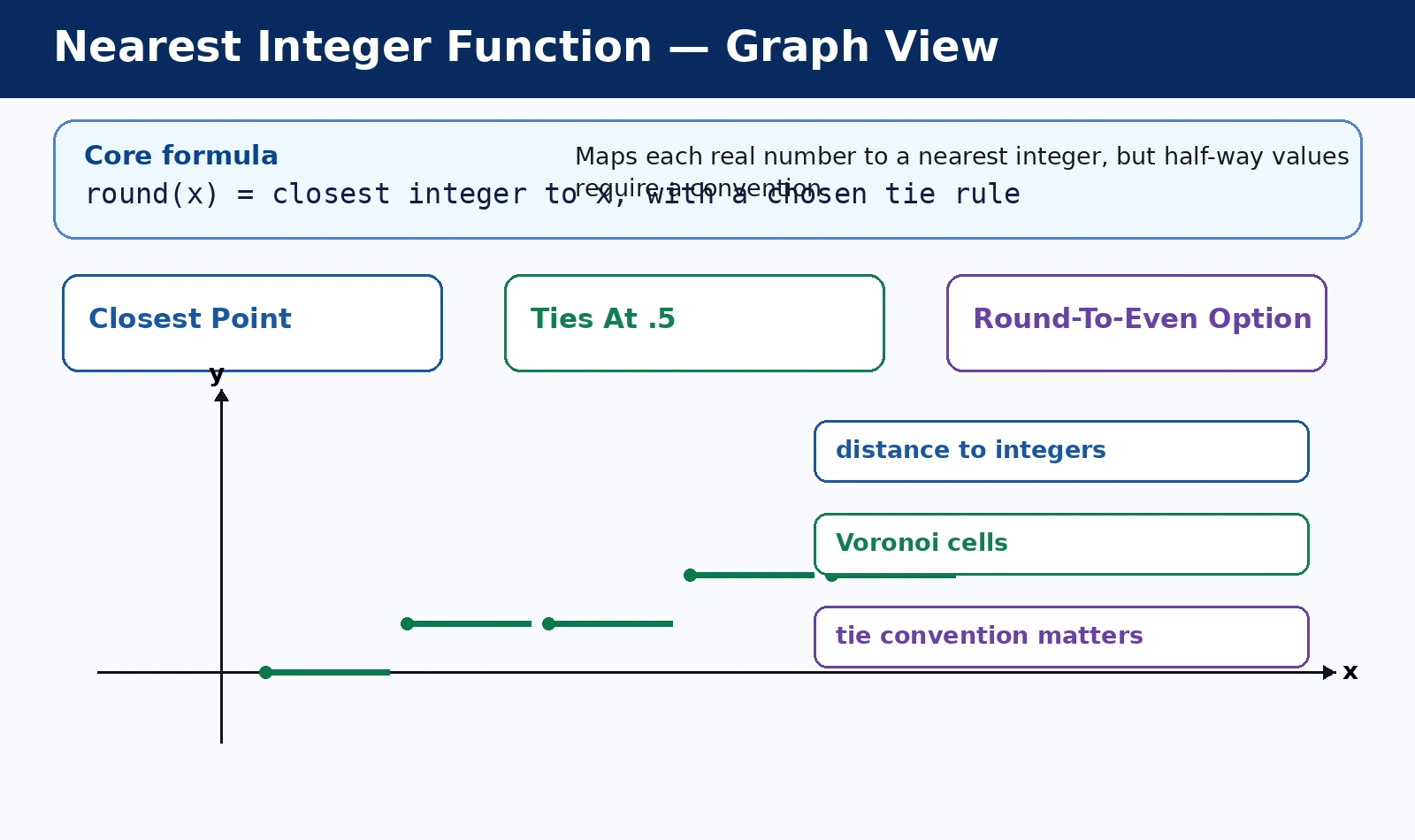
Rounding to the nearest even number is a strategy used to maintain statistical balance in large datasets. If we always rounded 0.5 up, the average of a rounded dataset would be higher than the original.
By rounding to the even neighbor, approximately half of the midpoints round up and half round down. For instance, 2.5 rounds down to 2, while 3.5 rounds up to 4, effectively canceling out the rounding bias.
This approach is particularly important in accounting and finance, where small errors can accumulate into significant discrepancies over thousands of transactions. Bankers' rounding provides a fair and predictable way to handle these edge cases.
From a mathematical perspective, the set of even integers is just as representative as the set of odd integers. Choosing "even" is a convention that provides a consistent rule without favoring the positive or negative direction.
This consistency is vital for reproducibility in scientific research and engineering. When everyone follows the same tie-breaking convention, numerical results remain comparable across different software platforms and hardware architectures.
Examples of Tie-Breaking in Practice
To see the nearest integer function in action with bankers' rounding, consider the value 2.5. Since 2 is the nearest even integer, the result of ##\text{round}(2.5)## is 2, which involves rounding down.
Contrast this with the value 3.5, where the nearest integers are 3 and 4. Because 4 is the even integer in this pair, the function rounds 3.5 up to 4, maintaining the "round to even" logic.
For non-midpoint values, the function behaves as expected without any special rules. A value like 2.51 is strictly closer to 3 than 2, so it always rounds to 3 regardless of the tie-breaking convention.
We Also Published
In a list of values like 0.5, 1.5, 2.5, and 3.5, the results would be 0, 2, 2, and 4. Notice how the results are distributed, preventing the sum from drifting too far from the original total.
These examples highlight how the function treats the decimal component of 0.5 as a special case. By mastering these examples, students can predict the behavior of rounding algorithms in most professional computing environments.
Mathematical Properties and Expressions
The nearest integer function possesses several unique mathematical properties that distinguish it from other rounding operations. It is a piecewise constant function, meaning its graph consists of horizontal segments at integer heights.
Mathematically, the function is often defined using the floor function as a base. However, the specific tie-breaking rule must be explicitly added to the formula to handle the discontinuities at the half-integer points.
The function is periodic in its fractional part, meaning ##\text{nint}(x + n) = \text{nint}(x) + n## for any integer ##n##. This property makes it useful for analyzing signals and waves in digital signal processing.
One of the most interesting properties is its symmetry around zero. Depending on the tie-breaking rule, the function can be an odd function, satisfying the condition ##\text{nint}(-x) = -\text{nint}(x)##, which is useful in linear algebra.
In this section, we will explore the algebraic representations of the function and its graphical behavior. These technical details provide the foundation for implementing the function in custom mathematical models.
Algebraic Representation
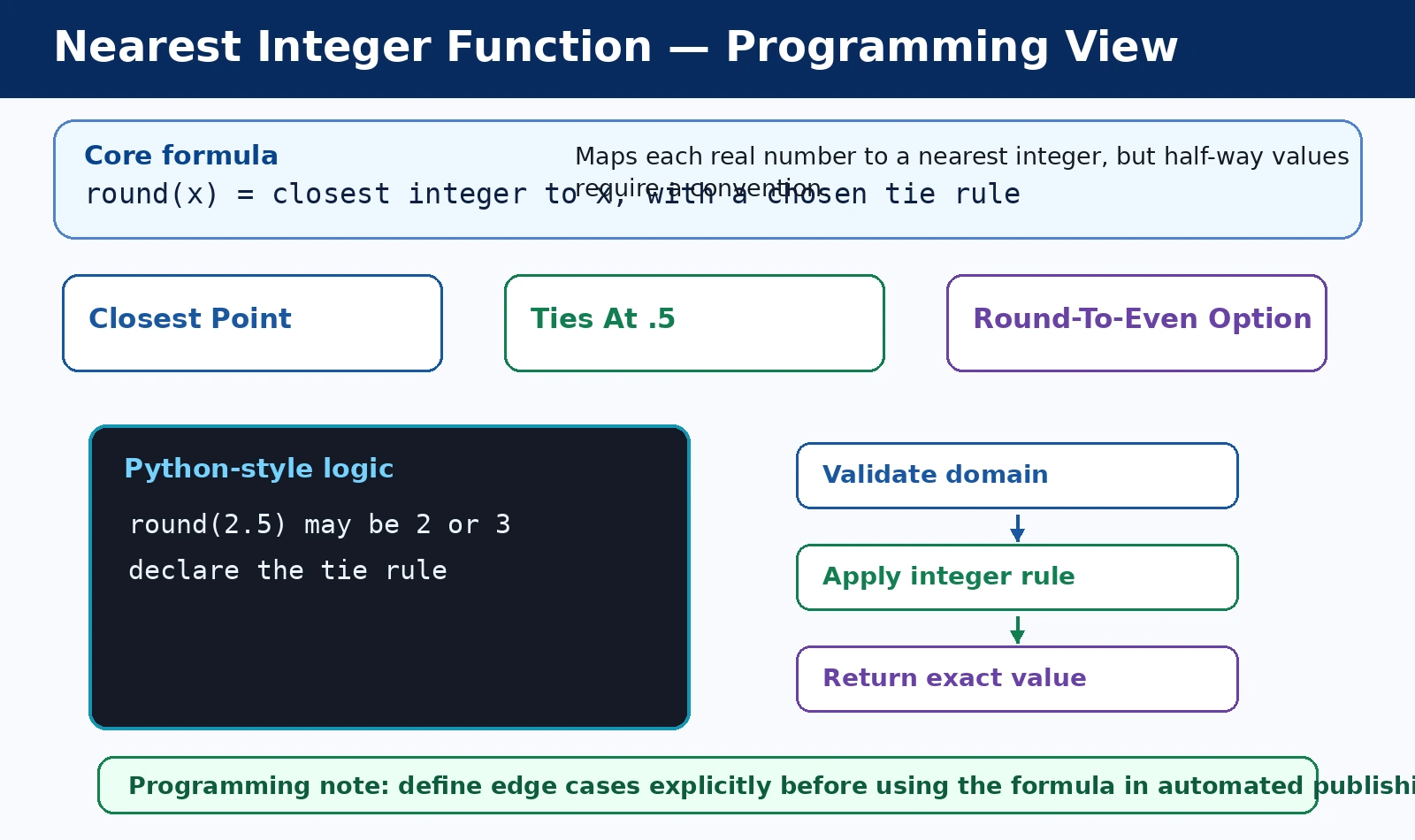
A common way to express the nearest integer function without tie-breaking is ##\text{nint}(x) = \lfloor x + 0.5 \rfloor##. This formula works perfectly for all values that are not exactly at the half-integer mark.
To incorporate the bankers' rounding rule, the algebraic expression becomes more complex. It must check if the fractional part is exactly 0.5 and then evaluate the parity of the preceding integer to decide the direction.
In terms of the signum function and floor operations, one could define the nearest integer as ##\lfloor x \rceil##. This notation is compact and frequently used in advanced calculus and discrete mathematics textbooks.
Another representation involves the use of the modulo operator to determine the distance to the nearest integer. If ##x \pmod 1## is less than 0.5, we round down; if greater, we round up; if equal, we check parity.
These formulas allow mathematicians to include rounding operations within larger equations. By defining the function algebraically, it becomes possible to perform symbolic manipulation and solve complex optimization problems involving discrete constraints.
Graphical Behavior and Discontinuity
The graph of the nearest integer function resembles a staircase, with jumps occurring at the half-integer points. Each "step" is centered on an integer, representing the range of values that round to that specific whole number.
At the points ##x = n + 0.5##, the function is discontinuous. The limit from the left and the limit from the right are different, which is why the tie-breaking rule is so important for defining the value at that point.
Because the function is constant between jumps, its derivative is zero almost everywhere. However, at the jump points, the derivative is undefined or can be modeled using the Dirac delta function in distribution theory.
The width of each step is exactly one unit, except perhaps at the boundaries of the domain. This uniformity reflects the consistent logic applied to every real number processed by the nearest integer function.
Visualizing this graph helps in understanding how small changes in input can lead to sudden changes in output. This "quantization" effect is a core concept in digital electronics and data compression technologies.
Practical Applications and Computing
The nearest integer function is ubiquitous in computer science, where it is used to convert continuous sensor data into discrete digital values. Without this function, digital systems could not accurately represent the physical world.
In graphics programming, rounding is used to map coordinate values to specific pixels on a screen. The nearest integer function ensures that lines and shapes are rendered with the highest possible visual fidelity.
Financial software relies heavily on rounding to manage currency values, which are typically restricted to two decimal places. Using the correct rounding rule prevents "penny-shaving" errors that could lead to significant financial loss.
Data science applications use rounding to simplify features and make models more interpretable. By reducing the noise in raw data, the nearest integer function helps in identifying patterns and trends more effectively.
This final section covers how the function is implemented in popular programming languages and its statistical significance. Understanding these practical aspects bridges the gap between theoretical mathematics and real-world utility.
Implementation in Programming Languages
Most modern programming languages provide a built-in round() function that implements the nearest integer logic. However, the specific tie-breaking rule can vary between languages, which developers must be aware of.
In Python 3, the round() function uses bankers' rounding by default. This means round(2.5) returns 2 and round(3.5) returns 4, following the mathematical standard for minimizing statistical bias in sums.
In contrast, some older languages or specific libraries might use "round half away from zero" as the default. This highlights the importance of checking documentation when porting mathematical code between different development environments.
For languages that do not have a built-in bankers' rounding function, it can be implemented using a combination of floor and conditional logic. This ensures that the application behaves consistently regardless of the underlying platform.
Efficient implementation is also a concern in high-performance computing. Using hardware-level instructions for rounding can significantly speed up the processing of large arrays in scientific simulations and 3D rendering engines.
Statistical Significance in Data Science
In the world of big data, the choice of rounding rule can have a measurable impact on the outcome of an analysis. Bankers' rounding is preferred because it preserves the mean of the distribution.
When rounding millions of data points, a biased rounding rule (like always rounding up) would cause the total sum to drift. This drift can lead to incorrect conclusions in fields like econometrics or epidemiology.
Statistical software like R and various Python libraries (such as NumPy) are designed with these considerations in mind. They provide robust tools for rounding that adhere to international standards for numerical accuracy.
Data scientists must also consider the "rounding error" as a form of noise. Understanding the properties of the nearest integer function allows them to quantify this noise and account for it in their models.
Ultimately, the nearest integer function is more than just a simple arithmetic trick. It is a sophisticated tool that, when used correctly, ensures the integrity and reliability of numerical data across all scientific and commercial disciplines.
From our network :
- EV 2.0: The Solid-State Battery Breakthrough and Global Factory ExpansionDiscover the impact of the Solid-State Battery Breakthrough on the EV market. Learn about CATL and BYD stock growth, global factory expansion in Europe, and the future of EV 2.0 technology.
- 10 Physics Numerical Problems with Solutions for IIT JEEPrepare for IIT JEE with 10 physics numerical problems, complete with detailed solutions and conceptual explanations. Ideal for mastering kinematics, thermodynamics, electromagnetism, and optics.
- Vite 6/7 'Cold Start' Regression in Massive Module GraphsIn-depth analysis of Vite 6/7 cold start regressions in massive module graphs. Learn about barrel file issues, pre-bundling optimizations, and how to improve Vite dev server performance.
- Mastering DB2 12.1 Instance Design: A Technical Deep Dive into Modern Database ArchitectureComprehensive guide to DB2 12.1 Instance Design. Explore architectural components, HADR setup, buffer pool tuning, and security policies for IBM DB2 12.1. Includes 10 functional SQL and Shell samples.
- Trump Political Strategy How Geopolitical Stunts Serve As Media Diversions
- Mastering DB2 LUW v12 Tables: A Comprehensive Technical GuideComprehensive guide on DB2 LUW v12 tables. Explore CREATE TABLE syntax, BLU Acceleration, range partitioning, data types, and security features for IBM DB2 LUW v12.
- AI-Powered 'Precision Diagnostic' Replaces Standard GRE Score ReportsDiscover the new GRE Precision Diagnostic. Learn how AI-powered behavioral analytics and time-to-solve tracking are replacing standard GRE score reports to empower students.
- Analyzing Trump Deportation Numbers Insights Into The 2026 Immigration Crackdown
- 98% of Global MBA Programs Now Prefer GRE Over GMAT Focus EditionExplore why 98% of global MBA programs now prefer the GRE over GMAT Focus. Learn about the shorter GRE format, verbal logic importance, and strategic versatility for students.
RESOURCES
- Nearest Integer Function -- from Wolfram MathWorld
- What is the mathematical notation for rounding a given number to ...
- How do you notate rounding to the nearest integer? : r/askmath
- sums involving the nearest-integer function - MathOverflow
- Floor and ceiling functions - Wikipedia
- Round number to nearest integer - python - Stack Overflow
- Round To Nearest Function - NI - National Instruments
- Rounding to nearest integer symbol in Latex - TeX
- Rounding - Wikipedia
- round - Round to nearest decimal or integer - MATLAB
- Greatest Integer Function - Graph, Domain & Range, Examples
- rounding to nearest integer - Perl Monks
- ROUND function - Microsoft Support
- ROUND function - Google Docs Editors Help
- ROUNDUP function - Microsoft Support


0 Comments