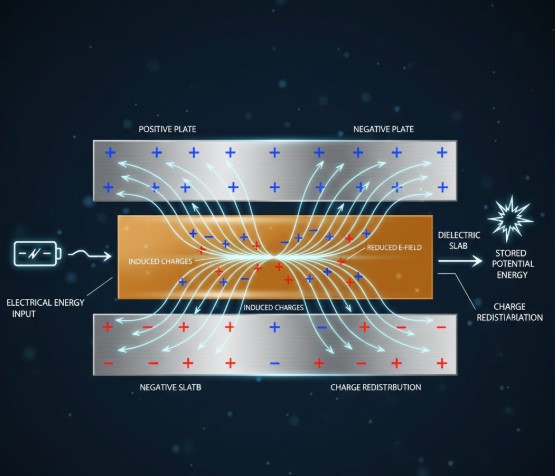
Inserting an insulating material between its plates drastically changes the capacitance, stored energy, and potential difference of a capacitor with a dielectric under varying conditions. Consequently, the SEO key phrase "Capacitors with dielectrics change energy and voltage" effectively captures both the underlying physics principle and its real-world implications. This topic forms one of the most fundamental problems in electrostatics because capacitors with dielectrics change energy and voltage depending on whether the battery remains connected or is removed. Specifically, they achieve this by modifying the electric field distribution, a crucial understanding for students preparing for physics exams and for engineers designing modern circuits.
In this detailed article, we will not only solve a classic problem involving a capacitor with a dielectric slab but also thoroughly explore the physics concepts behind capacitance, the role of the dielectric constant, energy transformations, and common exam questions. Ultimately, capacitors with dielectrics change energy and voltage in ways that reveal the subtle relationship among charge conservation, potential difference, and the electric field. Furthermore, we will present worked-out numerical problems, illustrative tables, and real-life applications of this principle in technology.
On This Page
We Also Published
Capacitors And Dielectrics
Capacitors store electric charge on two parallel plates. Their capacitance depends on geometry, including plate area and separation, and the medium between the plates. While air or a vacuum typically serves as the default medium, inserting a dielectric slab effectively changes the capacitance. Consequently, capacitors with dielectrics alter energy and voltage because the dielectric reduces the effective electric field, thereby allowing them to store more charge per unit voltage.
Key Principle
When a dielectric with constant \( K \) is inserted:
- New capacitance: \( C_f = K \times C_i \).
- If the battery is connected: voltage remains constant, charge increases.
- If the battery is disconnected: charge remains constant, voltage decreases.
Worked Example
Consider a ## 100 \, \text{pF}## capacitor charged by a ## 50 \, \text{V}## battery. The battery is then disconnected, and a dielectric slab with ## K = 2.5## is inserted. We must find the new potential difference and stored energy.
Step 1: Initial Charge
Using \( Q = C_i V_i \):
Step 2: New Capacitance
### C_f = K C_i = 2.5 × 100 \, \text{pF} = 250 \, \text{pF} ###
Step 3: New Potential Difference
###V_f = Q / C_f = (5 × 10^{-9}) / (250 × 10^{-12}) = (5 × 10^{-9}) / (250 × 10^{-12}) = 20 \, \text{V}###
Step 4: Energy Before And After
Initial energy: ### U_i = \tfrac{1}{2} C_i V_i^2 = 1.25 × 10^{-7} \, \text{J} ###
Final energy: ### U_f = \tfrac{1}{2} Q^2 / C_f = 0.5 × 10^{-7} \, \text{J} ###
The loss of energy is due to work done in pulling the dielectric into the capacitor and dissipated heat.
Additional Examples
Example 1: If the battery were connected, the final voltage remains ##50 \, \text{V} ##, but capacitance increases and hence stored energy increases.
Example 2: In a partially filled capacitor, capacitance changes depending on geometry (series or parallel filling), often asked in competitive exams.
Example 3: Dielectric breakdown occurs if electric field exceeds the material’s threshold.
Example 4: Practical capacitors like electrolytic or ceramic capacitors use different dielectric materials to maximize energy density.
Example 5: In physics labs, dielectric insertion experiments demonstrate energy conservation and field distribution.
Responsive Table Of Capacitor Changes
| Condition | Charge | Voltage | Energy |
|---|---|---|---|
| Before Insertion | 5 × 10⁻⁹ C | 50 V | 1.25 × 10⁻⁷ J |
| After Insertion (Disconnected) | 5 × 10⁻⁹ C (constant) | 20 V | 0.5 × 10⁻⁷ J |
| After Insertion (Connected) | 12.5 × 10⁻⁹ C | 50 V (constant) | 3.125 × 10⁻⁷ J |
From our network :
- Trump Political Strategy How Geopolitical Stunts Serve As Media Diversions
- Vite 6/7 'Cold Start' Regression in Massive Module GraphsIn-depth analysis of Vite 6/7 cold start regressions in massive module graphs. Learn about barrel file issues, pre-bundling optimizations, and how to improve Vite dev server performance.
- Analyzing Trump Deportation Numbers Insights Into The 2026 Immigration Crackdown
- Mastering DB2 12.1 Instance Design: A Technical Deep Dive into Modern Database ArchitectureComprehensive guide to DB2 12.1 Instance Design. Explore architectural components, HADR setup, buffer pool tuning, and security policies for IBM DB2 12.1. Includes 10 functional SQL and Shell samples.
- 10 Physics Numerical Problems with Solutions for IIT JEEPrepare for IIT JEE with 10 physics numerical problems, complete with detailed solutions and conceptual explanations. Ideal for mastering kinematics, thermodynamics, electromagnetism, and optics.
- EV 2.0: The Solid-State Battery Breakthrough and Global Factory ExpansionDiscover the impact of the Solid-State Battery Breakthrough on the EV market. Learn about CATL and BYD stock growth, global factory expansion in Europe, and the future of EV 2.0 technology.
- AI-Powered 'Precision Diagnostic' Replaces Standard GRE Score ReportsDiscover the new GRE Precision Diagnostic. Learn how AI-powered behavioral analytics and time-to-solve tracking are replacing standard GRE score reports to empower students.
- Mastering DB2 LUW v12 Tables: A Comprehensive Technical GuideComprehensive guide on DB2 LUW v12 tables. Explore CREATE TABLE syntax, BLU Acceleration, range partitioning, data types, and security features for IBM DB2 LUW v12.
- 98% of Global MBA Programs Now Prefer GRE Over GMAT Focus EditionExplore why 98% of global MBA programs now prefer the GRE over GMAT Focus. Learn about the shorter GRE format, verbal logic importance, and strategic versatility for students.


0 Comments