On This Page
The Structure of Integer Threshold Functions
The integer threshold function serves as a sophisticated bridge between continuous real numbers and discrete integer sets. Unlike simple rounding, it relies on a custom-defined sequence of boundaries to determine output values. This flexibility allows mathematicians to model non-uniform transitions across a numerical range.
At its core, the function transforms a real-valued input ##x## into a specific integer ##n##. This transformation depends entirely on where ##x## falls within a pre-defined set of intervals. These intervals are created by a strictly increasing sequence of real numbers.
The function is often characterized as a piecewise constant function, commonly known as a step function. Because the steps can have varying widths, it is more adaptable than standard periodic functions. This adaptability makes it a primary tool in discrete mathematics.
In many technical contexts, the integer threshold function is used to simplify complex data. By grouping values into specific "buckets," it reduces the precision of the input while maintaining the order. This process is fundamental to many categorization algorithms.
Understanding this function requires a firm grasp of interval notation and sequence theory. It represents a generalization that encompasses many familiar operations used in daily computation. By defining the partition carefully, one can replicate almost any discrete mapping.
Defining the Underlying Partition
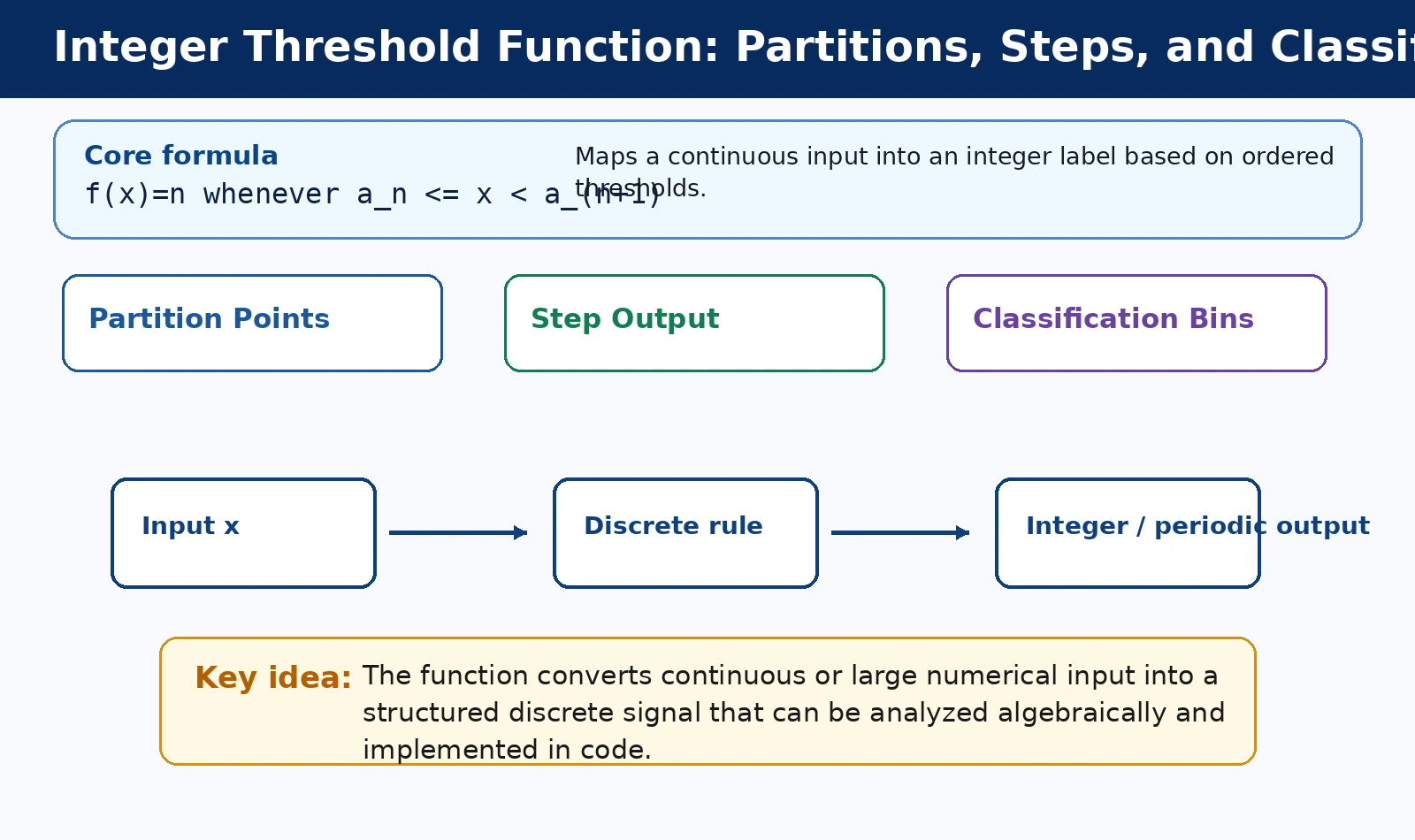
The foundation of the integer threshold function is a fixed partition sequence. This sequence is denoted as ##a_0, a_1, a_2, \dots##, where each subsequent value is strictly greater than the previous one. This creates a chain of non-overlapping intervals.
Mathematically, the partition is defined such that
. These values act as the "thresholds" or "breakpoints" on the real number line. Each interval represents a unique domain for a specific integer output.
The choice of these values determines the behavior and "width" of each step in the function. If the gaps between thresholds are equal, the function behaves linearly in its jumps. If the gaps vary, the function becomes non-uniform.
In most theoretical applications, the sequence is assumed to be infinite in at least one direction. However, practical implementations often use finite partitions for specific ranges. The starting point ##a_0## usually defines the lower bound of the function's domain.
This partition essentially carves the real number line into distinct segments. Each segment is typically left-closed and right-open, ensuring that every point maps to exactly one integer. This prevents ambiguity at the exact threshold points.
Formalizing the Mapping Logic
The mapping logic of the integer threshold function is elegant and precise. We define the function ##f(x)## such that it outputs the integer ##n## based on the interval containment. The relationship is strictly governed by the partition values.
Specifically, we state that
. This means that if the input ##x## is at least ##a_n## but strictly less than ##a_{n+1}##, the result is ##n##. This logic ensures a predictable step-up behavior.
This definition implies that the function is right-continuous at each threshold. When ##x## exactly equals a threshold value ##a_n##, the function value jumps to ##n##. This directional continuity is a hallmark of standard step function modeling.
The mapping is surjective onto the set of integers defined by the index of the partition. Each integer ##n## corresponds to a specific "bin" or "bucket" on the horizontal axis. This makes the function highly useful for classification tasks.
By adjusting the indices and the values of ##a_n##, the function can be shifted or scaled. This formal logic allows for the creation of complex grading or tiering systems. It effectively discretizes the continuous input space into meaningful units.
Generalizing Standard Discrete Functions
The integer threshold function is powerful because it acts as a "parent" function to many common operations. By selecting specific values for the partition, we can derive the floor and ceiling functions. This demonstrates its role as a universal generalization.
In standard arithmetic, the floor function ##\lfloor x \rfloor## maps a number to the greatest integer less than or equal to it. This is a specific case where the thresholds are simply the integers themselves. The integer threshold function formalizes this concept.
Similarly, other rounding functions can be viewed as variations of this threshold logic. While the floor function uses uniform steps of size one, the threshold function allows for any step size. This removes the constraint of uniformity found in basic math.
When we study functions that jump at specific intervals, we are often looking at threshold functions. They are essential in signal processing and digital logic where continuous signals must be quantized. The integer threshold function provides the mathematical framework.
By viewing these functions as special cases, students can better understand the underlying mechanics of discretization. It shifts the focus from simple rules to a more robust, interval-based perspective. This perspective is vital for advanced calculus and analysis.
Extending the Floor Function
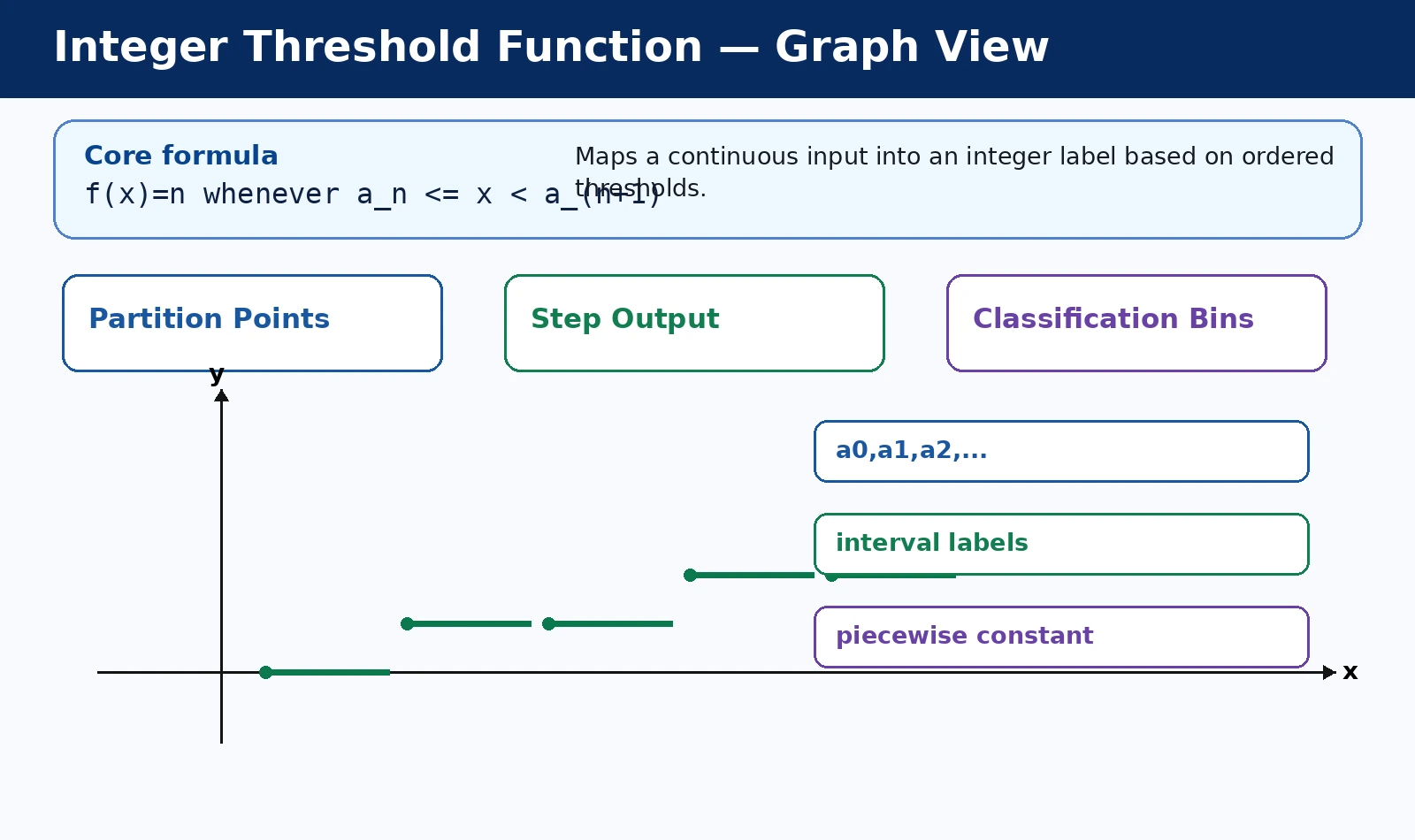
The floor function is perhaps the most famous example of a uniform integer threshold function. In this case, the partition sequence is defined as ##a_n = n## for all integers ##n##. This results in steps that occur exactly at integer values.
Under this specific partition, the rule
becomes
. This is the exact definition of the floor function ##f(x) = \lfloor x \rfloor##. It shows how the threshold function simplifies to basic rounding.
However, the integer threshold function extends this by allowing ##a_n## to be non-integers. For instance, one could set thresholds at every 0.5 units or at logarithmic intervals. This extension allows for "weighted" or "scaled" floor operations.
In computational contexts, extending the floor function is necessary for handling different scales of data. If a system needs to round values to the nearest ten or hundred, it is using a threshold partition. The math remains consistent regardless of scale.
This extension highlights the flexibility of the threshold approach. It allows for the creation of custom "rounding" rules that suit specific scientific or financial needs. The floor function is merely the simplest version of this broader concept.
Contrast with Ceiling Operations
While the standard integer threshold function is right-open, the ceiling function ##\lceil x \rceil## typically follows a left-open logic. To represent a ceiling-like function, the partition boundaries and the inequality signs must be slightly adjusted.
A ceiling function maps ##x## to the smallest integer greater than or equal to ##x##. In the threshold framework, this would involve intervals of the form ##a_{n-1} < x \le a_n##. This subtle shift changes the point of discontinuity.
The contrast lies in how the function handles the boundary points themselves. In the standard integer threshold function, the jump occurs *at* the threshold. In a ceiling-style mapping, the jump occurs immediately *after* the threshold value.
We Also Published
This distinction is crucial in programming and engineering where "off-by-one" errors are common. Choosing between a floor-like threshold and a ceiling-like threshold depends on the specific requirements of the system. Both are valid variations of interval mapping.
By comparing these two, we see that the integer threshold function is a template. It can be modified to be left-continuous or right-continuous depending on the inequality used. This makes it a robust tool for any discrete modeling scenario.
Practical Implementations in Social Systems
Beyond pure mathematics, the integer threshold function is used to structure many social and economic systems. Any system that uses "brackets" or "tiers" is effectively implementing this function. It provides a fair and objective way to categorize.
Social systems often require clear-cut boundaries to function efficiently. Whether it is determining eligibility for a program or calculating a fee, thresholds are necessary. The integer threshold function provides the logic to automate these decisions.
By using a fixed partition, these systems ensure that every individual is treated according to the same rules. The transition from one category to the next is clearly defined by the sequence ##a_n##. This transparency is vital for public trust.
In these applications, the output ##n## usually represents a level, a grade, or a category. The input ##x## is typically a continuous measure like income, score, or age. The function maps the measure to the appropriate administrative level.
Understanding the math behind these systems helps in analyzing their impact. For example, changing a single threshold value can shift thousands of people into a different category. This demonstrates the real-world power of the integer threshold function.
Economic Modeling via Tax Brackets
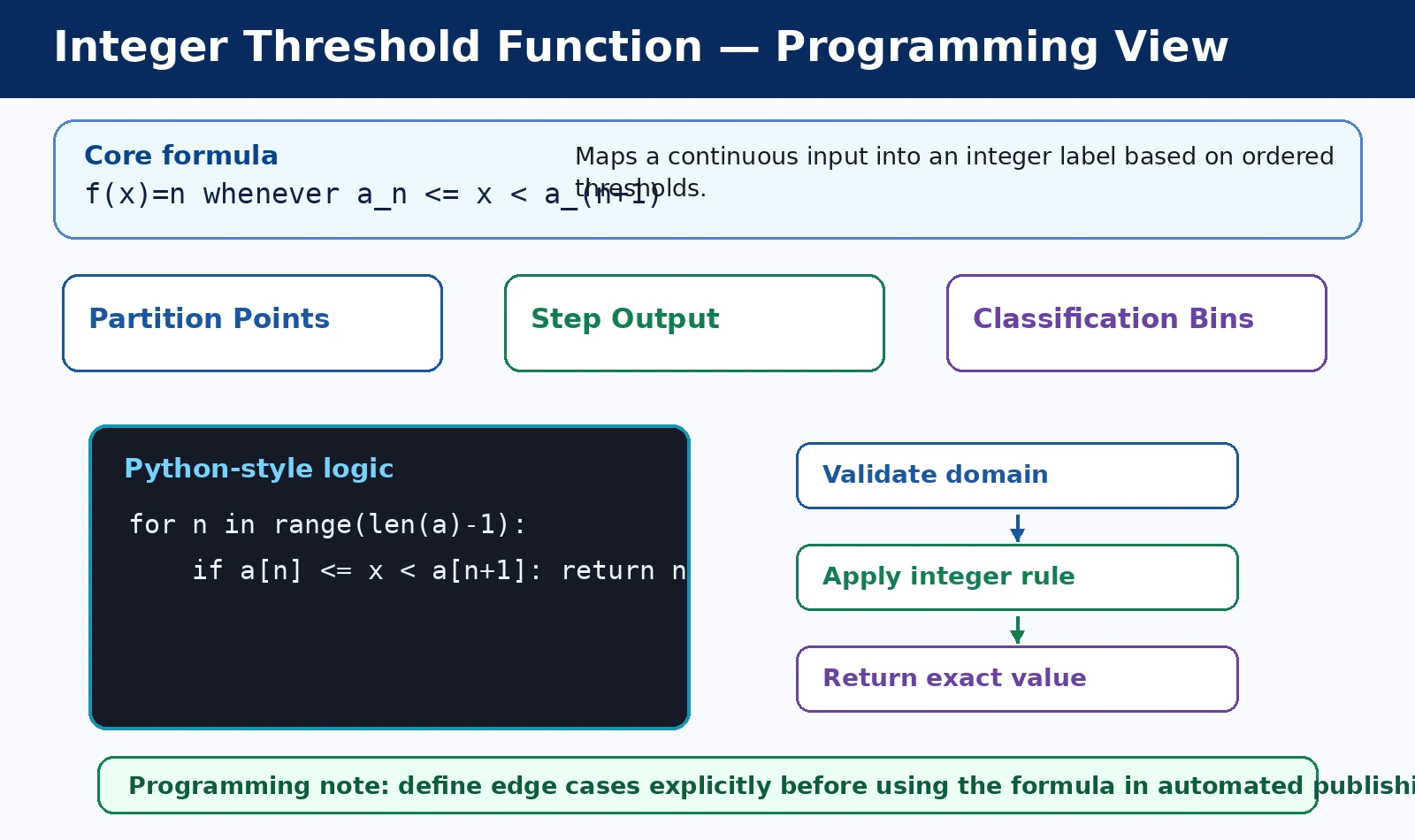
Tax systems are one of the most common real-world applications of the integer threshold function. In a progressive tax system, different portions of income are taxed at different rates based on brackets. These brackets are the intervals.
If ##x## represents an individual's taxable income, the tax bracket ##n## is determined by where ##x## falls. The thresholds ##a_n## are the income limits set by the government. As income crosses a threshold, the "level" of taxation changes.
While the actual tax calculation involves a bit more arithmetic, the identification of the bracket is a pure threshold function. It ensures that income is categorized into discrete tiers for the purpose of applying specific percentage rates.
This model allows for a non-linear relationship between income and tax liability. By adjusting the partition ##a_n##, policy makers can target specific income groups. The integer threshold function provides the structural framework for this economic design.
Without this mathematical concept, tax systems would be much harder to define and communicate. The use of discrete brackets simplifies a complex continuous variable into manageable parts. It is a fundamental tool in fiscal policy and accounting.
Educational Assessment and Grading
In education, the integer threshold function is used to convert raw scores into letter grades or grade points. A student's score on an exam is a continuous or high-resolution value that must be discretized. This is done via thresholds.
For example, a score ##x## might result in a grade of 'A' if it is above 90, 'B' if between 80 and 90, and so on. Here, the sequence ##a_n## consists of the cutoff points like 60, 70, 80, and 90. The grade is the output.
This system provides a standardized way to evaluate performance across different students and subjects. It reduces the noise of individual points into meaningful categories. The integer threshold function ensures that the grading is consistent and predictable.
Teachers and administrators use these partitions to set standards for achievement. By moving a threshold, they can change the difficulty of achieving a certain grade. This makes the function a key component of educational policy and assessment.
Furthermore, GPA calculations often involve mapping these discrete grades back to numerical values. The entire process relies on the reliable mapping provided by threshold logic. It is the invisible engine behind modern academic grading and certification.
Analytical Characteristics of Step Models
From an analytical perspective, the integer threshold function has unique properties that distinguish it from smooth functions. It is characterized by its "jumps" and its constant behavior between those jumps. This makes its derivative zero almost everywhere.
In calculus, these functions are often used to illustrate the concept of limits and continuity. Because the function is constant on intervals, its behavior is easy to predict locally. However, the points of discontinuity require special attention during analysis.
The function is not differentiable at the threshold points ##a_n##. This lack of smoothness means that traditional calculus tools must be applied carefully. Often, one uses distributions or generalized derivatives to describe the behavior at the jumps.
Despite these discontinuities, the function is integrable over any finite interval. The integral of an integer threshold function is simply the sum of the areas of the rectangles formed by the steps. This makes it very useful in approximation.
In engineering, these functions represent "on/off" states or quantized levels. Analyzing the frequency response of such functions is a major part of digital signal processing. The integer threshold function is the theoretical basis for these practical applications.
Handling Boundary Conditions
Boundary conditions are the most critical aspect of implementing an integer threshold function. The choice of whether an interval is left-closed or right-closed determines the output at the exact threshold. This choice must be consistent.
In the definition
, the function is inclusive of the lower bound. This means ##f(a_n) = n##. If the input is exactly on the boundary, it is "pushed" into the higher integer category.
If the boundary condition were swapped to ##a_n < x \le a_{n+1}##, the behavior would change. A value exactly on the threshold would remain in the lower category. This distinction is vital in legal and financial definitions.
In programming, these conditions are handled using comparison operators. A "greater than or equal to" (>=) versus a "greater than" (>) can lead to different results. Proper documentation of boundary conditions is essential for any threshold-based system.
Mathematically, these choices define the function's continuity from the left or right. Most standard models prefer right-continuity for consistency with the floor function. However, specific applications may require different boundary logic to meet user expectations.
Computational Logic for Binning
In data science and statistics, the integer threshold function is the logic behind "binning" or "bucketing." This process involves taking a large set of continuous data and grouping it into a histogram. Each bin is an interval.
The algorithm for binning identifies which bin an observation belongs to by checking it against the thresholds. This is a direct implementation of ##f(x) = n##. It allows for the visualization of data distributions and trends.
Computational efficiency is important when dealing with millions of data points. Binary search algorithms are often used to find the correct interval in the partition sequence. This ensures that the mapping happens quickly even with many thresholds.
Binning helps in reducing the complexity of models and can improve the performance of machine learning algorithms. By converting continuous features into discrete ones, the model can sometimes capture non-linear patterns more easily. The threshold function is the tool.
Ultimately, the integer threshold function is a fundamental building block of digital logic. It allows computers to categorize the messy, continuous real world into neat, discrete integers. This transformation is necessary for storage, processing, and human interpretation.
From our network :
- Trump Political Strategy How Geopolitical Stunts Serve As Media Diversions
- 98% of Global MBA Programs Now Prefer GRE Over GMAT Focus EditionExplore why 98% of global MBA programs now prefer the GRE over GMAT Focus. Learn about the shorter GRE format, verbal logic importance, and strategic versatility for students.
- Mastering DB2 LUW v12 Tables: A Comprehensive Technical GuideComprehensive guide on DB2 LUW v12 tables. Explore CREATE TABLE syntax, BLU Acceleration, range partitioning, data types, and security features for IBM DB2 LUW v12.
- 10 Physics Numerical Problems with Solutions for IIT JEEPrepare for IIT JEE with 10 physics numerical problems, complete with detailed solutions and conceptual explanations. Ideal for mastering kinematics, thermodynamics, electromagnetism, and optics.
- Vite 6/7 'Cold Start' Regression in Massive Module GraphsIn-depth analysis of Vite 6/7 cold start regressions in massive module graphs. Learn about barrel file issues, pre-bundling optimizations, and how to improve Vite dev server performance.
- Analyzing Trump Deportation Numbers Insights Into The 2026 Immigration Crackdown
- EV 2.0: The Solid-State Battery Breakthrough and Global Factory ExpansionDiscover the impact of the Solid-State Battery Breakthrough on the EV market. Learn about CATL and BYD stock growth, global factory expansion in Europe, and the future of EV 2.0 technology.
- AI-Powered 'Precision Diagnostic' Replaces Standard GRE Score ReportsDiscover the new GRE Precision Diagnostic. Learn how AI-powered behavioral analytics and time-to-solve tracking are replacing standard GRE score reports to empower students.
- Mastering DB2 12.1 Instance Design: A Technical Deep Dive into Modern Database ArchitectureComprehensive guide to DB2 12.1 Instance Design. Explore architectural components, HADR setup, buffer pool tuning, and security policies for IBM DB2 12.1. Includes 10 functional SQL and Shell samples.
RESOURCES
- Multivariate threshold integer-valued autoregressive processes with ...
- With Dafny, verify function to count integer set elements less than a ...
- Improved Approximation of Linear Threshold Functions
- Thresholds on integers - c++ - Stack Overflow
- An all integer-based spiking neural network with dynamic threshold ...
- Converting a Variable Type from Int to String - Image.sc Forum
- A Time-Varying Mixture Integer-Valued Threshold Autoregressive ...
- Do the columns contain integer values? — col_is_integer • pointblank
- the chow parameters problem - CMU School of Computer Science
- NN ops - Keras
- A new ambiguity acceptance test threshold determination method ...
- Layer activation functions - Keras
- How can I detect when a float value crosses an integer threshold?
- Weights of Exact Threshold Functions | Springer Nature Link
- Finding Thresholds - CRAN


0 Comments