
On This Page
Defining the Integer Part Function
Basic Concept and Notation
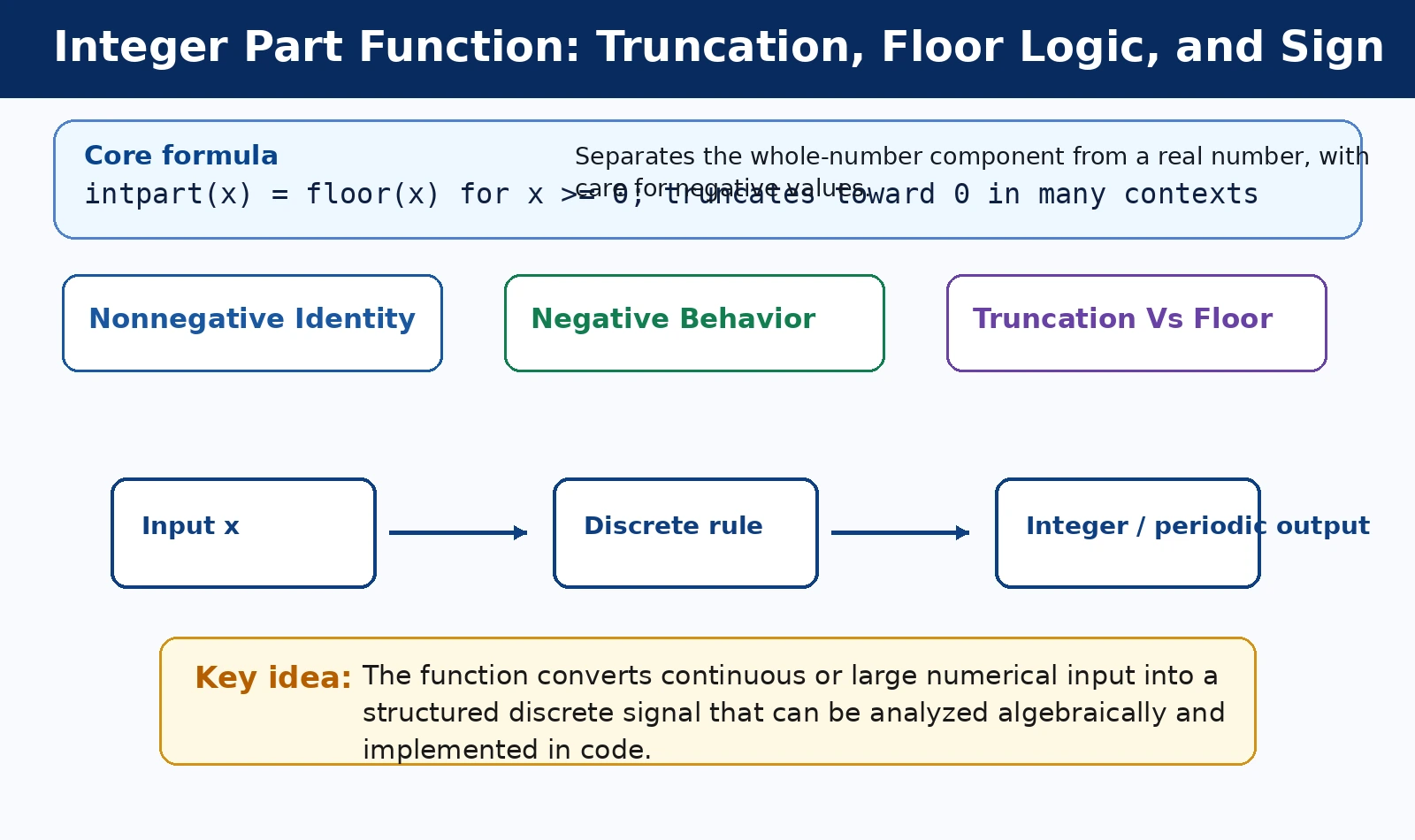
The integer part function serves as a fundamental mapping tool in discrete mathematics and calculus. It effectively reduces a real number to its nearest integer component based on specific rules. Understanding these rules is crucial for advanced numerical analysis and programming logic.
In technical literature, the notation for this function can vary significantly. Some authors represent it using square brackets, such as ##[x]##, while others use the prefix ##\text{int}(x)##. This variability requires careful attention to the context of the mathematical problem.
The domain of the integer part function is the set of all real numbers, denoted as ##\mathbb{R}##. Its range, however, is strictly limited to the set of integers, ##\mathbb{Z}##. This transformation is essential for algorithms requiring discrete data inputs.
Mathematically, the function strips away the fractional part of a number. If a number is already an integer, the function returns the value unchanged. This property makes it an idempotent operation, which is useful in various algebraic proofs and simplifications.
The function is piecewise constant, meaning it creates a step-like pattern when graphed on a Cartesian plane. These steps occur at every integer interval along the x-axis. Such characteristics are vital for understanding discontinuities in complex mathematical modeling and functions.
Relationship with the Floor Function
The floor function, often denoted as ##\lfloor x \rfloor##, is the most common interpretation of the integer part. It maps a real number to the largest integer less than or equal to that number. This definition is standard in most theoretical mathematics.
Historically, the terms "integer part" and "floor" were used interchangeably. However, modern computational science has introduced nuances that distinguish the two. This distinction is particularly evident when dealing with negative coordinates on a standard number line system.
For any real number ##x##, the floor function ensures that the result is always "to the left" on the number line. This consistent downward rounding provides a predictable framework for inequality proofs. It is a staple in number theory and sequences.
The floor function satisfies the identity
. This inequality defines the boundaries within which the real number resides relative to its integer floor. It is a cornerstone for deriving various floor-related mathematical properties.
Axiomatic foundations of the floor function rely on the Archimedean property of real numbers. This ensures that for any real value, a unique integer floor exists. This existence is fundamental to the consistency of the real number system in analysis.
Behavior with Nonnegative Real Numbers
The Identity Property
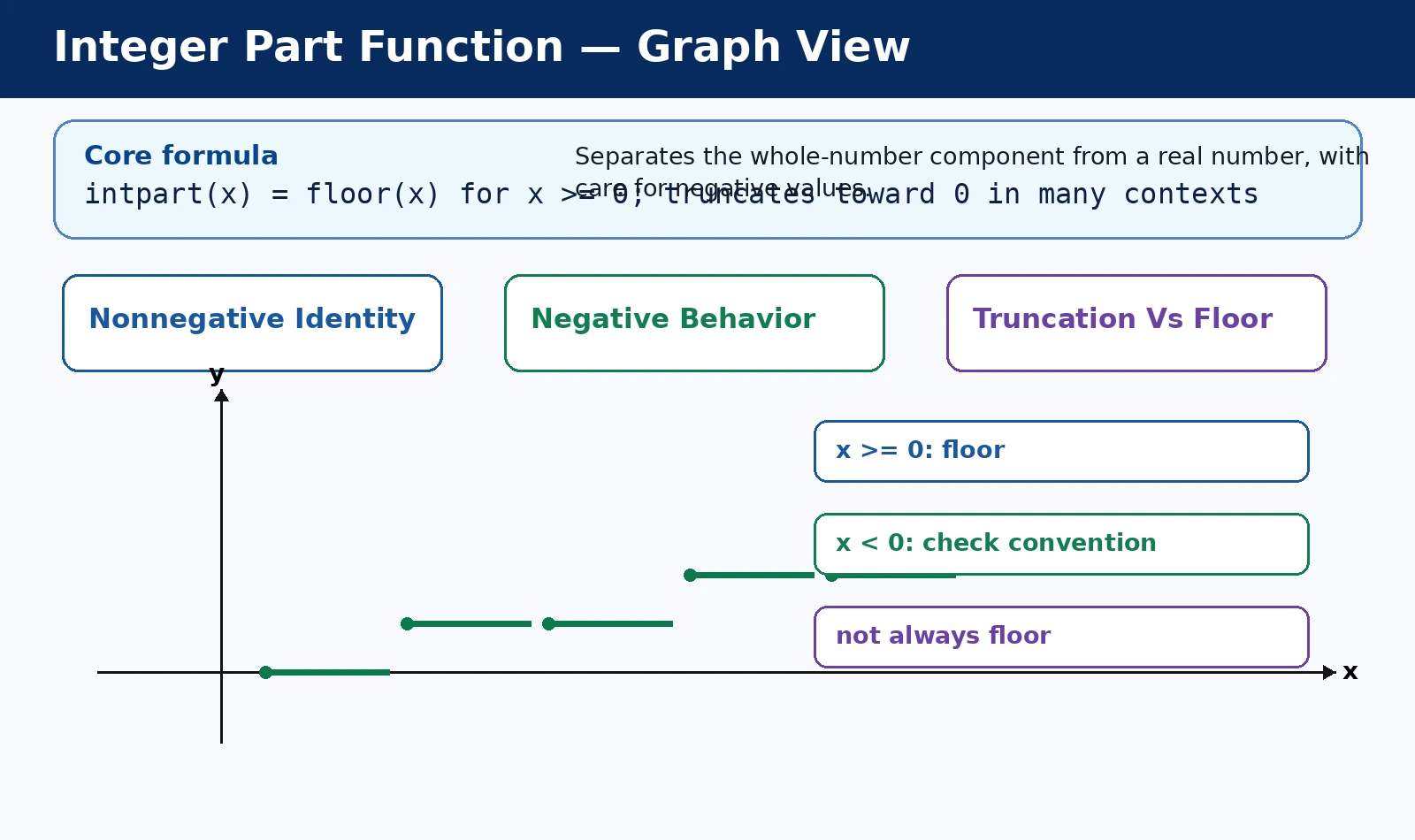
For nonnegative numbers, where ##x \ge 0##, the integer part function and the floor function are identical. This symmetry simplifies calculations in geometry and basic arithmetic. Most introductory students first encounter the function within this positive domain for clarity.
Consider the value ##3.7##; both the floor and the truncation methods yield ##3##. There is no ambiguity because the direction "toward zero" and "toward negative infinity" align. This alignment makes the positive domain highly intuitive for most users.
The identity property ensures that the fractional part is simply discarded. Mathematically, if ##x = n + f## where ##n## is an integer and ##0 \le f < 1##, then the result is ##n##. This decomposition is standard for all positive reals.
In geometric interpretations, this represents the projection of a point onto the nearest lower integer. On a positive number line, this movement is always toward the origin. The origin acts as a natural anchor for these positive projections and calculations.
Algorithmic simplicity in the positive domain allows for rapid data processing. Computers can often perform this operation by simply ignoring the bits representing the decimal. This efficiency is why the function is so prevalent in early computer science architectures.
Visualizing Positive Projections
Visualizing the function on a number line helps clarify its behavior. For positive values, every point between two integers "falls" back to the integer on its left. This visualization reinforces the concept of the floor as a physical boundary.
The movement is always unidirectional toward the left, which happens to be toward zero. This dual nature of the direction often masks the underlying logic of the function. It is only in the negative realm that the logic separates.
Integers themselves remain stable under this transformation, acting as fixed points. For example, the integer part of ##5.0## remains exactly ##5##. This stability is a required property for any consistent rounding or integer-extraction function used in engineering.
The distance from the origin decreases or stays the same for all positive inputs. This reduction in magnitude is a key feature of truncation. In the positive domain, "rounding down" and "rounding toward zero" are functionally the same operation.
Uniformity in results across different mathematical software is highest in this domain. Whether using MATLAB, Python, or Excel, the integer part of ##4.9## will consistently return ##4##. This reliability is essential for cross-platform scientific computing and data sharing.
We Also Published
Divergence in Negative Domains
Truncation Toward Zero
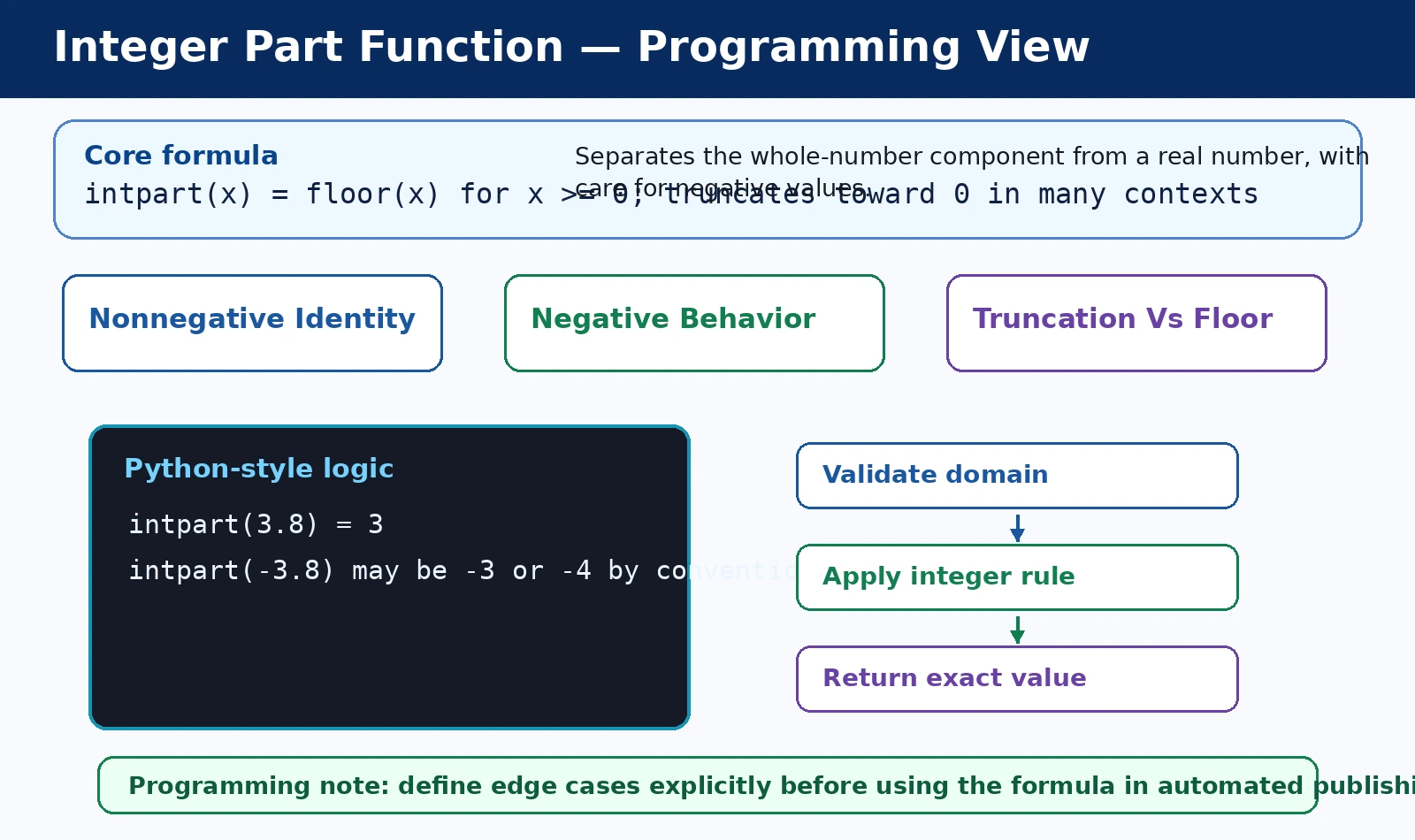
When dealing with negative numbers, the definition of "integer part" often shifts to truncation. Truncation is the process of removing the fractional part while moving toward zero. This results in a value with a smaller absolute magnitude than the original.
For example, if we apply truncation to ##-3.7##, the resulting integer is ##-3##. Here, the function ignores the ##.7## and keeps the integer component as it appears. This behavior is common in many programming languages like C and Java.
Rounding toward zero is mathematically described using the signum function. The formula can be expressed as
. This formula ensures that the magnitude is floored while the original sign is preserved.
This approach contrasts with the floor function, which would move further away from zero. Truncation effectively treats the negative sign as a separate entity from the magnitude. This distinction is vital for financial calculations where "whole units" are required.
Mathematical notation for truncation is sometimes written as ##\text{trunc}(x)## to avoid confusion. By explicitly naming the operation, mathematicians prevent errors in complex equations. Clear terminology is the first defense against calculation errors in advanced physics and engineering.
Comparison with Floor Function to Negative Infinity
The floor function behaves differently for negative numbers by always moving toward negative infinity. For the value ##-3.7##, the floor function yields ##-4##. This is because ##-4## is the largest integer that is less than or equal to ##-3.7##.
This downward movement is consistent across the entire real number line. Unlike truncation, the floor function does not change its directional logic based on the sign of ##x##. This consistency is preferred in pure mathematics and theoretical proofs.
The difference between the two can lead to significant errors if not accounted for. In a loop or recursive formula, a difference of ##1## can propagate into massive discrepancies. Engineers must specify which behavior they intend to use in their systems.
A comparison table of these functions shows that for ##x = -0.5##, truncation gives ##0## while floor gives ##-1##. This specific case is often a source of "off-by-one" errors in software development. Understanding the limit behavior at zero is critical.
Error propagation risks are higher in systems that mix different rounding conventions. If one module uses floor and another uses truncation, the data integrity may fail. Standardizing the integer part definition within a project is a best practice.
Computational and Practical Applications
Programming Language Implementations
In programming, the implementation of the integer part function is language-dependent. C, C++, and Java typically use truncation for their integer casting operations. This means that casting a float to an int moves the value toward zero.
Python, conversely, uses floor division as its default for the ##//## operator. This means that ##-7 // 2## results in ##-4## rather than ##-3##. Developers moving between these languages must be acutely aware of these underlying logic shifts.
The IEEE 754 standard for floating-point arithmetic defines various rounding modes, including toward zero. Hardware-level instructions often provide direct support for these different methods. This allows for high-performance calculations in graphics and scientific simulations.
Floating-point issues can arise when a number like ##-3.0## is represented as ##-2.9999999## due to precision limits. In such cases, truncation might yield ##-2## while the intended result was ##-3##. Robust code often includes a small epsilon value to handle these edge cases.
Library-specific functions like math.floor() or math.trunc() in Python provide explicit control. Using these named functions is generally safer than relying on implicit type casting. It makes the programmer's intent clear to anyone reviewing the technical source code.
Mathematical Modeling Implications
In engineering applications, the choice between floor and truncation depends on the physical system. For example, in digital signal processing, truncation is often used to model quantization errors. It represents the loss of precision when converting analog signals.
Signal processing algorithms must account for the "dead zone" around zero created by truncation. This zone can affect the symmetry of a signal and introduce harmonic distortion. Engineers use dither or alternative rounding to mitigate these specific mathematical artifacts.
Financial rounding often requires truncation to ensure that fractions of a cent are not over-credited. In these contexts, the "integer part" represents the actual currency units available. Consistency here is not just a mathematical requirement but a legal one.
Data quantization in machine learning models also relies on these functions to discretize weights. The choice of function can influence the convergence of gradient descent algorithms. Researchers often experiment with different integer mappings to optimize model performance and accuracy.
Ultimately, choosing the right function requires a deep understanding of the problem domain. Whether using floor, ceiling, or truncation, the goal is to map continuous reality into discrete logic. The integer part function remains a versatile tool for this essential task.
From our network :
- Analyzing Trump Deportation Numbers Insights Into The 2026 Immigration Crackdown
- 10 Physics Numerical Problems with Solutions for IIT JEEPrepare for IIT JEE with 10 physics numerical problems, complete with detailed solutions and conceptual explanations. Ideal for mastering kinematics, thermodynamics, electromagnetism, and optics.
- Mastering DB2 LUW v12 Tables: A Comprehensive Technical GuideComprehensive guide on DB2 LUW v12 tables. Explore CREATE TABLE syntax, BLU Acceleration, range partitioning, data types, and security features for IBM DB2 LUW v12.
- EV 2.0: The Solid-State Battery Breakthrough and Global Factory ExpansionDiscover the impact of the Solid-State Battery Breakthrough on the EV market. Learn about CATL and BYD stock growth, global factory expansion in Europe, and the future of EV 2.0 technology.
- Vite 6/7 'Cold Start' Regression in Massive Module GraphsIn-depth analysis of Vite 6/7 cold start regressions in massive module graphs. Learn about barrel file issues, pre-bundling optimizations, and how to improve Vite dev server performance.
- AI-Powered 'Precision Diagnostic' Replaces Standard GRE Score ReportsDiscover the new GRE Precision Diagnostic. Learn how AI-powered behavioral analytics and time-to-solve tracking are replacing standard GRE score reports to empower students.
- Trump Political Strategy How Geopolitical Stunts Serve As Media Diversions
- Mastering DB2 12.1 Instance Design: A Technical Deep Dive into Modern Database ArchitectureComprehensive guide to DB2 12.1 Instance Design. Explore architectural components, HADR setup, buffer pool tuning, and security policies for IBM DB2 12.1. Includes 10 functional SQL and Shell samples.
- 98% of Global MBA Programs Now Prefer GRE Over GMAT Focus EditionExplore why 98% of global MBA programs now prefer the GRE over GMAT Focus. Learn about the shorter GRE format, verbal logic importance, and strategic versatility for students.
RESOURCES
- Floor and ceiling functions - Wikipedia
- My teacher keeps insisting that the whole part of a number ... - Reddit
- Integer Part -- from Wolfram MathWorld
- Fractional part - Wikipedia
- How do I get the integer part of a number by using basic arithmetic?
- IntegerPart: Integer part of the number—Wolfram Documentation
- - How to get the integer part of a numeric field - Community
- modulo 1 (%1) and fractional part of a number - Perl Monks
- c++ - Getting the fractional part of a float without using modf()
- Summation Formulas for the Greatest Integer Part Function
- c++ convert a fractional part of a number into integer - Stack Overflow
- Whole and Fractional part symbols? - LaTeX.org
- How to return the fractional part of a number? [closed] - Stack Overflow
- Integer Part of a Value (Int) - Support - CASIO
- Integer and fractional part of the number - NI Forums


0 Comments