
The Large Hadron Collider has long served as humanity's most powerful instrument for interrogating the fabric of reality, and its latest achievement pushes that interrogation into territory that was, until recently, purely theoretical. Physicists analysing data from the LHCb experiment at CERN have detected signals emerging from a distance scale roughly one hundred billion times smaller than an atom — a realm some researchers have begun calling the "zeptoverse," borrowing the SI prefix for ##10^{-21}##. This is not merely a technical milestone to be filed away in a journal appendix; it represents the first experimental foothold in a domain where the known laws of particle physics begin to blur, and where the architecture of whatever deeper theory replaces the Standard Model may finally become visible.
What makes the result genuinely consequential is its connection to dark matter, the invisible substance whose gravitational influence shapes galaxies yet which has never been captured directly. Certain theoretical frameworks propose that new particles mediating interactions with dark matter would leave faint fingerprints on the behaviour of quarks at extraordinarily short distances. By observing beauty quarks decaying and interacting with other particles at scales of a billion-trillionth of a metre, the LHCb team has effectively opened a window onto precisely the regime where such fingerprints would appear. The measurement does not claim a dark matter discovery, but it establishes the observational infrastructure through which one might eventually be made.
The story carries a second, more uncomfortable dimension that extends well beyond the laboratory. The research was led by scientists based in Cambridge, yet the United Kingdom's continued participation in the next phase of the project has been thrown into doubt by funding withdrawals. The 28 nations collaborating on LHCb have committed to a £150 million detector upgrade that would multiply the frequency of these rare decays tenfold, but Britain's research funding agency has stepped back from its share. The consequences ripple outward — through the careers of early-career researchers now looking abroad, through the training pipeline that sustains a generation of physicists, and through the country's standing in a field where discovery is measured in decades rather than grant cycles.
On This Page
- The Zeptoverse: Mapping Nature at a Billion-Trillionth of a Metre
- Dark Matter and the Search for Physics Beyond the Standard Model
- The LHCb Upgrade and the Politics of Big Science Funding
- Quantum Mechanics of Short-Distance Interactions
- What Comes Next for Particle Physics and Its Institutions
- Reading the Zeptoverse Result in Context
- Conclusion: A Frontier Named and a Choice Pending
The Zeptoverse: Mapping Nature at a Billion-Trillionth of a Metre
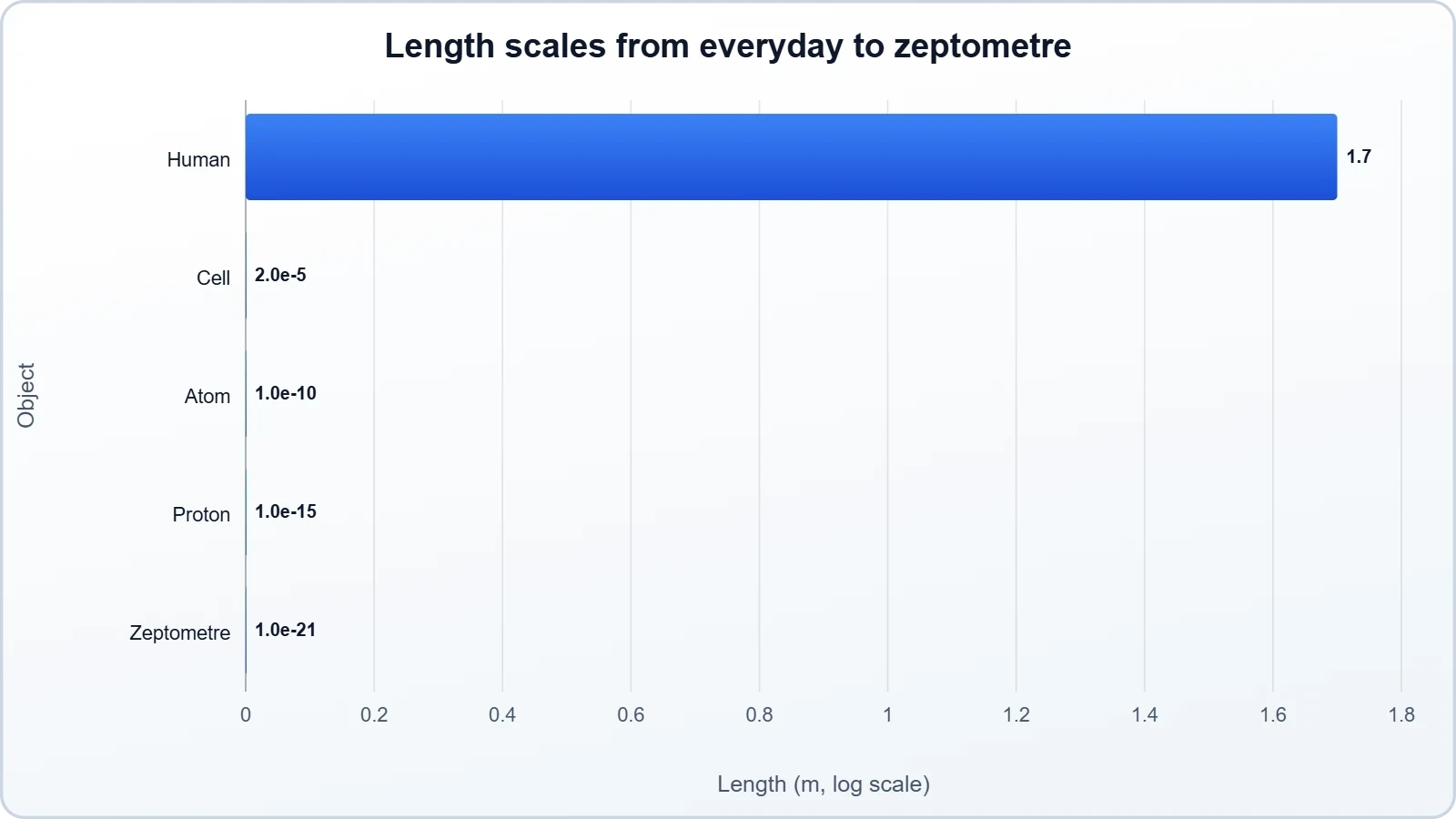
The term "zeptoverse" is a deliberate act of scientific branding, and it earns its place. The zeptometre corresponds to ##10^{-21}## metres, a distance so far below everyday experience that intuition offers no purchase whatsoever. For comparison, a proton measures roughly ##0.84## femtometres, or ##8.4 \times 10^{-16}## metres, meaning the zeptoverse sits some five orders of magnitude beneath the atomic nucleus itself. At such separations, the familiar picture of particles as tiny billiard balls collapses entirely, and what remains is a probabilistic haze of quantum fields whose interactions encode the deepest structural information physics can access.
Reaching this regime experimentally requires indirect methods, because no microscope will ever resolve structures at this scale. Instead, physicists exploit the uncertainty principle and the energetic violence of high-energy collisions. When particles are smashed together at the LHC, the debris carries imprints of interactions that occurred at distances far smaller than any detector could resolve directly. The LHCb experiment specialises in reading these imprints with extraordinary precision, tracking the decay products of unstable particles and reconstructing the short-distance physics that governed their behaviour.
Why Beauty Quarks Serve as Probes
Beauty quarks — also called bottom quarks — occupy a privileged position in this enterprise. They are heavy enough to be produced copiously in high-energy collisions, yet unstable enough to decay in ways that are exquisitely sensitive to new physics. A beauty quark survives for roughly ##1.5 \times 10^{-12}## seconds before transforming into lighter particles, a lifetime that sounds negligible but is long enough, in particle terms, for the quark to interact with virtual particles popping in and out of existence around it. Those fleeting interactions constitute the actual measurement target.
The theoretical logic is elegant. If unknown heavy particles exist — the kind that might mediate dark matter interactions — they would briefly materialise as quantum fluctuations during a beauty quark's decay, subtly altering the decay's probability and kinematics. The effect would be tiny, but precision measurements at LHCb are designed to detect exactly such tiny deviations from Standard Model predictions. Each confirmed anomaly becomes a signpost pointing toward physics beyond the established framework.
The Measurement and Its Statistical Weight
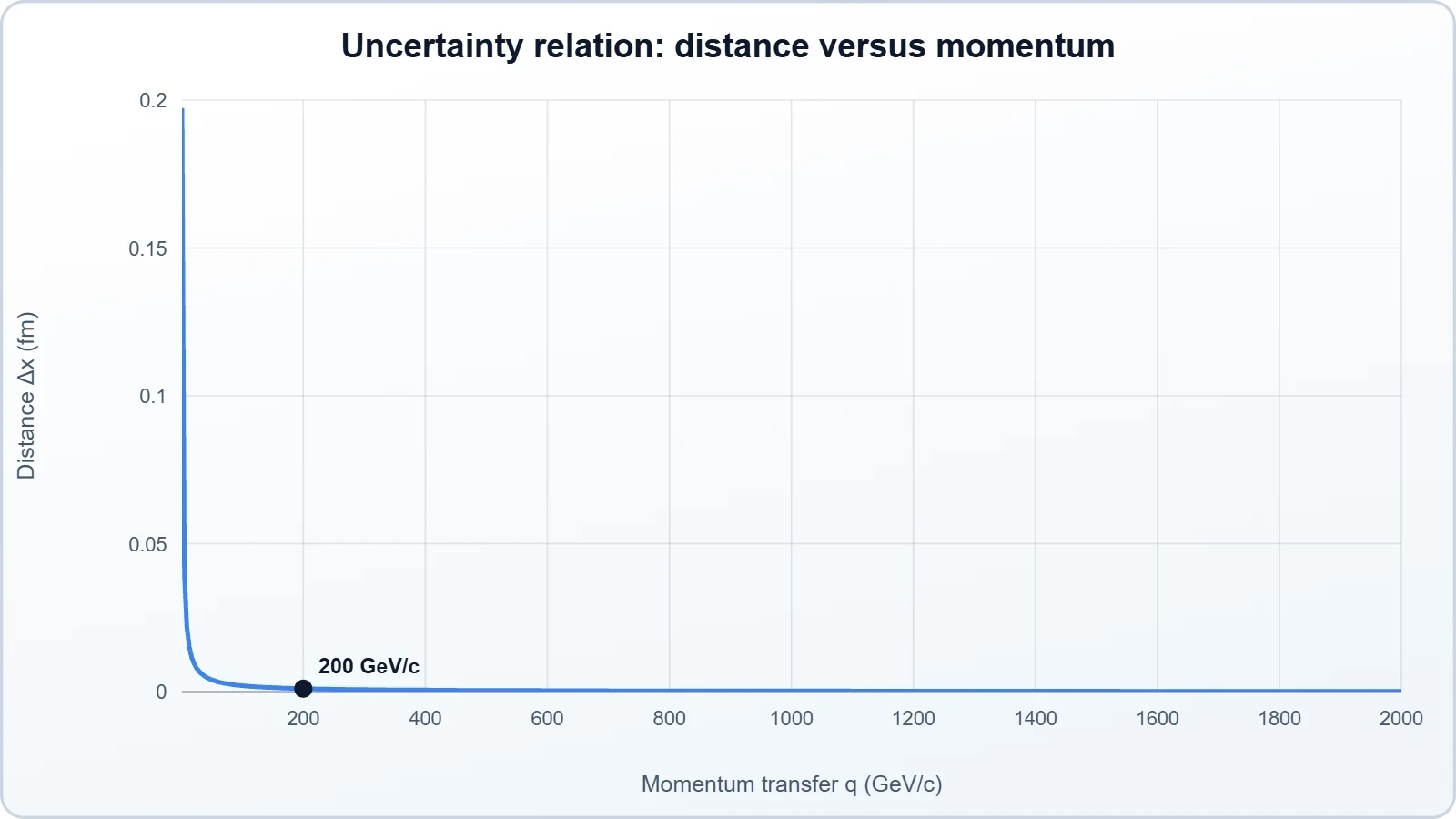
Detecting an interaction at ##10^{-21}## metres is not a matter of seeing something directly; it is a matter of inferring a distance scale from the energy and momentum exchanged. Quantum mechanics relates the two through the uncertainty relation ##\Delta x \cdot \Delta p \geq \dfrac{\hbar}{2}##, so probing shorter distances demands proportionally higher momentum transfers. The LHCb team reconstructed decay events in which the effective momentum transfer corresponded to the zeptometre regime, then compared the observed distributions against theoretical predictions to isolate any anomalous contributions.
Statistical rigour is paramount here, because the signals are faint and the background noise substantial. Researchers must accumulate enormous datasets, apply sophisticated multivariate analyses, and account for detector effects with painstaking care. The fact that the collaboration could extract a meaningful result at this scale speaks to more than a decade of incremental improvements in tracking resolution, particle identification, and computational reconstruction — an achievement as much engineering as physics.
We Also Published
Dark Matter and the Search for Physics Beyond the Standard Model
Dark matter remains the most conspicuous gap in modern physics. Astronomical observations — galactic rotation curves, gravitational lensing, the cosmic microwave background — converge on the conclusion that roughly 27 percent of the universe's energy content is dark matter, yet not a single particle of it has been identified in a laboratory. Its gravitational signature is unmistakable; its particle nature is entirely unknown. Every experiment that constrains the properties of dark matter, even indirectly, contributes a piece to a puzzle whose full picture remains stubbornly out of reach.
The connection between the zeptoverse and dark matter runs through the idea of mediator particles. Many dark matter models postulate a new force carrier that couples both to dark matter and, weakly, to ordinary quarks. Such a mediator would be heavy, but quantum mechanics permits heavy virtual particles to influence low-energy processes over extremely short distances. Beauty quark decays, with their precisely measurable rates and angular distributions, offer one of the cleanest arenas in which such virtual effects could manifest.
Theoretical Frameworks Linking Scales to Dark Sectors
Several classes of theory predict observable consequences at zeptometre scales. Leptoquarks, for instance, would couple quarks to leptons and could explain certain anomalies previously observed in beauty meson decays. Dark photons — hypothetical cousins of the ordinary photon — could mix with Standard Model particles and leave imprints on decay rates. More exotic scenarios invoke extra spatial dimensions or composite dark sectors, in which dark matter consists of bound states held together by new confining forces. Each framework makes specific, testable predictions.
What unites these possibilities is that they all modify interactions at short distances while leaving low-energy physics largely intact. This is precisely why precision measurements at the LHC are complementary to direct detection experiments buried deep underground. Direct detection searches for dark matter particles scattering off atomic nuclei; collider experiments search for the mediators and partners that dark matter theories predict. A signal in either approach would transform the other's interpretation.
Interpreting Null Results and Future Sensitivity
It is essential to be clear about what the LHCb result does and does not establish. The team has demonstrated sensitivity to interactions at an unprecedented scale and has constrained the parameter space available to certain new-physics models. It has not discovered dark matter, nor has it confirmed any specific theoretical framework. Null results, however, are scientifically valuable: they eliminate possibilities, sharpen theoretical priors, and guide the design of future experiments toward the regions where new physics might still hide.
The upgrade programme matters enormously in this context. Increasing the frequency of beauty quark decays tenfold would not merely improve statistical precision by a factor of roughly three; it would extend the reach of the search into regions of parameter space currently inaccessible. Discoveries in particle physics often emerge from exactly this kind of incremental sensitivity gain, where a modest improvement in data volume suddenly exposes an effect that was previously buried beneath statistical noise.
The LHCb Upgrade and the Politics of Big Science Funding
Big science has always been entangled with national politics, and the zeptoverse result has thrust that entanglement into sharp relief. The LHCb collaboration spans 28 countries, each contributing funding, personnel, and technical expertise. When one major partner withdraws, the consequences extend beyond the balance sheet: they affect the collaboration's strategic planning, the distribution of technical responsibilities, and the morale of researchers who built their careers around the project. The proposed £150 million upgrade to the LHCb detector is not a luxury item; it is the instrument through which the next decade of discovery would be conducted.
The United Kingdom's position is particularly awkward because British scientists led the analysis that produced this result. Dr Harry Cliff of Cambridge University headed the data analysis, and the discovery stands as a testament to the quality of UK particle physics. Yet the same funding agency that supported this work has withdrawn from the upgrade and announced cuts to other flagship projects, including Jodrell Bank's Lovell telescope. The juxtaposition of scientific leadership and financial retreat is difficult to reconcile with any coherent long-term research strategy.
What the Funding Withdrawal Means for Collaboration
Professor Tim Gershon, who leads the LHCb international collaboration, has been explicit about the risks. Full UK involvement in the upgraded detector is now in doubt, and with it the country's access to the data and discoveries that will follow. Particle physics operates on a principle of reciprocal contribution: nations that help build and operate detectors gain privileged access to the physics. Stepping back from the upgrade does not merely save money in the short term; it risks excluding British researchers from the frontier for a generation.
The collaboration's internal dynamics also matter. International projects depend on trust and continuity. When a partner withdraws mid-programme, other nations must absorb additional costs and responsibilities, and future collaborations may look more sceptically at British commitments. Reputational effects in science are slow to accumulate and slower to repair, and the damage often becomes visible only years later when invitations to join new ventures quietly fail to arrive.
The Human Cost: Early-Career Researchers at a Crossroads
Behind the institutional language lies a more personal story. Dr Mary Richardson-Slipper, an early-career researcher who contributed to the discovery, has said she is reconsidering her future and looking at positions abroad. Her situation is not unique. Particle physics training is long, specialised, and expensive, and the pipeline from doctoral study to independent research depends on a steady supply of postdoctoral positions and permanent roles. When funding contracts, the pipeline narrows at precisely the moment when experienced researchers are most productive.
The loss of early-career talent is arguably the most damaging consequence of funding instability, because it is the least reversible. Facilities can be upgraded later; collaborations can be rebuilt; but researchers who leave the field rarely return. Professor Gershon's observation that young people are the country's greatest product captures this precisely. A nation that trains excellent physicists and then exports them has not saved money — it has subsidised the scientific programmes of its competitors.
Quantum Mechanics of Short-Distance Interactions
The physics underlying the zeptoverse result rests on a principle that has no classical analogue: the relationship between distance and momentum encoded in the uncertainty principle. To probe a structure of size ##\Delta x##, one must use a probe with momentum uncertainty at least ##\Delta p \geq \dfrac{\hbar}{2\Delta x}##. For ##\Delta x = 10^{-21}## metres, this implies momentum transfers of order ##10^{5}## GeV/c — far beyond the reach of any single accelerator, but accessible indirectly through the virtual particles that mediate decays.
This indirect access is what makes precision measurements so powerful. A beauty quark decaying into lighter particles does so through weak interactions mediated by W bosons, but virtual contributions from unknown heavy particles can alter the decay amplitude. The observable consequence is a shift in branching fractions, angular distributions, or CP-violating asymmetries. By measuring these quantities with sufficient precision and comparing against Standard Model predictions, physicists can detect the presence of new physics even when the responsible particles are too heavy to produce directly.
Deriving the Sensitivity Threshold
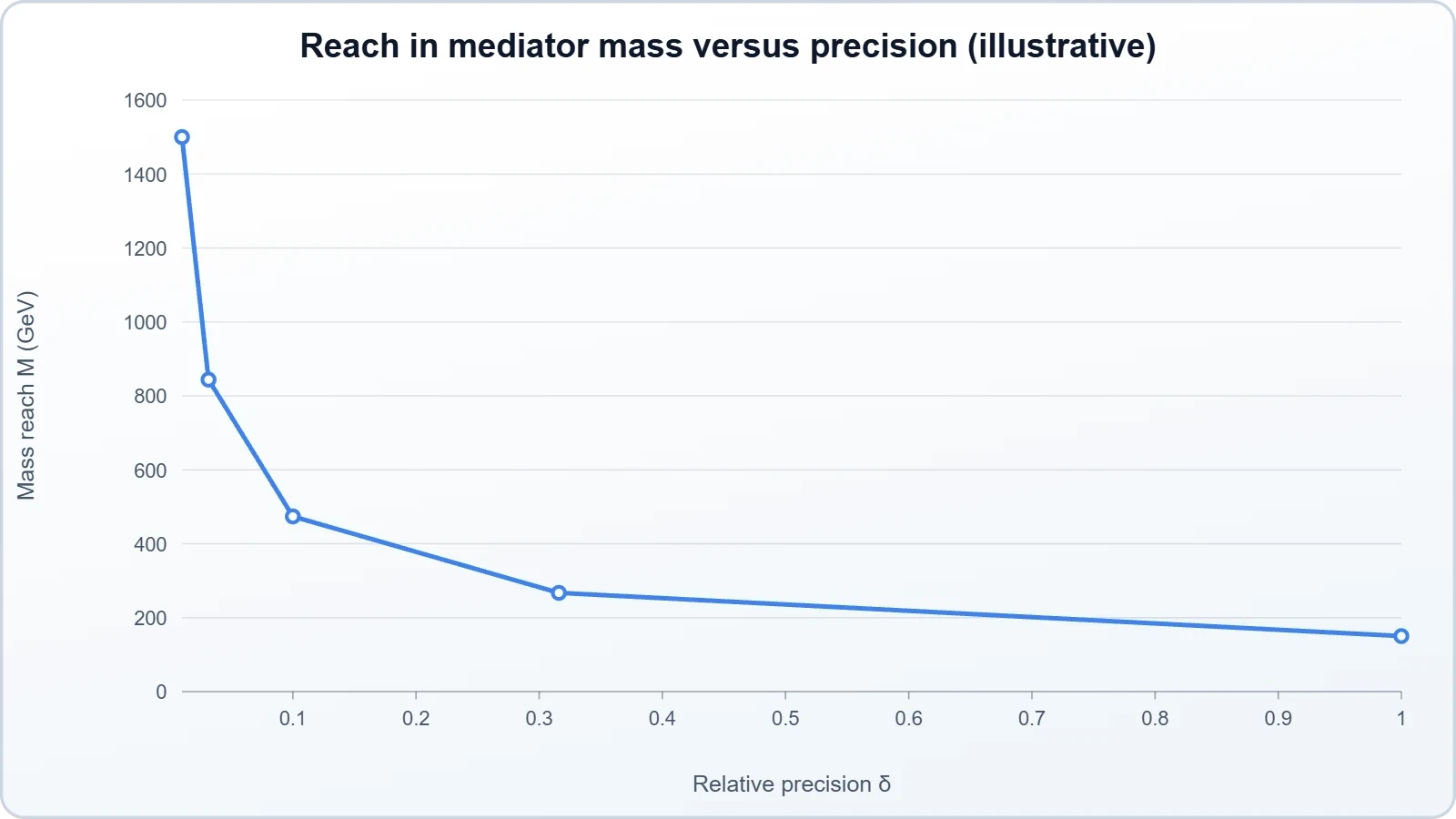
The sensitivity of a collider experiment to new physics at a given mass scale can be estimated through a standard dimensional argument. If a new particle of mass ##M## mediates an interaction, its virtual exchange produces an effective four-fermion operator suppressed by ##1/M^2##. The deviation from Standard Model predictions then scales as ##\mathcal{O}(E^2/M^2)##, where ##E## is the characteristic energy of the process. Setting this deviation equal to the experimental precision ##\delta## yields an estimate of the reachable mass scale.
For beauty quark decays, ##E \sim 5## GeV and current precision reaches ##\delta \sim 10^{-3}##, giving ##M_{\text{reach}} \sim 150## GeV. A tenfold increase in data would reduce ##\delta## by roughly ##\sqrt{10} \approx 3.16##, extending the reach to approximately ##270## GeV. This is the quantitative justification for the upgrade: each incremental improvement in precision pushes the sensitivity frontier outward, into territory where dark matter mediators might plausibly reside.
Worked Example: Estimating the Zeptometre Scale
Consider a concrete calculation that illustrates how the zeptometre scale emerges from measurable quantities. Suppose a decay process involves a momentum transfer of ##q = 200## GeV/c. The corresponding distance scale follows from the reduced Planck constant, ##\hbar c \approx 0.197## GeV·fm. Dividing gives the characteristic length associated with the interaction.
This result sits just below the zeptometre threshold, and pushing to ##q \sim 2000## GeV/c would bring the scale to ##10^{-19}## metres and below. The calculation demonstrates that the zeptoverse is not a speculative abstraction but a directly computable consequence of measured momentum transfers. Every decay event recorded at LHCb carries information about the distance scale at which its underlying interactions occurred, and the collaboration's analysis extracts that information with remarkable fidelity.
What Comes Next for Particle Physics and Its Institutions
The zeptoverse result arrives at a delicate moment for particle physics. The Large Hadron Collider has completed its initial mission with the Higgs boson discovery, and the field is searching for its next defining objective. Proposals for a future circular collider, upgrades to existing detectors, and expanded dark matter programmes all compete for finite resources. The LHCb result strengthens the case for precision measurements as a discovery pathway, complementing the brute-force energy frontier with a strategy of exquisite sensitivity to rare processes.
Institutional questions loom just as large. CERN's model of multinational collaboration has been remarkably successful, but it depends on sustained political commitment from member states. When domestic funding pressures cause major contributors to withdraw, the entire enterprise feels the strain. The UK's retreat from the LHCb upgrade is a local decision with global implications, and it will be watched closely by other nations weighing similar choices. Science funding is never merely arithmetic; it expresses a society's judgment about which forms of knowledge are worth pursuing.
Technological and Computational Frontiers
The next generation of detectors will demand advances in silicon tracking, fast electronics, and real-time data processing. Modern LHCb already employs a trigger system that reconstructs events in real time, discarding the overwhelming majority of collisions while preserving the rare decays of interest. Upgraded detectors will need to handle even higher luminosities, requiring radiation-hard sensors and machine-learning algorithms capable of identifying beauty quarks within microseconds of their production.
These technological demands generate returns far beyond particle physics. Silicon detector development feeds into medical imaging; fast electronics advance communications; data-processing techniques migrate into industry. The economic case for fundamental research has always rested partly on these spillovers, though the primary justification remains the pursuit of understanding itself. A society that funds particle physics is investing in both practical capability and the human impulse to comprehend nature at its deepest level.
Career Pathways and the Retention Challenge
The retention of early-career researchers deserves particular attention because it determines the field's long-term health. Particle physics training produces skills — statistical analysis, software engineering, instrument design, project management — that are highly transferable. When academic positions become scarce, talented physicists move into finance, technology, and data science, taking their expertise with them. The loss is not absolute, since these skills benefit the wider economy, but the research enterprise that trained them loses the capacity to train the next generation.
Dr Richardson-Slipper's decision to look abroad illustrates the mechanism precisely. Researchers follow opportunity, and opportunity follows funding. Countries that maintain stable research budgets attract talent from those that do not, and the resulting concentration of expertise shapes future discovery. The zeptoverse was opened by an international collaboration; whether it is explored further will depend on whether that collaboration can sustain the institutions and people required to do so.
Reading the Zeptoverse Result in Context
Placed alongside the broader arc of particle physics, the zeptoverse measurement belongs to a distinguished lineage of precision experiments that reshaped understanding without producing a single dramatic discovery image. The measurement of the anomalous magnetic moment of the muon, the study of rare kaon decays, and the precise characterisation of CP violation in beauty mesons all followed similar patterns: painstaking analysis, incremental sensitivity gains, and occasional hints of physics beyond the Standard Model that required years of confirmation or refutation.
What distinguishes the present result is its explicit framing around a new distance regime. By naming the zeptoverse, the researchers have given the public and the field a conceptual handle on a domain that previously lacked one. This matters for communication, for funding advocacy, and for the internal organisation of research priorities. A named frontier is easier to discuss, easier to defend, and easier to pursue than an abstract improvement in precision.
Balancing Discovery Claims Against Evidence
Responsible science communication requires distinguishing between sensitivity and discovery. The LHCb team has measured interactions at an unprecedented scale and constrained theoretical models accordingly. It has not found dark matter, and no responsible account should suggest otherwise. The value of the result lies in what it enables: a demonstrated capability to probe the zeptoverse, a set of constraints that narrow the search space, and a clear technical pathway toward greater sensitivity.
This distinction is not pedantry. Public trust in science depends on accurate representation of what experiments show, and overclaiming invites disillusionment when subsequent results fail to confirm preliminary hints. The history of particle physics includes cautionary examples of anomalies that dissolved under scrutiny. The zeptoverse result is best understood as a foundation for future work rather than a conclusion in itself.
The Long View: Why Fundamental Research Endures
Fundamental research operates on timescales that rarely align with political or funding cycles. The theoretical frameworks now being tested at the LHC were developed decades ago, often by researchers who never expected to see experimental confirmation in their lifetimes. The zeptoverse result is a dividend on investments made in the 1970s and 1980s, when the Standard Model was being constructed and the detectors that would test it were still blueprints.
This long horizon creates a persistent tension with short-term budgeting. Governments naturally prioritise immediate returns, yet the greatest scientific returns often arrive decades after the initial investment. The countries that sustained particle physics through lean periods are now reaping discoveries; those that withdraw risk finding themselves spectators when the next revolution arrives. The zeptoverse is not the end of the story but a chapter in a narrative that will unfold over generations.
Conclusion: A Frontier Named and a Choice Pending
The detection of interactions at zeptometre scales marks a genuine advance in experimental capability, and the name "zeptoverse" gives that advance a memorable identity. The result constrains theoretical models, demonstrates the reach of precision measurements at LHCb, and opens a pathway toward testing dark matter hypotheses through the behaviour of beauty quarks. It is the kind of result that accumulates significance over time, as subsequent analyses build upon its foundations and as upgraded detectors extend its sensitivity into unexplored territory.
Yet the result also exposes a vulnerability in the scientific ecosystem that produced it. The United Kingdom, whose researchers led the analysis, now faces reduced involvement in the very upgrade that would capitalise on the discovery. Early-career scientists are weighing opportunities abroad. The collaboration's future depends on decisions being made in budget offices rather than laboratories, and those decisions will determine whether the zeptoverse becomes a sustained research frontier or a brief glimpse that fades for lack of follow-through.
For readers following the trajectory of fundamental physics, the lesson is twofold. Scientifically, the zeptoverse represents a real and measurable domain where the next generation of discoveries may reside, accessible through instruments already built and analyses already underway. Institutionally, it demonstrates that discovery depends not only on ingenuity but on the willingness of nations to sustain commitments across decades. The door to the zeptoverse has been opened; whether it is walked through depends on choices that extend well beyond the laboratory walls.
From our network :
- Analyzing Trump Deportation Numbers Insights Into The 2026 Immigration Crackdown
- EV 2.0: The Solid-State Battery Breakthrough and Global Factory ExpansionDiscover the impact of the Solid-State Battery Breakthrough on the EV market. Learn about CATL and BYD stock growth, global factory expansion in Europe, and the future of EV 2.0 technology.
- AI-Powered 'Precision Diagnostic' Replaces Standard GRE Score ReportsDiscover the new GRE Precision Diagnostic. Learn how AI-powered behavioral analytics and time-to-solve tracking are replacing standard GRE score reports to empower students.
- Mastering DB2 LUW v12 Tables: A Comprehensive Technical GuideComprehensive guide on DB2 LUW v12 tables. Explore CREATE TABLE syntax, BLU Acceleration, range partitioning, data types, and security features for IBM DB2 LUW v12.
- 10 Physics Numerical Problems with Solutions for IIT JEEPrepare for IIT JEE with 10 physics numerical problems, complete with detailed solutions and conceptual explanations. Ideal for mastering kinematics, thermodynamics, electromagnetism, and optics.
- Trump Political Strategy How Geopolitical Stunts Serve As Media Diversions
- Mastering DB2 12.1 Instance Design: A Technical Deep Dive into Modern Database ArchitectureComprehensive guide to DB2 12.1 Instance Design. Explore architectural components, HADR setup, buffer pool tuning, and security policies for IBM DB2 12.1. Includes 10 functional SQL and Shell samples.
- 98% of Global MBA Programs Now Prefer GRE Over GMAT Focus EditionExplore why 98% of global MBA programs now prefer the GRE over GMAT Focus. Learn about the shorter GRE format, verbal logic importance, and strategic versatility for students.
- Vite 6/7 'Cold Start' Regression in Massive Module GraphsIn-depth analysis of Vite 6/7 cold start regressions in massive module graphs. Learn about barrel file issues, pre-bundling optimizations, and how to improve Vite dev server performance.
RESOURCES
- Physicists knock at the door of the zeptoversecam.ac.uk3 hours ago ... ... dark matter and how matter came into existence during the Big Bang may be hiding. The team, working at…
- Scientists detect signals at the smallest scale ever explored - BBCbbc.com7 hours ago ... 'Knocking on the door' of the zeptoverse. Dark matter makes up a large part of our cosmos, and yet researchers…
- Scientists detect signals at the smallest scale ever explored - BBCbbc.co.uk7 hours ago ... 'Knocking on the door' of the zeptoverse. Dark matter makes up a large part of our cosmos, and yet researchers…
- Physicists knock at the door of the zeptoverse - mySciencemyscience.org5 hours ago ... ... particles that could help explain mysteries like dark matter and how matter came into existence during the Big Bang…
- Scientists find evidence of rarest particle decay after 42-years - UKRIukri.org2 hours ago ... ... dark matter. Fleeting beauty. LHCb studies short-lived particles ... Zeptoverse. This information is particularly important at a time ...
- Cern breakthrough offers first glimpse into the zeptoverse - The Timesthetimes.com7 hours ago ... ... (LHCb), which focuses on the behaviour of “beauty” quarks. ... The collider may also help to to reveal the…
- Scientists close in on mysterious 'zeptoverse' after 40-year hunt for ...the-european.eu3 hours ago ... ... dark matter and the mysterious zeptoverse ... search for signs of previously undiscovered physics. The evidence has reached a…
- Cavendish Laboratory Department of Physicsphy.cam.ac.ukAfter a search ... Featured. Upcoming Talks. 3. NOV. Deep Science @ Boulby Underground Laboratory: The search for Dark Matter and beyond in the…
- Have you ever heard of a zeptometre? It's a trillionth of a billionth of ...facebook.com3 hours ago ... This strange world, dubbed the zeptoverse, could also be hiding the secrets of dark matter, or help us understand how…
- The University of Manchester Faculty of Science and Engineeringlinkedin.com5 hours ago ... It's a hidden world that could help explain mysteries like dark matter and how matter actually came into existence during…
- Manchester physicists step closer to the 'Zeptoverse' after 42-year ...nationaltribune.com.au7 hours ago ... The result, from the upgraded LHCb experiment at CERN's Large Hadron Collider (LHC), follows a search spanning more than 40…
- British scientists peer inside the minuscule world of the zeptoversedailymail.com3 hours ago ... Beauty quarks are exotic cousins of the up and down quarks that make up all of the atomic matter in…
- Have you ever heard of a zeptometre? It's a trillionth of a billionth of ...instagram.com4 hours ago ... ... zeptoverse, could also be hiding the secrets of dark matter, or help us ... search-for-dark-matter.html #DarkMatter #ParticlePhysics ...