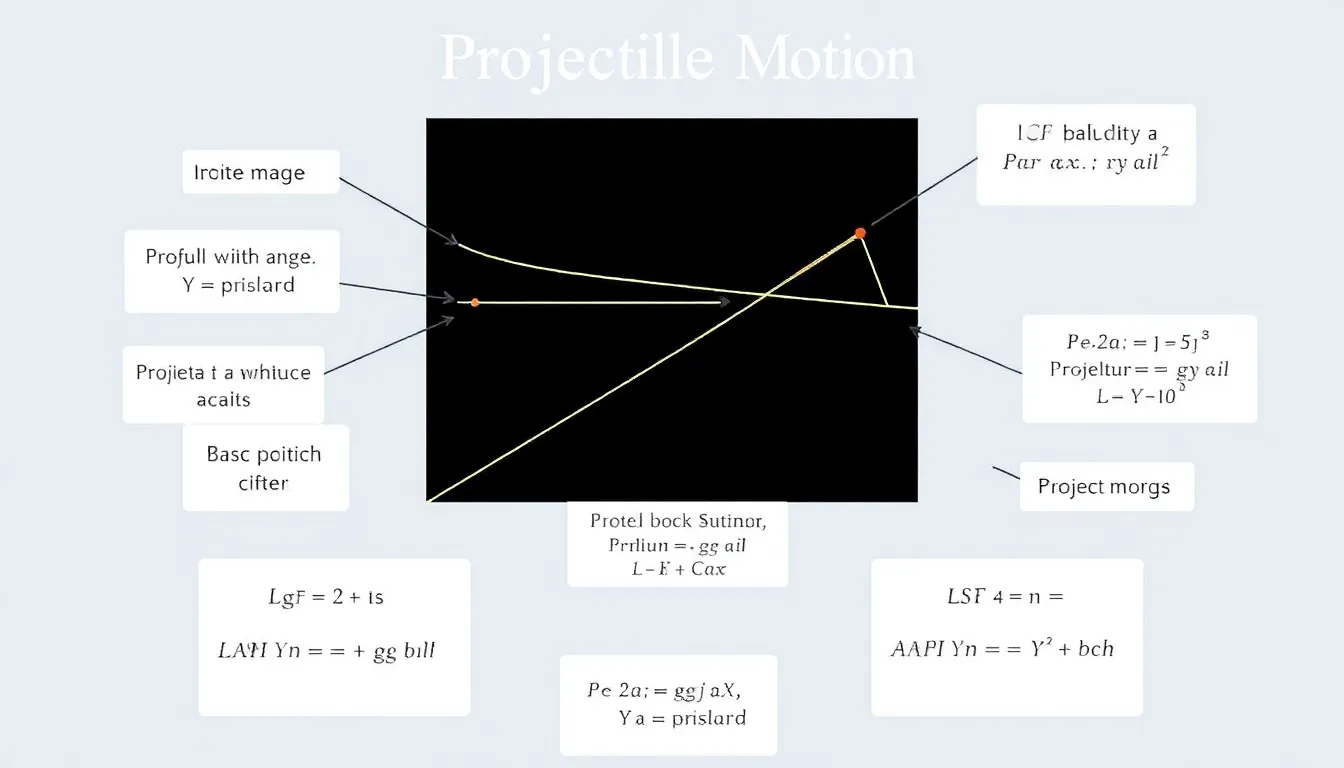
Mechanics is the backbone of physics and a crucial part of the IIT JEE syllabus. By solving numerical problems, you not only strengthen your concepts but also build problem-solving speed and accuracy. In this guide, we explore key areas — kinematics and dynamics — with illustrative problems.
On This Page
- Read More
- Kinematics: Motion Fundamentals
- Problem 1: Projectile Motion Fundamentals
- Problem 2: The Falling Projectile
- Dynamics: Applying Newton’s Laws
- Problem 3: Block on an Inclined Plane
- Problem 4: Connected Masses (Pulley System)
- Key Takeaways
- Summary Table
- Similar Problems — Quick Applications in Mechanics
- We also Published
- RESOURCES
Read More
Kinematics: Motion Fundamentals
Kinematics deals with describing motion in terms of displacement, velocity, acceleration, and time. Let’s look at classic problems that every IIT JEE aspirant must master.
Problem 1: Projectile Motion Fundamentals
A projectile is launched with initial velocity ##v_0## at angle ##\theta## to the horizontal. Breaking the velocity into components:
- Horizontal: ##v_{0x} = v_0 \cos\theta##
- Vertical: ##v_{0y} = v_0 \sin\theta##
Key results:
- Time of Flight: ### T = \frac{2 v_0 \sin\theta}{g} ###
- Range: ### R = \frac{v_0^2 \sin 2\theta}{g} ###
- Maximum Height: ### H = \frac{v_0^2 \sin^2\theta}{2g} ###
These formulas are cornerstones for projectile-based questions in JEE.
Problem 2: The Falling Projectile
A projectile is launched horizontally with velocity ##v_x## from height ##h##.
- Time to hit ground: ### t = \sqrt{\tfrac{2h}{g}} ###
- Horizontal range: ### R = v_x \, t ###
The independence of horizontal and vertical motion is the key principle here.
Dynamics: Applying Newton’s Laws
Dynamics explains why objects move, by relating forces and accelerations. Two classical problems illustrate this.
Problem 3: Block on an Inclined Plane
For a block of mass ##m## on an incline angle ##\theta##:
- Parallel force: ##mg \sin\theta##
- Perpendicular force: ##mg \cos\theta##
If no friction: ### a = g \sin\theta. ###
If friction coefficient = ##\mu##: ### a = g \sin\theta - \mu g \cos\theta. ###
Problem 4: Connected Masses (Pulley System)
Two masses ##m_1## and ##m_2## connected over a pulley:
- Acceleration: ### a = \frac{(m_2 - m_1)g}{m_1 + m_2} ###
- Tension: ### T = m_1(g + a) = m_2(g - a) ###
This classic Atwood machine problem tests Newton’s second law in systems.
Key Takeaways
- Projectile motion combines horizontal uniform motion with vertical accelerated motion.
- Kinematics requires mastering equations of motion, while dynamics applies Newton’s laws to forces.
- Inclined planes and pulley problems are standard JEE favorites for testing concepts of force resolution and system analysis.
- Consistent practice on diverse problems builds both intuition and accuracy.
Summary Table
| Concept | Formula | Application |
|---|---|---|
| Projectile (Time of Flight) | ### T = \frac{2 v_0 \sin\theta}{g} ### | Finding total flight duration |
| Projectile (Range) | ### R = \frac{v_0^2 \sin 2\theta}{g} ### | Finding horizontal distance |
| Projectile (Max Height) | ### H = \frac{v_0^2 \sin^2\theta}{2g} ### | Peak vertical displacement |
| Horizontal Launch | ### t = \sqrt{\tfrac{2h}{g}}, \; R = v_x t ### | Impact time and range |
| Inclined Plane | ### a = g \sin\theta - \mu g \cos\theta ### | Acceleration with/without friction |
| Pulley (Connected Masses) | ### a = \frac{(m_2 - m_1)g}{m_1+m_2} ### | Acceleration & tension in Atwood machine |
Similar Problems — Quick Applications in Mechanics
Here are a few solved examples that apply kinematics and dynamics concepts. These reinforce key formulas and prepare you for IIT JEE–style questions.
Problem 1: Vertical Throw
A ball is thrown vertically upwards with initial velocity ##u = 15## m/s. Maximum height is given by:
### H = \frac{u^2}{2g} = \frac{15^2}{2 \times 9.8} = 11.48 \,\text{m}. ###
Answer: 11.48 m
Problem 2: Accelerated Car
A car starts from rest (##u=0##) with acceleration ##a=2## m/s² for ##t=10## s. Distance traveled:
### s = ut + \tfrac{1}{2} a t^2 = 0 + \tfrac{1}{2} \times 2 \times 10^2 = 100 \,\text{m}. ###
Answer: 100 m
Problem 3: Friction on a Block
Block of mass ##m=5## kg, applied force ##F=20## N, coefficient of friction ##\mu=0.2##. Frictional force:
### f = \mu m g = 0.2 \times 5 \times 9.8 = 9.8 \,\text{N}. ###
Net force: ##F_{\text{net}} = 20 - 9.8 = 10.2## N. Acceleration:
### a = \frac{F_{\text{net}}}{m} = \frac{10.2}{5} = 2.04 \,\text{m/s}^2. ###
Answer: 2.04 m/s²
Problem 4: Pulley with Two Masses
Masses ##m_1=2## kg, ##m_2=3## kg. Acceleration of system:
### a = \frac{(m_2 - m_1) g}{m_1 + m_2} = \frac{(3-2)\times 9.8}{5} = 1.96 \,\text{m/s}^2. ###
Answer: 1.96 m/s²
Problem 5: Projectile Range
Projectile with ##v_0 = 30## m/s at angle ##\theta = 30^\circ##. Range:
### R = \frac{v_0^2 \sin 2\theta}{g} = \frac{30^2 \sin 60^\circ}{9.8}. ###
### R = \frac{900 \times 0.866}{9.8} \approx 79.5 \,\text{m}. ###
Answer: 79.5 m
Summary Table
| Problem | Scenario | Formula Used | Answer |
|---|---|---|---|
| 1 | Vertical throw (u=15 m/s) | ### H = u^2 / 2g ### | 11.48 m |
| 2 | Car accelerating from rest (a=2, t=10) | ### s = ut + \tfrac{1}{2} a t^2 ### | 100 m |
| 3 | Block with friction (m=5 kg, F=20 N, μ=0.2) | ### a = (F - \mu m g)/m ### | 2.04 m/s² |
| 4 | Pulley (m1=2 kg, m2=3 kg) | ### a = (m_2 - m_1)g/(m_1+m_2) ### | 1.96 m/s² |
| 5 | Projectile (v=30 m/s, θ=30°) | ### R = v^2 \sin 2\theta / g ### | 79.5 m |
We also Published
RESOURCES
- What is the best approach for mastering mechanics on the IIT-JEE ...
- How similar are the USA f=ma exam and IIT JEE : r/PhysicsStudents
- How should I strengthen my mechanics for IIT-JEE? - Quora
- Fluid Mechanics - Playlist | Class 11 | Unacademy JEE | LIVE DAILY ...
- Which is the best book for understanding mechanics for JEE ...
- Solved Examples on Mechanics -Study Material for IIT JEE | askIITians
- How to strengthen mechanics for JEE - Aman's Blog
- Mechanics - IIT JEE
- My mechanics part is weak, how should I improve it? - IIT JEE Main ...
- IIT JEE Super Course in Physics - Mechanics I | PDF



0 Comments