
On This Page
Introduction to the Distance to the Nearest Integer Function
The distance to the nearest integer function is a mapping that assigns every real number to its closest integer distance. This function is essential for researchers studying how real numbers behave relative to the discrete set of integers.
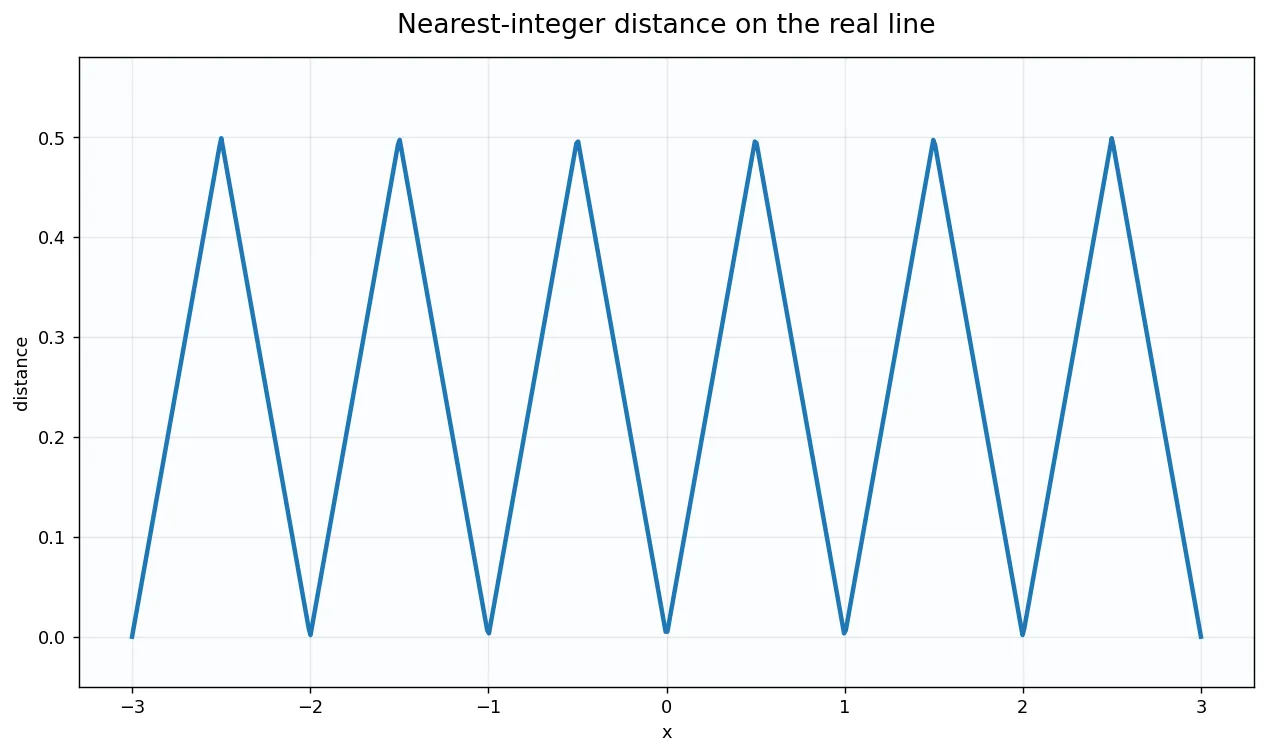
Mathematically, the function is represented by the double vertical bar notation, though notation can vary between different mathematical texts. It essentially measures the "error" when approximating a real number with its closest integer value.
The output of this function is always a non-negative value, reflecting the standard definition of distance in a metric space. It provides a bounded measurement that simplifies complex calculations in various analytical fields.
In computational mathematics, this function helps in rounding algorithms and signal processing tasks where periodic behavior is expected. It serves as a bridge between continuous real numbers and discrete integer structures.
Understanding this function requires a grasp of both the floor function and the fractional part function. These components combine to create the unique triangular wave characteristic of the distance function.
Mathematical Definition and Notation
The formal definition of the distance to the nearest integer is given by the expression
. Here, ##\{x\}## represents the fractional part of the number ##x##.
Alternatively, the function can be expressed using the nearest integer function, often denoted as ##[x]## or ##nint(x)##. In this context, the distance is simply the absolute difference ##\|x - nint(x)\|##.
The fractional part ##\{x\}## is defined as ##x - \lfloor x \rfloor##, where ##\lfloor x \rfloor## is the floor of ##x##. This relationship ensures the function remains within a specific range.
For any real number ##x##, the value of ##\|\|x\|\|## will always fall within the closed interval ##[0, 0.5]##. This is because no number is ever further than 0.5 from an integer.
The function is piecewise linear, which means its graph consists of straight line segments. This property makes it particularly useful for integration and differentiation within specific localized intervals.
Geometric Interpretation on the Real Line
If we visualize the real number line, the integers act as fixed points or "anchors." The distance function measures how far any point ##x## sits from these anchors.
The graph of ##f(x) = \|\|x\|\|## resembles a series of connected triangles, often called a sawtooth or triangular wave. The peaks occur exactly at the half-integers.
At every integer point, the value of the function drops to zero, representing a perfect match. These points are the local minima of the function across its domain.
Conversely, at points like ##0.5, 1.5,## or ##-2.5##, the function reaches its maximum value of ##0.5##. These points represent the maximum possible uncertainty in integer approximation.
The symmetry of the graph reflects the uniform distribution of integers along the real line. This periodic nature allows mathematicians to analyze the function using Fourier series expansions.
Analytic Properties and Periodic Nature
The distance to the nearest integer function is periodic with a period of 1. This means that for any integer ##k##, the equality ##\|\|x + k\|\| = \|\|x\|\|## holds true.
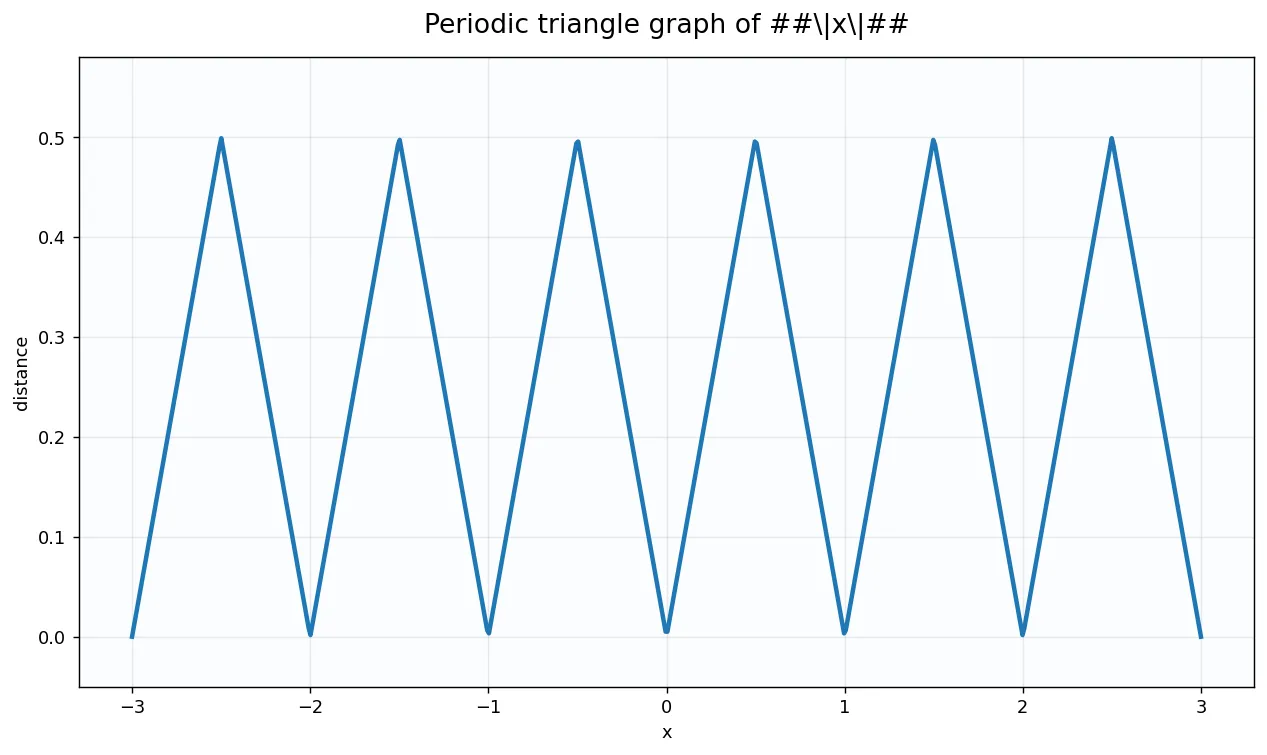
This periodicity allows researchers to focus their analysis on the unit interval ##[0, 1]##. Whatever behavior is observed here repeats infinitely across the entire real number line.
Analytically, the function is continuous everywhere but not differentiable at integers and half-integers. These points form the "corners" of the triangular wave where the slope changes abruptly.
The slope of the function is either ##1## or ##-1## almost everywhere. Specifically, the slope is ##1## when ##\{x\} < 0.5## and ##-1## when ##\{x\} > 0.5##.
These properties make the function a common example in real analysis and topology. It illustrates how a simple definition can lead to complex behavior in more advanced settings.
Range, Domain, and Symmetry
The domain of the distance to the nearest integer function is the set of all real numbers. It accepts any input, whether rational, irrational, or transcendental.
The range is strictly limited to the interval ##[0, 0.5]##, as previously mentioned. This boundedness is a critical feature for establishing convergence in various infinite series.
The function exhibits even symmetry, meaning ##\|\|x\|\| = \|\|-x\|\|##. This symmetry simplifies many proofs in number theory, particularly those involving negative rational approximations.
Furthermore, the function is symmetric about any integer point on the horizontal axis. This reflectional symmetry is a direct consequence of the uniform spacing of the integers.
In the context of modular arithmetic, this function can be viewed as the distance to zero in the quotient group ##\mathbb{R}/\mathbb{Z}##. This perspective is vital in higher algebra.
Relationship with the Fractional Part Function
The fractional part function ##\{x\}## and the distance function are intrinsically linked but serve different purposes. While ##\{x\}## is always in ##[0, 1)##, ##\|\|x\|\|## is restricted.
We can think of ##\|\|x\|\|## as a "folded" version of the fractional part function. When the fractional part exceeds ##0.5##, the distance function "folds" it back towards zero.
This relationship is often expressed as ##\|\|x\|\| = \frac{1}{2} - \| \{x\} - \frac{1}{2} \|##. This identity highlights the centered nature of the distance measurement.
In many Diophantine problems, the fractional part provides the raw deviation, while the distance function provides the effective deviation. Both are used to bound errors.
Calculations involving ##\|\|x\|\|## often require splitting the domain into cases based on the value of ##\{x\}##. This case-by-case analysis is standard in competitive mathematics and proofs.
We Also Published
Applications in Diophantine Approximation
Diophantine approximation is the study of approximating real numbers by rational numbers. The distance function ##\|\|qx\|\|## is the central object of study in this field.
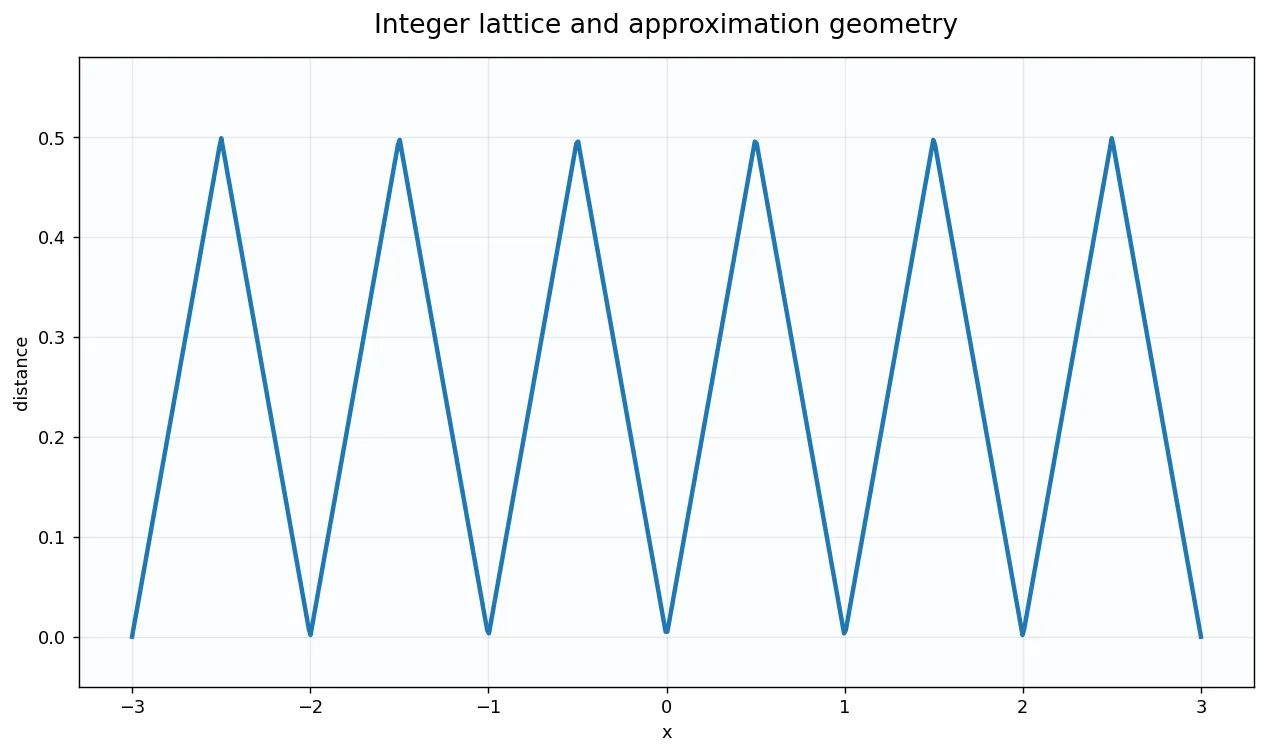
For a real number ##x## and an integer ##q##, ##\|\|qx\|\|## measures how close the multiple ##qx## is to an integer. Small values indicate a good rational approximation.
Mathematicians look for integers ##q## such that ##\|\|qx\|\|## is very small relative to the size of ##q##. This leads to the discovery of fundamental constants and properties.
The efficiency of these approximations determines whether a number is "well-approximable" or "badly approximable." This classification is a major theme in modern transcendental number theory.
Without the distance to the nearest integer function, describing the quality of these approximations would be significantly more cumbersome. It provides a clean, standardized metric.
Dirichlet's Approximation Theorem
Dirichlet's Approximation Theorem states that for any real ##x## and integer ##N##, there exists an integer ##q## such that ##1 \leq q \leq N## and ##\|\|qx\|\| < 1/N##.
This theorem uses the distance function to guarantee the existence of high-quality rational approximations. It is a cornerstone of the geometry of numbers and analysis.
The proof of this theorem often relies on the Pigeonhole Principle applied to the fractional parts of multiples of ##x##. The distance function captures the result.
By ensuring that ##\|\|qx\|\|## stays small, the theorem allows us to find a fraction ##p/q## such that ##\|x - p/q\| < 1/q^2##. This is a powerful result.
The distance function thus serves as the primary indicator of success in the search for rational bounds. It quantifies the "closeness" required by Dirichlet's fundamental assertion.
Rational Approximations and Continued Fractions
Continued fractions provide the "best" rational approximations to a real number. These approximations are those that minimize the value of ##\|\|qx\|\|## for a given denominator size.
Each convergent of a continued fraction yields a value of ##\|\|qx\|\|## that is smaller than any previous denominator could achieve. This optimization is central to the theory.
The sequence of values ##\|\|q_n x\|\|##, where ##q_n## are the denominators of the convergents, decreases rapidly. This rapid decay characterizes the irrationality of the number ##x##.
For quadratic irrationals, these values follow a periodic pattern related to the periodic continued fraction expansion. The distance function reveals this hidden algebraic structure.
In contrast, for numbers like ##e## or ##\pi##, the values of ##\|\|qx\|\|## behave in a more complex, though still structured, manner. The function remains the primary tool.
Advanced Theoretical Implications
Beyond simple approximations, the distance to the nearest integer function appears in the study of dynamical systems. It helps describe the distribution of sequences modulo one.
Weyl's Criterion for equidistribution involves sums of exponential functions that can be related back to the distance function. It determines if a sequence covers the interval uniformly.
The function is also used in the study of discrepancy, which measures how far a finite set of points deviates from a perfectly uniform distribution.
In the theory of mathematical billiards, the distance function helps calculate the paths of particles reflecting off boundaries. It models the periodic nature of the reflections.
Advanced research in analytic number theory often employs the distance function in the context of exponential sums and L-functions. Its simplicity belies its deep utility.
The Three-Gap Theorem and Beatty Sequences
The Three-Gap Theorem, also known as the Steinhaus Conjecture, concerns the distances between consecutive elements of the sequence ##\{nx\}##. The distance function is vital here.
It states that for any real ##x## and integer ##N##, the points ##\{x\}, \{2x\}, \dots, \{Nx\}## partition the unit interval into gaps of at most three lengths.
Beatty sequences, defined as ##\lfloor n \alpha \rfloor##, also interact with the distance function. The properties of these sequences depend on the approximation quality of ##\alpha##.
The distance to the nearest integer helps define the "dual" sequences and determine if two Beatty sequences partition the set of natural numbers. This is Rayleigh's Theorem.
These applications show how a simple measure of distance can govern the structure of infinite sequences. The function acts as a regulator for discrete distribution.
Role in Number Theory and Modern Research
In modern research, the distance function is used to study the Littlewood Conjecture. This conjecture involves the product of distances ##q \cdot \|\|qx\|\| \cdot \|\|qy\|\|## for two real numbers.
Researchers investigate whether this product can be arbitrarily small for any pair of real numbers. The behavior of the distance function is the crux of the problem.
Furthermore, the function plays a role in the study of quasi-crystals and non-periodic tilings. These structures often rely on projections that involve integer distance calculations.
In signal processing, the distance to the nearest integer is used in quantization error analysis. It helps engineers minimize noise when converting continuous signals to digital formats.
Ultimately, the function ##\|\|x\|\|## remains a vital bridge between the continuous and the discrete. Its simple definition continues to support the weight of complex mathematical discovery.
From our network :
- Analyzing Trump Deportation Numbers Insights Into The 2026 Immigration Crackdown
- 98% of Global MBA Programs Now Prefer GRE Over GMAT Focus EditionExplore why 98% of global MBA programs now prefer the GRE over GMAT Focus. Learn about the shorter GRE format, verbal logic importance, and strategic versatility for students.
- Trump Political Strategy How Geopolitical Stunts Serve As Media Diversions
- Mastering DB2 12.1 Instance Design: A Technical Deep Dive into Modern Database ArchitectureComprehensive guide to DB2 12.1 Instance Design. Explore architectural components, HADR setup, buffer pool tuning, and security policies for IBM DB2 12.1. Includes 10 functional SQL and Shell samples.
- AI-Powered 'Precision Diagnostic' Replaces Standard GRE Score ReportsDiscover the new GRE Precision Diagnostic. Learn how AI-powered behavioral analytics and time-to-solve tracking are replacing standard GRE score reports to empower students.
- EV 2.0: The Solid-State Battery Breakthrough and Global Factory ExpansionDiscover the impact of the Solid-State Battery Breakthrough on the EV market. Learn about CATL and BYD stock growth, global factory expansion in Europe, and the future of EV 2.0 technology.
- Mastering DB2 LUW v12 Tables: A Comprehensive Technical GuideComprehensive guide on DB2 LUW v12 tables. Explore CREATE TABLE syntax, BLU Acceleration, range partitioning, data types, and security features for IBM DB2 LUW v12.
- 10 Physics Numerical Problems with Solutions for IIT JEEPrepare for IIT JEE with 10 physics numerical problems, complete with detailed solutions and conceptual explanations. Ideal for mastering kinematics, thermodynamics, electromagnetism, and optics.
- Vite 6/7 'Cold Start' Regression in Massive Module GraphsIn-depth analysis of Vite 6/7 cold start regressions in massive module graphs. Learn about barrel file issues, pre-bundling optimizations, and how to improve Vite dev server performance.
RESOURCES
- Note on the Distance to the Nearest Integer - ResearchGate
- Definition:Distance to Nearest Integer Function - ProofWiki
- sums involving the nearest-integer function - MathOverflow
- What is the "distance from the nearest integer"? (is that a kind of ...
- Nearest Integer Function -- from Wolfram MathWorld
- Is there a standard name for "signed distance to the nearest integer ...
- Near integer decibel values - Applied Mathematics Consulting
- Define $f(x)$ to be the distance from x to the nearest integer. What ...
- How can I get the next closest integer out of 2 integers?
- Is 163 the "best" integer for Ramanujan's constant? : r/math - Reddit
- Harder than it looks: rounding float to nearest integer, part 1 - Frama-C
- [2401.10152] Sums of square roots that are close to an integer - arXiv
- Nearest Integer - an overview | ScienceDirect Topics
- Rounding up to the nearest integer that's congruent to k mod N
- Supported Functions - Desmos Help Center



0 Comments