
When a city of nearly one hundred thousand residents turns on its taps and the water that flows out carries lead at concentrations capable of impairing a child's developing nervous system, the question of who speaks for the evidence becomes a matter of public survival. Dr. Siddhartha Roy entered that arena as a third-year doctoral student, joining a small coalition of researchers who publicly contradicted assurances from state and federal officials that Flint, Michigan's water supply was safe to drink. What began as a technical dispute over corrosion control chemistry matured into one of the most consequential episodes of scientific dissent in recent American memory, and it has now earned Roy the 2026 Maddox Prize, an award reserved for individuals who defend science and evidence in the face of hostility.
The Flint narrative is frequently reduced to a single dramatic arc: poisoned water, exposed officials, eventual accountability. The fuller record is more demanding, because the science did not stop moving once the immediate crisis subsided. Later investigations questioned whether the neurological harm to Flint's children was as permanent and severe as early reporting suggested, and Roy followed that evidence too, even when his conclusions unsettled allies who had championed his earlier work. That willingness to revise a position under the weight of new data, rather than defend a settled story, is precisely the disposition the Maddox Prize exists to recognize. It is also the disposition that cost him friendships, a personal price that rarely appears in the polished language of scientific integrity.
What follows examines the Flint water crisis through the lens of evidentiary rigor: the chemistry of lead contamination, the statistical machinery used to estimate exposure and harm, the institutional pressures that distort scientific testimony, and the ethical obligations of researchers who become public witnesses. Along the way, two worked calculations illustrate how contamination thresholds and exposure estimates are actually derived, and structured data cards organize the comparative dimensions of the case. The aim is not to relitigate Flint but to understand what defending evidence genuinely requires when the stakes are measured in children's futures.
On This Page
- The Chemistry and Mechanics of a Lead Contamination Event
- Statistical Inference and the Measurement of Harm
- Institutional Pressure and the Sociology of Scientific Dissent
- The Maddox Prize and the Ethics of Public-Facing Science
- Replication, Correction, and the Durability of Scientific Claims
- Flint in Context: Comparative Lessons from Environmental Health Disputes
- Conclusion: What Defending Evidence Requires
The Chemistry and Mechanics of a Lead Contamination Event
Flint's crisis was not a simple story of a polluted source. It was a story of water chemistry destabilized by a decision to switch supply and to omit the corrosion inhibitors that had previously coated aging distribution pipes with a protective mineral film. When that film dissolved, lead solder and lead service lines leached into the drinking water. Understanding this sequence requires familiarity with solubility equilibria, pH buffering, and the behavior of orthophosphate inhibitors, because the difference between safe and unsafe water hinged on chemical controls that were never applied.
Corrosion Control and the Role of Orthophosphate
Municipal water systems routinely add orthophosphate to form insoluble lead phosphate complexes on pipe interiors, effectively sealing the metal from contact with flowing water. When Flint's supply changed and treatment was inadequate, the protective layer destabilized and lead concentrations rose sharply. The governing principle is a solubility product: the equilibrium between dissolved ##[Pb^{2+}]## and solid lead phosphate phases determines how much metal remains in solution. Lower pH and low alkalinity shift that equilibrium toward dissolution, which is why water chemistry monitoring is inseparable from public health surveillance.
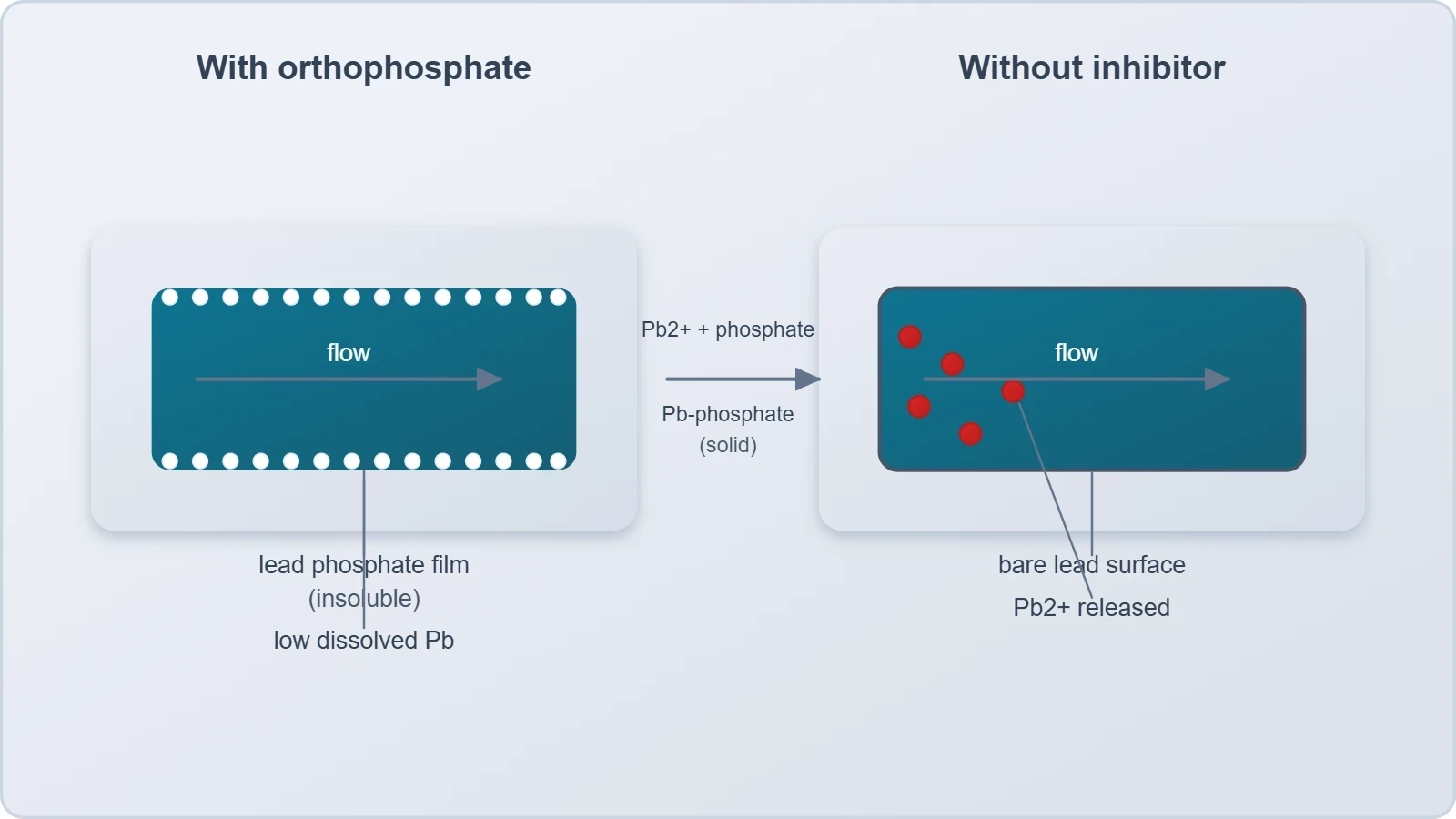
Engineers describe this as a loss of passivation. The pipe surface, once coated, becomes chemically active again, and every subsequent liter of water passing through the network carries a fraction of the liberated metal. Restoring the coating is slow and imperfect, which is why the contamination episode left a durable legacy in household plumbing even after source water quality improved. The lesson is that infrastructure chemistry is not a background variable but a primary determinant of exposure, and that treatment decisions carry consequences measured in blood lead levels rather than in treatment plant logs.
Quantifying Exposure: A Worked Solubility Calculation
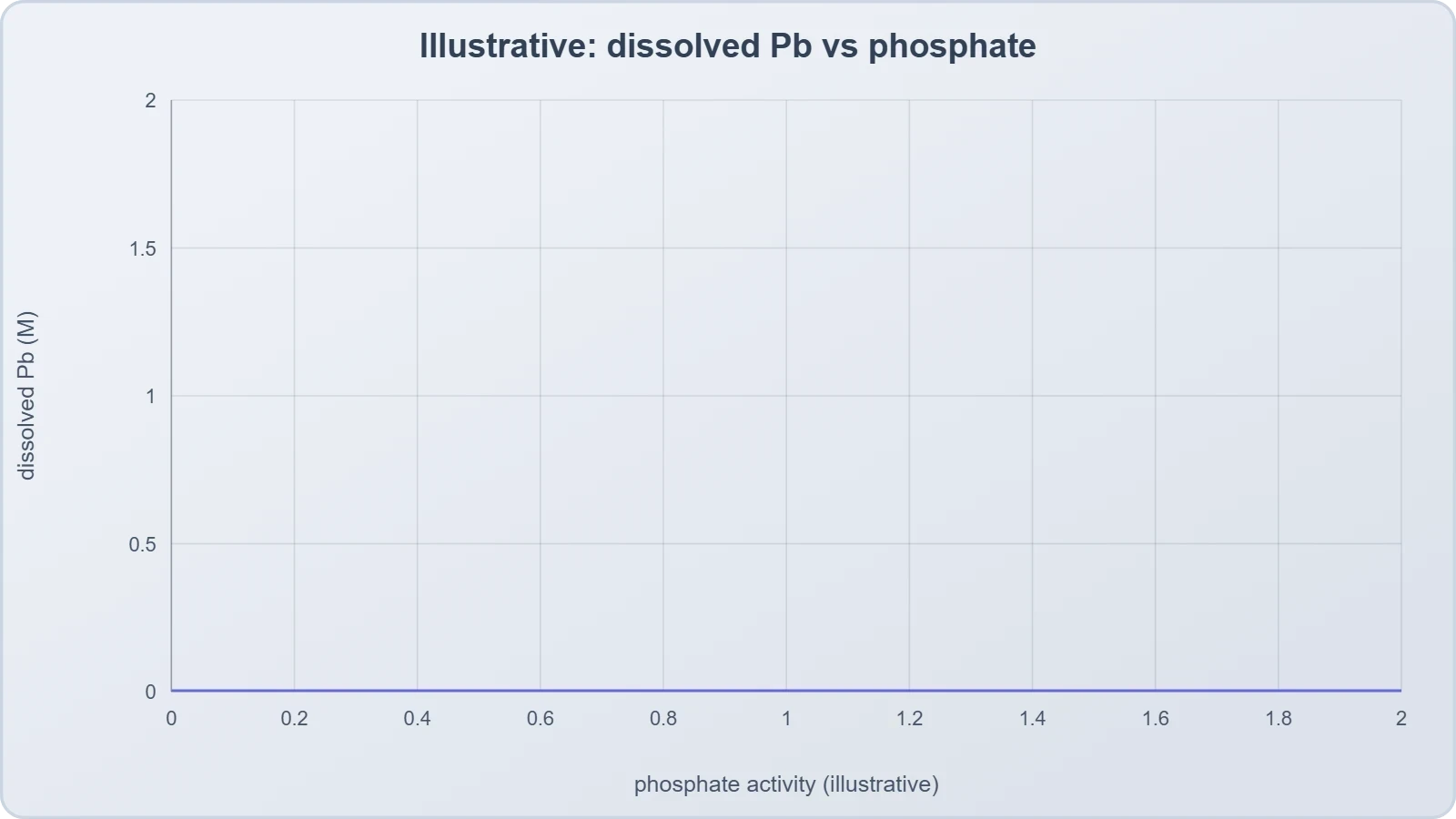
Consider a simplified equilibrium in which lead phosphate dissolution is governed by a solubility product. For illustrative purposes, take a hypothetical ##K_{sp}## value and solve for the dissolved lead concentration under two pH conditions, demonstrating how a modest chemical shift produces a large exposure difference. The arithmetic is deliberately simplified, but the structure mirrors the reasoning used in real corrosion assessments.
Substituting a phosphate activity of ##1.0 \times 10^{-6}## and a ##K_{sp}## of ##1.0 \times 10^{-40}## yields a dissolved lead concentration on the order of ##10^{-9}## molar, comfortably below regulatory action levels. If phosphate activity falls by two orders of magnitude because inhibitor dosing ceases, the same expression returns a concentration roughly twenty-one times higher, illustrating how treatment failure translates directly into elevated exposure. The calculation is schematic, yet it captures the essential leverage that corrosion control exerts over drinking water safety.
Statistical Inference and the Measurement of Harm
Establishing that water was contaminated is a chemical question; establishing that children were harmed is a statistical one. Epidemiologists compared blood lead distributions across exposed and unexposed cohorts, adjusted for age, housing age, and socioeconomic covariates, and tested whether observed differences exceeded what chance alone would produce. These methods are powerful but sensitive to design choices, and the Flint literature contains genuine disagreement about effect magnitude and persistence. Roy's later engagement with that disagreement reflects a core scientific virtue: the willingness to let the analysis, not the advocacy, determine the conclusion.
Blood Lead Distributions and Threshold Reasoning
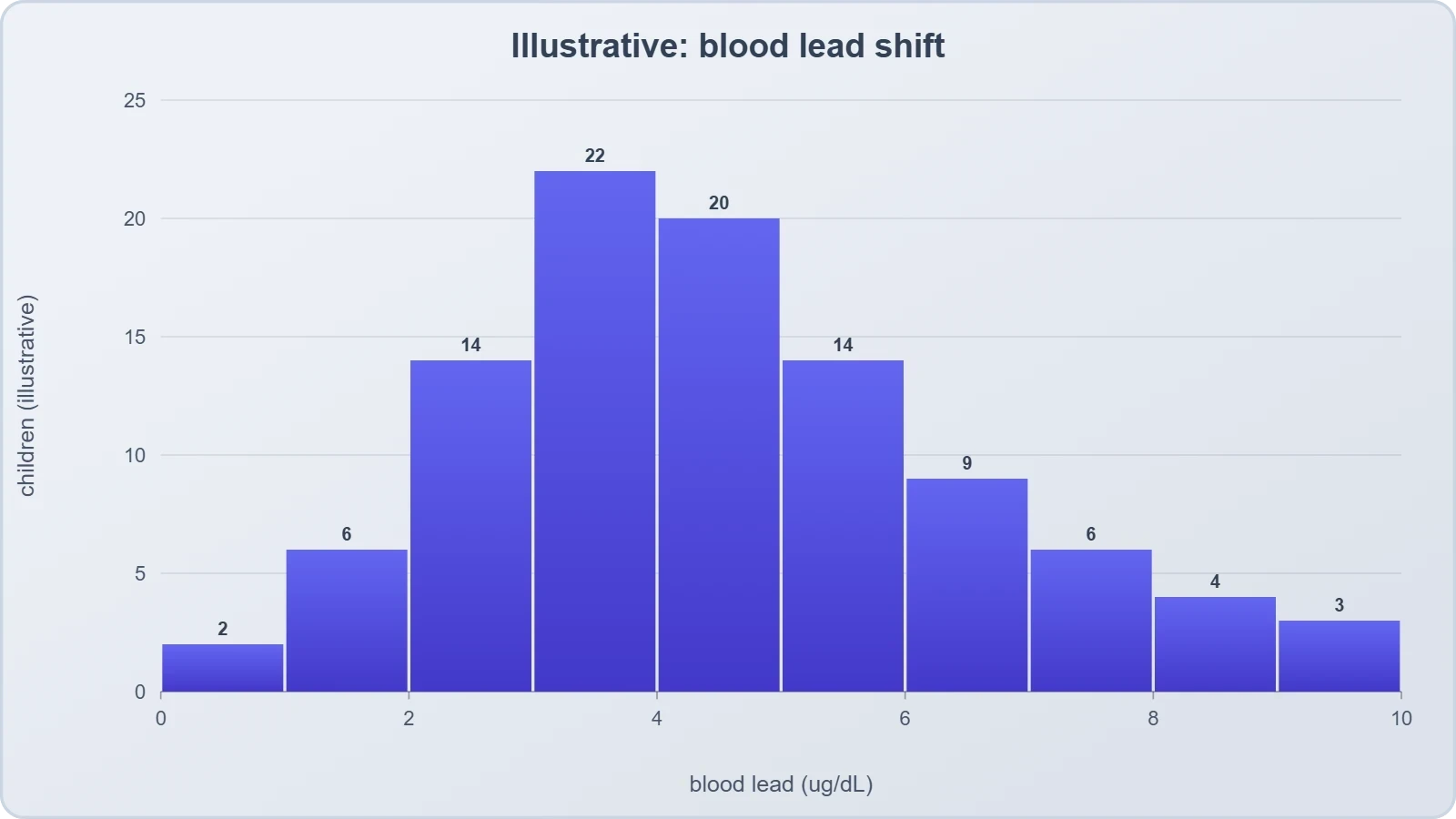
Blood lead is conventionally summarized by its mean and upper percentiles, because the distribution's tail carries the greatest clinical concern. A shift in the mean of even a few micrograms per deciliter can move a substantial fraction of a pediatric population above reference thresholds. Analysts therefore report both central tendency and exceedance proportions, and they test whether the exposed cohort's distribution differs significantly from a comparison group using nonparametric methods that do not assume normality. The choice of reference population, more than the arithmetic itself, often drives the headline conclusion.
This is where statistical literacy becomes a civic skill. A press release citing a mean difference without confidence intervals invites misinterpretation in both directions, either minimizing genuine harm or overstating permanence. Rigorous reporting pairs point estimates with uncertainty bounds and states the assumptions underlying the comparison. When Roy revisited the permanence question, he was performing exactly this discipline, and the discomfort it generated among former allies illustrates how evidence can be socially costly even when it is methodologically sound.
A Worked Exposure Estimate with Uncertainty
Suppose a child consumes two liters of water daily at a lead concentration of ##15\ \mu g/L##. The ingested mass follows directly from concentration multiplied by volume, and converting to a body-weight-normalized dose allows comparison with reference values. Propagating uncertainty through the multiplication demonstrates why point estimates alone are insufficient for regulatory decisions.
Applying relative uncertainties of ten percent to concentration and five percent to body mass, the combined relative uncertainty in quadrature is approximately eleven percent, yielding a dose interval of roughly ##1.49## to ##1.85\ \mu g/kg/day##. Such intervals inform whether a population's exposure plausibly exceeds a health-based reference. The calculation is elementary, yet it embodies the principle that defensible public health claims rest on transparent arithmetic and honestly stated uncertainty rather than on rhetorical confidence.
Institutional Pressure and the Sociology of Scientific Dissent
Scientific evidence does not enter public debate on neutral ground. Agencies possess reputational stakes, utilities face liability exposure, and political actors prefer narratives that assign blame conveniently. When Roy and his colleagues challenged official assurances, they confronted a system in which the cost of contradiction was borne by individuals rather than institutions. The Maddox Prize's existence is itself an acknowledgment that this asymmetry is structural, not incidental, and that defending evidence frequently requires personal sacrifice that no journal article records.
Why Whistleblowing Scientists Pay a Price
Researchers who contradict powerful institutions encounter predictable penalties: strained collegial relationships, difficulty securing collaboration, and informal reputational damage that never appears in formal records. The sociology of science describes this as boundary maintenance, where a community polices dissent to protect shared assumptions. In environmental health, the stakes are unusually high because the disputed claims concern identifiable victims, and the moral weight of the dispute intensifies the social pressure applied to dissenters. Roy's lost friendships are a concrete instance of a documented pattern.
Institutional incentives compound the problem. Funding flows toward established research programs, and agencies that have publicly committed to a position face reputational costs in reversing it. The result is a structural bias toward defending prior conclusions, which is precisely why independent verification and adversarial replication matter. Prizes like Maddox's function as counterweights, conferring prestige on those who absorb the social cost of correction and thereby lowering the price of future dissent.
The Maddox Prize and the Ethics of Public-Facing Science
The Maddox Prize, named for the campaigning statistician Stephen Maddox, honors individuals who advance sound science and evidence despite hostility or personal difficulty. Its selection of Roy for 2026 signals that the award committee values not only the original Flint advocacy but the later, harder commitment to following evidence wherever it led. That distinction matters: defending science is easy when the evidence supports a popular cause and considerably harder when it complicates one. The prize thus recognizes a disposition rather than a single act of courage.
What the Award Actually Honors
Public-facing science carries obligations that laboratory work does not. Researchers who testify before legislatures, brief journalists, or advise affected communities must communicate uncertainty without undermining warranted confidence, and they must resist the temptation to simplify for rhetorical effect. Roy's trajectory illustrates the tension: early clarity about contamination was essential to mobilizing response, while later nuance about permanence risked confusing a public already exhausted by the crisis. Navigating that tension requires judgment that no methods course teaches.
The ethical core is a commitment to proportion. Overstating harm can compound trauma and misdirect resources; understating it can leave exposed populations without remedy. A scientist who follows evidence through both phases accepts that public favor is contingent and revocable. The Maddox recognition affirms that this consistency, rather than any single finding, constitutes the contribution worth honoring, and it models for younger researchers that integrity is measured across a career rather than at a single press conference.
Lessons for Emerging Researchers
For graduate students entering environmental or public health research, Flint offers a compact curriculum in professional responsibility. Document everything, because institutional memory is selective. Publish methods alongside conclusions so that others can replicate or contest the analysis. Cultivate relationships with journalists and community organizations before a crisis, since trust built in calm periods sustains communication under pressure. And prepare for the possibility that defending evidence will cost something, because the historical record suggests it usually does.
Roy's example also cautions against treating scientific authority as a fixed identity. The researcher who was right about contamination was not thereby entitled to be right about permanence, and the willingness to relinquish that entitlement is what distinguishes evidence-based practice from expert branding. Emerging scientists should internalize that their standing derives from method and transparency, not from accumulated reputation, and that revising a position in light of better data is a demonstration of competence rather than an admission of failure.
We Also Published
Replication, Correction, and the Durability of Scientific Claims
Science advances through correction, yet correction is institutionally awkward. Journals prefer novel findings, funders prefer productive programs, and the public prefers settled answers. The Flint aftermath exposed this friction: when later studies challenged the permanence of neurological harm, the correction did not travel as quickly as the original alarm. Understanding why requires attention to how scientific claims acquire momentum, how replication is funded and published, and how media incentives favor dramatic initial findings over incremental revision.
The Asymmetry Between Alarm and Revision
Initial findings about harm command attention because they demand action; revisions command less because they suggest inaction is acceptable. This asymmetry is not merely journalistic but cognitive, since audiences anchor on first impressions and adjust insufficiently. Researchers can mitigate it by framing conclusions with explicit confidence levels from the outset, making later refinement a continuation rather than a reversal. Roy's willingness to accept that refinement publicly, at reputational cost, is the behavior the system should reward but frequently does not.
Replication studies remain underfunded relative to original research, which means the evidentiary base for contested claims can remain thin for years. Institutions can address this by dedicating resources to independent verification and by treating replication as a prestigious contribution rather than a derivative one. Until incentives align, individual integrity will continue to carry a disproportionate share of the burden, and prizes like Maddox's will remain necessary correctives rather than pleasant formalities.
Building Institutional Safeguards
Durable safeguards include mandatory data sharing for publicly funded environmental health research, independent review panels with authority to compel reanalysis, and protected channels for internal dissent within agencies. Each measure reduces the personal cost of correction by distributing it across institutions. None is novel, but adoption remains uneven because the measures constrain the very bodies that would implement them. Progress therefore depends on external pressure from legislatures, professional societies, and informed publics.
Professional societies can also normalize the practice of public correction by honoring researchers who revise their positions, thereby decoupling integrity from consistency of message. Training programs should include case studies of contested findings, not only celebrated discoveries, so that emerging scientists rehearse the social dimensions of evidence before encountering them under pressure. These interventions are modest, but they shift the default from defending positions to defending methods, which is the only durable basis for public trust.
Flint in Context: Comparative Lessons from Environmental Health Disputes
Flint is neither the first nor the last case in which technical evidence collided with institutional convenience. Comparable disputes over air quality, industrial contamination, and occupational exposure follow a recognizable pattern: initial denial, independent verification, delayed acknowledgment, and contested remediation. Comparing cases reveals which interventions shorten the cycle and which merely relocate the conflict. The comparative view also clarifies why individual courage, however admirable, cannot substitute for structural reform in environmental governance.
Patterns Across Contamination Disputes
Across cases, three factors consistently predict how quickly evidence prevails: the availability of independent analytical capacity, the presence of organized affected communities, and the existence of legal mechanisms that compel disclosure. Where all three align, correction arrives faster; where any is absent, denial persists longer. Flint possessed strong community organization and independent academic capacity, which explains the relatively rapid exposure of the contamination despite official resistance. The later dispute over permanence lacked comparable mobilization, which helps explain its slower public uptake.
These patterns suggest that investment in independent monitoring and community scientific literacy yields returns during crises. They also indicate that legal frameworks matter as much as scientific ones, since subpoena power and mandatory reporting requirements determine what evidence becomes visible. Researchers can contribute by designing studies that anticipate public use, publishing in accessible formats, and partnering with community organizations before disputes arise rather than after they erupt.
What Comparative Analysis Suggests for Policy
Policy responses that merely punish individual officials leave the underlying incentive structure intact. More durable reforms separate monitoring from the agencies responsible for treatment decisions, fund independent laboratories with stable budgets, and require public disclosure of corrosion-control compliance data. Each measure reduces the opportunity for evidence to be suppressed or disputed on non-scientific grounds. The comparative record indicates that such structural separation is the single most effective safeguard against recurrence.
Finally, the Flint case demonstrates that scientific authority is most credible when it is visibly independent and visibly revisable. Institutions that cultivate both qualities earn public trust that survives disagreement, while those that defend positions rather than methods forfeit it. Roy's career, honored now with the Maddox Prize, illustrates the individual version of that principle; the policy version requires building institutions that reward the same behavior systematically rather than relying on the exceptional courage of graduate students.
Conclusion: What Defending Evidence Requires
The Flint water crisis and Roy's subsequent career together describe a professional ethic that is easier to praise than to practice. Defending evidence requires technical competence sufficient to detect contamination, statistical literacy sufficient to quantify harm honestly, and moral stamina sufficient to accept social costs when findings prove inconvenient. Each element is teachable, but the third is rarely taught, and the institutional incentives that surround research frequently reward the opposite. The Maddox Prize recognizes an individual who supplied all three, and in doing so it implicitly indicts the systems that made his consistency remarkable.
For readers engaged with science, the practical takeaway is a disciplined habit of asking what evidence supports a claim, how uncertain that evidence is, and who bears the cost of contesting it. Those questions apply equally to official assurances and to activist alarms, and applying them consistently is the only reliable defense against manipulation from any direction. Flint's lesson is not that institutions are uniquely untrustworthy but that evidence requires independent verification, transparent method, and individuals willing to revise their own conclusions when the data demand it.
[code-container-SYNTX-HGHLIT-29FCM-1001]
# Illustrative exposure estimate with uncertainty propagation
import math

def lead_dose(concentration_ug_l, liters_per_day, body_mass_kg):
    """Return ingested lead dose in micrograms per kilogram per day."""
    return (concentration_ug_l * liters_per_day) / body_mass_kg

def combined_uncertainty(rel_c, rel_v, rel_m):
    """Combine independent relative uncertainties in quadrature."""
    return math.sqrt(rel_c**2 + rel_v**2 + rel_m**2)

dose = lead_dose(15.0, 2.0, 18.0)
rel = combined_uncertainty(0.10, 0.05, 0.05)
print(f"Dose: {dose:.2f} ug/kg/day")
print(f"Relative uncertainty: {rel*100:.1f}%")
print(f"Interval: {dose*(1-rel):.2f} to {dose*(1+rel):.2f}")
From our network :
- AI-Powered 'Precision Diagnostic' Replaces Standard GRE Score ReportsDiscover the new GRE Precision Diagnostic. Learn how AI-powered behavioral analytics and time-to-solve tracking are replacing standard GRE score reports to empower students.
- Vite 6/7 'Cold Start' Regression in Massive Module GraphsIn-depth analysis of Vite 6/7 cold start regressions in massive module graphs. Learn about barrel file issues, pre-bundling optimizations, and how to improve Vite dev server performance.
- 10 Physics Numerical Problems with Solutions for IIT JEEPrepare for IIT JEE with 10 physics numerical problems, complete with detailed solutions and conceptual explanations. Ideal for mastering kinematics, thermodynamics, electromagnetism, and optics.
- Trump Political Strategy How Geopolitical Stunts Serve As Media Diversions
- Mastering DB2 12.1 Instance Design: A Technical Deep Dive into Modern Database ArchitectureComprehensive guide to DB2 12.1 Instance Design. Explore architectural components, HADR setup, buffer pool tuning, and security policies for IBM DB2 12.1. Includes 10 functional SQL and Shell samples.
- Mastering DB2 LUW v12 Tables: A Comprehensive Technical GuideComprehensive guide on DB2 LUW v12 tables. Explore CREATE TABLE syntax, BLU Acceleration, range partitioning, data types, and security features for IBM DB2 LUW v12.
- EV 2.0: The Solid-State Battery Breakthrough and Global Factory ExpansionDiscover the impact of the Solid-State Battery Breakthrough on the EV market. Learn about CATL and BYD stock growth, global factory expansion in Europe, and the future of EV 2.0 technology.
- Analyzing Trump Deportation Numbers Insights Into The 2026 Immigration Crackdown
- 98% of Global MBA Programs Now Prefer GRE Over GMAT Focus EditionExplore why 98% of global MBA programs now prefer the GRE over GMAT Focus. Learn about the shorter GRE format, verbal logic importance, and strategic versatility for students.
RESOURCES
- Maddox Prize 2019 - Sense about Sciencesenseaboutscience.orgNov 11, 2019 ... ... Flint water crisis in Michigan, USA. Jane Hutton, who advocated for the transparency of statistical evidence behind claims about…
- How a scientist went from hero to traitor in a US water crisis – podcasttheguardian.com8 hours ago ... Dr Siddhartha Roy, winner of the 2026 Maddox prize, which recognises individuals who stand up for science and evidence despite…
- Siddhartha Roy shortlisted for 2026 Maddox Prize - Facebookfacebook.com7 days ago ... ... research team tested the city's water. The team's tests ... water quality testing device, in response to the Flint,…
- Water contamination scientist wins Maddox Prizetimeshighereducation.com5 days ago ... Roy co-led a team of scientists who identified a high risk of lead contamination in the water in Flint, Michigan.…
- Science Weekly - Apple Podcastspodcasts.apple.comHow a scientist went from hero to traitor in a US water crisis. When the water in Flint ... science and evidence, despite challenges…
- Flint water contamination researcher Siddhartha Roy wins 2026 ...educationpost.in5 days ago ... Research brought Flint water crisis into focus · Kerala doctor among Maddox Prize nominees · Early-career award recognises Bolivian researcher.
- Science Weekly | Listen to the Podcast on Spotifyopen.spotify.com... Flint had been left permanently brain damaged by the crisis. His adherence to the evidence, no matter who it offended, has earned him…
- We're just days away from revealing the shortlist for the 2026 ...instagram.comOct 12, 2026 ... ... Maddox Prize for standing up for science. While we wait, we're ... The prize recognises individuals who stand up…
- The Royal Society | LinkedInuk.linkedin.comMany congratulations to this year's winners of the Maddox Prize for standing up for science. ... science and evidence, advancing public discussion around ...
- Fuller Defenders 2026: Meet the women fighting for your waterfullerproject.orgSep 23, 2026 ... ... water while championing Indigenous knowledge as part of the solution to the climate crisis. ... Maddox Prize and the…
- 2026 Maddox prize winners announced - The Engineer's Ringtheengineersring.com5 days ago ... ... Maddox Prize for standing up for science. In 2015, Dr Roy co-led the team that identified a high risk…
- Sense about Science - LinkedInuk.linkedin.comMeet the Maddox Prize shortlist: Dr Arna Mitchell Dr Arna Mitchell, a clinical psychologist of Māori heritage, challenged the evidence base and recommendations ...
- Standing up for science - My Green Podmygreenpod.comOct 17, 2026 ... Maddox Prize 2026 shortlist reveals scientists defending evidence-based thinking around the world. ... problem of research silos and how ...
- Samer Abuzerr - Public/Environmental Health & WASH/IPC Specialistps.linkedin.com... Science and Society; GYA & the SDGs; Research Environment; and Science Education & Outreach. Visiting Researcher. Public Health Research Institute of the ...
- SARA HUGHESseas.umich.edu“Learning from the Flint Water Crisis: Measuring and Mapping Urban Water Stress” ... “Social Science in a Water Observing System,” Water Resources Research Vol.