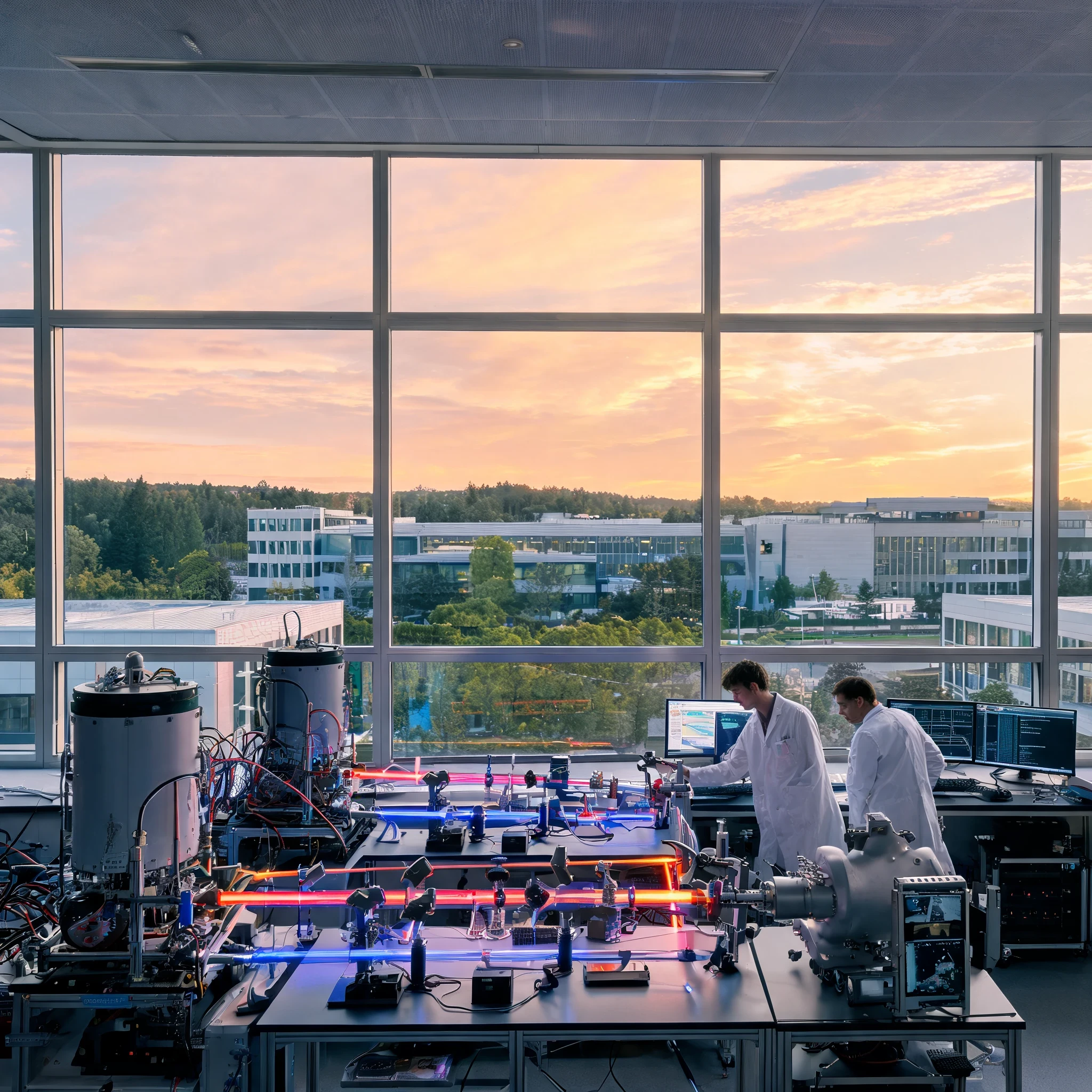
Navigating the intricate landscape of modern quantum mechanics requires an unwavering commitment to discovering advanced foundational components that exceed traditional boundaries. Researchers across elite academic institutions are currently investigating novel material compositions, such as complex chromium and nickel compounds, to resolve persistent hardware instability. These cutting-edge material breakthroughs serve as the indispensable bedrock for next-generation quantum technology architectures and highly secure national defense infrastructures.
Establishing robust hardware stability remains the single most critical challenge facing contemporary quantum computing engineers and defense contractors today. Traditional qubit configurations often suffer from extreme decoherence when exposed to minute thermal fluctuations or electromagnetic interference in operational environments. By engineering specialized compounds at the atomic scale, scientists can significantly suppress environmental noise and prolong quantum state coherence times effectively.
On This Page
Advanced Material Physics and Chromium-Nickel Compositions

Understanding the fundamental physical properties of transition metal compounds opens unprecedented pathways for engineering resilient quantum states. Investigators focus extensively on electron correlation phenomena within chromium and nickel matrices to manipulate magnetic moments with extreme precision. These atomic-scale manipulations dictate how effectively quantum information is stored, processed, and transmitted across complex computational networks.
Researchers employ sophisticated spectroscopic techniques to analyze the crystal field splitting energies inherent in these novel inorganic compounds. By evaluating the orbital degeneracy and spin-orbit coupling parameters, physicists can predict macroscopic quantum behaviors with remarkable accuracy. Such granular insights allow laboratories to synthesize custom substrates tailored explicitly for fault-tolerant quantum information processing systems.
Electronic Correlation in Transition Metals
The intricate behavior of correlated electrons within transition metal lattices forms the cornerstone of modern condensed matter physics research. When d-orbital electrons interact strongly, they generate collective phenomena that defy conventional band theory predictions and classical approximations.
This Hamiltonian models the onsite Coulomb repulsion ##[U]## and intersite interactions ##[V_{ij}]## governing electron localization. Managing these precise energy parameters prevents unwanted charge fluctuations that typically trigger catastrophic decoherence events in quantum registers.
Crystal Field Splitting and Magnetic Anisotropy
Symmetry breaking within crystal lattices induces distinct energy level splittings that directly govern the magnetic anisotropy of novel compounds. Experimental physicists measure these splitting parameters using high-frequency electron spin resonance and advanced magnetometry apparatus.
Optimizing ##[\Delta_{\text{CF}}]## ensures that the ground state spin configurations remain isolated from thermal excitation pathways. Consequently, quantum processors constructed from these engineered materials exhibit superior operational fidelity under ambient laboratory conditions.
Spectroscopic Verification and Atomistic Modeling
Validating theoretical predictions necessitates rigorous density functional theory calculations coupled with high-resolution synchrotron radiation experiments. Computational models simulate thousands of atomic permutations to identify optimal stoichiometric ratios for maximum phase stability.
Minimizing this total free energy equation guarantees that synthesized crystals maintain structural integrity during thermal cycling and high-stress deployment scenarios. Such rigorous validation protocols accelerate the transition from theoretical condensed matter physics to tangible engineering hardware.
Strategic Defense Hubs and National Infrastructure Integration
Translating laboratory breakthroughs into deployable sovereign capabilities requires coordinated institutional frameworks and dedicated innovation ecosystems. Academic centers like UCalgary have recently inaugurated specialized quantum defense hubs designed to bridge the gap between theoretical research and operational deployment. These collaborative entities unite defense analysts, cryptographers, and solid-state physicists under a unified strategic mission.
Securing national communications against emerging cryptographic threats demands quantum key distribution networks built upon certified hardware foundations. Strategic defense initiatives prioritize domestic material synthesis to eliminate supply chain vulnerabilities associated with foreign semiconductor manufacturing dependencies. Consequently, regional research clusters function as vital anchors for sovereign technological independence and economic resilience.
Institutional Collaboration and Academic Initiatives
Fostering talent pipelines through specialized student initiatives ensures a continuous influx of skilled researchers into the defense sector. Programs established at institutions like UChicago empower early-career scientists to tackle complex entanglement scaling problems directly. These academic incubators provide essential access to high-performance cryogenic testing facilities and specialized fabrication cleanrooms.
Cross-institutional partnerships further accelerate progress by pooling intellectual resources and sharing specialized characterization instrumentation. When academic rigor meets targeted government funding, the pace of materials discovery increases exponentially. Such synergies are vital for maintaining technological superiority in an increasingly contested geopolitical landscape.
Cryptographic Security and Post-Quantum Protocols
The imminent arrival of cryptographically relevant quantum computers threatens legacy encryption algorithms protecting sensitive government and commercial databases. Integrating novel quantum materials into communication hardware allows agencies to implement unbreakable post-quantum cryptographic protocols immediately. Photonic entanglement generated on stable substrates guarantees absolute interception detectability across all operational networks.
Network administrators deploy quantum key distribution systems to exchange encryption keys with mathematically proven security guarantees. Any unauthorized eavesdropping attempt alters the quantum state of transmitted photons, instantly alerting system operators to the breach. This paradigm shift permanently transforms defensive posture from reactive cybersecurity to proactive physical security.
Supply Chain Resilience and Domestic Manufacturing
Mitigating geopolitical risks requires establishing domestic foundries capable of producing high-purity quantum-grade substrates without external dependencies. National policy frameworks now incentivize domestic semiconductor innovation and specialized mineral extraction processes within allied territories. Securing access to refined chromium and nickel deposits remains a top priority for industrial planners.
Public-private consortia work tirelessly to scale manufacturing throughput while maintaining stringent atomic-level purity standards. By streamlining the path from feedstock purification to finished chip packaging, nations safeguard their technological edge against supply chain disruptions. Robust domestic manufacturing ultimately underpins both economic prosperity and long-term national security preparedness.
We Also Published
Scaling Hardware Stability and Future Technological Horizons
Overcoming physical scaling bottlenecks requires innovative architectural designs that integrate novel substrate materials seamlessly into existing semiconductor workflows. Engineers must ensure that quantum processors scale from dozens of noisy physical qubits to millions of fault-tolerant logical units. This transition demands rigorous error correction algorithms operating in real-time alongside hardware execution layers.
Future technological horizons will likely witness the convergence of quantum computing, advanced photonics, and neuromorphic architectures into unified processing nodes. Materials engineering will remain the primary catalyst enabling these monumental hardware transformations across global research laboratories. Sustained investment in foundational physics guarantees that next-generation computational systems will redefine the boundaries of human capability.
Error Correction Thresholds and Fault-Tolerant Architectures
Implementing surface codes for quantum error correction requires physical error rates to remain well below specific theoretical thresholds. Materials engineering directly impacts these physical error rates by reducing magnetic flux noise and dielectric loss tangents in substrates.
When material imperfections introduce noise exceeding ##[p_{\text{th}}]##, error correction codes fail to converge, rendering logical qubits unstable. Consequently, refining transition metal compounds is the paramount engineering prerequisite for achieving fault-tolerant quantum computation at scale.
Cryogenic Packaging and Thermal Management
Operating advanced quantum hardware requires sophisticated dilution refrigerators capable of maintaining milli-Kelvin temperatures under heavy coaxial cabling loads. Specialized thermal strap designs utilizing high-purity metal composites facilitate efficient heat extraction from multi-layer chip carriers.
Optimizing the thermal conductivity integral ##[Q]## prevents localized heating from degrading the delicate quantum states within chromium-nickel substrates. Effective cryopackaging ensures reliable long-term execution of complex quantum circuits in mission-critical defense environments.
Future Research Directions in Condensed Matter Physics
Ongoing investigations into topological insulators and Kagome lattice materials promise even greater resistance to environmental decoherence and magnetic noise. Researchers continually synthesize novel alloys to explore emergent quantum phases that defy conventional theoretical categorization and understanding.
By mapping these effective Hamiltonians ##[\mathcal{H}_{\text{eff}}]## onto scalable hardware platforms, physicists unlock unprecedented computational paradigms. The continuous synergy between theoretical condensed matter research and applied defense engineering ensures a secure and prosperous quantum future.
From our network :
- 98% of Global MBA Programs Now Prefer GRE Over GMAT Focus EditionExplore why 98% of global MBA programs now prefer the GRE over GMAT Focus. Learn about the shorter GRE format, verbal logic importance, and strategic versatility for students.
- EV 2.0: The Solid-State Battery Breakthrough and Global Factory ExpansionDiscover the impact of the Solid-State Battery Breakthrough on the EV market. Learn about CATL and BYD stock growth, global factory expansion in Europe, and the future of EV 2.0 technology.
- Mastering DB2 LUW v12 Tables: A Comprehensive Technical GuideComprehensive guide on DB2 LUW v12 tables. Explore CREATE TABLE syntax, BLU Acceleration, range partitioning, data types, and security features for IBM DB2 LUW v12.
- Analyzing Trump Deportation Numbers Insights Into The 2026 Immigration Crackdown
- AI-Powered 'Precision Diagnostic' Replaces Standard GRE Score ReportsDiscover the new GRE Precision Diagnostic. Learn how AI-powered behavioral analytics and time-to-solve tracking are replacing standard GRE score reports to empower students.
- Vite 6/7 'Cold Start' Regression in Massive Module GraphsIn-depth analysis of Vite 6/7 cold start regressions in massive module graphs. Learn about barrel file issues, pre-bundling optimizations, and how to improve Vite dev server performance.
- Mastering DB2 12.1 Instance Design: A Technical Deep Dive into Modern Database ArchitectureComprehensive guide to DB2 12.1 Instance Design. Explore architectural components, HADR setup, buffer pool tuning, and security policies for IBM DB2 12.1. Includes 10 functional SQL and Shell samples.
- 10 Physics Numerical Problems with Solutions for IIT JEEPrepare for IIT JEE with 10 physics numerical problems, complete with detailed solutions and conceptual explanations. Ideal for mastering kinematics, thermodynamics, electromagnetism, and optics.
- Trump Political Strategy How Geopolitical Stunts Serve As Media Diversions
RESOURCES
- Quantum Materials Sciencematerials.princeton.eduQuantum materials are vaguely defined as materials that don't behave according to laws of classical physics. Examples include superconductors, complex ...
- Quantum Materials - Narang Labnaranglab.ucla.eduWe are developing computational tools and a predictive understanding of quantum materials. Combining the power and possibilities of excited-state and ...
- Quantum Materialsquantum.uchicago.eduQuantum materials research links together a wide spectrum of areas, allowing theory, experiments, and fabrication to come together to both understand and employ ...
- Quantum Materials Science Unitoist.jpNov 27, 2025 ... The broad objective of the Quantum Materials Science Unit is to explore novel physics in quantum materials, which also leads…
- Quantum Materials Science BS | Temple University Bulletinbulletin.temple.eduAs a discipline, Quantum Materials Science represents the confluence of quantum theory, computational design, synthesis and characterization, in a feedback loop ...
- U.S. Naval Research Laboratory Unveils New Quantum Materials ...nrl.navy.milSep 30, 2025 ... The research focuses on quantum materials, which exhibit unusual properties rooted in quantum mechanics. These include superconductors, which ...
- Quantum Sensing and Quantum Materials (QSQM) - IQUISTiquist.illinois.eduThe Energy Frontier Research Center (EFRC) Quantum Sensing and Quantum Materials ... Materials Science and Engineering, and the Materials Research Laboratory.
- Quantum Materialsmaterialssciences.lbl.govThe goal of the Quantum Materials program is to understand, manipulate, and control interacting forms of order in condensed matter systems that arise ...
- Researchers define new frontier in quantum materials - Phys.orgphys.orgJul 14, 2026 ... A review article in Nature Materials titled "Excitons in van der Waals magnetic materials" surveys recent advances by the CCNY…
- Maryland Quantum Materials Center: Homeqmc.umd.eduThe Maryland Quantum Materials Center supports cutting-edge experimental research in Physics, Chemistry, Materials Science and Engineering at the University of ...
- Li Research Group - Sites at USC - University of Southern Californiasites.usc.eduOur group develops and applies advanced first-principles computational approaches to study excited-state phenomena of quantum materials. We use many-electron ...
- Programmable Quantum Materialsquantum-materials.columbia.eduColumbia Scientists Edge Closer to Affordable Superconductors. Columbia's research team led by physicist Cory R. Dean says novel materials could eventually ...
- Advanced Quantum Materials Lab | Stevens Institute of Technologystevens.eduThe EH Yang Group provides focused education and research training in advanced materials and nanotechnology to dedicated students while upholding high ...
- SQMS Centersqmscenter.fnal.govThe Superconducting Quantum Materials and Systems Center, led by Fermi National Accelerator Laboratory, is one of five research centers funded by the U.S. ...
- Quantum Materials & Nanoscience - Columbia Quantum Initiativequantum.columbia.eduColumbia's nanoengineers, chemists, and condensed matter scientists study the quantum nature of matter, including optical properties, electron transport ...




0 Comments