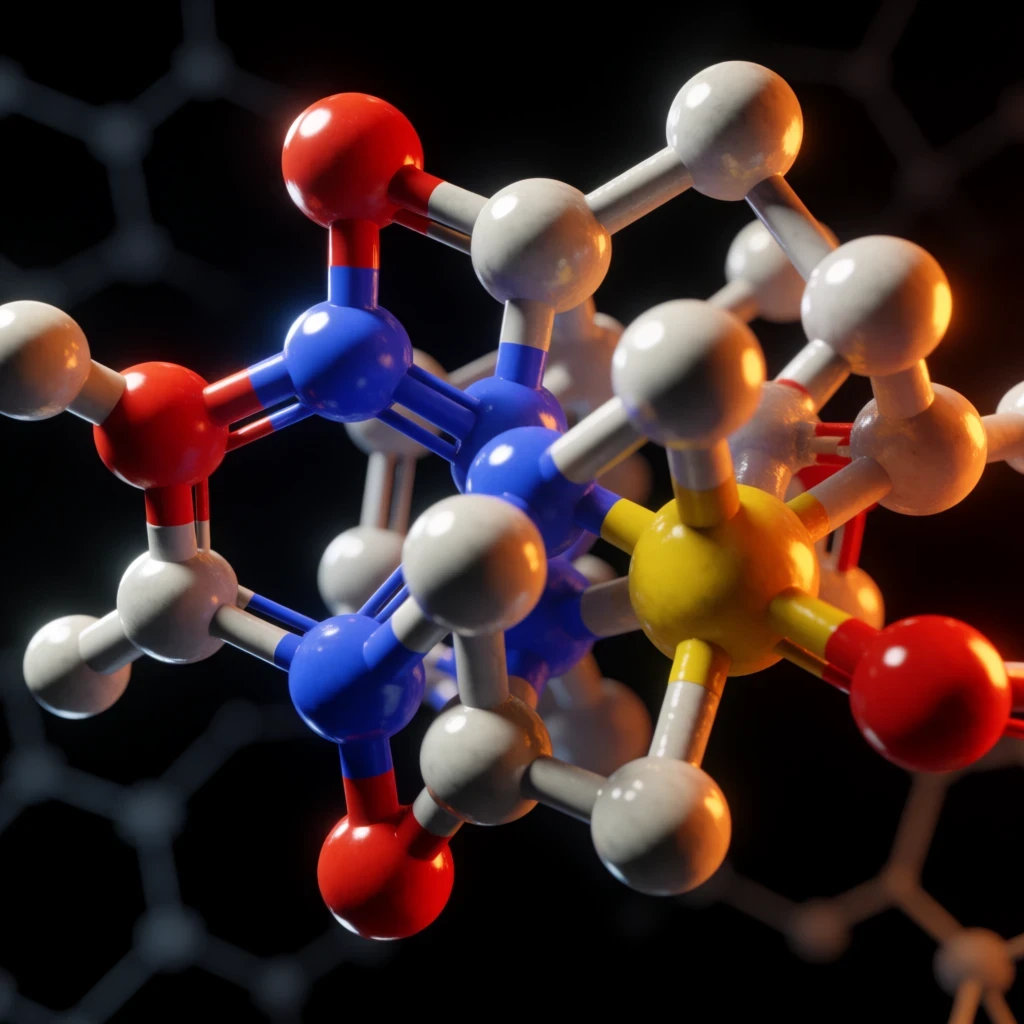
Medicinal chemistry has spent more than a century perfecting the flat aromatic ring, and that mastery now confronts a stubborn limitation. Most small-molecule drugs still resemble thin sheets of carbon and nitrogen, planar structures that bind efficiently but explore only a sliver of the three-dimensional space where proteins actually operate. Serially spiro-fused cyclobutanes represent a deliberate rebellion against that flatness, offering chemists a compact, rigid, and genuinely three-dimensional scaffold built from small carbon squares joined at single shared atoms.
This architectural shift matters because protein binding pockets are not flat. Enzymes, receptors, and transcription factors fold into crevices, channels, and cavities that reward molecules capable of reaching in three directions at once. A scaffold that projects substituents outward from a rigid core can achieve shape complementarity that planar rings simply cannot, and it can do so while remaining small enough to satisfy the strict molecular weight budgets of modern drug design. The spiro-cyclobutane motif sits precisely at that intersection of novelty and practicality.
The analysis below unpacks the geometry, synthesis, and strategic logic behind these scaffolds, moving from orbital-level reasoning about ring strain to the statistical realities of how novel chemists actually fare in discovery pipelines. Expect quantitative derivations, comparative datasets, and a clear-eyed assessment of where this chemistry helps and where it still struggles. The goal is not hype but understanding: why a four-membered ring, repeated in a spiral, has become one of the more intriguing ideas in contemporary scaffold design.
On This Page
- The Geometry of Flatness and the Case for Three-Dimensional Scaffolds
- Spiro-Fusion: Building a Molecular Spiral
- Synthesis and the Chemistry of Strained Rings
- Escape from Flatland: Strategic Value in Drug Discovery
- Quantitative Reasoning: Modeling Scaffold Behavior
- Challenges, Limitations, and the Road Ahead
- Frequently Asked Questions About Spiro-Fused Cyclobutanes
The Geometry of Flatness and the Case for Three-Dimensional Scaffolds
Drug discovery inherited its affection for aromatic rings from nature and from synthetic convenience in equal measure. Benzene-like systems are easy to build, chemically robust, and excellent at stacking against aromatic residues in proteins. Yet this very planarity imposes a hidden cost, because a flat molecule presents the same face regardless of how it rotates about its long axis, limiting the shapes it can adopt inside a folded protein.
Three-dimensionality, by contrast, lets a molecule sample distinct conformations and present different surfaces to a binding site. The concept is often quantified through the fraction of ##[sp^3]## hybridized carbons, a metric medicinal chemists call ##[F_{sp^3}]##. Raising this fraction generally correlates with improved solubility and reduced promiscuity, though the relationship is statistical rather than absolute and depends heavily on the specific target class under study.
Why Protein Pockets Reward Curvature
Binding pockets evolved under selection for molecular recognition, and recognition favors complementary surfaces rather than matching planes. Aromatic stacking provides strong but shallow contacts, whereas a curved scaffold can nestle into a deep cavity and make contacts on multiple faces simultaneously. This geometric complementarity translates directly into binding affinity and, crucially, into selectivity against closely related proteins.
Consider the energetic accounting. The free energy of binding decomposes into enthalpic contacts and entropic penalties, and a rigid three-dimensional core reduces the conformational entropy lost upon binding. If a flexible chain loses ##[\Delta S_{conf} \approx -R\ln(N)##] for ##[N]## accessible conformations, a pre-organized scaffold forfeits far less. Rigidity, in other words, is not merely aesthetic; it is thermodynamically bankable.
Planar molecules also suffer from a practical liability in development: they stack. Aromatic systems tend toward crystalline packing and poor aqueous solubility, problems that plague many kinase inhibitors and other flat drugs. Introducing saturated, three-dimensional character disrupts that packing, often improving both solubility and oral bioavailability without sacrificing potency at the target.
The intellectual case, then, is straightforward. If binding sites are three-dimensional, and if solubility and selectivity both improve with added saturation, then scaffolds that are rigid, compact, and non-planar should be valuable. The question becomes which scaffold delivers those properties most efficiently, and here the cyclobutane enters the conversation.
The Cyclobutane Advantage
Cyclobutane is a four-membered carbon ring carrying roughly ##[26\ \text{kcal/mol}##] of ring strain, a figure large enough to be chemically interesting yet small enough to remain stable under physiological conditions. That strain is not a defect to be eliminated but a feature to be exploited, because it stiffens the ring and locks its substituents into well-defined spatial relationships.
Unlike a flexible cyclohexane, which flip-flops between chair conformations, cyclobutane adopts a puckered geometry that resists deformation. Substituents attached to its corners therefore point in predictable directions, giving the medicinal chemist precise control over vector orientation. This predictability is exactly what structure-based design demands when fitting a ligand into a modeled pocket.
The ring also offers a compact footprint. Four carbons span a small volume, allowing the scaffold to thread into narrow channels where larger rings cannot follow. Combined with its saturated character, cyclobutane raises ##[F_{sp^3}]## sharply while adding minimal molecular weight, a rare combination in scaffold selection.
These properties explain why cyclobutane-containing fragments have appeared with increasing frequency in screening libraries and patent literature. The ring is no longer a curiosity; it is a recognized building block whose geometry can be tuned through substitution patterns to match the demands of a particular target.
Spiro-Fusion: Building a Molecular Spiral
Spiro fusion joins two rings through a single shared atom, a carbon that belongs simultaneously to both cycles. This connection differs fundamentally from fused systems like naphthalene, where rings share an entire bond, and from bridged systems where atoms are tethered across a ring. The spiro atom acts as a universal joint, fixing the two rings at a defined dihedral angle while allowing each to retain its own geometry.
When cyclobutanes are joined serially through spiro atoms, the result is a staircase-like assembly of squares. Each shared carbon enforces a near-perpendicular relationship between adjacent rings, so the molecule spirals through space rather than extending in a line. This serial arrangement creates a rigid, rod-like or helical core whose length can be tuned simply by adding more rings.
Orbital Constraints at the Spiro Carbon
The spiro carbon is ##[sp^3]## hybridized, with its four bonds directed toward the corners of a tetrahedron. Two of those bonds belong to one cyclobutane and two to the next, which forces the two ring planes into an approximately orthogonal orientation. The dihedral angle between ring planes is therefore not a free parameter but a consequence of tetrahedral geometry.
This constraint has energetic consequences. Each cyclobutane prefers a puckered conformation to relieve eclipsing interactions, and spiro fusion transmits that puckering from one ring to the next. The coupling can either reinforce or oppose the individual ring distortions, and the resulting conformational landscape determines how rigid the overall scaffold truly is.
Quantitatively, the strain energy of a spiro-fused pair is not simply additive. If each isolated cyclobutane carries ##[E_1 \approx 26\ \text{kcal/mol}##], a naive sum for two rings would give ##[52\ \text{kcal/mol}##]. In practice, the shared spiro carbon relieves some eclipsing strain, and measured or computed values for spiro[3.3]heptane fall near ##[50\ \text{kcal/mol}##], a modest but real deviation from additivity.
That deviation matters for synthesis. A scaffold carrying fifty kilocalories of strain per two rings is thermodynamically activated, meaning it can be assembled under carefully controlled conditions but may also be vulnerable to ring-opening under acidic or nucleophilic challenge. Stability testing therefore becomes a non-negotiable part of scaffold evaluation.
Serial Extension and Scaffold Length
Adding a third cyclobutane through another spiro junction extends the spiral and increases both rigidity and molecular length. The scaffold begins to resemble a molecular helix, with each square rotated relative to its neighbor by a fixed angle determined by the tetrahedral spiro center. This predictable rotation is a gift to structure-based design.
Consider the geometry more carefully. If each spiro junction rotates the ring plane by approximately ##[90^\circ]##, then a chain of ##[n]## rings traces a quarter-turn per junction, completing a full helical turn every four rings. The scaffold's end-to-end distance can therefore be estimated from the ring diagonal and the number of junctions, giving designers a simple handle on molecular reach.
For a cyclobutane with side length ##[a \approx 1.55\ \text{\AA}##], the diagonal across the ring is ##[a\sqrt{2} \approx 2.19\ \text{\AA}##]. A serial chain of ##[n]## rings spans roughly ##[n \times 2.19\ \text{\AA}##] along its axis, so a four-ring scaffold reaches about ##[8.8\ \text{\AA}##], comparable to the depth of many shallow binding grooves.
This tunability distinguishes spiro-cyclobutanes from rigidified scaffolds of fixed size. A medicinal chemist can dial the length and curvature by choosing how many rings to install, then decorate the periphery with substituents to engage specific residues. The scaffold becomes a modular chassis rather than a monolithic core.
We Also Published
Synthesis and the Chemistry of Strained Rings
Constructing a serial spiro-cyclobutane chain is a test of synthetic nerve. Each cyclobutane must be closed with controlled regiochemistry, and each spiro junction must be installed without rupturing the rings already built. The strain that makes the scaffold valuable also makes it fragile, so the order of operations and the choice of conditions carry outsized importance.
Several strategies dominate the literature. Photochemical ##[2+2]## cycloadditions remain a workhorse, allowing two alkenes to combine into a cyclobutane under ultraviolet light. Alternatively, ring contraction of larger cycles or intramolecular alkylation of suitably functionalized precursors can deliver the four-membered ring with high stereochemical control.
Photochemical and Metal-Catalyzed Routes
The ##[2+2]## photocycloaddition is elegant because it forms two carbon-carbon bonds in a single step, assembling the cyclobutane from simpler alkene partners. Selectivity depends on the substitution pattern of the alkenes and on the excited-state dynamics, which can be steered by sensitizers or by confinement within a template.
Metal catalysis offers a complementary approach. Palladium and nickel complexes can mediate cyclobutane formation through oxidative addition and reductive elimination sequences, and recent work has extended these methods to spiro-fused targets. The advantage is often milder conditions and better functional-group tolerance than photochemistry permits.
Each route carries trade-offs. Photochemistry excels at rapid assembly but can suffer from poor regiocontrol when unsymmetrical alkenes are used. Metal catalysis offers precision but introduces cost, toxicity concerns, and the need to remove residual metal from the final drug substance, a regulatory requirement that shapes process design.
Regardless of route, the final scaffold must survive purification, formulation, and storage. Forced degradation studies probe whether the strained rings open under heat, light, or acidic conditions, and any hint of instability redirects the design toward more robust analogs.
Strain Energy and Stability Calculations
Predicting stability begins with quantifying strain. For a serial spiro chain of ##[n]## cyclobutanes, a first-order estimate of total strain is ##[E_{total} \approx n \times 26 - (n-1)\times 2\ \text{kcal/mol}##], where the small correction accounts for relief at each shared spiro center. This simple model captures the trend without requiring full quantum chemistry.
For a three-ring scaffold, the estimate gives ##[E_{total} \approx 3 \times 26 - 2 \times 2 = 74\ \text{kcal/mol}##]. That figure is substantial, comparable to the strain in some small-ring explosives, and it flags the molecule as kinetically activated. Whether that activation translates into instability depends on the availability of ring-opening pathways.
A more rigorous treatment uses isodesmic reactions, comparing the strained scaffold to unstrained reference compounds at the same level of theory. Density functional calculations with dispersion corrections typically reproduce experimental strain energies within a few kilocalories, giving designers a reliable computational screen before committing to synthesis.
Stability also depends on substitution. Electron-withdrawing groups on the cyclobutane can accelerate nucleophilic ring opening, while bulky substituents shield the strained bonds from attack. Careful decoration can therefore convert a fragile scaffold into a robust one without sacrificing its three-dimensional character.
Escape from Flatland: Strategic Value in Drug Discovery
The phrase "escape from flatland" entered medicinal chemistry vocabulary as a rallying cry against aromatic dominance. It captures a genuine strategic insight: the space of possible drug-like molecules is vast, yet the pharmaceutical industry has explored only a narrow slice of it, disproportionately populated by planar rings. Novel scaffolds expand that slice.
Spiro-fused cyclobutanes contribute to this expansion by offering a shape that is simultaneously compact, rigid, and non-planar. They can serve as bioisosteres for aromatic rings, replacing a flat phenyl group with a three-dimensional surrogate that preserves approximate size while transforming the interaction profile. This substitution strategy is gaining traction in lead optimization.
Scaffold Diversity and Intellectual Property
Patent landscapes reward structural novelty, and a scaffold that has never appeared in a granted claim offers a cleaner path to protection. Spiro-cyclobutane cores are attractive partly for this reason: they allow companies to stake claims on chemical space that competitors have not occupied. Novelty, in this commercial sense, is a strategic asset.
Beyond patents, scaffold diversity improves the odds of finding hits in screening campaigns. A library dominated by flat aromatics will miss targets whose pockets demand curvature, whereas a library enriched with three-dimensional cores samples binding modes that flat compounds cannot access. Diversity, properly designed, is a statistical hedge against the unknown.
The numbers are sobering. Estimates suggest that the fraction of theoretically possible drug-like molecules actually synthesized is vanishingly small, on the order of ##[10^{-60}##] of the accessible chemical space. Any scaffold class that opens new regions of that space therefore carries disproportionate value, even if most individual compounds fail.
This is the deeper argument for spiro-cyclobutanes. They are not a guaranteed source of drugs but a systematic way of exploring territory that flat chemistry has left untouched. In an industry where attrition is the norm, expanding the search space is a rational response to repeated failure.
Case Studies and Emerging Applications
Several research groups have incorporated spiro-cyclobutane motifs into kinase inhibitors and receptor ligands, often as replacements for metabolically labile or planar groups. Early results suggest that the scaffolds can maintain potency while improving selectivity and pharmacokinetic profiles, though the data remain preliminary and target-dependent.
Fragment-based drug discovery has also embraced these cores. Because the scaffold is small and rigid, it serves well as a fragment that grows into a lead through structure-guided elaboration. The defined vector geometry of the cyclobutane corners makes growth strategies more predictable than with flexible linkers.
Agrochemical and materials chemistry have begun to take interest as well. The same rigidity and three-dimensionality that benefit drug design can improve the properties of functional materials, from liquid crystals to porous frameworks. Cross-disciplinary interest tends to accelerate methodological development, benefiting all users of the scaffold.
What remains uncertain is breadth. Whether spiro-cyclobutanes become a standard tool or remain a niche specialty depends on whether synthetic access improves and whether enough successful programs accumulate to justify the investment. The early signals are encouraging but not yet decisive.
Quantitative Reasoning: Modeling Scaffold Behavior
Rigorous scaffold evaluation demands numbers, not adjectives. Computational chemists model spiro-cyclobutanes using molecular mechanics and density functional theory, comparing predicted geometries and energies against experimental crystallography. These calculations guide which scaffolds are worth synthesizing and which should be abandoned early.
The mathematics of conformational analysis provides the foundation. A molecule's flexibility is described by its torsional potential energy surface, and a rigid scaffold occupies a narrow basin on that surface. Quantifying the width of that basin, through normal mode analysis or Monte Carlo sampling, gives a direct measure of pre-organization.
Conformational Entropy and Binding Penalty
When a flexible ligand binds, it surrenders conformational freedom, and the associated entropy penalty can be estimated from the number of low-energy conformations. A scaffold with ##[N]## accessible states pays roughly ##[\Delta G_{conf} \approx -RT\ln(N)##] upon binding, a cost that rigid scaffolds largely avoid.
For a typical flexible chain with ##[N = 100]## accessible conformations at ##[T = 298\ \text{K}##], the penalty is ##[\Delta G_{conf} \approx -RT\ln(100) \approx -2.7\ \text{kcal/mol}##]. A rigid spiro-cyclobutane with only a handful of states pays a fraction of that, translating into a meaningful boost in binding affinity.
This calculation explains why pre-organized scaffolds are prized. Every kilocalorie saved on conformational entropy is a kilocalorie available for specific interactions, and in the competitive world of drug binding, small energetic margins decide winners. Rigidity is, in effect, a thermodynamic subsidy.
The same logic applies to selectivity. A rigid scaffold presents a fixed shape, so it either fits a given pocket or it does not. Flexible molecules can adapt to multiple pockets, which raises potency but often lowers selectivity, a trade-off that medicinal chemists manage through careful scaffold choice.
Statistical Models of Discovery Success
Discovery success is probabilistic, and scaffold novelty influences the odds in measurable ways. Historical analysis suggests that compounds with higher ##[F_{sp^3}]## values progress through clinical phases at somewhat higher rates, though the effect is modest and confounded by target class and program quality.
A simple logistic model captures the intuition. If the probability of success is ##[P = \dfrac{1}{1 + e^{-(\beta_0 + \beta_1 x)}}##], where ##[x]## is a scaffold novelty score, then the odds ratio for a one-unit increase is ##[e^{\beta_1}##]. Reported estimates place ##[e^{\beta_1}##] modestly above unity, indicating a real but not dramatic advantage.
These statistics should temper enthusiasm. Novel scaffolds improve the odds at the margin, but they do not guarantee success, and most novel compounds still fail. The rational response is portfolio thinking: diversify across scaffolds, accept high attrition, and let the statistics work across many programs rather than betting everything on one elegant core.
Modeling also informs library design. If a screening collection is enriched with three-dimensional cores at a defined proportion, the expected number of novel hits can be estimated from the hit rate and the collection size. Such calculations guide investment in compound acquisition and synthesis.
Challenges, Limitations, and the Road Ahead
No scaffold is a panacea, and spiro-cyclobutanes carry liabilities that temper their promise. The strain that provides rigidity also invites decomposition, and the synthetic routes that build the rings are often long, low-yielding, or difficult to scale. These practical obstacles determine whether an elegant idea becomes a usable tool.
Metabolic stability is another concern. Strained rings can be susceptible to oxidative or hydrolytic attack, and the body's metabolic machinery is adept at opening small cycles. Careful substitution and metabolic profiling are essential before any spiro-cyclobutane compound advances toward the clinic.
Synthetic Accessibility and Scale-Up
Scaling a photochemical reaction from milligrams to kilograms is notoriously difficult, because light penetration and reactor geometry change dramatically with volume. Flow chemistry offers a partial solution, allowing thin films of solution to be irradiated uniformly, but the engineering remains demanding and capital-intensive.
Metal-catalyzed routes face their own scale-up hurdles. Catalyst loading, ligand cost, and metal removal all add expense, and regulatory limits on residual metals are strict. A route that works beautifully on a gram scale may be economically unviable at production scale, a reality that shapes process chemistry decisions.
Cost estimates illustrate the gap. If a photochemical step requires ##[24\ \text{hours}##] of irradiation at ##[10\%\ \text{yield}##], the material cost per gram of product can be an order of magnitude higher than a comparable thermal route. Improving yield and throughput is therefore a central research priority.
Progress is being made. Continuous-flow photoreactors, immobilized catalysts, and improved sensitizers are gradually closing the gap between laboratory elegance and industrial practicality. Each advance makes the scaffold more attractive to process chemists and, by extension, to project teams.
Future Directions and Open Questions
The most pressing open question is whether spiro-cyclobutanes will prove broadly useful or remain a specialized motif for select targets. Answering it requires more data: more crystal structures, more pharmacokinetic profiles, more clinical outcomes. The field is accumulating that evidence, but the verdict is not yet in.
Computational design is likely to accelerate progress. Machine learning models trained on reaction outcomes can predict which spiro-cyclobutane syntheses will succeed, and generative algorithms can propose novel substitution patterns tailored to specific pockets. These tools lower the cost of exploration and widen the search.
Hybrid scaffolds represent another frontier. Combining spiro-cyclobutanes with heteroatoms, aromatic caps, or other three-dimensional cores could yield molecules with properties neither component achieves alone. The design space is combinatorial, and systematic exploration has barely begun.
Ultimately, the value of any scaffold is measured in medicines, not in publications. Spiro-fused cyclobutanes have earned a place in the medicinal chemist's toolkit, but their ultimate significance will be written in clinical trials and approved therapies. The chemistry is compelling; the biology remains to be proven.
Frequently Asked Questions About Spiro-Fused Cyclobutanes
Readers encountering this chemistry for the first time often ask the same practical questions. The answers below distill the essential points without requiring a background in organic synthesis, and they clarify where the science is settled and where it remains speculative.
What exactly is a spiro-fused cyclobutane?
A spiro-fused cyclobutane is a four-membered carbon ring joined to another ring through a single shared carbon atom. When several cyclobutanes are connected this way in sequence, they form a rigid, spiral-shaped scaffold that extends through three-dimensional space rather than lying flat.
The defining feature is the spiro carbon, which belongs to two rings at once. This shared atom enforces a fixed angle between the rings, giving the scaffold its characteristic rigidity and its predictable geometry. The result is a compact core with well-defined exit vectors for substituents.
Serial versions contain multiple such junctions, creating a staircase or helical arrangement. Each additional ring extends the scaffold and adds strain, so designers balance length against stability. The motif is best understood as a modular chassis rather than a single fixed structure.
Why does three-dimensionality matter in drug design?
Protein binding sites are three-dimensional cavities, and molecules that match their curvature can make more extensive and selective contacts. Flat aromatic rings bind well but explore limited shape space, whereas three-dimensional scaffolds can reach into pockets that planar molecules cannot access effectively.
Three-dimensionality also improves properties beyond binding. Saturated scaffolds tend to be more soluble, less prone to crystalline packing, and less promiscuous than flat aromatics. These advantages translate into better drug-like behavior and, often, improved pharmacokinetics during development.
The concept is quantified through the fraction of ##[sp^3]## carbons, and higher values generally correlate with improved outcomes. The correlation is statistical, not deterministic, so three-dimensionality is a design heuristic rather than a guarantee of success.
Are these scaffolds stable enough to become drugs?
Stability depends on substitution and context. The cyclobutane ring carries significant strain, which can make it vulnerable to ring-opening under harsh conditions, but appropriate substituents can shield the strained bonds and improve robustness substantially.
Forced degradation studies are standard practice for any candidate, and spiro-cyclobutane compounds receive particular scrutiny. If a scaffold survives heat, light, acid, and oxidative challenge, it can proceed; if not, medicinal chemists modify the structure or abandon the series.
Several experimental compounds containing these cores have advanced into preclinical testing, suggesting that stability is achievable. The question is not whether the scaffold can be stable but whether it can be stable enough for a specific application.
How close are these molecules to becoming medicines?
The field is early. Most published work describes synthesis, modeling, and in vitro evaluation rather than clinical results. A handful of compounds have entered preclinical development, but no approved drug relies on a serial spiro-cyclobutane core as of current public knowledge.
Translation takes time. Even promising scaffolds require years of optimization, toxicology, and clinical trials before reaching patients. The current evidence supports cautious optimism rather than confident prediction, and the next decade will be decisive.
What is clear is that the scaffold has moved from curiosity to credible tool. Whether it becomes a standard element of the medicinal chemist's repertoire depends on the successes and failures of the programs now underway.
From our network :
- Vite 6/7 'Cold Start' Regression in Massive Module GraphsIn-depth analysis of Vite 6/7 cold start regressions in massive module graphs. Learn about barrel file issues, pre-bundling optimizations, and how to improve Vite dev server performance.
- Mastering DB2 12.1 Instance Design: A Technical Deep Dive into Modern Database ArchitectureComprehensive guide to DB2 12.1 Instance Design. Explore architectural components, HADR setup, buffer pool tuning, and security policies for IBM DB2 12.1. Includes 10 functional SQL and Shell samples.
- Trump Political Strategy How Geopolitical Stunts Serve As Media Diversions
- 10 Physics Numerical Problems with Solutions for IIT JEEPrepare for IIT JEE with 10 physics numerical problems, complete with detailed solutions and conceptual explanations. Ideal for mastering kinematics, thermodynamics, electromagnetism, and optics.
- Mastering DB2 LUW v12 Tables: A Comprehensive Technical GuideComprehensive guide on DB2 LUW v12 tables. Explore CREATE TABLE syntax, BLU Acceleration, range partitioning, data types, and security features for IBM DB2 LUW v12.
- 98% of Global MBA Programs Now Prefer GRE Over GMAT Focus EditionExplore why 98% of global MBA programs now prefer the GRE over GMAT Focus. Learn about the shorter GRE format, verbal logic importance, and strategic versatility for students.
- EV 2.0: The Solid-State Battery Breakthrough and Global Factory ExpansionDiscover the impact of the Solid-State Battery Breakthrough on the EV market. Learn about CATL and BYD stock growth, global factory expansion in Europe, and the future of EV 2.0 technology.
- Analyzing Trump Deportation Numbers Insights Into The 2026 Immigration Crackdown
- AI-Powered 'Precision Diagnostic' Replaces Standard GRE Score ReportsDiscover the new GRE Precision Diagnostic. Learn how AI-powered behavioral analytics and time-to-solve tracking are replacing standard GRE score reports to empower students.
RESOURCES
- Resources will be updated soon.


0 Comments