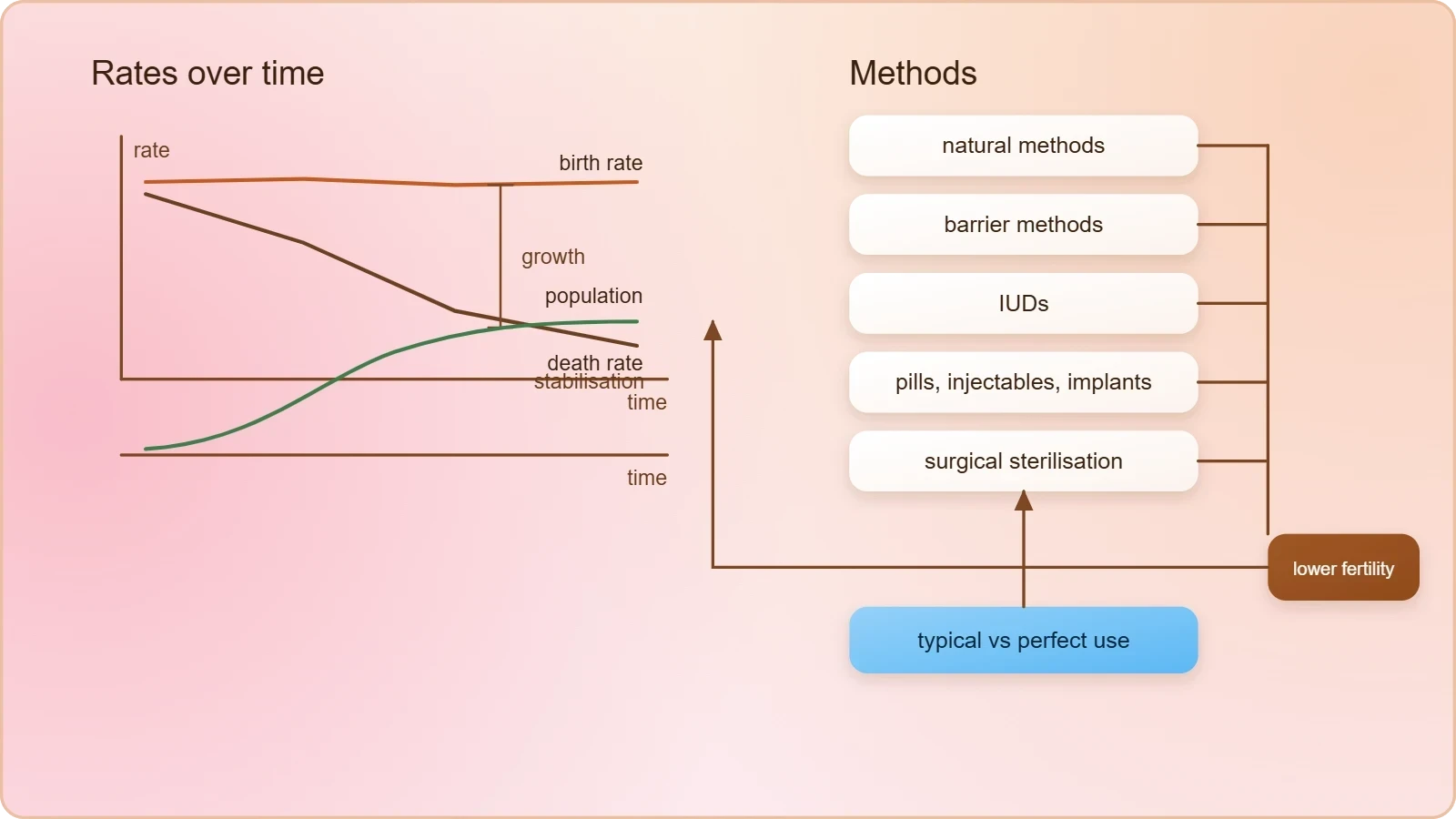
Population stabilisation sits at the intersection of demography, medicine, and public policy, and it is one of the most consequential themes in reproductive health. Across the twentieth century, sweeping gains in sanitation, nutrition, vaccines, and maternal care drove death rates down far faster than birth rates fell, producing the steepest population curve in human history. The world count climbed from roughly 2 billion in 1900 to about 6 billion by 2000 and 7.2 billion by 2011, while India moved from approximately 350 million at independence to nearly a billion by 2000 and beyond 1.2 billion by May 2011. These figures are not abstractions; they translate directly into demand for food, shelter, clothing, schooling, and employment.
This lesson examines why that growth accelerated, what stabilisation actually requires, and how contraception functions as the practical instrument of family planning. It moves systematically through natural and traditional methods, barrier devices, intrauterine devices, oral pills, injectables, implants, and surgical sterilisation, weighing each for mechanism, effectiveness, reversibility, and side effects. Beyond the mechanics, the discussion confronts the harder questions: how typical use differs from perfect use, why misconceptions quietly undermine uptake, where male responsibility fits, and how long-acting reversible methods are reshaping unintended pregnancy rates. Ethical tensions between coercion and reproductive rights, illustrated by Kerala's celebrated transition, anchor the analysis in real policy.
Because this material builds on the previous lesson on reproductive health problems and strategies, it assumes familiarity with maternal mortality, infant mortality, and sexually transmitted infections as public health indicators. It also deliberately stops short of the medical termination of pregnancy, which the next lesson treats in full. The aim here is a working command of the contraceptive landscape as it is actually used, prescribed, and debated, so that learners can reason about population policy with both demographic literacy and clinical nuance.
On This Page
- Why Population Growth Accelerated and Why Stabilisation Matters
- The Ideal Contraceptive and the Natural Methods
- Barrier Methods and Intrauterine Devices
- Hormonal Contraception: Pills, Injectables, and Implants
- Surgical Sterilisation and Male Involvement
- Ethics, Rights, and the Kerala Case Study
- Worked Example: Modelling Contraceptive Coverage
Why Population Growth Accelerated and Why Stabilisation Matters
The demographic explosion of the last century was, paradoxically, a by-product of success. Improved health facilities, better living conditions, and falling death rates meant more people survived infancy and reached reproductive age, while fertility remained high for a generation or more. This lag between declining mortality and declining fertility is the classic engine of what demographers call the demographic transition. India's Reproductive and Child Health programme helped bring the growth rate below 2 per cent, roughly 20 per 1000 per year by the 2011 census, yet even that rate compounds rapidly because the base population is enormous and the cohort entering reproductive age remains large.
Stabilisation matters because unchecked growth can produce absolute scarcity of the most basic requirements, food, shelter, and clothing, even where progress in those sectors has been genuine. The government's response combined persuasion with structural measures: motivating smaller families through contraceptive access, the familiar Hum Do Hamare Do campaign, statutory raising of the marriageable age to 18 for women and 21 for men, and incentives for small families. Many young urban working couples have gone further, adopting a one-child norm. Each measure targets a different lever, timing of first birth, spacing, and total family size.
The Demographic Transition and Its Arithmetic
Understanding why a growth rate of 2 per cent is alarming requires a feel for exponential mathematics. Population growing at a constant rate follows the compounding relationship below, where ##N_0## is the initial population, ##r## the annual growth rate, and ##t## the number of years.
At ##r = 0.02##, the doubling time is approximately ##\ln 2 / 0.02 \approx 34.7## years, meaning a population of 1.2 billion would reach 2.4 billion within a single generation if the rate held. This is why even modest reductions in fertility compound into large long-run differences, and why demographers focus on the total fertility rate rather than year-on-year headcounts alone.

Reading the Numbers: Growth Indicators Compared
Demographic indicators are frequently confused with one another, so a structured comparison clarifies what each measures and why policy targets specific ones. The table below consolidates the reference figures and their interpretation.
The Ideal Contraceptive and the Natural Methods
An ideal contraceptive should be user-friendly, easily available, effective, and reversible, with no or minimal side effects, and it should not interfere with sexual drive, desire, or the sexual act itself. No single method satisfies every criterion, which is precisely why a wide range exists and why method choice must be individualised. The available options group broadly into natural or traditional methods, barrier methods, intrauterine devices, oral contraceptives, injectables, implants, and surgical methods. Each occupies a distinct niche defined by effectiveness, convenience, reversibility, and the health profile of the user.
Natural methods operate on a single elegant principle: avoid any chance of the ovum and sperm meeting. They require no medicines or devices, so side effects are almost nil, but their failure rates are correspondingly high because they depend heavily on discipline, cycle regularity, and correct interpretation of fertile windows. For learners, these methods are valuable less as a first-line recommendation and more as a window into reproductive physiology, since each one exploits a specific biological fact about ovulation, ejaculation, or lactation.
Periodic Abstinence, Withdrawal, and Lactational Amenorrhea
Periodic abstinence asks couples to abstain from coitus on days 10 to 17 of the menstrual cycle, the window when ovulation is expected and fertilisation chances are highest, hence the term fertile period. Withdrawal, or coitus interruptus, has the male partner withdraw the penis just before ejaculation to avoid insemination, a method that demands considerable self-control and carries risk from pre-ejaculatory fluid. Lactational amenorrhea relies on the fact that intense breastfeeding following parturition suppresses ovulation, so conception chances are nearly nil while the mother fully breastfeeds, though effectiveness is documented only up to about six months.
Effectiveness in Practice: Typical Use Versus Perfect Use
The gap between perfect use and typical use is the single most important concept in contraception counselling. Perfect use measures a method when followed exactly; typical use reflects real human behaviour, including forgotten pills, delayed refills, and inconsistent technique. This distinction explains why a method with excellent theoretical efficacy can underperform in ordinary life, and why clinicians increasingly favour methods that remove the need for daily or per-act discipline.

We Also Published
Barrier Methods and Intrauterine Devices
Barrier methods prevent the ovum and sperm from physically meeting by interposing a mechanical shield, and they are available for both partners. Condoms are thin rubber or latex sheaths covering the penis in the male or the vagina and cervix in the female, applied just before coitus so that ejaculated semen cannot enter the female reproductive tract. Nirodh is a well-known male brand. Condom use has risen in recent years largely because of the additional benefit of protecting users from sexually transmitted infections and AIDS, a dual advantage no hormonal method offers. Both male and female condoms are disposable and self-inserted, preserving privacy.
Diaphragms, cervical caps, and vaults are reusable rubber barriers inserted into the female reproductive tract to cover the cervix during coitus, blocking sperm entry through the cervix. They are typically combined with spermicidal creams, jellies, or foams to raise contraceptive efficiency, since the barrier alone may permit sperm to bypass its edges. Correct sizing by a clinician and proper placement are essential, and the device must remain in place for several hours after intercourse. These methods offer the appeal of being non-hormonal and under the user's direct control, though they demand planning and comfort with insertion.
How Intrauterine Devices Work
Intrauterine devices are inserted by doctors or trained nurses into the uterus through the vagina and are among the most effective reversible methods available. Three families exist: non-medicated devices such as the Lippes loop, copper-releasing devices such as CuT, Cu7, and Multiload 375, and hormone-releasing devices such as Progestasert and LNG-20. IUDs increase phagocytosis of sperm within the uterus, while copper ions suppress sperm motility and fertilising capacity. Hormone-releasing IUDs additionally render the uterus unsuitable for implantation and the cervix hostile to sperm, adding a second layer of protection.

Why IUDs Suit Spacing and Delay
IUDs are ideal for women who wish to delay pregnancy or space children, because they combine high efficacy with rapid return to fertility after removal. They are among the most widely accepted contraceptive methods in India, partly because a single insertion removes the burden of daily adherence. The main drawbacks are the need for a trained provider, discomfort or heavier bleeding with copper devices in some users, and a small risk of expulsion or infection around insertion. Counselling about these effects substantially improves continuation rates and satisfaction.
Hormonal Contraception: Pills, Injectables, and Implants
Oral administration of small doses of either progestogens or progestogen-estrogen combinations is a widely used female method, taken as tablets and therefore popularly called the pill. Pills are taken daily for 21 days, preferably starting within the first five days of the menstrual cycle, followed by a seven-day gap during which menstruation occurs, then repeated in the same pattern until conception is no longer desired. They inhibit ovulation and implantation and alter cervical mucus quality to prevent or retard sperm entry. Pills are very effective with relatively few side effects and are well accepted by many women.
Saheli, a newer oral contraceptive for women, contains a non-steroidal preparation and is taken once a week, offering very few side effects with high contraceptive value. Progestogens alone or combined with estrogen can also be delivered as injections or as implants placed under the skin, with a mode of action similar to pills but far longer effective periods. These longer-acting formulations reduce the adherence burden that undermines daily pill use, though they may bring irregular bleeding patterns that require counselling and reassurance.
Emergency Contraception and Its Proper Use
Administration of progestogens, progestogen-estrogen combinations, or an IUD within 72 hours of coitus is highly effective as emergency contraception, useful after rape or casual unprotected intercourse. Emergency contraception is a rescue measure, not a routine method, and its effectiveness declines the longer the delay before use. Learners should note the ethical and clinical importance of timely access, particularly for survivors of sexual violence, and the need to offer ongoing contraception and STI screening alongside it.
Long-Acting Reversible Contraceptives and Unintended Pregnancy
Long-acting reversible contraceptives, principally implants and intrauterine devices, have transformed the management of unintended pregnancy because they eliminate the adherence gap entirely. Once inserted, they provide years of protection without daily action, and their typical-use failure rates approach those of sterilisation while remaining fully reversible. Programmes that train providers, stock devices reliably, and offer same-day insertion consistently report sharp declines in unintended pregnancy and repeat abortion. The main barriers are cost, provider skill, and persistent myths about IUDs causing infertility or discomfort, all of which counselling can address.
Surgical Sterilisation and Male Involvement
Surgical methods, also called sterilisation, are generally advised as a terminal method to prevent any further pregnancies. The intervention blocks gamete transport and thereby prevents conception. Sterilisation in the male is called vasectomy, in which a small part of the vas deferens is removed or tied through a small incision on the scrotum. In the female it is called tubectomy, in which a small part of the fallopian tube is removed or tied through a small incision in the abdomen or through the vagina. Both are highly effective, but their reversibility is very poor, so they suit couples who have completed their families.
Male involvement remains an underused lever in family planning. Vasectomy is simpler and safer than tubectomy, yet female sterilisation vastly outnumbers it in most programmes, reflecting cultural expectations rather than clinical logic. Condoms are the only male method that also prevents STIs, and their consistent use depends heavily on partner communication. Research toward a reversible hormonal male pill continues, with trials showing suppression of sperm production, but regulatory approval remains distant. Encouraging shared responsibility is therefore as much a communication challenge as a technological one.
Comparing Permanent and Long-Acting Methods
Choosing between sterilisation and a long-acting reversible method hinges on whether fertility is permanently complete or merely postponed. The comparison below frames the trade-offs clearly for counselling conversations.
Common Misconceptions and Their Consequences
Misconceptions quietly erode contraceptive uptake more than any single clinical limitation. Persistent myths hold that IUDs cause infertility, that pills accumulate in the body and require periodic "rests", that condoms reduce pleasure so severely they are unusable, and that emergency contraception induces abortion. Each belief is factually wrong, yet each drives discontinuation or non-use. The consequence is measurable: unintended pregnancies, unsafe abortions, and avoidable maternal morbidity. Correcting misinformation through clear, non-judgemental counselling is therefore a clinical intervention in its own right, and community health workers are often the most effective messengers.
Ethics, Rights, and the Kerala Case Study
Population policy carries an inescapable ethical dimension. Coercive approaches, such as forced sterilisation campaigns or targets tied to individual incentives, violate bodily autonomy and reproductive rights, and history records several such abuses. The defensible alternative treats contraception as an expansion of choice rather than a restriction: couples decide freely whether, when, and how many children to have, supported by access to information and services. India's own approach evolved toward voluntary family planning, with statutory marriage ages and small-family incentives framed as persuasion rather than compulsion. The distinction between enabling and enforcing is the moral core of the entire field.
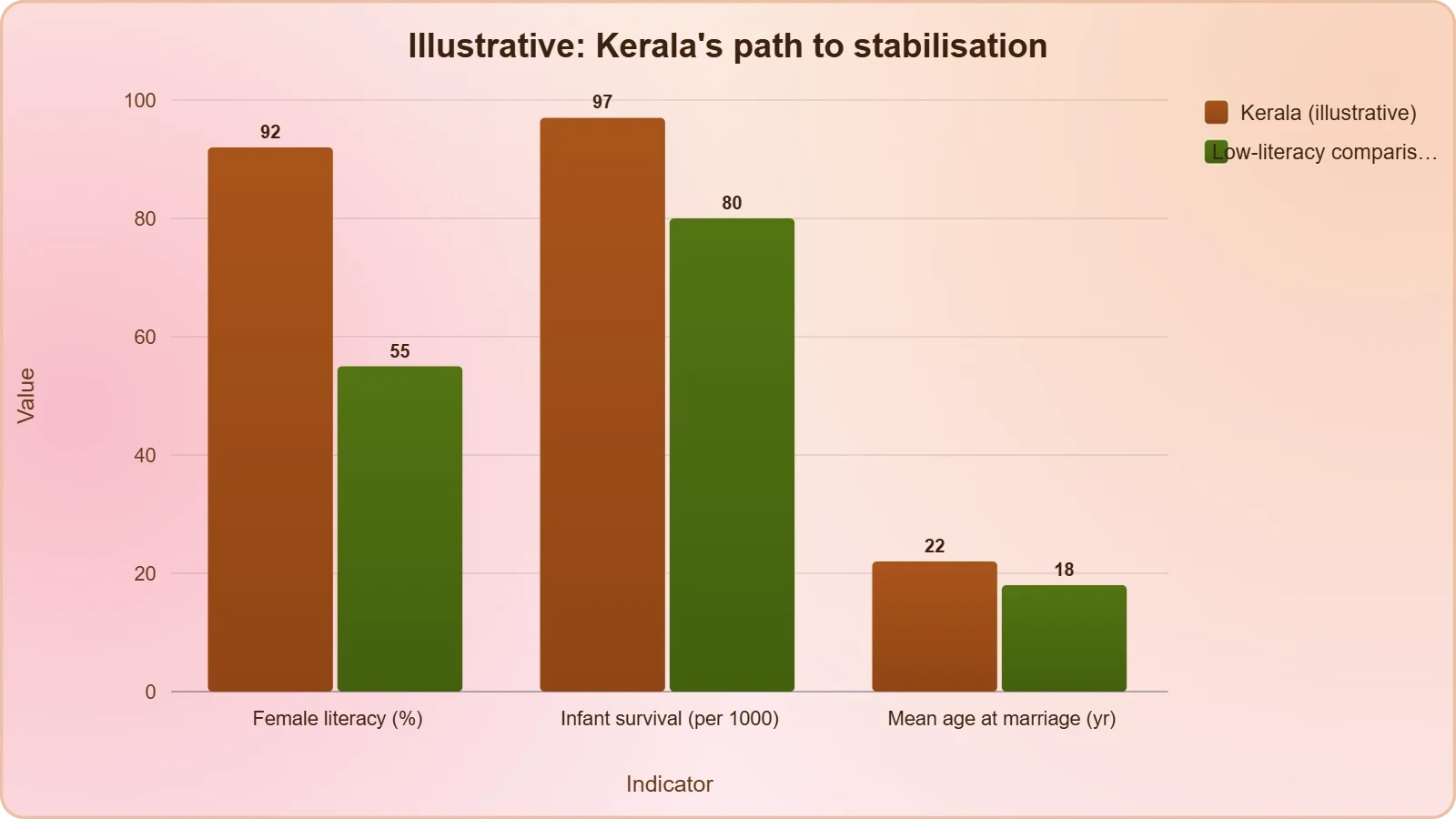
Kerala offers the most cited demonstration that education and healthcare, not coercion, can stabilise population. Through near-universal female literacy, strong public health infrastructure, later marriage, and high female workforce participation, the state achieved replacement-level fertility decades before the national average, without draconian measures. The lesson is that when women are educated and empowered, and when child survival is assured, fertility falls naturally. This aligns with global evidence linking female schooling to lower fertility and better maternal outcomes, and it reframes population stabilisation as a development outcome rather than a demographic target.
Safety, Side Effects, and Responsible Use
Contraceptives are not regular requirements for maintaining reproductive health; they are used against a natural reproductive event, conception, to prevent, delay, or space pregnancy for personal reasons. Their widespread use has played a significant role in checking uncontrolled population growth, but possible ill effects such as nausea, abdominal pain, breakthrough bleeding, irregular menstrual bleeding, or even breast cancer, though not very significant, should not be ignored. Selection of a suitable method and its use should always be undertaken in consultation with qualified medical professionals, who can match method to medical history and counsel on warning signs.
Emerging Directions and the Road Ahead
Several developments are reshaping the field. Hormonal male contraception continues in trials, promising to redistribute responsibility. Self-administered injectables and over-the-counter oral pills are expanding access by removing clinic dependence. Digital counselling and telemedicine extend reach into underserved areas, while improved postpartum IUD provision captures women already in contact with health systems. Each innovation must be paired with rigorous counselling and ethical safeguards, because access without understanding produces discontinuation, and technology without rights produces coercion. The next lesson turns to medical termination of pregnancy, where these same tensions between safety, law, and autonomy reappear in sharper form.
Worked Example: Modelling Contraceptive Coverage
To see how these concepts combine quantitatively, consider a district with 500,000 women of reproductive age, of whom 40 per cent currently use a modern contraceptive method. Planners want to know how many unintended pregnancies could be averted by shifting 10 per cent of users from a typical-use pill regimen to a long-acting reversible method. The calculation below uses approximate first-year failure rates of 7 per cent for typical pill use and 0.3 per cent for LARC, illustrating the arithmetic of method mix.
Here ##N = 500{,}000##, ##f = 0.40 \times 0.10 = 0.04##, and the rate difference is ##0.07 - 0.003 = 0.067##. Substituting gives ##\Delta P = 500{,}000 \times 0.04 \times 0.067 = 1{,}340## unintended pregnancies averted in a single year. The example is deliberately simplified, ignoring switching costs and discontinuation, but it demonstrates why method mix, not merely coverage, determines outcomes. A programme can raise contraceptive prevalence while leaving unintended pregnancy stubbornly high if it relies on methods with large typical-use gaps.
Implementing a Simple Coverage Calculator
Learners comfortable with programming can reproduce and extend this reasoning in code. The snippet below computes averted pregnancies for any assumed method mix and can be adapted to compare several scenarios.
def averted_pregnancies(women, prevalence, share_switched, rate_from, rate_to):
    """Estimate unintended pregnancies averted by a method-mix shift."""
    switchers = women * prevalence * share_switched
    return switchers * (rate_from - rate_to)

result = averted_pregnancies(
    women=500_000,
    prevalence=0.40,
    share_switched=0.10,
    rate_from=0.07,   # typical-use pill failure
    rate_to=0.003,    # LARC failure
)
print(f"Averted pregnancies per year: {result:,.0f}")
Running this produces approximately 1,340 averted pregnancies, matching the hand calculation. The value of the code lies in its flexibility: changing the prevalence or the share switched immediately shows how sensitive outcomes are to counselling quality and method availability. Such models are routinely used in public health planning to justify investment in provider training and device procurement, and they make the abstract language of population stabilisation concrete and testable.
From our network :
- Trump Political Strategy How Geopolitical Stunts Serve As Media Diversions
- AI-Powered 'Precision Diagnostic' Replaces Standard GRE Score ReportsDiscover the new GRE Precision Diagnostic. Learn how AI-powered behavioral analytics and time-to-solve tracking are replacing standard GRE score reports to empower students.
- EV 2.0: The Solid-State Battery Breakthrough and Global Factory ExpansionDiscover the impact of the Solid-State Battery Breakthrough on the EV market. Learn about CATL and BYD stock growth, global factory expansion in Europe, and the future of EV 2.0 technology.
- Do You Need a New Router or Is Your Internet Plan the Problem?A practical comparison of the signs that point to router limits versus signs your broadband speed or provider is the bottleneck, so you can decide what to replace before spending money.
- How to Print Cheaply: Cutting the Cost per PageA practical, measured guide to lowering what each printed page costs — duplex and draft modes, third-party ink, yield mathematics, and knowing when a new printer beats refills.
- 10 Physics Numerical Problems with Solutions for IIT JEEPrepare for IIT JEE with 10 physics numerical problems, complete with detailed solutions and conceptual explanations. Ideal for mastering kinematics, thermodynamics, electromagnetism, and optics.
- Where to Put Your Wireless Router for Better CoverageA practical, physics-grounded guide to router placement: why the centre of the home beats the corner, how walls and metal sap signal, and how to run a simple survey that proves the improvement.
- Analyzing Trump Deportation Numbers Insights Into The 2026 Immigration Crackdown
- 98% of Global MBA Programs Now Prefer GRE Over GMAT Focus EditionExplore why 98% of global MBA programs now prefer the GRE over GMAT Focus. Learn about the shorter GRE format, verbal logic importance, and strategic versatility for students.
RESOURCES
- Population Stabilization And Birth Control - Class 12 - GeeksforGeeksgeeksforgeeks.orgJun 27, 2023 ... Promoting small families. Promoting the use of contraceptive methods. Statutory increase of marriageable age of females to 18 years and…
- Population Stabilisation and Birth Control | CK-12 Foundationflexbooks.ck12.orgNov 1, 2026 ... Saheli stands out as an innovative oral contraceptive specifically developed for Indian women. It is a weekly pill, non-steroidal in…
- Population Stability and Birth Control Project | PDF - Scribdscribd.comStrategies include enhancing education, especially for women, promoting and providing access to contraceptive methods, economically incentivizing smaller ...
- Role of the urologist in population stabilization. I. Male sterilization ...pubmed.ncbi.nlm.nih.govBirth Rate; Contraceptive Agents / pharmacology; Contraceptive Devices; Costs ... Population Control*; Pregnancy; Public Opinion; Social Values; Sterilization ...
- Contraceptive awareness and practices in reproductive age couplespmc.ncbi.nlm.nih.govWith a lower contraceptive usage rate among eligible couples and resistance towards family planning methods, the goal of population stabilisation looks distant.
- Abortion and Demographic Fears in the Heartland - Project MUSEmuse.jhu.eduMay 29, 2025 ... ... methods of birth control."1. Hardin wholeheartedly agreed with West's perspective on the issue of abortion and population control. Hardin…
- Hormonal contraception and mood disorders - PMC - NIHpmc.ncbi.nlm.nih.govJun 1, 2022 ... Hormonal contraception is known to precipitate or perpetuate depression in some patients. The link between oral contraceptive pills and ...
- Ensuring Contraception Options Are Accessible and Affordableamericanprogress.orgMar 14, 2024 ... The development and use of contraception has contributed to improvements in women's economic stability, and federal and state policymakers ...
- the population (control) bill, 2021sansad.inmethods such as contraception and spacing between birth of two children; and ... methods to control population and a comprehensive policy towards stabilizing the.
- Birth Control - an overview | ScienceDirect Topicssciencedirect.comBirth control refers to methods used to prevent pregnancy, including ... Controversy surrounds the best way to achieve population stabilization. In ...
- INTERNATIONAL POPULATION ASSISTANCE PROGRAMS ...finance.senate.govJul 20, 2026 ... In the area of contraceptive supplies, U.S. AID was the sole provider to the public and private sectors until 1992.…
- Making Population Connections in Our Crowded Hectic Worldpopulationconnection.orgMar 11, 2021 ... ... population stabilization message is always there. Closing gaps ... methods that seek to control people. It's essential that we…
- Family planning/contraception methodswho.intJul 3, 2025 ... Only one contraceptive method, condoms, can prevent both pregnancy and the transmission of sexually transmitted infections, including HIV.
- Human Development is the Best Contraceptive—Why India Does ...thinkglobalhealth.orgFeb 12, 2020 ... ... population explosion." One, India has done well on the population front and is on course to achieve population stabilization.…
- India Tries Using Cash Bonuses to Slow Birthratesnytimes.comAug 21, 2010 ... “An educated girl is your best contraception,” said Dr. Amarjit Singh, executive director of the National Population Stabilization Fund, a…