On This Page
Defining Collections and Set Naming
Write the set of all whole numbers less than ##5## using set-builder notation.
Step 1: Identify the whole numbers less than ##5##: ##0, 1, 2, 3, 4##.
Step 2: Write the rule in set-builder notation.
Answer: ##\{x \mid x\text{ is a whole number and } x<5\}##
How many whole numbers are in the set ##\{x \mid x\text{ is a whole number and } x<7\}##?
Step 1: List the whole numbers less than ##7##: ##0, 1, 2, 3, 4, 5, 6##.
Step 2: Count them.
Answer: ##7##
Write the set of whole numbers greater than or equal to ##3## and less than ##8## using set-builder notation, then state how many numbers are in the set.
Step 1: List the whole numbers from ##3## up to ##7##: ##3, 4, 5, 6, 7##.
Step 2: Write the set in set-builder notation.
Answer: ##\{x \mid x\text{ is a whole number and } 3 \le x < 8\}##
Step 3: Count the numbers in the set.
Answer: ##5##
The Concept of a Well-Defined Collection
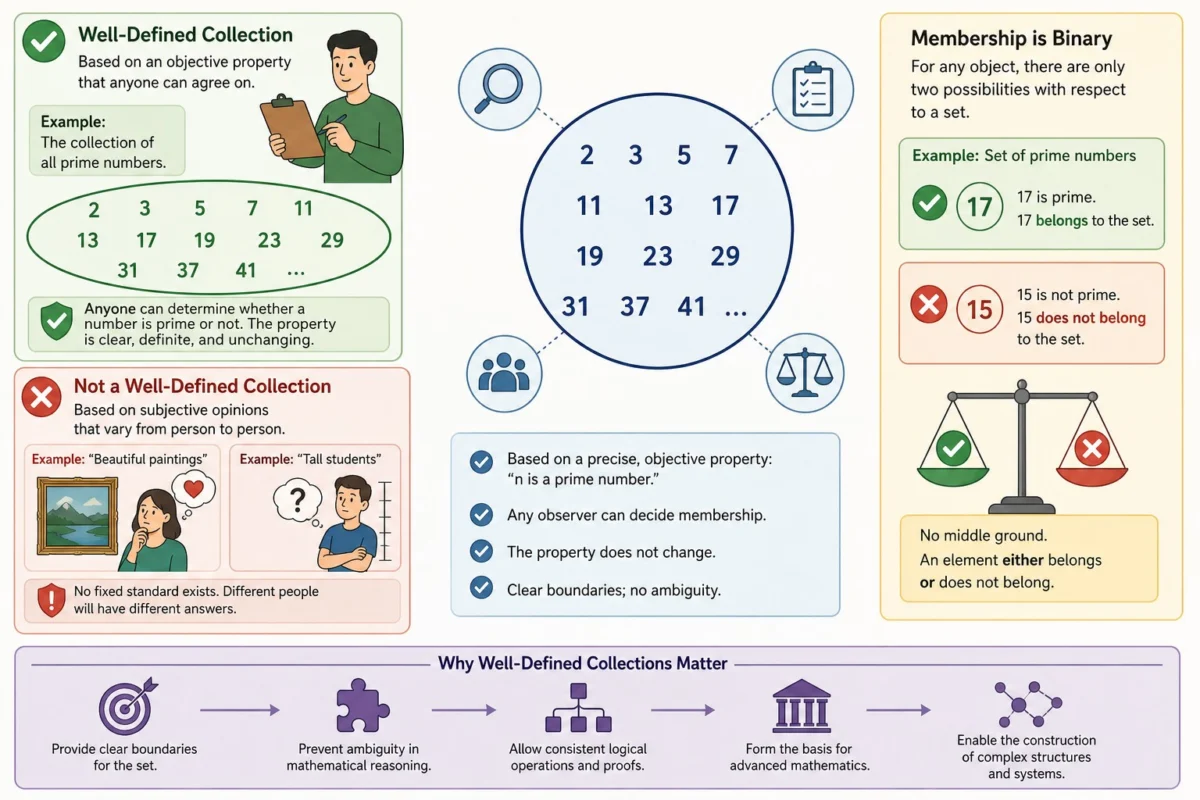
A set represents a collection of distinct objects grouped together based on specific shared properties. These objects must be well-defined to ensure mathematical clarity and consistency. In mathematics, a well-defined collection allows any observer to determine if an item belongs.
Subjective criteria like "beautiful paintings" or "tall students" do not form a set because they lack objective standards. Mathematical sets rely on absolute properties that do not change. For instance, the collection of all prime numbers is a valid set.
The concept of well-defined collections prevents ambiguity in logical operations and proofs. Every potential element must either belong or not belong to the set without any middle ground. This binary status is essential for building complex mathematical structures and systems.
When we define a collection, we focus on the shared characteristics of the objects involved. These characteristics provide the necessary boundaries for the set to exist formally. Without these boundaries, mathematical logic would lack the required precision for higher-level calculations.
Sets form the basic building blocks of modern mathematics across various specialized fields. From calculus to probability, the ability to group objects into sets is a fundamental requirement. Understanding how to define these collections is the first step in logic.
Standard Naming Conventions for Sets
Mathematicians use specific naming conventions to identify sets and their contents clearly. Usually, uppercase letters like A, B, or C denote the set itself. This standard practice helps distinguish the set from the individual elements it contains.
Individual elements within a set are typically represented by lowercase letters like x or y. For example, if x is an element of set A, the relationship is immediately clear. Consistent naming prevents confusion when dealing with multiple sets.
Some sets have reserved names because they appear frequently in mathematical literature. The set of natural numbers is often denoted by ##\mathbb{N}##. Similarly, integers are represented by ##\mathbb{Z}##, and the set of all real numbers uses ##\mathbb{R}##.
Naming a collection allows for easier symbolic manipulation in complex equations and proofs. Instead of listing every element, we can refer to the set by its assigned letter. This abstraction is a powerful tool in mathematical reasoning and theoretical analysis.
Choosing descriptive names can also be helpful in applied mathematics and computer science. In a program, a set of users might be named Users. However, in formal set theory, the single uppercase letter remains the primary standard protocol.
Mastering Brace Notation and Representation
The Roster Method and Braces
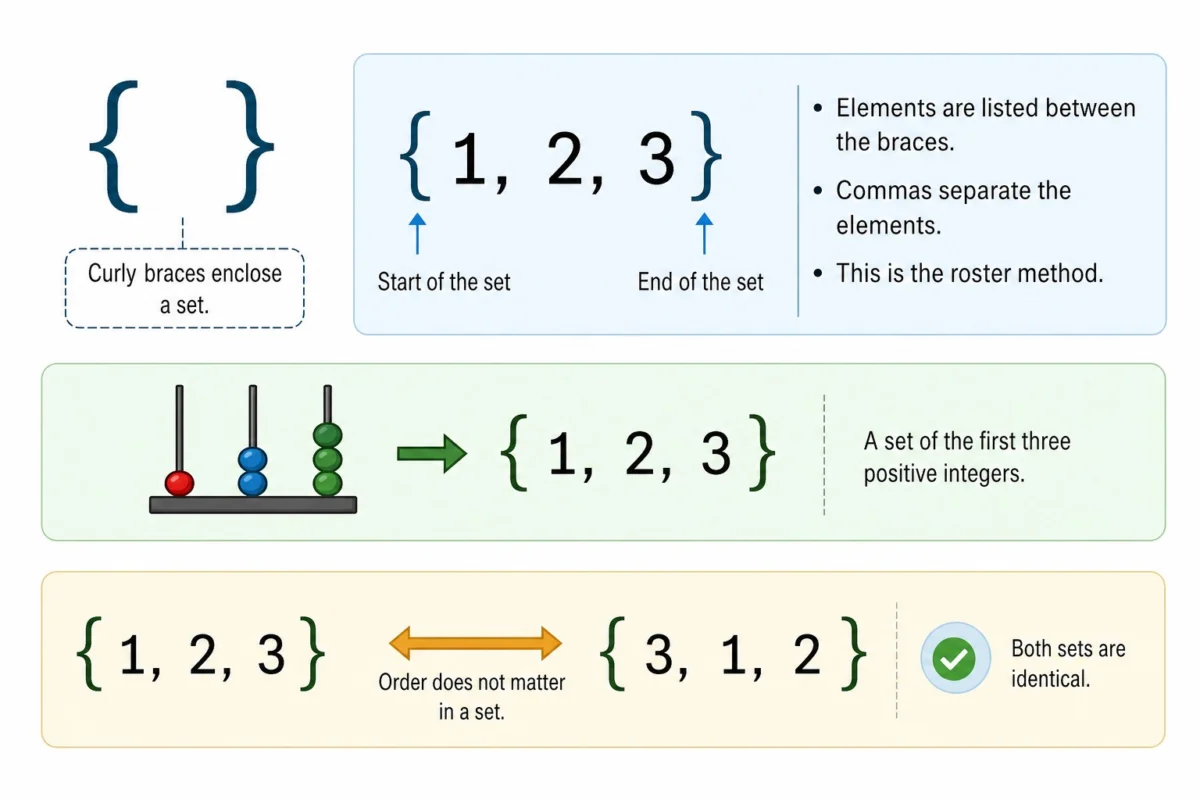
Brace notation is the most common way to represent a set in formal writing. We enclose the list of elements within curly braces, such as { }. This visual boundary clearly indicates where the set starts and where it ends.
The roster method involves listing every single element inside the curly braces. For example, a set of the first three positive integers is written as ##\{1, 2, 3\}##. This method is practical for sets that contain only few elements.
Commas separate the elements within the braces to maintain readability and structure. The order of the elements does not matter in a mathematical set. Thus, ##\{1, 2, 3\}## is identical to ##\{3, 1, 2\}## in mathematical logic.
If a set has many elements following a clear pattern, we use ellipses. For example, the set of numbers from one to one hundred is written as ##\{1, 2, 3, \dots, 100\}##. This notation saves space while remaining technically accurate.
Using braces is a formal requirement in all mathematical writing and documentation. It distinguishes a set from a simple list, a sequence, or a coordinate pair. Proper notation ensures that other mathematicians can interpret your work without any errors.
Describing Sets with Set-Builder Notation
Set-builder notation describes a set by the specific properties of its members. Instead of listing elements, we state a rule that every element must satisfy. This is highly useful for infinite sets or very large collections of data.
The general form uses a variable and a vertical bar or colon. For example, ##\{x \mid P(x)\}## means the set of all ##x## such that the property ##P(x)## is true. This provides a compact way to define complex sets.
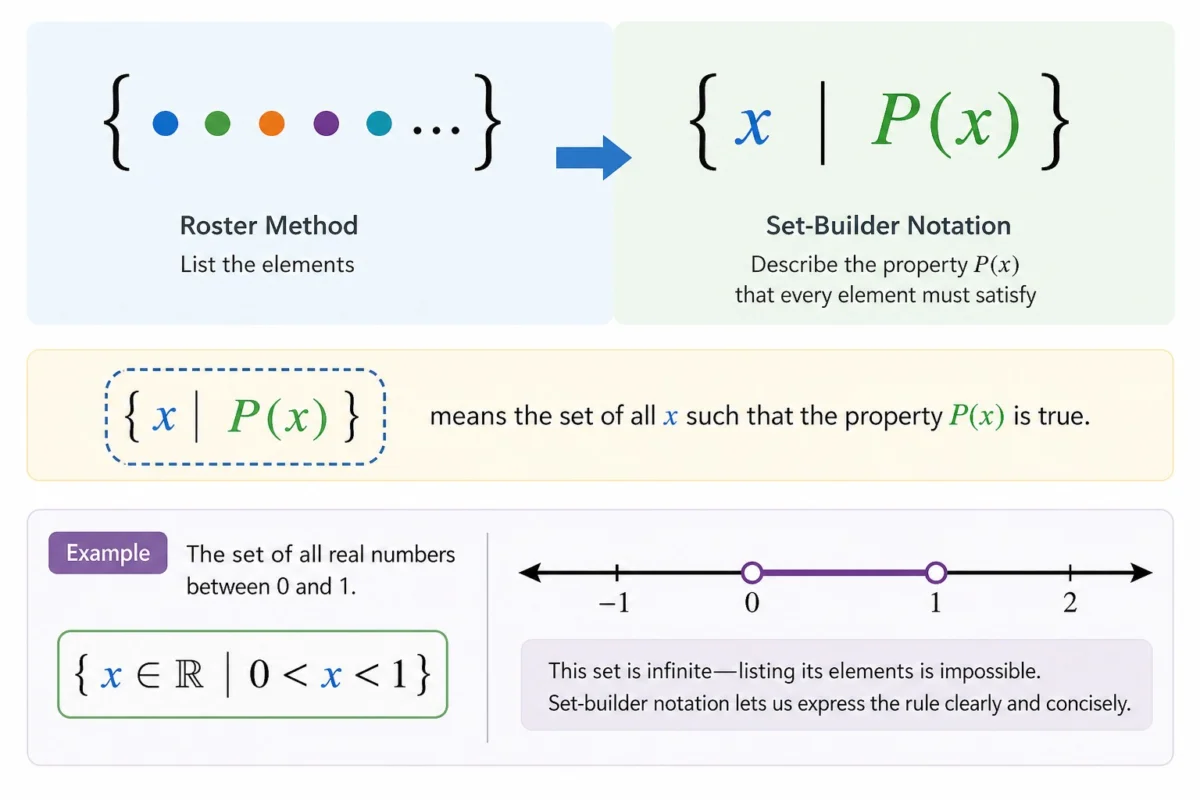
This notation is extremely efficient for defining intervals on a number line. We can define a set of all real numbers between zero and one easily. Listing these elements is impossible, but the rule is simple to write.
Set-builder notation often includes the domain of the variable for extra clarity. We might specify that ##x## must be an integer before stating the rule. This clarifies the scope and prevents any logical inconsistencies during calculation or proofs.
Mastering set-builder notation allows students to handle advanced calculus and linear algebra. It is the language used to define functions and their domains. Clear notation is the hallmark of professional mathematical communication and rigorous logical thought.
What is meant by a well-defined collection in mathematics?
A well-defined collection is one where it is always clear whether an item belongs to the collection or not.
- The objects are grouped by specific shared properties.
- Any observer can decide membership without ambiguity.
- There is no middle ground between belonging and not belonging.
Which of the following is described in the content as a valid set: beautiful paintings, tall students, or the collection of all prime numbers?
The collection of all prime numbers is a valid set.
- “Beautiful paintings” is subjective.
- “Tall students” is also subjective.
- Prime numbers are defined by an objective mathematical property.
Why do subjective descriptions like “beautiful paintings” not form a set?
They do not form a set because they lack objective standards.
- Mathematical sets require clear, fixed criteria.
- Subjective descriptions can vary from person to person.
- Without exact criteria, membership is ambiguous.
In standard naming conventions, what type of letter is usually used to denote a set, and what type is usually used for its elements?
Uppercase letters usually denote the set, and lowercase letters usually denote its elements.
- Set: uppercase letter such as A, B, or C.
- Element: lowercase letter such as x or y.
- This helps distinguish the collection from individual members.
Match each set with its common reserved notation: natural numbers, integers, and real numbers.
The common reserved notations are:
- Natural numbers: ##\mathbb{N}##
- Integers: ##\mathbb{Z}##
- Real numbers: ##\mathbb{R}##
Write the set of the first three positive integers using brace notation.
The set is written as ##\{1, 2, 3\}##.
- List each element inside curly braces.
- Use commas to separate the elements.
- This is the roster method.
Are the sets ##\{1, 2, 3\}## and ##\{3, 1, 2\}## considered the same set? Explain briefly.
Yes, they are the same set.
- In a mathematical set, order does not matter.
- Both collections contain exactly the same elements.
- So the two representations are identical in logic.
What is the purpose of using ellipses in a set such as ##\{1, 2, 3, \dots, 100\}##?
Ellipses show that the pattern continues without listing every element.
- This saves space.
- It remains technically accurate.
- It is useful when a set has many elements following a clear pattern.
Why is brace notation important in formal mathematical writing?
Brace notation clearly marks a set and distinguishes it from a list, sequence, or coordinate pair.
- Curly braces show where the set begins and ends.
- They help avoid confusion in interpretation.
- They make the notation formally correct.
What does the notation ##\{x \mid P(x)\}## mean?
It means the set of all ##x## such that the property ##P(x)## is true.
- ##x## is the variable.
- The vertical bar means “such that.”
- The rule ##P(x)## determines membership in the set.
Describe set-builder notation in one or two sentences.
Set-builder notation describes a set by stating a property or rule that its members must satisfy, rather than listing every element.
- It is especially useful for large or infinite sets.
- It gives a compact definition.
- It focuses on membership conditions.
Why is set-builder notation especially useful for defining intervals on a number line?
It is useful because an interval may contain infinitely many numbers, so listing them all is impossible.
- A rule can describe the interval compactly.
- The notation remains clear and precise.
- It is more efficient than writing every element.
In set-builder notation, why might we specify the domain of the variable, such as saying that ##x## must be an integer?
Specifying the domain adds clarity and prevents logical inconsistencies.
- It tells us what kind of values ##x## may take.
- It narrows the scope of the rule.
- It helps avoid confusion during calculation or proofs.
State one way in which naming collections helps in mathematical reasoning and proofs.
Naming a collection makes it easier to refer to the set symbolically instead of listing every element.
- This simplifies equations and proofs.
- It supports abstraction.
- It helps with complex mathematical manipulation.
Explain why the binary status of membership is important for sets.
Binary membership is important because every potential element must either belong to the set or not belong to it.
- There is no middle ground.
- This prevents ambiguity in logical operations and proofs.
- It supports the precise structure needed in mathematics.
Understanding Members and Element Relationships
Identifying Elements within a Set
Elements are the individual objects that make up a mathematical set. They can be numbers, letters, points, or even other sets. Every element must be distinct, meaning duplicates are not counted as separate members in the theoretical definition.
Identifying elements requires checking them against the set's specific definition or rule. If an object meets the criteria, it is a member. If it does not, it remains outside. This binary status is fundamental to all logical operations.
The nature of elements determines the type of set being studied. A set of integers contains numerical elements, while a set of colors contains abstract concepts. The rules of set theory apply equally to all types of elements.
We often use the term "members" interchangeably with "elements" in casual conversation. Both words describe the components of a collection. In technical writing, "elements" is the more common term used in formal proofs and standard textbook definitions.
Understanding elements is crucial for operations like union, intersection, and complement. We must know which elements belong to which set to combine or compare them. This basic identification is the foundation for all set-related calculations in math.
The Membership Symbol and Its Negation
The symbol ##\in## denotes that an object is an element of a specific set. If we write ##a \in A##, we are stating that ##a## belongs to set ##A##. This shorthand is used globally in mathematical literature and education.
To show that an object does not belong to a set, we use ##\notin##. This symbol is the membership sign with a diagonal slash through it. It indicates the exclusion of an item from a collection based on the rules.
These symbols allow us to write concise logical statements and formulas. Instead of using long sentences, we use these mathematical operators to save time. They improve the efficiency of proofs and make the logic easier to follow.
Membership is a direct relationship between an individual item and a collection. It is different from the subset relationship, which connects two sets together. Distinguishing between these two concepts is a common challenge for many beginning mathematics students.
Accurate use of membership symbols is vital in discrete mathematics and logic. It ensures that logical propositions are framed correctly for evaluation. Practicing these symbols helps students transition from basic arithmetic to the abstract world of set theory.
Exploring the Null Set and Cardinality
Characteristics of the Empty Set
The empty set is a unique collection that contains no elements at all. It is also known as the null set in many technical contexts. Despite having no members, it is a fundamental concept in all branches of mathematics.
We represent the empty set using the symbol ##\emptyset## or empty braces ##\{ \}##. Both notations are acceptable and mean exactly the same thing. It is the only set with a cardinality of exactly zero in mathematical theory.
The empty set is considered a subset of every set in existence. This is a crucial property used in many mathematical proofs and theorems. Even if a set has many elements, the empty set is technically contained within it.
We encounter the empty set when a specific condition has no possible solutions. For example, the set of all humans who are ten meters tall is empty. It exists as a mathematical concept even without any physical members present.
Understanding the null set prevents errors in logic and set operations. It acts as the identity element for the union operation in set algebra. Recognizing when a set is empty is a key skill in solving complex problems.
How many elements are in the empty set ##\emptyset##?
Step 1: The empty set contains no elements.
Step 2: So its cardinality is ##0##.
Answer: ##0##
If a set has ##7## elements, how many elements does the empty set have in comparison?
Step 1: The empty set is the set with no elements.
Step 2: Its cardinality is always ##0##, no matter what other set it is compared with.
Answer: ##0##
The empty set is a subset of every set in existence. How many subsets does the empty set have?
Step 1: A set is always a subset of itself.
Step 2: The empty set has no elements, so the only subset it can have is itself.
Step 3: Therefore, it has exactly ##1## subset.
Answer: ##1##
Distinguishing Empty Sets from Zero
A common mistake is confusing the empty set with the number zero. Zero is a number, while the empty set is a collection. They belong to different categories of mathematical objects and behave differently in equations and logical proofs.
The set ##\{0\}## is not an empty set because it contains an element. It is a set containing one element, which happens to be the number zero. Its cardinality is one, whereas the empty set's cardinality is always zero.
Think of a set as a container, like a box. An empty set is an empty box. A set containing zero is a box with a piece of paper that has the number "0" written on it clearly.
In computer science, this distinction is similar to the difference between a null pointer and an integer. Confusing the two can lead to significant errors in logic and program execution. Precision is required to avoid these common technical pitfalls.
Precise definitions are the core of set theory and logical reasoning. By distinguishing between the empty set and zero, students develop the rigor needed for advanced math. This technical accuracy is essential for success in higher education and research.
RESOURCES
- World Chess Shop: Buy Chess Sets, Chess Boards & Pieces for Sale
- The World is a Set (@theworldisaset) - Facebook
- Set the World on Fire - University of Pennsylvania Press
- Ordinary People Change the World Gift Set - Amazon.com
- The World Exists to Set Us Free
- Coffees of the World Gift Set - Whittard
- The Absolute Minimum Every Software Developer ... - Joel on Software
- The World Set Free - Wikipedia
- World Bank Open Data | Data
- World Economic Outlook, April 2022: War Sets Back The Global ...