On This Page
Finite and Infinite Sets
Defining Finite Sets
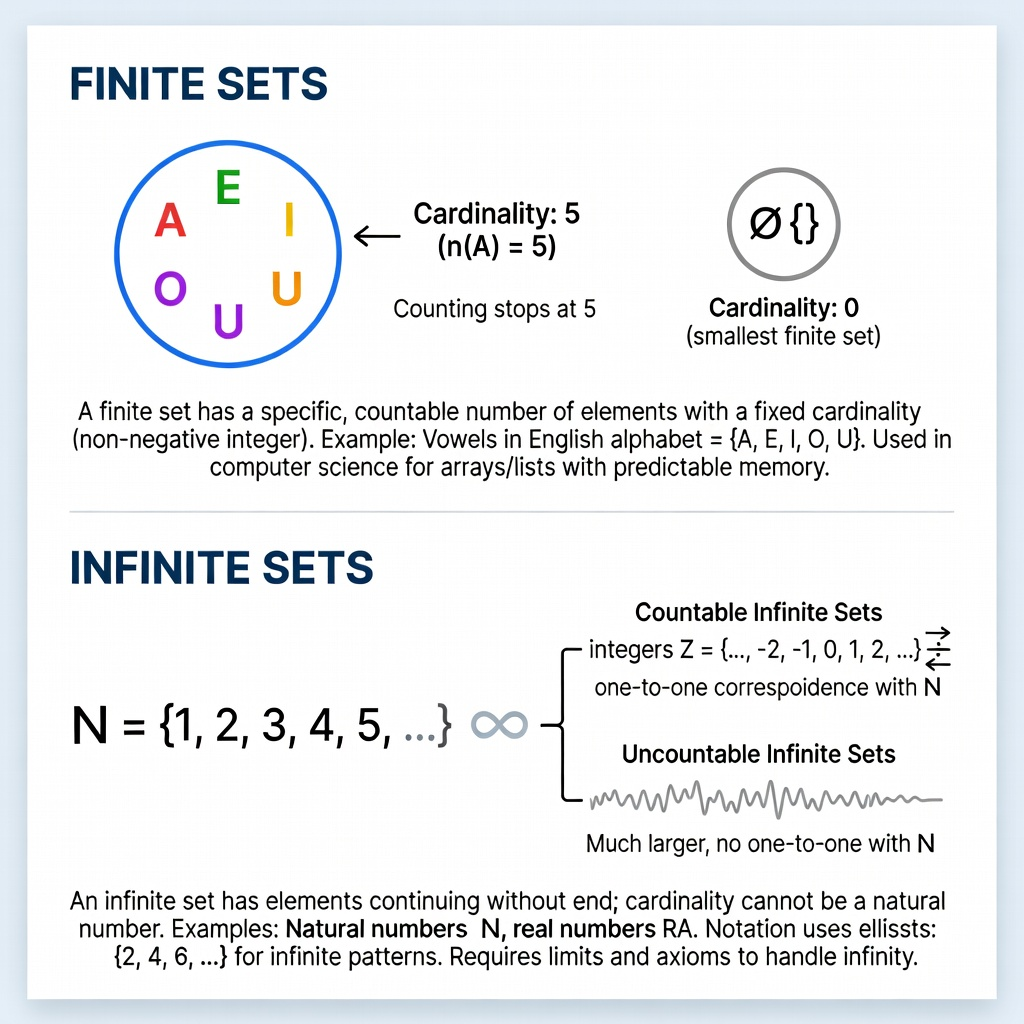
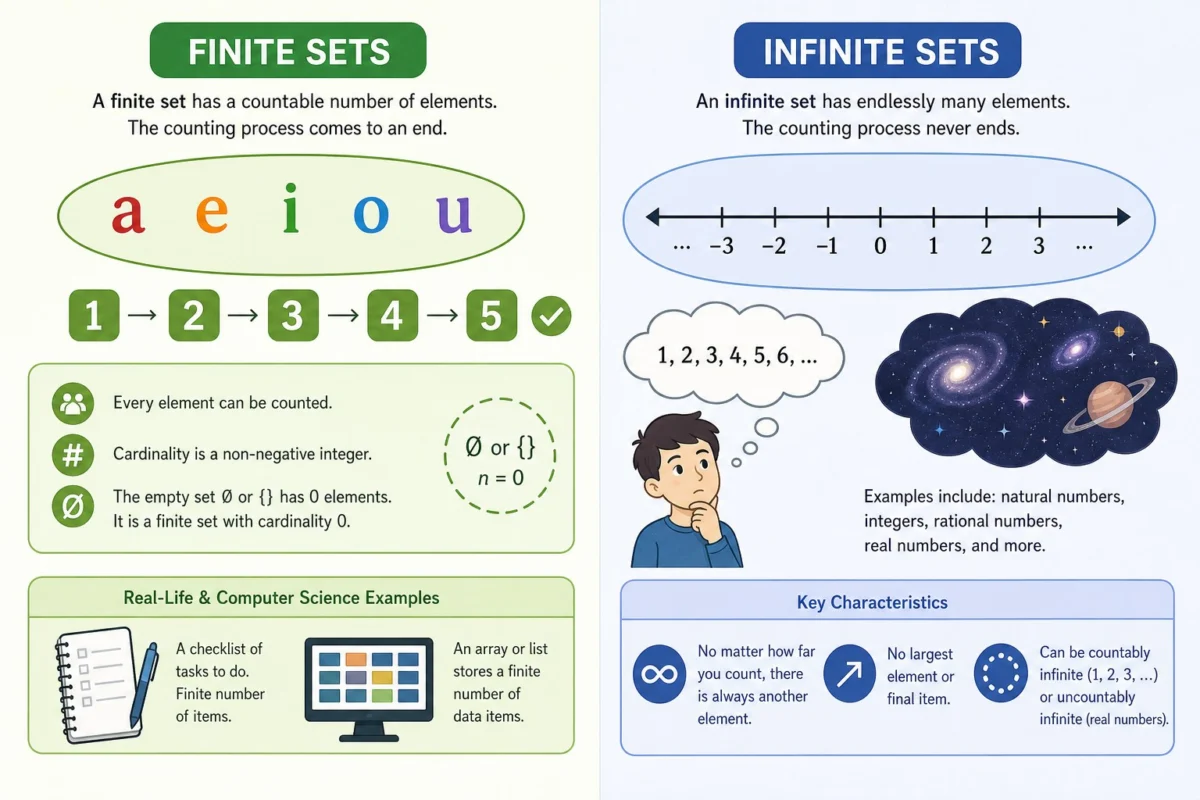
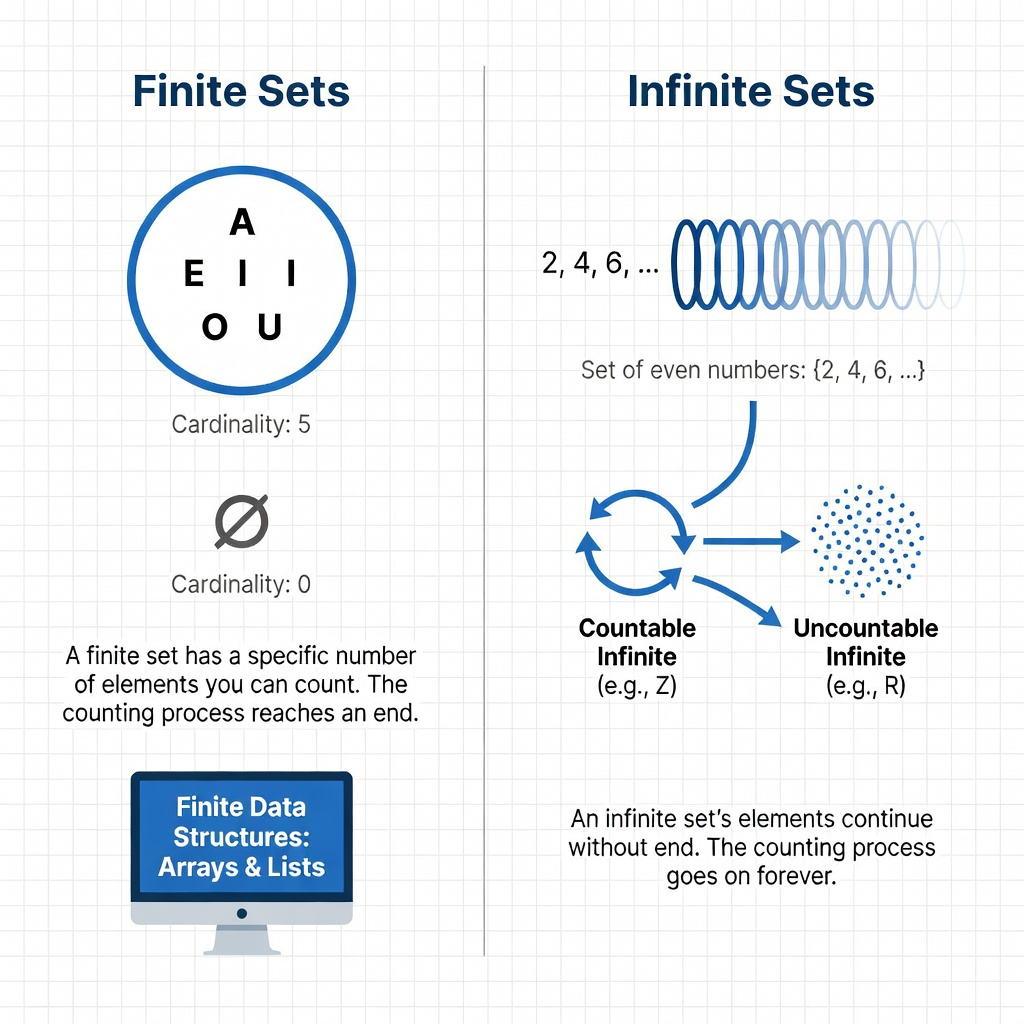
A finite set contains a specific number of elements that you can count. The process of counting these elements eventually reaches an end. This count is known as the cardinality of the set.
In technical terms, a set ##A## is finite if its cardinality ##n(A)## is a non-negative integer. This means the set has a fixed size. Even a very large number of elements can still be finite.
The empty set, denoted by ##\emptyset## or ##\{\}##, is also considered a finite set. It has a cardinality of zero. This is the smallest possible finite set in set theory.
Consider the set of vowels in the English alphabet. This set contains exactly five elements. Since the counting process stops at five, it is a perfect example of a finite set.
Finite sets are essential in computer science for defining data structures. Arrays and lists usually represent finite sets of data points. They allow for predictable memory allocation and processing.
Understanding Infinite Sets
An infinite set contains elements that continue without any end. You cannot assign a natural number to represent the total count of its members. The counting process goes on forever.
Common examples include the set of all natural numbers ##\mathbb{N}## or real numbers ##\mathbb{R}##. These sets lack a final element. They represent continuous or unending mathematical sequences.
Mathematically, we often represent infinite sets using an ellipsis. For instance, the set of even numbers is written as ##\{2, 4, 6, \dots\}##. This notation indicates the pattern continues infinitely.
Infinite sets can be countable or uncountable. Countable infinite sets, like integers, can be put into a one-to-one correspondence with natural numbers. Uncountable sets, like real numbers, are much larger.
Working with infinite sets requires tools like limits and set theory axioms. These concepts help mathematicians handle the idea of "infinity" without logical contradictions. They are foundational for calculus.
What is the term used to describe the count of elements in a finite set?
The count of elements in a finite set is known as its cardinality, denoted as ##n(A)##.
Is the empty set, denoted by ##\emptyset##, considered a finite set? If so, what is its cardinality?
Yes, the empty set is a finite set. Its cardinality is zero, because it contains no elements.
True or False: A set with a very large number of elements cannot be a finite set.
False. A set is finite as long as its cardinality is a non-negative integer, regardless of how large that number is.
The set of English vowels is ##{a, e, i, o, u}##. Is this set finite or infinite?
This set is finite because the counting process stops at five elements.
Why are finite sets important in the field of computer science?
Finite sets are essential because they allow for predictable memory allocation and processing when defining data structures like arrays and lists.
How does the counting process for an infinite set differ from that of a finite set?
In a finite set, the counting process reaches an end. In an infinite set, the counting process goes on forever and never reaches a final element.
What mathematical symbol is used to indicate that a set continues infinitely, such as in the set ##{2, 4, 6, \dots}##?
The symbol used is an ellipsis (##\dots##), which indicates that the established pattern continues without end.
Provide two examples of infinite sets mentioned in the text.
Two examples are the set of all natural numbers (##\mathbb{N}##) and the set of all real numbers (##\mathbb{R}##).
What is the difference between a countable infinite set and an uncountable infinite set?
Countable infinite sets can be put into a one-to-one correspondence with natural numbers, whereas uncountable sets (like real numbers) are much larger.
Which mathematical field relies on tools like limits and set theory axioms to handle the concept of infinity?
These concepts are foundational for calculus.
The Singleton Set Concept
Characteristics of Single-Element Sets
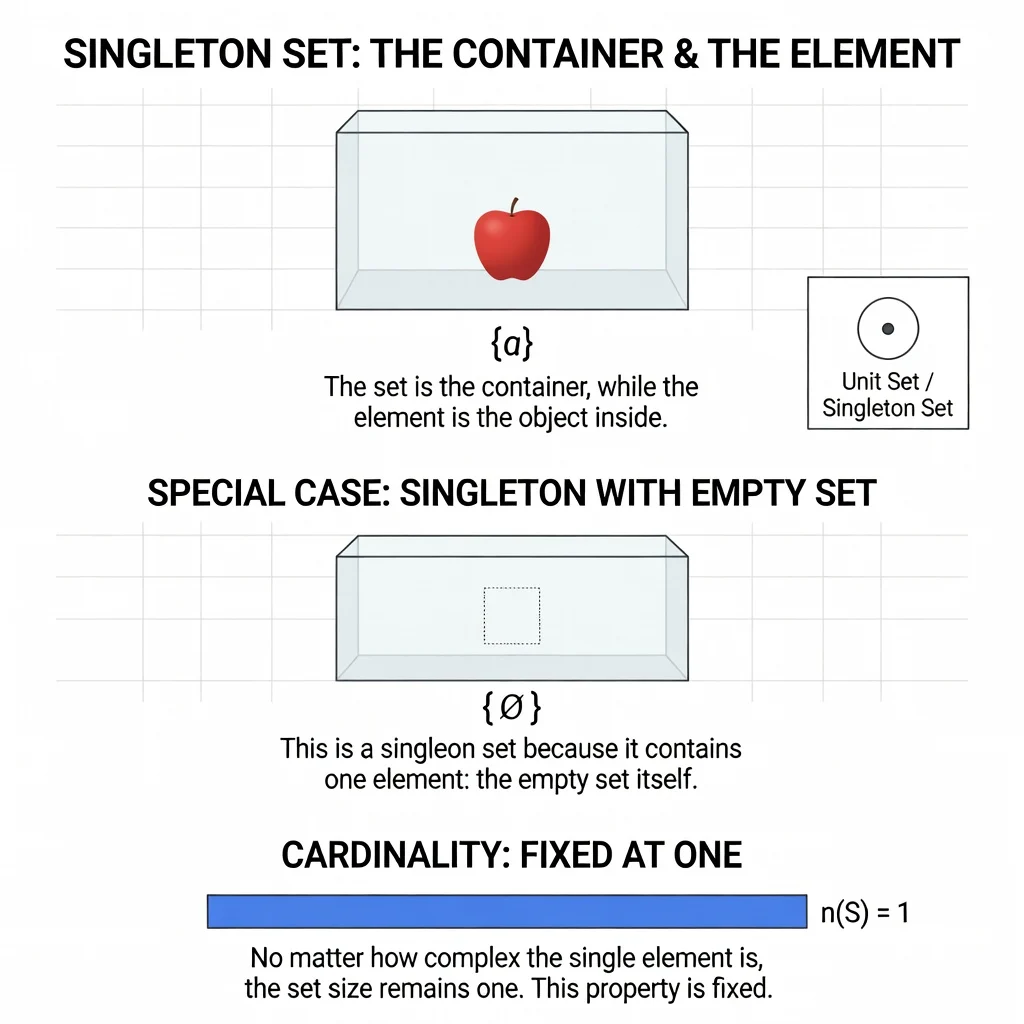
A singleton set is a set that contains exactly one element. In formal notation, it is written as ##\{a\}##. The cardinality of any singleton set is always exactly one.
It is important to distinguish the set ##\{a\}## from the element ##a##. The set is a container, while the element is the object inside. This distinction is vital in logic.
In set theory, a singleton set is often called a unit set. It represents the simplest non-empty set structure possible. It serves as a base case for many mathematical proofs.
A set like ##\{ \emptyset \}## is a singleton set because it contains one element. That element happens to be the empty set. This is a common point of confusion for students.
The cardinality of a singleton set ##S## is denoted as ##n(S) = 1##. No matter how complex the single element is, the set size remains one. This property is fixed.
Practical Examples and Applications
Consider the set of even prime numbers. Since 2 is the only even prime, the set is ##\{2\}##. This is a classic example of a singleton set in number theory.
In algebra, the solution set of the equation ##x + 5 = 10## is a singleton. The only value that satisfies the equation is 5. Thus, the set is ##\{5\}##.
Singleton sets appear frequently in function theory. The image of a constant function is always a singleton set. This happens because every input maps to the same single output.
In computer programming, a singleton pattern ensures a class has only one instance. This concept mirrors the mathematical singleton set. It restricts the "set" of instances to exactly one.
When analyzing relations, a singleton set might represent a unique coordinate or a specific state. It simplifies the domain when only one specific input is relevant to the system.
Equal Sets and Identity
Criteria for Set Equality
Two sets are equal if they contain exactly the same elements. The order of elements inside the sets does not change their equality. Repetition of elements also does not matter.
If set ##A## and set ##B## are equal, we write ##A = B##. This means every element of ##A## is in ##B##. Simultaneously, every element of ##B## must be in ##A##.
Formally, ##A = B## if and only if ##A \subseteq B## and ##B \subseteq A##. This double-inclusion method is the standard way to prove two sets are identical in advanced math.
For example, ##\{1, 2, 3\}## is equal to ##\{3, 1, 2\}##. Even though the numbers are listed in a different sequence, the membership is identical. The sets represent the same collection.
Repetition is ignored in set equality definitions. The set ##\{1, 2, 2\}## is equal to ##\{1, 2\}##. Adding duplicate elements does not create a new or different set structure.
Understanding Set Equality
This table clarifies the essential criteria and formal conditions for determining when two sets are considered equal.
| Aspect | Explanation | Example | Formal Principle |
|---|---|---|---|
| Core Definition | Two sets are equal if they contain precisely the same elements. | If A = {a, b} and B = {b, a}, then A = B. | A = B means every element of A is in B, and vice versa. |
| Element Repetition | Duplicate elements are ignored; adding them does not change the set. | {1, 2, 2} is equal to {1, 2}. | A set is defined by its unique elements. |
| Formal Proof | Advanced math proves set equality using the double-inclusion method. | To show A = B, prove A ⊆ B and B ⊆ A. | A = B if and only if A ⊆ B and B ⊆ A. |
- The symbol '⊆' denotes a subset relationship, meaning all elements of the first set are also in the second set.
Yes. The order of elements does not affect set equality. Since both sets contain the exact same elements {4, 5, 6}, they are equal.
Yes. Repetition of elements does not change the identity of a set. Both sets contain only the unique elements 7 and 8.
No. For sets to be equal, every element of A must be in B AND every element of B must be in A. Since 3 is in B but not in A, the sets are not equal.
The conditions are and .
The positive integers less than 3 are 1 and 2. Therefore, A = {1, 2}.
Answer Key
- Math Problem 1: 1
- Math Problem 2: 1
- Math Problem 3: 0
- Math Problem 4: A subset B and B subset A
- Math Problem 5: {1, 2}
Distinguishing Equality from Similarity
Equality is a strict relationship based on content. It requires identical members, not just the same number of members. It is the strongest form of set comparison.
When checking for equality, compare every individual element. If even one element differs, the sets are not equal. This applies to sets of numbers, letters, or objects.
In database management, equal sets might represent two queries that return the same records. Identifying equal sets helps in optimizing data retrieval and removing redundant information.
Mathematical proofs often involve showing that a calculated set equals a known set. This confirms the validity of a theorem or an algebraic operation. It ensures accuracy.
Equal sets must have the same cardinality. However, having the same cardinality does not guarantee equality. This is a crucial distinction to remember during set analysis.
Two sets are given: ##A = \{1, 2, 3\}## and ##B = \{1, 2, 3\}##. Are the sets equal? Explain your reasoning by comparing the elements.
Step 1: Compare the elements in both sets.
Step 2: Set ##A## contains ##1, 2, 3## and set ##B## contains ##1, 2, 3##.
Step 3: Every element matches exactly, so the sets are equal.
Answer: Yes, ##A = B##.
Consider the sets ##C = \{a, b, c\}## and ##D = \{a, b, d\}##. Are these sets equal or not? Give a clear reason.
Step 1: Compare each element in the two sets.
Step 2: The sets both contain ##a## and ##b##, but they differ on the third element.
Step 3: Set ##C## has ##c## while set ##D## has ##d##.
Step 4: Since at least one element differs, the sets are not equal.
Answer: No, ##C \neq D##.
Two sets have the same cardinality: ##E = \{2, 4, 6\}## and ##F = \{1, 3, 5\}##. Are they necessarily equal? Use the idea of equality from the content to justify your answer.
Step 1: Count the elements in each set.
Step 2: Set ##E## has 3 elements and set ##F## also has 3 elements, so they have the same cardinality.
Step 3: Compare the actual members. ##E## contains ##2, 4, 6##, while ##F## contains ##1, 3, 5##.
Step 4: The elements are not identical, so the sets are not equal.
Answer: No. Same cardinality does not guarantee equality.
A database query returns the set ##G = \{\text{r1}, \text{r2}, \text{r3}\}##, and another query returns the set ##H = \{\text{r1}, \text{r2}, \text{r3}\}##. What does this tell you about the two queries, based on the idea of equal sets?
Step 1: Compare the records returned by each query.
Step 2: Both queries return exactly the same records: ##\text{r1}, \text{r2}, \text{r3}##.
Step 3: Since the content matches exactly, the sets are equal.
Step 4: In database management, this suggests the queries produce redundant results and may help in optimizing data retrieval.
Answer: The two queries return equal sets.
In a proof, a calculated set is ##I = \{x, y, z\}## and the known set is ##J = \{x, y, z\}##. Why is showing ##I = J## useful in a mathematical proof?
Step 1: Compare the calculated set with the known set.
Step 2: Since both sets contain exactly ##x, y, z##, they are equal.
Step 3: Showing equality confirms that the calculation matches the expected result.
Step 4: This helps validate a theorem or algebraic operation and supports the accuracy of the proof.
Answer: Proving ##I = J## confirms the calculation is correct and helps validate the proof.
Equivalent Sets and Cardinality
The Role of One-to-One Correspondence
Two finite sets are equivalent if they have the same number of elements. This means their cardinalities are equal. We denote equivalence using the symbol ##\sim## or ##\approx##.
If ##n(A) = n(B)##, then set ##A## is equivalent to set ##B##. The actual values of the elements do not need to be the same. Only the count matters.
Equivalent sets allow for a one-to-one correspondence between their members. You can pair every element of ##A## with exactly one element of ##B## without any leftovers.
For example, ##\{a, b, c\}## and ##\{1, 2, 3\}## are equivalent sets. Both contain three elements. However, they are not equal because their contents are entirely different.
This concept is fundamental when comparing the "size" of sets. It is especially useful when dealing with sets that contain different types of mathematical objects.
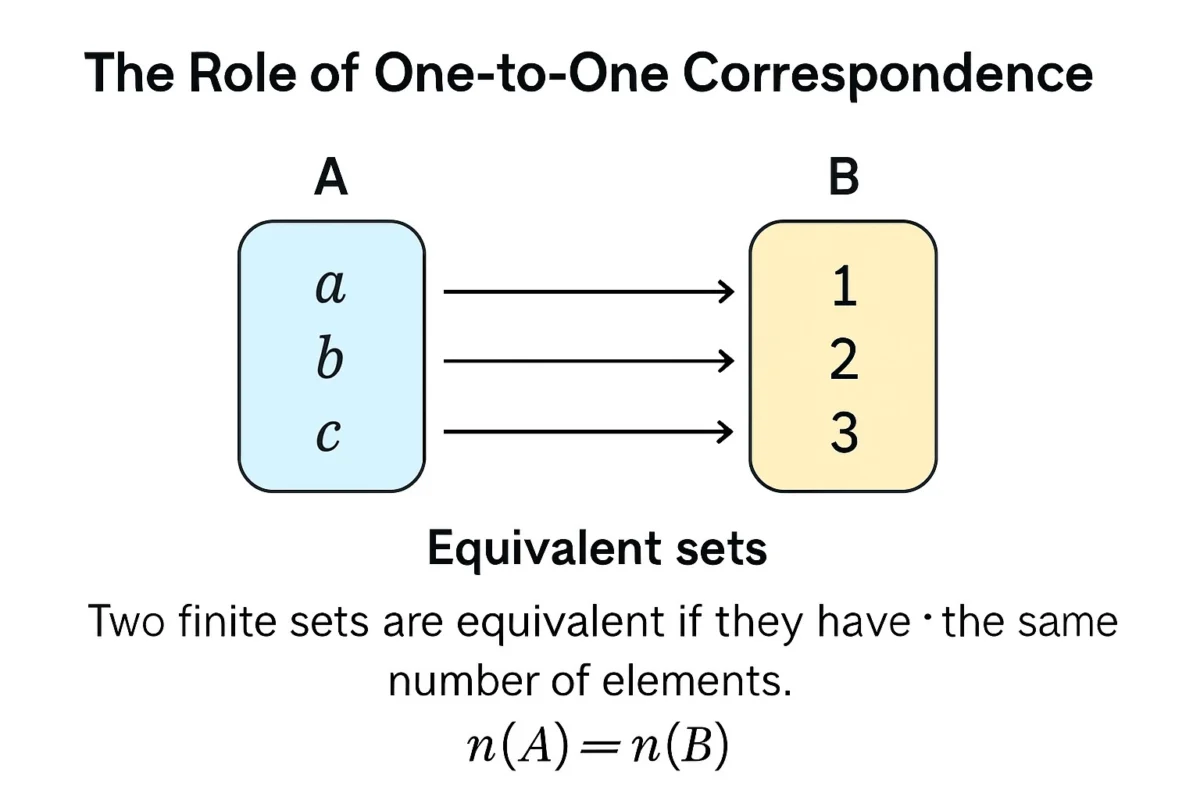
Comparing Equal vs. Equivalent Sets
All equal sets are equivalent because they must have the same number of elements. However, not all equivalent sets are equal. Equality requires identical content, not just size.
Think of equivalent sets as having the same capacity. Two boxes might both hold five items. If the items are different, the boxes are equivalent but not equal.
In discrete mathematics, equivalence is used to categorize sets into cardinality classes. This helps in understanding the scale of different mathematical structures and their mappings.
When solving problems, always check the cardinality first. If cardinalities differ, the sets cannot be equal or equivalent. If they match, they are at least equivalent.
Understanding these types of sets provides a clear framework for logic. Whether you are studying algebra or computer science, these definitions ensure precise communication of mathematical ideas.
What is the cardinality of the singleton set defined as S = { {∅} }?
Show Solution
A singleton set is defined as a set containing exactly one element. In the set S = { {∅} }, the element is the empty set {∅}. Since there is only one element inside the outer braces, the cardinality is 1.
Determine the solution set for the equation x - 7 = 3 and state if it is a singleton set.
Show Solution
Solving for x: x - 7 = 3 implies x = 10. The solution set is {10}. Since it contains exactly one element, it is a singleton set.
Given set A = {1, 2, 3} and set B = {3, 2, 1}, are these sets equal? Explain why.
Show Solution
Yes, sets are equal if they contain the same elements, regardless of order. Since both sets contain the exact same members {1, 2, 3}, A = B.
Are the sets A = {5, 5, 10} and B = {5, 10} equal? Why or why not?
Show Solution
In set theory, repetition of elements does not matter. Both sets contain the elements 5 and 10. Therefore, A = B.
If set A = {a, b} and set B = {1, 2}, are these sets equivalent? Are they equal?
Show Solution
Sets are equivalent if they have the same cardinality. Here, n(A) = 2 and n(B) = 2, so they are equivalent. They are not equal because their contents are different.
Define the condition for two sets A and B to be equal using the double-inclusion method.
Show Solution
Two sets A and B are equal if and only if A ⊆ B and B ⊆ A.
If set A has 5 elements and set B has 6 elements, can they be equivalent? Why?
Show Solution
No. Equivalent sets must have the same cardinality (the same number of elements). Since 5 ≠ 6, the sets cannot be equivalent.
Is the set of even prime numbers a singleton set? Justify your answer.
Show Solution
The only even prime number is 2. Therefore, the set is {2}. Since it contains exactly one element, it is a singleton set.
If n(A) = 1 and n(B) = 1, does this guarantee that A = B?
Show Solution
No. While they are both singleton sets (and thus equivalent), they are only equal if they contain the exact same element. For example, {1} and {2} are both singletons but are not equal.
What is the cardinality of the empty set ∅? Is it a singleton set?
Show Solution
The cardinality of the empty set is 0. A singleton set must have a cardinality of 1. Therefore, the empty set is not a singleton set.
Two sets A and B are equivalent. Does this imply they are equal?
Show Solution
No. Equivalence only requires the same number of elements (same cardinality). Equality requires the elements themselves to be identical.
If A = {x | x is a positive integer and x < 2}, is A a singleton set?
Show Solution
The only positive integer less than 2 is 1. Thus, A = {1}. Since it contains exactly one element, it is a singleton set.
Explain the difference between the set {a} and the element a.
Show Solution
The set {a} is a container (a collection), while a is the object contained within that set.
Are the sets {1, 2, 3} and {1, 2, 3, 3} equivalent? Are they equal?
Show Solution
The sets are equal because repetition is ignored ({1, 2, 3} = {1, 2, 3}). Since they are equal, they must also be equivalent.
If set S = { {1}, {2}, {3} }, what is the cardinality of S?
Show Solution
The elements of set S are the sets {1}, {2}, and {3}. There are 3 elements in total, so n(S) = 3.
If two sets have the same cardinality, what can we conclude about their relationship?
Show Solution
We can conclude that the sets are equivalent (denoted by ##\sim## or ##\approx##), but we cannot conclude they are equal.
Answer Key
- Math Problem 1: 1
- Math Problem 2: Yes, {10} is a singleton set.
- Math Problem 3: Yes, they are equal.
- Math Problem 4: Yes, they are equal.
- Math Problem 5: They are equivalent but not equal.
- Math Problem 6: A ⊆ B and B ⊆ A
- Math Problem 7: No, because their cardinalities are different.
- Math Problem 8: Yes, it is {2}.
- Math Problem 9: No.
- Math Problem 10: Cardinality is 0; it is not a singleton.
- Math Problem 11: No.
- Math Problem 12: Yes, it is {1}.
- Math Problem 13: {a} is a set; a is an element.
- Math Problem 14: They are both equal and equivalent.
- Math Problem 15: 3
- Math Problem 16: They are equivalent.
RESOURCES
- Types versus sets in math and programming languages - Reddit
- Types Of Sets - GeeksforGeeks
- Are there practical differences between type based and set ... - Reddit
- Set (mathematics) - Wikipedia
- What exactly is the semantic difference between set and type?
- Types, Sets and Categories - Mathematics Stack Exchange
- Types of Sets - Properties, Examples | Sets in Math - Cuemath
- Can sets contain objects of different types? - Math Stack Exchange
- What set-theoretic definitions can't easily be formalized in a type ...
- From Set Theory to Type Theory | The n-Category Café
- What are the types of Sets? - BYJU'S
- Chapter 1: Set Theory: Section 1.1: Types of Sets and Set Notation:
- Types and terms — Formalising Mathematics 0.1 documentation
- Set Theory Symbols - BYJU'S
- How do philosophers of mathematics understand the difference ...