On This Page
Understanding Union and Intersection
The Concept of Set Union
Set union represents the combination of all elements from two or more sets into a single collection. This operation ensures that every unique item present in the original sets is included in the resulting set without any unnecessary duplication.
The mathematical symbol for union is ##\cup##, which is often referred to as the "cup" operator. When we perform this operation on two sets, we are essentially performing a logical "OR" operation on their individual members.
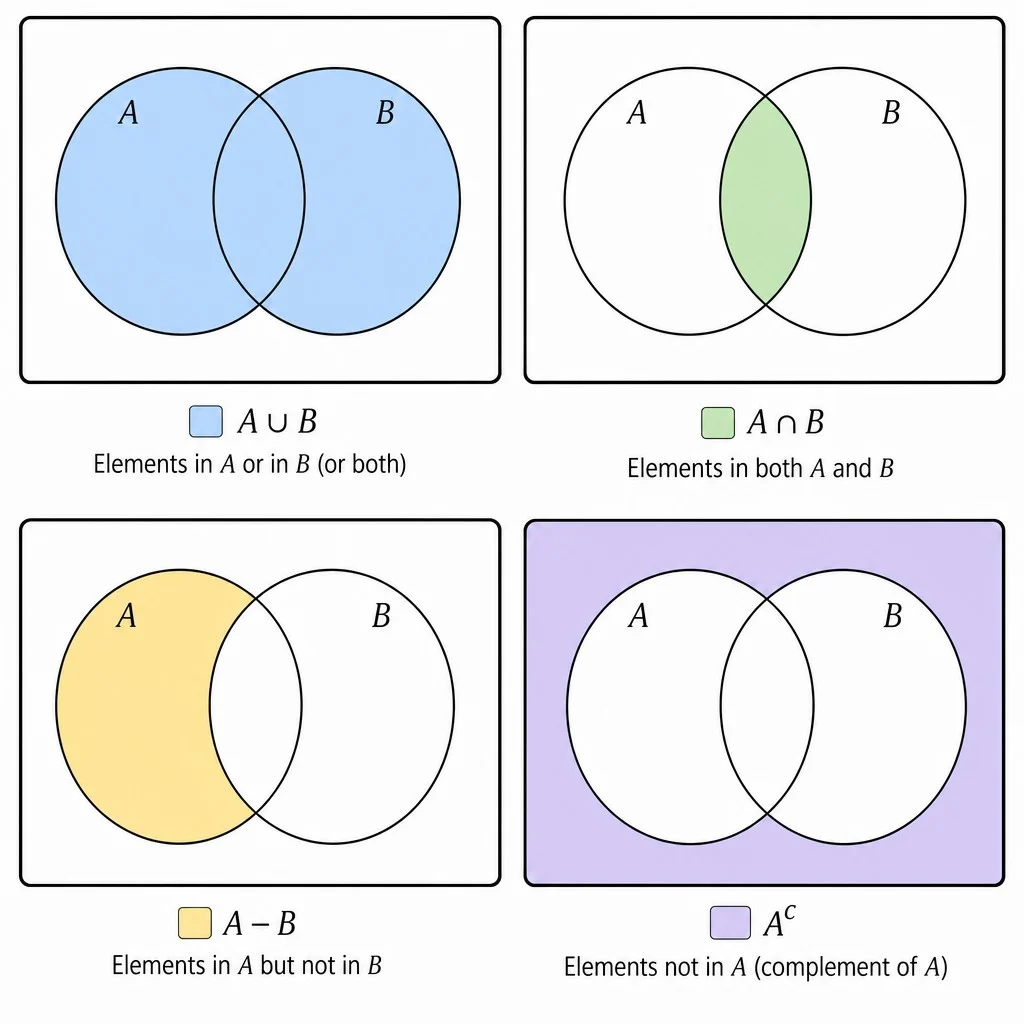
In formal notation, the union of set ##A## and set ##B## is written as ##A \cup B##. This set contains every element ##x## such that ##x## belongs to ##A##, or ##x## belongs to ##B##, or both.
Consider the following mathematical example that demonstrates how to calculate the union of two distinct sets of integers. The process involves listing all elements from both sets and removing any repeated values to maintain set integrity.
The union operation is commutative, meaning the order of the sets does not change the final result. Therefore, ##A \cup B## is always equal to ##B \cup A##, which simplifies many algebraic manipulations in set theory problems.
If Set A = {1, 2, 3} and Set B = {3, 4, 5}, what is the union of these two sets, written as A ∪ B?
To find the union, list all unique elements from both sets without duplication:
1. Combine elements: {1, 2, 3, 3, 4, 5}
2. Remove duplicates: {1, 2, 3, 4, 5}
Therefore, A ∪ B = {1, 2, 3, 4, 5}.
True or False: Because the union operation is commutative, A ∪ B is not necessarily equal to B ∪ A.
False. The concept of set union is commutative, which means that the order of the sets does not change the final result. Therefore, A ∪ B is always equal to B ∪ A.
In formal set notation, the union of set A and set B is defined as the set of all elements x such that:
According to the definition, the union contains every element x such that:
x belongs to A, OR x belongs to B, OR both.
The Concept of Set Intersection
Set intersection identifies the common elements shared between two or more sets. Unlike the union, which expands the collection, the intersection narrows it down to only those members that appear in every set involved in the operation.
The symbol used for intersection is ##\cap##, commonly known as the "cap" operator. This operation corresponds to the logical "AND" condition, where an element must satisfy membership in all participating sets to be included in the result.
We denote the intersection of ##A## and ##B## as ##A \cap B##. This set includes only those elements that are members of both ##A## and ##B## simultaneously. If no common elements exist, the result is an empty set.
When the intersection of two sets is empty, the sets are called disjoint sets. This occurs when ##A \cap B = \emptyset##, indicating that there is no overlap between the two collections in terms of their member elements.
Given the sets ##A = \{1, 2, 3, 4\}## and ##B = \{3, 4, 5, 6\}##, find ##A \cap B##.
Step 1: Look for elements that appear in both sets.
- ##A## has ##1, 2, 3, 4##
- ##B## has ##3, 4, 5, 6##
Step 2: The common elements are ##3## and ##4##.
Answer: ##A \cap B = \{3, 4\}##
Two sets have no elements in common. What is the name of this type of sets, and what is their intersection?
Step 1: If two sets have no common elements, they are called disjoint sets.
Step 2: The intersection of disjoint sets is the empty set.
Answer: They are called disjoint sets, and their intersection is ##\emptyset##.
Use the commutative property of intersection to write ##B \cap A## in a different order.
Step 1: The commutative property means the order of the sets does not change the intersection.
Step 2: So ##B \cap A## can be rewritten as ##A \cap B##.
Answer: ##B \cap A = A \cap B##
Intersection is also commutative and associative. These properties allow mathematicians to reorder or regroup intersection operations without affecting the final set of shared elements, providing flexibility when working with multiple complex sets in a single equation.
Set Difference and Relative Complement
Calculating the Difference Between Sets
The difference between two sets, often called the relative complement, identifies elements that belong to one set but not the other. This operation subtracts the overlapping members of the second set from the first set's total collection.
We represent the difference between set ##A## and set ##B## using the notation ##A - B## or ##A \setminus B##. The order is critical here because set difference is not commutative, unlike the union or intersection operations previously discussed.
The formal definition of ##A - B## includes all elements ##x## such that ##x## is a member of ##A## and ##x## is not a member of ##B##. This effectively removes any shared elements from the primary set.
The following example illustrates how to perform the subtraction of elements between two sets. Notice how only the elements unique to the first set remain after the operation is completed according to the formal definition provided above.
Understanding set difference is essential for isolating specific subsets within a larger data structure. It allows researchers to exclude specific categories of data when performing statistical analysis or when filtering elements in computer science algorithms.
Given set ##A = {1, 2, 3, 4}## and set ##B = {3, 4, 5, 6}##, find the difference ##A - B##.
To find ##A - B##, we start with set ##A## and remove any elements that are also present in set ##B##. Since 3 and 4 are in both sets, we remove them from ##A##. The remaining elements are {1, 2}. Therefore, ##A - B = {1, 2}##.
True or False: Is the set difference operation commutative? In other words, does ##A - B = B - A## always hold true?
False. The text states that the order is critical and that set difference is not commutative. For example, if ##A = {1, 2}## and ##B = {2, 3}##, then ##A - B = {1}##, but ##B - A = {3}##.
If set ##A = {a, b, c}## and set ##B = {d, e, f}##, what is the result of ##A - B##?
Since there are no overlapping elements between set ##A## and set ##B##, removing the elements of ##B## from ##A## changes nothing. Therefore, ##A - B = {a, b, c}##.
Define the formal requirement for an element ##x## to be included in the set difference ##A - B##.
According to the formal definition, an element ##x## is included in ##A - B## if and only if ##x## is a member of ##A## AND ##x## is not a member of ##B##.
If set ##A = {10, 20, 30}## and set ##B = {10, 20, 30}##, what is ##A - B##?
Since all elements of ##A## are also present in ##B##, subtracting ##B## from ##A## removes every element. The result is the empty set, denoted as ##\emptyset## or {}.
Properties of Set Difference
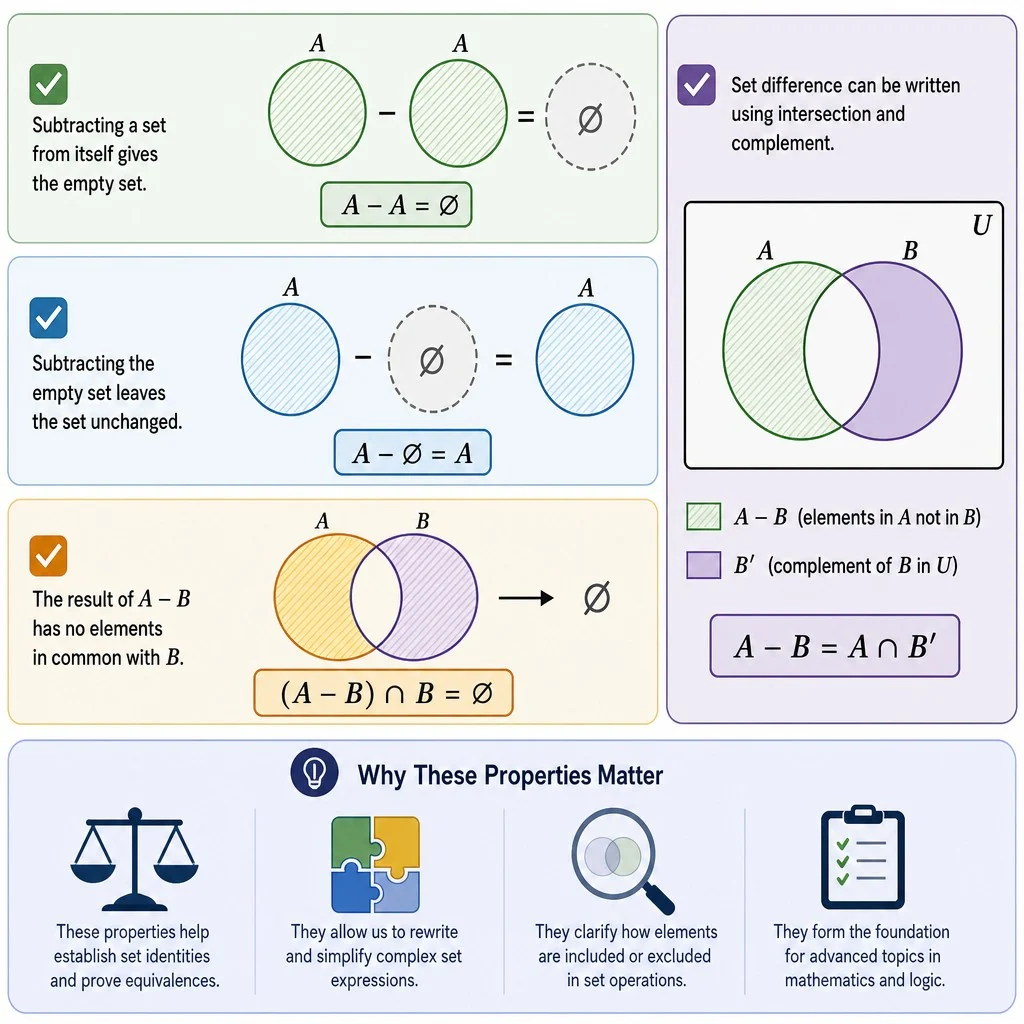
Set difference exhibits specific properties that distinguish it from other operations. For instance, subtracting a set from itself results in the empty set, denoted as ##A - A = \emptyset##, because no elements can remain after subtraction.
Another important property is that the difference between a set and the empty set is the set itself. Formally, ##A - \emptyset = A##. This occurs because there are no elements in the empty set to remove from ##A##.
The intersection of ##A - B## and ##B## is always an empty set. This is because the operation specifically removes all elements of ##B## from ##A##, ensuring that the result shares no common members with the subtracted set.
We can also express set difference using intersection and complement notation. Specifically, ##A - B## is equivalent to ##A \cap B'##, where ##B'## represents the absolute complement of set ##B## within a defined universal set of elements.
These logical relationships help in proving set identities and simplifying complex expressions. By converting differences into intersections, mathematicians can apply distributive and associative laws more easily during the process of formal mathematical proofs and logical reasoning.
The Complement of a Set
Universal Sets and Absolute Complements
The complement of a set refers to all elements that are not in that specific set but are part of a larger context. This context is defined by the universal set, which is usually denoted by the symbol ##U##.
An absolute complement is represented by notation such as ##A'##, ##A^c##, or ##\overline{A}##. It contains every element existing in the universal set ##U## that does not belong to the primary set ##A## during the calculation.
Mathematically, the complement is defined as ##A' = U - A##. This definition relies on the set difference operation to isolate everything outside of ##A## within the boundaries established by the universal set's total membership list.
The following problem demonstrates how to find the complement when a universal set is clearly defined. This calculation is a fundamental step in probability and logic where we must identify the "not" condition for various events.
The union of a set and its complement always results in the universal set, so ##A \cup A' = U##. Conversely, the intersection of a set and its complement is always the empty set, which means ##A \cap A' = \emptyset##.
If the universal set is U = {1, 2, 3, 4, 5} and set A = {1, 2}, what is the complement A'?
Using the definition A' = U - A, we remove the elements of A from U:
A' = {1, 2, 3, 4, 5} - {1, 2} = {3, 4, 5}.
Given that A is a set and A' is its complement, what is the result of the intersection A ∩ A'?
According to the provided content, the intersection of a set and its complement is always the empty set:
A ∩ A' = ##\emptyset##.
If the universal set U = {a, b, c, d} and set A = {a, c, d}, find the complement A'.
To find A', identify all elements in U that are not in A:
A' = {b}.
True or False: The union of a set and its complement, A ∪ A', always results in the universal set U.
True. As stated in the text, the union of a set and its complement always results in the universal set:
A ∪ A' = U.
Which mathematical symbol is commonly used to denote the universal set?
The universal set is usually denoted by the symbol ##U##.
De Morgan's Laws in Set Theory
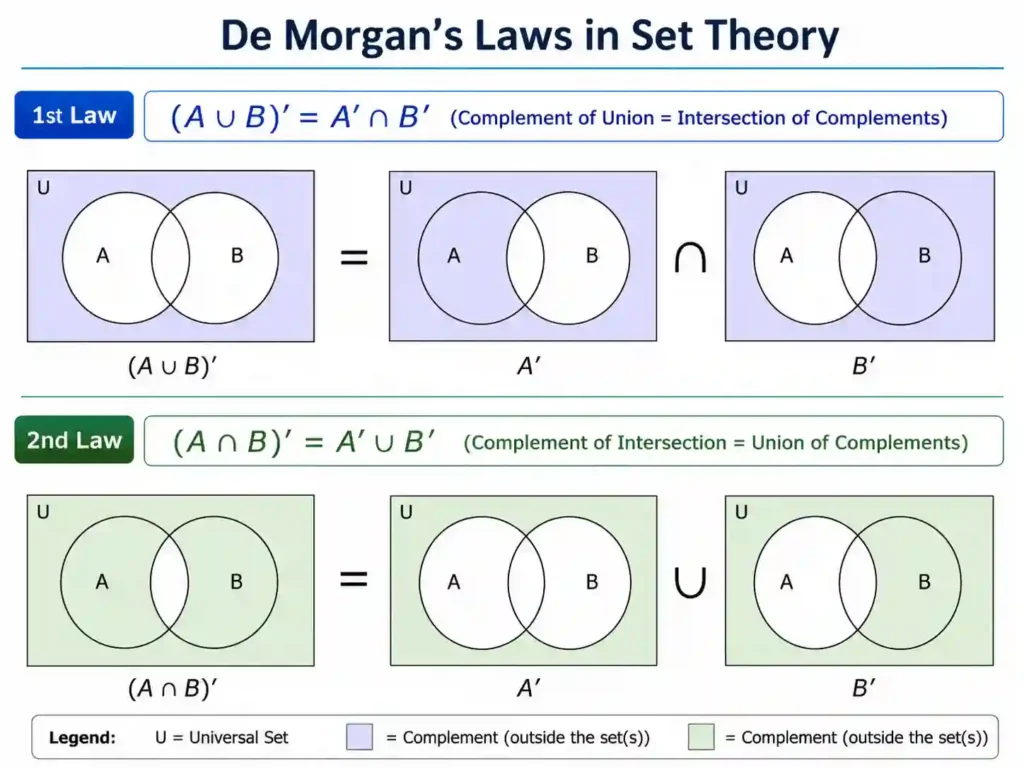
De Morgan's Laws are critical principles that describe the relationship between union, intersection, and complements. These laws allow us to distribute a complement operation across a union or intersection by changing the operator to its opposite.
The first law states that the complement of the union of two sets is equal to the intersection of their individual complements. Formally, this is written as ##(A \cup B)' = A' \cap B'## in standard set notation.
The second law states that the complement of the intersection of two sets is equal to the union of their complements. This is expressed as ##(A \cap B)' = A' \cup B'##, providing a powerful tool for simplification.
These laws are highly useful in digital logic design and computer programming. They allow developers to rewrite complex conditional statements into simpler forms, often reducing the number of logical gates or comparisons required in a system.
Applying De Morgan's Laws helps in visualizing set relationships without needing to list every element. By understanding how complements interact with other operations, students can solve abstract problems involving infinite sets or complex logical constraints more efficiently.
Practical Applications and Problem Solving
Representing Operations with Venn Diagrams
Venn diagrams provide a visual method for representing set operations and their relationships. They use overlapping circles within a rectangular boundary, where the rectangle represents the universal set and the circles represent individual sets being analyzed.
In a Venn diagram, the union ##A \cup B## is shown by shading the entire area covered by both circles. This visual representation clearly shows that elements from either or both sets are part of the combined collection.
The intersection ##A \cap B## is represented by shading only the overlapping region where the two circles meet. This area highlights the shared elements that satisfy the membership criteria for both sets simultaneously in the diagram.
The set difference ##A - B## is visualized by shading the part of circle ##A## that does not overlap with circle ##B##. This "crescent" shape effectively demonstrates the exclusion of elements belonging to the second set from the first.
Complements are shown by shading everything inside the universal rectangle that is outside the designated set circle. This helps students grasp the concept of the "outside" elements that exist within the context of the universal set definition.
Venn diagrams are discussed in details in next lesson
Solved Examples of Set Operations
Solving problems involving multiple operations requires a step-by-step approach. It is often helpful to solve the operations inside parentheses first, following a standard order of operations similar to arithmetic, to ensure accuracy in the final result.
For example, to find ##(A \cup B) \cap C##, one would first determine the union of ##A## and ##B##. Then, the resulting set would be intersected with set ##C## to find the final collection of elements that meet both conditions.
When dealing with complements in complex expressions, applying De Morgan's laws can often simplify the work. Breaking down the problem into smaller, manageable parts allows for a more systematic verification of the membership of each individual element.
Practicing these operations with small finite sets builds the intuition necessary for more advanced topics in probability and statistics. Mastery of set manipulation is a prerequisite for understanding functions, relations, and modern database query languages like SQL.
By consistently applying these technical definitions and visual tools, students can confidently navigate the foundational concepts of set theory. These skills form the backbone of mathematical reasoning and logical analysis across various scientific and technical disciplines.
The first step is to solve the operation inside the parentheses, which is finding the union of set ##A## and set ##B##, denoted as ##A \cup B##.
False. Similar to arithmetic, you must follow a standard order of operations, prioritizing the operations inside parentheses first to ensure accuracy.
After finding the union ##(A \cup B)##, you intersect that resulting set with set ##C## to find the elements that are common to both.
De Morgan's laws are the specific rules mentioned for simplifying complex expressions involving complements.
Breaking down problems allows for a more systematic verification of the membership of each individual element, reducing the chance of errors.
Practicing with small finite sets helps build the necessary intuition for more advanced topics like probability and statistics.
Mastery of set manipulation is a prerequisite for understanding SQL (Structured Query Language).
Set theory is a prerequisite for understanding functions and relations.
The result is a new set containing the collection of elements that meet the specified conditions defined by the operations.
Set operations form the backbone of mathematical reasoning and logical analysis across various scientific and technical disciplines.
RESOURCES
- Dictionaries should have key-based set operations - Ideas
- Set Operation - an overview | ScienceDirect Topics
- Set (mathematics) - Wikipedia
- Set socket: failed to open ICMPV4 socket: operation not permitted
- Set Operations | Union | Intersection | Complement | Difference
- Add elementary set operators for Arrays and Dictionaries · Issue #821
- Set Operation Destination DN - NetIQ Identity Manager
- Classical set operations for java.util.Collection - Stack Overflow
- Set operations - Grasshopper
- Measure Reports by Topic | MQIS - NH Medicaid Quality