On This Page
Defining Subsets and Their Notation
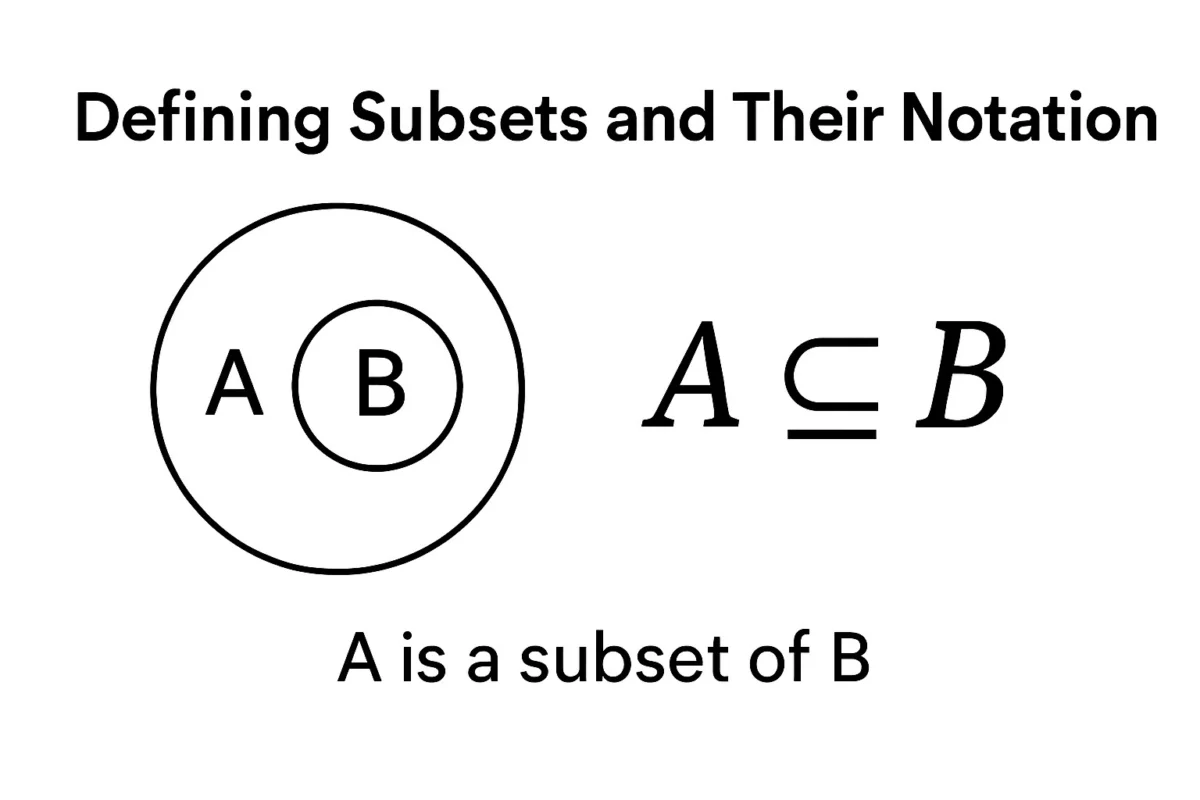
A subset is a fundamental concept where every element of one set exists within another set. If set A is a subset of set B, we conclude that there are no elements in A that are missing from B.
Mathematical notation uses a specific symbol to represent this inclusion relationship. We write ##A \subseteq B## to indicate that A is a subset of B. This symbol combines the "less than or equal to" logic with set boundaries.
The definition of a subset allows for the possibility that the two sets are identical. If ##A \subseteq B## and ##B \subseteq A##, then the sets are equal. This reflexive property is essential for formal mathematical proofs and logical set comparisons.
In practical terms, we check every single element of the first set against the second set. If we find even one element in A that is not in B, the subset condition fails immediately. We then write ##A \nsubseteq B##.
Subsets help mathematicians organize data into hierarchies and categories. By defining a subset, we focus on a specific portion of a larger mathematical universe. This categorization is the basis for more complex operations in discrete mathematics and logic.
Understanding Subsets: Definition, Notation, and Properties
This table clarifies the fundamental concept of subsets, including their definition, mathematical notation, and practical implications.
| Concept | Explanation | Notation / Example | Application |
|---|---|---|---|
| Subset Definition | Every element of Set A is also an element of Set B. No elements in A are missing from B. | A={1,2}, B={1,2,3}. Here, A is a subset of B. | Organizing data into hierarchies and categories. |
| Subset Notation | The specific symbol used to formally express the subset relationship between two sets. | ##A \subseteq B## (A is a subset of B) | Formalizing mathematical statements and proofs in logic. |
| Set Equality (Reflexive Property) | If A is a subset of B, AND B is a subset of A, then A and B are the same set. | If ##A \subseteq B## and ##B \subseteq A##, then A = B. | Proving set equivalence in discrete mathematics and algorithms. |
| Non-Subset Condition | If even one element in Set A is not found in Set B, then A is not a subset of B. | ##A \nsubseteq B##. Example: A={1,4}, B={1,2,3}. | Validating set relationships and conditions in data filtering. |
- The ##...## notation indicates mathematical symbols.
- Subsets are foundational for more complex operations in discrete mathematics.
The Symbolism of Inclusion
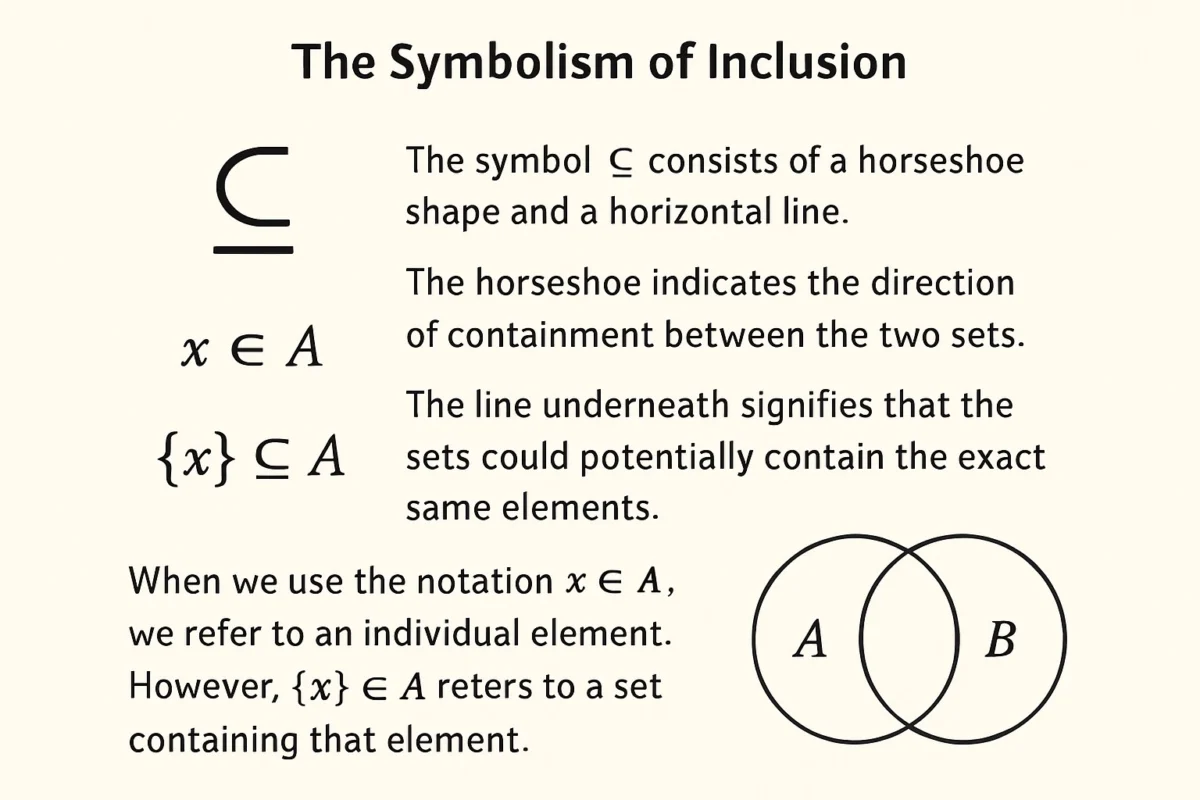
The symbol ##\subseteq## consists of a horseshoe shape and a horizontal line. The horseshoe indicates the direction of containment between the two sets. The line underneath signifies that the sets could potentially contain the exact same elements.
When we use the notation ##x \in A##, we refer to an individual element. However, ##\{x\} \subseteq A## refers to a set containing that element. Distinguishing between membership and inclusion is a critical step for beginners in set theory.
Logical statements often define subsets using conditional logic. We say ##A \subseteq B## if and only if for every element ##x##, if ##x \in A##, then ##x \in B##. This formal definition removes ambiguity from set relationships.
Venn diagrams provide a visual way to represent these symbolic relationships. A circle representing set A would be drawn entirely inside the circle for set B. This visual aid clarifies how elements are distributed across different mathematical boundaries.
Transitivity is another important symbolic property of subset notation. If ##A \subseteq B## and ##B \subseteq C##, it logically follows that ##A \subseteq C##. This chain of inclusion allows us to relate multiple sets through their shared elements.
Identifying Subsets in Practice
Is the set of even numbers a subset of the set of integers ##\mathbb{Z}##? Explain your reasoning.
Yes, the set of even numbers is a subset of the set of integers. By definition, a set A is a subset of set B if every element of A is also an element of B. Since every even number is by definition an integer, the condition is satisfied.
True or False: The empty set ##\emptyset## is a subset of the set of natural numbers ##\mathbb{N}##.
True. By definition, the empty set ##\emptyset## is a subset of every set because it contains no elements that could fail the inclusion test.
If we define set A as {2, 4, 6}, which of the following is the correct notation for a subset of A: 2 or {2}?
The correct notation is {2}. Writing a number alone, such as 2, indicates an element of the set, whereas enclosing it in curly braces {2} denotes a subset.
Explain why the definition of the universal set is important when identifying subsets.
Identifying subsets requires adherence to a defined domain. If the universal set changes, the relationships between sets can change. Therefore, consistency in defining the boundaries of each set is vital for accurate mathematical reasoning.
Given the hierarchy of number systems, is ##\mathbb{N}## a subset of ##\mathbb{Z}##?
Yes, ##\mathbb{N}## (natural numbers) is a subset of ##\mathbb{Z}## (integers). This represents a standard hierarchy in number systems where every natural number is also an integer.
To identify a subset, we must examine the members of the given sets. Consider the set of even numbers and the set of all integers. Since every even number is an integer, the first is a subset of the second.
We often encounter subsets when working with number systems. For instance, the set of natural numbers ##\mathbb{N}## is a subset of the set of integers ##\mathbb{Z}##. This hierarchy continues through rational numbers and finally to the real number system.
The empty set, denoted as ##\emptyset## or ##\{\}##, is a unique case. By definition, the empty set is a subset of every set. This is because there are no elements in ##\emptyset## that could possibly fail the inclusion test.
When listing subsets, we must use curly braces {} to maintain proper set syntax. Writing a number alone indicates an element, not a subset. Proper formatting ensures that mathematical operations like unions and intersections remain valid and clear.
Identifying subsets requires a strict adherence to the defined domain. If we change the universal set, the subset relationships might also change. Consistency in defining the boundary of each set is vital for accurate mathematical reasoning and problem-solving.
Proper Subsets and Set Equality
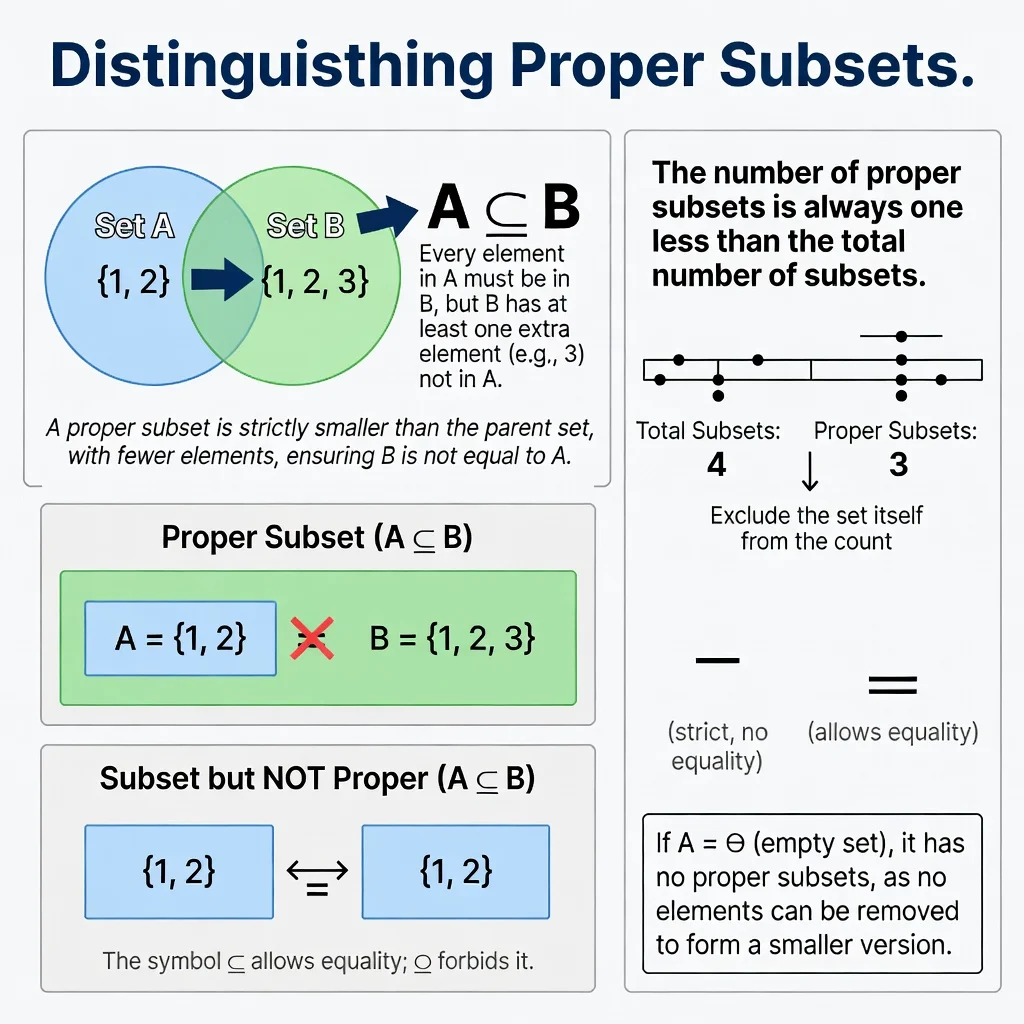
A proper subset is a more restrictive version of a standard subset. While a regular subset can be equal to the parent set, a proper subset must contain fewer elements. This distinction is vital for understanding set sizes.
We use the notation ##A \subset B## to represent a proper subset. The absence of the horizontal line under the horseshoe indicates that equality is not permitted. This means B must contain at least one element not found in A.
Every set has subsets, but not every set has proper subsets. The empty set is the only set that contains no proper subsets. Since it has no elements to remove, you cannot create a smaller version of it.
Proper subsets help define the concept of "strictly contained." If ##A \subset B##, we know for certain that A is a smaller collection than B. This property is useful when comparing the cardinality of finite and infinite sets.
In many textbooks, the symbol ##\subsetneq## is used to emphasize that the sets are not equal. This notation explicitly excludes the possibility of ##A = B##. Using clear symbols prevents errors in logic when building mathematical proofs or algorithms.
Distinguishing Proper Subsets
To distinguish a proper subset, we first verify that the inclusion condition is met. Every element in the first set must be in the second. Then, we check if the second set has any extra elements that the first lacks.
If set A is ##\{1, 2\}## and set B is ##\{1, 2, 3\}##, then A is a proper subset. However, if B was also ##\{1, 2\}##, then A would be a subset but not a proper subset.
The number of proper subsets is always one less than the total number of subsets. This is because we exclude the set itself from the count. The set itself is the only "improper" subset that exists for any given set.
Proper subsets are frequently used in the study of topology and analysis. They allow mathematicians to define neighborhoods and open sets with precision. Understanding the "proper" constraint is a prerequisite for higher-level courses in pure mathematics.
In computer science, proper subsets are used to define strict hierarchies in data structures. When one category is a proper subset of another, it implies a specialized subtype. This logic mirrors class inheritance in many object-oriented programming languages.
Explain why the set of even numbers is considered a subset of the set of integers ##\mathbb{Z}##.
A set A is a subset of set B if every element of A is also an element of B. Since every even number is by definition an integer, every member of the set of even numbers is contained within the set of integers ##\mathbb{Z}##. Therefore, the set of even numbers is a subset of ##\mathbb{Z}##.
True or False: The empty set ##\emptyset## is a subset of the set of natural numbers ##\mathbb{N}##. Explain your reasoning.
True. By definition, the empty set ##\emptyset## is a subset of every set. This is because there are no elements in the empty set that could fail the inclusion test, satisfying the condition for being a subset for any given set.
Identify the error in the following statement: "The number 5 is a subset of the set of integers ##\mathbb{Z}##."
The error lies in the notation. Writing a number alone, such as 5, indicates an element, not a subset. To represent 5 as a subset, it must be enclosed in curly braces: {5}. Thus, {5} is a subset of ##\mathbb{Z}##, whereas 5 is an element of ##\mathbb{Z}##.
Describe the hierarchy of number systems mentioned in the text starting from natural numbers ##\mathbb{N}##.
The hierarchy follows this progression: The set of natural numbers ##\mathbb{N}## is a subset of the set of integers ##\mathbb{Z}##, which is a subset of the set of rational numbers, which is finally a subset of the real number system.
Why is it important to define the universal set when determining subset relationships?
Identifying subsets requires strict adherence to the defined domain. If the universal set is changed, the relationships between sets may change. Consistency in defining the boundaries of each set is essential for accurate mathematical reasoning and valid set operations.
The Role of the Empty Set
The empty set is considered a proper subset of any non-empty set. Since the empty set contains zero elements, and the target set contains at least one, the "strictly smaller" condition is satisfied. This is a standard convention.
If we have set ##A = \{5\}##, its subsets are ##\emptyset## and ##\{5\}##. In this case, the only proper subset is ##\emptyset##. The set ##\{5\}## is a subset but fails the "proper" criteria because it equals set A.
The empty set acts as the starting point for building all other sets. In axiomatic set theory, complex structures are built from the empty set using specific rules. Its role as a universal subset makes it a unique mathematical object.
When counting subsets, students often forget to include the empty set. It is a valid subset because the logical condition for inclusion is "vacuously true." There are no elements in the empty set to contradict the subset definition.
In programming, the empty set is often represented by a null value or an empty list. Understanding its mathematical properties helps developers handle edge cases in set-based algorithms. It ensures that functions returning subsets always account for the empty possibility.
Given set A = {1, 2, 3}, list all the proper subsets of set A.
A proper subset of A must be a subset of A that is not equal to A itself. The subsets of A are: ∅, {1}, {2}, {3}, {1, 2}, {1, 3}, {2, 3}, and {1, 2, 3}. Removing the set equal to A, the proper subsets are: ∅, {1}, {2}, {3}, {1, 2}, {1, 3}, and {2, 3}.
If set B = {x, y}, is set {x, y} a proper subset of B? Explain why or why not.
No, {x, y} is not a proper subset of B. By definition, a proper subset must contain fewer elements than the original set. Since {x, y} is equal to B, it is a subset, but it is not a proper subset.
Let set C = {5, 10}. Is the empty set ∅ a proper subset of C? Use the definition of proper subsets to justify your answer.
Yes, the empty set ∅ is a proper subset of C. The empty set is a subset of every set, and since ∅ does not contain all the elements of C (it contains zero elements while C contains two), it satisfies the condition of being a proper subset.
The Concept of Power Sets
A power set is a set that contains every possible subset of a given set. If we start with a set S, the power set is the collection of all its parts. This includes the empty set and S itself.
The notation for a power set is usually ##P(S)## or ##\wp(S)##. It is important to remember that the elements of a power set are sets themselves. This creates a higher-order structure where sets are treated as individual members.
Power sets are significantly larger than the original sets. As the number of elements in the original set increases, the power set grows exponentially. This growth makes power sets a key topic in computational complexity and set theory.
Constructing a power set requires a systematic approach to ensure no subsets are missed. We usually start with the empty set, then list single-element sets, followed by pairs, and so on. This organized method prevents common counting errors.
In the context of the power set, every element ##X \in P(S)## corresponds to the relationship ##X \subseteq S##. The power set effectively maps the "subset of" relationship into a new set of its own. This abstraction is powerful for advanced logic.
Defining the Power Set Collection
The formal definition of a power set uses set-builder notation. We define it as follows:
This states that the power set of A is the set of all X such that X is a subset of A.
When writing out a power set, we must use double braces for subsets with multiple elements. For example, if ##A = \{1\}##, then ##P(A) = \{ \emptyset, \{1\} \}##. The outer braces define the power set, while inner braces define the elements.
The power set of the empty set is not empty. Since the empty set has one subset (itself), its power set contains exactly one element: the empty set. We write this as ##P(\emptyset) = \{ \emptyset \}##.
In discrete mathematics, power sets are used to explore the concept of the "power of the continuum." This involves comparing the sizes of infinite sets. The power set of the natural numbers has a strictly larger cardinality than the natural numbers themselves.
Understanding power sets is essential for understanding Boolean algebras. The collection of subsets of a set, under the operations of union and intersection, forms a structure that follows specific algebraic laws. This has direct applications in digital circuit design.
Systematic Construction Methods
A common way to construct a power set is the binary method. For a set with n elements, we can represent each subset as a binary string of length n. Each bit indicates whether an element is included or excluded.
Another method is the recursive approach. To find the power set of a set with an additional element, take the power set of the original set. Then, create a new copy of those subsets and add the new element to each.
Systematic construction helps in verifying the total count. If we know a set has three elements, we expect eight subsets. If our list has seven or nine, we know an error occurred during the construction process.
For a set ##\{1, 2, 3\}##, the construction starts with ##\emptyset##. Then we add ##\{1\}, \{2\}, \{3\}##. Next, we form pairs: ##\{1, 2\}, \{1, 3\}, \{2, 3\}##. Finally, we add the original set ##\{1, 2, 3\}## to complete the collection.
Visualizing the power set as a Hasse diagram can clarify the inclusion hierarchy. The diagram shows how smaller subsets are contained within larger ones. This visual tool is often used in order theory to study partially ordered sets.
How many subsets are in the power set of a set with ##3## elements?
Answer: ##8##
Step 1: A set with ##n## elements has ##2^n## subsets in its power set.
Step 2: Substitute ##n = 3##.
Step 3: ##2^3 = 8##.
So, the power set has ##8## subsets.
If a set has ##4## elements, how many subsets does its power set contain?
Answer: ##16##
Step 1: Use the power set formula ##2^n##.
Step 2: Substitute ##n = 4##.
Step 3: ##2^4 = 16##.
So, the power set contains ##16## subsets.
How many subsets are in the power set of the empty set?
Answer: ##1##
Step 1: The empty set has ##0## elements.
Step 2: Use the formula ##2^n## for a power set.
Step 3: Substitute ##n = 0##, so ##2^0 = 1##.
So, the power set of the empty set has ##1## subset.
Calculating Subsets and Power Set Cardinality
The cardinality of a power set refers to the total number of elements it contains. For any finite set with ##n## elements, there is a specific mathematical formula to determine this size. This formula is derived from basic combinatorics.
Each element in a set has two choices: it is either in a subset or it is not. Since there are ##n## elements and each has 2 choices, the total number of combinations is ##2 \times 2 \times \dots \times 2##.
calculation results in the exponential formula ## 2^n ##. For example, a set with 4 elements will have ## 2^4 = 16 ## subsets. This rapid growth explains why listing power sets for large sets is physically impossible.
The number of proper subsets is calculated by subtracting the set itself from the total. The formula for the number of proper subsets is therefore ##2^n - 1## . This accounts for every subset except the improper one.
Understanding these formulas is crucial for probability and statistics. Many problems involve choosing groups from a larger set, which is essentially selecting subsets. Cardinality provides the denominator for many probability calculations in finite sample spaces.
The Power of Two Formula
The formula ##2^n## is a cornerstone of discrete mathematics. It relates the number of elements in a set to the size of its power set. This relationship is often used to prove theorems about set sizes and functions.
If a set is empty, ##n = 0##. Applying the formula gives ## 2^0 = 1 ## . This confirms that the empty set has exactly one subset, which is the empty set itself. The formula remains consistent across all non-negative integers.
For a set with 10 elements, the power set contains ##1024## elements. This illustrates how quickly the complexity increases. In computer science, this exponential growth often leads to problems that are computationally expensive to solve.
The power of two also appears in binary representation. Each subset can be mapped to a unique binary number. This mapping is why power sets are frequently discussed in the context of bitwise operations and data compression.
In mathematical logic, the power set formula is linked to the concept of the "characteristic function." A characteristic function maps elements to either 0 or 1. The set of all such functions has the same cardinality as the power set.
Solving Cardinality Problems
When solving problems, always identify the value of ##n## first. This is the number of distinct elements within the set. Be careful with sets that contain other sets as elements, as they only count as one item.
Consider the set ##A = \{1, \{2, 3\}\}##. Here, ##n = 2## because the set ##\{2, 3\}## is treated as a single member. The number of subsets for this set would be ##2^2 = 4##, not eight.
If a problem asks for non-empty subsets, you must subtract the empty set from the total. The formula would then be ##2^n - 1##. Always read the requirements carefully to determine which subsets to include or exclude.
For competitive exams like the JEE, cardinality problems often involve intersections and unions. You might be asked to find the number of subsets of ##A \cup B##. In such cases, calculate the size of the resulting set before applying the formula.
Practicing with different set sizes builds intuition for exponential growth. Recognizing powers of two (2, 4, 8, 16, 32, 64...) allows for faster calculations during timed assessments. This numerical fluency is a hallmark of an expert mathematician.
Show Solution
The subsets are: ∅, {1}, {2}, and {1, 2}.
Show Solution
The power set of the empty set is the set containing the empty set: {∅}.
Show Solution
The number of elements in a power set is given by ##2^n##, where ##n## is the number of elements in the set. Since B has 3 elements, P(B) has ##2^3 = 8## elements.
Show Solution
Yes, because every element of {1, 2} is also an element of {1, 2, 3}.
Show Solution
The elements of P(C) are the subsets of C, which are ∅ and {a}. So, P(C) = {∅, {a}}.
Show Solution
True. For any set A, A ⊆ A.
Show Solution
Using the formula ##2^n##, where ##n = 4##, we get ##2^4 = 16## subsets.
Show Solution
Yes, by definition, the empty set ∅ is a subset of every set.
Show Solution
Yes, because both 5 and 15 are contained within set D.
Show Solution
The power set P(S) is the set of all possible subsets of S, including the empty set and S itself.
Show Solution
We solve ##2^n = 32##. Since ##2^5 = 32##, the set has 5 elements.
Show Solution
Yes, because {1, 2} is a subset of {1, 2, 3} and {1, 2} ≠ {1, 2, 3}.
Show Solution
The subsets are ∅, {0}, {1}, and {0, 1}. Thus, P({0, 1}) = {∅, {0}, {1}, {0, 1}}.
Show Solution
Yes, if set A = B, then A is a subset of B (and B is a subset of A).
Show Solution
Yes, the empty set is always an element of the power set because the empty set is a subset of every set.
Show Solution
The set E has 2 elements. Therefore, P(E) has ##2^2 = 4## elements.
Show Solution
Yes, the order of elements in a set does not matter, so {a, b} is equal to {b, a}.
Show Solution
A set with 0 elements has ##2^0 = 1## subset (the empty set).
Show Solution
Yes, every set is a subset of itself.
Show Solution
The positive integers less than 3 are 1 and 2. So, G = {1, 2}.
RESOURCES
- No results found.