The systematic study of organic nitrogen chemistry begins with the realization that amines are structural and chemical derivatives of ammonia, wherein one or more hydrogen atoms have been sequentially replaced by alkyl or aryl hydrocarbyl fragments. In physiological environments, industrial synthesis, and biochemical pathways, amines govern critical behaviors ranging from enzymatic catalysis to macromolecular architecture. Naturally occurring amines encompass vital neurotransmitters such as adrenaline, cardiovascular regulators such as ephedrine, as well as foundational biogenic building blocks like amino acids, vitamins, and nucleic acids. Synthetic amines are equally pervasive across contemporary chemical manufacturing, serving as active pharmaceutical ingredients, agrochemical formulations, textile dyestuffs, and specialty polymers.
Understanding the systematic principles of amine classification and nomenclature requires a rigorous departure from the familiar conventions applied to oxygen-bearing functional groups like alcohols. In alcohol chemistry, primary, secondary, and tertiary designations depend on the substitution degree of the adjacent carbon atom attached to the hydroxyl function. By contrast, amine classification is defined entirely by the degree of substitution at the trivalent nitrogen atom itself. This fundamental distinction alters both physical properties and reaction topologies, controlling the presence of acidic ##\ce{N-H}## protons, hydrogen-bonding capacities, and accessibility to the basic non-bonding electron lone pair.
Mastery of amine nomenclature, spanning trivial designations and modern
(IUPAC) protocols, is an indispensable prerequisite for predicting chemical behavior, spectroscopic signatures, and synthetic pathways. Beyond simple monoamines, polyfunctional substrates and aromatic heterocycles introduce hierarchical priority rules where the amino group fluctuates between being a senior characteristic suffix and a subordinate prefix. Exploring these nomenclatural rules alongside constitutional isomerism and metamerism establishes the conceptual foundation required for evaluating basicity, nucleophilicity, and advanced transformations across the entire nitrogen curriculum.
On This Page
- Fundamental Classification and Electronic Architecture of Amines
- Systematic IUPAC Rules for Aliphatic and Diamine Frameworks
- IUPAC Nomenclature of Aromatic, Alkaryl, and Heterocyclic Amines
- Polyfunctional Molecules and IUPAC Seniority Hierarchies
- Structural Isomerism Across Isomeric Amine Systems
- Complete Structural Mapping of the C4H11N Isomer Series
Fundamental Classification and Electronic Architecture of Amines
The structural classification of amines is anchored on the degree of organo-substitution observed at the central trivalent nitrogen atom. Unlike haloalkanes or aliphatic alcohols, where primary, secondary, and tertiary descriptors characterize the substitution pattern of the alpha carbon atom, an amine's classification is determined strictly by the number of carbonaceous groups directly bound to nitrogen. Replacing a single hydrogen atom of ammonia (##\ce{NH3}##) yields a primary (1°) amine, replacing two gives a secondary (2°) amine, and displacing all three yields a tertiary (3°) amine. A further alkylation event yields a quaternary ammonium cation containing four carbon-nitrogen bonds.
Primary, Secondary, and Tertiary Distinctions vs. Carbocations
The contrast between amine classification and carbocation or alcohol taxonomy represents a perennial point of confusion in organic analysis. In the case of 2-methylpropan-2-ol, the compound is universally categorized as a tertiary alcohol because the hydroxyl functional group resides upon a carbon bonded to three other carbons. Conversely, 2-methylpropan-2-amine, possessing the empirical formula ##\ce{(CH3)3C-NH2}##, is unequivocally classified as a primary (1°) amine. Even though the attached tert-butyl group is structurally tertiary, the nitrogen atom itself retains two direct bonds to hydrogen atoms and bears only one covalent linkage to carbon, satisfying the exact criterion for a primary amine.
This fundamental distinction carries major structural implications for physical behavior, boiling points, and reactive capacities. Primary amines exhibit two polar ##\ce{N-H}## bonds capable of serving as both hydrogen-bond donors and acceptors, secondary amines retain a solitary ##\ce{N-H}## bond with diminished donor capacity, and tertiary amines lack direct ##\ce{N-H}## bonds entirely. Consequently, tertiary amines cannot engage in intermolecular hydrogen bonding with themselves, which depresses their boiling points relative to isomeric primary and secondary counterparts. In addition, quaternary ammonium species, represented by the general formulation ##\ce{[R4N]+ X-}##, lack non-bonding lone pairs on nitrogen and exist purely as ionic crystalline salts.
Aliphatic, Aromatic, and Alkaryl Amine Distinctions
Beyond the simple numerical degree of substitution, amines are broadly segregated into aliphatic, aromatic, and alkaryl subcategories based upon the hybridization of the attached carbon skeletons. Aliphatic amines link the nitrogen center exclusively to ##\mathrm{sp^3}##-hybridized carbon atoms, preserving an active lone pair that exhibits localized electron density and localized basicity. Conversely, aromatic amines (arylamines), typified by aniline (##\ce{C6H5NH2}##), feature direct covalent attachment between the nitrogen atom and an ##\mathrm{sp^2}##-hybridized aromatic ring carbon. This arrangement enforces resonance overlap between the nitrogen lone pair and the delocalized ##\pi##-electron framework of the aromatic arene nucleus.
Alkaryl amines occupy a structurally distinct category in which the amino functional group resides upon an aliphatic side chain appended to an aromatic ring. The canonical archetype is benzylamine, ##\ce{C6H5CH2NH2}##, where the ##-\ce{NH2}## unit connects to an intervening benzylic ##\mathrm{sp^3}## carbon rather than directly to the aryl system. Because the saturated methylene spacer disrupts ##\mathrm{p-\pi}## orbital conjugation, the nitrogen lone pair cannot delocalize into the aromatic sextet. As a result, alkaryl amines demonstrate physical properties, basicity constants, and nucleophilic reactivities that align with standard aliphatic amines rather than conjugated aromatic arylamines.
Systematic IUPAC Rules for Aliphatic and Diamine Frameworks
The International Union of Pure and Applied Chemistry dictates clear protocols for designating organic amines without ambiguity. Common nomenclature persists in vernacular laboratory settings, appending the suffix "amine" directly to the name of the attached alkyl radical to form single words such as methylamine or ethylamine. Under the systematic IUPAC framework, aliphatic amines are viewed as alkanamines. Here, the final vowel "e" of the corresponding parent alkane name is dropped and replaced with the characteristic functional suffix "amine," incorporating numerical locants to pinpoint the position of attachment along the continuous carbon spine.
Alkanamine Substitutive Rules and Locant Notation
When generating systematic IUPAC designations for primary aliphatic amines, the initial step requires locating the longest continuous carbon chain that incorporates the carbon atom bearing the nitrogen functional group. The chain is numbered sequentially from the terminal end that yields the lowest possible locant for the amino-bearing carbon atom, regardless of where alkyl branch points reside. For instance, the unbranched saturated three-carbon amine ##\ce{CH3-CH2-CH2-NH2}## is designated propan-1-amine, whereas its constitutional isomer ##\ce{CH3-CH(NH2)-CH3}## carries the systematic name propan-2-amine under IUPAC 1993 and 2013 revision recommendations.
For secondary and tertiary amines possessing unsymmetrical carbon frameworks, IUPAC protocol requires selecting the longest continuous carbon chain as the parent alkanamine root. Any remaining alkyl or aryl fragments attached to the nitrogen atom are subsequently treated as structural substituents. Rather than using numerical locants, these substituents receive the italicized capital prefix ##N-##, which explicitly denotes their direct linkage to the nitrogen heteroatom. Accordingly, ##\ce{CH3-NH-CH2-CH3}## is named ##N##-methylethanamine, while ##\ce{CH3-CH2-N(CH3)-CH2-CH2-CH3}## is designated ##N##-ethyl-##N##-methylpropan-1-amine, alphabetizing the respective ##N##-substituents across the formal entry.
Di-, Tri-, and Polyamines in Industrial Substrates
When an aliphatic hydrocarbon chain bears more than one amino functional group, the nomenclatural rules change slightly to preserve phonetic clarity and structural accuracy. Rather than eliding the final vowel "e" from the parent hydrocarbon, the complete name of the parent alkane is preserved intact. A multiplicative prefix such as "diamine," "triamine," or "tetramine" is appended directly, preceded by the appropriate numerical locants indicating functional attachments. This rule prevents ambiguous consonant clusters and clarifies the identity of the underlying saturated aliphatic core backbone.
A familiar industrial example of this rule is 1,2-diaminoethane, represented by the condensed formula ##\ce{H2N-CH2-CH2-NH2}##. Under formal IUPAC conventions, this chelating ligand is systematically designated ethane-1,2-diamine, retaining the terminal "e" of ethane. Similarly, the primary precursor to Nylon-6,6, historically known as hexamethylenediamine, is systematically named hexane-1,6-diamine: ##\ce{H2N-(CH2)6-NH2}##. Symmetrical polyamines such as propane-1,2,3-triamine illustrate how multi-carbon scaffolds with identical amino functions are named systematically, ensuring every amine group is numbered along the parent framework.
IUPAC Nomenclature of Aromatic, Alkaryl, and Heterocyclic Amines
Aromatic amines introduce unique naming conventions due to historical precedence and the widespread adoption of trivial designations by IUPAC bodies. Benzenamine, commonly known as aniline (##\ce{C6H5NH2}##), serves as the foundational parent structure for an extensive family of substituted aromatic amines. While benzenamine represents the strictly systematic substitutive name derived by dropping the final letter from benzene, IUPAC accepts "aniline" as an official, fully approved parent designation for deriving substituted aromatic analogs, including ring-functionalized derivatives and ##N##-substituted aryl complexes.
Benzenamine Derivatives and Ring Substitutions
When additional ring substituents populate the aromatic nucleus of an aniline framework, the ring carbon bearing the primary amino group is automatically designated as carbon ##\ce{C-1}##. The numbering of the six-membered carbocycle then proceeds sequentially in the direction that assigns the lowest possible locants to subsequent substituents. In traditional chemical practice, the relative positions 1,2-, 1,3-, and 1,4- are frequently designated by the classical prefixes ortho- (##o##-), meta- (##m##-), and para- (##p##-), although IUPAC rules require explicit numerical locants in formal contexts.
For instance, an amino derivative bearing a methyl substituent at the 2-position, historically termed ##o##-toluidine, carries the systematic IUPAC name 2-methylbenzenamine or 2-methylaniline. When dealing with halogens, such as ##\ce{p-Br-C6H4-NH2}##, the approved designation is 4-bromobenzenamine (or 4-bromoaniline). Secondary and tertiary aromatic amines with alkyl groups appended to the exocyclic nitrogen use the locant prefix ##N-##. Thus, ##\ce{C6H5-NH-CH3}## is systematically designated ##N##-methylaniline (or ##N##-methylbenzenamine), and its fully alkylated relative ##\ce{C6H5-N(CH3)2}## is named ##N,N##-dimethylbenzenamine.
Heterocyclic Nitrogen Systems in Competitive Examinations
Heterocyclic nitrogen compounds are cyclic systems containing one or more nitrogen heteroatoms within the ring perimeter. These molecules appear regularly in competitive examinations like JEE Advanced and NEET. Although systematic Hantzsch-Widman nomenclature exists for naming heterocycles, IUPAC strongly retains traditional trivial names for the most fundamental rings. Five-membered unsaturated heterocycles containing a single nitrogen heteroatom are termed pyrrole (azacyclopenta-2,4-diene), whereas its fully hydrogenated, saturated aliphatic counterpart is termed pyrrolidine (azacyclopentane). In both systems, the ring nitrogen heteroatom is assigned position 1 by definition.
Among six-membered rings, pyridine (azabenzene) is the foundational aromatic nitrogen heterocycle. Its nitrogen lone pair occupies an ##\mathrm{sp^2}## hybrid orbital orthogonal to the aromatic ##\pi## system, preserving its basicity and nucleophilic character. The fully saturated six-membered ring is named piperidine (azacyclohexane), a cyclic secondary amine found across numerous alkaloid frameworks. Saturated heterocycles with multiple heteroatoms, such as piperazine (1,4-diazacyclohexane) or the bicyclic aromatic indole (1H-benzo[b]pyrrole), follow similar numbering patterns, beginning with the nitrogen heteroatom and proceeding around the ring perimeter to yield the lowest locant set.
Polyfunctional Molecules and IUPAC Seniority Hierarchies
In polyfunctional organic compounds, multiple distinct functional groups compete to define the principal characteristic suffix of the molecule. The IUPAC Blue Book specifies a strict hierarchy of functional seniority to determine which group claims the suffix and which must be relegated to an adjectival prefix. When an organic molecule contains a carboxylic acid, sulfonic acid, ester, acid halide, amide, nitrile, aldehyde, ketone, or alcohol alongside an amine, the amino moiety loses seniority. Under these circumstances, the ##-\ce{NH2}## functionality is relegated to a prefix and designated simply as "amino."
The Seniority Order of Functional Classes
The formal hierarchy of functional classes established by IUPAC dictates that oxygen-bearing functionalities at higher oxidation states take precedence over trivalent nitrogen groups. Carboxylic acids occupy the highest priority tier among common classes, followed in descending seniority by their acyl derivatives: carboxylic esters, acid halides, and carboxamides. Nitriles follow closely, leading into carbonyl species (aldehydes, then ketones). Hydroxyl functions (alcohols and phenols) hold immediate seniority above nitrogen functions. Consequently, the amine group ranks below alcohols and thiols, but remains senior to alkenes, alkynes, halides, ethers, and nitro groups.
When an amino group is relegated to substituent status by a senior functional group, its prefix varies according to its specific substitution pattern. An unsubstituted primary amino group is designated with the prefix "amino-." If alkyl groups are attached to the nitrogen atom, the prefix becomes "alkylamino-" (e.g., "methylamino-" for ##-\ce{NH-CH3}##) or "dialkylamino-" (e.g., "dimethylamino-" for ##-\ce{N(CH3)2}##). The locant assigned to the nitrogen substituent is defined by its position on the parent carbon chain, which is numbered to minimize the locant of the senior functional group regardless of where the amino substituent falls.
Practical Naming of Bifunctional Amino Derivatives
Applying priority hierarchies is illustrated by the systematic naming of alpha-amino acids. Consider 2-aminopropanoic acid (alanine), represented by ##\ce{CH3-CH(NH2)-COOH}##. Because the carboxylic acid takes precedence over the amine, the terminal carboxyl carbon is designated ##\ce{C-1}##. The amino group resides at ##\ce{C-2}##, making the systematic name 2-aminopropanoic acid. In similar fashion, 4-aminobenzoic acid (PABA) features a carboxylic acid directly bonded to an aromatic ring opposite an amino group; assigning position 1 to the carboxyl carbon yields the official IUPAC designation 4-aminobenzoic acid.
When amino and hydroxyl functionalities coexist on an aliphatic chain, the alcohol claims senior suffix priority. The bifunctional compound ##\ce{H2N-CH2-CH2-OH}## is thus named 2-aminoethan-1-ol, rather than 2-hydroxyethanamine. If an alkyl substituent resides on the subordinate nitrogen, it is incorporated into the prefix using the ##N-## locant. For instance, ##\ce{CH3-NH-CH2-CH2-OH}## is systematically designated 2-(methylamino)ethan-1-ol. If the amine outranks its partner—such as an unsaturated bond or halide—it retains the suffix: ##\ce{CH2=CH-CH2-NH2}## is systematically named prop-2-en-1-amine.
We Also Published
Structural Isomerism Across Isomeric Amine Systems
Isomerism in organic nitrogen compounds is unusually rich due to the trivalence of nitrogen and its ability to distribute carbon atoms across multiple chains. For any given saturated open-chain amine with molecular formula ##\ce{C_n H_{2n+3} N}##, the absence of degrees of unsaturation allows for structural isomerism across four categories: chain isomerism, position isomerism, functional group isomerism, and metamerism. Analyzing these constitutional variants requires examining both the branching of the hydrocarbon framework and the position or distribution of alkyl groups about the nitrogen center.
Chain and Position Isomerism in Alkanamines
Chain isomerism in amines occurs when two or more compounds share the same functional class and identical amine positions, but differ in the skeletal branching of their underlying carbon backbone. For example, both butan-1-amine, ##\ce{CH3-CH2-CH2-CH2-NH2}##, and 2-methylpropan-1-amine, ##\ce{(CH3)2CH-CH2-NH2}##, are primary aliphatic amines bearing an amino group at the 1-position. However, butan-1-amine possesses an unbranched four-carbon skeleton, whereas 2-methylpropan-1-amine contains a branched isobutyl framework. These structural isomers differ in their packing efficiency, intermolecular contact areas, and resulting boiling points.
Position isomerism, by contrast, arises when compounds possess identical carbon skeletons and functional groups, but differ in the location of the amino group along the chain. This is exemplified by the isomeric pair propan-1-amine (##\ce{CH3-CH2-CH2-NH2}##) and propan-2-amine (##\ce{CH3-CH(NH2)-CH3}##). Both share an identical unbranched three-carbon propane spine and are primary amines. However, the amino group resides at an end-chain primary carbon in propan-1-amine, whereas it is positioned at the central secondary carbon in propan-2-amine. This positional shift alters steric accessibility and local dipole orientation, causing measurable differences in boiling points.
Metamerism and Functional Isomerism in Secondary and Tertiary Amines
One of the most theoretically significant forms of isomerism in nitrogen chemistry is functional group isomerism. In IUPAC and board curricula, primary, secondary, and tertiary amines are considered distinct functional classes due to their fundamentally divergent chemical reactions. For instance, primary amines undergo the carbylamine reaction and react with nitrous acid to liberate nitrogen gas, whereas secondary amines yield yellow oily ##N##-nitrosamines, and tertiary amines form soluble salts or undergo complex ring nitrosations. As a result, the isomeric pair ethanamine (1°) and ##N##-methylmethanamine (2°) are classified as functional group isomers.
Secondary and tertiary amines also exhibit metamerism, a specialized constitutional isomerism characterized by unequal distributions of carbon atoms on either side of a polyvalent heteroatom. Consider the secondary amine molecular formula ##\ce{C4H11N}##: one structural isomer is diethylamine, ##\ce{CH3-CH2-NH-CH2-CH3}##, which features symmetrical ethyl substituents flanking the nitrogen atom. An alternative constitutional isomer is ##N##-methylpropan-1-amine, ##\ce{CH3-NH-CH2-CH2-CH3}##, which possesses an unsymmetrical methyl/propyl distribution. These two secondary amines are metamers, demonstrating how altering alkyl substituents around nitrogen produces distinct chemical entities.
Complete Structural Mapping of the C4H11N Isomer Series
A classic test of constitutional analysis frequently featured in CBSE board questions and entrance examinations involves mapping all structural isomers for the molecular formula ##\ce{C4H11N}##. Calculating the degree of unsaturation (double bond equivalents, DBE) confirms that the system is fully saturated and acyclic:
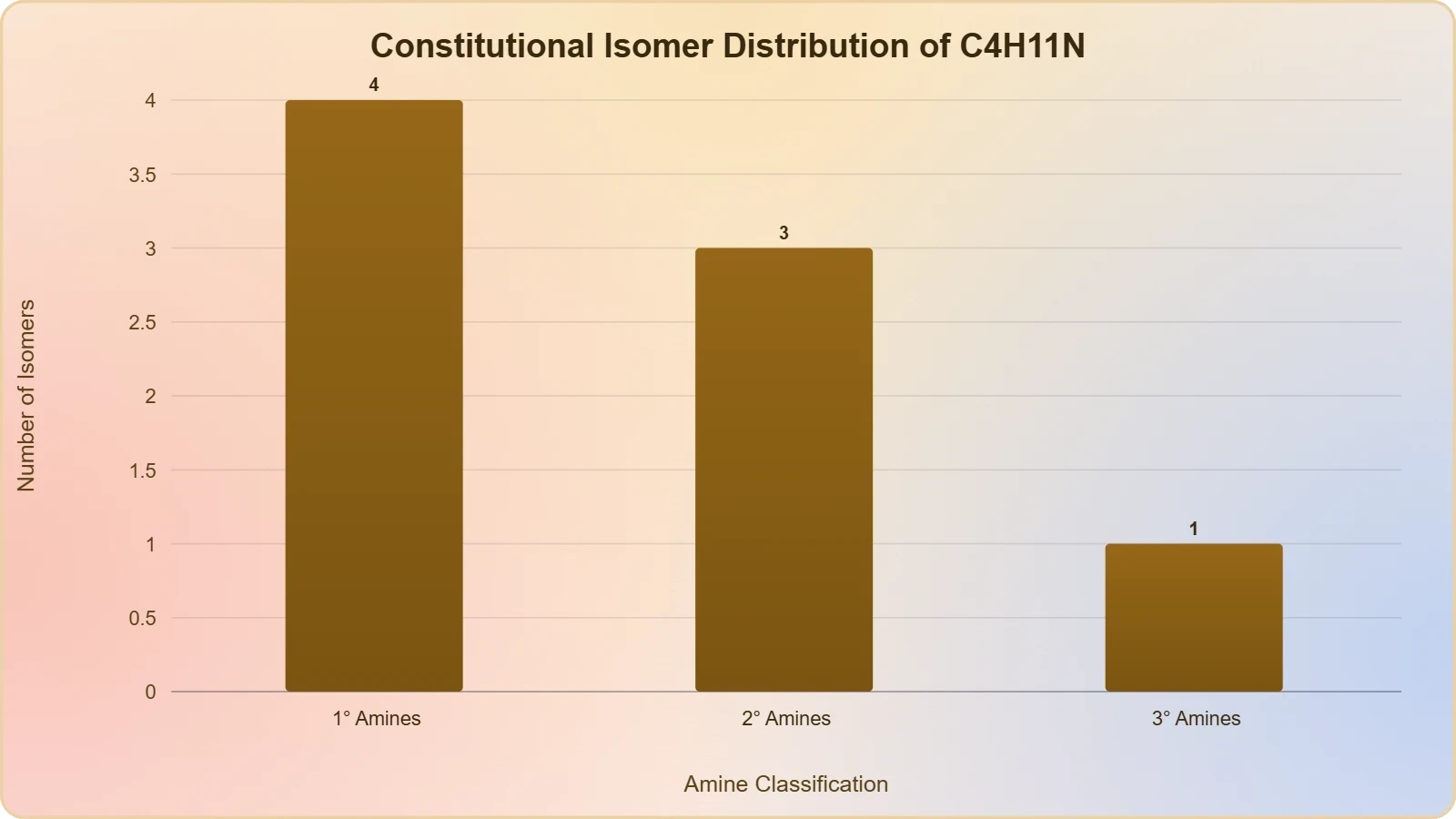
This zero unsaturation value establishes that the formula ##\ce{C4H11N}## generates purely saturated open-chain constitutional isomers. A rigorous, exhaustive enumeration reveals exactly eight isomeric amines: four primary amines, three secondary amines, and one tertiary amine.
The Four Primary Amine Constitutions of Butylamine
The four primary amines conforming to ##\ce{C4H11N}## are derived by systematically varying the underlying four-carbon chain and the attachment position of the ##-\ce{NH2}## functional group. Beginning with the unbranched butane skeleton, two position isomers emerge: butan-1-amine, ##\ce{CH3-CH2-CH2-CH2-NH2}##, where the amino group attaches to a terminal primary carbon, and butan-2-amine, ##\ce{CH3-CH2-CH(NH2)-CH3}##, where the functional group resides at an internal carbon atom. Notably, butan-2-amine features a stereogenic chiral center at ##\ce{C-2}##, enabling the existence of a pair of enantiomers (non-superimposable mirror images) under stereochemical analysis.
Branching the four-carbon backbone into a 2-methylpropane (isobutane) skeleton yields the remaining two primary amine isomers. Attaching the amino function to any of the three equivalent primary carbons generates 2-methylpropan-1-amine (isobutylamine), ##\ce{(CH3)2CH-CH2-NH2}##. Alternatively, attaching the amino group to the central tertiary carbon yields 2-methylpropan-2-amine (tert-butylamine), ##\ce{(CH3)3C-NH2}##. Although this compound contains a tertiary alkyl scaffold, it remains an authentic primary amine because its nitrogen atom retains two hydrogen bonds and links to only one carbon atom.
From our network :
- EV 2.0: The Solid-State Battery Breakthrough and Global Factory ExpansionDiscover the impact of the Solid-State Battery Breakthrough on the EV market. Learn about CATL and BYD stock growth, global factory expansion in Europe, and the future of EV 2.0 technology.
- 98% of Global MBA Programs Now Prefer GRE Over GMAT Focus EditionExplore why 98% of global MBA programs now prefer the GRE over GMAT Focus. Learn about the shorter GRE format, verbal logic importance, and strategic versatility for students.
- Do You Need a New Router or Is Your Internet Plan the Problem?A practical comparison of the signs that point to router limits versus signs your broadband speed or provider is the bottleneck, so you can decide what to replace before spending money.
- How to Print Cheaply: Cutting the Cost per PageA practical, measured guide to lowering what each printed page costs — duplex and draft modes, third-party ink, yield mathematics, and knowing when a new printer beats refills.
- Trump Political Strategy How Geopolitical Stunts Serve As Media Diversions
- 10 Physics Numerical Problems with Solutions for IIT JEEPrepare for IIT JEE with 10 physics numerical problems, complete with detailed solutions and conceptual explanations. Ideal for mastering kinematics, thermodynamics, electromagnetism, and optics.
- Where to Put Your Wireless Router for Better CoverageA practical, physics-grounded guide to router placement: why the centre of the home beats the corner, how walls and metal sap signal, and how to run a simple survey that proves the improvement.
- AI-Powered 'Precision Diagnostic' Replaces Standard GRE Score ReportsDiscover the new GRE Precision Diagnostic. Learn how AI-powered behavioral analytics and time-to-solve tracking are replacing standard GRE score reports to empower students.
- Analyzing Trump Deportation Numbers Insights Into The 2026 Immigration Crackdown