Organic nitrogen chemistry occupies a foundational position within molecular science, bridging fundamental principles of covalent bonding with complex biochemical machinery and targeted synthetic design. Derived formally from ammonia by substituting one or more hydrogen atoms with aliphatic or aromatic hydrocarbons, amines represent some of the most structurally versatile and biologically critical functional groups known. In nature, amino architectures constitute essential structural backbones within proteins, coenzymes, natural alkaloids, and neurotransmitters. Biologically active compounds such as adrenaline and ephedrine, which feature secondary amino motifs, serve as physiological regulators of human blood pressure, while synthetic tertiary amines like diphenhydramine hydrochloride under the trade name
provide antihistaminic therapeutic intervention. Furthermore, local anesthetics like Novocain rely on functionalized amino domains for receptor interaction, while quaternary ammonium salts find widespread industrial application as cationic phase-transfer surfactants.
Understanding the structural configuration, hybridization state, and spatial arrangement of amines is vital for comprehending their nucleophilic reactivity, aqueous versus gaseous basicity, and stereochemical stability. Unlike simple tetrahedral carbon frameworks, the nitrogen atom possesses a trivalent connectivity that bears a sterically and chemically active non-bonding valence electron pair. This unshared electron pair profoundly alters the ideal tetrahedral geometry through localized electrostatic repulsions, shifting the localized interatomic angles away from classic crystallographic archetypes. In competitive curricula such as
Class 12,
, and
, grasping these spatial nuances is indispensable for deciphering reaction mechanisms, optical isomerism, and conformational energetics.
This lesson undertakes an exhaustive examination of the structural framework governing aliphatic and aromatic amines. We deconstruct the valence orbital mixing of nitrogen, establish the precise molecular geometry and angular perturbations driven by valence shell repulsion, evaluate the stereoelectronic consequences of the non-bonding electron pair, and explore the kinetic mechanisms governing rapid pyramidal umbrella inversion. Through structural comparisons between acyclic alkylamines, bridged polycyclic frameworks, and resonance-stabilized arylamines, this discussion establishes the stereochemical bedrock necessary to master subsequent topics in amine taxonomy, synthesis, and electrophilic transformations.
On This Page
Fundamental Orbital Architecture and Hybridization in Amines
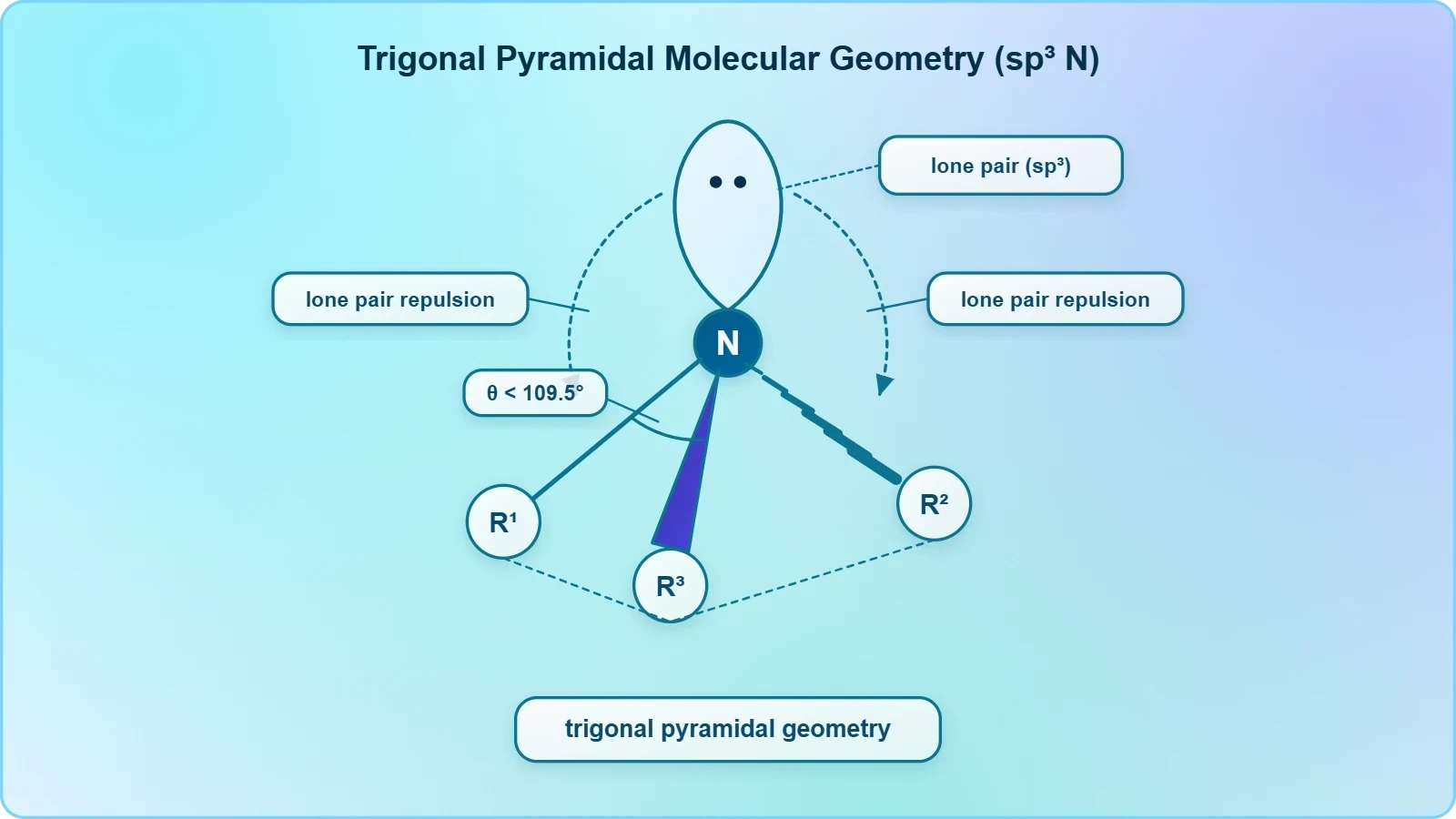
The electronic ground state of nitrogen, characterized by the valence shell configuration ##2s^2 2p_x^1 2p_y^1 2p_z^1##, undergoes orbital reorganization upon covalent bonding to construct four degenerate or nearly degenerate hybrid manifolds. In classical aliphatic amines, the mathematical hybridization of the central nitrogen core is treated as ##sp^3##, creating a tetrahedral arrangement of electron pairs that manifests macroscopically as a trigonal pyramidal molecular geometry. Because one of these hybridized lobes is exclusively filled by two paired non-bonding electrons, the three-dimensional architecture exhibits pronounced directional asymmetry, dictating both chemical reactivity and physical properties.
Valence Orbital Mixing and the sp3 Model
The formulation of covalent bonding in amines requires the linear combination of the nitrogen atom's single 2s orbital with its three orthogonal ##2p## orbitals. This mathematical transformation yields four equivalent ##sp^3## hybrid orbitals oriented toward the vertices of a regular tetrahedron, each forming an idealized angle of 109.5° relative to the others. In a primary aliphatic amine such as methanamine (##\ce{CH3NH2}##), one of these hybrid orbitals overlaps axially with an ##sp^3## hybrid orbital of a carbon atom to establish a localized ##\sigma(\ce{C}_{sp^3}-\ce{N}_{sp^3})## single bond. The remaining two bonding hybrid orbitals engage with the 1s atomic orbitals of hydrogen atoms, producing two ##\sigma(\ce{N}_{sp^3}-\ce{H}_{1s})## covalent links.
The fourth ##sp^3## orbital accommodates the non-bonding electron pair without participating in internuclear bonding. Because this electron pair is under the electrostatic attraction of only one atomic nucleus—the nitrogen core—its spatial domain is significantly more diffuse and laterally expanded than that of bonding electron pairs held between two positive nuclei. Consequently, the nitrogen center exhibits an unsymmetrical electron distribution wherein the lone pair exerts profound electrostatic repulsive pressure against the neighboring bonding orbitals. The molecular envelope is consequently non-planar, and despite possessing tetrahedral electronic geometry, the physical positions of the nuclei define a distinct trigonal pyramidal shape.
Electron Density Distribution and Lone Pair Localization
The non-bonding electron pair on the nitrogen atom represents a localized region of concentrated negative electrostatic potential. According to quantum mechanical charge density mappings, this localized orbital lobe projects outward along the molecular three-fold rotational axis (in ##C_{3v}## symmetric systems like ammonia), serving as the primary source of basicity and nucleophilicity. The spatial orientation of this electron cloud means that any incoming electrophilic center or Brønsted-Lowry proton encounters a highly accessible electron density field. This accessible valence pair permits immediate dative coordination without requiring substantial structural rearrangement during the initial approach of an electrophile.
Furthermore, the degree of spatial localization of this lone pair depends critically on the chemical nature of the attached substituents. When bonded exclusively to alkyl substituents exhibiting electron-donating inductive effects (##+I##), the electron density on nitrogen increases, consolidating the lone pair within a localized hybrid orbital. Conversely, electronegative heteroatoms or neighboring ##\pi##-systems pull charge away through inductive or mesomeric mechanisms. In aliphatic amines, the localized nature of this non-bonding orbital remains largely intact, ensuring that the lone pair continues to dominate the physical dipole moment of the molecule, which generally ranges between ##1.2\text{ D}## and ##1.4\text{ D}##.
Geometric Deformations and Bond Angle Anomalies
The deviation of bond angles in amines from the classic tetrahedral value of 109.5° provides compelling evidence for the interplay between electronic repulsions and steric factors. While the valence shell electron pair repulsion (VSEPR) model successfully predicts angular compression relative to pure methane, empirical spectroscopic measurements reveal significant variations across primary, secondary, and tertiary amines. These variations illustrate how electronic repulsion between non-bonding and bonding electrons competes against steric repulsions among attached alkyl groups, producing unique structural balances across homologous series.
Valence Shell Electron Pair Repulsion Effects in Methylamines
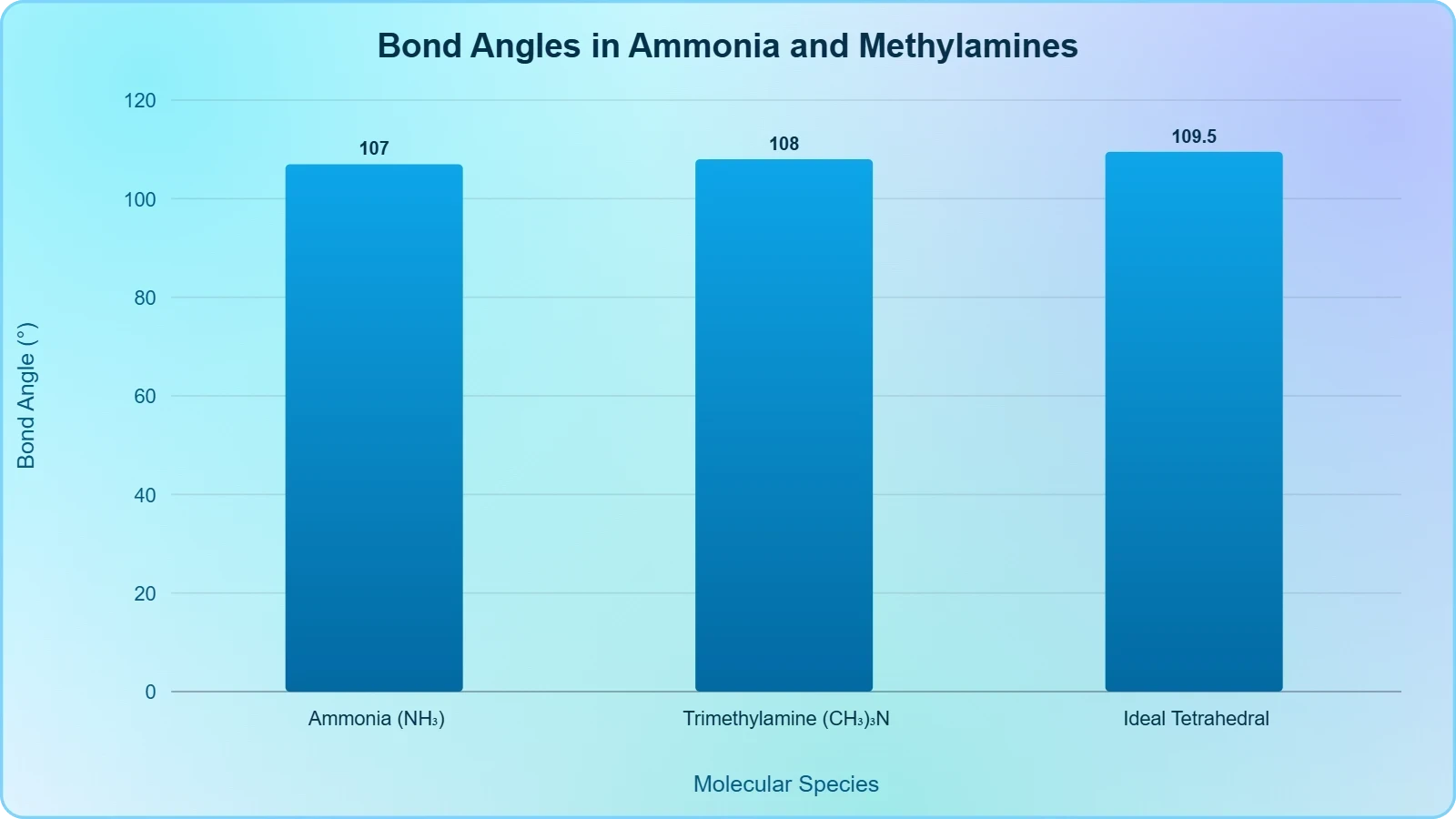
In classical VSEPR theory, electron pair repulsions follow a clear hierarchy: lone pair-lone pair interactions exceed lone pair-bonding pair interactions, which in turn exceed bonding pair-bonding pair repulsions. In ammonia (##\ce{NH3}##), the lone pair compresses the three ##\ce{N-H}## single bonds from the regular tetrahedral angle of 109.5° down to 107.0°. When evaluating methylamine (##\ce{CH3NH2}##), the replacement of a proton with a methyl carbon produces a ##\ce{C-N-H}## angle of approximately 106.7°, while the remaining ##\ce{H-N-H}## angle is compressed to 105.9°, reflecting the asymmetrical charge field of the molecule.
Progressing across the methyl-substituted series to trimethylamine (##\ce{(CH3)3N}##), the ##\ce{C-N-C}## bond angle widens to approximately 108.0°. This value remains below the ideal tetrahedral angle of 109.5°, demonstrating that the localized lone pair continues to exert strong repulsive pressure on adjacent bonding pairs. The non-bonding pair forces the carbon-nitrogen bonds toward one another, maintaining a clear trigonal pyramidal geometry. This compression preserves significant directional character in the lone pair orbital, retaining high Lewis basicity in small, unhindered tertiary aliphatic amines.
Steric Crowding and Non-Bonded Ligand Repulsion
While trimethylamine exhibits an angle of 108.0°, substituting larger or branched alkyl groups introduces non-bonded steric repulsions that directly oppose lone pair compression. In triethylamine (##\ce{(CH3CH2)3N}##), the bulky methylene and terminal methyl groups cannot comfortably occupy the space dictated by a sub-tetrahedral arrangement. Consequently, the ##\ce{C-N-C}## bond angle expands to approximately 110.1°, exceeding the classical 109.5° tetrahedral geometry. In such systems, mutual Van der Waals repulsions between non-bonded carbon groups overcome the compressive force of the lone pair.
When steric demands increase further, as seen in sterically congested secondary and tertiary amines like di-tert-butylamine or tri-tert-butylamine, this angular widening becomes extreme. Bulky tert-butyl domains force the ##\ce{C-N-C}## angles to widen beyond 115°, significantly flattening the nitrogen pyramid. As the pyramid flattens, the nitrogen atom shifts toward a near-##sp^2## hybridization state. This geometric reorganization forces the unshared electron pair into an orbital with increased ##p##-orbital character, directly modifying the nucleophilicity of the nitrogen center by making it sterically shielded yet electronically distinct.
We Also Published
Stereoelectronic Dynamics of Pyramidal Inversion
One of the most remarkable stereochemical characteristics of trivalent nitrogen compounds is their fluxional nature. Unlike tetracoordinated tetrahedral carbon atoms, which form rigid three-dimensional stereocenters, trivalent nitrogen compounds undergo rapid, continuous umbrella-like oscillations known as pyramidal or Walden-like inversion. This dynamic process rapidly interconverts the two pyramidal enantiomeric forms of the molecule, with significant ramifications for the isolability of chiral amines at room temperature.
The Planar sp2 Transition State and Energy Barriers
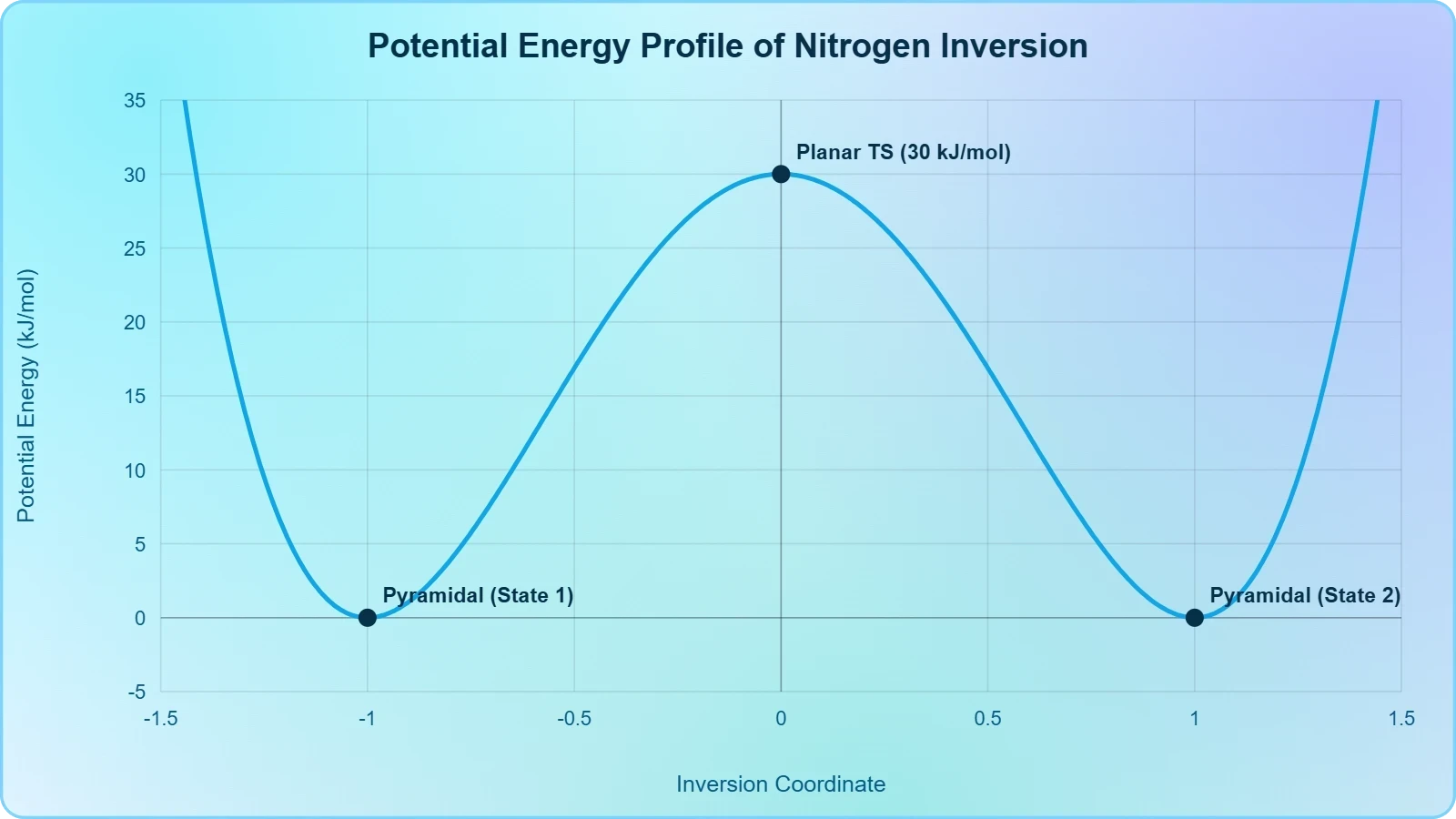
The molecular orbital description of nitrogen inversion involves the deformation of the ground-state trigonal pyramidal geometry (##C_{3v}## symmetry in simple symmetric cases) toward a completely flat, trigonal planar transition state belonging to the ##D_{3h}## point group. During this deformation, the three hybrid bonding orbitals—initially ##sp^3## with approximately 25% ##s##-character—rehybridize into a trigonal planar ##sp^2## framework containing roughly 33.3% ##s##-character. Concurrently, the non-bonding electron pair transitions from an ##sp^3## hybrid orbital into an unhybridized, pure ##2p_z## atomic orbital oriented perpendicular to the molecular plane.
The activation barrier for this structural interconversion corresponds to the electronic and strain energy required to compress the bonding orbitals into a single plane while shifting the lone pair into a higher-energy unhybridized ##p##-orbital:
In simple aliphatic amines, this energy penalty is relatively modest, typically ranging between ##20\text{ kJ/mol}## and ##35\text{ kJ/mol}## (approximately ##5\text{ to } 8\text{ kcal/mol}##). Because ambient thermal energy at room temperature (##RT \approx 2.48\text{ kJ/mol}## at 298 K) provides ample kinetic drive, molecules clear this barrier rapidly without requiring external catalysts.
Walden-like Umbrella Inversion and Temperature Dependence
The kinetics of this process follow the classic Arrhenius and Eyring formulations, yielding exceptionally high inversion rates at standard room temperature. In ammonia, the inversion frequency reaches an astounding ##2.5 \times 10^{10}\text{ s}^{-1}##, occurring primarily via quantum mechanical tunneling through the low barrier. In simple trialkylamines like trimethylamine or ethylmethylamine, the inversion rate remains on the order of ##10^7\text{ to } 10^8\text{ s}^{-1}##. At this speed, the three substituents sweep through the horizontal plane millions of times each second, analogous to an umbrella turning inside out during a powerful gust of wind.
Because the rate of inversion depends directly on thermal energy, lowering the ambient temperature diminishes the kinetic energy of the system according to the Boltzmann distribution. At temperatures approaching cryogenic conditions (e.g., below ##-80^\circ\text{C}## to ##-100^\circ\text{C}##), the rate of inversion can be slowed sufficiently to allow distinct conformers to be observed via dynamic nuclear magnetic resonance (NMR) spectroscopy. However, under typical chemical conditions and biological temperatures, the process is practically instantaneous on the human observational timescale.
Chiral Nitrogen Centers and Optical Invertomers
The stereochemical ramifications of rapid pyramidal inversion are particularly pronounced when evaluating trivalent nitrogen compounds bearing three distinct substituents. According to fundamental stereochemical criteria, a tetrahedral center bonded to four different ligands lacks improper rotation axes and is inherently chiral. Because a trivalent amine carries three distinct groups alongside a single unshared electron pair, the nitrogen center fulfills these geometric requirements, creating non-superimposable mirror images. However, their experimental optical behavior differs fundamentally from that of chiral carbon frameworks.
The Racemization Conundrum in Trivalent Amines
Consider an unsymmetrical tertiary amine such as ethylmethylpropylamine, where the central nitrogen atom is bonded to an ethyl group, a methyl group, a propyl group, and a localized lone pair. Because all four coordination sites differ, this molecule possesses no plane or center of symmetry, classifying it as a theoretically chiral species. One would expect such a chiral material to rotate plane-polarized light in a polarimeter, yielding distinct dextrorotatory and levorotatory enantiomeric samples upon classical fractional crystallization or chiral resolution.
In reality, trivalent amines with three distinct groups cannot be resolved into stable enantiomers at room temperature. The low activation energy of pyramidal inversion allows rapid interconversion between the ##(R)## and ##(S)## enantiomeric geometries. Because this umbrella flip occurs millions of times per second, any isolated non-racemic sample racemizes almost instantaneously. The two enantiomeric invertomers exist in dynamic equilibrium, forming an equimolar, time-averaged racemic mixture that displays zero net optical rotation under standard experimental conditions.
Enantiomeric Resolution in Quaternary Ammonium Salts and Bridged Systems
To preserve optical activity at a chiral nitrogen center, pyramidal inversion must be structurally or chemically prevented. The most common solution involves quaternizing the nitrogen atom to form a quaternary ammonium salt, represented generally as ##\ce{[N(R^1)(R^2)(R^3)(R^4)]+ X-}##. By replacing the flexible non-bonding electron pair with a fourth covalent ##\sigma##-bond, the nitrogen atom is locked into a rigid tetrahedral framework. Because accessing a planar transition state would require breaking a covalent bond (an energy penalty exceeding ##300\text{ kJ/mol}##), quaternary ammonium salts with four distinct groups can be readily resolved into stable, optically active enantiomers.
A second method for preventing inversion involves incorporating the nitrogen atom into a rigid, bridged polycyclic framework. A classic example is Tröger’s base, where two nitrogen atoms occupy bridgehead positions within a rigid bicyclic methano-diazocine core. For either nitrogen atom to invert, the bicyclic framework would need to distort through a completely planar ##sp^2## geometry, introducing severe ring strain. Consequently, pyramidal inversion is mechanically blocked, allowing Tröger’s base to be resolved into stable enantiomers that maintain robust optical rotation indefinitely at room temperature.
Electronic Perturbations: Aliphatic Amines versus Arylamines
Replacing an aliphatic alkyl substituent with an aromatic aryl group substantially alters both the hybridization state and physical geometry of the nitrogen center. While aliphatic amines feature localized electron pairs within well-defined ##sp^3## hybrid orbitals, arylamines exhibit extensive stereoelectronic interactions with the adjacent aromatic ring. This conjugative interaction profoundly influences bond lengths, molecular planarity, basicity, and electrophilic substitution chemistry.
From our network :
- How to Print Cheaply: Cutting the Cost per PageA practical, measured guide to lowering what each printed page costs — duplex and draft modes, third-party ink, yield mathematics, and knowing when a new printer beats refills.
- Do You Need a New Router or Is Your Internet Plan the Problem?A practical comparison of the signs that point to router limits versus signs your broadband speed or provider is the bottleneck, so you can decide what to replace before spending money.
- 10 Physics Numerical Problems with Solutions for IIT JEEPrepare for IIT JEE with 10 physics numerical problems, complete with detailed solutions and conceptual explanations. Ideal for mastering kinematics, thermodynamics, electromagnetism, and optics.
- EV 2.0: The Solid-State Battery Breakthrough and Global Factory ExpansionDiscover the impact of the Solid-State Battery Breakthrough on the EV market. Learn about CATL and BYD stock growth, global factory expansion in Europe, and the future of EV 2.0 technology.
- AI-Powered 'Precision Diagnostic' Replaces Standard GRE Score ReportsDiscover the new GRE Precision Diagnostic. Learn how AI-powered behavioral analytics and time-to-solve tracking are replacing standard GRE score reports to empower students.
- Analyzing Trump Deportation Numbers Insights Into The 2026 Immigration Crackdown
- Trump Political Strategy How Geopolitical Stunts Serve As Media Diversions
- 98% of Global MBA Programs Now Prefer GRE Over GMAT Focus EditionExplore why 98% of global MBA programs now prefer the GRE over GMAT Focus. Learn about the shorter GRE format, verbal logic importance, and strategic versatility for students.
- Where to Put Your Wireless Router for Better CoverageA practical, physics-grounded guide to router placement: why the centre of the home beats the corner, how walls and metal sap signal, and how to run a simple survey that proves the improvement.