Every substitution reaction at a saturated carbon is, at heart, a small drama of three-dimensional geometry. When a nucleophile approaches a haloalkane, it does not merely swap one group for another on a flat page; it negotiates with a tetrahedral framework whose spatial arrangement determines whether the product emerges as a single mirror-image form, an inverted one, or a scrambled mixture of both. This lesson examines that spatial drama in detail, moving from the physical basis of optical activity through the language of chirality, and then applying those ideas to the two great mechanistic pathways already encountered: the concerted SN2 displacement and the stepwise SN1 ionisation.
The stakes here extend well beyond examination technique. Stereochemistry governs how a reaction actually proceeds at the molecular level, and it therefore serves as one of the most powerful diagnostic tools available to the mechanistic chemist. If a substitution proceeds with clean inversion of configuration, the evidence points decisively toward a single-step backside attack; if the product is extensively racemised, a planar carbocation intermediate is almost certainly involved. Learning to read these stereochemical signatures is the central intellectual reward of this lesson, and it prepares the ground for the elimination chemistry that follows, where competing pathways and their own geometric demands come into play.
We will also push past the syllabus minimum into territory that separates a competent student from an excellent one: the Cahn–Ingold–Prelog rules for assigning absolute configuration, the distinction between enantiomers and diastereomers, the special case of meso compounds, and the practical problem of resolving a racemic mixture into its pure components. Along the way we will confront the single most common misconception in the entire topic — the confusion between a molecule's observed direction of optical rotation and its actual three-dimensional configuration — and see why that confusion has had real consequences in pharmaceutical history.
On This Page
- Optical Activity and the Physical Basis of Chirality
- Enantiomers, Racemisation and the Meaning of Optical Purity
- Assigning Absolute Configuration with the Cahn–Ingold–Prelog Rules
- Diastereomers, Meso Compounds and Resolution of Racemates
- Stereochemical Consequences of the SN1 and SN2 Mechanisms
- Stereochemistry in Pharmaceuticals and the Cost of Getting It Wrong
- Consolidating the Stereochemical Toolkit
Optical Activity and the Physical Basis of Chirality
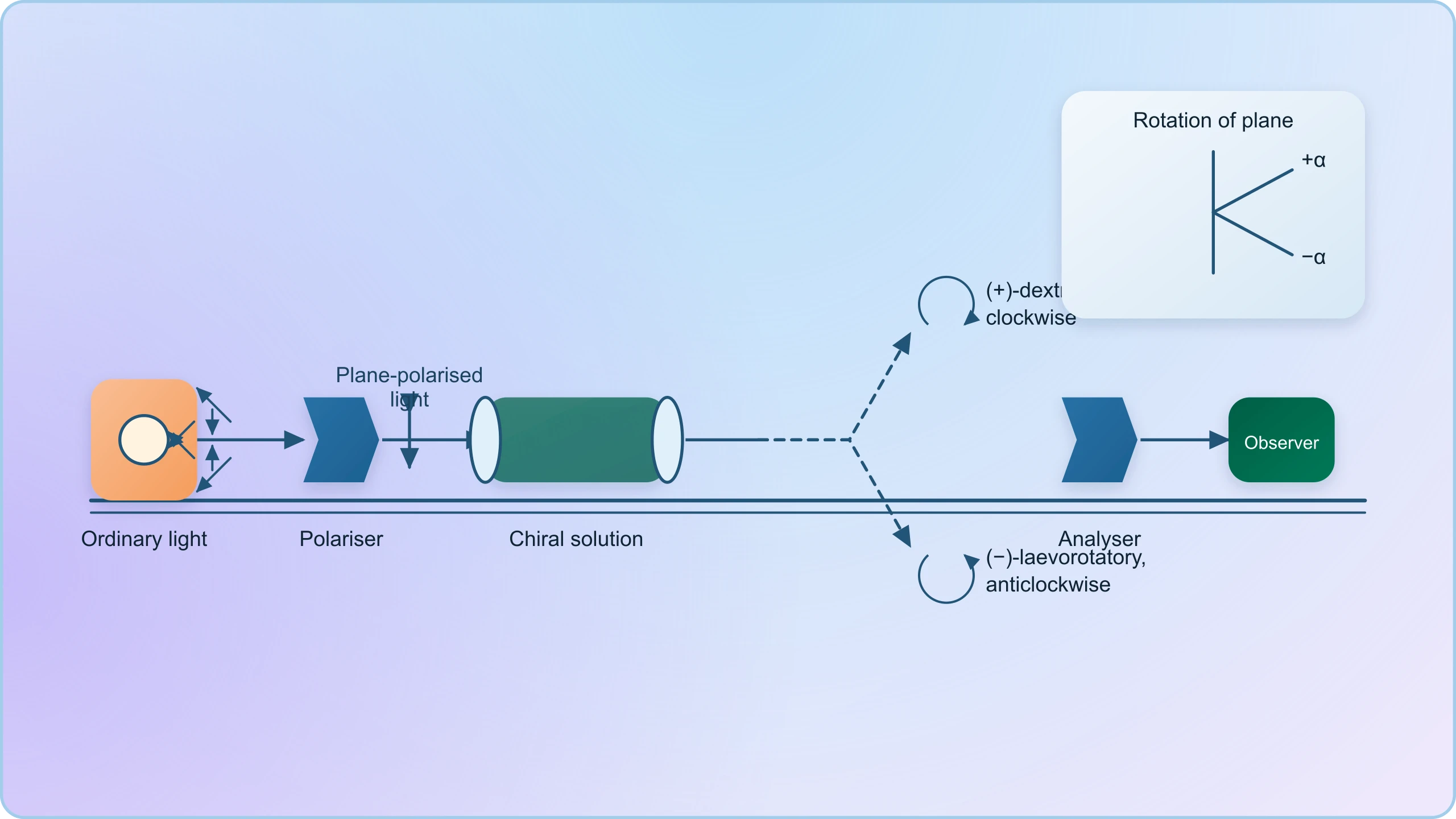
Ordinary light oscillates in every plane perpendicular to its direction of travel. When such light is passed through a Nicol prism, a device developed by William Nicol in the late eighteenth century, only oscillations in a single plane survive, producing plane-polarised light. Certain compounds, when dissolved and placed in the path of this polarised beam, rotate the plane of oscillation either clockwise or anticlockwise. The instrument that measures this rotation is the polarimeter, and the magnitude of the effect, expressed as a specific rotation, depends on concentration, path length, temperature and the wavelength of light employed.
A compound that rotates the plane to the right, in a clockwise direction as viewed toward the source, is termed dextrorotatory and carries a positive sign; one that rotates it to the left is laevorotatory and carries a negative sign. These two forms of the same substance are optical isomers, and the phenomenon itself is optical isomerism. Crucially, the sign of rotation is an experimental observation, not a structural label — a point we shall return to repeatedly, because it is the source of more examination errors than any other single idea in this lesson.
Pasteur's Discovery and the Tetrahedral Carbon
Louis Pasteur's 1848 examination of certain crystals revealed that they existed as two distinct mirror-image habits, and that aqueous solutions of each rotated polarised light by equal amounts in opposite directions. He inferred correctly that this difference arose from the three-dimensional arrangement of atoms within the molecules themselves. In 1874, Jacobus van 't Hoff and Joseph Le Bel independently proposed that the four valencies of a carbon atom point toward the corners of a tetrahedron, and that when all four substituents differ, the mirror image of the molecule cannot be superimposed upon the original.
Such a carbon is called an asymmetric carbon or stereocentre, and the molecule bearing it is asymmetric. The combination of molecular asymmetry with non-superimposability of the mirror image is precisely what produces optical activity. This is a structural property, fixed by constitution and configuration, whereas the rotation observed in a polarimeter is a physical measurement. The two are correlated but never interchangeable, and treating them as synonyms is the foundational error that later leads students astray on configuration assignments.
Chirality, Handedness and Everyday Objects
The test for chirality is disarmingly simple: construct the object and its mirror image, then attempt to superimpose them. A sphere, a cube and a cone all coincide with their mirror images and are therefore achiral. A pair of hands does not — place your left hand over your right, moving them within the same plane, and the thumbs point in opposite directions. Objects that fail the superposition test are chiral, and the property they possess is chirality, from the Greek for hand. Chiral molecules are optically active; achiral molecules are optically inactive.
Applying this test to organic molecules requires either physical models or disciplined three-dimensional visualisation. Propan-2-ol serves as the instructive negative case: its central carbon bears two identical methyl groups, so no asymmetry exists, and rotating the mirror image by 180° brings it into perfect coincidence with the original. Butan-2-ol, by contrast, carries four different groups — hydrogen, hydroxyl, methyl and ethyl — and its mirror image cannot be superimposed under any rotation. The presence of a single asymmetric carbon is a reliable, though not infallible, indicator of chirality.
Enantiomers, Racemisation and the Meaning of Optical Purity
Stereoisomers related to one another as non-superimposable mirror images are called enantiomers. They share every scalar physical property — melting point, boiling point, density, refractive index, solubility in achiral solvents — and differ only in the direction in which they rotate plane-polarised light. If one enantiomer is dextrorotatory, its mirror partner is laevorotatory by exactly the same magnitude under identical conditions. This near-identity of physical properties is what makes their separation so difficult, and it is why nature's own stereochemical selectivity is such a remarkable achievement.
When equal quantities of the two enantiomers are present, the rotations cancel exactly and the mixture shows zero net rotation. Such a mixture is a racemic mixture or racemic modification, denoted by the prefix dl or the symbol (±) before the name, as in (±)-butan-2-ol. The process by which a single enantiomer is converted into a racemic mixture is racemisation. It is essential to recognise that a racemic mixture is optically inactive for an entirely different reason from an achiral compound: the former contains chiral molecules whose effects cancel, while the latter contains no chiral molecules at all.
Measuring Optical Purity
Because the specific rotation of a pure enantiomer is a known constant, the observed rotation of a sample provides a direct measure of its enantiomeric composition. Optical purity, sometimes called the enantiomeric excess, is defined as the observed specific rotation divided by the specific rotation of the pure enantiomer, expressed as a percentage. A sample showing half the rotation of the pure compound contains 75 per cent of one enantiomer and 25 per cent of the other, giving an enantiomeric excess of 50 per cent.
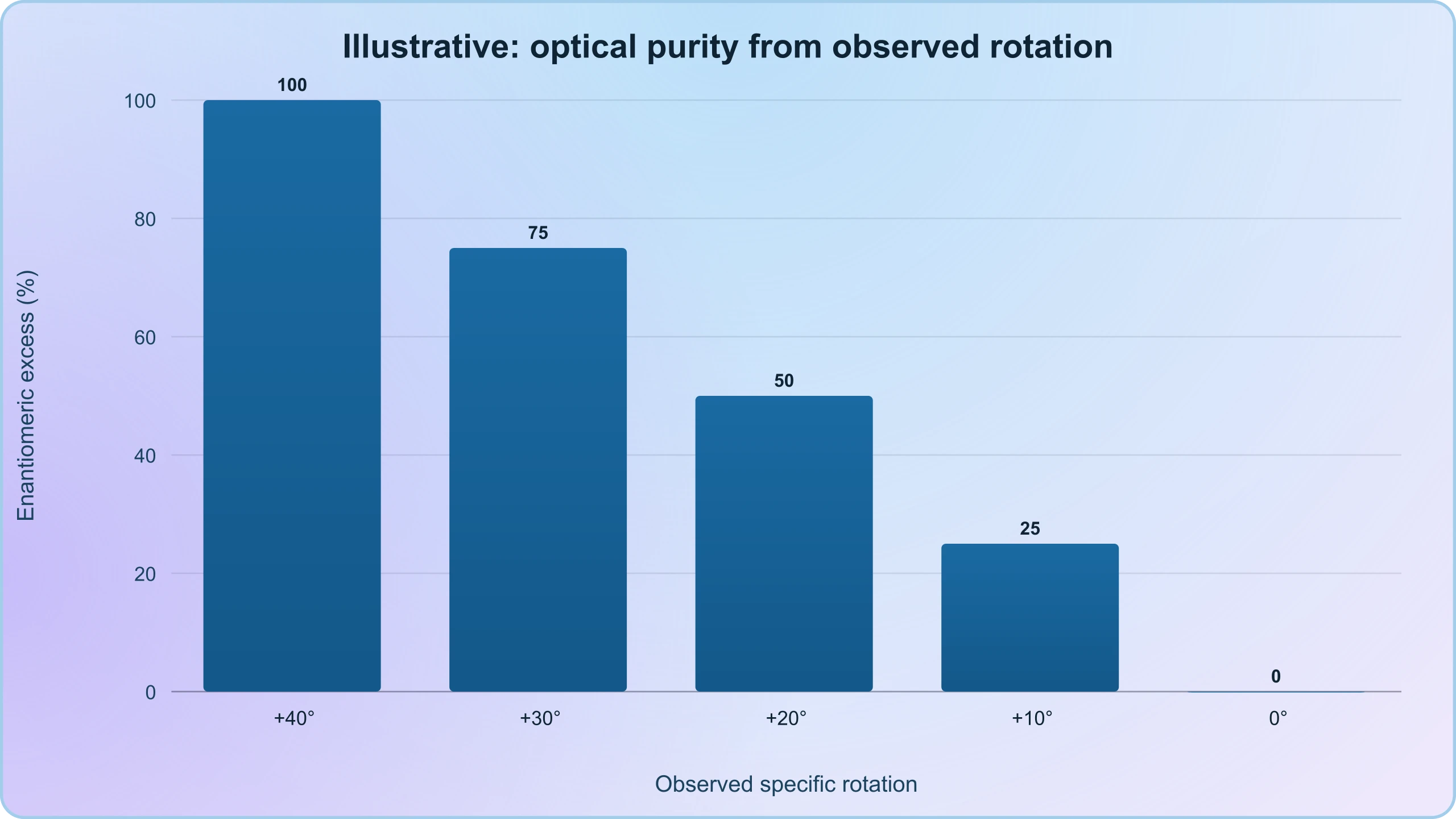
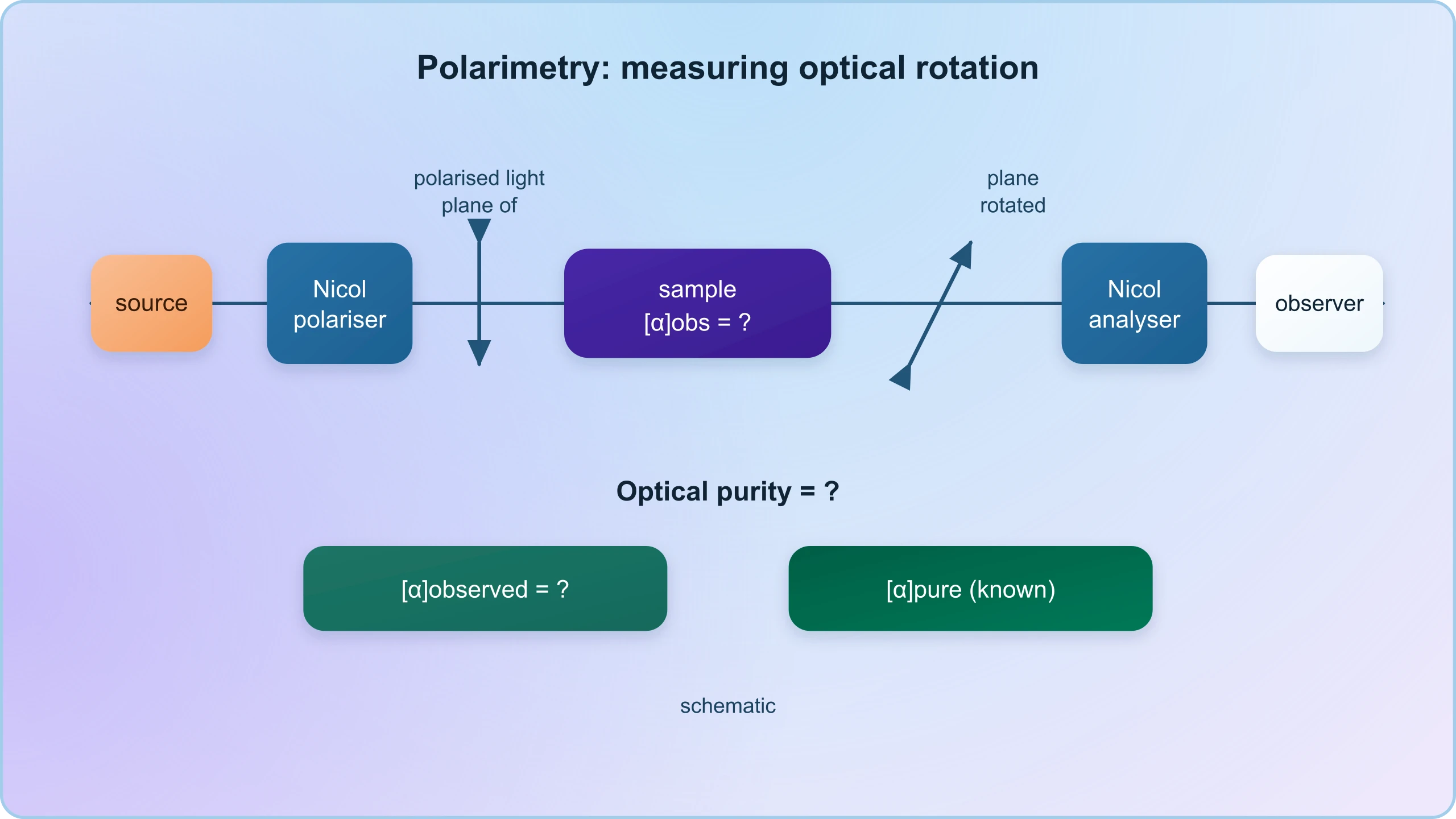
This relationship is the quantitative bridge between the polarimeter and the molecular world. It allows a chemist to state not merely that a reaction produced an optically active product, but precisely how much of each enantiomer was formed — information that immediately constrains the mechanism. A reaction giving 100 per cent optical purity has proceeded with complete stereospecificity; one giving zero has produced a racemic mixture; intermediate values indicate partial racemisation or competing pathways.
Why Racemisation Happens at All
Racemisation of an optically active halide can occur through several routes. The most important in this context is the formation of a planar carbocation: once the leaving group departs and the carbon rehybridises from sp³ to sp², the distinction between the two faces of the cation vanishes. Nucleophilic attack is then equally probable from either face, and the product is racemic. This is the stereochemical signature of the SN1 mechanism, and it explains why tertiary halides, which ionise readily, typically give extensively racemised products.
A second route involves repeated SN2 displacements, each inverting the centre, so that a sequence of backside attacks gradually erodes optical purity. A third involves proton exchange at the stereocentre or enolisation in molecules bearing electron-withdrawing groups adjacent to the chiral carbon. Recognising which route operates in a given case requires careful attention to solvent, temperature, nucleophile concentration and substrate structure — the same variables that govern the competition between SN1 and SN2 themselves.
We Also Published
Assigning Absolute Configuration with the Cahn–Ingold–Prelog Rules
Describing a molecule as dextro- or laevorotatory tells us what it does to light but nothing about how its atoms are arranged in space. To specify the actual three-dimensional arrangement — the absolute configuration — chemists use the Cahn–Ingold–Prelog (CIP) system, which assigns the labels R (from Latin rectus, right) and S (sinister, left) to each stereocentre. The system is purely geometric and entirely independent of any optical measurement, which is precisely why it is indispensable.
The procedure rests on ranking the four substituents attached to the stereocentre by priority. Higher atomic number takes precedence at the first point of difference; if two atoms are identical, we move outward along the chain until a difference appears, treating a double bond as two single bonds to the same atom. Once the four groups are ranked from highest (1) to lowest (4) priority, the molecule is viewed along the bond from the stereocentre to the lowest-priority group, and the direction in which priorities 1 → 2 → 3 run is read off.
The Priority Rules in Practice
Consider 2-chlorobutane. The four groups on C-2 are chlorine, the ethyl group, the methyl group and hydrogen. Chlorine has the highest atomic number and takes priority 1; hydrogen, being lowest, takes priority 4. Between ethyl and methyl, both attach through carbon, but the ethyl carbon is bonded to a further carbon whereas the methyl carbon is bonded only to hydrogens, so ethyl outranks methyl. The order is therefore Cl > C₂H₅ > CH₃ > H.
With the lowest-priority group pointing away from the viewer, a clockwise sequence 1 → 2 → 3 corresponds to R, and an anticlockwise sequence to S. If the lowest-priority group happens to point toward the viewer, the assignment is reversed. A useful shortcut when hydrogen points toward you is to determine the apparent direction and then invert the label — a technique that saves time in examinations but must be applied with care.
Worked Example: A Molecule with Two Stereocentres
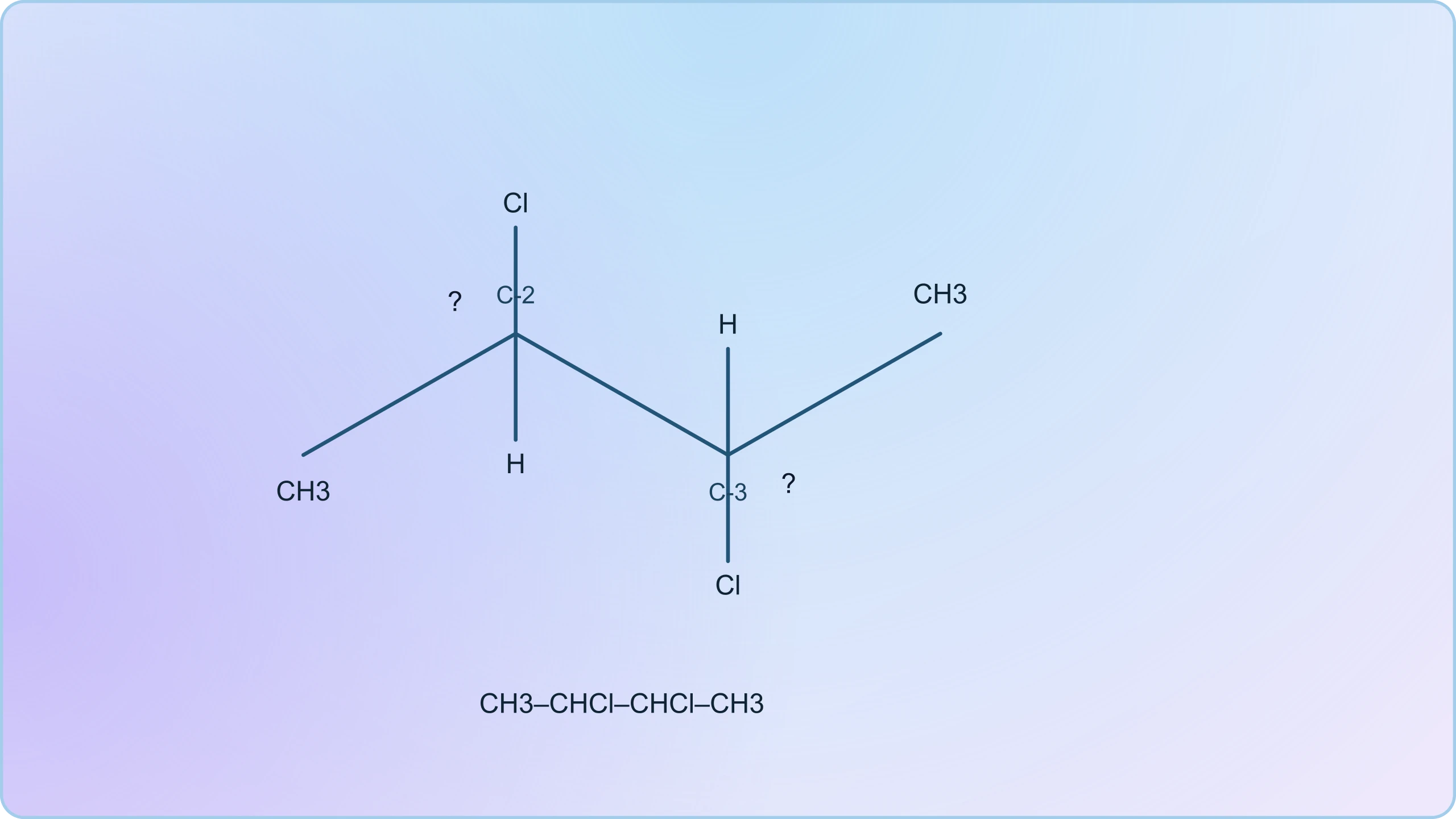
Take 2,3-dichlorobutane, CH₃–CHCl–CHCl–CH₃. Each of C-2 and C-3 carries H, Cl, CH₃ and the remaining substituted carbon, so both are stereocentres. Assigning each independently gives three distinct stereoisomers rather than the four that naive counting would suggest: an (R,R) form, its mirror image the (S,S) form, and an (R,S) form that is identical to its own mirror image. That third isomer is achiral despite containing two stereocentres, and it is our first example of a meso compound.
Diastereomers, Meso Compounds and Resolution of Racemates
Enantiomers are only one class of stereoisomer. When a molecule contains two or more stereocentres, stereoisomers that are not mirror images of one another are called diastereomers. Unlike enantiomers, diastereomers differ in their scalar physical properties — melting points, boiling points, solubilities and spectroscopic behaviour all diverge — and they are not related by reflection. This difference is enormously practical: because diastereomers can be separated by ordinary techniques such as crystallisation or chromatography, they provide the classical route to resolving a racemic mixture.
The meso compound deserves particular attention because it defeats the simple rule that stereocentres imply chirality. In (R,S)-2,3-dichlorobutane, the two stereocentres are opposite in configuration and the molecule possesses an internal plane of symmetry, so it is superimposable on its mirror image and therefore achiral. It is optically inactive despite containing two stereocentres. Students who count stereocentres and conclude "two centres, four isomers, all chiral" will lose marks; the correct count for such a molecule is three stereoisomers, of which only two are chiral.
Resolving a Racemic Mixture
Because enantiomers have identical physical properties in achiral environments, they cannot be separated by distillation or simple crystallisation. The classical solution, introduced by Pasteur himself, is to convert the mixture into a pair of diastereomers by reaction with a single enantiomer of a resolving agent — a chiral acid or base such as tartaric acid or brucine. The resulting diastereomeric salts differ in solubility and can be separated by fractional crystallisation; each is then treated to regenerate the free enantiomer.
Modern alternatives include chiral chromatography, where a stationary phase bearing a single enantiomeric selector interacts differently with the two enantiomers, and enzymatic kinetic resolution, in which an enzyme selectively transforms one enantiomer while leaving the other untouched. Each method exploits the same underlying principle: enantiomers behave identically only in an achiral environment, so introducing chirality anywhere in the system makes them distinguishable.
Common Mistakes Worth Naming
The most persistent error is to equate the sign of optical rotation with the R/S descriptor. There is no general relationship between them: (R)-2-butanol happens to be dextrorotatory, but (R)-lactic acid is laevorotatory. The R/S label describes geometry; the (+)/(−) label describes an experimental measurement. A second frequent error is to assume that an SN1 reaction always gives a perfectly racemic product — in practice, the departing halide ion may shield one face of the carbocation and bias the attack, giving partial inversion.
A third mistake is to treat all stereocentres as equivalent when assigning configuration, forgetting that each must be evaluated independently. A fourth is to overlook the possibility of a meso form when counting isomers. A fifth, more subtle, is to confuse the terms inversion and retention: inversion means the nucleophile enters from the face opposite the departing group, while retention means it enters from the same face, which can occur through double displacement or neighbouring-group participation.
Stereochemical Consequences of the SN1 and SN2 Mechanisms
The two substitution mechanisms leave fingerprints that are unmistakable once the stereochemical vocabulary is in place. In the SN2 reaction, the nucleophile attacks the electrophilic carbon from the side directly opposite the leaving group, and the three remaining substituents pass through a trigonal bipyramidal transition state like an umbrella blown inside out. The result is complete inversion of configuration at the reacting centre, a stereospecific outcome often described as Walden inversion after the chemist who first observed it.
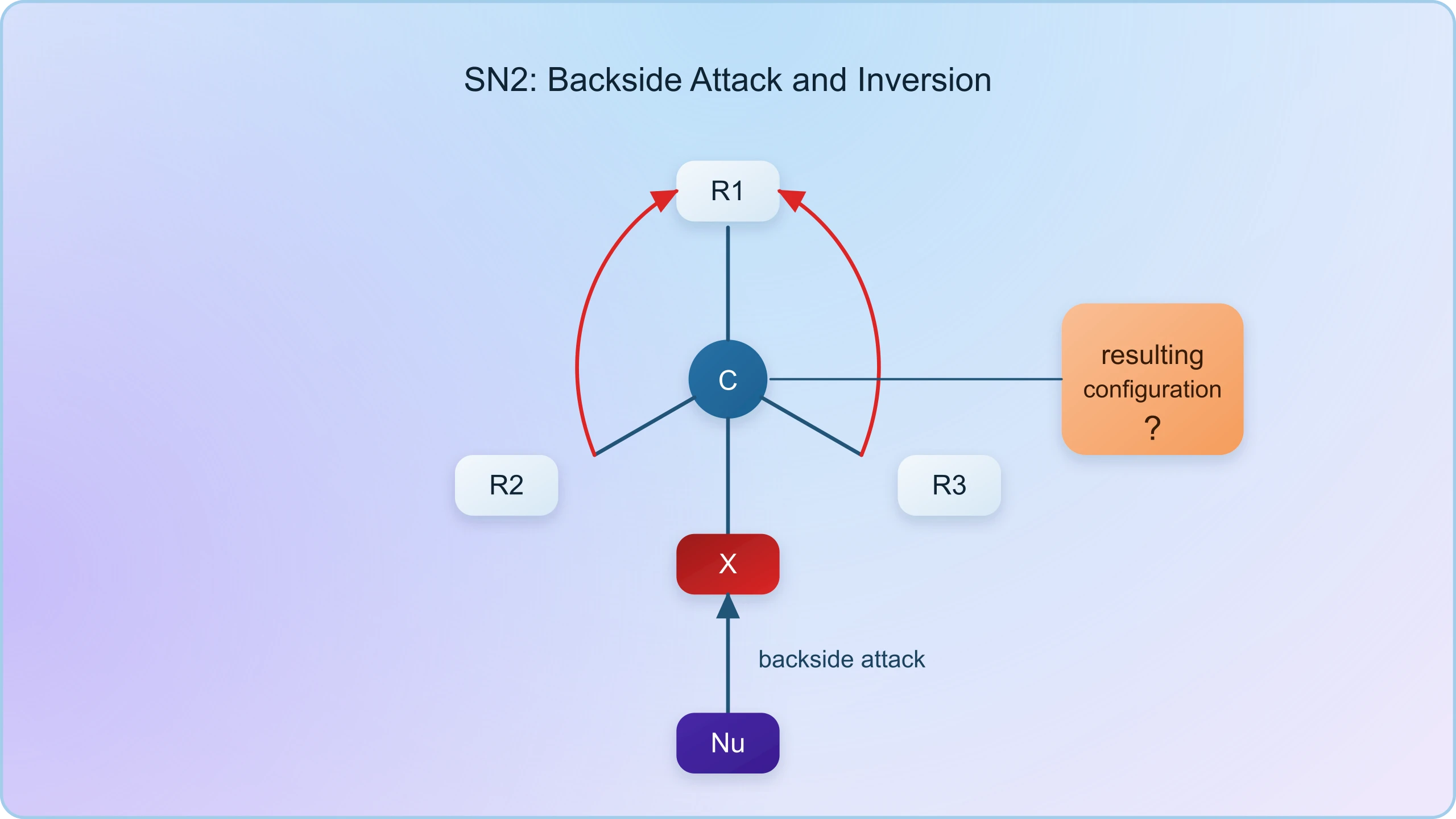
In the SN1 reaction, the picture is quite different. The slow, rate-determining step is the heterolysis of the carbon–halogen bond, generating a planar carbocation in which the carbon is sp² hybridised and the two faces are equivalent. The nucleophile may then attack either face with roughly equal probability, so a substrate that was optically pure yields a product that is largely racemic. The rate depends only on the concentration of the alkyl halide, and the stereochemical outcome is described as non-stereospecific.
Why SN2 Gives Inversion and SN1 Gives Racemisation
The SN2 inversion follows directly from orbital considerations. The nucleophile must approach the carbon along the axis of the σ* orbital of the carbon–leaving-group bond, which lies directly behind the leaving group. Backside attack is therefore geometrically mandated, and the three non-reacting substituents are forced to invert their positions. Steric hindrance around the electrophilic carbon slows this approach, which is why the SN2 reactivity order runs primary > secondary > tertiary, exactly the reverse of the SN1 order.
For SN1, the planar carbocation is the decisive intermediate. Because the empty p orbital is perpendicular to the plane of the three substituents, it presents two equivalent lobes to an incoming nucleophile. Attack at either lobe gives a product of opposite configuration, and if both faces are equally accessible the result is a 50:50 mixture. In practice, ion pairing and the persistence of the departing halide on one face often tip the balance toward inversion, so real SN1 products are frequently described as showing inversion with racemisation rather than perfect racemisation.
Reactivity Orders Revisited Through a Stereochemical Lens
The reactivity sequences established earlier now acquire a geometric rationale. For the four isomeric bromobutanes, the SN1 order runs 1-bromobutane < 1-bromo-2-methylpropane < 2-bromobutane < 2-bromo-2-methylpropane, tracking the stability of the developing carbocation from primary through tertiary. The SN2 order is precisely reversed, because steric congestion around the electrophilic carbon blocks the required backside trajectory. Both sequences are consequences of the same three-dimensional reasoning.
The benzylic series behaves similarly but with an instructive twist. Among C₆H₅CH₂Br, C₆H₅CH(CH₃)Br, C₆H₅CH(C₆H₅)Br and C₆H₅C(CH₃)(C₆H₅)Br, the SN1 order follows carbocation stability, with two phenyl groups providing powerful resonance stabilisation. In SN2, the bulkier phenyl group retards attack more than a methyl group, so C₆H₅CH(C₆H₅)Br is less reactive than C₆H₅CH(CH₃)Br. For a given alkyl group, the leaving-group order R–I > R–Br > R–Cl >> R–F holds in both mechanisms.
Stereochemistry in Pharmaceuticals and the Cost of Getting It Wrong
Nowhere does stereochemistry matter more visibly than in medicine. Because the body is itself a chiral environment — enzymes, receptors and transport proteins are built from single enantiomers of amino acids — the two enantiomers of a drug frequently behave as entirely different substances. One may bind a receptor productively while the other is inert, or worse, activates an unintended pathway. Regulatory agencies now require separate characterisation of each enantiomer for any new chiral drug, a policy that traces directly back to a single historical catastrophe.
Thalidomide, introduced in the late 1950s as a sedative and prescribed for morning sickness, is the canonical case. Its (R) enantiomer has the desired sedative effect, while the (S) enantiomer is teratogenic, causing severe limb malformations in thousands of children. The tragedy was compounded by the fact that the drug racemises in vivo, so administering the pure (R) form does not prevent formation of the harmful enantiomer. The episode reshaped drug regulation worldwide and made stereochemical analysis a mandatory part of pharmaceutical development.
Beyond Thalidomide: Modern Examples
Ibuprofen provides a gentler illustration: the (S) enantiomer is the active anti-inflammatory agent, while the (R) form is largely inactive, though the body slowly converts it to the active form. Propranolol, a beta-blocker, shows a hundredfold difference in receptor affinity between its enantiomers. Omeprazole, the proton-pump inhibitor, is marketed as a racemate while its pure (S) enantiomer, esomeprazole, offers more predictable bioavailability. In each case, the three-dimensional arrangement of atoms around a single carbon determines therapeutic value.
Agrochemicals and flavour compounds follow the same logic. The characteristic aroma of carvone depends on which enantiomer is present: (R)-carvone smells of spearmint, while (S)-carvone smells of caraway. Synthetic routes to such compounds must therefore be stereoselective, and the design of chiral catalysts — a field recognised by the Nobel Prize in 2001 — exists precisely to control which face of a prochiral substrate a reagent attacks.
Reading Stereochemistry Off a Reaction
For the examining student, the practical skill is to predict the stereochemical outcome of a given substitution and then to interpret an observed outcome mechanistically. If a pure enantiomer of a secondary halide reacts with a strong nucleophile in a polar aprotic solvent, expect inversion and high optical purity. If the same halide is solvolysed in aqueous ethanol, expect extensive racemisation with some net inversion. If the substrate is tertiary, expect racemisation regardless of nucleophile concentration, because ionisation controls the rate.
These predictions can be tested experimentally, and the results feed back into mechanistic understanding. The observation that SN2 reactions of pure enantiomers give products of opposite configuration with high optical purity was among the strongest early evidence for backside attack. Conversely, the near-zero rotation of solvolysis products supported the planar carbocation. Stereochemistry is thus not an ornamental addendum to substitution chemistry but one of its principal sources of evidence.
Consolidating the Stereochemical Toolkit
The ideas assembled in this lesson form a coherent toolkit rather than a list of definitions. Optical activity is a measurable physical property; chirality is a structural property defined by non-superimposability; enantiomers are mirror-image stereoisomers with identical scalar properties; diastereomers are stereoisomers that are not mirror images and therefore differ in physical behaviour; meso compounds are achiral molecules containing stereocentres related by internal symmetry. Each term occupies a distinct conceptual slot, and precision in using them is itself a mark of chemical maturity.
The mechanistic payoff is equally clear. SN2 proceeds through a single concerted step with backside attack, giving inversion and high optical purity. SN1 proceeds through a planar carbocation, giving racemisation with some inversion due to ion pairing. The reactivity orders for the two mechanisms run in opposite directions because one is governed by carbocation stability and the other by steric accessibility. These are not facts to memorise in isolation but consequences of a single geometric picture that can be reconstructed from first principles whenever needed.
Looking Ahead to Elimination
The stereochemical vocabulary developed here will be needed immediately in the next lesson, where haloalkanes undergo elimination rather than substitution. Elimination has its own geometric requirements: the E2 pathway demands an anti-periplanar arrangement of the leaving group and the β-hydrogen, which imposes a stereochemical constraint every bit as strict as the backside requirement of SN2. The competition between substitution and elimination, and the stereochemical consequences of each, will occupy us next.
For now, the essential discipline is to practise assigning R and S to unfamiliar molecules, to count stereoisomers correctly including meso forms, and to predict the optical outcome of any substitution given the substrate class, the nucleophile and the solvent. Students who can do these three things fluently will find the remaining lessons in this course considerably easier, because stereochemistry is the thread that runs through every reaction of the haloalkanes.
From our network :
- How to Print Cheaply: Cutting the Cost per PageA practical, measured guide to lowering what each printed page costs — duplex and draft modes, third-party ink, yield mathematics, and knowing when a new printer beats refills.
- EV 2.0: The Solid-State Battery Breakthrough and Global Factory ExpansionDiscover the impact of the Solid-State Battery Breakthrough on the EV market. Learn about CATL and BYD stock growth, global factory expansion in Europe, and the future of EV 2.0 technology.
- Trump Political Strategy How Geopolitical Stunts Serve As Media Diversions
- 98% of Global MBA Programs Now Prefer GRE Over GMAT Focus EditionExplore why 98% of global MBA programs now prefer the GRE over GMAT Focus. Learn about the shorter GRE format, verbal logic importance, and strategic versatility for students.
- AI-Powered 'Precision Diagnostic' Replaces Standard GRE Score ReportsDiscover the new GRE Precision Diagnostic. Learn how AI-powered behavioral analytics and time-to-solve tracking are replacing standard GRE score reports to empower students.
- Where to Put Your Wireless Router for Better CoverageA practical, physics-grounded guide to router placement: why the centre of the home beats the corner, how walls and metal sap signal, and how to run a simple survey that proves the improvement.
- Analyzing Trump Deportation Numbers Insights Into The 2026 Immigration Crackdown
- 10 Physics Numerical Problems with Solutions for IIT JEEPrepare for IIT JEE with 10 physics numerical problems, complete with detailed solutions and conceptual explanations. Ideal for mastering kinematics, thermodynamics, electromagnetism, and optics.
- Do You Need a New Router or Is Your Internet Plan the Problem?A practical comparison of the signs that point to router limits versus signs your broadband speed or provider is the bottleneck, so you can decide what to replace before spending money.