
The Neil Gehrels Swift Observatory, a NASA space telescope that spent twenty-two years mapping the most violent explosions in the cosmos, is now falling back to Earth as an uncontrolled piece of orbital debris. Launched in 2004 to trace the origins of high-energy gamma-ray bursts, Swift was retired at the end of October 2026 after a privately mounted rescue attempt earlier in the year failed to lift its decaying orbit. The spacecraft, roughly the size of a minibus with its solar panels deployed, now drifts through the upper atmosphere with no ability to steer, no propellant to spend, and no ground team able to command its path. Its descent is a slow, irreversible surrender to atmospheric drag.
What makes the situation genuinely instructive, rather than merely newsworthy, is the physics behind the uncertainty. Re-entry predictions for an uncontrolled satellite are not vague because engineers are careless; they are vague because the upper atmosphere itself is a moving target, swelling and contracting with solar activity in ways that remain difficult to forecast beyond a few days. Swift's altitude fell from roughly 340 kilometres in June to 275 kilometres by late October, a decline accelerated by heightened solar output over the past two years. Two independent forecasts now bracket the moment of re-entry within a window of many hours, and the geographic footprint of that window spans a vast band of the planet.
The story also carries a quiet scientific irony. A telescope built to watch stellar collisions, supernovas, and stars being shredded by black holes will end its life as a brief, glowing streak in the sky, visible only if the geometry of its final orbit happens to favour an observer on the ground. This analysis examines the mission's scientific legacy, the mechanics of orbital decay, the mathematics of re-entry prediction, and the practical realities of a spacecraft returning home without a pilot.
On This Page
- The Scientific Legacy of the Swift Observatory
- The Physics of Atmospheric Drag and Orbital Decay
- Why Re-Entry Forecasts Remain Uncertain
- Risk, Debris, and the Realities of Uncontrolled Return
- Solar Activity as the Hidden Driver
- What the Final Descent Teaches Us
- Frequently Asked Questions About the Swift Re-Entry
The Scientific Legacy of the Swift Observatory
Swift was never an ordinary telescope. Its name referred to its defining capability: the ability to slew rapidly toward a newly detected gamma-ray burst and observe the afterglow across X-ray, ultraviolet, and optical wavelengths within seconds. That agility transformed the study of cosmic explosions from a reactive scramble into a coordinated, multi-wavelength science. Over its operational lifetime, the observatory detected at least 1,400 supernovas and contributed to thousands of papers on stellar death, neutron star mergers, and the relativistic jets that power the brightest events in the universe. Its retirement closes a chapter in high-energy astrophysics that began with the Compton Gamma Ray Observatory and continues with newer, more specialised instruments.
Gamma-Ray Bursts and the Value of Speed
A gamma-ray burst can fade within minutes, so the scientific return depends almost entirely on how quickly a telescope can point at it. Swift's Burst Alert Telescope detected the initial flash, then autonomously repositioned the spacecraft so that its X-ray and ultraviolet instruments could capture the decaying afterglow. This automated response loop allowed astronomers to measure distances, identify host galaxies, and test models of relativistic shock physics. The observatory effectively turned transient events into measurable laboratories, and much of what is now standard practice in time-domain astronomy traces directly to the operational template Swift established.
The mission's longevity also produced an unexpected dividend: a two-decade baseline of observations that revealed how burst environments evolve and how often apparently similar explosions differ in their underlying physics. Long-duration surveys of this kind are difficult to replicate, because they depend on an instrument remaining healthy far beyond its design life. Swift outlived its original mission by nearly two decades, and the resulting archive will remain a reference dataset for years after the spacecraft itself has burned up.
From Discovery Engine to Orbital Liability
The same orbital position that made Swift useful eventually made it vulnerable. Low Earth orbit offers relatively easy access and good sky coverage, but it sits within the tenuous upper atmosphere, where even trace gas produces continuous drag. Over twenty-two years, that drag quietly removed orbital energy, lowering the spacecraft's altitude metre by metre. Increased solar activity in the past two years expanded the atmosphere outward, increasing drag at a given altitude and accelerating the decline. By June 2026 the observatory was orbiting at roughly 340 kilometres, and by late October it had fallen to about 275 kilometres, at which point NASA shut it down.
The failed rescue attempt in July illustrates how narrow the margins become late in a satellite's life. A privately sent craft was intended to raise Swift's orbit, but control problems with the rescue vehicle prevented the manoeuvre. Once that window closed, the observatory's fate was sealed. Engineers then transitioned to a controlled retirement: shutting down instruments, discharging stored energy where possible, and preparing the spacecraft for an uncontrolled but predictable descent. The distinction between a controlled deorbit and an uncontrolled re-entry matters enormously for risk assessment, and Swift now belongs firmly to the second category.
The Physics of Atmospheric Drag and Orbital Decay
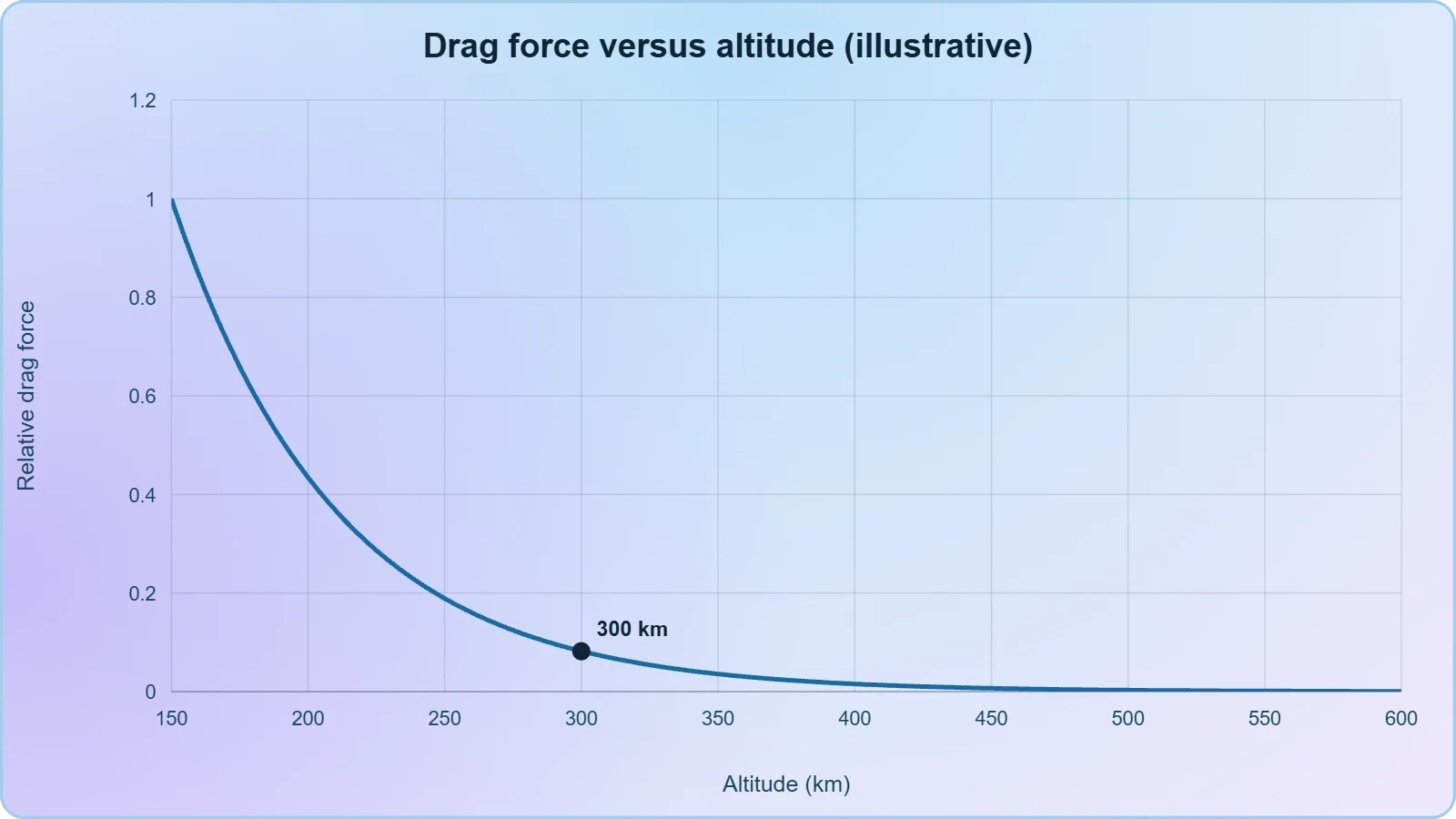
Orbital decay is a deceptively simple process with complicated inputs. A satellite in low Earth orbit moves at roughly 7.8 kilometres per second, and even the extremely thin gas at 300 kilometres altitude exerts a measurable retarding force. That force removes kinetic energy, which lowers the orbit, which in turn places the spacecraft in denser air, which increases drag further. The feedback is gradual but relentless. What makes prediction difficult is not the drag law itself but the density of the atmosphere, which depends on solar extreme-ultraviolet flux, geomagnetic activity, and the seasonal and diurnal expansion of the thermosphere.
Quantifying the Drag Force
The standard drag equation provides the starting point for any decay analysis. The force depends on atmospheric density, the spacecraft's velocity, its cross-sectional area, and a drag coefficient that captures the geometry of the body. For a tumbling, uncontrolled satellite, the effective area changes as the object rotates, which introduces additional scatter into any long-range forecast.
Here ##\rho## is the local atmospheric density, ##v## is the orbital velocity, ##C_d## is the drag coefficient, typically near 2.2 for a complex body in free-molecular flow, and ##A## is the cross-sectional area. Because ##\rho## varies by orders of magnitude between solar minimum and solar maximum at a fixed altitude, the same spacecraft can experience wildly different decay rates at different points in the solar cycle. Swift's final years coincided with rising solar activity, which is precisely why its descent accelerated when it did.
Estimating the Decay Timescale
A useful first-order estimate of the remaining orbital lifetime comes from equating the rate of energy loss to the work done by drag. For a circular orbit, the semi-major axis shrinks at a rate proportional to density and inversely proportional to altitude, which produces the characteristic acceleration of decay as the satellite descends.
In this expression ##a## is the semi-major axis, ##m## is the spacecraft mass, and the other symbols carry their usual meaning. The key insight is the feedback: as ##a## decreases, ##\rho## rises sharply, so ##da/dt## becomes more negative and the descent accelerates. This is why a satellite can linger for years at 400 kilometres and then fall through the final 100 kilometres in a matter of weeks. Swift's drop from 340 to 275 kilometres over a few months is entirely consistent with this behaviour.
We Also Published
Why Re-Entry Forecasts Remain Uncertain
Two credible organisations produced re-entry estimates that differ by many hours, and neither is wrong. NASA's Space Weather Operational Readiness Development program placed the event around 4:37am AEDT on 4 November, give or take a few hours, while the Aerospace Corporation estimated roughly 8:11pm AEDT the same day, give or take twelve hours. The discrepancy reflects genuine physical uncertainty rather than institutional disagreement. Small errors in the modelled atmospheric density compound over each orbit, and the final plunge depends on the exact attitude and tumbling state of a spacecraft that can no longer be commanded.
The Sources of Prediction Error
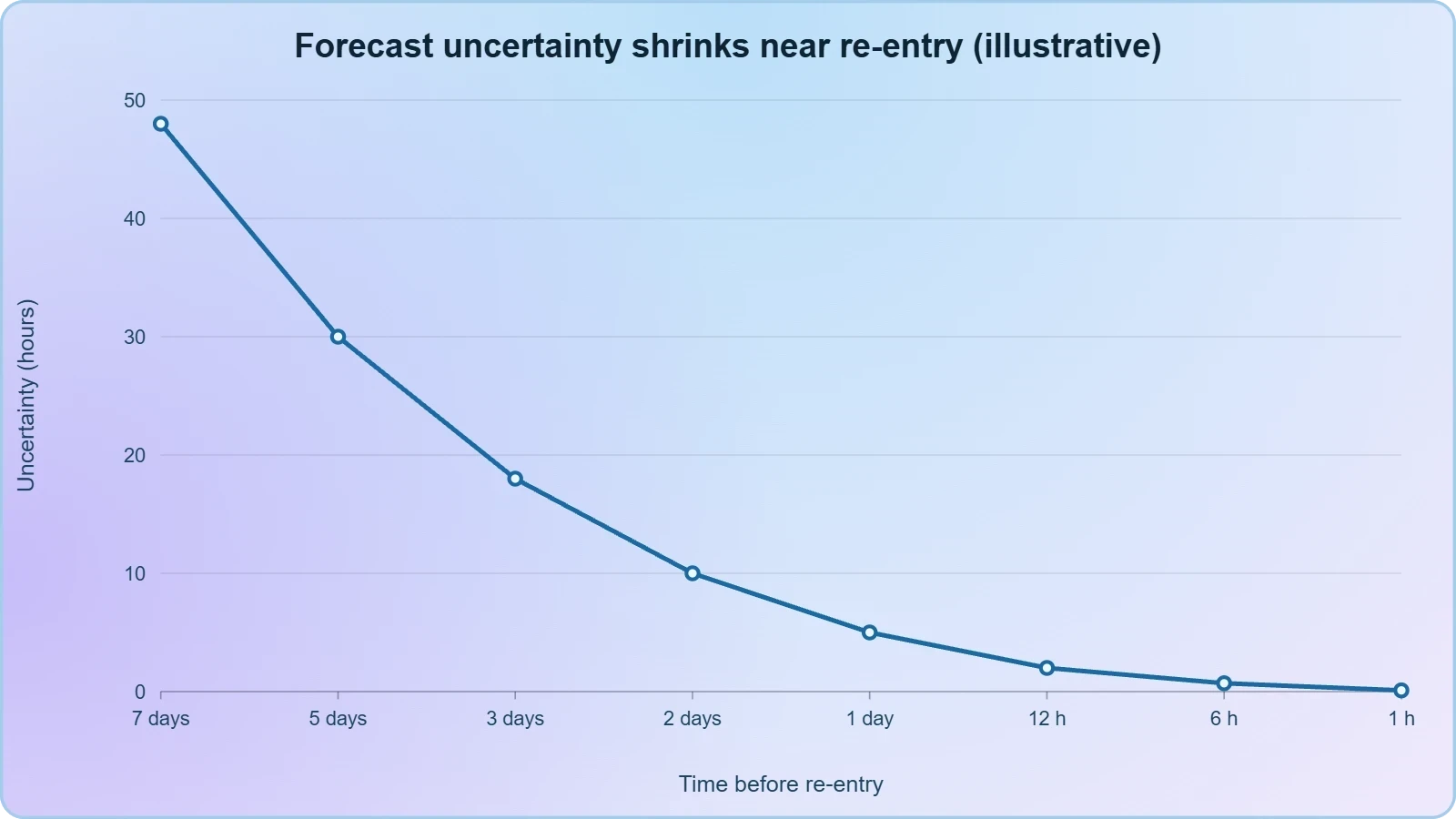
Space weather is the dominant variable. Solar extreme-ultraviolet output heats the thermosphere and changes its density at a given altitude, and geomagnetic storms can produce sudden, short-lived increases in drag. Forecasts of these conditions degrade rapidly beyond a few days, which is why re-entry windows widen as the event approaches rather than narrowing smoothly. The spacecraft's own configuration adds further noise: a tumbling body presents a changing cross-section, and any residual gas or venting can impart small, unpredictable forces. Together these effects make the final hours of an uncontrolled re-entry inherently probabilistic.
Prediction accuracy improves dramatically in the last few orbits, when tracking data can pin down the trajectory and the remaining lifetime shrinks to hours. This is why space agencies issue increasingly refined warnings as the object descends below roughly 200 kilometres. The practical consequence is that authorities cannot designate a specific landing zone days in advance; they can only define a latitude band and prepare for the possibility of debris reaching the surface.
The Geometry of the Ground Track
Swift's orbital inclination confines its ground track to a band between 21 degrees north and south of the equator. That band crosses northern Australia, Africa, India, South-East Asia, and South and Central America, meaning the spacecraft passes over a large share of the world's population on every orbit. The re-entry point could fall anywhere along that track, and the timing determines which region lies beneath the spacecraft at the critical moment. Because roughly seventy per cent of Earth's surface is ocean, the most probable outcome is a splashdown far from land.
Visibility is a separate question from risk. If re-entry occurs during daylight or over open water, the event may pass unobserved. If it happens at night over a populated area, the result could be spectacular: once the telescope descends to about 120 kilometres, the surrounding air heats up and the spacecraft begins to glow, producing a bright, slow-moving streak. Such displays are scientifically valuable as well, because ground observations of the breakup can inform models of how complex structures disintegrate under aerodynamic stress.
Risk, Debris, and the Realities of Uncontrolled Return
An uncontrolled re-entry sounds alarming, and it deserves careful attention, but the statistical picture is reassuring. Most of a satellite's mass is consumed by aerodynamic heating during the final descent, and the surviving fragments are typically small, dense components such as reaction wheels, structural fittings, and heat-resistant housings. The probability that any individual piece strikes a person is extraordinarily low, and no confirmed fatality from re-entering orbital debris has ever been recorded. The genuine concern is not personal injury but the diffuse, cumulative hazard of an increasingly crowded orbital environment.
What Actually Survives the Plunge
Breakup modelling divides a spacecraft into components and tracks each one's thermal and mechanical response to the extreme heating of re-entry. Materials with high melting points and substantial mass, such as titanium and steel alloys, tend to survive, while aluminium structures, solar arrays, and thermal blankets ablate or vaporise. The final debris footprint can stretch for hundreds of kilometres along the ground track, which is one reason precise impact prediction is so difficult. For a telescope of Swift's size, the surviving mass is likely to be modest but not negligible.
Ground-based observations during the final descent can validate these models, and the growing record of observed re-entries has steadily improved them. Each event adds data on how real hardware behaves under real heating, which matters for designing future spacecraft that can be safely disposed of. The trend in mission design is toward controlled deorbits or designs that fully demise, and Swift's uncontrolled return illustrates precisely why that discipline has become standard practice.
The Growing Problem of Orbital Debris
Swift is one object among tens of thousands tracked, and many more untracked fragments too small to catalogue. Each uncontrolled re-entry removes a piece of debris from orbit, which is beneficial, but the broader trend is toward a more congested low Earth orbit. Mega-constellations have multiplied the number of active satellites, and the corresponding rise in collision risk has prompted new norms around end-of-life disposal. Regulators increasingly require operators to demonstrate that a spacecraft will either deorbit within a defined period or move to a graveyard orbit.
The scientific community has also begun to treat the upper atmosphere as a finite resource. Satellite re-entries deposit metallic vapours into the stratosphere and thermosphere, and researchers are only beginning to quantify the consequences for atmospheric chemistry. Swift's contribution to that inventory is small, but the aggregate effect of thousands of future re-entries is a legitimate area of study. The telescope's final act, in other words, is a small data point in a much larger question about how humanity manages the space environment.
Solar Activity as the Hidden Driver
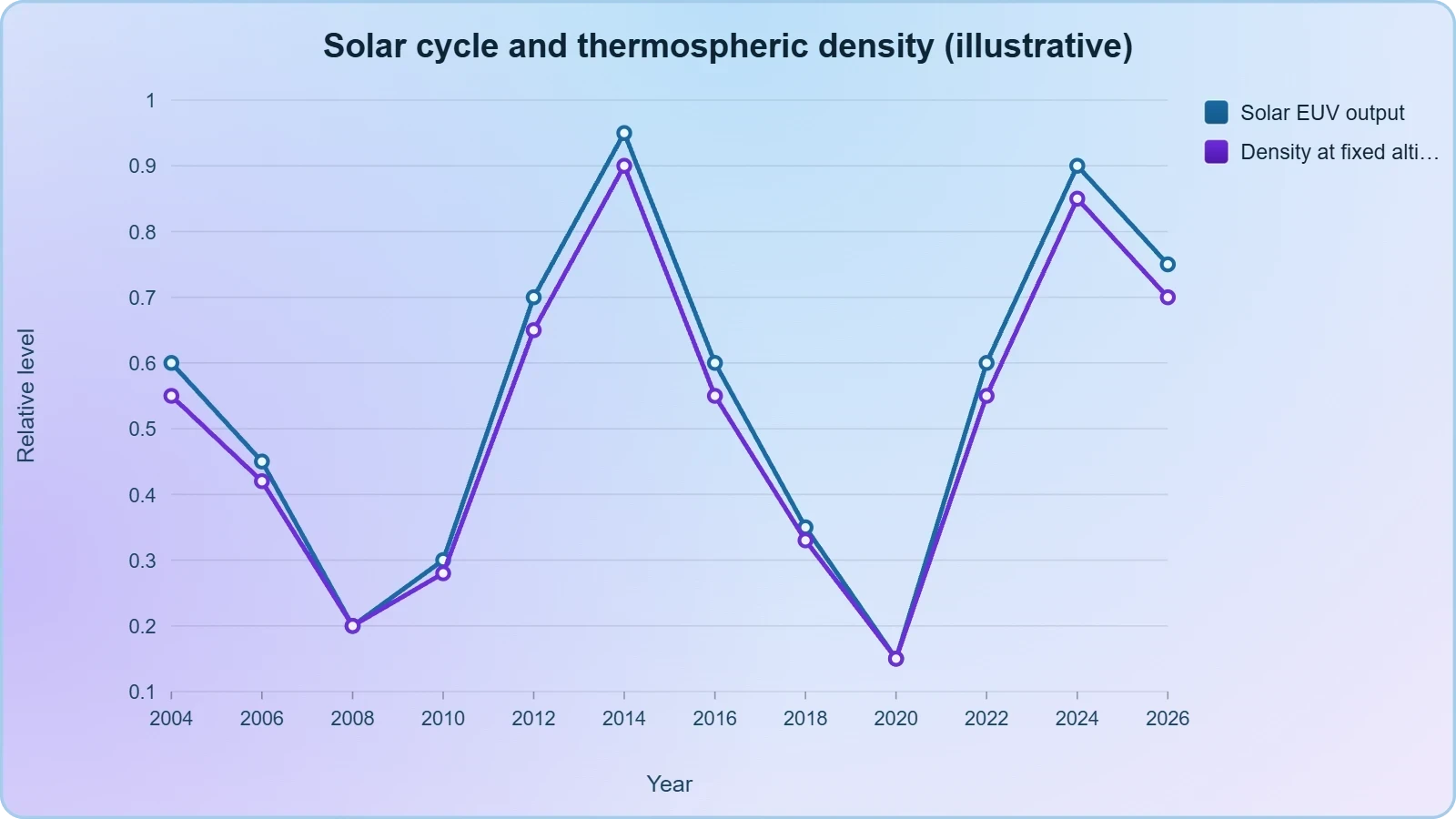
The single most important factor in Swift's accelerated decline was not the spacecraft's age but the Sun's behaviour. Solar activity follows an approximately eleven-year cycle, and the past two years have seen heightened output that expanded the thermosphere and increased drag at low altitudes. This is a well-understood phenomenon, yet it remains difficult to forecast precisely because the Sun's magnetic activity is inherently variable. Mission planners account for it when estimating lifetimes, but the actual timing of a solar maximum can shift by a year or more, which introduces substantial uncertainty into any long-range decay projection.
The Solar Cycle and Thermospheric Density
During solar maximum, extreme-ultraviolet radiation heats the upper atmosphere, causing it to expand outward. A satellite at a fixed altitude therefore finds itself in denser air than it would encounter at solar minimum, and its decay rate can increase by an order of magnitude. This is why satellites launched during quiet solar periods often outlive their design lifetimes, while those caught by an unexpectedly strong maximum can fail early. Swift's twenty-two-year run spanned two full solar cycles, and its final descent coincided with rising activity that effectively shortened its remaining orbital life.
Space weather forecasting has improved considerably, drawing on a fleet of solar observatories and numerical models of the coupled Sun-Earth system. Even so, predictions beyond a few days remain probabilistic, and the drag environment can change abruptly during a geomagnetic storm. For re-entry forecasting, this means the uncertainty window cannot be eliminated, only narrowed as the event approaches. The two competing estimates for Swift's return reflect exactly this limitation.
Implications for Future Missions
The lesson for satellite operators is that end-of-life planning must account for solar variability rather than assuming a benign environment. A spacecraft designed for a fifteen-year mission in low Earth orbit may need propellant reserves sized for an unexpectedly active Sun, or a design that guarantees demise within a defined period regardless of conditions. Newer missions increasingly incorporate drag sails, propulsion for controlled deorbit, or higher operational altitudes that reduce atmospheric sensitivity. Swift, built under earlier assumptions, had none of these provisions.
There is also a scientific opportunity here. Re-entering spacecraft provide natural experiments in high-enthalpy aerodynamics, and the data they generate can validate models used for crewed capsule design and planetary entry. Instruments that track the breakup of large objects contribute to this body of knowledge, and the growing record of observed re-entries is gradually turning an operational nuisance into a source of engineering insight.
What the Final Descent Teaches Us
Swift's return is a case study in the life cycle of a scientific asset. A spacecraft that reshaped high-energy astronomy now serves as a reminder that orbit is not a permanent address. The engineering, the physics, and the policy dimensions all converge in the final weeks of an uncontrolled descent, and each offers lessons that apply well beyond this single mission. The most immediate is that prediction is a probabilistic exercise, and communicating uncertainty honestly is part of responsible space operations.
Reading the Forecasts Correctly
When two agencies publish re-entry times that differ by hours, the public may read this as confusion. In fact it reflects a mature understanding of the underlying physics. The correct interpretation is that the event will occur within a broad window, that the location is constrained to a latitude band, and that the probability of any particular outcome is low. Authorities use these forecasts to issue advisories and, where necessary, to prepare for debris recovery, not to pinpoint a landing site. The precision improves only in the final orbits, when tracking data dominate the uncertainty budget.
For observers, the practical advice is straightforward: watch for updates in the final day, and treat any predicted time as approximate. If the re-entry occurs at night over a populated region, the resulting fireball could be visible for tens of seconds, moving steadily across the sky before fragmenting. If it occurs over ocean or in daylight, the event will pass largely unseen. Either way, the scientific value lies in the data collected during the descent, not in the spectacle.
Lessons for the Next Generation of Spacecraft
The clearest takeaway is that end-of-life design matters as much as launch performance. Missions built today are expected to demonstrate a credible disposal plan, whether through controlled deorbit, a graveyard orbit, or a design that fully demises on re-entry. Propellant budgets now include reserves for disposal, and drag sails and electrodynamic tethers are moving from concept to practice. Swift, designed in an era when such provisions were optional, illustrates the cost of that earlier assumption.
There is also a broader cultural shift underway. Space agencies and commercial operators increasingly treat orbital debris as a shared resource problem, and the norms around transparency in re-entry forecasting have strengthened accordingly. Public data on predicted re-entries, such as those published for Swift, allow independent analysts to verify and refine models. That openness is itself a form of risk management, and it represents a meaningful advance over the secrecy that once surrounded satellite operations.
Frequently Asked Questions About the Swift Re-Entry
Public interest in a falling satellite tends to concentrate on a handful of practical questions: when will it come down, where will it land, and is there any danger. The answers are more nuanced than headlines suggest, and understanding them requires a basic grasp of orbital mechanics and atmospheric physics. The following questions address the most common concerns, drawing on the published forecasts and the underlying science rather than speculation.
Timing, Location, and Visibility
The re-entry is expected on 4 November 2026, with estimates ranging from early morning to evening AEDT and uncertainty of several hours. The location could be anywhere along the orbital ground track between 21 degrees north and south, which includes northern Australia, Africa, India, South-East Asia, and the Americas. Because most of that band is ocean, a water impact is most likely. Visibility depends on timing and location: a night-time pass over a populated area could produce a dramatic fireball, while a daytime or oceanic re-entry would likely go unseen.
Predictions will tighten considerably in the final orbits, and observers should consult updated forecasts rather than relying on early estimates. The spacecraft will begin to glow at roughly 120 kilometres altitude, and the visible phase may last only a minute or two. Anyone hoping to see it should track official updates and be prepared for the possibility that the event occurs on the far side of the planet.
Risk and Scientific Significance
The risk to any individual is negligible. Most of the spacecraft will burn up, surviving fragments are likely to be small, and the vast majority of the ground track is ocean or sparsely populated. No confirmed injury from re-entering orbital debris has ever been recorded. The more significant concern is the broader issue of orbital debris and the need for responsible end-of-life planning, which Swift's uncontrolled return illustrates vividly.
Scientifically, the mission's legacy is secure. Swift detected at least 1,400 supernovas and transformed the study of gamma-ray bursts through rapid, multi-wavelength follow-up. Its archive will remain in use for years, and its operational model has influenced successor missions. The re-entry itself adds a final data point, contributing to models of how large spacecraft break up and what survives the descent, knowledge that informs the design of safer future missions.
From our network :
- Analyzing Trump Deportation Numbers Insights Into The 2026 Immigration Crackdown
- Vite 6/7 'Cold Start' Regression in Massive Module GraphsIn-depth analysis of Vite 6/7 cold start regressions in massive module graphs. Learn about barrel file issues, pre-bundling optimizations, and how to improve Vite dev server performance.
- Trump Political Strategy How Geopolitical Stunts Serve As Media Diversions
- 98% of Global MBA Programs Now Prefer GRE Over GMAT Focus EditionExplore why 98% of global MBA programs now prefer the GRE over GMAT Focus. Learn about the shorter GRE format, verbal logic importance, and strategic versatility for students.
- 10 Physics Numerical Problems with Solutions for IIT JEEPrepare for IIT JEE with 10 physics numerical problems, complete with detailed solutions and conceptual explanations. Ideal for mastering kinematics, thermodynamics, electromagnetism, and optics.
- Mastering DB2 12.1 Instance Design: A Technical Deep Dive into Modern Database ArchitectureComprehensive guide to DB2 12.1 Instance Design. Explore architectural components, HADR setup, buffer pool tuning, and security policies for IBM DB2 12.1. Includes 10 functional SQL and Shell samples.
- Mastering DB2 LUW v12 Tables: A Comprehensive Technical GuideComprehensive guide on DB2 LUW v12 tables. Explore CREATE TABLE syntax, BLU Acceleration, range partitioning, data types, and security features for IBM DB2 LUW v12.
- EV 2.0: The Solid-State Battery Breakthrough and Global Factory ExpansionDiscover the impact of the Solid-State Battery Breakthrough on the EV market. Learn about CATL and BYD stock growth, global factory expansion in Europe, and the future of EV 2.0 technology.
- AI-Powered 'Precision Diagnostic' Replaces Standard GRE Score ReportsDiscover the new GRE Precision Diagnostic. Learn how AI-powered behavioral analytics and time-to-solve tracking are replacing standard GRE score reports to empower students.
RESOURCES
- NASA's Swift space telescope will crash back to Earth — but when ...space.comAug 27, 2026 ... ... Swift space telescope. (Image credit: NASA/GSFC). Uncontrolled reentry. "Yes, Swift will have an uncontrolled reentry," said Alise Fisher ...
- Katalyst Develops Design for NASA to Rescue $500M Space ...katalystspace.comAug 11, 2025 ... Katalyst Develops Design for NASA to Rescue $500M Space Telescope from Uncontrolled Reentry ... First-of-its-kind mission would extend Swift ...
- NASA's Swift Observatory Faces Uncontrolled Reentry | FODNewsfodnews.comOct 6, 2026 ... NASA confirms its 22-year-old Swift Observatory is in uncontrolled decay toward reentry this month after a $30M rescue attempt failed.
- NASA Swift Observatory Projected for Atmospheric Re-entry ...satnews.comAug 22, 2026 ... ... telescope's orbital decay rate ahead of an uncontrolled atmospheric re-entry over the ocean. Filed Under: Missions & Constellations. Primary ...
- Ain't So Swift: Uncontrolled Fall to Earthleonarddavid.com19 hours ago ... An upcoming and uncontrolled reentry of the NASA's Swift observatory is expected to occur in the next few days. The…
- Swift boost mission - Wikipediaen.wikipedia.org... Swift Observatory, which is anticipated to undergo uncontrolled reentry by the end of 2026. The LINK servicing spacecraft, built and operated by Katalyst ...
- Safran DSI Selected for Katalyst Space Mission to Extend NASA's ...safran-dsi.comJun 29, 2026 ... ... uncontrolled re-entry by the end of 2026. “Safran's hall-effect electric propulsion system will be used to maneuver and boost…
- Leonard David's INSIDE OUTER SPACEleonarddavid.comAn upcoming and uncontrolled reentry of the NASA's Swift observatory is expected to occur in the next few days. The Neil Gehrels Swift Observatory…
- The mission to save NASA's sinking Swift Observatory was called off ...facebook.comAug 20, 2026 ... The telescope is now expected to make an uncontrolled atmospheric reentry ... Swift unexpectedly entered an unstable orbit and does…
- As Swift Nears Reentry, NASA Has No Dedicated Replacement for ...natureworldnews.com5 days ago ... 28, 2026 (Eastern Time). NASA's Swift observatory is drifting toward an uncontrolled reentry, and the agency has no dedicated spacecraft…
- NASA's Swift space telescope is expected to crash back to Earth in ...instagram.com21 hours ago ... Scientists expect the 1.5-ton spacecraft to make an uncontrolled reentry into our planet's atmosphere within days. Launched in November 2004, ...
- Swift Observatory Live Tracker, Where Is It Now | Orbital Radarorbitalradar.comSep 27, 2026 ... Without a boost, uncontrolled re-entry is expected before the end of this decade. The commercial reboost. NASA has contracted a…
- Katalyst to boost the orbit of Nasa telescope poised for uncontrolled ...eandt.theiet.orgSep 29, 2025 ... ... telescope that is headed for an uncontrolled re-entry into the Earth's atmosphere. The Neil Gehrels Swift Observatory, launched in…
- NASA's Swift observatory faces uncontrolled reentry after failed orbit ...digg.com1 day ago ... TLDR. Swift's failed orbit rescue has left the long-serving observatory facing uncontrolled reentry. Forecasts published Nov. 1 and 2 disagree ...
- Swift Re-entry and Thermosphere Neutral Density Modeling ...helioshine.orgOct 2, 2026 ... NASA's Neil Gehrels Swift Observatory was launched in 2004 to detect and monitor gamma-ray bursts. After 21 years of science…