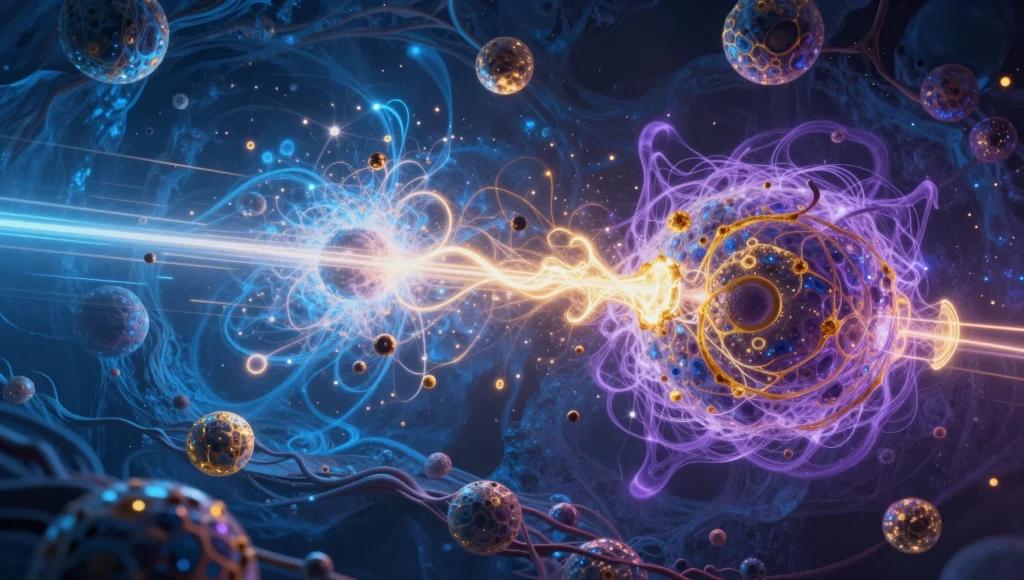
Physics has always advanced by pushing the boundaries of the measurable, and the announcement of signals from a realm roughly one hundred billion times smaller than an atom represents one of the most audacious extensions of that frontier yet attempted. The term "zeptoverse" has been coined by researchers to describe a domain whose characteristic lengths sit near the zeptometre, a unit so minuscule that it defies ordinary intuition. This is not merely a curiosity of nomenclature; it is a statement about the energy scales, detector sensitivities, and theoretical frameworks required to probe distances that were once considered permanently beyond experimental reach. The work, conducted at the Large Hadron Collider at CERN and led by scientists based in Cambridge, signals a genuine methodological shift rather than a single isolated result.
What makes the finding consequential is the way it connects the smallest observable structures to the largest questions in cosmology. A more complete theory of how the Universe operates must reconcile the behaviour of matter at extreme energies with the gravitational architecture of galaxies and the expansion of spacetime itself. When physicists speak of detecting signals at such compressed scales, they are effectively testing the mathematical scaffolding that underpins the Standard Model and its suspected extensions. The zeptoverse, in this reading, is less a place than a regime: a set of conditions under which familiar particles dissolve into more fundamental degrees of freedom, and where the predictions of competing theories begin to diverge measurably.
Understanding this development requires appreciating both the experimental machinery and the conceptual stakes. The LHC smashes atoms together precisely so that their internal structure can be broken apart and studied, and the debris of those collisions carries information about interactions that occur at extraordinarily short distances. This article examines the physics of the zeptoverse, the role of the LHC in reaching it, the theoretical motivations that make such measurements worthwhile, and the practical limits that still constrain what can be claimed. It also considers how the result fits into the broader programme of particle physics and what a confirmed detection would mean for the future of the field.
On This Page
- The Physics of the Zeptoverse and the Meaning of Scale
- The Large Hadron Collider as a Microscope for the Infinitesimal
- Theoretical Motivations for Probing the Zeptoverse
- Interpreting the Cambridge-Led Detection
- Implications for the Future of Particle Physics
- Communicating Extreme Scales with Intellectual Honesty
- Conclusion: What the Zeptoverse Means for Physics
The Physics of the Zeptoverse and the Meaning of Scale
The prefix "zepto" denotes a factor of ##[10^{-21}]##, and a zeptometre is therefore one sextillionth of a metre. To place this in perspective, a hydrogen atom measures roughly ##[5.3 \times 10^{-11}]## metres across, so a length one hundred billion times smaller sits near ##[5 \times 10^{-21}]## metres. At such distances, the notion of a particle as a compact object loses meaning, and what physicists actually probe is the probability of interactions between fields. The zeptoverse is thus a shorthand for the shortest distances accessible through high-energy collisions, where quantum field theory predicts that new phenomena may emerge from the vacuum itself.
From the Atom to the Zeptometre
The journey from atomic to subatomic to zeptometric scales is a story of successive demotions of matter's apparent solidity. Rutherford's scattering experiments revealed the nucleus; later work exposed protons and neutrons as composites of quarks; and deep inelastic scattering at ever-higher energies showed that even quarks carry structure at finer resolution. Each step required a leap in accelerator energy, because the resolving power of a collision scales inversely with the momentum transferred. The zeptoverse represents the current endpoint of that logic, a regime where the wavelength associated with the probing particles becomes comparable to the distances being investigated.
The relationship between energy and distance is captured by the de Broglie relation and its relativistic counterpart, which together establish that reaching smaller scales demands proportionally greater energy. This is why the LHC, with its multi-TeV collision energies, is the natural instrument for such exploration. The zeptoverse is not observed directly; it is inferred from the behaviour of collision products whose kinematics encode the dynamics of the underlying interaction. Researchers reconstruct those dynamics statistically, comparing vast numbers of events against theoretical predictions to isolate any deviation that might signal new physics.
Why Shorter Distances Demand Higher Energies
The quantitative link between energy and spatial resolution can be expressed through the reduced Planck constant and the speed of light. The characteristic wavelength of a probe with momentum ##[p]## is given by ##[\lambda = \dfrac{h}{p}]##, so increasing momentum compresses the wavelength and sharpens the probe. In collider physics, the relevant quantity is the momentum transfer ##[Q]##, and the accessible distance scales as ##[\Delta x \sim \dfrac{\hbar c}{Q}]##. Pushing ##[Q]## into the multi-TeV range brings ##[\Delta x]## into the zeptometre domain, which is precisely the regime the new measurements target.
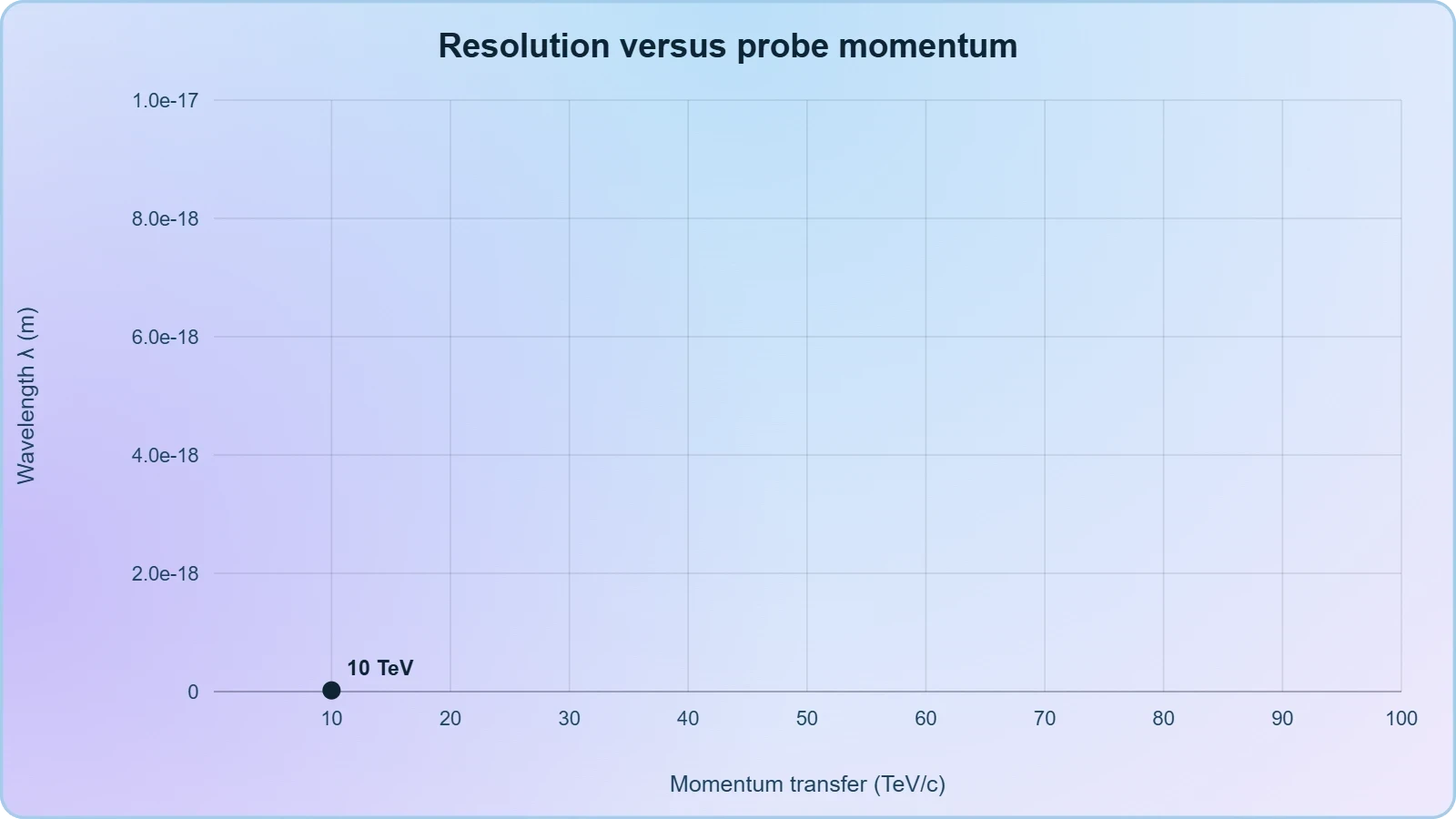
Evaluating this expression for a momentum transfer of ##[10\ \text{TeV}]##, or ##[10^{4}\ \text{GeV}]##, yields a resolution near ##[2 \times 10^{-20}]## metres, comfortably within the zeptometric range. The calculation illustrates why accelerator energy is the decisive resource: every order of magnitude in energy buys an order of magnitude in spatial resolution. It also explains why proposals for future colliders are framed in terms of the scales they would open, since the zeptoverse is less a destination than a threshold that shifts as technology improves.
The Large Hadron Collider as a Microscope for the Infinitesimal
The Large Hadron Collider is often described as a machine for smashing atoms, but its deeper function is to concentrate energy into a volume small enough that the strong, weak, and electromagnetic interactions can be studied under extreme conditions. Protons are accelerated to within a whisker of light speed and brought into collision at designated interaction points, where detectors record the trajectories and energies of the resulting particles. The Cambridge-led analysis draws on this data stream, applying sophisticated reconstruction techniques to extract signals that would be invisible to coarser methods. The LHC thus operates as a microscope whose resolving power is set by collision energy rather than by lenses.
How Collisions Reveal Short-Distance Structure
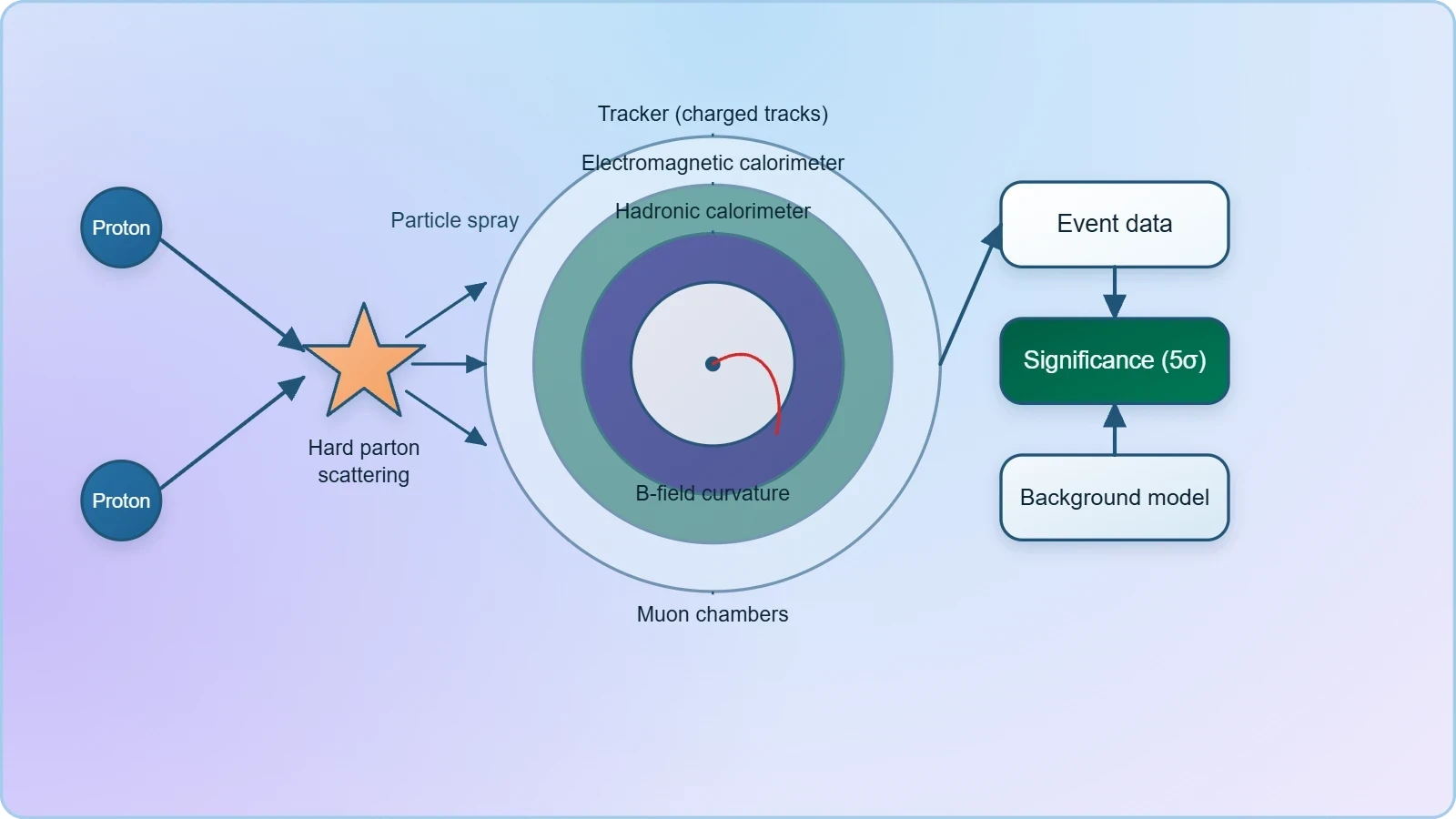
When two protons collide at high energy, the interaction is best described as a collision between their constituent partons, the quarks and gluons that carry the proton's momentum. The hard scattering produces a spray of particles whose angular distribution and energy flow reflect the dynamics of the underlying partonic event. By measuring these final states with precision, physicists infer the properties of the interaction at distances far smaller than the proton itself. The zeptoverse emerges from this inference: it is the domain of momentum transfers so large that the probe effectively resolves structure at the zeptometre scale, even though no detector physically spans that distance.
Detector technology is central to this enterprise. Tracking systems measure charged-particle trajectories in magnetic fields, calorimeters absorb and measure energy, and muon chambers identify penetrating particles that escape the inner layers. Each subsystem contributes to a global event reconstruction that must be calibrated to extraordinary precision. The statistical power of the LHC comes from the sheer number of collisions, which allows rare processes to be isolated from overwhelming backgrounds. In this sense, the zeptoverse is mapped not by a single dramatic event but by the accumulated weight of millions of measurements analysed with rigorous statistical discipline.
Detector Sensitivity and Statistical Inference
Claiming a detection at such scales requires more than an interesting anomaly; it demands a defensible statistical threshold. Particle physicists conventionally require a significance of five standard deviations before announcing an observation, a bar designed to suppress false positives arising from statistical fluctuations. The Cambridge team's result must therefore be understood in the context of background modelling, systematic uncertainties, and the look-elsewhere effect, which accounts for the many possible places a signal could appear. These methodological safeguards are what separate a genuine discovery from an artefact of analysis, and they explain why results at the frontier are reported with careful qualification.
Theoretical Motivations for Probing the Zeptoverse
The Standard Model of particle physics is a triumph of prediction and measurement, yet it remains conspicuously silent on several profound questions. It does not incorporate gravity, offers no explanation for the observed matter-antimatter asymmetry, and treats dark matter and dark energy as external mysteries. Many theoretical frameworks that address these gaps predict new phenomena at short distances, which is precisely why the zeptoverse matters. If additional spatial dimensions exist, or if particles are composites of more fundamental entities, the effects would appear as deviations from Standard Model expectations at high momentum transfer. The LHC's reach into the zeptometric regime is therefore a direct test of these ideas.
Beyond the Standard Model
Among the most influential proposals are theories with extra spatial dimensions, which can lower the effective Planck scale and bring quantum gravity within experimental reach. In such models, the apparent weakness of gravity arises because it propagates through additional dimensions, while the other forces remain confined to the familiar three. Other frameworks invoke composite Higgs models, in which the Higgs boson is not elementary but a bound state of new strongly interacting particles. Each scenario leaves a distinctive imprint on high-energy collisions, and the zeptoverse provides the arena in which those imprints would become visible. The Cambridge-led analysis is best read as a contribution to this broader search programme.
Supersymmetry offers another motivation, positing a symmetry between fermions and bosons that would stabilise the Higgs mass and provide a dark matter candidate. If supersymmetric partners exist at accessible energies, their production and decay would alter the distribution of collision products in measurable ways. The absence of such signals so far has constrained the parameter space considerably, pushing expected masses higher and making the zeptoverse an increasingly important testing ground. Theoretical elegance and experimental null results together shape the direction of the field, and each new reach into smaller scales sharpens the boundary between viable and excluded models.
Quantum Gravity and the Planck Frontier
The ultimate short-distance frontier is the Planck length, approximately ##[1.6 \times 10^{-35}]## metres, where quantum effects of gravity are expected to become comparable to the other forces. The zeptoverse sits many orders of magnitude above this limit, yet it represents meaningful progress toward it. Some extra-dimension scenarios predict that gravitational interactions could become strong at TeV energies, producing microscopic black holes or enhanced missing-energy signatures. While no such signals have been confirmed, the theoretical possibility illustrates why pushing to smaller scales is not merely incremental. Each order of magnitude brings physicists closer to the regime where the deepest unresolved tension in modern physics must finally be confronted.
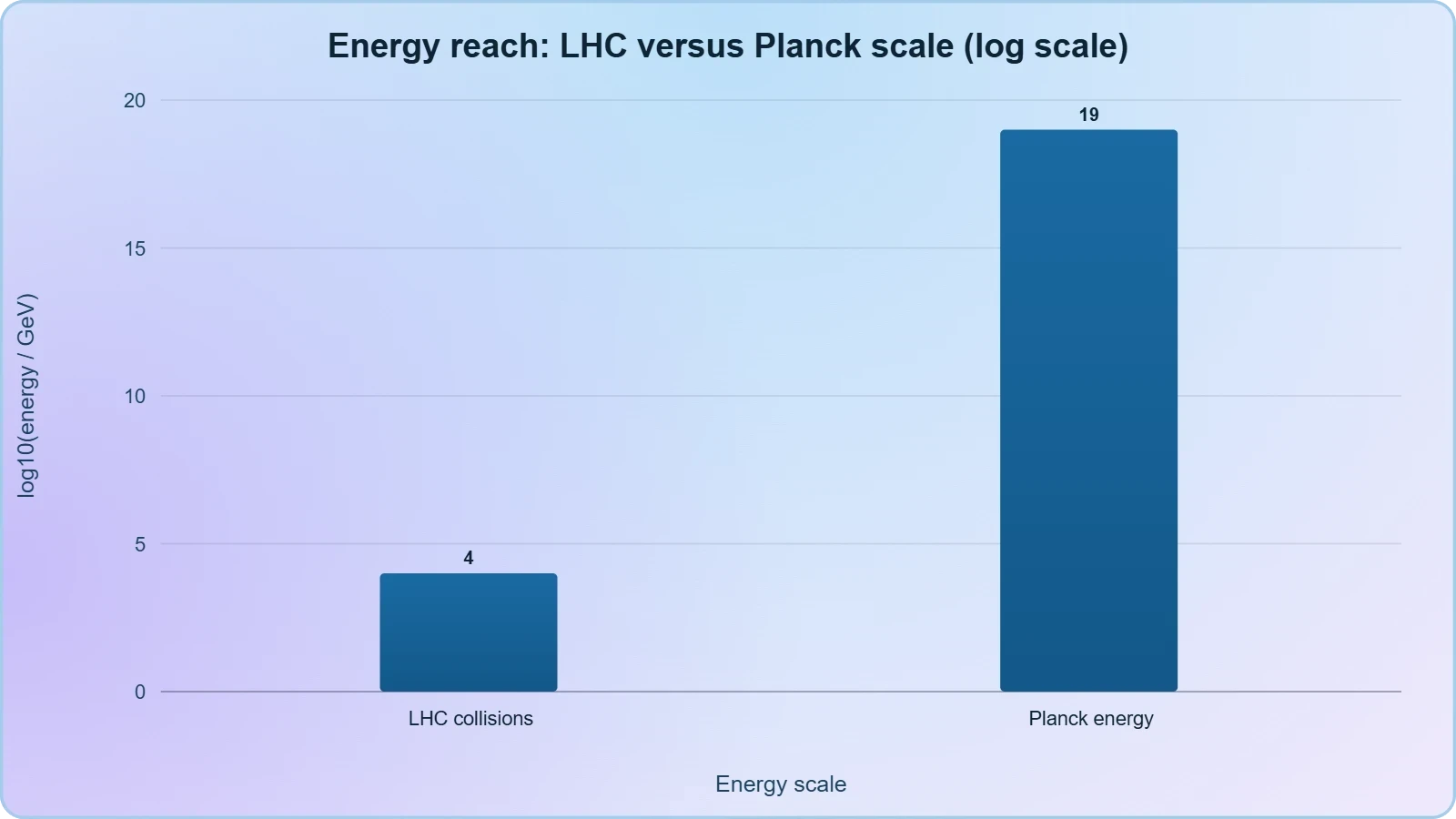
This Planck energy, roughly fifteen orders of magnitude beyond LHC collision energies, defines the chasm that remains. The calculation shows that reaching the Planck scale directly is far beyond foreseeable technology, which is why theorists explore scenarios in which the effective Planck scale is lowered by extra dimensions. In those models, the zeptoverse could host gravitational phenomena normally associated with vastly higher energies. The experimental programme is thus doubly motivated: it tests specific beyond-Standard-Model proposals while also probing the general question of whether spacetime itself has structure at distances that current theory cannot yet describe.
Interpreting the Cambridge-Led Detection
The reported result originates from an analysis led by scientists based in Cambridge, working within one of the LHC's major experimental collaborations. Such analyses are inherently collaborative, drawing on detector calibration, simulation, and statistical expertise distributed across many institutions. The Cambridge group's leadership likely concerns a specific channel or observable, where their reconstruction techniques or theoretical modelling provided a decisive advantage. Understanding the result therefore requires attention to the particular final state being studied, the backgrounds that must be controlled, and the assumptions embedded in the simulation used to model them. These details determine how much weight the finding can bear.
What the Signal Actually Represents
In collider physics, a "signal" is rarely a single event but a statistically significant excess over predicted backgrounds in a defined region of phase space. The zeptoverse framing suggests that the excess corresponds to interactions with very high momentum transfer, where the effective resolution approaches the zeptometric scale. Whether this constitutes evidence for new physics or a refinement of Standard Model predictions depends on the size and consistency of the deviation. The responsible interpretation is cautious: a detection of signals at unprecedented scales is a statement about experimental reach, not necessarily about the discovery of new particles or forces.
It is equally important to distinguish between reaching a scale and resolving structure at that scale. Reaching the zeptoverse means that collisions produce momentum transfers capable of probing such distances in principle; resolving structure means that a deviation from point-like behaviour has actually been observed. The two are related but not identical, and conflating them is a common source of overstatement in popular coverage. The Cambridge-led work should be assessed on which of these claims it actually supports, and on the robustness of the statistical and systematic evidence presented in the underlying publication.
Limits of Current Evidence
Every frontier measurement carries uncertainties that temper its interpretation. Luminosity calibration, parton distribution functions, detector response, and theoretical higher-order corrections all contribute to the total error budget. At the extreme edges of phase space, where the zeptoverse signals are expected, statistics are sparse and systematic effects can dominate. The result must therefore be read alongside independent analyses and, ideally, confirmed by a second experiment. Reproducibility is the bedrock of particle physics, and a claim of this magnitude will rightly be subjected to intense scrutiny before it enters the canon of established knowledge.
Implications for the Future of Particle Physics
If the zeptoverse signals hold up, their implications extend well beyond a single measurement. They would inform the design of future colliders, sharpen the priorities of theoretical work, and reshape the questions that experimentalists pursue in the coming decades. A confirmed deviation from Standard Model expectations at zeptometric scales would be among the most significant discoveries in physics, while a null result would still be valuable as a constraint on speculative models. Either outcome advances the field, because the value of frontier exploration lies as much in the boundaries it establishes as in the discoveries it delivers.
Next-Generation Colliders and Precision Frontiers
Proposals for future machines, including high-energy circular colliders and compact linear designs, are explicitly framed around the scales they would open. A collider reaching energies an order of magnitude beyond the LHC would extend the zeptoverse into a broader domain, allowing systematic study rather than isolated glimpses. Precision measurements at lower energies complement this reach by probing virtual effects of heavy particles that cannot be produced directly. The combination of energy-frontier and precision-frontier strategies is widely regarded as the most promising path forward, and the zeptoverse result adds weight to arguments for sustained investment in both.
Technological development is inseparable from this ambition. Superconducting magnets, advanced vacuum systems, and radiation-hard detectors all require years of research before they can be deployed. The Cambridge-led analysis contributes to this ecosystem by demonstrating what current instruments can achieve and by identifying the observables where future machines would deliver the greatest return. In this sense, the zeptoverse is not only a scientific target but a design brief, specifying the performance characteristics that next-generation facilities must meet if they are to resolve the questions the current generation has raised.
Open Questions and Research Directions
Several questions remain unresolved and will shape the research agenda. The most pressing is whether the reported signals are robust under independent analysis and whether they persist with additional data. Beyond that, theorists must determine which models best accommodate the observations and what new predictions follow. Experimentalists will refine their reconstruction techniques, reduce systematic uncertainties, and extend the search to related channels. The zeptoverse, whatever its ultimate status, has already served its purpose by focusing attention on the extreme kinematic regime where the next discovery is most likely to emerge.
We Also Published
Communicating Extreme Scales with Intellectual Honesty
Reporting on the zeptoverse places a special burden on science communication, because the numbers involved resist intuitive grasp. A distance one hundred billion times smaller than an atom is not something a reader can visualise, and metaphors can mislead as easily as they illuminate. The responsible approach is to anchor the scale in a chain of comparisons, explain the inferential nature of the measurement, and resist the temptation to present a provisional result as a settled discovery. The BBC's coverage, drawing on correspondent Pallab Ghosh and additional reporting by Salman Mushatat, performs a public service by bringing the result to a broad audience, but the underlying nuance must be preserved.
From Laboratory Data to Public Understanding
Effective communication of frontier physics requires distinguishing between what was measured, what was inferred, and what remains speculative. The zeptoverse is a useful label precisely because it conveys reach without claiming resolution, but it can also invite overinterpretation. Journalists and scientists alike must be explicit about statistical significance, the role of theoretical models, and the provisional character of any single analysis. When these caveats are omitted, public understanding suffers and trust in science can erode. When they are included, readers gain a genuine appreciation of how knowledge at the frontier is actually constructed.
The collaborative nature of modern physics also deserves emphasis. A result attributed to a Cambridge-led team rests on the labour of thousands of researchers, engineers, and technicians across many countries. Communicating this collective dimension counters the misleading image of the lone genius and conveys the institutional scale required for frontier science. It also clarifies why progress is incremental and why confirmation takes time. The zeptoverse, in this framing, is a shared achievement of an international community, and its significance is best understood as part of a long tradition of collective inquiry into the structure of matter.
Why Scale Claims Require Careful Language
Language matters enormously when describing extremes. Saying that scientists have "detected signals from the zeptoverse" is evocative but ambiguous, since the signals are detected in detectors of ordinary size and the zeptometric scale is inferred from kinematics. Precision in wording protects against the impression that a new microscope has literally photographed a zeptometre-sized object. The most accurate formulations describe momentum transfers, cross sections, and deviations from predicted distributions, translating these into scale language only as a secondary convenience. This discipline is not pedantry; it is the difference between informing the public and entertaining it at the expense of accuracy.
Conclusion: What the Zeptoverse Means for Physics
The zeptoverse is best understood as a statement about the reach of contemporary experiment rather than a claim to have conquered the smallest scale of nature. The Cambridge-led work at the LHC demonstrates that collisions can probe momentum transfers corresponding to distances roughly one hundred billion times smaller than an atom, opening a regime where the Standard Model and its extensions can be tested under extreme conditions. Whether the reported signals ultimately signify new physics or a refined understanding of known processes, the measurement extends the empirical frontier and sharpens the questions that future experiments must answer.
For students and researchers alike, the episode offers a lesson in how frontier science proceeds: through collaborative instrumentation, statistical discipline, theoretical imagination, and careful communication. The zeptoverse will not be the final frontier, since the Planck scale remains vastly more remote, but it marks a meaningful step in a centuries-long descent into the structure of matter. Its significance lies less in a single headline than in the cumulative process of measurement and interpretation that gradually converts speculation into knowledge, and that process continues with every additional collision recorded at CERN.
From our network :
- 98% of Global MBA Programs Now Prefer GRE Over GMAT Focus EditionExplore why 98% of global MBA programs now prefer the GRE over GMAT Focus. Learn about the shorter GRE format, verbal logic importance, and strategic versatility for students.
- EV 2.0: The Solid-State Battery Breakthrough and Global Factory ExpansionDiscover the impact of the Solid-State Battery Breakthrough on the EV market. Learn about CATL and BYD stock growth, global factory expansion in Europe, and the future of EV 2.0 technology.
- 10 Physics Numerical Problems with Solutions for IIT JEEPrepare for IIT JEE with 10 physics numerical problems, complete with detailed solutions and conceptual explanations. Ideal for mastering kinematics, thermodynamics, electromagnetism, and optics.
- Trump Political Strategy How Geopolitical Stunts Serve As Media Diversions
- Vite 6/7 'Cold Start' Regression in Massive Module GraphsIn-depth analysis of Vite 6/7 cold start regressions in massive module graphs. Learn about barrel file issues, pre-bundling optimizations, and how to improve Vite dev server performance.
- Analyzing Trump Deportation Numbers Insights Into The 2026 Immigration Crackdown
- Mastering DB2 LUW v12 Tables: A Comprehensive Technical GuideComprehensive guide on DB2 LUW v12 tables. Explore CREATE TABLE syntax, BLU Acceleration, range partitioning, data types, and security features for IBM DB2 LUW v12.
- AI-Powered 'Precision Diagnostic' Replaces Standard GRE Score ReportsDiscover the new GRE Precision Diagnostic. Learn how AI-powered behavioral analytics and time-to-solve tracking are replacing standard GRE score reports to empower students.
- Mastering DB2 12.1 Instance Design: A Technical Deep Dive into Modern Database ArchitectureComprehensive guide to DB2 12.1 Instance Design. Explore architectural components, HADR setup, buffer pool tuning, and security policies for IBM DB2 12.1. Includes 10 functional SQL and Shell samples.
RESOURCES
- Physicists knock at the door of the zeptoversecam.ac.uk3 hours ago ... ... subatomic 'beauty' particle ever seen. The ... But at the LHC, physicists are now probing distances 10 billion times…
- Physicists knock at the door of the zeptoverse - mySciencemyscience.org5 hours ago ... ... subatomic 'beauty' particle ever seen. The ... But at the LHC, physicists are now probing distances 10 billion times…
- Cern breakthrough offers first glimpse into the zeptoverse - The Timesthetimes.com7 hours ago ... The LHC acts like a giant microscope as it zooms in on the subatomic ... scale or energy level of…
- Have you ever heard of a zeptometre? It's a trillionth of a billionth of ...facebook.com3 hours ago ... ... physics might exist at the zeptometre scale. This strange world, dubbed the zeptoverse, could also be hiding the secrets…
- Scientists Detect Signals Inside the Zeptoverse at CERNdemokratis.co.id3 hours ago ... ... zeptoverse scale, opening new possibilities for dark matter research and fundamental physics ... Large Hadron Collider (LHC) have detected ...
- Large hadron collider: A revamp that could revolutionise physics - BBCbbc.comApr 22, 2022 ... What all this means is that there's now the best chance ever of the LHC finding subatomic particles that are…
- British scientists peer inside the minuscule world of the zeptoversedailymail.com3 hours ago ... The zeptoverse exists at the smallest scales ever explored by ... LHC, probing physics at an even smaller scale.' Likewise,…
- Scientists at Fermilab close in on fifth force of nature - BBCbbc.comAug 10, 2023 ... Physicists believe that an unknown force could be acting on sub-atomic particles known as muons.
- Physicists knock at the door of the zeptoverse - YouTubeyoutube.com5 hours ago ... ... physics might exist at the zeptometre scale. This strange world, dubbed the zeptoverse, could also be hiding the secrets…
- Scientists Detect Signals From the Zeptoverse at CERNsuaragarut.id2 hours ago ... Researchers at Cambridge detect particle interactions at the zeptoverse scale using CERN's Large Hadron Collider, opening new possibilities ...
- Have you ever heard of a zeptometre? It's a trillionth of a billionth of ...instagram.com4 hours ago ... Today at the Large Hadron Collider, we're probing distances 10 billion times smaller than an atom. This is a region…