
On This Page
Understanding the Integer Logarithm Floor
The integer logarithm floor provides a discrete way to measure exponential growth within a specific numerical range. It identifies the largest integer ##n## where the inequality ##b^n \leq x## holds true for any base ##b > 1##.
Mathematically, this value is denoted as ##\lfloor \log_b(x) \rfloor##, representing the downward rounding of a standard logarithm. It bridges the gap between continuous logarithmic functions and the discrete nature of digital computation systems.
In many practical scenarios, we are interested only in the integer component of a result. This specific floor value tells us exactly how many times a base can be multiplied by itself before exceeding ##x##.
By focusing on the floor, mathematicians and engineers can simplify complex calculations involving large powers. This simplification is crucial when dealing with hardware constraints that favor integer arithmetic over floating-point operations.
Understanding this concept requires a shift from thinking about exact values to thinking about boundaries. It establishes a lower bound for the exponent needed to reach or surpass a given numerical magnitude.
Definition and Mathematical Foundation
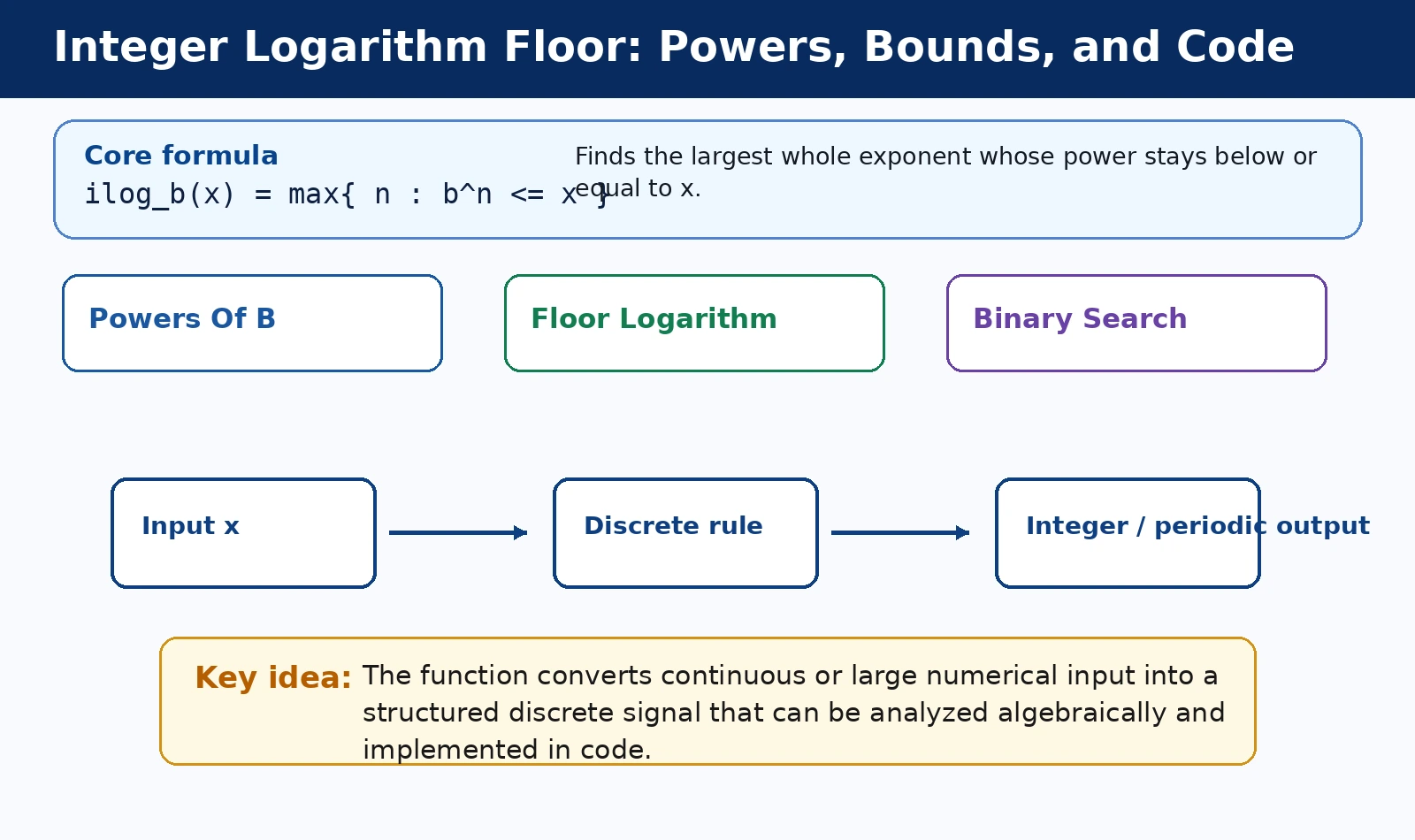
The formal definition of the integer logarithm floor rests on the relationship between powers and their bases. For a given positive integer ##x## and base ##b##, we seek the maximum ##n##.
This relationship is expressed through the fundamental inequality:
Here, ##n## is the integer logarithm floor of ##x## to the base ##b##.
The function is monotonically non-decreasing, meaning as ##x## increases, the floor value either stays the same or increases. This property is vital for maintaining consistency across various mathematical proofs and algorithm designs.
Logarithms are the inverse of exponentiation, and the floor function adds a layer of discretization. This combination is essential for mapping continuous growth patterns into finite, manageable digital steps.
The domain of this function typically includes all positive real numbers for ##x## and ##b##. However, in computer science, we almost exclusively deal with integers to ensure precision and speed.
Practical Examples and Interpretation
Consider the example of finding the floor of a base-2 logarithm for the number ten. We calculate powers of two: ##2^3 = 8## and ##2^4 = 16##.
Since eight is less than ten but sixteen is greater, the integer floor is three. This tells us that ten requires at least four bits for binary representation.
Another example involves base-10, where the floor of ##\log_{10}(150)## equals two. This is because ##10^2 = 100## is the largest power of ten below one hundred fifty.
These examples illustrate how the floor function identifies the "magnitude" of a number. It provides a quick way to estimate the scale of a value without needing precise decimals.
In financial modeling or data scaling, these integer values help categorize data into buckets. Each bucket represents a different order of magnitude, facilitating easier data analysis and visualization.
Algorithmic Implementation and Computation
Computing the integer logarithm floor efficiently is a common task in software development. Most modern programming languages provide built-in functions, but understanding the underlying logic is beneficial.
The simplest approach involves repeated multiplication or division until the target value is reached. While intuitive, this method can be slow for very large numbers or high bases.
More advanced algorithms utilize binary search techniques to find the exponent in logarithmic time. This significantly improves performance when dealing with high-precision arithmetic or large-scale data processing.
In low-level systems, engineers often use precomputed lookup tables for common bases like two or ten. This allows for near-instantaneous retrieval of the floor value at the cost of memory.
Choosing the right implementation depends on the specific constraints of the target environment. Speed, memory usage, and precision requirements all influence the final choice of algorithmic strategy.
Iterative and Recursive Approaches
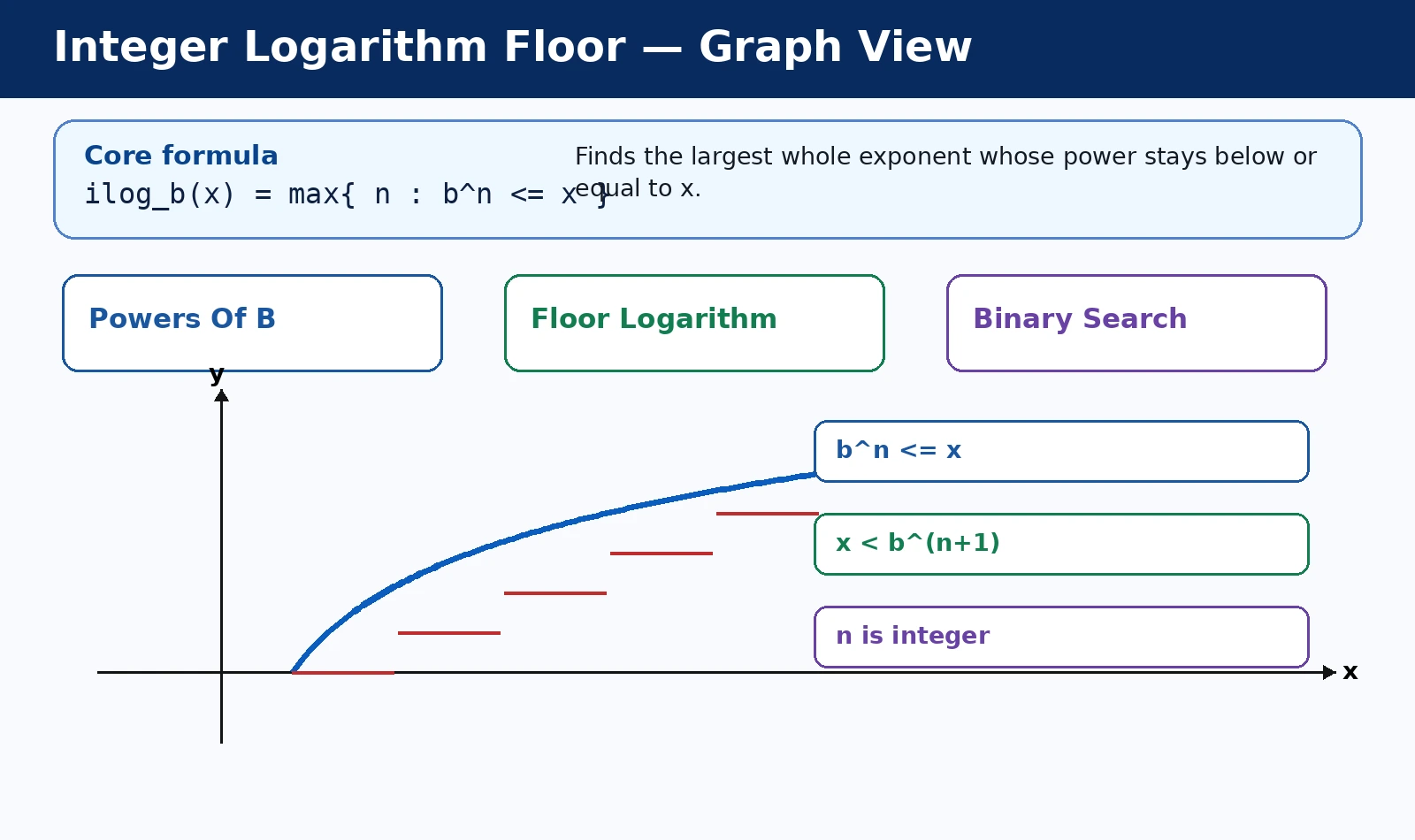
An iterative approach starts with an exponent of zero and increments it sequentially. In each step, the base is multiplied until the product exceeds the target value.
The loop terminates when the condition ##b^n > x## is met, returning ##n-1##. This is straightforward to implement but has linear time complexity relative to the result.
Recursive versions of this logic follow a similar path but use function calls to track progress. While elegant, recursion can lead to stack overflow issues if the exponent is extremely large.
Optimization can be achieved by doubling the exponent in each step to narrow the range. This "galloping" technique quickly finds the upper bound before refining the result with a binary search.
For most standard applications, these basic methods are sufficient and easy to debug. They provide a reliable foundation for more complex mathematical libraries used in scientific computing.
Bitwise Operations for Binary Logarithms
When the base is exactly two, we can leverage bitwise operations for maximum efficiency. The integer logarithm floor of ##x## is essentially the position of the highest set bit.
In many CPU architectures, there are dedicated instructions like "Count Leading Zeros" (CLZ). These hardware-level commands can calculate the binary floor in a single clock cycle.
If hardware instructions are unavailable, bit-shifting techniques can simulate the process. By shifting the number right until it becomes zero, we count the number of shifts performed.
This method is incredibly fast and avoids the overhead of floating-point math or loops. It is the preferred way to determine bit-length in low-level systems programming.
For example, the binary representation of ten is ##1010##, where the highest bit is at index three. This directly correlates to the integer logarithm floor we calculated earlier.
We Also Published
Applications in Computer Science
The integer logarithm floor is more than a mathematical curiosity; it is a workhorse in computer science. It appears in data structures, networking protocols, and even graphics rendering.
One primary use is in determining the number of bits required to store a specific integer. This allows for dynamic memory allocation and efficient data compression in restricted environments.
In networking, it helps in calculating subnet masks and determining the depth of routing tables. It ensures that addresses are grouped logically and efficiently across a distributed system.
Graphics engines use it to determine mipmap levels for textures based on distance. This ensures that the appropriate level of detail is rendered without wasting processing power.
By providing a mathematical way to handle scales, the integer logarithm floor simplifies many complex engineering problems. it remains a fundamental tool for any serious software architect or developer.
Data Storage and Bit-Length Determination
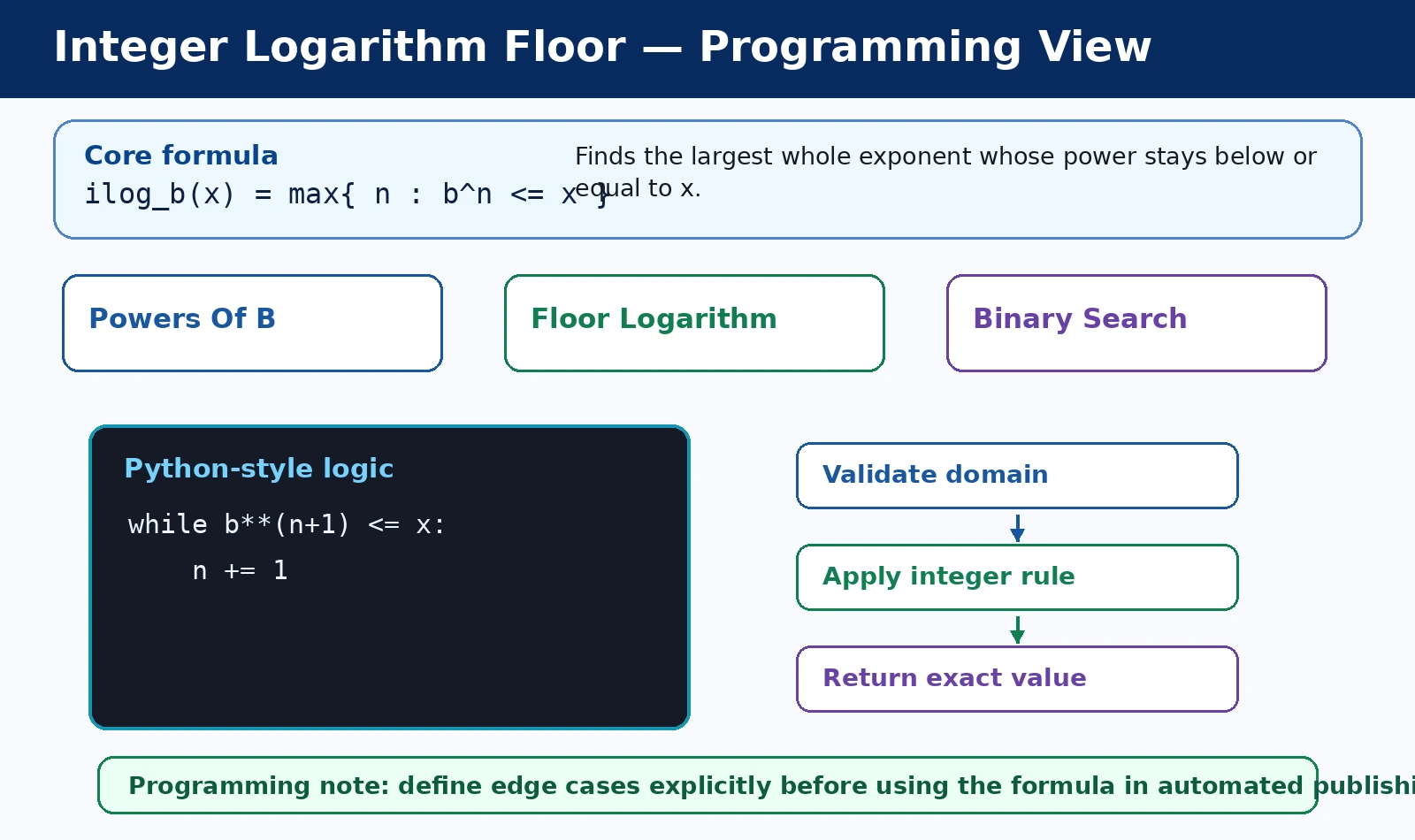
Every piece of data in a computer is stored in bits, which are binary digits. To know how many bits an integer needs, we use the base-2 logarithm floor.
Specifically, the number of bits required for an integer ##x## is ##\lfloor \log_2(x) \rfloor + 1##. This formula is essential for designing efficient file formats.
Without this calculation, programmers might over-allocate memory, leading to significant waste. In large-scale databases, saving even one bit per record can result in gigabytes of saved space.
Compression algorithms like Huffman coding rely heavily on logarithmic principles to assign codes. The floor function helps in structuring the trees used for encoding and decoding data.
Understanding bit-length also aids in preventing integer overflow errors by validating input sizes. It ensures that values fit within the designated hardware registers before processing begins.
Analyzing Time and Space Complexity
In Big O notation, the logarithm represents one of the most efficient growth rates. Many optimal algorithms, like Merge Sort or Binary Search, have logarithmic components.
The integer logarithm floor helps in visualizing the depth of balanced search trees. For a tree with ##N## nodes, the height is approximately the floor of ##\log_2(N)##.
This height directly determines the maximum number of comparisons needed to find an element. Knowing this floor value allows developers to predict worst-case performance with high accuracy.
Complexity analysis often involves dividing a problem into smaller sub-problems repeatedly. The number of times a problem can be halved is precisely the integer logarithm floor.
By mastering this concept, students and professionals can better evaluate the efficiency of their code. It provides a standard metric for comparing different algorithmic approaches to the same problem.
Advanced Considerations and Edge Cases
While the concept seems simple, implementing it for all possible inputs requires care. Edge cases like zero, negative numbers, or non-integer bases can complicate the logic.
Logarithms are undefined for non-positive numbers, so the input ##x## must always be greater than zero. Robust software must include checks to handle invalid inputs gracefully.
When the base ##b## is not an integer, the calculation becomes more complex. Floating-point precision starts to play a role, potentially leading to off-by-one errors in the floor.
High-performance computing often requires handling very large integers that exceed standard 64-bit limits. In these cases, specialized "BigInt" libraries must implement the logarithm floor carefully.
Testing across a wide range of values is essential to ensure the implementation is robust. Developers must consider boundary conditions where ##x## is exactly a power of the base.
Floating Point Precision and Rounding Issues
Using standard floating-point functions like floor(log(x, b)) can be risky in programming. Due to binary representation limits, the intermediate result might be slightly less than intended.
For example, a result that should be exactly ##3.0## might be computed as ##2.99999999999##. Applying the floor function to this value would incorrectly return two instead of three.
To avoid this, many developers add a small "epsilon" value before flooring the result. Alternatively, they use integer-only algorithms that do not rely on floating-point arithmetic at all.
Integer-only methods are generally slower for arbitrary bases but are much more reliable. They guarantee that the result is mathematically sound without the quirks of decimal approximations.
Precision is particularly important in cryptography and financial software where errors are unacceptable. In these fields, every mathematical operation must be verified for absolute accuracy.
Generalizing for Arbitrary Bases
While base-2 and base-10 are most common, some applications require other bases. Base-16 is used in hexadecimal systems, while base-64 is popular for encoding binary data.
The formula for changing bases is ##\log_b(x) = \frac{\log_k(x)}{\log_k(b)}##. This allows us to use standard natural log functions to find any integer floor.
However, the division involved introduces the same precision risks mentioned previously. For arbitrary integer bases, an iterative search or specialized root-finding method is often safer.
In abstract algebra, the concept can even be extended to discrete logarithms in finite fields. While much more complex, the underlying goal of finding an exponent remains the same.
Generalizing the integer logarithm floor allows for a unified approach to scaling problems. It ensures that the same logical framework can be applied regardless of the numerical system.
From our network :
- 10 Physics Numerical Problems with Solutions for IIT JEE
- Mastering DB2 LUW v12 Tables: A Comprehensive Technical Guide
- 98% of Global MBA Programs Now Prefer GRE Over GMAT Focus Edition
- Mastering DB2 12.1 Instance Design: A Technical Deep Dive into Modern Database Architecture
- Vite 6/7 'Cold Start' Regression in Massive Module Graphs
- AI-Powered 'Precision Diagnostic' Replaces Standard GRE Score Reports
- https://www.themagpost.com/post/analyzing-trump-deportation-numbers-insights-into-the-2026-immigration-crackdown
- https://www.themagpost.com/post/trump-political-strategy-how-geopolitical-stunts-serve-as-media-diversions
- EV 2.0: The Solid-State Battery Breakthrough and Global Factory Expansion
RESOURCES
- Logarithm of integers - The Rust Programming Language Forum
- python - Better way to compute floor of log(n,b) for integers n and b?
- math — Mathematical functions — Python 3.14.5 documentation
- Floor of Natural Logarithm - Stack Overflow
- How to compute the floor of a logarithm - IME-USP
- Integer part of natural logarithm - Math Stack Exchange
- Mathematical functions and operators — Trino 480 Documentation
- 4.3.2 Generic Numerics - Racket docs
- Math.floor() - JavaScript - MDN Web Docs
- Math Class | Apex Reference Guide - Salesforce Developers
- [Solved] float logs as 2, but floors to 1, and != 2. - Unity Discussions
- Math Functions - Syntax & Usage | AutoHotkey v1
- Logarithms as Digit-Counters in ANY base!
- Built-In Mathematical SQL Functions - SQLite
- MySQL 8.4 Reference Manual :: 14.6.2 Mathematical Functions

0 Comments