
On This Page
Fundamentals of the Digit Extraction Function
Defining Positional Notation in Base ##b##
Positional notation represents numbers as a weighted sum of powers of a base ##b##. Each specific position in the sequence corresponds to a unique power of the base.
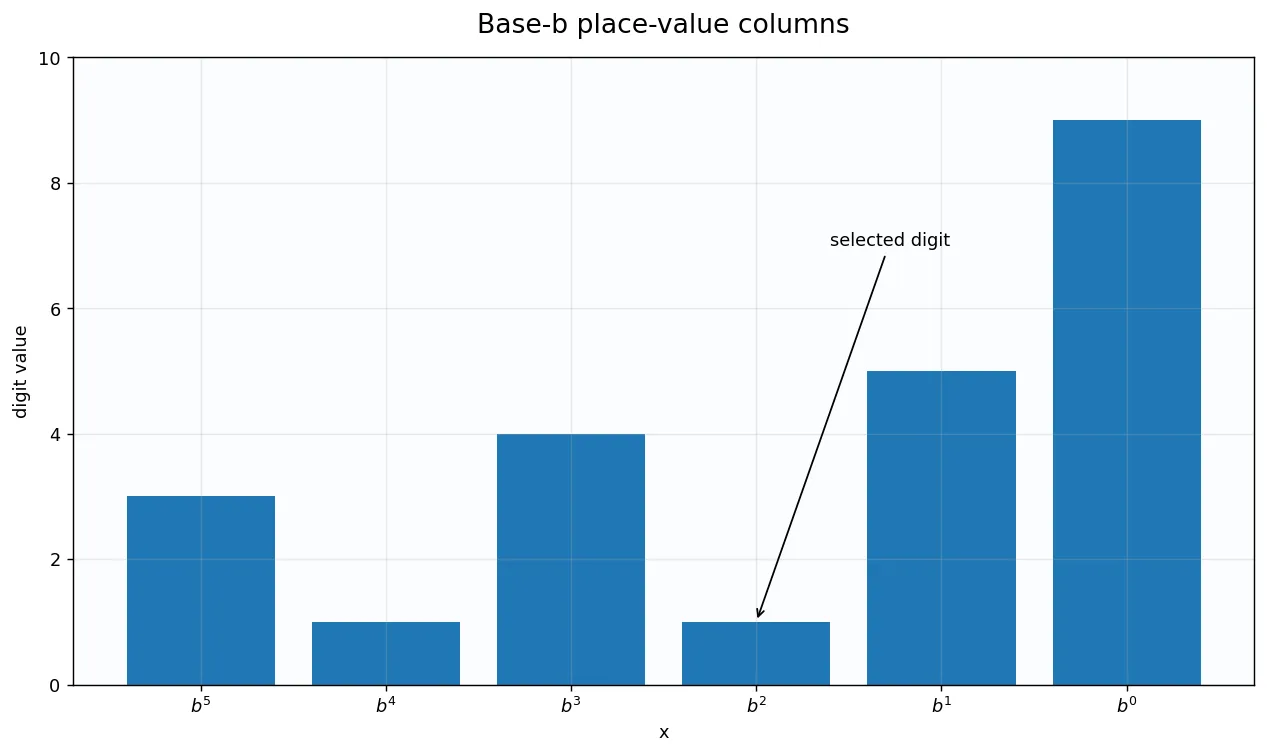
In any base ##b##, the digits used range from ##0## to ##b-1##. For example, the decimal system uses base ##10##, while binary systems utilize base ##2## for operations.
The digit extraction function identifies the value at a specific power. It isolates a single component from the composite numerical structure for detailed analysis or computational processing.
Mathematically, an integer ##x## is expressed as a sum of digits and powers. We write
where ##d_i## represents the digit at position ##i##.
Understanding this structure is essential for advanced mathematical study. It provides the framework for converting between bases and simplifies complex arithmetic operations by breaking numbers into discrete parts.
The Mathematical Formalism for Extraction
To extract the ##k##-th digit, we use specific mathematical operators. The floor function and the modulo operator are the primary tools used to isolate the desired numerical value.
For an integer ##x##, the extraction function ##f(x, k, b)## returns the digit at position ##k##. This position is typically indexed starting from zero for the least significant digit.
The standard display expression for this operation is precise. We calculate the digit using the formula
to ensure an accurate result.
The term ##\lfloor \frac{x}{b^k} \rfloor## shifts the number to the right. This moves the ##k##-th digit to the units place, effectively removing all digits at lower positions.
The modulo operation ##\pmod{b}## then discards all digits more significant than the target. This leaves only the isolated digit, ensuring the function returns a value within the correct range.
Digit Extraction for Integers
Using Modular Arithmetic for Retrieval
Modular arithmetic is the study of remainders in division. In digit extraction, the modulo operator acts as a filter that captures the remainder when a number is divided.
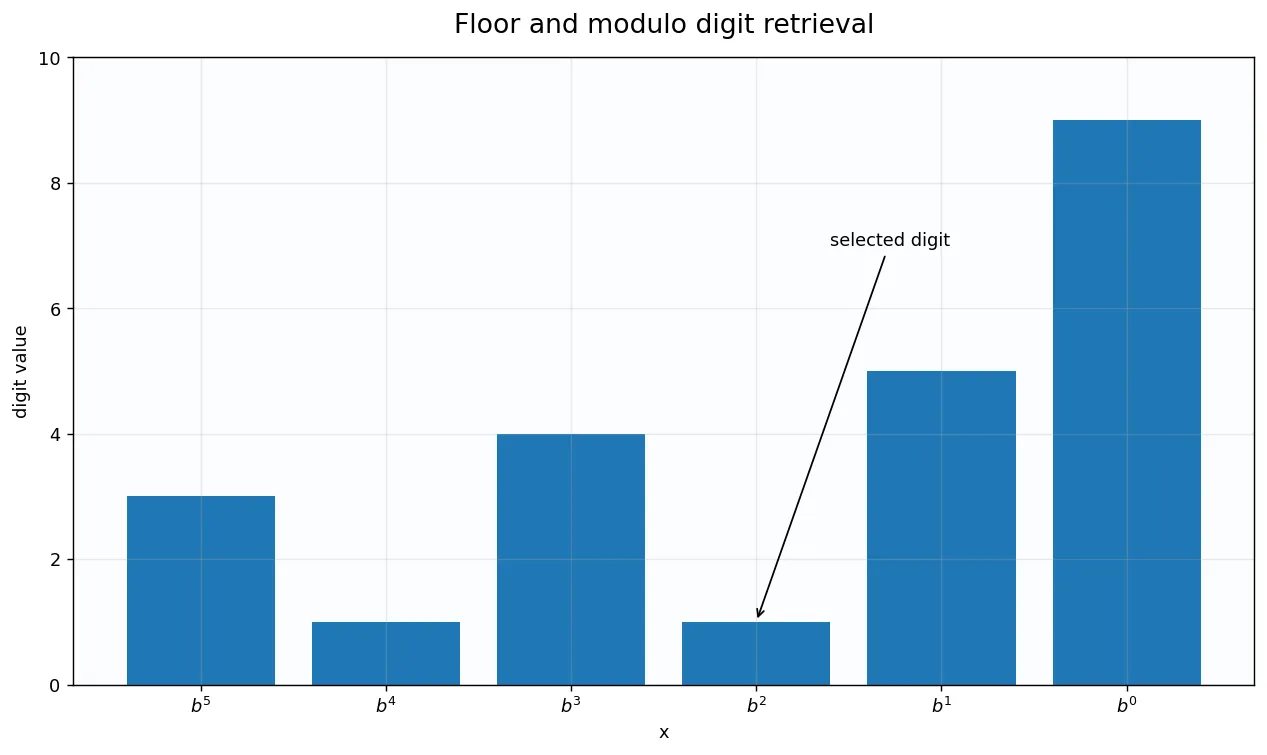
When we calculate ##x \pmod{b}##, we find the remainder. This remainder is the ##0##-th digit of the number. To find higher digits, we must first shift the number.
This process is often iterative in computer algorithms. By repeatedly applying modulo and division, we can extract all digits, which is useful for converting integers into readable strings.
The efficiency of modular arithmetic is very high in modern computing. Processors have dedicated instructions for these operations, making digit-by-digit processing extremely fast for large numerical values.
Modular arithmetic also helps in verifying basic numerical properties. Checking if a number is even involves a modulo ##2## operation, which is the simplest form of digit extraction.
The Role of the Floor Function
The floor function, denoted by ##\lfloor \cdot \rfloor##, maps a real number to the greatest integer less than or equal to it. It performs the essential shift operation.
Dividing an integer ##x## by ##b^k## creates a rational number. The floor function discards the remainder of this division, removing all digits at positions ##0## through ##k-1##.
Without the floor function, the extraction would yield a fraction. The goal is to return a discrete integer digit, making the floor operation indispensable for maintaining output integrity.
In programming, integer division often implicitly applies the floor function. When we divide two integers, the result is truncated, making the implementation of digit extraction very natural.
The combination of floor and modulo defines the extraction perfectly. One operation clears the right side of the digit, while the other clears the left, leaving the target.
We Also Published
Handling Real Numbers and Fractional Parts
Extracting Digits After the Decimal Point
Real numbers require a different indexing approach for extraction. Digits after the decimal point correspond to negative powers of the base, such as ##b^{-1}## or ##b^{-2}##.
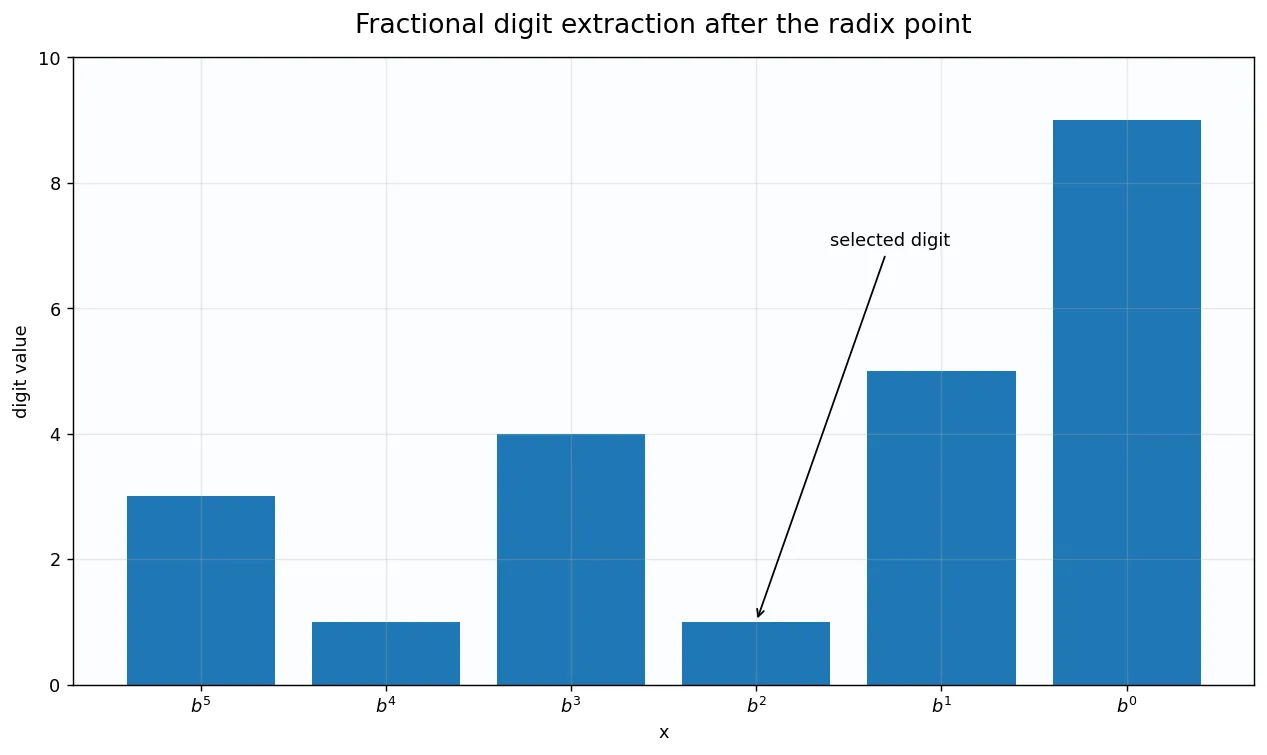
To extract the ##k##-th digit where ##k < 0##, we perform a multiplication. We multiply ##x## by ##b^{|k|}## to shift the fractional digit into the integer units place.
The formula for a fractional digit is slightly modified. We can express it as
where ##k## is a negative integer.
Alternatively, one can use the fractional part function. We take the fractional part of ##x \cdot b^{-k-1}## and multiply by ##b## to isolate the specific digit value.
Accuracy is a major concern with real numbers in computing. Floating-point representations have limited precision, which can lead to rounding errors when extracting digits far down the expansion.
Infinite Expansions and Periodic Digits
Some real numbers have infinite base-##b## expansions. Rational numbers result in terminating or periodic expansions, while irrational numbers like ##\pi## have non-repeating, infinite sequences of digits.
The extraction function can still target any ##k##. Even if the expansion is infinite, the mathematical definition holds, allowing us to theoretically retrieve any digit in the sequence.
Periodic digits occur when the denominator has specific factors. If the denominator is not coprime to the base, the expansion eventually repeats, which is a core study area.
Specialized algorithms like the BBP formula exist for certain constants. These allow for the extraction of specific digits without calculating preceding ones, known as the spigot algorithm approach.
Understanding infinite expansions helps in approximating values. By extracting a finite number of digits, we create rational bounds essential for scientific computations involving transcendental mathematical constants and measurements.
Applications in Computation and Theory
Digital Signal Processing and Encoding
In digital signal processing, numbers are often quantized. Digit extraction is used to analyze specific bits of a sample, which is crucial for bit-masking and control flag analysis.
Encoding schemes rely heavily on base conversion principles. To convert colors to hexadecimal, we extract the red, green, and blue components as digits in a base-##256## system.
Data compression also utilizes these principles effectively. By identifying patterns in digit sequences, we can reduce redundancy and allow compressors to scan and categorize numerical data for storage.
Cryptography often operates at the bit level. Extracting specific digits from large prime numbers is part of many encryption algorithms, ensuring the security of modern digital communication systems.
Hardware design uses extraction for memory routing. Address decoders extract specific bits from a memory address to activate chips, representing the physical implementation of the digit extraction function.
Number Theoretic Properties and Algorithms
Number theory uses extraction to study digit sums. The sum of digits can reveal divisibility; for example, a number is divisible by nine if its decimal digit sum is.
Benford's Law describes the distribution of first digits. The extraction function shows that the digit one appears more frequently than nine in many naturally occurring sets of numerical data.
Palindromic numbers are defined by their digits. To check if a number is a palindrome, we extract digits from both ends and compare them using a consistent extraction function.
The study of normal numbers involves digit extraction. A number is normal if every finite sequence of digits appears with equal frequency, a difficult challenge in modern mathematical research.
Finally, digit extraction facilitates the study of fractals. Many fractal sets are defined by the presence or absence of certain digits, linking simple arithmetic to complex topological structures.
From our network :
- AI-Powered 'Precision Diagnostic' Replaces Standard GRE Score Reports
- EV 2.0: The Solid-State Battery Breakthrough and Global Factory Expansion
- Mastering DB2 LUW v12 Tables: A Comprehensive Technical Guide
- 98% of Global MBA Programs Now Prefer GRE Over GMAT Focus Edition
- https://www.themagpost.com/post/analyzing-trump-deportation-numbers-insights-into-the-2026-immigration-crackdown
- Mastering DB2 12.1 Instance Design: A Technical Deep Dive into Modern Database Architecture
- https://www.themagpost.com/post/trump-political-strategy-how-geopolitical-stunts-serve-as-media-diversions
- 10 Physics Numerical Problems with Solutions for IIT JEE
- Vite 6/7 'Cold Start' Regression in Massive Module Graphs
RESOURCES
- Bailey–Borwein–Plouffe formula - Wikipedia
- The effect of base 10 on our understanding of numbers. : r/math
- Find the Nth digit from right in base B of the given number in ...
- The math behind converting from any base to any base without ...
- A class of digit extraction BBP-type formulas in general binary bases
- Intuitive explanation of Bailey-Borwein-Plouffe π extraction formula?
- Getting a specific digit from a ratio expansion in any base (nth digit ...
- Function to grab specific digits from a number? - Math Stack Exchange
- How to extract digits from a number from left to right? - Stack Overflow
- Extract the Number Out of Text - Spiceworks Community
- How to get the digits of a number without converting it to a string
- Formula for computing sqrt(2) of binary numbers - Wolfram Community
- Symbolic routes to BBP-type formulas of any degree in arbitrary bases
- Re: programming challenge for HP-12c
- Base Conversions from Base 2 through 100 Using Radix Points


0 Comments