On This Page
Fundamentals of Visualizing Sets
The Role of Venn Diagrams
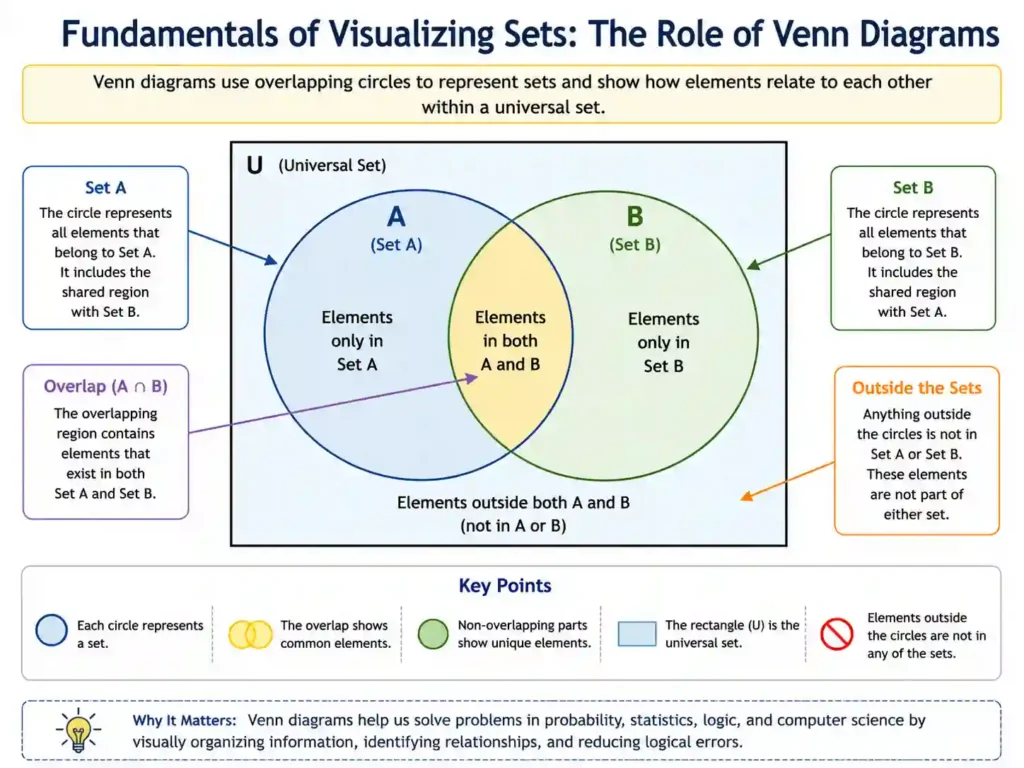
Venn diagrams provide a visual way to represent sets and their relationships. We use overlapping circles to show how elements interact within a defined space. This method simplifies logical statements into clear geometric shapes for students.
Each circle represents a specific set, such as Set A or Set B. The area inside the circle contains all members belonging to that group. When circles overlap, the shared space represents elements existing in both sets simultaneously.
Mathematicians use these diagrams to solve problems in probability and statistics. By looking at the areas, we quickly identify which elements are unique or shared. This visual approach reduces the chance of making logical errors during calculation.
The boundary of a set is usually a smooth curve or circle. Anything outside this boundary does not belong to the set. This clear distinction helps in defining the scope of our mathematical operations and logical reasoning.
Visualizing sets allows us to grasp abstract concepts more naturally. Instead of just looking at lists, we see the structure of the data. This foundation is essential for learning advanced topics in discrete mathematics and logic.
Defining the Universal Set
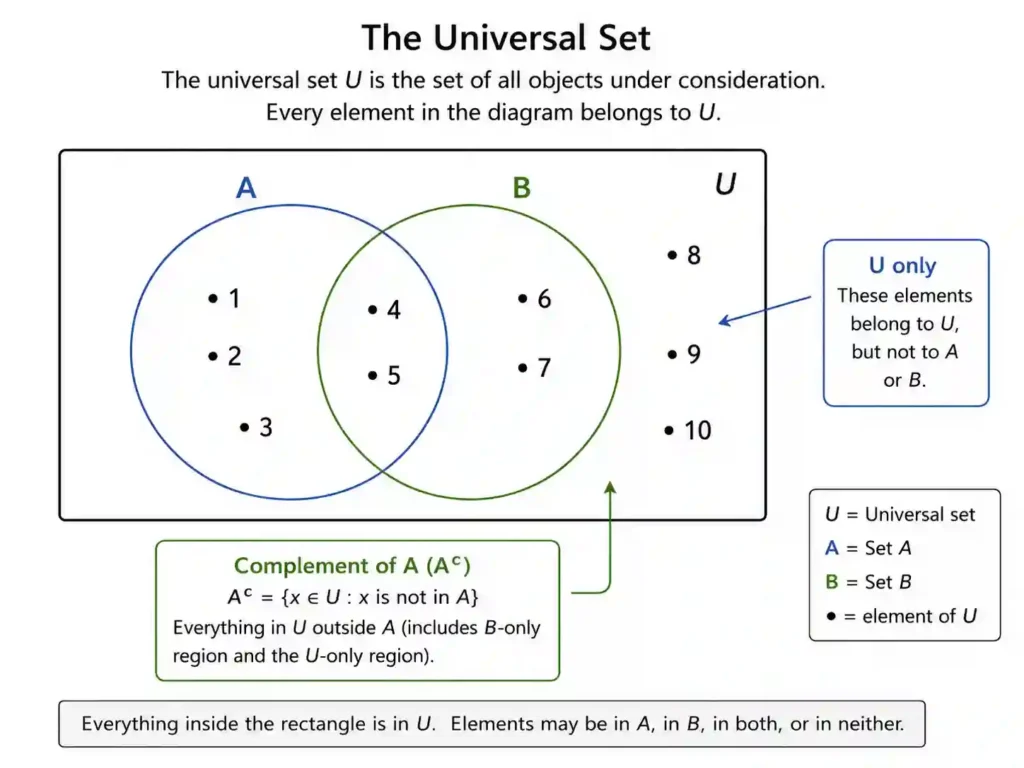
The universal set ##U## represents the totality of all elements being studied. In a Venn diagram, we draw a large rectangle to symbolize this universe. Every other set must stay within the borders of this rectangular frame.
Defining the universal set is the first step in any set theory problem. If we study integers, ##U## might be the set of all integers ##\mathbb{Z}##. This context determines what elements can possibly exist in our subsets.
Without a universal set, the concept of a complement becomes impossible to define. The complement of set ##A## consists of everything in ##U## that is not in ##A##. Therefore, ##U## provides the necessary background for operations.
Elements outside the circles but inside the rectangle belong to the universal set only. They are not part of the specific subsets we are focusing on. This distinction helps categorize every single item within the problem's scope.
The size of the universal set can be finite or infinite. Regardless of its size, we treat it as the ultimate container. Understanding its role ensures that we do not include irrelevant data in our mathematical calculations.
Core Set Operations and Visuals
Union and Intersection
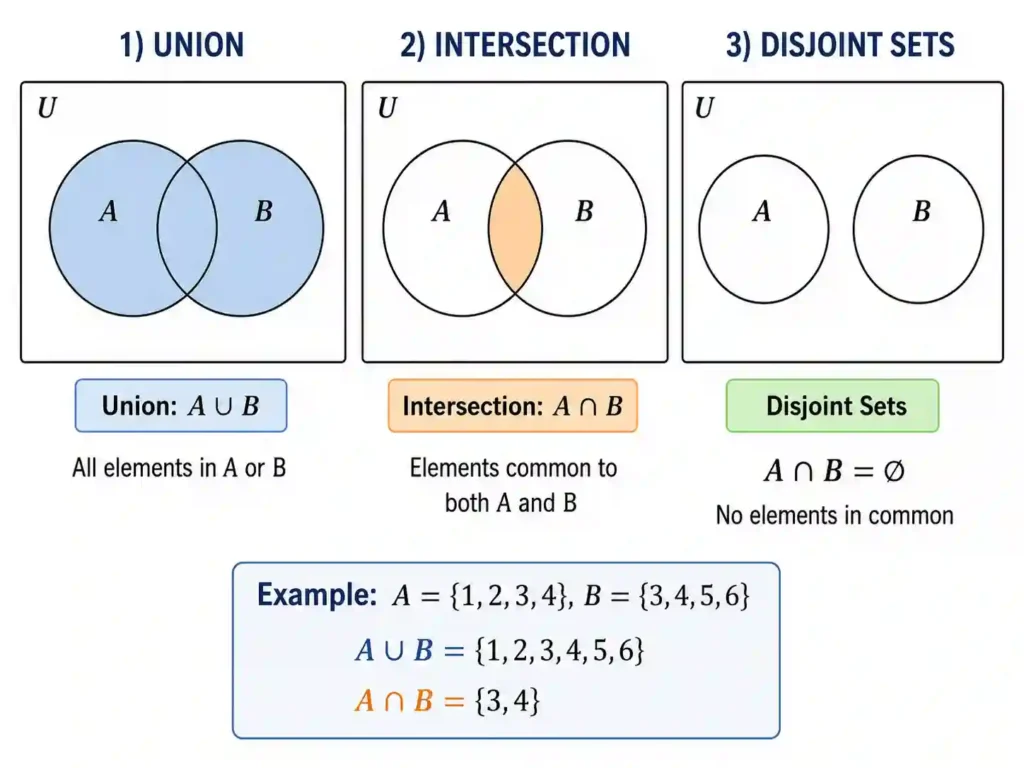
The union of two sets, written as ##A \cup B##, includes all elements from both. It combines the contents without repeating any shared members. Visually, this covers the entire area of both circles in the Venn diagram.
Intersection, denoted as ##A \cap B##, focuses only on the shared elements. In the diagram, this is the overlapping region where the two circles meet. It represents the "and" condition in logical operations and set theory.
If two sets have no elements in common, their intersection is the empty set ##\emptyset##. We call these disjoint sets, and they appear as separate circles that do not touch. This visual separation indicates a lack of shared properties.
Calculating these operations requires careful attention to the membership of each element. We must ensure that each item is accounted for exactly once in a union. This precision is vital for accurate data analysis and logical proofs.
Use the following math problem to practice these operations with basic sets. Identifying the members of the union and intersection is a fundamental skill. It prepares you for more complex algebraic manipulations of sets later.
Set Theory Operations: Union vs. Intersection
A comparison of the two fundamental set operations and their visual and logical characteristics.
| Operation | Notation | Logical Meaning | Venn Diagram Visual |
|---|---|---|---|
| Union | A ∪ B | Includes all elements from both sets | Entire area of both circles |
| Intersection | A ∩ B | Includes only shared elements | Overlapping region only |
| Disjoint Sets | A ∩ B = ∅ | No shared elements | Separate, non-touching circles |
- Union combines contents without repeating shared members.
- Intersection represents the 'and' condition in logical operations.
Given the sets ##A = \{1,2,3\}## and ##B = \{3,4,5\}##, find ##A \cup B## and ##A \cap B##.
Step 1: List all elements in either set for the union.
##A \cup B = \{1,2,3,4,5\}##
Step 2: Identify the elements common to both sets for the intersection.
##A \cap B = \{3\}##
Explain the difference between the union and intersection of two sets, and state what each one represents in a Venn diagram.
Step 1: The union includes all elements from both sets without repeating shared elements.
Step 2: In a Venn diagram, the union is the entire area covered by both circles.
Step 3: The intersection includes only the elements that both sets have in common.
Step 4: In a Venn diagram, the intersection is the overlapping region.
Two sets are ##C = \{a,b\}## and ##D = \{c,d\}##. What is ##C \cap D##? What term describes these sets?
Step 1: Check for common elements between the two sets.
There are no shared elements.
Step 2: Therefore, the intersection is the empty set.
##C \cap D = \emptyset##
Step 3: Sets with no elements in common are called disjoint sets.
If a set ##E## has elements ##\{2,4,6\}## and a set ##F## has elements ##\{6,8\}##, find ##E \cup F##. Make sure each element is written once only.
Step 1: Combine all elements from both sets.
Step 2: Do not repeat shared elements.
##E \cup F = \{2,4,6,8\}##
Step 3: The repeated element ##6## is listed only once in the union.
Choose the correct statement about ##A \cap B##:
- It contains all elements from both sets.
- It contains only elements common to both sets.
- It contains elements that are in either set but not both.
Correct statement: It contains only elements common to both sets.
Reason: The intersection ##A \cap B## represents the overlapping part of the two sets and matches the “and” condition in set theory.
Why is it important to count each element exactly once when finding a union of sets?
Step 1: A union combines all elements from both sets.
Step 2: If an element appears in both sets, it must still be counted only once in the union.
Step 3: This prevents duplication and keeps set calculations accurate.
Conclusion: Exact counting is important for correct data analysis and logical reasoning.
Set Difference and Complement
Set difference, noted as ##A - B##, includes elements in ##A## that are not in ##B##. In a diagram, this looks like a crescent moon shape. We remove the overlapping part from the first set's total area.
The complement of a set ##A##, written as ##A'##, includes everything in ##U## outside ##A##. This operation depends entirely on the definition of the universal set. It covers all space in the rectangle not occupied by ##A##.
Complements help us describe what an element is not. If ##A## is the set of even numbers, its complement in the set of integers is the set of odd numbers. This duality is a core part of logic.
We can visualize the complement of a union as the area outside both circles. This region represents elements that belong to neither ##A## nor ##B##. Understanding these external areas is key to mastering De Morgan's laws.
Practicing these visuals builds intuition for algebraic proofs. When we subtract one set from another, we are essentially filtering the data. This logic is used extensively in computer science for database queries and filtering.
Algebra of Sets and Identities
Commutative and Associative Laws
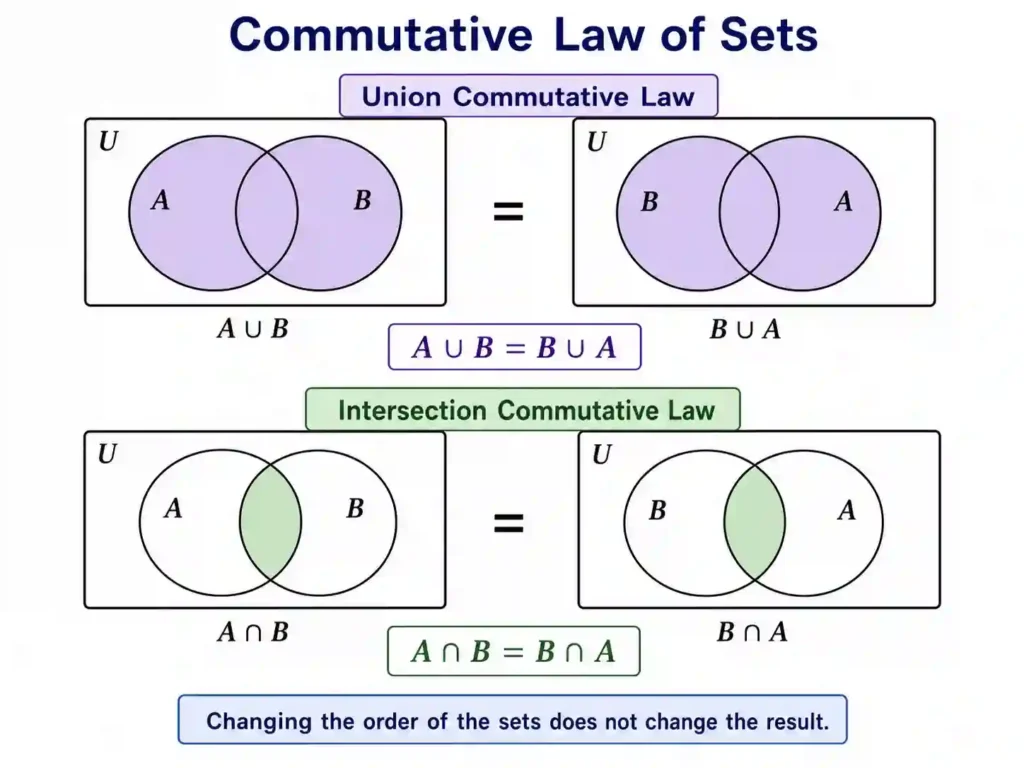
The algebra of sets follows specific rules similar to standard arithmetic. The commutative law states that the order of sets in a union or intersection does not matter. Thus, ##A \cup B## is exactly the same as ##B \cup A##.
This symmetry also applies to intersections, where ##A \cap B = B \cap A##. These laws simplify calculations by allowing us to rearrange terms. It ensures that the result remains consistent regardless of how we approach the problem.
Associative laws deal with how we group three or more sets together. For union, ##(A \cup B) \cup C = A \cup (B \cup C)##. This means the grouping of operations does not change the final collection of elements.
Similarly, for intersection, ##(A \cap B) \cap C = A \cap (B \cap C)##. We can find the common elements of two sets first, then compare with the third. The final result will always include elements shared by all three.
These laws form the backbone of set simplification. By applying them, we can reduce complex expressions into simpler forms. This is particularly useful when dealing with large datasets or complex logical conditions in programming.
Distributive and Identity Laws
Distributive laws describe how union and intersection interact with each other. The first law states that ##A \cup (B \cap C) = (A \cup B) \cap (A \cup C)##. This allows us to distribute the union across the intersection.
The second distributive law is ##A \cap (B \cup C) = (A \cap B) \cup (A \cap C)##. Here, we distribute the intersection over the union of two sets. This mirrors the distribution of multiplication over addition in algebra.
Identity laws involve the universal set ##U## and the empty set ##\emptyset##. Any set unioned with the empty set remains itself, ##A \cup \emptyset = A##. This shows that the empty set adds no new elements.
When we intersect a set with the universal set, the result is the set itself, ##A \cap U = A##. This is because all elements of ##A## are already contained within ##U##. These identities are essential for simplifying proofs.
Test your understanding of these identities with this math problem. Verify that the distributive property holds true for the given sets. This exercise reinforces the connection between visual diagrams and algebraic manipulation of sets.
Let ##A = \{1, 2\}##, ##B = \{2, 3\}##, and ##C = \{3, 4\}##.
Verify the identity: ##A \cap (B \cup C) = (A \cap B) \cup (A \cap C)##.
De Morgan’s Laws and Proofs
Understanding the First Law
De Morgan’s laws are fundamental principles that relate unions, intersections, and complements. The first law states that the complement of a union is the intersection of the complements. Algebraically, we write this as ##(A \cup B)' = A' \cap B'##.
This law tells us that being "not in the union" is the same as being "not in ##A## AND not in ##B##." Visually, the area outside both circles is the overlap of the areas outside each individual circle.
We use this law to simplify logical negations in computer programming. Instead of checking if a value is outside a large range, we check if it fails two specific conditions. This often makes the code more readable.
Proving this law involves showing that every element in the left side is also in the right side. We pick an arbitrary element ##x## and track its membership through the operations. This step-by-step logic confirms the identity.
Understanding the first law provides a deep insight into the structure of logic. It shows how the "OR" operation in a union transforms into an "AND" operation for complements. This transformation is a powerful tool in mathematics.
Applying the Second Law
The second of De Morgan’s laws states that the complement of an intersection equals the union of the complements. We express this as ##(A \cap B)' = A' \cup B'##. This relates the shared region to the outer regions.
This means that if an element is not in the intersection, it must be missing from at least one of the sets. It could be outside ##A##, outside ##B##, or outside both. This covers a large portion of the universe.
In a Venn diagram, the complement of the intersection is everything except the small overlapping middle part. This matches the union of everything outside ##A## and everything outside ##B##. The visual proof is very intuitive.
These laws are used to design digital circuits and search engine algorithms. They help engineers optimize logic gates and refine search queries. Mastering them is essential for anyone entering technical fields like software engineering or data science.
Use this final math problem to verify the second De Morgan law. By listing the elements for both sides of the equation, you can see the law in action. This concludes our technical study of set algebra and visuals.
Let ##U = \{1, 2, 3, 4, 5\}##, ##A = \{1, 2, 3\}##, and ##B = \{3, 4\}##.
Verify the identity: ##(A \cap B)' = A' \cup B'##.
RESOURCES
- Algebra of Sets - Laws, Proofs, Venn Diagram and Examples
- Is proving set properties like demorgans law with Venn diagram ...
- Venn diagrams to prove laws true or false - Math Stack Exchange
- 5.5 Set Operations with Three Sets – Finite Mathematics
- TEACHING LEGAL THEORY WITH VENN DIAGRAMS - jstor
- 4.2 Laws of Set Theory
- Applying Mathematical Set Theory to Statutory Construction of ...
- Maths in IT #3: Algebra of sets - Sander Rossel
- De Morgan's laws - Wikipedia
- Sets and Venn diagrams - Inquiry Maths
- Venn diagram of Sets - BYJU'S
- The laws of cooking as Venn diagrams - Spaghetti Wires
- Solved 2. Draw Venn diagrams to verify DeMorgan's laws. That
- Set Identities (Defined & Illustrated w/ 13+ Examples!) - Calcworkshop
- 1C Venn Diagrams
0 Comments