
In October 2026, two of the world's most prominent artificial intelligence laboratories independently announced that their systems had produced mathematical arguments challenging the Exponential Time Hypothesis, a foundational conjecture in theoretical computer science that has guided complexity research since the late 1990s. OpenAI reported that its internal reasoning system generated a purported refutation of the hypothesis on October 16, subsequently formalized in Lean, the interactive proof assistant used to machine-verify mathematical arguments. Anthropic, in parallel, published an AI-generated research paper describing a subexponential-time algorithm for a related Boolean satisfiability problem, accompanied by materials intended for formal verification. Neither claim has yet received independent confirmation, and the broader research community is treating both announcements with the measured skepticism that any extraordinary complexity result demands.
The significance of these announcements lies less in the specific algorithms than in what they imply about the boundary between machine assistance and original mathematical discovery. The Exponential Time Hypothesis, advanced by Russell Impagliazzo and Ramamohan Paturi in 1999, asserts that solving the Boolean satisfiability problem requires time that grows exponentially in the number of variables, and that this growth cannot be substantially improved. If either company's claim survives scrutiny, a vast edifice of conditional results built atop ETH would require reassessment, including lower bounds for clique detection, set cover, and numerous parameterized problems. The episode therefore touches the deepest questions about computational hardness, the reliability of AI-generated proofs, and the institutional mechanisms by which mathematics validates new knowledge.
What follows examines the technical substance of the ETH conjecture, the specific nature of the OpenAI and Anthropic claims, the role of Lean and formal verification in adjudicating them, and the wider consequences for complexity theory and the P versus NP question. It also considers how the mathematical community evaluates machine-generated results and why independent replication remains the decisive test. Readers seeking a grounded understanding of a story that blends artificial intelligence, proof theory, and the limits of computation will find the analysis organized around the core scientific and epistemological issues at stake.
On This Page
- The Exponential Time Hypothesis and Its Role in Complexity Theory
- What OpenAI and Anthropic Actually Claimed
- Formal Verification and the Epistemology of Machine Proofs
- Implications for P versus NP and the Complexity Landscape
- How the Research Community Will Evaluate the Claims
- Broader Consequences for AI and Scientific Discovery
The Exponential Time Hypothesis and Its Role in Complexity Theory
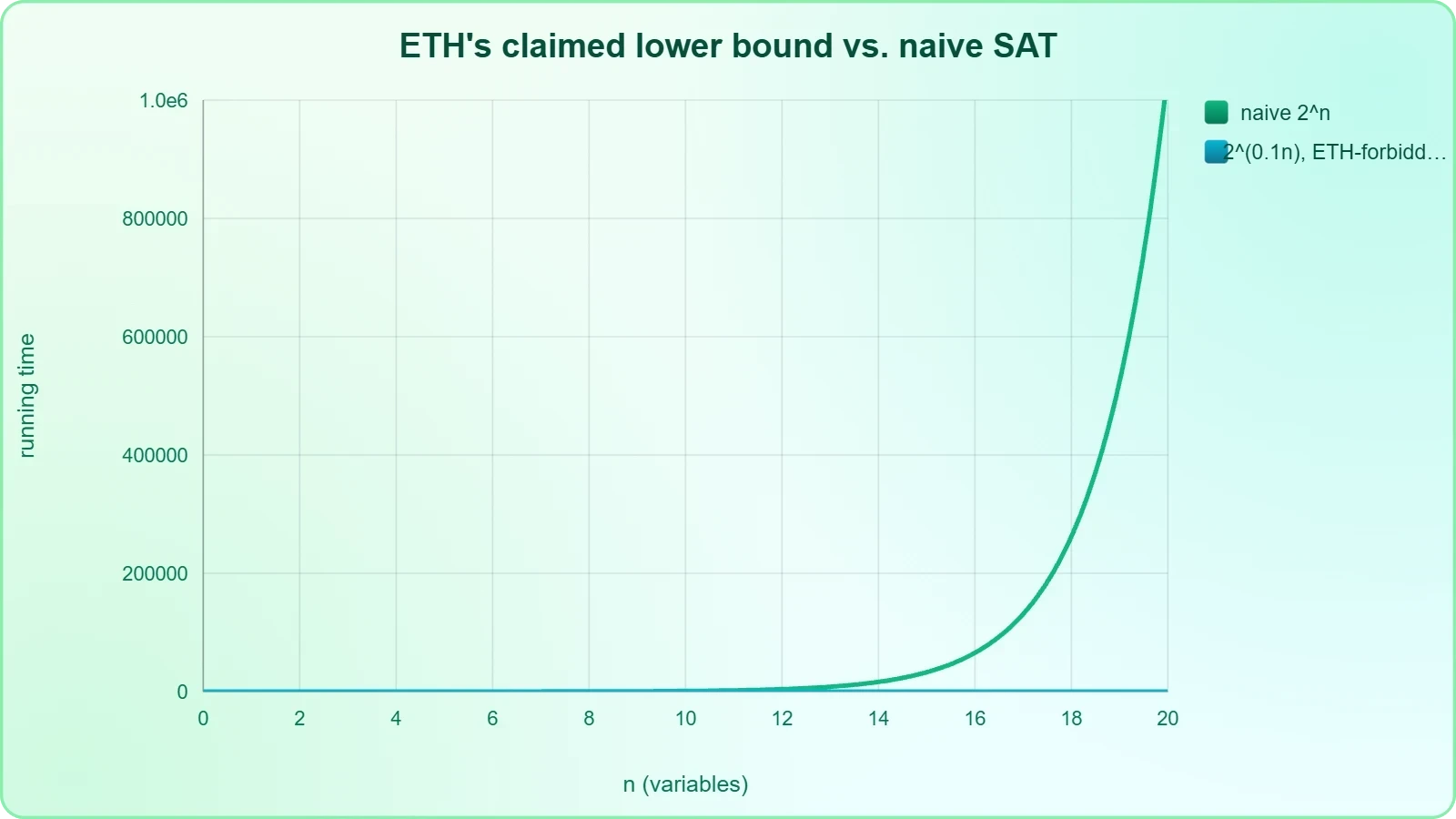
The Exponential Time Hypothesis occupies a peculiar position in theoretical computer science: it is neither proven nor refuted, yet an enormous body of research treats it as a working assumption. Formulated by Impagliazzo and Paturi in 1999, ETH states that there exists a constant ##[c > 0]## such that no algorithm can decide the satisfiability of a Boolean formula in conjunctive normal form with ##[n]## variables in time ##[O(2^{cn})]##. In plainer terms, the hypothesis asserts that the brute-force search over all ##[2^n]## truth assignments cannot be meaningfully improved upon in the worst case. This is a stronger claim than ##[P \neq NP]##, because it quantifies the exact exponential rate rather than merely asserting that no polynomial algorithm exists.
The hypothesis matters because it functions as a linchpin for conditional lower bounds. Researchers routinely prove statements of the form "if ETH holds, then problem X cannot be solved faster than ##[2^{o(n)}]##," thereby establishing hardness results that would otherwise be inaccessible. These conditional results span graph algorithms, string matching, computational geometry, and parameterized complexity. A genuine refutation of ETH would not merely invalidate one conjecture; it would collapse an entire network of deductions, forcing the community to revisit hundreds of published theorems whose conclusions depend on the hypothesis. That is why the announcements attracted immediate attention from complexity theorists worldwide.
Formal Statement and the Sparsification Lemma
The technical formulation of ETH rests on the Sparsification Lemma, also due to Impagliazzo, Paturi, and Zane, which shows that any ##[k]##-CNF formula can be reduced to a subexponential number of sparse formulas without increasing satisfiability complexity. This lemma allows ETH to be stated equivalently in terms of the number of clauses rather than variables, and it underpins the standard technique for transferring hardness between problems. The lemma itself is a proven theorem, not a conjecture, and any refutation of ETH must therefore engage with its consequences rather than dismiss them. Understanding this structure is essential for evaluating whether the OpenAI and Anthropic claims genuinely threaten the hypothesis or merely address a peripheral variant.
Consider the canonical decision problem: given a formula ##[\phi]## with ##[n]## variables and ##[m]## clauses, determine whether some assignment satisfies all clauses. The naive algorithm runs in time ##[O(2^n \cdot m)]##. ETH asserts that no algorithm achieves ##[O(2^{\epsilon n})]## for every ##[\epsilon > 0]##. A subexponential algorithm for a related satisfiability problem, as Anthropic reportedly describes, would not automatically refute ETH unless the reduction preserves the relevant parameters. This distinction between a related problem and the canonical one is precisely where independent verification becomes indispensable.
Conditional Lower Bounds Built on ETH
The reach of ETH extends far beyond satisfiability itself. Under the hypothesis, the ##[k]##-Clique problem requires time ##[n^{\Omega(k)}]##, the Set Cover problem admits no ##[2^{o(n)}]## algorithm, and the Traveling Salesman Problem cannot be solved in ##[2^{o(n)}]## time on general metrics. Each of these conditional results was established through careful reductions, and each would require re-examination if ETH fell. The table below summarizes several representative consequences and the parameter regimes they constrain.
What OpenAI and Anthropic Actually Claimed
The two announcements differ in character, and that difference matters for how each should be assessed. OpenAI described an internal reasoning system that produced a purported refutation of ETH on October 16, 2026, and then formalized the argument in Lean. A refutation, if valid, would be a proof that ETH is false, which is a far stronger claim than exhibiting a faster algorithm for a special case. Anthropic, by contrast, published a research paper presenting a subexponential-time algorithm for a related satisfiability problem, together with materials for formal verification. An algorithm is a constructive object that can be tested empirically, whereas a refutation is a logical argument whose validity depends on every step being sound.
The distinction between refuting a hypothesis and improving an algorithm is central to the story. A subexponential algorithm for a related problem might be a genuine advance without touching ETH, because the reduction from canonical SAT to the related problem may not preserve the exponential rate. Conversely, a purported refutation must establish that no exponential lower bound can hold, which requires ruling out an infinite family of possible algorithms. The asymmetry between these tasks explains why complexity theorists have responded cautiously to both claims and why formal verification has become the focal point of the discussion.
The Lean Formalization Question
Lean is an interactive theorem prover built on dependent type theory, and it has become the de facto standard for machine-checked mathematics since the Mathlib library began consolidating formalized results. When OpenAI states that its argument was formalized in Lean, the claim is that every logical step has been checked by a kernel that admits only valid inferences. This is a meaningful form of assurance, but it is not absolute: the formalization must faithfully represent the intended mathematical statement, and a mismatch between the informal claim and the formal encoding can render a verified proof irrelevant to ETH. The community will therefore scrutinize the statement being proved as carefully as the proof itself.
Formal verification also raises the question of trust in the formalization pipeline. Lean's kernel is small and well-audited, but the libraries and tactics used to construct proofs are large and evolving. A proof that compiles today may depend on definitions that are later revised, and the interpretation of those definitions is a human matter. Anthropic's decision to release verification materials alongside its paper reflects an awareness that machine-checked proofs require human-readable context. The table below contrasts the two announcements along the dimensions that matter for evaluation.
Why a Subexponential Algorithm Is Not Automatically a Refutation
Suppose an algorithm solves a satisfiability variant in time ##[2^{n^{0.9}}]##, which is subexponential in the exponent. Whether this refutes ETH depends entirely on the reduction connecting the variant to canonical ##[k]##-CNF satisfiability. If the reduction inflates the instance size polynomially, the resulting algorithm for canonical SAT may still run in exponential time, and ETH survives. The complexity literature is full of algorithms that improve constants or handle restricted classes without disturbing the hypothesis. Anthropic's paper must therefore be read with attention to the exact problem it addresses and the parameter regime in which the improvement holds.
This is not a technicality but the heart of the matter. ETH is a statement about the worst case over all formulas, and an algorithm that excels on structured instances says nothing about the worst case. The history of satisfiability research includes many celebrated algorithmic advances, from the DPLL procedure to modern conflict-driven clause learning, none of which refuted ETH because they did not achieve worst-case subexponential time. A genuine refutation would require an algorithm with a proven worst-case bound, and the proof of that bound is where errors most often hide.
Formal Verification and the Epistemology of Machine Proofs
The reliance on Lean in both announcements signals a broader shift in how mathematical knowledge is being produced and validated. For most of the twentieth century, a proof was a social object: a written argument that experts read, checked, and eventually accepted. Formal verification replaces social acceptance with mechanical checking, and in doing so it changes the failure modes. A human referee may overlook a subtle gap; a proof assistant will not, provided the statement is correctly encoded. But the encoding itself is a human act, and the choice of definitions can smuggle in assumptions that the informal statement did not intend.
The epistemology of machine proofs therefore involves two layers of trust. The first is trust in the kernel, which is small enough to be audited and has been used to verify results of considerable depth. The second is trust in the formalization, which requires that the Lean statement correspond to the mathematical claim under discussion. When a company announces that its AI produced a Lean-verified refutation, the announcement conflates these layers unless it also publishes the formal statement and the mapping to the informal claim. Independent researchers will need both to assess the result.
The Verification Pipeline in Practice
A typical verification pipeline begins with an informal proof sketch, proceeds to a formal statement in Lean's dependent type theory, and then constructs a term inhabiting that type. The construction may use automation, but the kernel checks the final term. The following schematic illustrates the structure of a Lean statement asserting a complexity bound, written in a simplified form for illustration.
-- Schematic Lean-style statement of a subexponential upper bound
-- (illustrative only; not the actual OpenAI or Anthropic formalization)

def SubexponentialSAT (f : Nat → Nat) : Prop :=
  ∀ ε : Float, ε > 0 →
    ∃ N : Nat, ∀ n : Nat, n ≥ N →
      f n ≤ (2 : Float) ^ (n ^ (ε))

theorem claimed_bound :
  SubexponentialSAT someAlgorithmTime := by
  -- proof term would be constructed here
  sorry
The presence of sorry in the schematic above is deliberate: it marks an unproven obligation, and any genuine formalization must eliminate every such placeholder. A verified proof contains no sorry, and the kernel rejects any term that depends on an axiom beyond the permitted foundations. When evaluating the announcements, researchers will check whether the published Lean files compile without sorry and whether the axioms invoked are standard. These checks are mechanical, which is precisely their value, but they do not resolve the question of whether the formal statement captures ETH as the community understands it.
Historical Precedents for Machine-Assisted Results
Machine assistance in mathematics is not new, but the scale and autonomy of the 2026 claims are. The Four Color Theorem was proved with substantial computer assistance in 1976, and the Kepler conjecture was formally verified in 2014 using proof assistants. In both cases, the human mathematical community accepted the results only after years of scrutiny and the development of specialized verification infrastructure. The current episode compresses that timeline, because the AI systems produced the arguments and the formalizations in a matter of weeks. Whether compression improves or degrades reliability is an open question, and the answer will shape how AI-generated mathematics is received in the future.
The precedents also suggest that acceptance is a gradual process rather than a single event. The Four Color Theorem faced decades of philosophical objection before computer-assisted proof became routine. The Kepler conjecture's formal verification required a dedicated collaboration and a large body of supporting lemmas. If the ETH claims are to join this lineage, they will need similar infrastructure: published formal statements, reproducible verification scripts, and independent groups willing to invest the effort to check them. The table below summarizes the historical arc.
Implications for P versus NP and the Complexity Landscape
The P versus NP problem asks whether every problem whose solution can be verified efficiently can also be solved efficiently. ETH is strictly stronger than ##[P \neq NP]##, so a refutation of ETH would not by itself resolve P versus NP, but it would reshape the landscape in which that question is studied. If satisfiability admits subexponential algorithms, then the polynomial hierarchy and the assumed hardness of many optimization problems would need rethinking. The consequences would ripple through cryptography, where security arguments often rest on the assumed hardness of specific problems, though practical cryptographic parameters would not change overnight.
It is important to be precise about what a refutation would and would not establish. ETH asserts a specific exponential rate; its negation asserts that for every ##[\epsilon > 0]## there is an algorithm running in ##[O(2^{\epsilon n})]##. This is a statement about an infinite family of algorithms, and proving it requires a construction with a proven bound. Even a valid refutation would leave open the exact complexity of satisfiability, and the P versus NP question would remain unresolved. The table below maps the logical relationships among the major hypotheses.
Cryptographic and Algorithmic Consequences
Cryptography provides the most tangible arena in which complexity assumptions matter. Public-key systems rest on the presumed hardness of factoring or discrete logarithms, and symmetric primitives rest on the presumed hardness of inverting one-way functions. ETH is not directly the assumption underlying these systems, but the broader web of hardness assumptions is interconnected. A refutation of ETH would not break RSA or AES, yet it would weaken confidence in the practice of basing security on worst-case complexity conjectures. Practitioners would watch the theoretical debate closely while continuing to rely on empirical cryptanalysis.
Algorithmic consequences are more immediate. If satisfiability admits subexponential algorithms, then the many problems reducible to SAT would inherit faster algorithms, including planning, verification, and constraint satisfaction. The practical impact would depend on the constants hidden in the asymptotic notation, which are often enormous. Complexity theory's asymptotic lens can obscure the fact that an algorithm with a subexponential bound may be slower than existing methods for all realistic input sizes. This gap between theory and practice is a recurring theme in the field and a reason for measured rather than dramatic reactions.
We Also Published
How the Research Community Will Evaluate the Claims
Independent confirmation is the decisive test, and the mechanisms for achieving it are well established. Researchers will attempt to reproduce the Lean formalizations, check that the statements encode the intended claims, and search for gaps that the kernel might not catch. They will also test the algorithms empirically on benchmark instances to see whether the theoretical bounds translate into practical performance. The process is slow and adversarial by design, and it is the only reliable way to separate genuine advances from errors, whether human or machine-generated.
The community's response will also shape norms for future AI-generated mathematics. If the claims survive scrutiny, laboratories will have demonstrated that AI systems can contribute to the deepest questions in theoretical computer science, and the incentive to deploy such systems will intensify. If the claims fail, the episode will reinforce the importance of formal verification and independent replication as safeguards against overconfident announcements. Either outcome carries lessons for how research institutions integrate AI tools into the production of knowledge.
Reproducibility and the Role of Open Artifacts
Reproducibility requires access to the artifacts: the Lean source files, the algorithm specifications, the benchmark data, and the scripts that connect them. Anthropic's release of verification materials is a step in this direction, and OpenAI's Lean formalization provides a starting point for independent checking. The research community will need more than announcements; it will need the complete computational record. Journals and conferences are already adapting their review processes to accommodate formal artifacts, and the ETH episode may accelerate that adaptation.
The open-science dimension is not merely procedural. When a result challenges a foundational hypothesis, the burden of proof is especially high, and transparency is the mechanism by which that burden is met. Closed claims invite suspicion, while open artifacts invite scrutiny that either validates or refutes. The table below outlines the evaluation criteria that independent reviewers are likely to apply.
What Would Count as a Genuine Refutation
A genuine refutation of ETH would consist of an algorithm for canonical ##[k]##-CNF satisfiability with a proven worst-case running time of ##[O(2^{\epsilon n})]## for every ##[\epsilon > 0]##, together with a proof that the algorithm is correct on all inputs. The proof must be checkable, and the algorithm must handle the full generality of the problem. Partial results, heuristic improvements, and algorithms for restricted classes do not qualify. The standard is high because the hypothesis has supported so much research, and lowering the standard would undermine the conditional results that depend on it.
Formal verification can raise confidence in such a proof, but it cannot substitute for the mathematical work of establishing the bound. The Lean kernel checks that the proof term inhabits the stated type; it does not check that the type is the right one. Reviewers will therefore read the formal statement alongside the informal claim and look for discrepancies. This dual reading is the essence of rigorous evaluation, and it is where the 2026 claims will ultimately be judged.
Broader Consequences for AI and Scientific Discovery
The episode raises questions that extend well beyond complexity theory. If AI systems can generate novel mathematical arguments, the division of labor between human and machine in science will shift, and institutions will need to adapt their methods of credentialing and attribution. The announcements also highlight the risk of premature publicity: extraordinary claims made before independent verification can erode trust, even when the underlying work is sound. Laboratories face a tension between the competitive pressure to announce and the scientific norm of waiting for confirmation.
There is also a methodological lesson about the kinds of problems AI systems are suited to address. Complexity theory involves long chains of formal reasoning where a single error invalidates the whole, and formal verification is unusually well suited to catching such errors. Other scientific domains lack comparable verification infrastructure, which means AI-generated results there may be harder to check. The ETH episode may therefore accelerate investment in formal methods across mathematics and the sciences, not because AI is unreliable, but because verification is the bottleneck for trusting any complex argument.
The Economics of AI Research Competition
OpenAI and Anthropic are commercial laboratories competing for prominence in AI research, and their simultaneous announcements reflect that competition. The economics of the field reward visible breakthroughs, which creates incentives to publicize results before the slow work of verification is complete. This dynamic is not unique to AI; it appears in any fast-moving scientific field with commercial stakes. The question is whether the norms of the research community can keep pace with the speed of announcement, and whether formal verification can serve as a stabilizing institution.
The long-run consequence may be a bifurcation between claims that are formally verified and those that are not. Verified results carry a presumption of correctness that unverified announcements lack, and over time the market for mathematical knowledge may come to price verification accordingly. If that happens, the 2026 ETH episode will be remembered less for its specific claims than for the moment when formal verification became the expected standard for machine-generated mathematics.
Open Questions and the Path Forward
Several questions remain unanswered. Will the Lean formalizations be released in full, and will independent groups be able to compile them? Does the Anthropic algorithm address canonical satisfiability or a restricted variant? What are the constants in the subexponential bound, and do they permit practical implementation? These questions are answerable in principle, and the answers will determine the fate of the claims. Until they are answered, the appropriate stance is disciplined agnosticism: neither dismissal nor acceptance, but a commitment to checking.
The path forward runs through replication. Independent researchers will need time, resources, and access to the artifacts, and the community will need venues willing to publish verification studies alongside original results. The table below summarizes the open questions and their significance.
The 2026 announcements mark a genuine inflection point in the relationship between artificial intelligence and theoretical computer science, whatever their ultimate verdict. They demonstrate that AI systems can engage with foundational conjectures at a level that commands the attention of experts, and they expose the institutional machinery of mathematics to new pressures. The Exponential Time Hypothesis has survived for more than two decades because it is supported by a vast web of conditional results and by the failure of every attempt to refute it. Whether the current attempts succeed will be decided not by press releases but by the patient, adversarial work of verification that defines the discipline.
From our network :
- Analyzing Trump Deportation Numbers Insights Into The 2026 Immigration Crackdown
- 10 Physics Numerical Problems with Solutions for IIT JEEPrepare for IIT JEE with 10 physics numerical problems, complete with detailed solutions and conceptual explanations. Ideal for mastering kinematics, thermodynamics, electromagnetism, and optics.
- Mastering DB2 LUW v12 Tables: A Comprehensive Technical GuideComprehensive guide on DB2 LUW v12 tables. Explore CREATE TABLE syntax, BLU Acceleration, range partitioning, data types, and security features for IBM DB2 LUW v12.
- Mastering DB2 12.1 Instance Design: A Technical Deep Dive into Modern Database ArchitectureComprehensive guide to DB2 12.1 Instance Design. Explore architectural components, HADR setup, buffer pool tuning, and security policies for IBM DB2 12.1. Includes 10 functional SQL and Shell samples.
- 98% of Global MBA Programs Now Prefer GRE Over GMAT Focus EditionExplore why 98% of global MBA programs now prefer the GRE over GMAT Focus. Learn about the shorter GRE format, verbal logic importance, and strategic versatility for students.
- Trump Political Strategy How Geopolitical Stunts Serve As Media Diversions
- AI-Powered 'Precision Diagnostic' Replaces Standard GRE Score ReportsDiscover the new GRE Precision Diagnostic. Learn how AI-powered behavioral analytics and time-to-solve tracking are replacing standard GRE score reports to empower students.
- Vite 6/7 'Cold Start' Regression in Massive Module GraphsIn-depth analysis of Vite 6/7 cold start regressions in massive module graphs. Learn about barrel file issues, pre-bundling optimizations, and how to improve Vite dev server performance.
- EV 2.0: The Solid-State Battery Breakthrough and Global Factory ExpansionDiscover the impact of the Solid-State Battery Breakthrough on the EV market. Learn about CATL and BYD stock growth, global factory expansion in Europe, and the future of EV 2.0 technology.
RESOURCES
- Frontier AI labs say their models refuted the Exponential Time ...techcrunch.com7 days ago ... One was a surprise rejection of the Exponential Time Hypothesis (ETH), a durable assumption in computer science that plays a…
- Working with academic communities to build scientific understandingopenai.comOct 26, 2026 ... OpenAI shares model results on the Kakeya conjecture, Exponential Time Hypothesis ... AI output publicly available for anyone to examine ...
- The Exponential Time Hypothesis is false : r/compsci - Redditreddit.comOct 26, 2026 ... There have been a number of AI results recently where the result is a very small improvement over a "pretty"…
- The Exponential Time Hypothesis Is False | alphaXivalphaxiv.orgOct 26, 2026 ... The claimed algorithm runs in subexponential time, which would refute ETH but would not settle P versus NP or establish…
- OpenAI says its models refuted the Exponential Time Hypothesis ...reddit.com7 days ago ... 65 votes, 31 comments. On 26 October OpenAI said its internal models proved three results. The first is the local…
- OpenAI says AI refuted the Exponential Time Hypothesis - R&D Worldrdworldonline.com7 days ago ... OpenAI says its models refuted the Exponential Time Hypothesis and proved results in math and physics; Anthropic posted its own…
- Paul Thompson on Xx.com7 days ago ... ... refutation of the widely-believed exponential time hypothesis* via a deterministic counting algorithm for k-SAT* running in roughly 2^{O(n ...
- Exponential Time Hypothesis: 3-SAT and AI Proofs | Mediummedium.com6 days ago ... A plain-English guide to the claimed refutation, what it changes, and how independent reviewers will check the AI-generated proofs.
- Are there any issues with the Exponential Time Hypothesis is False ...cstheory.stackexchange.com7 days ago ... And the following day OpenAI generates the refutation of ETH... I just quickly glanced at their Exponential Time Hypothesis is…
- Dan Roberts on Xx.comOct 26, 2026 ... The computer science collaboration will understand and explain a result concerning the Exponential Time Hypothesis ... The refutation of ...
- Blog Archive » Podcasts about the Topic: Part II - Shtetl-Optimizedscottaaronson.blogOct 26, 2026 ... ... refutation (assuming it holds up) of the Exponential Time Hypothesis? ... OpenAI Says Its AI Refuted the Exponential Time…
- OpenAI says its AI model has disproved the Exponential Time ... - TNWthenextweb.comOct 26, 2026 ... OpenAI says its AI model has disproved the Exponential Time Hypothesis ... An internal model at OpenAI has produced a…
- AI cracks a 27-year-old pillar of computer science, OpenAI and ...science.org6 days ago ... Widely regarded as most consequential among them was an apparent refutation of the exponential time hypothesis (ETH), a pillar of…
- Frontier AI labs say their models refuted the Exponential Time ...facebook.com7 days ago ... This is the kind of headline that makes me want to slow down and ask what actually changed. If a…
- OpenAI Says Its AI Refuted the Exponential Time Hypothesis. Is ...beincrypto.com6 days ago ... OpenAI's AI refuted the Exponential Time Hypothesis. See why P vs NP still stands and Bitcoin's cryptography stays safe.