Satellite internet is no longer merely an engineering ambition; it is becoming a planetary-scale intervention in the visual and electromagnetic environment. Forecasts suggesting that as many as 1.7 million satellites could eventually be proposed or deployed demand scrutiny because the night sky is a finite scientific and cultural resource. The central question is not whether connectivity matters, but whether orbital expansion can proceed without making darkness, precision astronomy, and public stargazing collateral damage.
The impact will not be measured by satellite numbers alone. Orbital altitude, spacecraft size, surface reflectivity, attitude control, deployment cadence, atmospheric scattering, radio-frequency emissions, and the time satellites spend above an observer all determine the severity of the problem. A responsible assessment therefore needs more than alarming headlines: it requires a transparent model linking constellation design to sky brightness, observing losses, orbital congestion, and the public value of dark skies.
This analysis treats the proposed satellite boom as a trade-off rather than an automatic technological triumph or an anti-space catastrophe. It explains why satellite trails disrupt long exposures, how diffuse reflected light differs from visible streaks, why radio astronomy faces a separate threat, and which technical and regulatory measures could preserve both global connectivity and serious astronomical research.
On This Page
The scale of the proposed orbital expansion
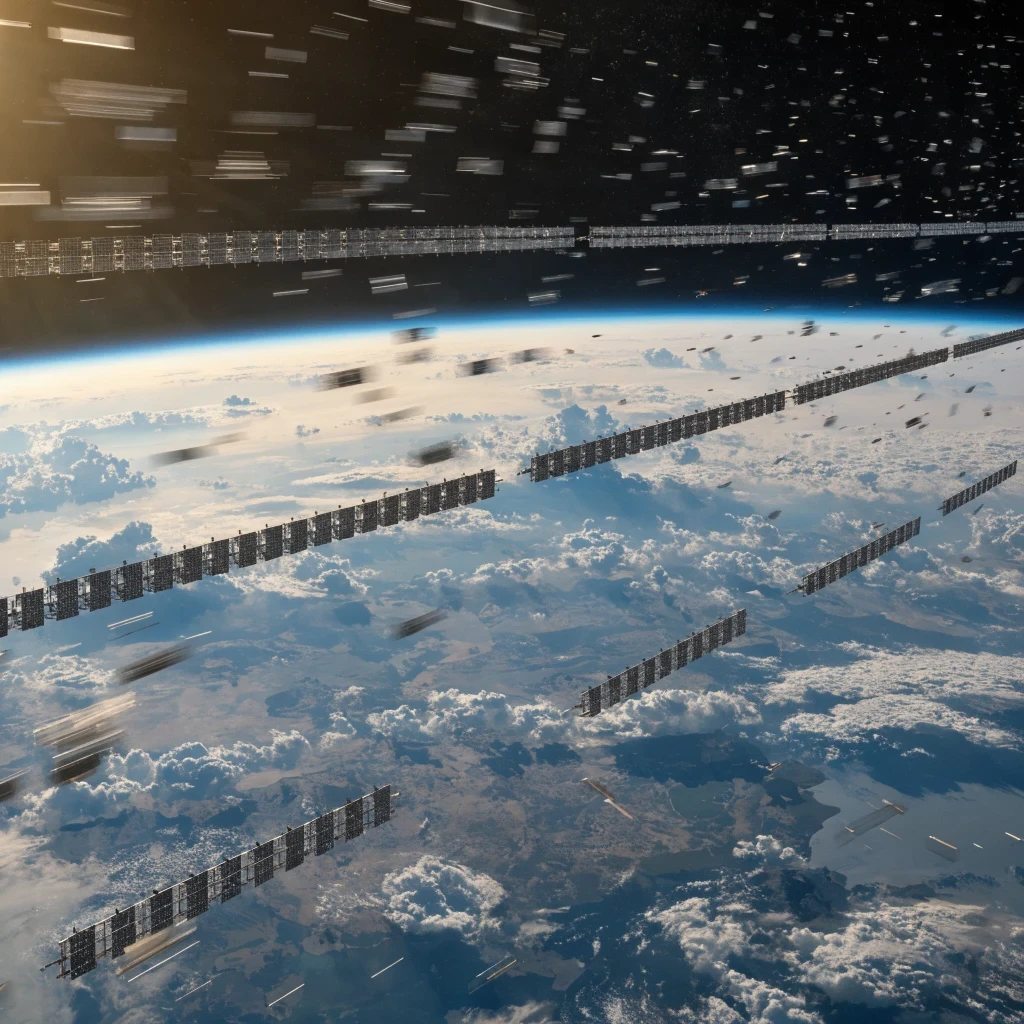
Claims of 1.7 million satellites must be interpreted carefully. A proposal, licence request, filing, or long-term deployment ambition is not equivalent to a functioning orbital population. Many projects will be delayed, consolidated, redesigned, or abandoned. Even so, the number is strategically important because it exposes the weakness of treating each constellation as an isolated commercial project rather than as part of a shared orbital and environmental system.
Low Earth orbit is attractive because shorter signal paths reduce latency and launch vehicles can deploy large batches efficiently. That advantage creates a powerful feedback loop: lower launch costs enable more spacecraft, more spacecraft make broadband coverage easier, and broader coverage encourages still larger networks. Without cumulative assessment, individual approvals can produce a combined impact that no single operator was required to model.
Why satellite counts are an incomplete metric
A satellite’s apparent brightness depends strongly on geometry. A spacecraft crossing the sky near sunset may reflect intense sunlight toward the ground, while the same object becomes invisible when Earth’s shadow reaches it. Brightness also changes with phase angle, altitude, orientation, solar-array design, and whether the vehicle presents a broad reflective surface to an observer.
Orbital altitude creates a genuine tension. Higher satellites can cover larger footprints and may require fewer spacecraft, but they remain illuminated later into the evening and move more slowly across a telescope’s field. Lower satellites often move rapidly and spend more time in Earth’s shadow, yet a low-orbit network needs many more vehicles to provide persistent global coverage.
The relevant quantity is therefore not simply “satellites in orbit.” Astronomers need the number of illuminated spacecraft visible from a particular observatory, their brightness distribution, angular speed, crossing rate, and the fraction of observations they contaminate. A constellation of fewer but brighter, higher spacecraft may be more damaging to some surveys than a larger fleet of dimmer, lower vehicles.
From individual streaks to a crowded sky
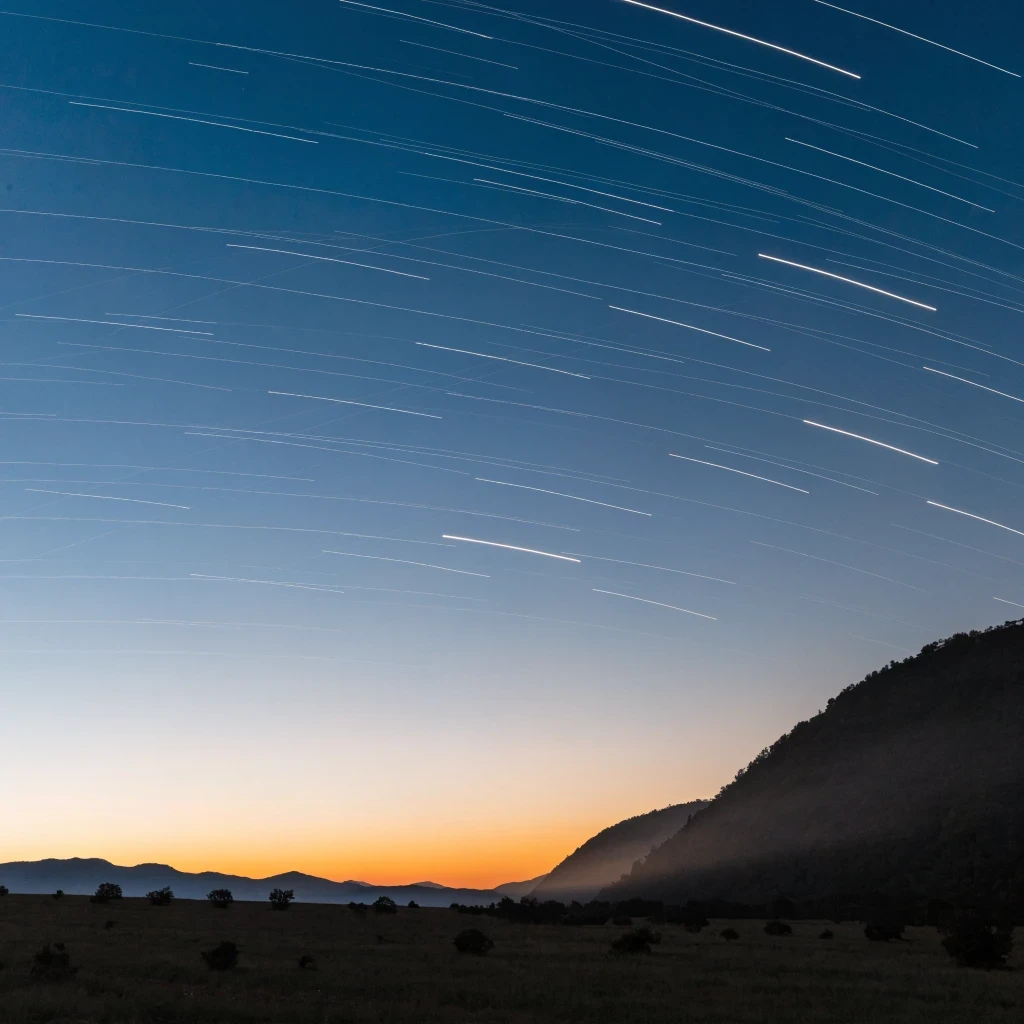
Long-exposure astronomy is especially vulnerable because a telescope collects photons over minutes or hours. A satellite that crosses a detector for only a few seconds can carve a saturated line through a wide field, damage nearby pixels through blooming, and complicate the recovery of faint sources. Repeated crossings turn an occasional nuisance into a predictable loss of observing efficiency.
Wide-field survey telescopes face the sharpest exposure problem. Instruments designed to scan enormous portions of the sky are statistically more likely to intersect a satellite track, particularly during twilight when spacecraft remain sunlit but the ground is already dark. The result is not merely unattractive imagery; it can impair transient detection, photometry, weak-lensing measurements, and the identification of moving objects.
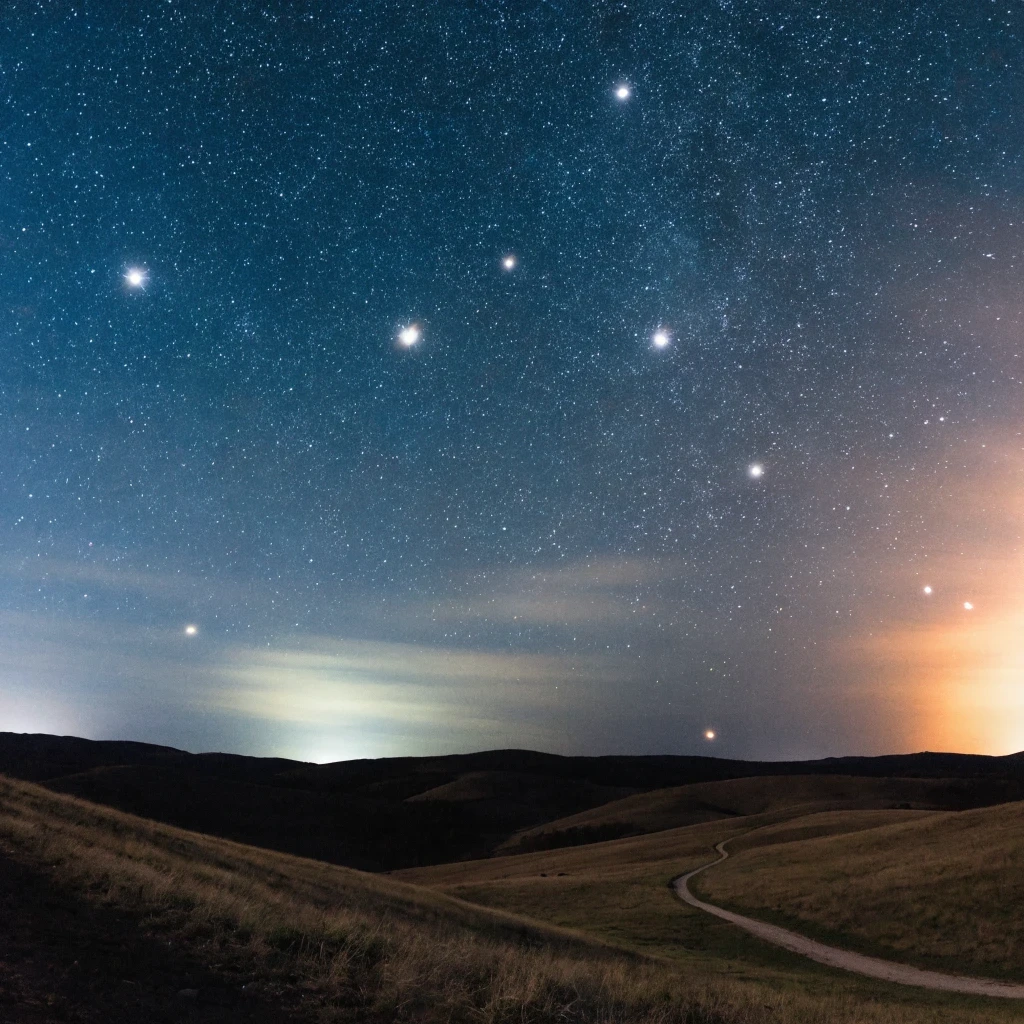
Public observers encounter a different but equally real consequence. Dense satellite trains can transform a pristine star field into a moving procession of artificial lights, undermining cultural astronomy, amateur observation, astrophotography, and the experience of natural darkness. That loss matters because dark skies are educational infrastructure, a tourism asset, and an increasingly rare environmental condition.
How satellite illumination changes astronomical observations
Satellite-related light pollution has two distinct forms: concentrated streaks from individual spacecraft and diffuse skyglow created when sunlight is scattered by many objects, atmospheric particles, or reflective surfaces. The first is visually obvious and often removable through image processing. The second is subtler, potentially persistent, and more dangerous because it raises the background against which every faint astronomical signal must be detected.
Optical observatories can sometimes schedule around predictable satellite passages, close shutters during bright twilight, or use software to mask contaminated pixels. Those adaptations are useful but not free. They reduce usable exposure time, increase calibration demands, consume processing capacity, and can create selection effects in scientific datasets. No algorithm can reconstruct information that was physically overwhelmed or never recorded.
Five-minute exposure: a practical contamination estimate
Consider a telescope taking a 300-second exposure. If a visible satellite crosses the active detector for 4 seconds, the directly contaminated time fraction is modest, but the affected area may be much larger than the narrow track. Let the crossing probability during one exposure be 0.25, and let each crossing compromise 8 percent of the image after masking and artifact removal.
This calculation yields an expected two-percent image-area loss under deliberately simple assumptions. It does not mean that every exposure loses exactly two percent, nor does it capture saturation, scattered charge, overlapping trails, or the scientific importance of the pixels involved. A faint galaxy survey and a bright-star monitoring program can suffer very different consequences from the same geometric contamination.
The calculation’s real value is methodological. Observatory managers should estimate losses from actual orbital predictions, instrument footprints, observing seasons, and target distributions. Reporting only the percentage of images containing trails conceals the more consequential question: how much scientifically usable information disappears after masking, re-observation, and quality-control rejection?
Brightness, signal-to-noise, and the cost of a brighter background
Diffuse sky brightness damages observations by increasing the background photon count. In a simplified photon-limited regime, the signal-to-noise ratio behaves approximately as the source signal divided by the square root of the combined source and background counts. When background dominates, a brighter sky forces longer exposures or larger telescopes to achieve the same confidence.
Suppose a target produces 100 useful photons while the natural background contributes 400 photons. If artificial illumination increases the background by 25 percent, the new background is 500 photons. The signal-to-noise ratio changes according to the following comparison.
The decline from 4.47 to 4.08 is approximately 8.7 percent, despite a 25-percent increase in background. That appears manageable for one target, but surveys observe millions of sources and often operate close to detection thresholds. A small degradation can reduce catalogue completeness, weaken parameter estimates, and force expensive repeat observations across entire observing campaigns.
Radio astronomy, orbital congestion, and hidden interference
Optical pollution is only half the issue. Radio observatories study faint natural emissions from planets, stars, galaxies, pulsars, molecular clouds, and the early universe. Satellite communications occupy radio bands with signals vastly stronger than many cosmic sources. Even where allocations are formally separated, imperfect filtering, side lobes, harmonics, out-of-band leakage, and receiver saturation can threaten measurements.
Unlike optical streaks, radio interference may not be visible in a public image. It can appear as lost frequency channels, corrupted time intervals, false signals, or unusable data around a moving transmitter. The growth of electronically steered antennas and frequent inter-satellite links further complicates interference management because transmissions can change direction, frequency, and power rapidly.
Estimating the aggregate brightness burden
A first-order model can estimate the average contribution of a constellation by multiplying the number of visible spacecraft by their mean flux and an effective visibility factor. This is not a substitute for radiative-transfer modelling, but it clarifies why aggregate effects can rise even when each vehicle is individually dimmed.
If 20,000 spacecraft are simultaneously visible, each contributes a normalized mean flux of 0.003 units, and the effective atmospheric and geometric factor is 0.6, then the aggregate index is 36 units. Reducing each satellite’s mean flux by half lowers the index to 18, but doubling the fleet restores the original burden. Mitigation must therefore address both spacecraft brightness and constellation scale.
This is the central policy lesson: per-satellite improvements are not automatically system-level improvements. Dark coatings, sunshades, attitude restrictions, and operational avoidance can reduce local damage, but their gains may be overwhelmed by population growth. Environmental assessment must publish both normalized performance per spacecraft and predicted cumulative exposure for observatories worldwide.
Orbital congestion is a collision-risk problem
Orbital congestion introduces a second externality. Every spacecraft occupies a moving path through a shared three-dimensional environment, and collision risk depends on object density, tracking accuracy, conjunction frequency, manoeuvre reliability, and the quality of end-of-life disposal. A collision can generate thousands of fragments, increasing the hazard for operators that did not create the original event.
The probability of a collision is often represented in simplified form as a product of spatial density, effective collision cross-section, relative velocity, and time. This model is imperfect because orbital encounters are structured rather than random, but it demonstrates why adding objects increases risk nonlinearly when traffic becomes dense and avoidance windows overlap.
For an illustrative case with density 0.00002 objects per cubic kilometre, an effective cross-section of 0.01 square kilometres, relative speed of 10 kilometres per second, and one year of exposure, the hazard rate is approximately 0.0000063 per year. That individual risk is small, but multiplying it across thousands of spacecraft and repeated conjunction opportunities produces a serious fleet-level governance challenge.
Orbital congestion also affects astronomy indirectly. More avoidance manoeuvres can alter satellite pointing and brightness, while debris clouds may create additional optical tracks and radio complications. The night-sky problem and the space-sustainability problem are therefore linked: poorly managed orbital growth can degrade both the scientific environment and the long-term reliability of space infrastructure.
We Also Published
Connectivity benefits versus dark-sky costs
Satellite broadband can deliver meaningful social and economic benefits where terrestrial fibre, mobile towers, or reliable power infrastructure are absent. Remote communities, ships, aircraft, disaster-response teams, and scientific expeditions may gain communications that geography previously denied them. Any serious policy must acknowledge these benefits rather than pretending that astronomy is the only public interest at stake.
Recognition of connectivity benefits does not justify unlimited orbital growth. The correct comparison is marginal: how much additional coverage, resilience, or affordability does each new tranche of satellites provide, and what additional burden does it impose on observatories, radio quiet zones, astronomy education, and orbital safety? If the public pays the environmental cost, operators must demonstrate measurable public value.
Connectivity is not a blank cheque
Market competition can encourage rapid deployment, but commercial incentives rarely price externalities accurately. A company benefits from spectrum access, orbital slots, and global visibility, while the costs of lost observing time and degraded dark skies are distributed across universities, national facilities, amateur astronomers, and future generations.
That imbalance is familiar from terrestrial light pollution. Individual lamps appear harmless, yet millions of poorly shielded sources create a collective skyglow that no single owner intended. Satellite constellations reproduce the same logic above the atmosphere, except that orbital objects move across borders and are governed through fragmented international systems.
A defensible approval process should require cumulative impact assessments, independently verifiable brightness data, radio-emission compliance, collision-avoidance capability, and funded end-of-life disposal. Operators should also publish ephemerides and performance measurements in formats that observatories can use directly. Transparency is not a courtesy; it is the minimum condition for credible coexistence.
The economics of lost observing time
Observatory time is scarce because major instruments operate under demanding schedules, expensive staffing arrangements, and narrow atmospheric windows. A contaminated exposure may be repeated, but replacement time may not exist. The opportunity cost includes delayed discoveries, incomplete survey coverage, and weaker statistical power in projects designed around uniform observations.
We can express a simple annual loss model by multiplying the number of scheduled exposures by the contamination probability and the fraction of each contaminated exposure rendered unusable. This converts an abstract sky-brightness concern into an operational quantity that funding agencies and facility managers can compare with mitigation costs.
For 100,000 exposures, a 0.12 probability of unusable contamination, 300 seconds per exposure, and an unusable fraction of 0.8, the lost time is 2,880,000 seconds, or 800 hours. The figures are illustrative, but the method is practical. A real assessment should separate twilight and darkness, instrument types, weather losses, and whether a contaminated exposure can be repaired computationally.
The economic conclusion is blunt: mitigation should be judged against the value of avoided scientific loss, not merely against the price of a satellite coating or software update. If a small operational change protects hundreds of observatory hours, it is not an optional public-relations gesture. It is efficient infrastructure management.
What responsible satellite deployment should require
The night sky can still be protected, but voluntary promises alone are insufficient for a fleet numbering in the tens of thousands or beyond. The International Astronomical Union, national regulators, spectrum authorities, observatories, and operators need enforceable technical benchmarks. Those benchmarks should be measured in real observing conditions, not only in laboratory claims or idealized simulations.
The objective should not be to freeze innovation. It should be to make orbital design compatible with scientific observation from the beginning. That requires treating optical brightness, radio leakage, debris generation, and data transparency as core engineering requirements, alongside latency, throughput, power, and launch economics.
Engineering controls that can reduce harm
Spacecraft can be designed with lower-reflectivity materials, carefully controlled attitudes, deployable shades, reduced specular surfaces, and operational modes that avoid directing reflections toward major observatories. These measures must be tested across phase angles and orbital seasons because a surface that appears dark from one geometry can become highly reflective from another.
Constellations can also provide accurate, machine-readable predictions of satellite positions, illumination, brightness, and transmission schedules. Observatories can use those data to plan exposures, coordinate avoidance windows, and improve image masking. Predictability does not eliminate contamination, but it converts some uncertainty into a manageable scheduling problem.
Radio protection requires geographically coordinated exclusion zones, dynamic power control, frequency discipline, robust filtering, and direct consultation with radio observatories. Passive astronomy cannot simply “turn off” the universe when interference appears. Regulators should therefore require demonstrated compatibility with protected bands and meaningful penalties for repeated violations.
Regulation, monitoring, and the principle of reversibility
Licensing should be staged. Operators could receive permission to deploy an initial tranche, demonstrate measured compliance, and then qualify for expansion. This adaptive approach is superior to granting enormous capacity before the environmental consequences are known. It creates an evidence-based feedback loop and prevents speculative filings from becoming an irreversible orbital reality.
Independent monitoring is essential. Optical observatories, all-sky cameras, satellite-tracking networks, and radio facilities should be able to compare predicted and observed behaviour. Regulators should publish aggregate statistics on brightness, radio leakage, conjunctions, disposal success, and astronomy downtime. Public data would allow scientists to identify trends before damage becomes systemic.
Finally, the principle of reversibility must govern orbital growth. If a constellation produces measurable harm beyond its approved limits, the operator should be required to modify operations, reduce the active population, or suspend deployment. Connectivity is valuable, but it cannot be treated as permission to occupy a shared environment without accountability. A sustainable satellite economy must earn the right to expand.
The proposed satellite boom is therefore neither a trivial inconvenience nor proof that space-based communications should be abandoned. It is a governance test. If up to 1.7 million proposed spacecraft become part of the orbital landscape, the difference between enlightened deployment and reckless accumulation will be determined by cumulative modelling, enforceable standards, transparent measurements, and the willingness to value scientific darkness as a public good.
Protecting astronomy does not mean protecting an outdated privilege. Optical and radio observatories support planetary defence, climate research, fundamental physics, navigation science, education, and humanity’s understanding of its origins. The same night sky that enables frontier research also connects ordinary observers with the wider universe. Preserving it is not opposition to progress; it is a demand that progress remain worthy of the name.
Five simple calculations illustrate the governing logic: contamination scales with crossing probability, noise rises with background photons, aggregate brightness grows with visible population, collision risk accumulates over time, and lost observing hours carry measurable operational value. These models are intentionally modest. The next step belongs to regulators and operators, who must replace broad assurances with full-scale assessments grounded in real orbital behaviour.
From our network :
- Analyzing Trump Deportation Numbers Insights Into The 2026 Immigration Crackdown
- AI-Powered 'Precision Diagnostic' Replaces Standard GRE Score ReportsDiscover the new GRE Precision Diagnostic. Learn how AI-powered behavioral analytics and time-to-solve tracking are replacing standard GRE score reports to empower students.
- Mastering DB2 LUW v12 Tables: A Comprehensive Technical GuideComprehensive guide on DB2 LUW v12 tables. Explore CREATE TABLE syntax, BLU Acceleration, range partitioning, data types, and security features for IBM DB2 LUW v12.
- EV 2.0: The Solid-State Battery Breakthrough and Global Factory ExpansionDiscover the impact of the Solid-State Battery Breakthrough on the EV market. Learn about CATL and BYD stock growth, global factory expansion in Europe, and the future of EV 2.0 technology.
- Vite 6/7 'Cold Start' Regression in Massive Module GraphsIn-depth analysis of Vite 6/7 cold start regressions in massive module graphs. Learn about barrel file issues, pre-bundling optimizations, and how to improve Vite dev server performance.
- 98% of Global MBA Programs Now Prefer GRE Over GMAT Focus EditionExplore why 98% of global MBA programs now prefer the GRE over GMAT Focus. Learn about the shorter GRE format, verbal logic importance, and strategic versatility for students.
- 10 Physics Numerical Problems with Solutions for IIT JEEPrepare for IIT JEE with 10 physics numerical problems, complete with detailed solutions and conceptual explanations. Ideal for mastering kinematics, thermodynamics, electromagnetism, and optics.
- Mastering DB2 12.1 Instance Design: A Technical Deep Dive into Modern Database ArchitectureComprehensive guide to DB2 12.1 Instance Design. Explore architectural components, HADR setup, buffer pool tuning, and security policies for IBM DB2 12.1. Includes 10 functional SQL and Shell samples.
- Trump Political Strategy How Geopolitical Stunts Serve As Media Diversions
RESOURCES
- Call to Protect the Dark and Quiet Sky from Harmful Interference by ...cps.iau.orgMar 14, 2024 ... brightness of a satellite as seen by astronomical observers. Depending on the field of view of the telescope (the por-…
- Recommendation on the Protection of Astronomical Sitesiau.org... Dark and Quiet Sky from Satellite Constellation Interference (CPS) in 2022. The international working group for D&QS 1 consisted of nine astronomers, four ...
- IAU WG6 session: Executive working group on dark & quiet sky ...cps.iau.orgAug 15, 2024 ... ... Protection of the Dark and Quiet Sky from Satellite Constellation Interference (CPS) ... Skies by the AAS Committee to…
- [2412.08244] Call to Protect the Dark and Quiet Sky from Harmful ...arxiv.orgDec 11, 2024 ... ... astronomical observations and research, and the ... Protection of the Dark and Quiet Sky from Satellite Constellation Interference (CPS).
- The high optical brightness of the BlueWalker 3 satellite - PubMedpubmed.ncbi.nlm.nih.govIAU Centre for the Protection of the Dark and Quiet Sky from Satellite Constellation Interference, Paris, France. eggl@illinois.edu. 4 Instituto de ...
- The IAU CPS: How to protect the Dark and Quiet Sky?conference.sdo.esoc.esa.intThe International Astronomical Union Centre for the Protection of the Dark and Quiet Sky from Satellite Constellation Interference (IAU CPS) promotes ...
- Dark Sky Protection: We Are Losing the Universe - NOIRLabnoirlab.eduMar 16, 2023 ... ... brightness measured by satellites ... interference caused by large satellite constellations. By bringing together astronomers, satellite ...
- SKAO and international partners petition UN for the protection of ...skao.intFeb 7, 2022 ... However, in some areas, these satellites can disrupt astronomy because of the sheer number of them, their brightness in the…
- Dark and quiet skies preservation - ESO.orgeso.org... brightness of light from astronomical objects). This is ... While important for global communications networks, these satellites can impact astronomy ...
- Dark and Quiet Skies - IAU Office for Astronomy Outreachiauoutreach.orgMore recently, dark sky protection has also included the protection of the night sky from optical and infrared impacts (such as trails seen in…

0 Comments