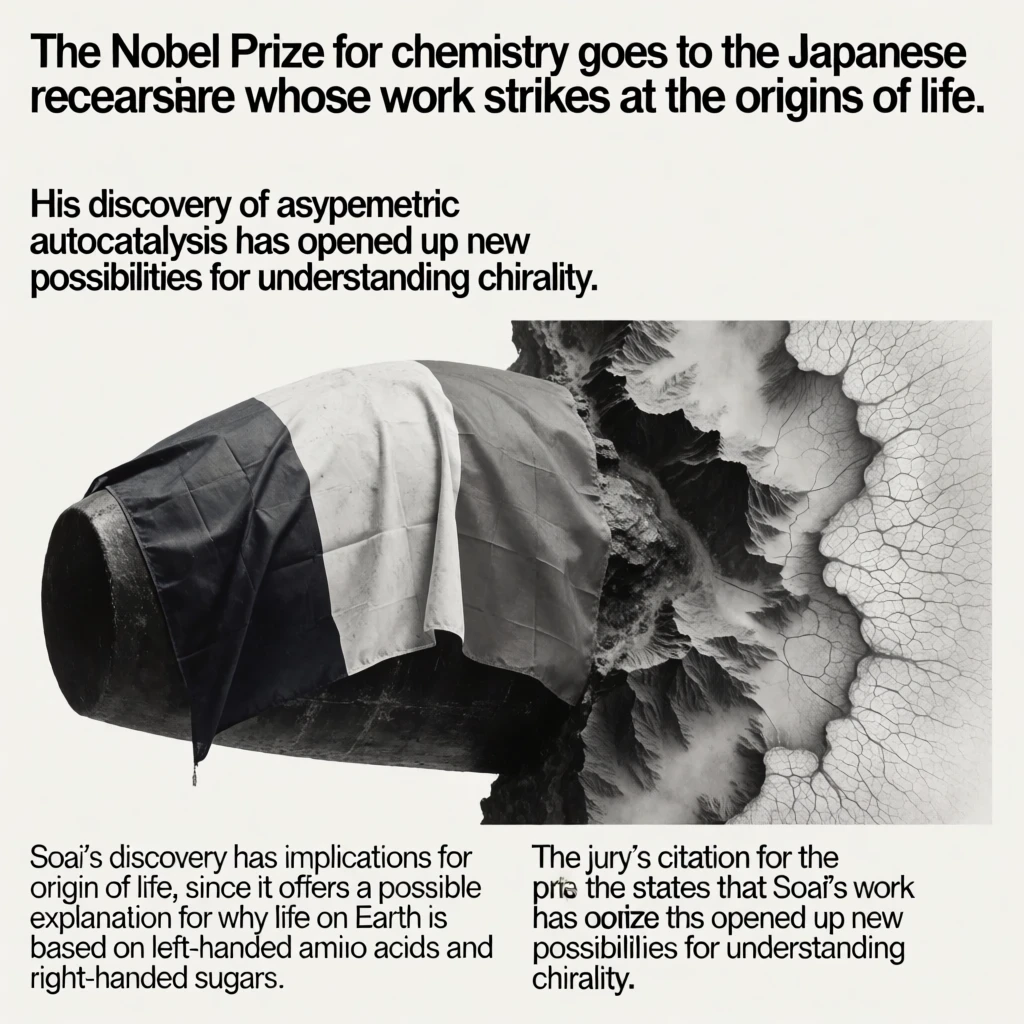
Chirality is the geometric property that makes a molecule distinguishable from its own mirror image, much as a left hand differs from a right one. Every living system on Earth exploits this asymmetry with ruthless consistency: proteins are built almost exclusively from left-handed amino acids, while nucleic acids run on right-handed sugars. This single-handedness, called homochirality, is so universal that it functions as a chemical signature of life itself, yet chemistry alone offers no obvious reason why one hand should have won.
The recognition of asymmetric autocatalysis by the Nobel committee elevated a deceptively simple idea into a central explanatory framework. In an autocatalytic reaction, a product accelerates its own formation; when that product is chiral, the reaction can amplify a tiny initial imbalance into a near-total dominance of one handedness. This is chemical amplification in its purest form, and it transforms a statistical curiosity into a plausible engine for the origin of biological asymmetry. The prize honored decades of patient laboratory work that turned a philosophical puzzle into measurable kinetics.
What follows examines the mechanism, the mathematics, and the cosmological stakes of this discovery. We will trace how nonlinear kinetics converts infinitesimal biases into overwhelming outcomes, why the Soai reaction became the canonical demonstration, and what these findings imply about self-organization in the prebiotic world. The analysis connects rigorous physical chemistry to one of biology's deepest unresolved questions, showing that the origin of homochirality may be less a mystery of chance than a predictable consequence of amplification dynamics.
On This Page
The Geometry of Handedness and the Homochirality Puzzle
Chirality arises whenever a molecule lacks an internal plane of symmetry, most commonly through a carbon atom bonded to four distinct substituents. Such a center generates two non-superimposable mirror forms, termed enantiomers, which share nearly every physical property yet rotate polarized light in opposite directions. This optical activity provided the first experimental window into molecular asymmetry during the nineteenth century.
Why Life Chose One Hand
The universality of left-handed amino acids and right-handed sugars across all known organisms is striking precisely because abiotic synthesis produces them in equal measure. Any prebiotic soup generated by random chemistry should yield a racemic mixture, containing both enantiomers in a one-to-one ratio. Life, by contrast, operates at what appears to be complete enantiomeric excess, a discrepancy that demands explanation.
Biological homogeneity carries functional advantages that reinforce its persistence. A protein assembled from mixed handedness cannot fold into a stable, reproducible tertiary structure, because the geometry of the backbone becomes inconsistent. Once a lineage committed to one hand, the entire translational machinery became locked into that choice, making reversal functionally catastrophic and evolutionarily prohibitive.
This lock-in suggests that homochirality emerged early, before the last universal common ancestor, and was then inherited by every descendant lineage. The question therefore shifts from why life is homochiral to how the first bias arose and survived. Amplification, rather than selection alone, must have played the decisive role in converting a fleeting imbalance into a durable one.
Researchers have long debated whether the initial bias came from circularly polarized starlight, mineral surfaces, or statistical fluctuation in small molecular populations. Each mechanism supplies only a minuscule excess, typically far below one percent. The critical insight is that such tiny seeds are sufficient if the subsequent chemistry amplifies them efficiently.
Enantiomeric Excess as a Quantitative Measure
Chemists quantify asymmetry through enantiomeric excess, defined as the normalized difference between the two enantiomer populations. A value of zero indicates a perfect racemic mixture, while unity signifies complete single-handedness. This metric provides the essential variable for tracking how amplification evolves over the course of a reaction.
Here ##[ [R] ]## and ##[ [S] ]## denote the concentrations of the right- and left-handed enantiomers respectively. The definition is symmetric and bounded between negative one and positive one, allowing a single number to capture both the magnitude and direction of chiral bias. Experimentalists routinely report this quantity to characterize autocatalytic runs.
Tracking enantiomeric excess over time reveals the signature of nonlinear amplification. In a linear process, an initial excess decays toward zero as random racemization competes with production. In a nonlinear autocatalytic process, the excess instead grows, accelerating as the dominant enantiomer captures an ever-larger share of the reacting material.
Asymmetric Autocatalysis: The Engine of Amplification
Asymmetric autocatalysis describes a reaction in which a chiral product catalyzes its own formation while simultaneously favoring the production of its own handedness. The product acts as both catalyst and template, so each turnover generates more of the very species that drives the next cycle. This self-reinforcing loop is the chemical analogue of a population that reproduces its own kind.
The Soai Reaction as Canonical Evidence
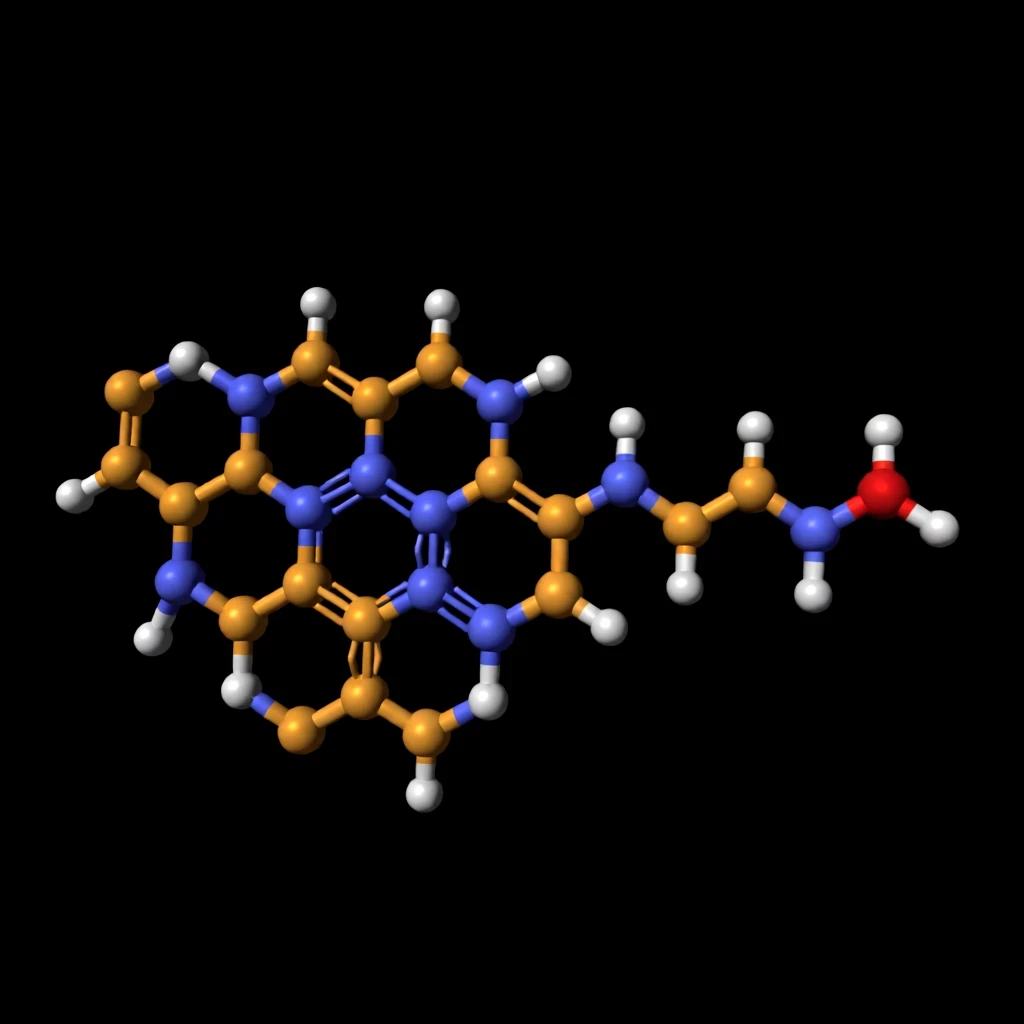
The pyrimidyl alkanol system discovered by Kenso Soai remains the most celebrated experimental realization of this phenomenon. A small initial excess of one enantiomer of the product catalyzes formation of additional product with the same configuration, and the excess climbs dramatically. Starting from a barely detectable bias, the reaction can reach nearly complete single-handedness.
What makes the Soai reaction remarkable is its sensitivity to extraordinarily weak chiral influences. Even isotopic substitution, or a chiral crystal surface, can serve as the seed that determines the final outcome. The reaction effectively reads a whisper of asymmetry and broadcasts it as a shout, demonstrating that amplification requires no special prebiotic conditions.
Kinetic analysis reveals the underlying nonlinearity. When the reaction rate depends on the square of the product concentration, the two enantiomers compete in a winner-take-all dynamic. The initially more abundant hand grows faster, widening the gap until the minority species is effectively starved of substrate and the system settles into a single-handed state.
This behavior is mathematically analogous to symmetry breaking in physics, where a system poised at an unstable equilibrium spontaneously selects one of several equivalent states. The final handedness is not predetermined by the laws of chemistry but is decided by the initial fluctuation, then locked in by positive feedback.
Modeling the Kinetics of Symmetry Breaking
A minimal model captures the essential competition between the two enantiomers through coupled rate equations. Each species catalyzes its own production while consuming a shared substrate, and the nonlinear dependence on concentration produces the bifurcation that drives amplification. Solving these equations reveals the threshold behavior characteristic of autocatalytic systems.
In this scheme, ##[ k ]## governs the autocatalytic production and ##[ k' ]## represents a racemization or decay term. The cubic coupling reflects the requirement that two molecules of the favored enantiomer cooperate to template a third. Subtracting the two equations yields an equation for the evolution of the excess itself.
This result is illuminating: the excess grows whenever the autocatalytic term exceeds the racemization term, and the growth rate itself scales with the product of the two concentrations. As the reaction proceeds and total concentration rises, amplification accelerates, driving the system toward complete dominance of one hand.
The mathematics confirms an intuitive picture. Small biases are unstable in the presence of strong autocatalysis, because any deviation from perfect symmetry is rewarded with faster growth of the majority species. The racemic state is an unstable equilibrium, and the system inevitably falls toward one of the two chiral attractors.
Chemical Amplification and the Physics of Self-Organization
Amplification is not merely a laboratory curiosity; it is a general principle by which small causes produce large effects in systems far from equilibrium. Autocatalytic chiral reactions belong to a broader class of nonlinear phenomena in which feedback loops generate order from disorder. Understanding this class illuminates how complexity can emerge without external design.
Nonlinearity as the Source of Order
Linear systems obey superposition: small inputs yield proportionally small outputs, and symmetry is preserved. Nonlinear systems break this rule, allowing fluctuations to be amplified into macroscopic structure. The chiral autocatalytic reaction exemplifies this, converting a microscopic imbalance into a macroscopic property of the entire sample.
This behavior echoes phenomena across physics and biology, from the formation of convection cells to the patterning of developing embryos. In each case, a system poised near an instability selects one of several possible ordered states. The selection is governed by noise, and the resulting order is robust once established.
Self-organization therefore does not require a designer or a blueprint. It requires only the right kinetics: positive feedback to amplify fluctuations, and a mechanism to lock in the chosen state. Chiral autocatalysis supplies both, making it a compelling model for how molecular order could have bootstrapped itself on the early Earth.
The broader lesson is that the emergence of biological handedness may be a generic consequence of chemistry operating far from equilibrium. Given sufficient time and the right reaction network, homochirality becomes not a miracle but an expected outcome of the underlying dynamics.
From Molecular Bias to Biological Handedness
Bridging the gap between a laboratory reaction and a living cell requires more than amplification alone. The amplified product must be incorporated into a self-sustaining chemical network capable of replication and, eventually, metabolism. This transition from simple amplification to genuine biology remains an active frontier of research.
Protocell models suggest that chiral amplification could have occurred within membrane-bound compartments, where reaction products are concentrated and retained. Confinement enhances autocatalysis by keeping the product in proximity to its precursors, accelerating the feedback loop. Such compartments also protect the emerging bias from dilution by the surrounding environment.
Once a compartmentalized system achieved a strong chiral bias, it could propagate that bias through growth and division. Daughter compartments inheriting the dominant enantiomer would outcompete those with weaker or opposite biases, adding a layer of Darwinian selection atop the chemical amplification. This coupling of chemistry and selection is precisely what origin-of-life researchers seek to demonstrate.
Experimental progress continues to narrow the gap. Researchers have shown that autocatalytic systems can operate under prebiotically plausible conditions, using simple organic building blocks and mild aqueous chemistry. Each demonstration strengthens the case that homochirality is an accessible, even likely, outcome of natural processes.
We Also Published
Cosmic and Geological Seeds of Asymmetry
If amplification is the engine, the seed must come from somewhere. Candidate sources range from astrophysical radiation to mineral surfaces and meteoritic delivery. Each provides a physically plausible mechanism for generating the initial excess that autocatalysis then magnifies into biological significance.
Circularly Polarized Light and Meteoritic Delivery
Circularly polarized ultraviolet light, generated in star-forming regions, can selectively destroy one enantiomer while sparing the other. Laboratory experiments confirm that such irradiation produces measurable excesses in amino acids. The effect is small but real, and it operates on cosmic scales over immense timescales.
Meteorites provide complementary evidence. Certain carbonaceous chondrites contain amino acids with enantiomeric excesses reaching several percent, favoring the left-handed form. These extraterrestrial samples demonstrate that abiotic chemistry can generate bias, and that such bias can be delivered to planetary surfaces intact.
The combination of cosmic irradiation and meteoritic delivery suggests that the early Earth received a steady supply of slightly biased organic material. Once delivered, these molecules could participate in autocatalytic reactions that amplified the bias further. The universe, in effect, may have seeded life's handedness before life existed.
Mineral surfaces offer a third route. Chiral crystal faces can preferentially adsorb one enantiomer, concentrating it relative to its mirror form. This adsorption-based selection, though modest, provides a mechanism for local enrichment that could trigger subsequent amplification in solution.
Quantifying the Seed-to-Signal Ratio
The power of amplification is best appreciated by calculating how many cycles are needed to convert a tiny seed into a dominant signal. If each autocatalytic cycle multiplies the excess by a factor ##[ f ]##, the number of cycles required to reach a target excess follows a logarithmic relationship. This calculation reveals how modest amplification factors suffice over geologically plausible timescales.
Consider a seed excess of ##[ ee_0 = 0.001 ]## and an amplification factor of ##[ f = 1.5 ]## per cycle. Reaching an excess of ##[ ee_n = 0.99 ]## requires roughly seventeen cycles, a modest demand for a prebiotic environment. Even a factor of ##[ f = 1.1 ]## needs only about seventy cycles, well within reach.
This arithmetic dissolves a common objection to prebiotic homochirality. Critics argue that tiny biases are too small to matter, but the logarithmic scaling shows that small biases are precisely what amplification is designed to exploit. The seed need only be nonzero; the dynamics handle the rest.
The calculation also clarifies why racemization must be controlled. If the decay term is comparable to the amplification term, the effective factor ##[ f ]## approaches unity and the required cycle count diverges. Prebiotic environments that suppress racemization, through low temperature or confinement, are therefore favored sites for chiral evolution.
Experimental Frontiers and Open Questions
The Nobel recognition has accelerated interest in extending chiral amplification beyond the Soai reaction. Researchers are searching for autocatalytic systems built from simpler, more prebiotically relevant molecules, and for conditions under which these systems operate in water. Success would strengthen the case that homochirality is a natural consequence of early-Earth chemistry.
Beyond the Soai Reaction
Organocatalytic and metal-free systems are being explored for their ability to amplify chirality under mild conditions. Some rely on crystallization-driven amplification, in which the growth of one crystal form preferentially consumes the available material. These approaches broaden the mechanistic repertoire available to prebiotic scenarios.
Systems chemistry, an emerging discipline, studies networks of coupled reactions rather than isolated transformations. Chiral amplification within such networks can exhibit emergent behaviors, including spontaneous symmetry breaking and the coexistence of competing handedness in different compartments. These phenomena hint at richer dynamics than single-reaction models suggest.
Computational chemistry complements experiment by simulating reaction networks at the molecular level. Simulations can explore parameter regimes inaccessible in the laboratory, identifying conditions under which amplification is robust. They also reveal the sensitivity of outcomes to initial conditions, informing experimental design.
The ultimate test would be a fully synthetic protocell that achieves and maintains homochirality through its own metabolism. Such a system would demonstrate that the transition from chemistry to biology is achievable in principle, closing the loop between amplification and life.
What Remains Unresolved
Despite progress, key questions persist. The precise mechanism by which the first bias arose on Earth remains uncertain, and multiple sources may have contributed. The relative importance of cosmic, geological, and statistical seeds is still debated among researchers.
Another open question concerns the robustness of amplification in complex mixtures. Prebiotic environments contained thousands of organic species, many of which could interfere with autocatalytic cycles. Whether amplification survives such molecular noise is an active area of investigation.
The relationship between chiral amplification and the emergence of metabolism is also unclear. Homochirality may have been a prerequisite for efficient catalysis, or it may have emerged alongside metabolic networks as a consequence of selection. Distinguishing these possibilities requires deeper understanding of early biochemical evolution.
Finally, the universality of homochirality across all life raises the question of whether alternative biochemistries could exist with opposite handedness. If amplification is a general phenomenon, then mirror life may be chemically possible, even if it never arose on Earth. This speculation carries practical weight for planetary protection and the search for extraterrestrial biology.
Why the Nobel Recognition Matters
A Nobel Prize signals that a field has matured from speculative inquiry into a rigorous science with established results. The recognition of asymmetric autocatalysis does exactly this for the chemistry of chirality, elevating a topic once dismissed as philosophical into a central problem of physical chemistry. It also validates decades of work by researchers who pursued an unfashionable question.
Scientific and Philosophical Implications
The deeper significance lies in what amplification reveals about the relationship between chance and necessity. A tiny random fluctuation, once amplified, becomes a deterministic feature of the system. This interplay is central to understanding how order emerges in a universe that otherwise trends toward disorder.
Chirality also connects chemistry to biology in a way that few topics can. The handedness of molecules is not an abstract curiosity; it is a physical property that shapes how enzymes recognize substrates, how drugs interact with receptors, and how life itself functions. Understanding its origins illuminates the boundary between the living and the nonliving.
Philosophically, the work suggests that life's asymmetry may not require a special explanation. If amplification is a general property of autocatalytic systems, then homochirality is an expected outcome of natural chemistry, not an improbable accident. This reframing has profound implications for how we think about the inevitability of life.
The recognition also carries practical weight. Chiral synthesis is essential to the pharmaceutical industry, where the two enantiomers of a drug can have dramatically different effects. Advances in asymmetric catalysis, inspired by autocatalytic principles, continue to improve the efficiency of drug manufacturing.
Practical Consequences for Chemistry and Medicine
Asymmetric autocatalysis offers a route to enantiopure compounds without the need for external chiral catalysts. In principle, a small seed of the desired enantiomer can drive the production of more of itself, reducing waste and cost. Industrial applications remain limited, but the principle informs the design of new catalytic processes.
In medicine, the lessons of chirality are already embedded in regulatory practice. Thalidomide, whose two enantiomers have different biological effects, remains a cautionary tale. Understanding amplification helps chemists predict and control the enantiomeric purity of drug substances, improving safety and efficacy.
Materials science also benefits. Chiral materials exhibit unique optical properties, including the ability to rotate polarized light and to generate circularly polarized emission. Amplification principles guide the design of such materials, which find use in displays, sensors, and security features.
Finally, the work inspires a broader view of chemistry as a science of emergence. Reactions are not merely transformations of matter; they are processes that can generate order, memory, and function. The Nobel Prize honors this vision, and the field it recognizes will continue to shape our understanding of matter for decades.
From our network :
- 98% of Global MBA Programs Now Prefer GRE Over GMAT Focus EditionExplore why 98% of global MBA programs now prefer the GRE over GMAT Focus. Learn about the shorter GRE format, verbal logic importance, and strategic versatility for students.
- Vite 6/7 'Cold Start' Regression in Massive Module GraphsIn-depth analysis of Vite 6/7 cold start regressions in massive module graphs. Learn about barrel file issues, pre-bundling optimizations, and how to improve Vite dev server performance.
- AI-Powered 'Precision Diagnostic' Replaces Standard GRE Score ReportsDiscover the new GRE Precision Diagnostic. Learn how AI-powered behavioral analytics and time-to-solve tracking are replacing standard GRE score reports to empower students.
- Mastering DB2 12.1 Instance Design: A Technical Deep Dive into Modern Database ArchitectureComprehensive guide to DB2 12.1 Instance Design. Explore architectural components, HADR setup, buffer pool tuning, and security policies for IBM DB2 12.1. Includes 10 functional SQL and Shell samples.
- Trump Political Strategy How Geopolitical Stunts Serve As Media Diversions
- Analyzing Trump Deportation Numbers Insights Into The 2026 Immigration Crackdown
- EV 2.0: The Solid-State Battery Breakthrough and Global Factory ExpansionDiscover the impact of the Solid-State Battery Breakthrough on the EV market. Learn about CATL and BYD stock growth, global factory expansion in Europe, and the future of EV 2.0 technology.
- 10 Physics Numerical Problems with Solutions for IIT JEEPrepare for IIT JEE with 10 physics numerical problems, complete with detailed solutions and conceptual explanations. Ideal for mastering kinematics, thermodynamics, electromagnetism, and optics.
- Mastering DB2 LUW v12 Tables: A Comprehensive Technical GuideComprehensive guide on DB2 LUW v12 tables. Explore CREATE TABLE syntax, BLU Acceleration, range partitioning, data types, and security features for IBM DB2 LUW v12.
RESOURCES
- Resources will be updated soon.
0 Comments