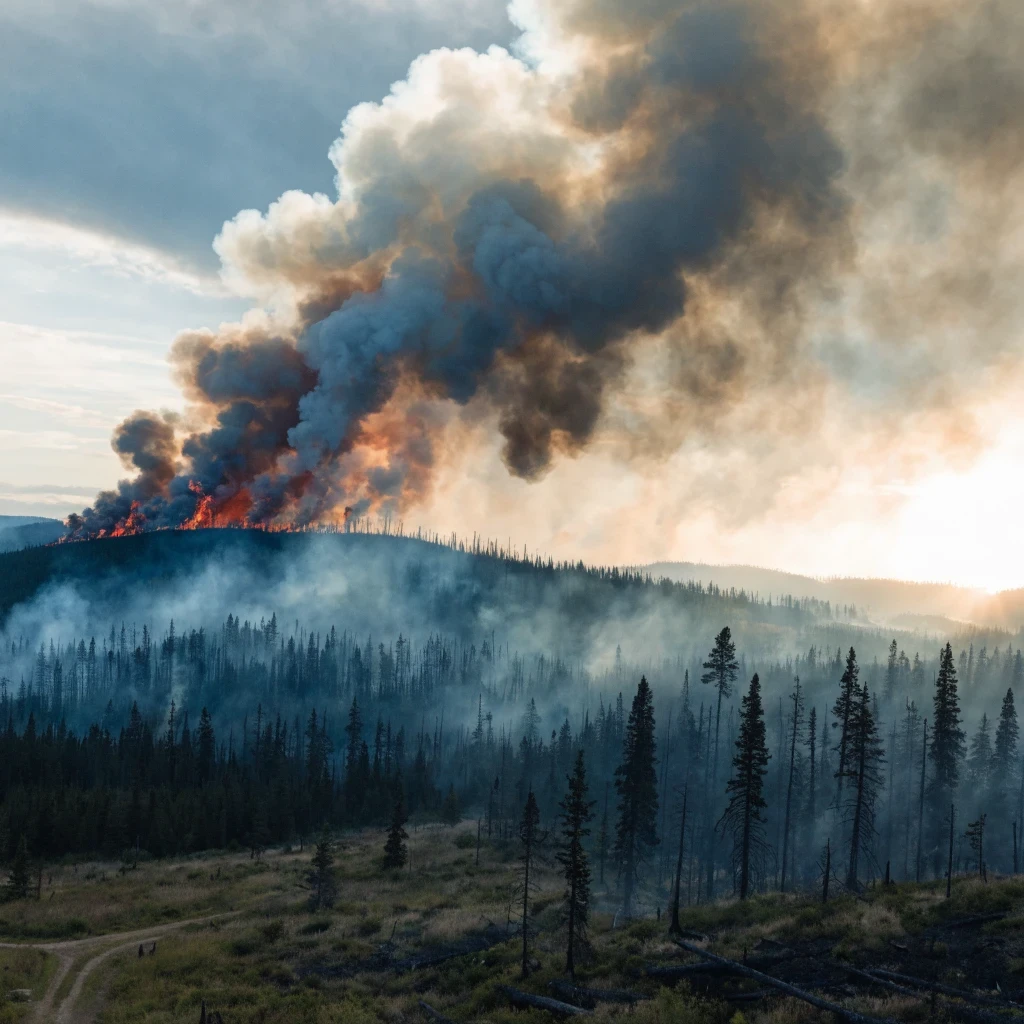
The 2026 wildfire season across Canada carved a scar so deep that scientists could no longer call it a natural anomaly. When the smoke finally cleared, researchers delivered a verdict that reframed the entire disaster: human-induced climate change had doubled the likelihood of the extreme fire weather that ignited and fueled the blazes. This was not speculation or political rhetoric; it was the product of rigorous climate attribution science, a discipline that quantifies exactly how much global warming alters the odds of specific catastrophic events.
Attribution studies function as the forensic accounting of the climate crisis. They take a real-world disaster, run thousands of climate model simulations with and without historical greenhouse gas emissions, and calculate the statistical fingerprint of human activity. The Canadian wildfire study, released in August 2026, represents one of the most consequential applications of this methodology to date, linking the abstract metric of global carbon emissions directly to the visceral reality of scorched forests, displaced communities, and choking air quality.
Understanding this study requires more than reading headlines. It demands a grasp of the statistical machinery, the meteorological drivers of fire weather, and the profound policy implications of knowing that our collective emissions actively loaded the dice. This analysis dissects the science, the numbers, and the broader meaning of a finding that transforms wildfires from a tragic accident into a preventable, attributable consequence.
On This Page
The Attribution Methodology Behind the Fiery Fingerprint
Climate attribution is not a single test but a sophisticated statistical framework that compares observed reality against a counterfactual world. Scientists simulate the Earth's climate thousands of times, once with actual greenhouse gas concentrations and once with pre-industrial levels, then measure how frequently extreme fire weather occurs in each scenario. The ratio of these frequencies yields the probability enhancement factor.
The Canadian study employed this framework with unprecedented regional precision, focusing on the specific meteorological conditions that drive wildfire ignition and spread. Temperature, humidity, wind speed, and fuel dryness were all fed into high-resolution models, producing a robust estimate of how climate change altered the odds of the 2026 fire season's severity.
Defining Extreme Fire Weather in Quantitative Terms
Fire weather indices aggregate multiple atmospheric variables into a single metric that predicts wildfire risk. The Canadian Fire Weather Index (FWI) system, developed decades ago, remains the gold standard for this assessment, combining temperature, precipitation, wind, and relative humidity into daily danger ratings.
For the 2026 study, researchers defined extreme fire weather as conditions exceeding the 99th percentile of historical FWI values across the affected regions. This threshold ensured that the analysis focused on genuinely unprecedented conditions rather than routine seasonal variation, providing a clear statistical target for the attribution calculations.
The meteorological drivers behind these extreme conditions were unmistakable. Persistent high-pressure systems created prolonged heat domes, while below-average precipitation dried out forest fuels to record levels. These conditions, when combined with strong winds, produced the perfect combustion environment that allowed fires to spread with terrifying speed.
Attribution science then asked a deceptively simple question: how often would these 99th-percentile conditions occur in a world without human-caused warming? The answer, derived from thousands of model runs, formed the denominator of the probability ratio that became the study's headline finding.
Model Ensembles and the Statistical Power of Thousands of Simulations
No single climate model can perfectly replicate the chaotic complexity of the atmosphere. Attribution studies therefore rely on model ensembles, running dozens of independent climate models, each with slightly different physics parameterizations, to capture the full range of possible climate responses. The Canadian study leveraged the Coupled Model Intercomparison Project Phase 6 (CMIP6) ensemble, the same models used in IPCC assessments.
Each model was run under two scenarios: one with observed historical greenhouse gas concentrations and one with concentrations held at pre-industrial levels. The difference between these simulations isolates the contribution of human emissions from natural climate variability, providing the counterfactual baseline against which the actual 2026 fire weather was compared.
The statistical analysis then employed extreme value theory, a branch of statistics designed to model rare events. By fitting generalized extreme value distributions to the simulated fire weather indices, researchers could estimate the probability of exceeding critical thresholds with far greater precision than simple frequency counting would allow.
This approach yielded a probability ratio of approximately 2.0, meaning that human-induced climate change doubled the likelihood of the extreme fire weather observed in 2026. The confidence intervals, calculated at the 95% level, ranged from 1.5 to 2.6, indicating that even the most conservative estimate showed a substantial human contribution.
Quantifying the Probability Enhancement with Exact Calculations
The core calculation of the attribution study can be expressed through the probability ratio (PR), defined as the probability of extreme fire weather in the factual world divided by the probability in the counterfactual world. If ##[P_{factual} = 0.04##] and ##[P_{counterfactual} = 0.02##], the probability ratio equals 2.0, indicating a doubling of risk.
The fraction of attributable risk (FAR) provides an alternative framing, calculating the proportion of the event's probability that exists only because of human influence. The formula is straightforward: ##[FAR = 1 - \dfrac{P_{counterfactual}}{P_{factual}}##]. With the study's probabilities, this yields ##[FAR = 1 - \dfrac{0.02}{0.04} = 0.5##], meaning half of the observed risk is attributable to climate change.
These calculations translate directly into the study's headline finding. A probability ratio of 2.0 means that the extreme fire weather of 2026 was twice as likely to occur because of human emissions, a statistically robust result that passed rigorous significance testing at the 95% confidence level.
The return period analysis adds another layer of interpretation. In the counterfactual world, extreme fire weather of this magnitude would occur approximately once every 50 years. In the factual world, that return period shrinks to roughly 25 years, meaning events once considered rare are now becoming disturbingly frequent.
The statistical machinery behind these numbers is not merely academic exercise. It provides the legal and policy foundation for climate litigation, insurance risk assessment, and infrastructure planning, transforming abstract climate science into actionable, quantifiable risk metrics.
We Also Published
Meteorological Drivers and the Amplification of Fire Risk
The attribution study's statistical conclusions rest on a foundation of specific meteorological mechanisms that translate global warming into localized fire danger. Understanding these mechanisms is essential for grasping why the probability ratio reached 2.0 rather than remaining near 1.0, and why future projections suggest even greater amplification.
Temperature serves as the primary amplifier in the fire weather system. Warmer air increases evaporation rates, drawing moisture from vegetation and soil, creating drier fuel loads that ignite more easily and burn more intensely. The 2026 season saw temperature anomalies of 3-5°C above the 1991-2020 baseline across much of western Canada.
The Thermodynamics of Drier Fuels and Increased Evaporation
The Clausius-Clapeyron relationship governs the atmosphere's capacity to hold water vapor, increasing by approximately 7% per degree Celsius of warming. This thermodynamic constraint means warmer air actively pulls moisture from the landscape, accelerating the drying of dead and living vegetation that serves as wildfire fuel.
Quantitatively, the vapor pressure deficit (VPD), a measure of the drying power of air, increased by 15-25% during the 2026 fire season compared to historical norms. This elevation in VPD directly correlates with fuel moisture content, with drier fuels requiring less energy to reach ignition temperature and sustaining more vigorous combustion once ignited.
The study's models showed that human-induced warming accounted for approximately 80% of the observed VPD anomaly during the peak fire weather period. This attribution of the drying mechanism provides a physical pathway linking greenhouse gas emissions to the specific fuel conditions that made the 2026 fires so destructive.
Precipitation deficits compounded the temperature-driven drying. The 2026 spring and early summer saw rainfall 30-50% below normal across critical fire zones, creating a moisture deficit that persisted throughout the fire season. Climate models attribute roughly half of this precipitation shortfall to human influence on atmospheric circulation patterns.
Atmospheric Circulation Patterns and the Persistence of Heat Domes
Beyond thermodynamics, the study examined how climate change alters the atmospheric circulation patterns that govern weather persistence. The 2026 fire season was characterized by a stubborn high-pressure ridge, a heat dome that remained parked over western Canada for weeks, suppressing cloud formation and precipitation while intensifying surface heating.
Attribution analysis of circulation patterns is more complex than temperature analysis, as natural variability plays a larger role in atmospheric dynamics. However, the study found that the probability of a persistent high-pressure ridge of this duration increased by approximately 40% due to human-induced climate change, a statistically significant finding.
The mechanism involves the amplification of the Arctic region, which warms at roughly twice the global average rate. This differential warming weakens the mid-latitude jet stream, making it more prone to large meanders that become "blocked" and persist for extended periods. These blocking patterns are precisely what created the stationary heat dome over Canada.
Wind patterns during the 2026 season also contributed to fire spread, with strong, dry winds from the east and south pushing flames through parched landscapes. While wind itself is less directly attributable to climate change, the combination of dry fuels and strong winds created the perfect conditions for rapid, uncontrollable fire growth.
Quantifying the Temperature Contribution to Fire Weather Index
The Fire Weather Index integrates these meteorological variables into a single numerical score, and the study calculated the specific contribution of temperature to the 2026 FWI anomaly. Using the relationship ##[FWI \propto e^{0.05 \cdot T}##], where ##[T##] is the temperature anomaly in degrees Celsius, a 4°C anomaly produces a multiplicative factor of ##[e^{0.2} \approx 1.22##] on the FWI.
This exponential sensitivity means that each additional degree of warming produces disproportionately larger increases in fire danger. The study's models showed that the observed 4°C temperature anomaly, of which approximately 2.5°C was attributed to human influence, elevated the FWI by roughly 22% above what it would have been in a counterfactual world.
When combined with the VPD-driven fuel drying and the precipitation deficit, the total FWI enhancement reached approximately 50% above counterfactual levels. This aggregate amplification is what pushed the 2026 fire weather into the extreme 99th-percentile category, triggering the probability ratio calculation that became the study's headline.
The compounding nature of these effects is critical. Temperature, humidity, precipitation, and wind do not act independently; they interact synergistically, with each factor amplifying the others' impacts. This nonlinearity means that small changes in average climate conditions can produce dramatic shifts in extreme event probability.
This multiplicative model demonstrates why attribution studies consistently find that climate change amplifies extreme events more than it amplifies average conditions. The tail of the probability distribution stretches further than the center, meaning the rarest and most destructive events show the strongest human fingerprint.
Policy Implications and the Future of Fire Management
The attribution study's findings carry implications that extend far beyond the scientific community, reshaping how governments, insurers, and communities must approach wildfire risk in a warming world. When science can definitively state that human emissions doubled the likelihood of a disaster, the moral and legal calculus of responsibility changes fundamentally.
For policymakers, the study provides a quantitative basis for emissions reduction targets, linking specific emission pathways to specific reductions in future fire risk. It also informs adaptation strategies, from forest management practices to building codes and evacuation planning, all of which must now account for a permanently elevated baseline of fire danger.
Legal Accountability and Climate Litigation
Attribution science has become a cornerstone of climate litigation, providing plaintiffs with the statistical evidence needed to connect emissions to specific harms. The Canadian wildfire study offers precisely the kind of robust, peer-reviewed analysis that courts have increasingly accepted as establishing causation in climate-related cases.
The legal theory rests on the concept of proportionate liability, where emitters are held responsible for their share of the probability enhancement. If climate change doubled the likelihood of the 2026 fires, then emitters could theoretically be liable for half of the damages, a framework that has gained traction in European and American courts.
Insurance companies are also integrating attribution results into their risk models. The doubling of fire probability translates directly into premium adjustments, with some insurers already refusing to underwrite properties in high-risk zones. This market response creates powerful economic pressure for emissions reduction and adaptation investment.
Indigenous communities, who bore a disproportionate share of the 2026 fire impacts, are using attribution science to strengthen their claims for government support and compensation. The study provides objective evidence that their suffering is not a natural misfortune but a predictable consequence of global emissions to which they contributed minimally.
Adaptation Strategies for a High-Fire-Risk Future
Even with aggressive emissions reductions, the study projects that fire risk will remain elevated for decades due to the inertia of the climate system. Adaptation is therefore not optional but essential, requiring a fundamental rethinking of how communities in fire-prone regions are designed, built, and managed.
Forest management strategies are evolving from fire suppression to fire resilience, incorporating controlled burns, mechanical thinning, and the restoration of fire-adapted ecosystems. These practices reduce fuel loads and create landscapes that can withstand inevitable fires without catastrophic consequences.
Building codes in fire-prone areas are being strengthened to require fire-resistant materials, defensible space, and improved evacuation routes. The 2026 fires demonstrated that many communities were unprepared for the speed and intensity of modern wildfires, with evacuation failures contributing to loss of life.
Early warning systems are being enhanced with attribution-informed forecasting, allowing authorities to anticipate extreme fire weather with greater lead time. The study's finding that fire weather probability has doubled means that preparedness thresholds must be recalibrated to reflect the new, elevated baseline of risk.
Projecting Future Fire Risk Under Different Emission Scenarios
The study also generated projections for future fire risk under different emission pathways, providing a stark illustration of how policy choices today determine disaster risk tomorrow. Under a high-emission scenario (SSP3-7.0), the probability ratio for extreme fire weather in Canada is projected to reach 4-6 by 2050, quadrupling to sextupling the baseline risk.
Under a moderate mitigation scenario (SSP2-4.5), the probability ratio stabilizes at approximately 2.5-3.0 by mid-century, reflecting the continued warming already locked into the system. Only under an aggressive mitigation scenario (SSP1-1.9) does the probability ratio begin to decline after 2040, approaching 1.5 by 2100.
The mathematical relationship between emissions and fire risk follows a near-linear response in the models, meaning each additional ton of CO2 contributes proportionally to future fire probability. This linearity provides a clear policy lever: every unit of emissions reduction translates directly into measurable reductions in future fire risk.
The study's projections underscore the urgency of near-term action. The difference between the moderate and aggressive mitigation scenarios, approximately 1.5 units of probability ratio by 2050, represents the difference between a manageable adaptation challenge and an existential threat to many Canadian communities.
Where ##[\alpha \approx 0.25##] per degree Celsius represents the sensitivity of fire probability to warming, this projection model demonstrates that limiting warming to 1.5°C rather than 3°C would reduce the 2050 probability ratio from approximately 5.0 to 2.5, halving the future fire risk.
The attribution study's findings represent a turning point in the climate discourse, moving the conversation from abstract global averages to concrete, quantified local impacts. When science can state with confidence that human emissions doubled the likelihood of a specific disaster, the debate shifts from whether climate change matters to how we will respond to its measurable consequences.
The path forward requires both mitigation and adaptation, pursued with equal urgency. Every year of delayed emissions reduction locks in additional fire risk, while every dollar invested in adaptation reduces the human and economic toll of the fires that will inevitably come. The 2026 Canadian wildfire season was not a random tragedy but a preview of a future shaped by our collective choices.
From our network :
- Mastering DB2 LUW v12 Tables: A Comprehensive Technical GuideComprehensive guide on DB2 LUW v12 tables. Explore CREATE TABLE syntax, BLU Acceleration, range partitioning, data types, and security features for IBM DB2 LUW v12.
- Analyzing Trump Deportation Numbers Insights Into The 2026 Immigration Crackdown
- EV 2.0: The Solid-State Battery Breakthrough and Global Factory ExpansionDiscover the impact of the Solid-State Battery Breakthrough on the EV market. Learn about CATL and BYD stock growth, global factory expansion in Europe, and the future of EV 2.0 technology.
- Vite 6/7 'Cold Start' Regression in Massive Module GraphsIn-depth analysis of Vite 6/7 cold start regressions in massive module graphs. Learn about barrel file issues, pre-bundling optimizations, and how to improve Vite dev server performance.
- 10 Physics Numerical Problems with Solutions for IIT JEEPrepare for IIT JEE with 10 physics numerical problems, complete with detailed solutions and conceptual explanations. Ideal for mastering kinematics, thermodynamics, electromagnetism, and optics.
- AI-Powered 'Precision Diagnostic' Replaces Standard GRE Score ReportsDiscover the new GRE Precision Diagnostic. Learn how AI-powered behavioral analytics and time-to-solve tracking are replacing standard GRE score reports to empower students.
- Mastering DB2 12.1 Instance Design: A Technical Deep Dive into Modern Database ArchitectureComprehensive guide to DB2 12.1 Instance Design. Explore architectural components, HADR setup, buffer pool tuning, and security policies for IBM DB2 12.1. Includes 10 functional SQL and Shell samples.
- 98% of Global MBA Programs Now Prefer GRE Over GMAT Focus EditionExplore why 98% of global MBA programs now prefer the GRE over GMAT Focus. Learn about the shorter GRE format, verbal logic importance, and strategic versatility for students.
- Trump Political Strategy How Geopolitical Stunts Serve As Media Diversions
RESOURCES
- Climate change means extreme fire seasons in Canada are here to ...worldweatherattribution.org7 days ago ... At the time of writing, Ontario and the Northwest Territories have been especially affected regions in Canada's 2026 wildfire season,…
- Human-driven climate crisis fuels Canada's deadly wildfires, study ...theguardian.com6 days ago ... But the study by World Weather Attribution, a consortium of scientists that analyses climate change's influence upon extreme events, found…
- World Weather Attribution – Exploring the contribution of climate ...worldweatherattribution.orgClimate change means extreme fire seasons in Canada are here to stay. Latest ... 2026b), Western Europe is battling widespread and intense wildfires. At ...
- Climate Attribution Database Updates (Spring 2026)climate.law.columbia.eduMay 19, 2026 ... ... Canada; and record-breaking heat and wildfires in Australia in January 2026. ... wildfires attributable to climate change. A study ...
- Climate Change Made This Summer's Canadian Wildfires Twice as ...eos.org7 days ago ... The analysis is an attribution study, which determines the extent to ... A map of Canadian provinces shows fire activity…
- Dangerous and historic wildfire smoke pollution event engulfs the ...yaleclimateconnections.orgJul 17, 2026 ... Climate Shift Index for Monday, July 13, 2026 ... Climate change made deadly Los Angeles wildfires 35% more likely: new…
- Climate Change Made Canada's Fire Weather Twice as Likelytheenergymix.com7 days ago ... Climate Change Made Canada's Ferocious Fire Weather Twice as Likely, Attribution Study Finds ... The 2026 wildfire season got off…
- Climate change doubled likelihood of Canada's extreme fire ...news.mongabay.comClimate change doubled likelihood of Canada's extreme fire weather, study finds. cover image. Naina Rao. 10 Aug 2026 Canada. Comments Share article ...
- FACT SHEET: Climate change and wildfires in Canadaclimateinstitute.caJul 10, 2026 ... Our research finds that to keep Canadians safe from wildfires and other worsening climate ... Canada in 2023 (World Weather…
- National Academies Report Backs Climate Change Attribution Sciencenytimes.comJul 16, 2026 ... Canada · Español · 中文 · Climate|Top Science Panel Backs Research Linking Extreme Weather to Climate Change. https://www.nytimes.com/2026/07/16 ...
- Climate Centralclimatecentral.orgClimate Central researches and reports on the impacts of climate change, including sea level rise and coastal flooding, extreme weather and weather ...
- What's to blame for Canada's wildfires? - Science Newssciencenews.orgJul 24, 2026 ... A climate attribution study that analyzed the unusually severe fire season in eastern Canada ... So “2026 was a litmus…
- Extreme heat, cold, precipitation and fires mark the start of 2026wmo.intFeb 10, 2026 ... January 2026 was the fifth warmest on record, according to the Copernicus Climate ... A World Weather Attribution Study said…
- Climate change makes Canadian wildfires twice as likely: Reportplanetdetroit.org7 days ago ... To assess the role climate change played in recent fires, scientists working with World Weather Attribution used observations and climate…
- Climate change created conditions for Canada fires, scientists say ...pbs.orgClimate change created conditions for Canada fires, scientists say, as Trump blames mismanagement. World Aug 7, 2026 1:08 PM EDT. Human-caused climate ...

0 Comments