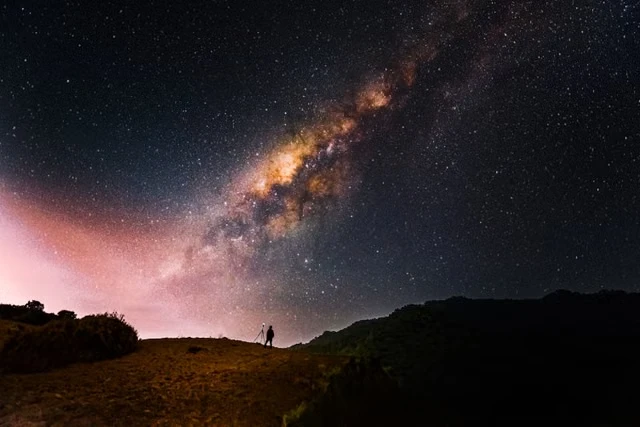
September 2026 presents a celestial theater of rare alignment and seasonal spectacle, offering both seasoned observers and curious newcomers a month of remarkable skywatching opportunities. The Harvest Moon, that luminous herald of autumn, will perform an unusually intimate celestial dance with Saturn, while distant Neptune reaches opposition in a configuration that rewards patient observers with dark skies and optical aid. These events, cataloged in NASA's monthly skywatching guide, transform ordinary evenings into gateways for understanding planetary mechanics and our place within the solar system.
What makes this particular September exceptional is not merely the presence of bright planets but the pedagogical richness embedded in their arrangements. When the full Moon passes near Saturn, observers witness the geometry of orbital planes projected against the ecliptic, a visual lesson in celestial mechanics that no textbook can replicate. Similarly, Neptune's opposition—the moment when Earth passes directly between the Sun and the ice giant—demonstrates the elegant clockwork of heliocentric motion while challenging observers to push their equipment to its limits. These are not passive viewing sessions but active engagements with the fundamental physics governing our cosmic neighborhood.
For the uninitiated, skywatching represents the most democratic form of scientific inquiry, requiring nothing more than curiosity and a clear horizon. Yet beneath this accessibility lies a sophisticated framework of orbital periods, light travel times, and atmospheric optics that rewards deeper investigation. This guide dissects the September 2026 sky region by region, translating NASA's observational data into practical viewing strategies while illuminating the astronomical principles that make each event significant.
On This Page
- The Harvest Moon's Celestial Conjunction with Saturn
- Neptune at Opposition: Observing the Distant Ice Giant
- Planetary Lineup: Venus, Jupiter, and Mars in the Morning Sky
- Regional Viewing Guides: Northern Hemisphere Highlights
- Southern Hemisphere Skywatching: September 2026 Opportunities
- Essential Equipment and Preparation for September Skywatching
- Photographing the September Sky: Techniques and Challenges
The Harvest Moon's Celestial Conjunction with Saturn
September's full Moon, traditionally designated the Harvest Moon for its proximity to the autumnal equinox, rises with unusual promptness around sunset, providing extended evening illumination historically vital for farmers gathering crops. In 2026, this familiar lunar beacon acquires extraordinary significance as it sweeps past Saturn, creating a conjunction visible across most of the Northern Hemisphere. The apparent closeness of these two bodies, however, masks an immense physical separation measured in astronomical units.
Understanding this conjunction requires appreciating the geometry of lunar and planetary orbits projected onto our sky. The Moon orbits Earth at an average distance of approximately 384,400 kilometers, while Saturn resides roughly 1.3 billion kilometers distant during this period. Their apparent proximity results purely from line-of-sight alignment, a perspective effect that astronomers exploit to teach concepts of angular separation and parallax.
Optimal Viewing Windows and Magnification Strategies
The finest views of the Harvest Moon and Saturn pairing occur during the hours immediately following moonrise, when the lunar disk sits low on the horizon and atmospheric refraction imparts a warm, golden hue. Observers should locate an eastern horizon unobstructed by trees or structures, ideally at an elevation providing a clear view of the sky's lower ten degrees. Binoculars of 7x50 or 10x50 specification reveal Saturn's rings as an elongated oval, while small telescopes at 60x magnification begin resolving the ring system's structure.
Timing proves critical, as the Moon's rapid eastward orbital motion—approximately 13 degrees per day—carries it past Saturn within a single evening. The closest apparent approach occurs roughly two hours after sunset for observers at mid-northern latitudes, with the pair separated by less than two lunar diameters. This proximity creates stunning wide-field photographic opportunities, particularly when foreground landscape elements frame the scene.
For astrophotographers, the conjunction offers a rare chance to capture two vastly different celestial bodies in a single frame. The Moon's bright surface, reflecting approximately 12 percent of incident sunlight, requires short exposures, while Saturn's dimmer glow demands longer integration times. Modern smartphone cameras equipped with night modes can surprisingly capture the pairing, though dedicated astronomy cameras produce superior results.
Atmospheric stability, or seeing, dramatically affects the quality of planetary observation during this period. September evenings often experience turbulent air as summer heat dissipates, causing stars to twinkle and planetary details to shimmer. Observers should monitor weather forecasts for high-pressure systems, which typically deliver calmer air and steadier telescopic images.
Saturn's rings, currently tilted approximately 12 degrees toward Earth, present their northern face in a configuration that highlights the Cassini Division—a 4,800-kilometer gap separating the A and B rings. Even modest telescopes of 90mm aperture can resolve this feature under good seeing conditions, offering a tangible connection to the spacecraft imagery popularized by the Cassini mission.
The Astronomical Significance of Harvest Moon Timing
The Harvest Moon's defining characteristic—rising soon after sunset for several consecutive evenings—stems from the Moon's orbital geometry relative to the ecliptic during September. Near the autumnal equinox, the Moon's orbital path makes a shallow angle with the eastern horizon, reducing the daily delay in moonrise to approximately 25 minutes rather than the average 50 minutes. This compression creates the illusion of several consecutive full moons rising at nearly the same time.
This phenomenon carries profound cultural and agricultural significance, having guided harvest schedules across civilizations for millennia. The Algonquin peoples named this lunation the Harvest Moon, a designation later adopted by European settlers and formalized in the Old Farmer's Almanac. Modern skywatchers inherit this tradition, connecting contemporary observation with centuries of human celestial tracking.
Mathematically, the moonrise delay varies with observer latitude and the Moon's declination, which during September 2026 reaches approximately -5 degrees at full phase. The relationship between these parameters determines the precise timing of successive moonrises, a calculation astronomers perform using the lunar ephemeris. For observers at 40 degrees north latitude, the delay compresses to roughly 22 minutes during the Harvest Moon period.
The Harvest Moon's low trajectory across the sky also enhances its perceived color and size, phenomena rooted in atmospheric optics rather than physical changes. When the Moon sits near the horizon, its light traverses a thicker atmospheric column, scattering shorter wavelengths and transmitting longer red and orange wavelengths preferentially. This same atmospheric path magnifies the lunar disk through refraction, creating the famous "Moon illusion" that makes horizon moons appear larger than their zenith counterparts.
Photographers seeking the classic oversized Harvest Moon should employ telephoto lenses of 300mm or greater, which compress perspective and exaggerate the Moon's apparent size relative to foreground objects. Combining this technique with the Saturn conjunction produces composite images of exceptional beauty, though careful planning of location and timing remains essential for success.
Neptune at Opposition: Observing the Distant Ice Giant
September 2026 brings Neptune to opposition, the moment when Earth passes directly between the Sun and the eighth planet, placing Neptune at its closest approach to our world for the year. During this configuration, Neptune shines at magnitude 7.8, technically visible through binoculars yet requiring dark skies and precise star charts for positive identification. The ice giant's slow orbital motion—taking 165 Earth years to complete one solar circuit—means it remains within the constellation Pisces throughout the observing season.
Opposition geometry fundamentally alters the observational experience of outer planets. At opposition, a planet rises at sunset, culminates near midnight, and sets at sunrise, providing maximum visibility throughout the night. More significantly, Earth's position between the Sun and planet minimizes the Earth-planet distance, yielding the largest apparent disk and greatest brightness of the year. For Neptune, whose angular diameter never exceeds 2.4 arcseconds, this enhancement remains subtle yet measurable.
Locating Neptune with Star-Hopping Techniques
Finding Neptune demands systematic star-hopping, a technique that builds confidence in celestial navigation while revealing the sky's deeper structure. Begin by locating the Great Square of Pegasus, an asterism visible high in the eastern sky during September evenings. From the square's northeastern corner, trace a line southeastward through the constellation Pisces, where Neptune currently resides near the magnitude 4.8 star 20 Piscium.
Observers should prepare detailed finder charts showing stars down to magnitude 9, available from astronomical software or printed resources. Neptune's blue-gray color, distinctly different from surrounding stellar hues, provides a valuable identification clue once a candidate object appears in the eyepiece. At 150x magnification, the planet reveals a tiny disk rather than the point-like appearance of stars, confirming the observation.
For urban observers limited by light pollution, Neptune presents a formidable challenge requiring exceptional conditions. Magnitude 7.8 objects demand skies darker than approximately magnitude 5.5 naked-eye limiting magnitude, conditions found in suburban or rural locations. Light pollution filters, while helpful for extended objects, provide minimal benefit for planetary observation and cannot compensate for severely degraded skies.
Binocular observers can attempt Neptune detection using 15x70 or 20x80 instruments mounted on stable tripods, which gather sufficient light to reveal the planet as a faint stellar point. The key distinction lies in Neptune's steady, non-twinkling appearance compared to surrounding stars, a consequence of its finite angular size. This subtle difference rewards patient observers who compare candidate objects carefully.
Astrophotography offers the most definitive Neptune observation, with even modest telescopes capturing the planet's distinctive coloration. Long-exposure images reveal Neptune's atmosphere, including its prominent dark storm systems and the bright methane cloud bands that circle the planet. Stacking multiple short exposures through software dramatically improves signal-to-noise ratios, revealing details invisible to visual observation.
The Physics of Opposition Brightness Enhancement
The brightness increase at opposition follows from the inverse-square law governing light propagation, which states that illumination decreases with the square of distance from the source. When Earth-Neptune distance shrinks from its maximum of approximately 4.7 billion kilometers to its minimum of roughly 4.3 billion kilometers, the received flux increases by the square of the distance ratio. This calculation yields approximately a 20 percent brightness enhancement at opposition compared to conjunction.
For Neptune, an additional phenomenon—opposition surge—amplifies this effect beyond simple distance considerations. When the Sun, Earth, and Neptune align nearly perfectly, the planet's atmosphere backscatters sunlight preferentially toward Earth, a coherent backscattering effect that increases brightness by several tenths of a magnitude. This surge proves most pronounced for airless bodies like asteroids but remains measurable for Neptune's cloud tops.
The mathematical relationship governing planetary brightness follows the magnitude system, where each magnitude step represents a brightness ratio of approximately 2.512. Neptune's opposition magnitude of 7.8 compares to Uranus at magnitude 5.7, a difference of 2.1 magnitudes corresponding to a brightness ratio of approximately 6.9. This comparison helps observers calibrate expectations when transitioning between the two ice giants.
Calculating the expected brightness enhancement from opposition geometry requires applying the inverse-square law to the changing Earth-Neptune distance. If the mean opposition distance is ##[4.3 \times 10^9 \text{ km}]## and the mean conjunction distance is ##[4.7 \times 10^9 \text{ km}]##, the flux ratio becomes:
This 19.5 percent flux increase translates to a magnitude change of approximately 0.19, a subtle yet detectable shift for photometric instruments. Visual observers perceive this difference as a marginal brightening, while astrophotographers capturing calibrated images can measure the enhancement precisely. Such measurements provide tangible confirmation of orbital mechanics operating on cosmic scales.
Planetary Lineup: Venus, Jupiter, and Mars in the Morning Sky
September 2026 delivers a spectacular morning planetary gathering as Venus, Jupiter, and Mars cluster within a relatively compact region of the pre-dawn sky. Venus, blazing at magnitude -4.2, serves as the anchor of this configuration, its brilliance unmistakable even as dawn brightens the eastern horizon. Jupiter follows at magnitude -2.1, while Mars contributes a distinctly reddish hue at magnitude 0.8, creating a tricolor display spanning roughly 20 degrees of sky.
This planetary alignment results from the orbital positions of these worlds relative to Earth, with each planet's apparent motion governed by its orbital period and distance from the Sun. Venus completes its solar orbit in 225 days, Jupiter in 11.86 years, and Mars in 687 days, creating a complex choreography that occasionally brings them into apparent proximity. September 2026 presents one such favorable configuration, offering observers a comparative study in planetary characteristics.
Comparative Planetology Through Binocular Observation
Morning skywatching sessions reward observers with the opportunity to compare planetary appearances directly, revealing fundamental differences in atmospheric composition and surface features. Venus presents a brilliant, featureless disk through binoculars, its thick carbon dioxide atmosphere and sulfuric acid clouds reflecting approximately 70 percent of incident sunlight. This high albedo explains Venus's exceptional brightness despite its relatively small angular size of approximately 15 arcseconds.
Jupiter, by contrast, reveals its dynamic atmosphere even through modest binoculars, with the Galilean moons—Io, Europa, Ganymede, and Callisto—appearing as tiny points of light flanking the planet. These moons, discovered by Galileo in 1610, orbit Jupiter with periods ranging from 1.77 days for Io to 16.69 days for Callisto, providing a dynamic display that changes noticeably within a single observing session. Tracking their positions across successive mornings demonstrates Kepler's laws in real time.
Mars presents the most challenging observation of the trio, its small angular diameter of approximately 6 arcseconds revealing little surface detail through binoculars. However, its distinctive orange-red coloration, caused by iron oxide dust covering its surface, makes identification unambiguous. Observers with telescopes of 100mm aperture or larger may glimpse the planet's polar ice caps or dark surface features during moments of steady seeing.
The angular separation between these planets changes daily as their orbital motions carry them along their respective paths. Venus, moving fastest due to its proximity to the Sun, shifts noticeably eastward each morning, while Jupiter and Mars move more slowly. This differential motion creates evolving configurations that reward regular observation throughout September.
Photographing the morning planetary lineup presents unique challenges, requiring careful planning to capture all three planets before dawn brightens the sky. Wide-field lenses of 24-50mm focal length frame the entire configuration, while longer telephoto lenses isolate individual planets. Successful images typically require exposures of 1-4 seconds at moderate ISO settings, with the exact parameters depending on ambient light conditions.
Calculating Planetary Elongations and Visibility Windows
Understanding when and where to observe morning planets requires calculating their elongations—the angular distance from the Sun as seen from Earth. Venus reaches its greatest western elongation of approximately 46 degrees on September 15, 2026, placing it highest above the eastern horizon before sunrise. This geometry maximizes Venus's visibility window, with the planet rising approximately three hours before the Sun at mid-northern latitudes.
The visibility window for each planet depends on its elongation and the observer's latitude, with the relationship expressed through the equation for the altitude of a celestial object at sunrise. For an object at elongation ##[\delta]## from the Sun, the maximum altitude ##[h_{\text{max}}]## at sunrise depends on the ecliptic's angle to the horizon, which varies seasonally. September mornings at 40 degrees north latitude provide favorable geometry, with the ecliptic rising steeply from the eastern horizon.
Calculating the precise rising time for each planet requires solving the spherical astronomy problem relating right ascension, declination, and observer latitude. The hour angle ##[H]## at which a celestial object crosses the horizon satisfies:
where ##[\phi]## represents observer latitude and ##[\delta]## the object's declination. For Venus at declination approximately +10 degrees during September 2026, an observer at 40 degrees north latitude calculates ##[\cos H = -\tan 40^\circ \tan 10^\circ \approx -0.148]##, yielding ##[H \approx 98.5^\circ]## or approximately 6.57 hours before meridian transit. This calculation determines when Venus clears the eastern horizon relative to local midnight.
Practical skywatching rarely requires such precise calculations, as planetarium software and smartphone applications compute these values automatically. However, understanding the underlying geometry enhances appreciation for why planets appear where they do and when they become visible. This knowledge transforms casual observation into informed skywatching, connecting visual experience with orbital mechanics.
We Also Published
Regional Viewing Guides: Northern Hemisphere Highlights
Observers across the Northern Hemisphere enjoy distinct advantages during September 2026, with the Harvest Moon and Saturn conjunction visible from virtually all latitudes north of the equator. The autumnal equinox on September 22 brings approximately equal day and night lengths, with darkness falling early enough for convenient evening observing sessions. This seasonal transition also brings cooler, drier air that typically improves atmospheric transparency and seeing conditions.
High-latitude observers above 50 degrees north face the challenge of extended twilight during early September, which delays the onset of fully dark skies until approximately 9:30 PM local time. However, these same latitudes benefit from the Harvest Moon's shallow rising angle, which prolongs the period of nearly full moonlight for several consecutive evenings. This trade-off between twilight duration and lunar spectacle characterizes high-latitude September observing.
North American Observing Strategies
North American observers spanning from Alaska to Florida experience significant variation in observing conditions, with latitude determining both the duration of darkness and the altitude of celestial objects. Observers in the continental United States between 25 and 49 degrees north latitude enjoy optimal conditions, with the Harvest Moon reaching respectable altitudes within two hours of moonrise. The Saturn conjunction remains well-placed for evening viewing throughout the continent.
Eastern North America benefits from earlier sunset times, allowing the Harvest Moon conjunction to be observed at reasonable evening hours. Observers in the Eastern Time Zone should target approximately 8:00 PM EDT on September 26 for the closest lunar-Saturn approach, when the pair sits roughly 15 degrees above the eastern horizon. Central and Mountain time zones experience the conjunction slightly higher in the sky, improving atmospheric clarity.
Western North America, particularly the Pacific coast, enjoys the advantage of later sunset combined with generally drier air masses that enhance transparency. California's coastal ranges and the desert Southwest offer exceptional observing conditions, with many locations experiencing fewer than 20 percent cloud cover during September evenings. These regions attract serious amateur astronomers seeking optimal conditions for planetary observation.
Canadian observers face the challenge of higher latitudes, where September twilight persists longer and the Harvest Moon's shallow rising angle delays optimal viewing. However, northern locations benefit from the Moon's extended presence above the horizon, with the full Moon remaining visible for longer periods than at southern latitudes. This extended visibility compensates for the delayed onset of full darkness.
Mexican and Central American observers enjoy tropical conditions with minimal seasonal variation in day length, providing consistent observing windows throughout the year. The Harvest Moon rises at a steeper angle near the equator, reducing the multi-night phenomenon that characterizes higher latitudes. However, the Saturn conjunction remains well-placed, with both objects reaching favorable altitudes during evening hours.
European and Asian Observing Perspectives
European observers across the continent share similar latitude ranges with North America, experiencing comparable observing conditions for the September sky events. Western Europe's maritime climate introduces greater cloud cover variability, with observers advised to monitor satellite imagery for clear windows. Southern Europe, particularly Spain, Italy, and Greece, offers more reliable conditions with lower average cloud cover during September.
Eastern European and Russian observers at higher latitudes experience extended twilight during early September, delaying dark sky conditions until later evening hours. However, these regions benefit from the Harvest Moon's pronounced shallow rising angle, creating an extended period of bright moonlight that persists for nearly a week. This phenomenon, more dramatic at higher latitudes, rewards patient observers with exceptional lunar viewing.
Asian observers from the Middle East through India, China, and Japan experience varying conditions based on latitude and monsoon patterns. The Indian subcontinent's monsoon season typically concludes by early September, bringing clearing skies and excellent transparency. East Asian observers in Japan and coastal China benefit from relatively stable autumn weather, though typhoon activity can disrupt observing plans during early September.
Southeast Asian observers near the equator experience minimal seasonal variation, with the Harvest Moon rising at a steep angle that limits the multi-night phenomenon. However, these latitudes offer consistent 12-hour nights throughout the year, providing reliable observing windows for the morning planetary lineup. The Saturn conjunction remains visible, though at lower altitudes than at higher latitudes.
Observing strategies must adapt to local conditions, with latitude, climate, and light pollution all influencing the optimal approach. Successful skywatchers maintain flexibility, monitoring weather forecasts and adjusting observation times based on local conditions. This adaptability transforms skywatching from a passive activity into an engaged practice requiring ongoing attention to environmental factors.
Southern Hemisphere Skywatching: September 2026 Opportunities
Southern Hemisphere observers experience September as the beginning of spring, with lengthening days and improving weather conditions that enhance skywatching opportunities. The Harvest Moon, while still full on September 26, rises at a steeper angle than in northern latitudes, reducing the extended moonrise phenomenon that characterizes northern autumn. However, southern observers gain access to celestial sights invisible from northern latitudes, including the Magellanic Clouds and the rich star fields of the Milky Way's core.
The morning planetary lineup of Venus, Jupiter, and Mars appears in the southeastern sky for southern observers, with the planets climbing to respectable altitudes before dawn. The ecliptic's angle to the eastern horizon during September favors southern latitudes, placing the morning planets higher above the horizon than they appear from equivalent northern latitudes. This geometry enhances observing conditions for the planetary gathering.
Unique Southern Celestial Features
Southern Hemisphere observers enjoy access to the Large and Small Magellanic Clouds, dwarf satellite galaxies of the Milky Way visible to the naked eye under dark skies. These irregular galaxies, located approximately 160,000 and 200,000 light-years distant respectively, appear as faint cloudy patches in the southern constellation Dorado and Tucana. Binoculars reveal their intricate structure, including star-forming regions and globular clusters.
The Southern Cross, or Crux, serves as the southern sky's most recognizable asterism, its four bright stars pointing toward the south celestial pole. Unlike northern observers who lack a bright pole star, southern skywatchers locate south using the Southern Cross and the two bright pointers Alpha and Beta Centauri. This celestial navigation technique has guided southern hemisphere travelers for centuries.
September evenings in the southern hemisphere showcase the Milky Way's brightest region, with the galactic center lying near the constellation Sagittarius, visible high in the sky during early evening hours. This dense star field contains numerous open clusters, nebulae, and the supermassive black hole at our galaxy's center. Dark-sky locations reveal the Milky Way's structure with extraordinary clarity.
Saturn's rings present a different orientation for southern observers, with the planet's northern face tilted toward Earth but appearing upside-down relative to northern views. This perspective difference, while purely psychological, affects how observers interpret telescopic images. Southern observers also enjoy Saturn at higher altitudes than their northern counterparts, improving atmospheric stability and image quality.
Neptune's opposition in Pisces places the planet at moderate altitudes for southern observers, with the constellation rising in the east during evening hours. While not as favorably placed as for northern observers, Neptune remains observable throughout the night from most southern latitudes. Dark-sky locations in Australia, New Zealand, and southern Africa provide excellent conditions for this challenging observation.
Equatorial Observing: The Best of Both Hemispheres
Observers near the equator enjoy access to celestial objects from both hemispheres, with the celestial equator passing overhead and both celestial poles visible on the horizon. This unique geometry allows equatorial observers to view the Harvest Moon, Saturn, and Neptune at favorable altitudes while also accessing southern hemisphere treasures like the Magellanic Clouds. The trade-off involves minimal seasonal variation, with day length remaining near 12 hours throughout the year.
Equatorial locations in South America, Africa, and Southeast Asia experience two rainy seasons annually, with September typically falling between wet periods in many regions. The Andes mountains of Ecuador and Colombia offer exceptional high-altitude observing sites, with thin atmosphere and minimal light pollution. Similarly, East African locations like Kenya and Tanzania provide dark skies with excellent transparency.
The morning planetary lineup appears nearly overhead for equatorial observers, with Venus, Jupiter, and Mars reaching altitudes exceeding 60 degrees before dawn. This favorable geometry minimizes atmospheric extinction and turbulence, providing exceptional observing conditions. The planets' proximity to the zenith also reduces the air mass through which their light must travel, enhancing brightness and clarity.
Equatorial observers experience the Harvest Moon phenomenon differently, with the full Moon rising at a steep angle that minimizes the extended moonrise effect. However, the Moon reaches higher altitudes than at temperate latitudes, providing excellent observing conditions throughout the night. The Saturn conjunction remains well-placed, with both objects visible for extended periods.
For observers seeking the ultimate dark-sky experience, remote equatorial locations in the high Andes or East African savannas offer conditions rivaling professional observatory sites. These locations combine high altitude, dry air, and minimal artificial light to create exceptional transparency. Amateur astronomers willing to travel to such sites are rewarded with views of the cosmos rarely experienced by urban observers.
Essential Equipment and Preparation for September Skywatching
Successful skywatching requires appropriate equipment matched to observing goals, with options ranging from the naked eye to sophisticated computerized telescopes. Beginning observers should master naked-eye observation first, learning constellations and tracking planetary motions before investing in optical equipment. This foundational approach builds celestial literacy that enhances all subsequent observation.
Binoculars represent the most versatile first optical instrument, offering wide fields of view that facilitate locating objects while providing magnification sufficient for lunar craters, Jupiter's moons, and the Pleiades cluster. Quality 7x50 or 10x50 binoculars balance light gathering with portability, making them ideal for casual skywatching sessions. Their wide field of view proves particularly valuable for observing the Harvest Moon and Saturn conjunction.
Telescope Selection and Setup for Planetary Observation
Telescope selection depends on observing priorities, with different designs optimized for various celestial targets. Refracting telescopes using lenses offer crisp planetary views with minimal maintenance, while reflecting telescopes using mirrors provide larger apertures per dollar for deep-sky observation. Compound telescopes combining lenses and mirrors offer portability with good performance, making them popular choices for serious amateurs.
Aperture—the diameter of the primary light-gathering element—determines a telescope's resolving power and light collection capability. Larger apertures reveal finer planetary detail and fainter objects, with 150mm instruments representing a practical threshold for serious planetary observation. However, larger telescopes require more substantial mounts and increased setup time, factors that influence observing frequency and convenience.
Mount stability proves critical for planetary observation, as vibrations at high magnification render images unusable. Equatorial mounts that track celestial motion provide advantages for long-duration observation, while altazimuth mounts offer simpler setup for casual viewing. Computerized GoTo mounts automatically locate celestial objects, reducing the learning curve for beginners while enabling efficient multi-target sessions.
Eyepiece selection dramatically affects observing experience, with different focal lengths providing varying magnifications. A general rule suggests using eyepieces providing magnifications between 50x and 200x for planetary observation, with the optimal magnification depending on aperture and atmospheric conditions. Zoom eyepieces offering variable magnification provide flexibility for observers seeking to adapt to changing conditions.
Preparation extends beyond equipment to include clothing, seating, and accessories that enhance comfort during extended observing sessions. Warm layers prove essential for autumn evenings, while red-filtered flashlights preserve night vision without disrupting dark adaptation. Folding chairs, observing tables, and insulated beverage containers transform skywatching from a brief glance into an extended engagement with the cosmos.
Calculating Magnification and Field of View
Understanding the relationship between telescope focal length, eyepiece focal length, and magnification enables observers to select appropriate equipment combinations. The magnification ##[M]## produced by a telescope-eyepiece combination equals the ratio of telescope focal length ##[f_{\text{tel}}]## to eyepiece focal length ##[f_{\text{ep}}]##:
For a telescope with focal length 1200mm and an eyepiece of 10mm focal length, the magnification equals ##[1200/10 = 120\text{x}]##. This magnification proves suitable for observing Saturn's rings and Neptune's disk, provided atmospheric conditions support such enlargement. Exceeding approximately 50x per inch of aperture typically degrades image quality due to diffraction limitations.
The true field of view ##[TFOV]## visible through an eyepiece depends on the eyepiece's apparent field of view ##[AFOV]## and the magnification:
An eyepiece with 50-degree apparent field at 120x magnification provides a true field of approximately 0.42 degrees, sufficient to frame the Moon's full disk. For the Harvest Moon and Saturn conjunction spanning 1.5 degrees, observers require lower magnification or wider-field eyepieces to capture both objects simultaneously. This calculation guides equipment selection for specific observing goals.
Practical skywatching benefits from maintaining an observing log documenting dates, times, equipment used, and observations made. Such records reveal patterns in planetary positions, lunar phases, and atmospheric conditions that enhance predictive capability. Digital logging applications simplify this process while enabling data sharing with the broader amateur astronomy community.
Photographing the September Sky: Techniques and Challenges
Astrophotography transforms skywatching from passive observation into creative expression, capturing celestial events for sharing and study. September 2026 offers exceptional photographic opportunities, from wide-field images of the Harvest Moon and Saturn conjunction to detailed planetary portraits through telescope-mounted cameras. Success requires understanding the unique challenges of photographing objects ranging from the brilliant Moon to the faint disk of Neptune.
The fundamental challenge in astrophotography involves capturing sufficient light while managing the Earth's rotation, which causes celestial objects to drift across the sky. Short exposures freeze this motion but capture limited light, while long exposures accumulate light but produce star trails unless the camera tracks celestial motion. This exposure-motion trade-off shapes every astrophotography technique.
Wide-Field and Smartphone Astrophotography
Wide-field astrophotography captures the Moon, planets, and constellations within their surrounding context, creating images that convey the sky's grandeur. Modern smartphone cameras with night modes and computational photography capabilities produce surprisingly capable wide-field images, particularly when mounted on tripods to prevent camera shake. The Harvest Moon and Saturn conjunction, spanning 1.5 degrees, fits comfortably within a smartphone's wide-angle field of view.
For smartphone lunar photography, tapping the Moon on the screen to lock focus and exposure prevents the camera from overexposing the bright lunar disk. Reducing exposure compensation by one to two stops reveals surface details that automatic exposure settings wash out. The Saturn conjunction requires balancing the Moon's brightness against the much dimmer planet, a dynamic range challenge that may require HDR techniques.
Dedicated cameras with interchangeable lenses offer greater control and image quality, with focal lengths from 24mm to 200mm suitable for various compositions. Wide-angle lenses capture the Moon with foreground landscape elements, while telephoto lenses isolate the lunar disk and nearby planets. The Moon's apparent size at 200mm focal length measures approximately 3.6mm on a full-frame sensor, requiring longer focal lengths for detailed lunar surface imagery.
Intervalometer shooting, which captures a sequence of images at set intervals, enables time-lapse videos showing the Moon's motion relative to Saturn throughout the evening. This technique requires careful planning of framing to accommodate the Moon's eastward drift of approximately one lunar diameter per hour. Post-processing software combines individual frames into smooth video sequences.
Image stacking, a technique combining multiple short exposures to reduce noise and enhance detail, dramatically improves smartphone and camera astrophotography. Software aligns and averages frames, canceling random noise while preserving consistent signal. This technique proves particularly valuable for capturing the faint glow of Neptune or the subtle details of Saturn's rings.
Telescopic Astrophotography: Planetary Imaging
Planetary astrophotography through telescopes requires different techniques than wide-field imaging, with high magnification and video capture replacing long exposures. The "lucky imaging" technique records hundreds or thousands of short video frames, then selects and stacks the sharpest portions to overcome atmospheric turbulence. This approach produces planetary images rivaling those from space-based observatories.
For Saturn and Neptune imaging, observers attach a planetary camera—typically a monochrome or color CMOS sensor—to the telescope's eyepiece port. The camera's small sensor and high frame rate capture magnified images of the planet's disk, with the telescope serving as the camera's lens. Recording 30-60 seconds of video at 30-60 frames per second provides sufficient frames for stacking.
Software processes the recorded video by aligning frames, selecting the sharpest percentage, and stacking them to produce a single high-quality image. Programs like RegiStax and AutoStakkert automate this process, producing images revealing details invisible during visual observation. Wavelet sharpening algorithms enhance fine structure, bringing out cloud bands on Saturn and subtle features on Neptune.
Color planetary imaging typically employs a color camera capturing RGB data in each frame, simplifying the workflow compared to monochrome imaging with separate filters. However, monochrome cameras with RGB filter wheels produce superior color fidelity and resolution, at the cost of increased complexity and acquisition time. Advanced imagers often capture separate R, G, and B sequences and combine them during post-processing.
Successful planetary imaging requires precise telescope collimation, accurate focusing, and optimal camera settings, with each parameter affecting final image quality. Collimation—aligning the telescope's optical elements—proves critical for reflecting telescopes, while focusing requires careful adjustment to achieve the sharpest possible image. Camera settings including gain, exposure time, and frame rate must balance signal capture against noise accumulation.
From our network :
- 10 Physics Numerical Problems with Solutions for IIT JEEPrepare for IIT JEE with 10 physics numerical problems, complete with detailed solutions and conceptual explanations. Ideal for mastering kinematics, thermodynamics, electromagnetism, and optics.
- Trump Political Strategy How Geopolitical Stunts Serve As Media Diversions
- Vite 6/7 'Cold Start' Regression in Massive Module GraphsIn-depth analysis of Vite 6/7 cold start regressions in massive module graphs. Learn about barrel file issues, pre-bundling optimizations, and how to improve Vite dev server performance.
- Mastering DB2 12.1 Instance Design: A Technical Deep Dive into Modern Database ArchitectureComprehensive guide to DB2 12.1 Instance Design. Explore architectural components, HADR setup, buffer pool tuning, and security policies for IBM DB2 12.1. Includes 10 functional SQL and Shell samples.
- 98% of Global MBA Programs Now Prefer GRE Over GMAT Focus EditionExplore why 98% of global MBA programs now prefer the GRE over GMAT Focus. Learn about the shorter GRE format, verbal logic importance, and strategic versatility for students.
- Mastering DB2 LUW v12 Tables: A Comprehensive Technical GuideComprehensive guide on DB2 LUW v12 tables. Explore CREATE TABLE syntax, BLU Acceleration, range partitioning, data types, and security features for IBM DB2 LUW v12.
- EV 2.0: The Solid-State Battery Breakthrough and Global Factory ExpansionDiscover the impact of the Solid-State Battery Breakthrough on the EV market. Learn about CATL and BYD stock growth, global factory expansion in Europe, and the future of EV 2.0 technology.
- AI-Powered 'Precision Diagnostic' Replaces Standard GRE Score ReportsDiscover the new GRE Precision Diagnostic. Learn how AI-powered behavioral analytics and time-to-solve tracking are replacing standard GRE score reports to empower students.
- Analyzing Trump Deportation Numbers Insights Into The 2026 Immigration Crackdown
RESOURCES
- Calendar of space events 2026 | The Planetary Societyplanetary.orgJan 1, 2026 ... September · Sept. 22: September equinox. · Sept. 25: Neptune at opposition. · Sometime this month: Juice makes a gravity…
- Most Notable 2026 Astronomical Events: A Year of Watching the Skiesnasa.govJan 16, 2026 ... January 2-3: Quadrantids Meteor Shower · January 3: Supermoon · January 10: Jupiter at Opposition · February 17: Annular Solar…
- What's Up: August 2026 Skywatching Tips from NASA - NASA Sciencescience.nasa.govJul 31, 2026 ... Skywatching Highlights · Aug. 5: Last Quarter Moon · Aug. 12: Total solar eclipse across northern Russia, Greenland, Iceland, northern…
- Space and astronomy highlights 2026 | Royal Observatory Greenwichrmg.co.ukIn 2026 the autumnal equinox will occur on 23 September at 1.06am BST. On this day the Sun will illuminate the northern and southern…
- Astronomy on Tap – Lansing – September 2026astronomyontap.orgAstronomy on Tap – Lansing – September 2026. September 16 @ 7:30 PM - 9:30 PM EDT.
- Great Basin Astronomy Festival - National Park Servicenps.govThe 2026 astronomy festival will be September 10-12. See below for each ... Parking is limited at astronomy events and you will be turned…
- 15 skywatching events you won't want to miss in 2026 - Spacespace.comJan 1, 2026 ... 15 skywatching events you won't want to miss in 2026 · 1. Jupiter at opposition: Jan. · 2. "Blood moon"…
- Upcoming Events | American Astronomical Societyaas.orgYear. 2026 2026; 2027 2027. Inclusion of events & deadlines on the ... Open SkAI 2026: Annual Astronomy & AI Conference at SkAI. Event.…
- Adler Planetarium: Homeadlerplanetarium.orgUpcoming Events. Astronomy Conversations. September 9, 2026 | 6:00 pm. Astronomy Conversations. Doane Observatory. September 9, 2026 | 8:00 pm. Special Event!
- LOOK UP! September 2026 is packed with incredible skywatching ...facebook.com6 days ago ... Which September sky event are you most excited to see? 23 of SeptemberEquinox, I hope to see... الأعتدال الصيفي ،هو…
- Harvest Moon to Aurigid meteor shower, key events you must not missstarlust.org6 days ago ... September 2026 skywatching guide: Harvest Moon to Aurigid meteor shower, key events you must not miss ... Memorable skywatching events…
- What's Up? Get your September 2026 skywatching tips from NASA ...facebook.com4 days ago ... ... SEPTEMBER 2026 2026-SK SKY EVENTS. Patricia Mehlberg Frederick. 1 reaction ·. 1 share. September 2026 celestial events and skywatching…
- Events | Physics & Astronomy - Johns Hopkins Universityphysics-astronomy.jhu.eduSeptember 2026. Tue 8. Science coffee. September 8 @ 10:00 ...
- Stargazing — Texas Parks & Wildlife Departmenttpwd.texas.govSeptember 2026. Sep 5 End Date. Star Party in the Borderlands *Reservations Required*. Big Bend Ranch State Park. *** The event for Saturday September…
- Upcoming Events - Caltech Astronomyastro.caltech.eduThursday-Saturday September 10-12 2026. Great Basin Astronomy Festival @ Great Basin NP. Poster for Dark Sky Festival Credit: Cameron Hummels.

0 Comments