On This Page
Understanding the Sawtooth Wave
Mathematical Foundation
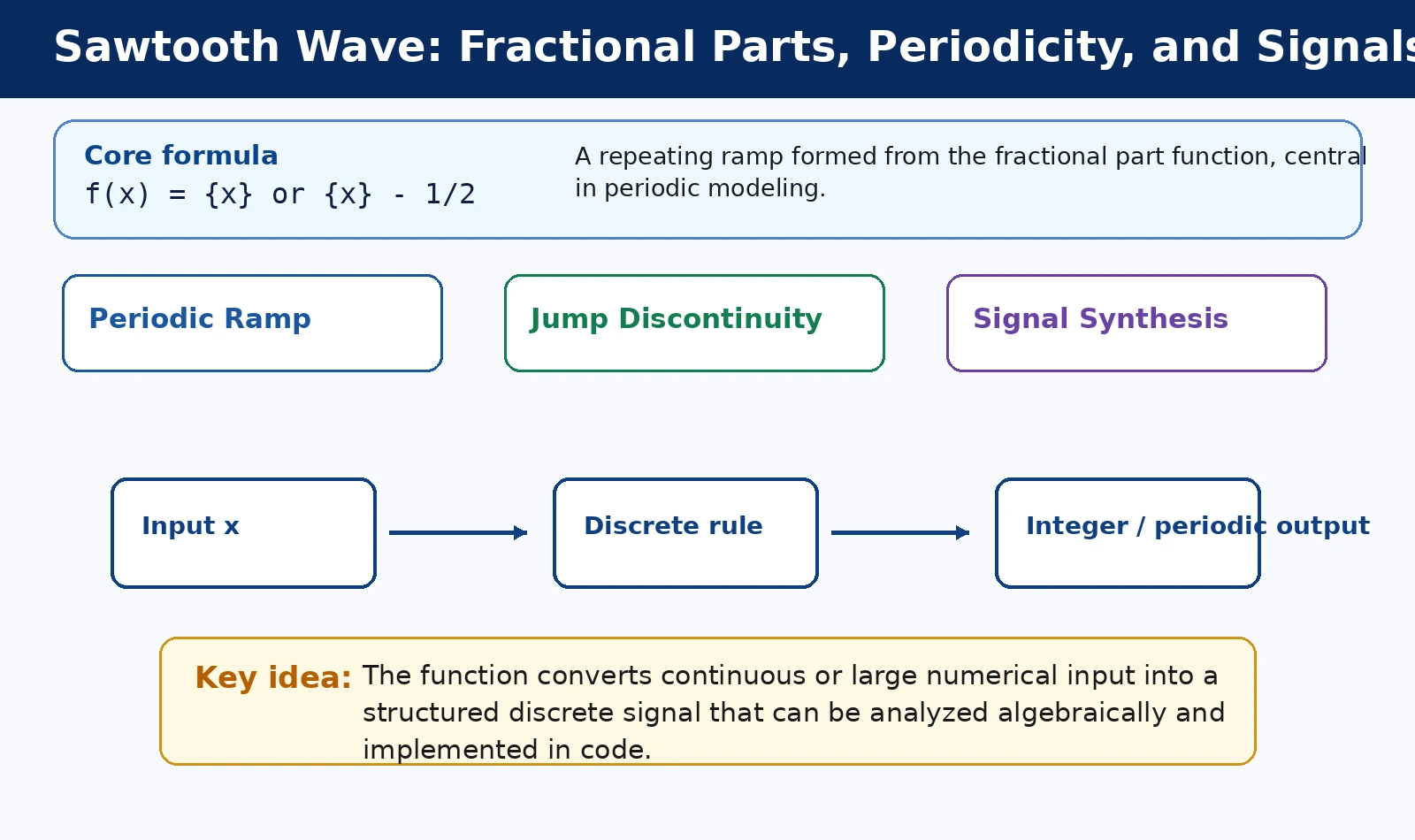
The sawtooth wave is most commonly defined using the floor function to create its characteristic ramp. The expression
provides a periodic signal that oscillates between specific bounds. This formula ensures the wave resets at integer intervals.
By subtracting the floor of x from x, we obtain the fractional part of the variable. This fractional part creates a linear ramp that repeats every unit. The constant subtraction of one-half centers the waveform around the horizontal axis.
In many technical contexts, the simpler form ##f(x) = x - \lfloor x \rfloor## is used instead. This version produces a wave that rises from zero to one. Both forms are mathematically valid depending on the required DC offset of the system.
The slope of the ramp is constant throughout the increasing phase of the cycle. This linearity distinguishes the sawtooth from other periodic functions like sine waves. It represents a steady rate of change over a fixed duration of time.
Mathematically, the function is piecewise linear but remains discontinuous at every integer value. These discontinuities are crucial for the wave's spectral properties. They represent the instantaneous reset from the peak back to the minimum value.
Periodicity and Discontinuity
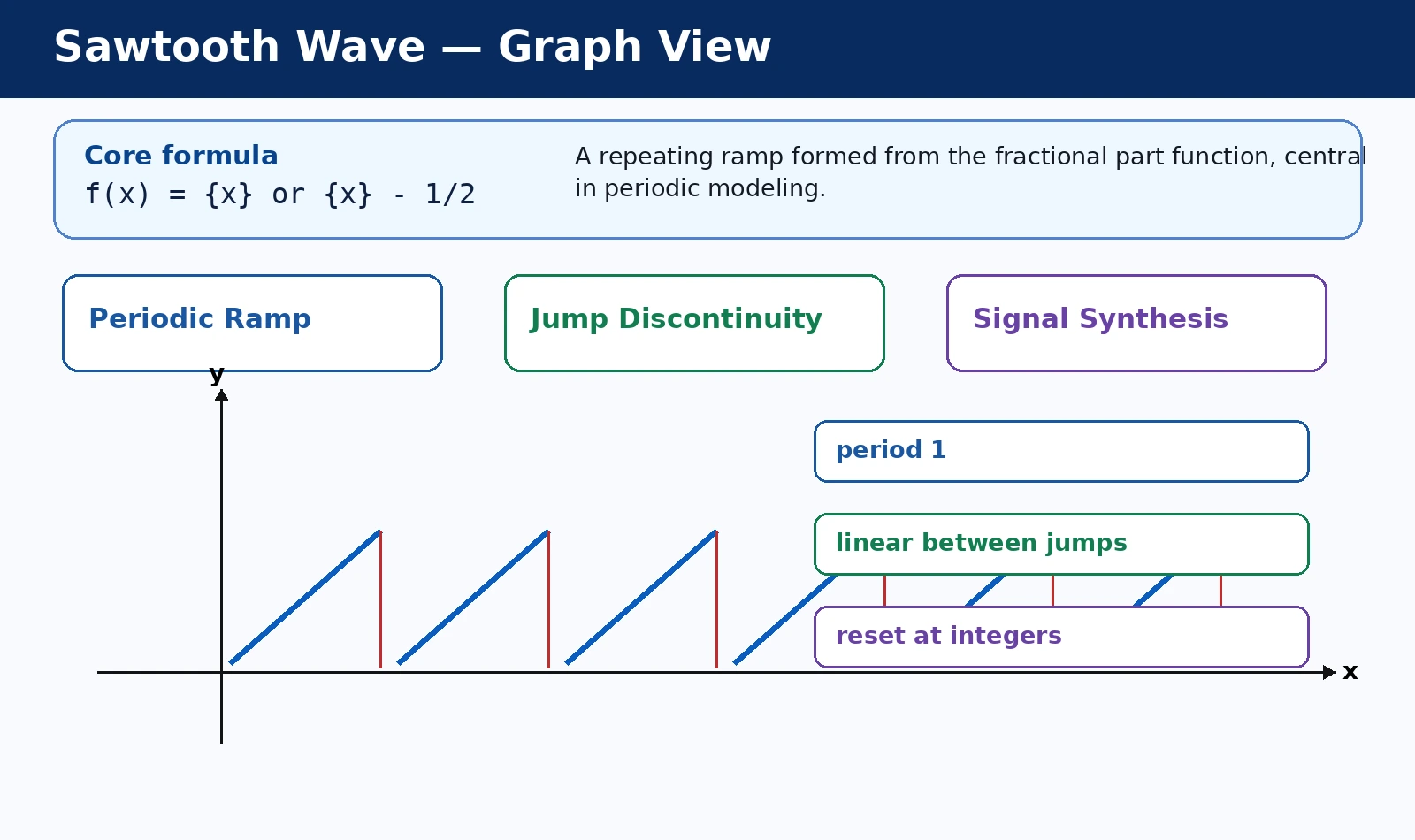
A sawtooth wave is defined by its period, which determines the frequency of the oscillation. In the standard definition, the period is exactly one unit of the input variable. This periodicity allows for consistent repetition in signal generation.
The most striking feature of this waveform is its sharp vertical drop. Unlike the smooth transitions of a sine wave, the sawtooth contains an abrupt change. This jump occurs at the end of each linear ramp cycle.
In real-world physical systems, an instantaneous jump is impossible to achieve perfectly. There is always a finite "flyback" time required for the signal to reset. However, in mathematical theory, the transition is treated as a zero-width discontinuity.
The symmetry of the sawtooth can vary based on its orientation and phase. A "rising" sawtooth increases over time, while a "falling" sawtooth decreases linearly. Both types share the same fundamental periodic and discontinuous mathematical properties.
Understanding these discontinuities is essential for analyzing the wave in the frequency domain. The sharp edges contribute to a rich harmonic content that is not found in smoother waves. This makes the sawtooth a unique tool in electronics.
Generation and Synthesis
Analog Circuitry Methods
Analog generation of sawtooth waves often involves the controlled charging of a capacitor. A constant current source is used to ensure the voltage rises linearly. This linear voltage increase forms the ramp portion of the wave.
To create the reset, a rapid discharge mechanism is required across the capacitor. This is typically achieved using a transistor switch or a comparator circuit. When the voltage reaches a threshold, the switch closes to reset.
Operational amplifiers are frequently employed to maintain high precision in the ramp's slope. By using an integrator configuration, engineers can achieve very high linearity. This is vital for applications requiring accurate timing and synchronization.
The stability of the analog sawtooth depends heavily on component tolerances. Temperature fluctuations can affect the capacitance and current, leading to frequency drift. Precision resistors and capacitors are necessary for high-quality analog signal generators.
Despite the rise of digital technology, analog sawtooth generators remain popular in synthesizers. They provide a unique character and "warmth" due to slight non-linearities. These imperfections are often desirable in creative audio production and sound design.
Digital Signal Processing
In digital systems, sawtooth waves are often generated using phase accumulators. An increment value is added to a register at every clock cycle. The overflow of this register naturally creates a periodic ramp signal.
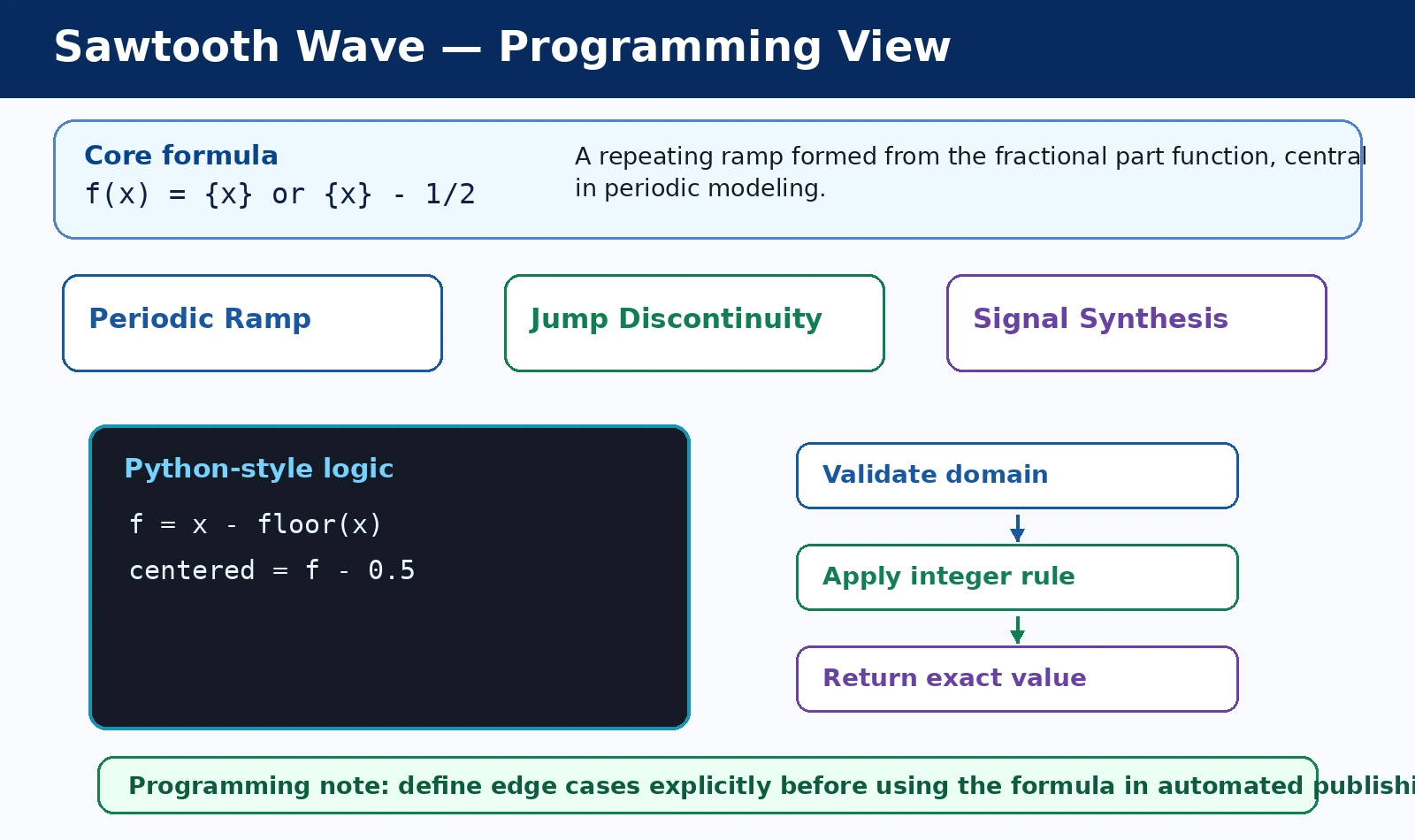
The mathematical definition ##f(x) = x - \text{floor}(x)## is easily implemented in software. Floating-point arithmetic allows for high-precision calculations of the waveform's value. This method ensures that the frequency remains perfectly stable over time.
One major challenge in digital generation is the problem of aliasing. Because the sawtooth has infinite harmonics, a simple digital ramp will fold back. This creates unwanted noise and distortion in the audible frequency range.
To solve aliasing, engineers use band-limited synthesis techniques like BLIT or BLEP. These methods smooth out the discontinuities to fit within the Nyquist limit. This ensures a clean signal that is suitable for high-fidelity audio.
Digital sawtooth waves are the backbone of virtual analog synthesizers and plugins. They offer flexibility that analog hardware cannot easily match, such as instant modulation. Software-defined oscillators can change parameters with microsecond precision during operation.
We Also Published
Applications in Engineering
Audio Synthesis and Timbre
The sawtooth wave is a favorite among sound designers because of its harmonic richness. It contains every integer harmonic, both even and odd, at decreasing amplitudes. This provides a full, bright sound that cuts through mixes.
In subtractive synthesis, the sawtooth serves as the primary raw material. Musicians use resonant filters to carve away specific frequencies from the wave. This process allows for the creation of complex and evolving textures.
The wave is particularly effective for emulating bowed string instruments and brass. The linear ramp mimics the physical "slip-stick" motion of a violin string. This makes it essential for creating realistic orchestral patches in synthesizers.
Modulating the frequency or amplitude of a sawtooth creates vibrant movement. Common techniques include pulse width modulation and frequency modulation using the ramp. These techniques are fundamental to the "super-saw" sounds found in electronic music.
Beyond music, the sawtooth's spectrum is useful for testing audio equipment. Its wide range of harmonics allows technicians to check filter responses. It provides a comprehensive view of how a system handles complex signals.
Scanning and Display Systems
Historically, sawtooth waves were critical for the operation of CRT monitors. They controlled the horizontal and vertical deflection of the electron beam. The linear ramp ensured the beam moved steadily across the screen.
The rapid reset of the sawtooth allowed the beam to "fly back" quickly. This flyback happened during the blanking interval to avoid visible streaks. Without this precise waveform, stable television images would not have been possible.
In modern lidar and radar systems, sawtooth-like signals are used for ranging. Frequency-modulated continuous waves often employ a ramp-up approach for distance calculation. The linearity of the ramp is key to measuring time-of-flight accurately.
Precision timing circuits also rely on the sawtooth's predictable slope. By comparing the ramp voltage to a reference, engineers create pulse-width modulation. This is a standard method for controlling power in modern switching supplies.
Even in modern laser scanning, the sawtooth principle remains highly relevant. It guides mirrors to sweep light across a surface at a constant speed. This ensures uniform exposure and high-resolution data acquisition in various sensors.
Mathematical Properties
Fourier Series Representation
The Fourier series of a sawtooth wave reveals its complex internal structure. It is expressed as a sum of infinite sine waves with specific amplitudes. The series shows that the wave contains all integer harmonics of the base.
Mathematically, the amplitudes of the harmonics decrease according to the ratio ##1/n##. This means the second harmonic is half as loud as the first. This specific decay rate defines the characteristic "buzz" of the sawtooth.
The Fourier expansion is typically written as
. This formula demonstrates the relationship between time and frequency. It highlights how the sharp edges are formed by high frequencies.
At the points of discontinuity, the Fourier series exhibits the Gibbs phenomenon. This results in a slight "ringing" or overshoot at the vertical edges. In mathematical theory, this overshoot persists even as more terms are added.
Analyzing the Fourier series is essential for understanding signal bandwidth. It tells engineers how many harmonics must be preserved to maintain signal integrity. This knowledge is applied daily in telecommunications and data compression.
Power Spectrum and Harmonics
The power spectrum of a sawtooth wave shows how energy is distributed. Most of the energy is concentrated in the fundamental frequency and lower harmonics. However, the infinite tail of harmonics requires significant bandwidth for transmission.
Compared to a square wave, the sawtooth has a denser harmonic profile. While square waves only contain odd harmonics, sawtooth waves include even ones. This results in a more complex and "nasal" sonic character.
Filtering a sawtooth wave significantly alters its power distribution and shape. A low-pass filter will remove high-frequency harmonics, making it look more like a sine wave. This relationship is fundamental to the study of linear systems.
In practical electronics, the signal-to-noise ratio must be carefully managed. The high-frequency content of the sawtooth can interfere with other sensitive components. Proper shielding and PCB layout are required to contain these wideband signals.
Ultimately, the sawtooth wave represents a perfect balance of simplicity and complexity. Its simple mathematical definition leads to a rich set of physical behaviors. It remains one of the most studied and utilized waveforms in science.
From our network :
- 10 Physics Numerical Problems with Solutions for IIT JEEPrepare for IIT JEE with 10 physics numerical problems, complete with detailed solutions and conceptual explanations. Ideal for mastering kinematics, thermodynamics, electromagnetism, and optics.
- Mastering DB2 12.1 Instance Design: A Technical Deep Dive into Modern Database ArchitectureComprehensive guide to DB2 12.1 Instance Design. Explore architectural components, HADR setup, buffer pool tuning, and security policies for IBM DB2 12.1. Includes 10 functional SQL and Shell samples.
- Mastering DB2 LUW v12 Tables: A Comprehensive Technical GuideComprehensive guide on DB2 LUW v12 tables. Explore CREATE TABLE syntax, BLU Acceleration, range partitioning, data types, and security features for IBM DB2 LUW v12.
- Vite 6/7 'Cold Start' Regression in Massive Module GraphsIn-depth analysis of Vite 6/7 cold start regressions in massive module graphs. Learn about barrel file issues, pre-bundling optimizations, and how to improve Vite dev server performance.
- EV 2.0: The Solid-State Battery Breakthrough and Global Factory ExpansionDiscover the impact of the Solid-State Battery Breakthrough on the EV market. Learn about CATL and BYD stock growth, global factory expansion in Europe, and the future of EV 2.0 technology.
- 98% of Global MBA Programs Now Prefer GRE Over GMAT Focus EditionExplore why 98% of global MBA programs now prefer the GRE over GMAT Focus. Learn about the shorter GRE format, verbal logic importance, and strategic versatility for students.
- AI-Powered 'Precision Diagnostic' Replaces Standard GRE Score ReportsDiscover the new GRE Precision Diagnostic. Learn how AI-powered behavioral analytics and time-to-solve tracking are replacing standard GRE score reports to empower students.
- Trump Political Strategy How Geopolitical Stunts Serve As Media Diversions
- Analyzing Trump Deportation Numbers Insights Into The 2026 Immigration Crackdown
RESOURCES
- Sawtooth wave - Wikipedia
- Sawtooth or triangle wave - MATLAB - MathWorks
- Triangle wave - Wikipedia
- Equation (mathematical function) of ramp signal vs saw tooth signal
- Sawtooth Wave -- from Wolfram MathWorld
- What makes oscillators “good”? : r/synthesizers - Reddit
- Driving Servo Sinusoidally - Arduino Forum
- Is there such a thing as a sawtooth transform? : r/math - Reddit
- Sawtooth Function (Wave) - Statistics How To
- sawtooth wave - Wiktionary, the free dictionary
- Types of Waves
- Do different synthesizers have different timbres and/or produce ...
- Efficiently generate a sawtooth with rounded peaks.
- Digital Anti Aliasing Filter For Waveform Band Limiting
- Ways to generate triangle wave function. - Math Stack Exchange


0 Comments