On This Page
Defining the Reciprocal-of-Fractional-Part Function
Mathematical Foundation and Notation
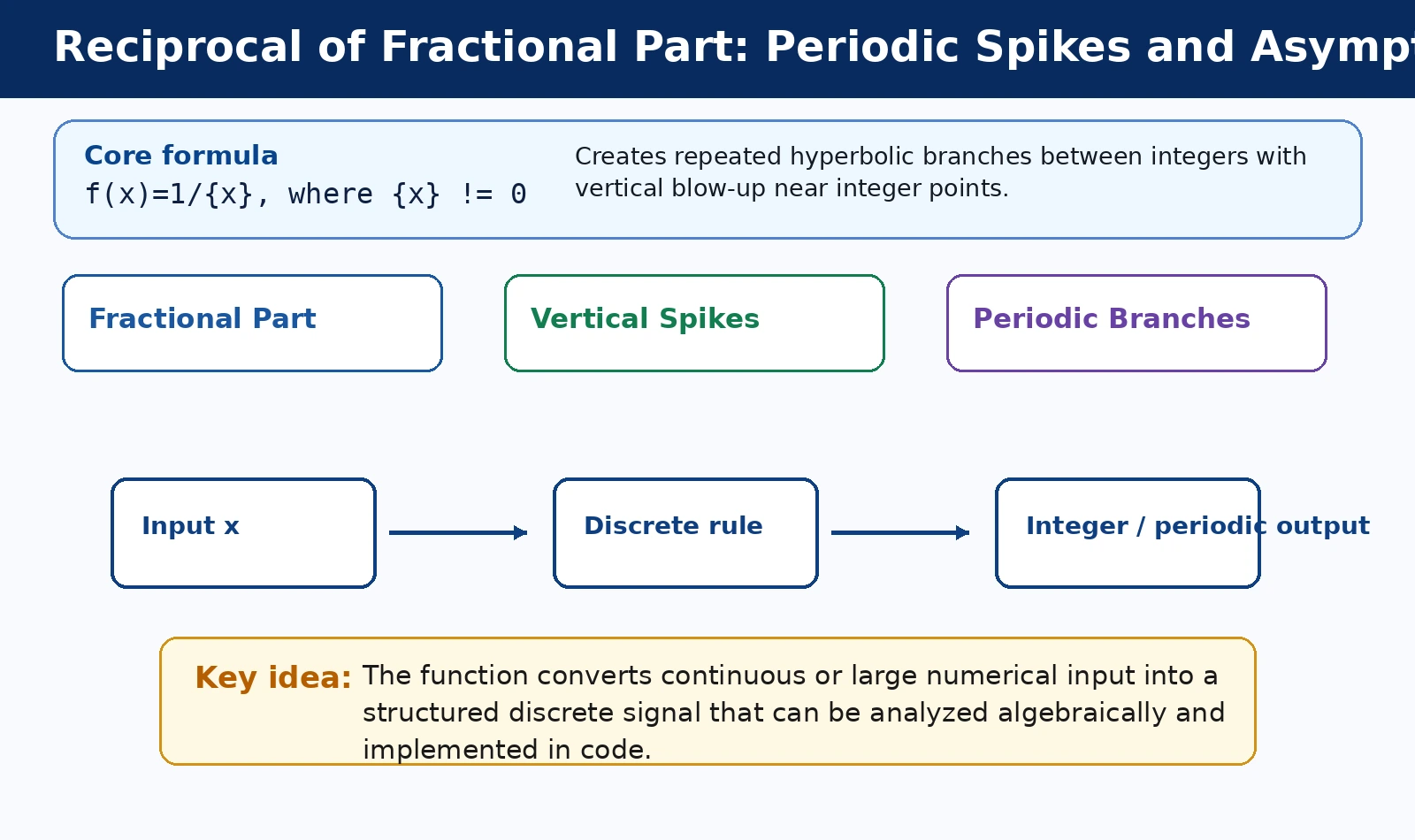
The reciprocal-of-fractional-part function is primarily defined using the fractional part operator. This operator, denoted as ##\{x\}##, represents the difference between a real number and its floor. Specifically, the relationship is expressed as ##\{x\} = x - \lfloor x \rfloor##.
When we take the reciprocal of this value, we generate the function ##f(x) = 1 / \{x\}##. This transformation significantly alters the behavior of the standard saw-tooth fractional part. The resulting values are always greater than or equal to one.
The function is inherently sensitive to the proximity of ##x## to any integer value. Because ##\{x\}## approaches zero as ##x## approaches an integer from the right, the reciprocal grows without bound. This creates a series of dramatic vertical spikes.
In technical literature, this function is often associated with the Gauss map, which is used in the study of continued fractions. The mapping ##x \mapsto \{1/x\}## is a closely related variation. However, the direct reciprocal remains a fundamental analytical tool.
Understanding the behavior of ##1/\{x\}## requires a solid grasp of modular arithmetic and interval analysis. Each unit interval on the number line presents a unique but identical copy of the function's curve. This repetition defines its core identity.
Domain and Range Considerations
The domain of the reciprocal-of-fractional-part function is restricted to prevent division by zero. Since ##\{x\} = 0## whenever ##x## is an integer, the domain is typically defined as ##\mathbb{R} \setminus \mathbb{Z}##. This excludes all whole numbers.
In some contexts, mathematicians may define ##f(n) = 0## for integers ##n## to create a more complete mapping. However, this introduces a jump discontinuity that is not naturally part of the reciprocal's curve. Standard analysis usually leaves these points undefined.
The range of the function is strictly limited to the interval ##(1, \infty)##. Because the fractional part ##\{x\}## is always strictly less than one, its reciprocal must always be greater than one. There is no upper bound.
As ##\{x\}## approaches its maximum value of nearly one, the function ##f(x)## approaches a minimum value of one. This occurs just before ##x## reaches the next integer from the left. The function never reaches a value below unity.
These domain and range constraints are vital for computational modeling. When implementing this function in software, one must handle the potential for overflow errors near integers. Precise boundary checking is necessary to maintain numerical stability during calculations.
Visualizing the Function and Its Behavior
Periodic Nature and Discontinuities
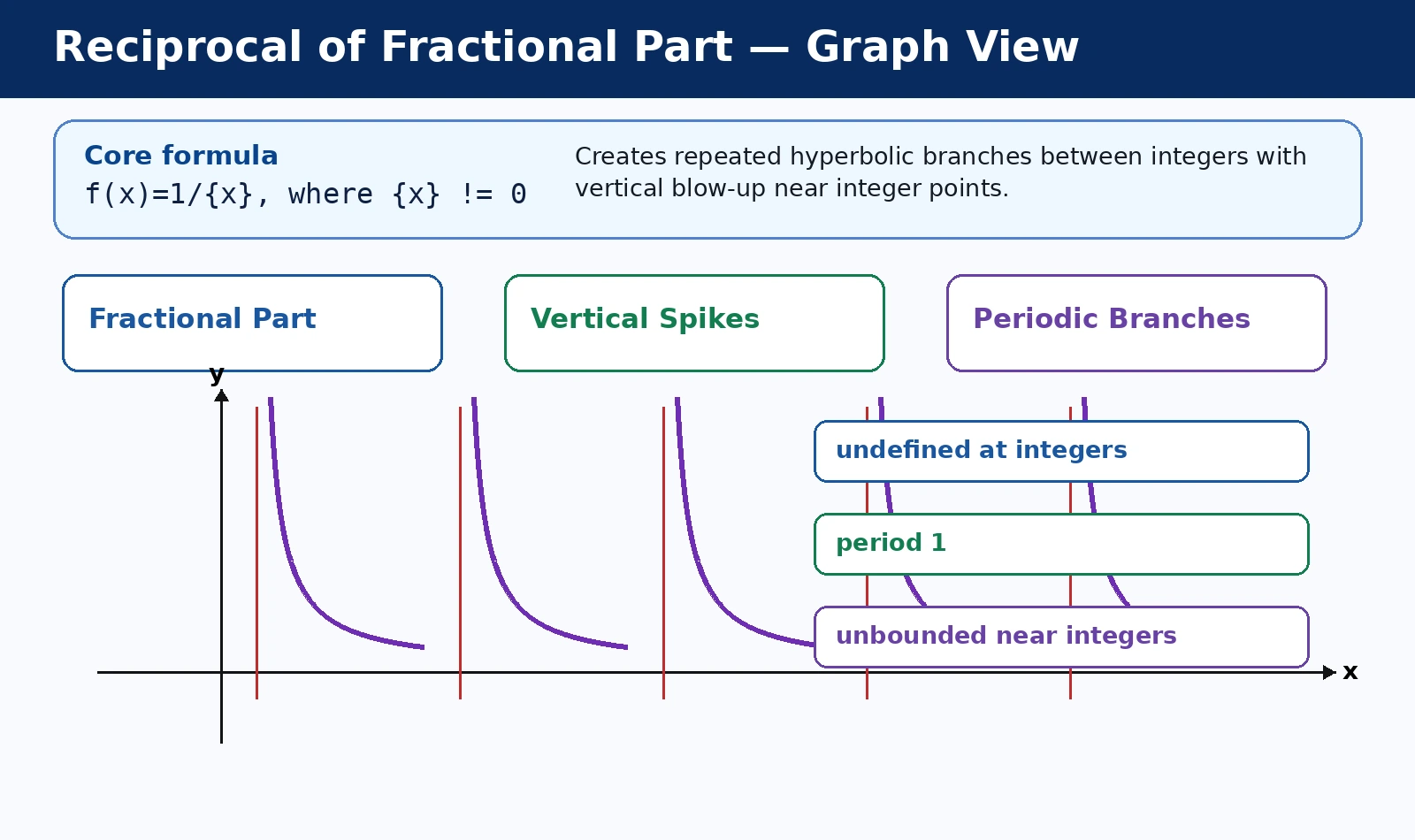
The reciprocal-of-fractional-part function is periodic with a period of ##T = 1##. This means that for any non-integer ##x##, the identity ##f(x) = f(x + 1)## holds true. The function repeats its shape exactly.
This periodicity arises directly from the fractional part function itself. Since ##\{x + 1\} = \{x\}##, the reciprocal naturally inherits this cyclic behavior. This makes the function useful for analyzing phenomena that occur in discrete intervals.
Within each interval ##(n, n+1)##, the function is continuous and strictly decreasing. It begins at an infinite value at ##x = n^+## and descends toward one at ##x = (n+1)^-##. This creates a characteristic hyperbolic shape.
The discontinuities at integers are classified as infinite discontinuities. Unlike the simple jump discontinuities of the fractional part function, these involve a divergence to infinity. This makes the function non-integrable over intervals containing integers.
Visualizing these discontinuities reveals a forest of "spikes" across the real number line. Each spike represents a transition from one integer interval to the next. The sharpness of these spikes is a hallmark of the function’s geometry.
Asymptotic Growth Near Integer Values
The most striking feature of ##f(x) = 1 / \{x\}## is its asymptotic growth. As ##x## approaches an integer ##n## from the right, the denominator ##\{x\}## becomes arbitrarily small. This forces the function value toward positive infinity.
Mathematically, we express this as
. This right-sided limit confirms the existence of a vertical asymptote at every integer. These asymptotes divide the graph into distinct, disconnected branches.
Conversely, as ##x## approaches an integer from the left, the behavior is different. The fractional part ##\{x\}## approaches one. Therefore, the left-sided limit is
. This creates a "cliff" effect.
This asymmetry is a critical property of the function. On one side of an integer, the function is nearly flat at one. On the other side, it shoots upward toward the infinite. This contrast is vital for chaotic mapping.
The rate of growth near the asymptote is comparable to the standard hyperbola ##1/x##. By shifting the input, we can see that near zero, ##f(x) \approx 1/x## for small positive ##x##. This local behavior dictates its analytical properties.
We Also Published
Advanced Mathematical Contexts
Role in Continued Fraction Expansions
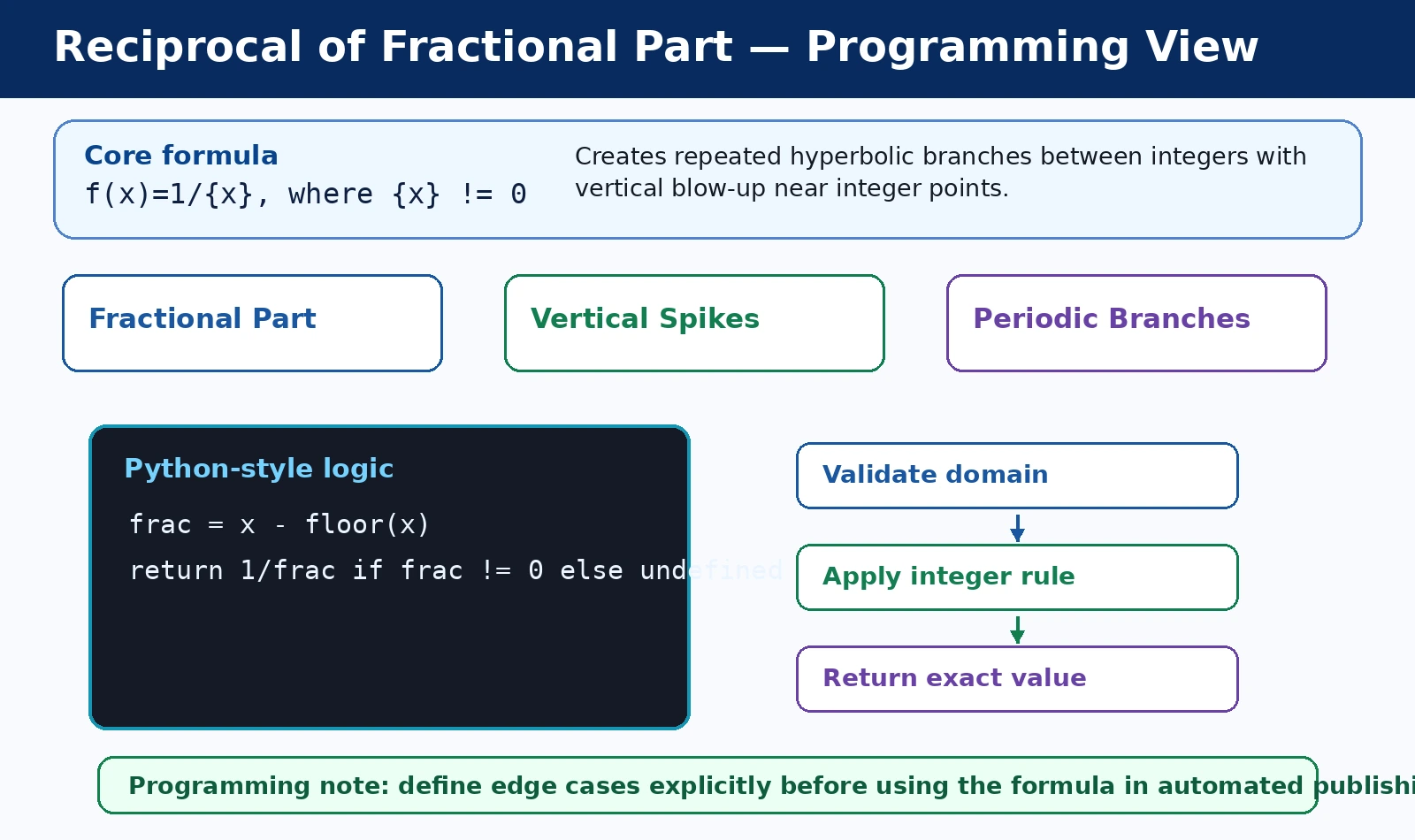
The reciprocal-of-fractional-part function is the engine behind continued fraction expansions. To find the coefficients of a real number ##x##, one repeatedly takes the reciprocal of the fractional part. This process extracts successive integers.
For a given ##x_0##, the first integer coefficient is ##a_0 = \lfloor x_0 \rfloor##. The remainder is ##\{x_0\}##. To continue, one calculates ##x_1 = 1 / \{x_0\}##. The next coefficient is then ##a_1 = \lfloor x_1 \rfloor##.
This recursive algorithm relies on the function's ability to "magnify" the fractional remainder. By flipping the small fractional part into a value greater than one, the next integer can be identified. This is the foundation of rational approximation.
If the function ever hits an integer value, the process terminates. This occurs only when the original number ##x## is rational. For irrational numbers, the reciprocal-of-fractional-part function generates an infinite sequence of coefficients.
The efficiency of this process is tied to how ##f(x)## distributes values. Because the function spends more time near small values of ##\{x\}##, the resulting coefficients follow specific statistical patterns. These patterns are described by the Kuzmin theorem.
The Gauss Map and Chaotic Systems
A variation of this function, known as the Gauss map, is defined as ##G(x) = \{1/x\}## for ##x \in (0, 1]##. This map is essentially the fractional part of our reciprocal function. It is a cornerstone of ergodic theory.
The Gauss map is highly chaotic and exhibits sensitive dependence on initial conditions. Small changes in the input ##x## lead to vastly different sequences of iterates. This makes it a classic example in the study of dynamical systems.
Because the reciprocal function maps the interval ##(0, 1)## onto ##(1, \infty)##, the Gauss map re-folds this range back onto ##(0, 1)##. This "stretch and fold" mechanism is the primary driver of mathematical chaos.
Researchers use the Gauss map to understand the distribution of digits in continued fractions. The invariant measure of this map, known as the Gauss measure, provides deep insights into number theory. It helps predict the frequency of integers.
The complexity of the reciprocal-of-fractional-part function ensures that its iterations are unpredictable. This unpredictability is not random but follows a structured chaotic law. It bridges the gap between simple arithmetic and complex dynamics.
Computational and Analytical Applications
Integrability and Convergence Issues
In calculus, the reciprocal-of-fractional-part function presents unique challenges for integration. Because the function diverges at every integer, any integral over an interval including an integer is improper. Specifically, the integral fails to converge.
Consider the integral of ##1/\{x\}## from 0 to 1. Since ##\{x\} = x## in this range, the integral becomes
. This integral is divergent, as the logarithm evaluated at zero is undefined.
This divergence means that the area under the curve is infinite for any unit interval. Consequently, the function cannot be integrated in the standard Riemann sense over the real line. This limits its use in certain types of signal processing.
However, the function can be used in the context of summation and series. Analysts often look at the behavior of sums involving ##1/\{x\}## at specific points. These sums are relevant in the study of the Riemann zeta function.
Handling these singularities requires specialized techniques like Cauchy principal values. In many cases, mathematicians work with the logarithm of the function instead. This tames the growth and allows for more stable analytical results.
Algorithmic Implementations and Modeling
In computer science, implementing the reciprocal-of-fractional-part function requires careful attention to floating-point precision. As ##x## nears an integer, ##\{x\}## becomes extremely small, leading to potential division-by-zero or overflow errors.
Programmers typically include a small epsilon value to prevent crashes. For example, the function might be calculated as ##1 / (\{x\} + \epsilon)##. This ensures that the output remains finite, even if it is very large.
The function is frequently used in procedural generation and noise functions. Because of its periodic yet sharp behavior, it can create interesting visual patterns. It is often a component in generating "spiky" terrain or textures.
In financial modeling, versions of this function help simulate market shocks. The sudden spikes represent extreme events that occur at regular intervals or under specific conditions. It provides a mathematical framework for modeling volatility.
Ultimately, the reciprocal-of-fractional-part function is more than a curiosity. It is a bridge between discrete and continuous mathematics. Its presence in continued fractions and chaos theory highlights its enduring importance in modern science.
From our network :
- Trump Political Strategy How Geopolitical Stunts Serve As Media Diversions
- Analyzing Trump Deportation Numbers Insights Into The 2026 Immigration Crackdown
- 10 Physics Numerical Problems with Solutions for IIT JEEPrepare for IIT JEE with 10 physics numerical problems, complete with detailed solutions and conceptual explanations. Ideal for mastering kinematics, thermodynamics, electromagnetism, and optics.
- AI-Powered 'Precision Diagnostic' Replaces Standard GRE Score ReportsDiscover the new GRE Precision Diagnostic. Learn how AI-powered behavioral analytics and time-to-solve tracking are replacing standard GRE score reports to empower students.
- EV 2.0: The Solid-State Battery Breakthrough and Global Factory ExpansionDiscover the impact of the Solid-State Battery Breakthrough on the EV market. Learn about CATL and BYD stock growth, global factory expansion in Europe, and the future of EV 2.0 technology.
- 98% of Global MBA Programs Now Prefer GRE Over GMAT Focus EditionExplore why 98% of global MBA programs now prefer the GRE over GMAT Focus. Learn about the shorter GRE format, verbal logic importance, and strategic versatility for students.
- Mastering DB2 LUW v12 Tables: A Comprehensive Technical GuideComprehensive guide on DB2 LUW v12 tables. Explore CREATE TABLE syntax, BLU Acceleration, range partitioning, data types, and security features for IBM DB2 LUW v12.
- Vite 6/7 'Cold Start' Regression in Massive Module GraphsIn-depth analysis of Vite 6/7 cold start regressions in massive module graphs. Learn about barrel file issues, pre-bundling optimizations, and how to improve Vite dev server performance.
- Mastering DB2 12.1 Instance Design: A Technical Deep Dive into Modern Database ArchitectureComprehensive guide to DB2 12.1 Instance Design. Explore architectural components, HADR setup, buffer pool tuning, and security policies for IBM DB2 12.1. Includes 10 functional SQL and Shell samples.
RESOURCES
- Fractional part - Wikipedia
- [2305.07394] Remarks on sums of reciprocals of fractional parts - arXiv
- Badly Approximable Numbers: Lower Bound for Sum of Reciprocals ...
- Efficient method of taking out square roots? : r/math - Reddit
- Middle school students' construction of reciprocal reasoning with ...
- Tricks to calculate the reciprocal of a fixed point number? - Reddit
- The reciprocal of x's non-integer decimal part equals x + 1
- rat - Rational fraction approximation - MATLAB - MathWorks
- Racing the Hardware: 8-bit Division | Speculative Branches
- Sums of reciprocals of fractional parts - World Scientific Publishing
- Inverse of the Riemann zeta function [closed] - MathOverflow
- Java, extract just the fractional part of a BigDecimal? - Stack Overflow
- Sums of reciprocals of fractional parts and applications to ...
- How to get the remainder of floats? (GDScript) - Archive - Godot Forum
- (PDF) Sums of Reciprocals of Fractional Parts and Multiplicative ...


0 Comments