On This Page
The Core Mechanics of Nearest Multiple Calculation
The nearest multiple function serves as a bridge between continuous numerical values and discrete sets of data points. By applying this transformation, mathematicians can simplify complex datasets into manageable, standardized units.
This operation is frequently encountered in computational algorithms where precision must be balanced with practical constraints of hardware. It ensures that output values remain within a predefined grid or scale.
The function relies heavily on the concept of division and subsequent multiplication to achieve its rounding objective effectively. This two-step process isolates the fractional component before re-scaling the result to the original magnitude.
In technical literature, this function is often referred to as a "step function" because of its discrete output. It creates a series of horizontal plateaus when visualized on a two-dimensional coordinate plane.
Understanding the behavior of this function is critical for engineers who work with discrete-time systems and digital logic. It provides the mathematical foundation for converting analog signals into digital formats.
Mathematical Formulation and Structure
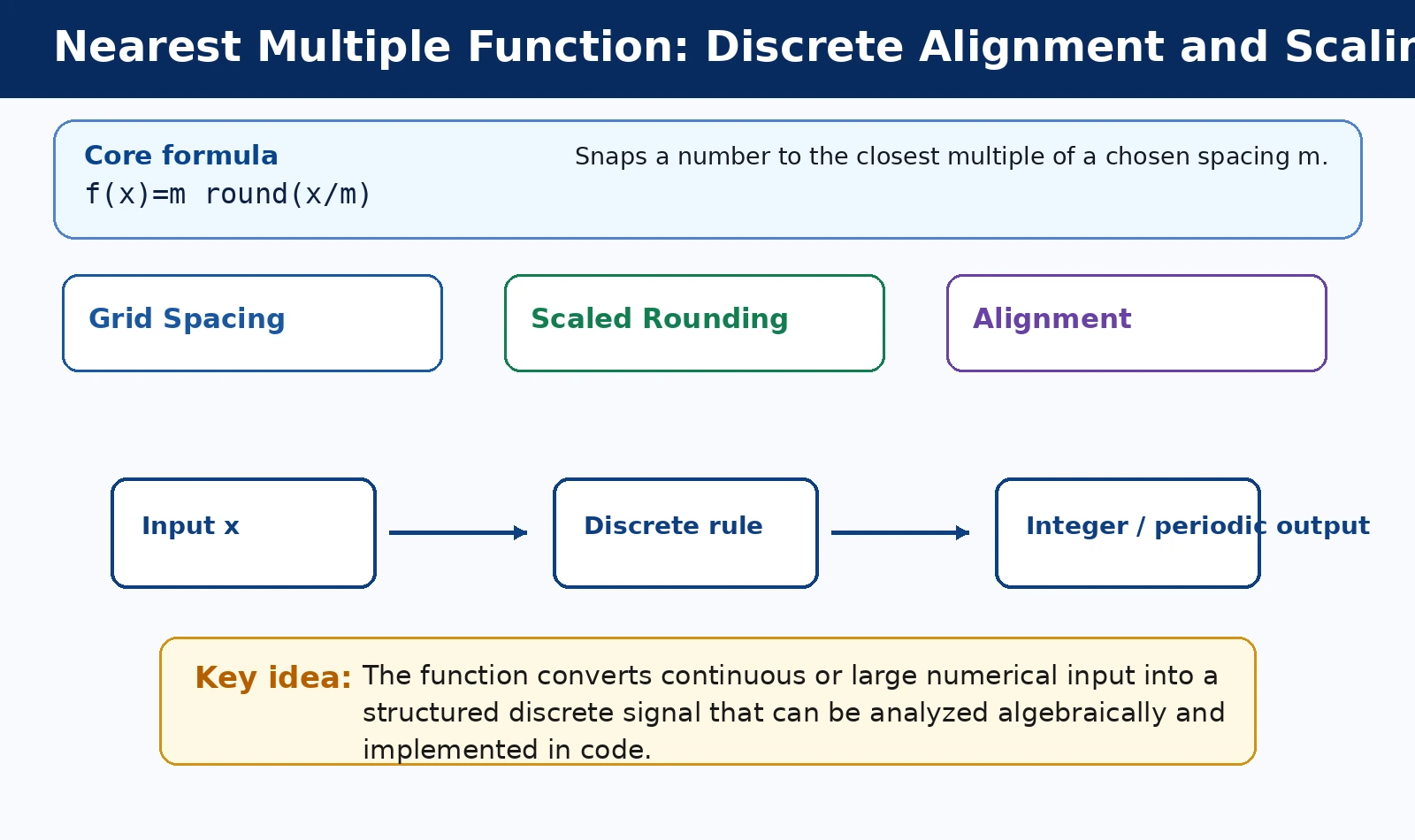
The formal definition of the nearest multiple function utilizes a scaling factor and a standard rounding operation. The expression is written as follows:
In this equation, ##x## represents the input value that requires rounding to a specific discrete interval. The variable ##m## defines the multiple or the "step size" for the desired output grid.
The internal operation ##x/m## first normalizes the input relative to the target multiple, creating a decimal value. This value is then passed through a rounding function to find the nearest whole integer.
Finally, multiplying the resulting integer by ##m## restores the value to its scaled representation in the original domain. This ensures the output is always an exact multiple of the specified base ##m##.
Understanding the Scaling Constant
The scaling constant ##m## is the most influential parameter in determining the resolution of the nearest multiple function. It defines the distance between adjacent valid output points on the number line.
When ##m## is large, the function produces a coarse grid, leading to significant differences between input and output. Conversely, a small ##m## value results in a finer grid with higher numerical fidelity.
In practical applications, ##m## is chosen based on physical constraints or industry standards, such as currency or manufacturing tolerances. It dictates the precision of the entire mathematical model being used.
The constant ##m## must be a non-zero value to avoid division by zero errors during the normalization phase. Typically, it is a positive real number representing a physical or logical unit.
By adjusting ##m##, developers can control the level of "granularity" in their data, which is vital for optimization. This flexibility makes the function highly adaptable to various scientific and engineering contexts.
Handling Rounding and Discontinuities
The nearest multiple function is inherently discontinuous, meaning it contains "jumps" where the output changes abruptly between multiples. These discontinuities occur at the midpoints between two consecutive multiples of the base ##m##.
At these specific points, the function must decide which direction to round, a process known as tie-breaking. The choice of rounding convention significantly affects the statistical properties of the resulting data set.
Different software environments and mathematical libraries may implement different rounding rules for these midpoints. Common choices include rounding toward zero, away from zero, or toward the nearest even integer.
Engineers must be aware of these subtle differences to ensure consistency across different platforms and programming languages. Inconsistent rounding can lead to cumulative errors in long-running simulations or financial systems.
The behavior of the function at these boundaries defines the "dead zone" or the interval of input values. Understanding these zones is essential for error analysis and precision tracking in technical projects.
Tie-Breaking Rules and Conventions
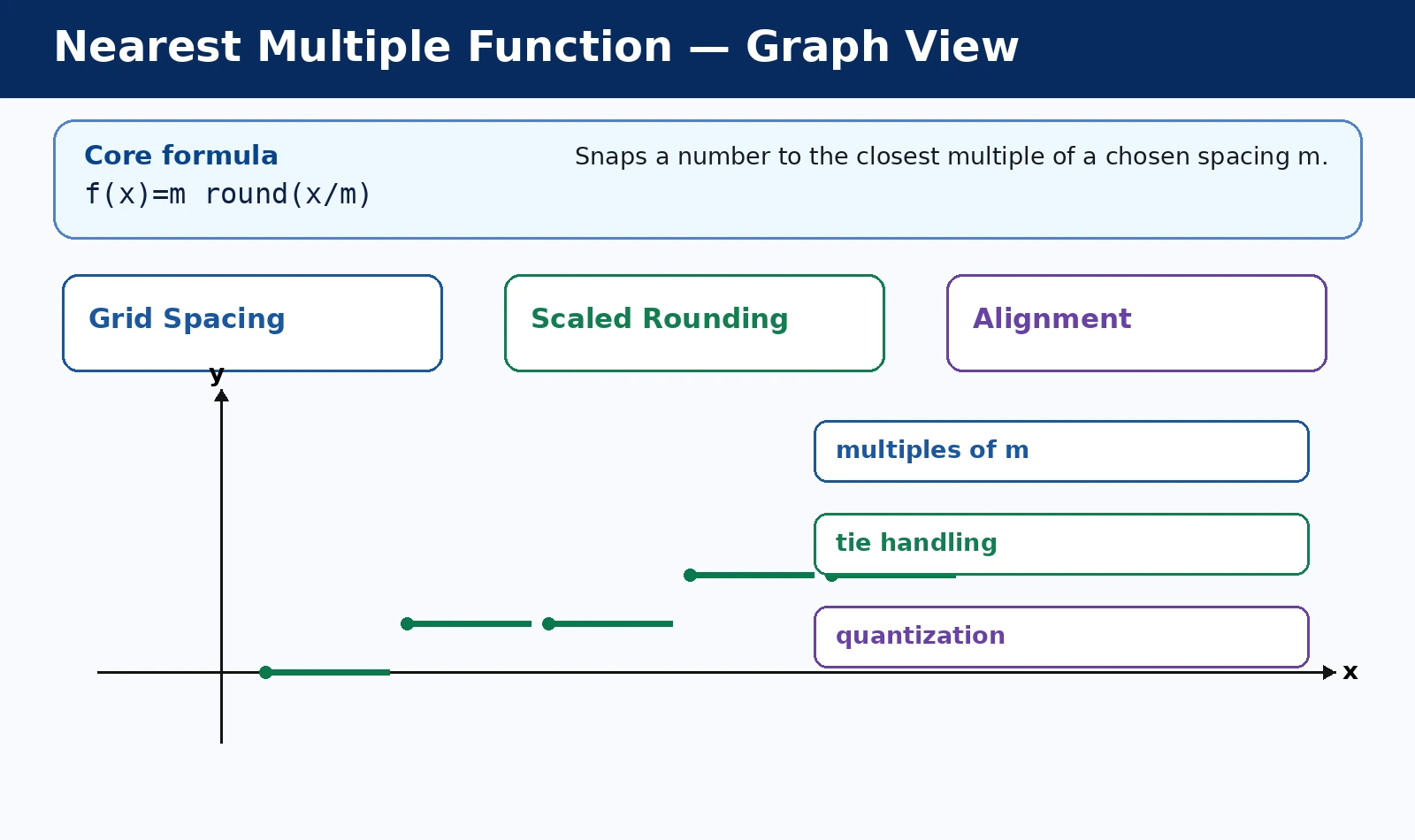
Tie-breaking occurs when the normalized value ##x/m## ends in exactly ##.5##, representing a point equidistant between two integers. The "round half up" convention is perhaps the most common approach used in basic arithmetic.
However, many technical fields prefer the "round half to even" method, also known as statistician's rounding. This approach reduces cumulative bias when processing large batches of numerical data over time.
Other conventions include "round toward zero" or "round toward infinity," each offering unique advantages for specific use cases. The choice depends on whether the application prioritizes simplicity or statistical neutrality.
The impact of these rules is most visible when the scaling factor ##m## is large relative to the input. In such cases, the direction of the tie-break can significantly shift the final calculated result.
Documentation for mathematical libraries usually specifies which convention is active by default to prevent unexpected behavior. Developers should always verify these settings when precision is a mission-critical requirement for their software.
Analyzing the Step Function Behavior
Visualizing the nearest multiple function reveals a characteristic staircase pattern that represents the mapping of intervals. Each "step" corresponds to an interval of width ##m## centered around a specific multiple of the base.
The horizontal length of each step is exactly ##m##, while the vertical height between steps is also ##m##. This symmetry creates a predictable and uniform distribution of values across the entire domain.
Mathematically, the error between the input ##x## and the output ##f(x)## is bounded by the value ##m/2##. This means the output is never further than half the step size from the original input.
This bounded error is a key property that makes the function useful for data compression and quantization. It allows engineers to quantify the maximum possible loss of information during the rounding process.
The derivative of this function is zero almost everywhere, except at the jump points where it is undefined. This property makes the function challenging to use in gradient-based optimization without specific modifications.
We Also Published
Real-World Implementation in Financial Systems
In the world of finance, the nearest multiple function is used to align transactions with currency denominations. Many countries have phased out small coins, requiring totals to be rounded to the nearest five cents.
This process ensures that physical cash transactions can be completed using available legal tender in a market. It simplifies the handling of change and reduces the logistical burden on retailers and banks.
Financial software must implement these rounding rules precisely to ensure that accounting ledgers remain balanced and accurate. Even small discrepancies can lead to significant issues during audits or end-of-year reporting cycles.
The function is also used in the bond market and for calculating interest rates on specific products. Here, the multiples may represent basis points or other standardized financial units of measure.
By standardizing values, the nearest multiple function helps maintain liquidity and efficiency in global financial markets. it provides a consistent framework for pricing and settlement across different platforms and regions.
Rounding to Currency Denominations
When a currency does not support fractional units below a certain point, the function is applied to the total. For example, if ##m = 0.05##, an amount of
#1.00##.
Conversely, an amount like
#1.05## under the standard nearest multiple logic. This ensures that every transaction total is a value that can be paid using physical coins.
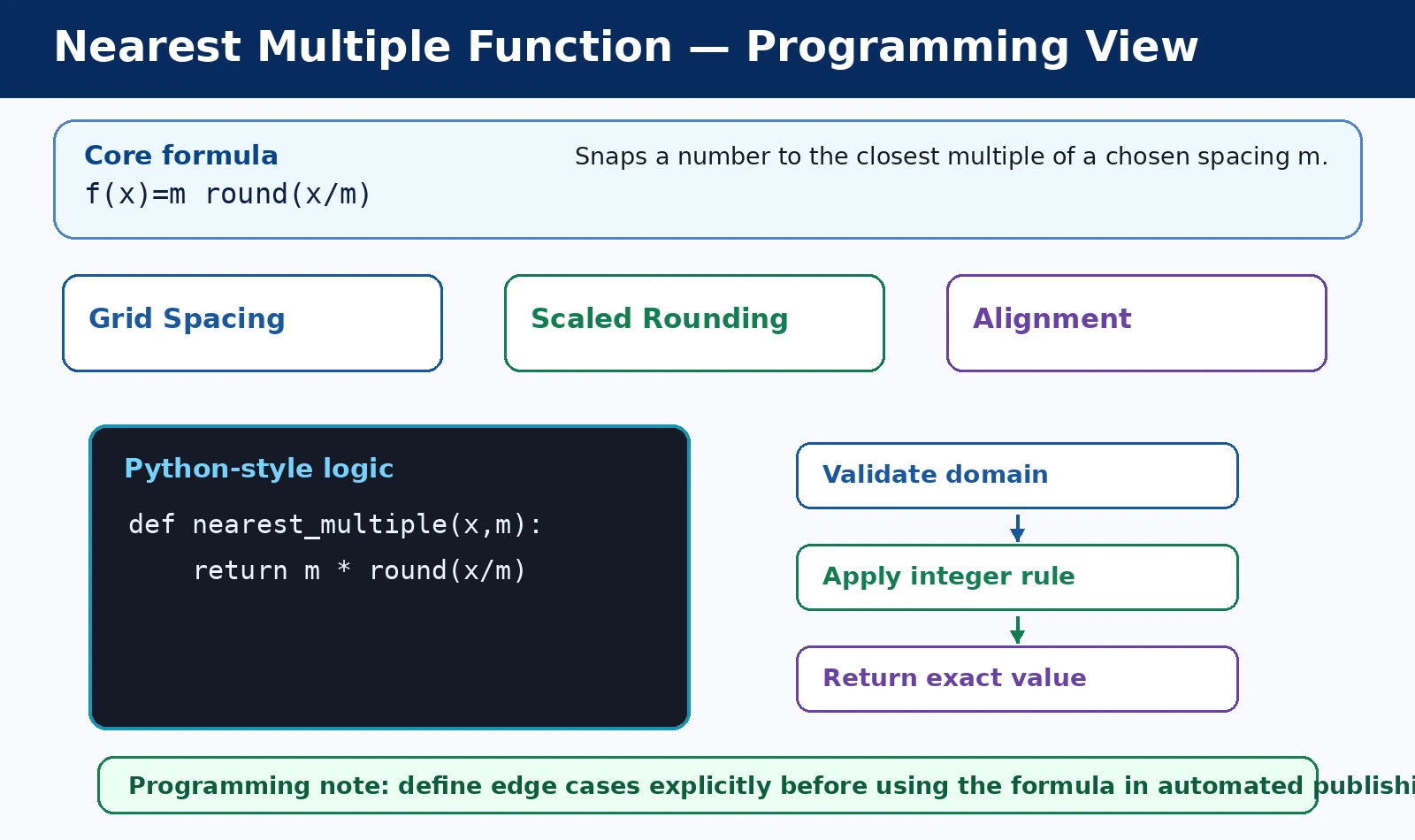
This application demonstrates the practical utility of the formula ##f(x) = m \cdot \text{round}(x/m)## in daily life. It automates a process that would otherwise require manual calculation by cashiers and consumers.
Retailers often use this function in their point-of-sale systems to handle tax calculations and discount applications. It provides a transparent and predictable way to finalize the cost of goods and services.
The adoption of these rounding rules is often mandated by national central banks to ensure uniformity. This legal framework provides the parameters for the scaling factor ##m## used in these specific calculations.
Inventory Management and Unit Constraints
In manufacturing and logistics, items are often sold or shipped in fixed batch sizes or case quantities. The nearest multiple function helps managers determine how many full units to order based on demand.
If a product is only available in boxes of 12, the function can round a demand of 50 to 48. This ensures that orders align with the physical constraints of the supplier's packaging and shipping methods.
This approach minimizes waste and optimizes the use of warehouse space by preventing the storage of partial units. It streamlines the supply chain by ensuring that all movements involve standardized, predictable quantities.
Software used for Enterprise Resource Planning (ERP) relies on these functions to automate procurement and production scheduling. It allows for more accurate forecasting and resource allocation across the entire organization.
By integrating these mathematical constraints, businesses can improve their operational efficiency and reduce overhead costs. The function serves as a vital tool for translating theoretical demand into actionable logistical plans.
Technical Roles in Digital Signal Processing
Digital signal processing (DSP) relies heavily on the nearest multiple function for the process of quantization. Quantization involves mapping a vast range of analog voltages to a limited set of digital levels.
In this context, the scaling factor ##m## represents the quantization step size, which is determined by the bit depth. A higher bit depth allows for a smaller ##m##, resulting in a more accurate digital representation.
This transformation is necessary for storing and transmitting audio, video, and sensor data in digital formats. Without this function, it would be impossible to represent continuous real-world signals in a binary system.
Engineers must carefully select the step size to balance signal quality against storage space and bandwidth requirements. This trade-off is a fundamental challenge in the design of modern telecommunications and media systems.
The nearest multiple function also plays a role in dithering, a technique used to mask quantization errors. By adding controlled noise, engineers can improve the perceived quality of a rounded digital signal.
Quantization and Bit Depth Reduction
Quantization error is the difference between the original signal and the nearest multiple used for its representation. This error manifests as noise in audio signals or "banding" artifacts in digital images and videos.
Using the nearest multiple function allows engineers to calculate the signal-to-noise ratio (SNR) for a given system. This metric is essential for evaluating the performance and fidelity of digital recording equipment.
When reducing bit depth, the function is applied to re-map high-resolution data to a coarser grid of values. This is common when converting professional 24-bit audio to the standard 16-bit format used for distribution.
The mathematical precision of the rounding operation determines how much detail is preserved during this destructive process. Proper implementation ensures that the resulting signal remains as faithful to the original as possible.
Advanced algorithms may use non-linear scaling factors, but the underlying logic of finding the nearest value remains constant. This fundamental operation is the cornerstone of all digital media technology currently in use today.
Image Resampling and Grid Alignment
In computer graphics, the nearest multiple function is used for coordinate alignment and image resampling tasks. When scaling an image, pixels must be mapped from the source grid to the destination grid.
Nearest-neighbor interpolation is a specific application of this function that assigns the value of the closest pixel. This method is computationally efficient and preserves the sharpness of edges in low-resolution graphics.
The function is also used in "snapping" tools within design software, where objects align to a background grid. By rounding coordinates to the nearest multiple of the grid size, the software ensures perfect alignment.
This geometric application helps maintain visual consistency and professional standards in digital layouts and architectural blueprints. It automates the tedious task of manual pixel-perfect placement for designers and artists.
Grid alignment is also crucial for rasterization, the process of converting vector shapes into a grid of pixels. The nearest multiple function ensures that lines and curves are rendered accurately on a digital display.
From our network :
- EV 2.0: The Solid-State Battery Breakthrough and Global Factory ExpansionDiscover the impact of the Solid-State Battery Breakthrough on the EV market. Learn about CATL and BYD stock growth, global factory expansion in Europe, and the future of EV 2.0 technology.
- Vite 6/7 'Cold Start' Regression in Massive Module GraphsIn-depth analysis of Vite 6/7 cold start regressions in massive module graphs. Learn about barrel file issues, pre-bundling optimizations, and how to improve Vite dev server performance.
- Mastering DB2 LUW v12 Tables: A Comprehensive Technical GuideComprehensive guide on DB2 LUW v12 tables. Explore CREATE TABLE syntax, BLU Acceleration, range partitioning, data types, and security features for IBM DB2 LUW v12.
- Trump Political Strategy How Geopolitical Stunts Serve As Media Diversions
- 10 Physics Numerical Problems with Solutions for IIT JEEPrepare for IIT JEE with 10 physics numerical problems, complete with detailed solutions and conceptual explanations. Ideal for mastering kinematics, thermodynamics, electromagnetism, and optics.
- AI-Powered 'Precision Diagnostic' Replaces Standard GRE Score ReportsDiscover the new GRE Precision Diagnostic. Learn how AI-powered behavioral analytics and time-to-solve tracking are replacing standard GRE score reports to empower students.
- Mastering DB2 12.1 Instance Design: A Technical Deep Dive into Modern Database ArchitectureComprehensive guide to DB2 12.1 Instance Design. Explore architectural components, HADR setup, buffer pool tuning, and security policies for IBM DB2 12.1. Includes 10 functional SQL and Shell samples.
- Analyzing Trump Deportation Numbers Insights Into The 2026 Immigration Crackdown
- 98% of Global MBA Programs Now Prefer GRE Over GMAT Focus EditionExplore why 98% of global MBA programs now prefer the GRE over GMAT Focus. Learn about the shorter GRE format, verbal logic importance, and strategic versatility for students.
RESOURCES
- MROUND function - Microsoft Support
- How to find the nearest multiple of 16 to my given number n
- Round to Nearest Multiple in Excel - Step by Step Tutorial - Excel Easy
- Generic function to accurately round floating-point to the nearest ...
- Wait Until Next ms Multiple Function - NI - National Instruments
- Round to the Nearest 5 in Excel Using 3 Different Functions
- MROUND - Google Docs Editors Help
- Round a number up to nearest multiple - Excel formula - Exceljet
- round - Round to nearest decimal or integer - MATLAB
- Rounddown to the nearest multiple of 25 - Excel Help Forum
- MROUND function (DAX) - Microsoft Learn
- Formula to round down to nearest 5 or 0 : r/excel - Reddit
- MROUND Function - Round Numbers to the Nearest Multiple in ...
- "Move Selection with First Transient to Nearest Beat" Function
- MROUND Function - Smartsheet Learning Center


0 Comments