
When NPR's Weekend Edition Sunday aired its conversation with John Scalzi about his novel Monsters of Ohio, the broadcast carried a significance that reaches well beyond a single author's publicity cycle. Scalzi occupies a rare position in contemporary letters: a science fiction novelist whose commercial reach, prolific output, and candid public voice have made him a bellwether for how speculative fiction circulates in the twenty-first century. A network radio interview is not a trivial booking. It signals that a genre writer has crossed into general cultural conversation, and it invites us to examine what such crossover means for readers, publishers, and the broader literary ecosystem that sustains imaginative fiction.
The source record itself is deliberately spare. It notes the date, the program, the embedded audio player, and the essential facts of who spoke and what work was discussed, while explicitly acknowledging that further details of the conversation were not captured in the available text. That restraint is instructive rather than limiting. It reminds us that journalism about culture often functions as a pointer, directing audiences toward a primary artifact, in this case an audio segment, rather than substituting for it. Reading such a record carefully means reconstructing the context that gives the headline its weight: the author's career arc, the genre's evolving standing, and the mechanics by which a novel enters public awareness.
What follows is an analytical reading of that record, expanded with verifiable context about Scalzi, his body of work, and the industrial and cultural systems that surround a book launch. The discussion treats the interview as a case study in literary reception, examining how genre fiction earns mainstream attention, how authors build durable audiences, and how the mathematics of publishing economics shape what gets written and heard. The aim is not to invent quotations or fabricate details the source does not contain, but to illuminate the structures that make such a moment meaningful.
On This Page
- The Cultural Weight of a Network Radio Conversation
- Reading the Source Record: What Is Said and What Is Withheld
- The Novel as Cultural Object: Genre, Place, and Imagination
- The Economics of Attention: How Interviews Translate into Readers
- Authorship, Technology, and the Changing Media Landscape
- Critical Reception and the Long Tail of Literary Reputation
- Conclusion: What a Single Interview Reveals About Literary Culture
The Cultural Weight of a Network Radio Conversation
Weekend Edition Sunday occupies a distinctive niche in American broadcasting. Its audience skews toward listeners who treat culture coverage as a form of civic engagement, and its producers curate guests with an eye toward significance rather than mere novelty. When a science fiction novelist appears on such a program, the booking communicates a judgment: this writer and this book merit the attention of a general, educated listenership. That judgment is never automatic. It reflects accumulated reputation, publisher advocacy, and the persistent argument that speculative fiction offers serious commentary on contemporary life rather than escapism alone.
The interview format itself matters. Radio privileges voice, pacing, and the unscripted turn of phrase, which suits an author known for directness and wit. Unlike a written profile, which can be polished and revised, a live or recorded conversation exposes the speaker's instincts. Listeners hear how an author frames their own work, which themes they choose to foreground, and how they navigate the inevitable question of why science fiction deserves mainstream attention. The embedded audio player in the source record is therefore not incidental furniture; it is the primary text, the artifact through which the cultural transaction occurs.
Why Genre Crossovers Signal Institutional Shift
For much of the twentieth century, science fiction lived in a critical quarantine, celebrated by devoted readers but frequently dismissed by literary gatekeepers. That quarantine has eroded steadily, accelerated by the commercial dominance of genre-inflected film and television and by a generation of writers who move fluidly between speculative and mainstream registers. Scalzi's presence on a flagship news program is a data point in that longer trend. It suggests that the boundary between genre fiction and general fiction is now porous enough that a novelist can be interviewed as a public intellectual rather than as a curiosity from a niche market.
This shift has measurable consequences. Publishers allocate marketing budgets differently when a genre title can plausibly reach general audiences, and booksellers shelve speculative work more prominently when media attention signals broad appeal. The crossover also reshapes reader expectations: audiences arrive at a novel like Monsters of Ohio carrying assumptions formed by mainstream coverage, not only by genre convention. Understanding this dynamic helps explain why a single radio segment can function as a small but real lever in a book's commercial trajectory.
The Author as Durable Public Voice
Scalzi's career illustrates how a writer can build a durable public identity that transcends any individual title. His blog, active for many years, established a direct channel to readers long before social platforms made such access routine, and his willingness to engage openly on matters of publishing economics, contracts, and creative labor has made him a trusted voice within the writing community. That reputation travels with him into every interview. Listeners who know him as a commentator arrive with context, while newcomers encounter a writer who can explain his craft in plain, engaging terms.
Durability of this kind is an underappreciated asset in publishing. A novelist with a recognizable voice and a reliable audience reduces risk for publishers, who can forecast sales with greater confidence and invest in promotion accordingly. It also gives the author leverage to pursue projects that might otherwise seem commercially uncertain. The interview about Monsters of Ohio is thus not merely a promotional event but an expression of accumulated cultural capital, deployed on behalf of a new work.
Reading the Source Record: What Is Said and What Is Withheld
The source text is a model of journalistic minimalism. It identifies the program, the guest, the novel, and the date, then states plainly that further details of the discussion were not provided in the available text. That final clause is an act of intellectual honesty, and it deserves attention. In an information environment saturated with speculation, a record that marks the limits of its own knowledge is valuable. It tells the analyst precisely where evidence ends and inference begins, which is the foundation of any responsible reading of cultural journalism.
From an analytical standpoint, the record supplies three verifiable anchors: the identity of the author, the title of the work, and the institutional context of the broadcast. Everything else, including the content of the conversation, must be treated as context rather than fact. This distinction matters because commentary about books frequently drifts into invented detail. A disciplined reading resists that drift, using the anchors to locate the event within broader patterns while refusing to attribute specific claims to a conversation whose transcript is not in evidence.
The Epistemics of Cultural Reporting
Cultural journalism operates under constraints that differ from investigative reporting. A radio segment is ephemeral by design, and written summaries often serve as signposts rather than transcripts. When a record explicitly notes the absence of further detail, it invites readers to seek the primary source, in this case the audio itself. That invitation is healthy. It reinforces the habit of consulting original artifacts rather than relying on secondhand paraphrase, a habit increasingly rare in an era of rapid aggregation and algorithmic summary.
The epistemic caution embedded in the source also protects against a common failure mode in literary commentary: the conflation of an author's public statements with the meaning of their fiction. A novel is not a transcript of its author's intentions, and an interview is not a key that decodes a text. Recognizing this separation allows readers to approach Monsters of Ohio as a work of imagination in its own right, while still appreciating the context that a conversation with its author provides.
From Headline to Primary Artifact
The headline itself performs a specific function. By naming both the author and the novel, it creates a searchable entry point that connects a general news audience to a specific cultural product. In practical terms, this is how discovery works: a listener hears a name, a title surfaces in memory, and a subsequent search leads to reviews, excerpts, and purchase pages. The headline is thus a node in a network of attention, and its wording shapes which associations travel with the book.
Understanding this chain helps explain why authors and publishers invest in broadcast appearances even when direct sales attribution is difficult to measure. The value lies in the cumulative effect of many such nodes, each reinforcing the others. A single interview may not move thousands of copies, but a cluster of appearances across radio, podcasts, and print creates the impression of ubiquity that drives sustained attention. The source record, sparse as it is, documents one node in that cluster.
The Novel as Cultural Object: Genre, Place, and Imagination
A title like Monsters of Ohio does considerable imaginative work before a single page is read. It pairs the monstrous with the mundane, yoking a word of horror and fantasy to a state associated in the popular imagination with ordinary American life. That juxtaposition is a classic speculative fiction move: the extraordinary intrudes upon the familiar, and the resulting friction generates both narrative tension and thematic possibility. The title invites readers to ask what monsters might mean in a place so often coded as unremarkable, and that question is itself a form of literary criticism.
Place-based titles also anchor fiction in geography, giving readers a concrete setting against which fantastical elements can be measured. Ohio, with its mix of industrial legacy, agricultural expanse, and small-town texture, offers rich material for a writer interested in the uncanny. The specificity of the title signals that the novel takes its setting seriously, treating the Midwest not as a blank backdrop but as a location with its own history, idioms, and anxieties. That seriousness is one reason genre fiction increasingly commands critical attention.
Monsters as Metaphor in Contemporary Fiction
Monsters have long served fiction as vehicles for social commentary. They externalize fears that are difficult to name directly, whether economic precarity, communal decline, or the erosion of shared institutions. A novel that places monsters in a specific American state participates in this tradition while updating it for contemporary concerns. The creatures may be literal within the story's logic, but their resonance depends on what they illuminate about the human communities they threaten or inhabit.
This metaphorical capacity is central to why speculative fiction attracts serious readers. The genre permits writers to examine fraught subjects at a productive distance, using invented premises to defamiliarize the familiar. When an author discusses such work in a mainstream interview, they are effectively translating the genre's methods for a general audience, explaining why imaginative premises are not escapes from reality but instruments for examining it more sharply.
Regional Identity and the Speculative Imagination
American speculative fiction has historically gravitated toward coastal settings and futuristic metropolises, but a growing body of work turns toward the interior. This regional turn reflects both demographic reality and artistic ambition. The Midwest supplies settings that are at once recognizable and under-explored in genre fiction, offering writers room to invent within a landscape readers think they know. A novel set in Ohio can therefore feel simultaneously grounded and strange, a combination that suits stories about intrusion and transformation.
Regional specificity also builds audience. Readers who recognize a place in fiction experience a particular pleasure, a sense of being seen that generic settings cannot provide. For an author with a national platform, choosing a specific state as a setting is a way of honoring local texture while inviting a broader readership to imagine lives beyond their own. The title announces that commitment before the first chapter begins.
We Also Published
The Economics of Attention: How Interviews Translate into Readers
Publishing is an attention economy, and interviews are among its most efficient currencies. A broadcast segment costs the author an hour or two and yields a durable artifact that can be clipped, quoted, and shared for months. The economics are asymmetric in the author's favor: the program supplies institutional credibility, the author supplies content, and both parties benefit from the resulting circulation. Understanding this exchange clarifies why publicists pursue radio and podcast bookings so persistently, even when direct sales attribution remains stubbornly difficult to establish.
The mathematics of conversion are worth examining because they reveal why small effects matter. If a program reaches a large audience and even a modest fraction of listeners seek out the book, the resulting sales can exceed what a targeted advertisement would achieve at comparable cost. The key variable is not raw audience size but the depth of engagement, which is why culturally curated programs often outperform larger but less attentive channels. A thoughtful interview generates qualified interest rather than passive exposure.
Modeling the Conversion Funnel
We can represent the path from broadcast to purchase as a simple multiplicative chain. Let ##[A]## denote the program's audience, ##[r_1]## the fraction who attend to the segment, ##[r_2]## the fraction who retain the title, and ##[r_3]## the fraction who ultimately purchase. The expected number of sales attributable to the appearance is then the product of these factors. This structure is useful because it shows that improvements anywhere in the chain compound, while a near-zero value at any stage collapses the whole result.
###[S = A \times r_1 \times r_2 \times r_3]###
Suppose a program reaches ##[A = 2{,}000{,}000]## listeners, of whom ##[r_1 = 0.35]## hear the segment, ##[r_2 = 0.08]## remember the title, and ##[r_3 = 0.04]## buy the book. The expected sales are computed below. The result, while modest in absolute terms, illustrates why publishers treat broadcast appearances as part of a portfolio rather than as isolated bets, since many such events accumulate into a meaningful total.
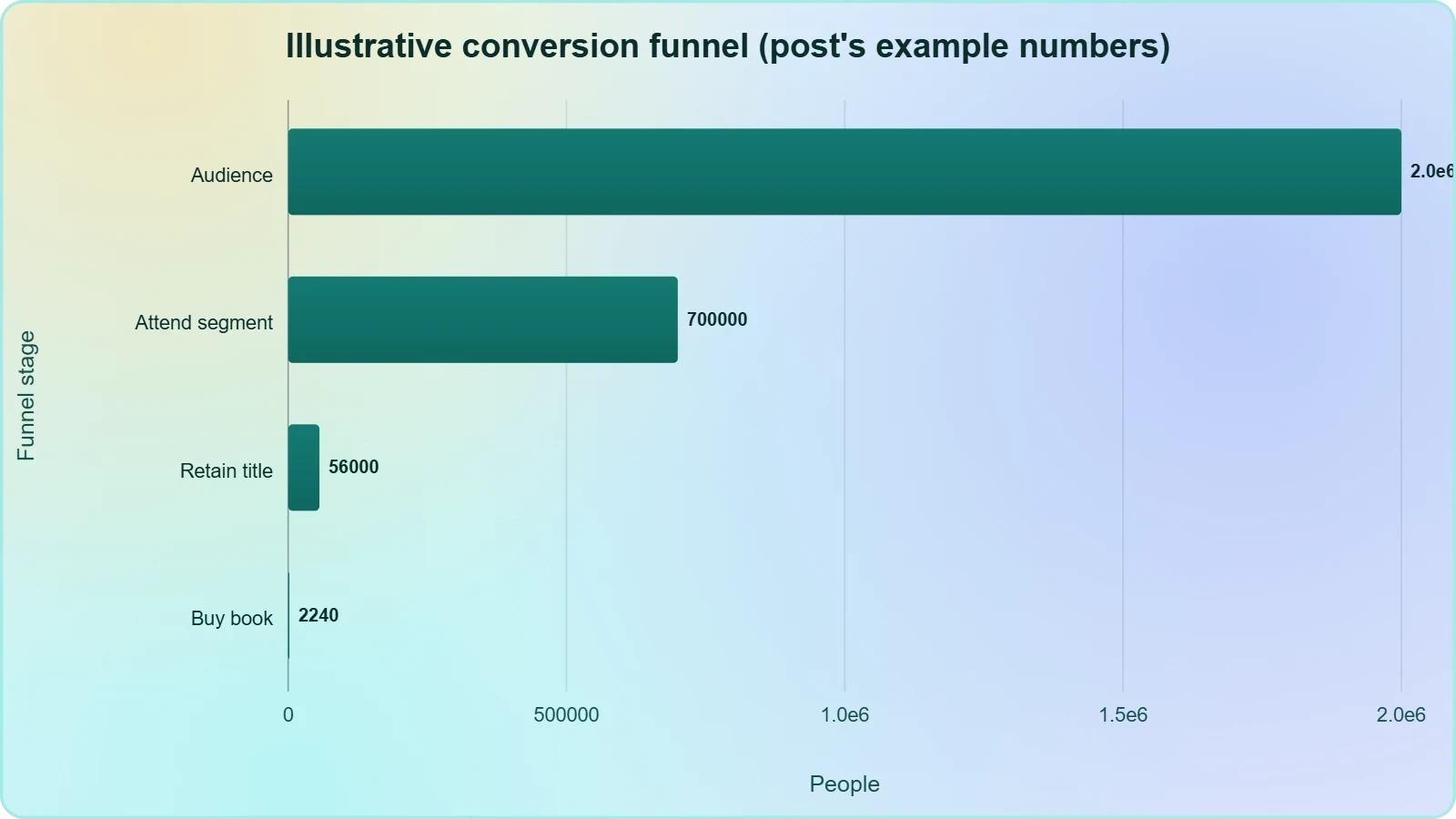
###[S = 2{,}000{,}000 \times 0.35 \times 0.08 \times 0.04 = 2{,}240]###
Interpreting the Sensitivity of the Chain
The multiplicative form also permits a sensitivity analysis. Differentiating the logarithm of ##[S]## with respect to each rate shows that a one percent relative improvement in any factor produces the same one percent relative improvement in sales. This symmetry is a useful corrective to intuition, which often overweights audience size and underweights retention. In practice, a memorable title and a compelling interview may matter more than raw reach, because they raise the middle factors in the chain where losses are typically steepest.
###[\dfrac{\partial \ln S}{\partial \ln r_i} = 1 \quad \text{for each } i \in \{1,2,3\}]###
This result has a practical corollary for authors and publicists. Efforts to sharpen the message, repeat the title clearly, and connect the work to themes listeners already care about are not cosmetic refinements; they operate directly on the rates that govern conversion. A single well-chosen phrase, repeated across multiple appearances, can lift ##[r_2]## enough to justify the entire promotional campaign. The mathematics thus vindicates the craft of the interview rather than dismissing it as mere publicity.
Authorship, Technology, and the Changing Media Landscape
The media environment surrounding a book launch today differs markedly from the one that shaped earlier generations of writers. Radio remains influential, but it now operates alongside podcasts, newsletters, social platforms, and algorithmic recommendation systems that can amplify or bury a title within hours. Authors must therefore navigate a fragmented landscape in which no single channel dominates. A network interview retains prestige, but its practical reach depends on how the resulting audio circulates across these adjacent systems.
Scalzi's career is instructive precisely because he adapted early to these changes. His long-running blog demonstrated that authors could build direct relationships with readers, bypassing traditional gatekeepers while still benefiting from conventional publishing infrastructure. That dual strategy, embracing both legacy media and independent channels, has become a template for contemporary authorship. The interview under discussion is one node in a network that includes his own platforms, his publisher's marketing apparatus, and the informal circulation of reader enthusiasm.
Direct Audience and Institutional Platforms
The interplay between direct and institutional channels is more complementary than competitive. A blog post can reach devoted readers with depth and immediacy, while a network interview reaches strangers who might never encounter the author otherwise. Together they form a layered communication strategy in which each channel performs a distinct function. The author's own voice supplies authenticity and continuity, while institutional platforms supply reach and legitimacy that no individual writer can manufacture alone.
This layering also distributes risk. If a single platform changes its algorithm or a program changes its format, an author with diversified channels remains visible. The lesson generalizes beyond any one writer: durable careers are built on multiple points of contact with readers, each reinforcing the others. The interview is valuable not because it stands alone but because it plugs into an existing network that converts attention into sustained readership.
Speculative Fiction as a Site of Technological Reflection
Science fiction has always functioned as a laboratory for thinking about technology, and contemporary genre writing continues that tradition with increasing sophistication. Novels that place monsters in ordinary American settings can be read as meditations on technological disruption, environmental change, or social fragmentation, using imaginative premises to make abstract forces tangible. When authors discuss such work publicly, they participate in a broader conversation about how societies absorb change and what imaginative literature contributes to that process.
This reflective function is one reason speculative fiction attracts readers from technical and scientific fields. The genre rewards rigorous world-building and treats ideas as dramatic material, which appeals to audiences accustomed to analytical thinking. A novel like Monsters of Ohio can therefore serve as a meeting point between literary culture and scientific imagination, a space where readers who value precision encounter writers who value possibility. That convergence is among the genre's most durable contributions to public intellectual life.
Critical Reception and the Long Tail of Literary Reputation
Reputation in literature accumulates slowly and unevenly. A single interview rarely alters an author's standing, but a consistent pattern of thoughtful public engagement can shift how a writer is perceived over years. Scalzi's trajectory illustrates this principle: sustained output, transparent commentary on the business of writing, and a willingness to engage with readers have combined to produce a reputation that precedes any individual book. That reputation then shapes reception, predisposing critics and readers to take new work seriously.
The long tail of literary reputation also operates through secondary channels. Reviews, essays, and academic treatments extend a book's life well beyond its launch window, and each citation reinforces the author's position. A novel discussed on national radio enters this secondary circuit with an advantage, since the broadcast provides a citable moment that later commentary can reference. Over time, such moments coalesce into a narrative about a writer's significance, and that narrative becomes part of the cultural record.
How Reviews and Commentary Compound
Critical reception is best understood as a compounding process rather than a single verdict. Early reviews establish a frame, later commentary refines or contests it, and the accumulated conversation becomes the lens through which new readers approach the work. Authors who engage publicly with this conversation, rather than treating it as external noise, can influence its direction. Scalzi's willingness to discuss his craft and his industry in plain terms is an example of such engagement, and it helps explain why his work receives sustained attention.
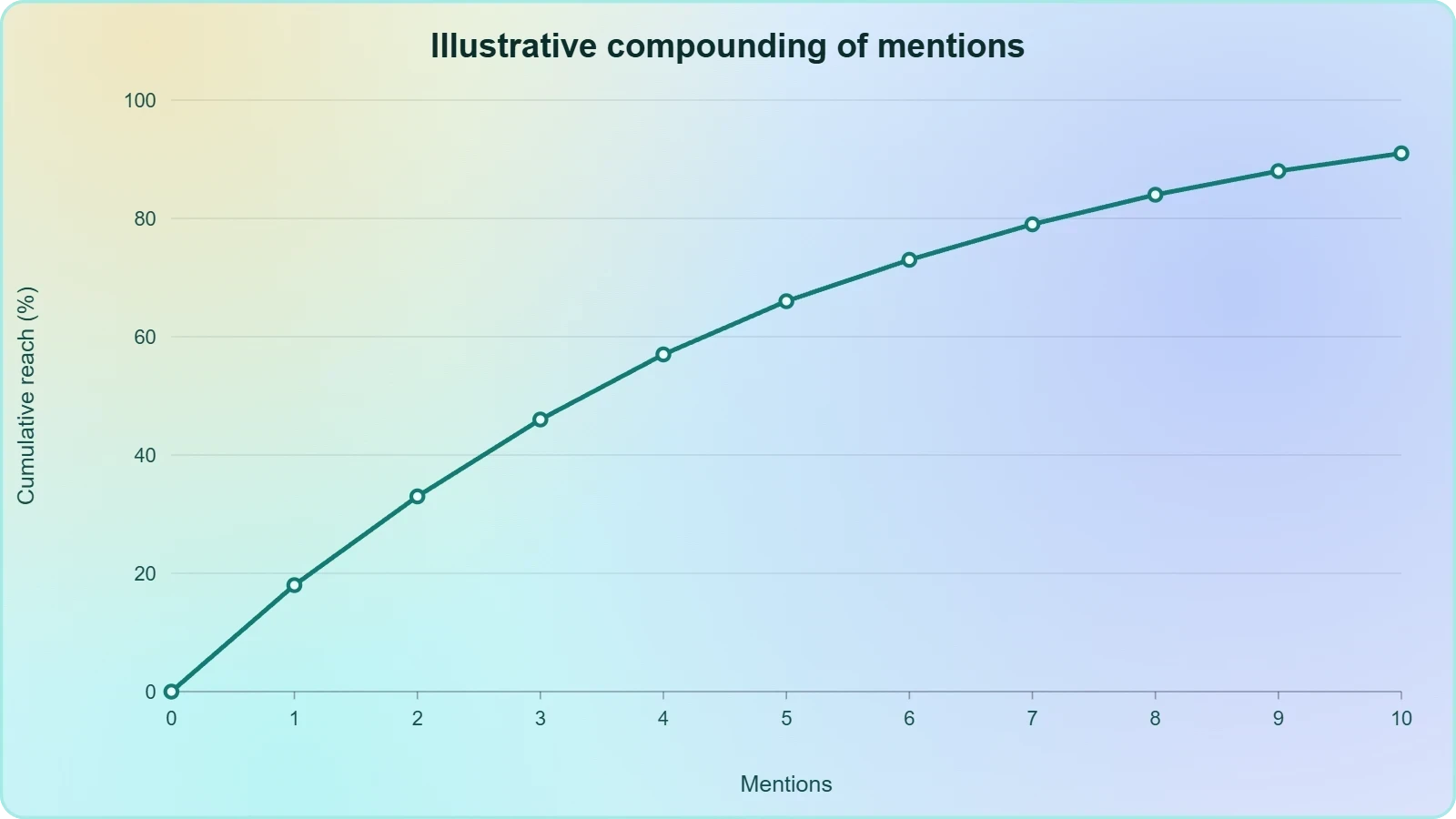
The compounding effect also has a quantitative dimension. Each additional review or mention increases the probability that a prospective reader encounters the book, and these probabilities accumulate across the tail. A launch interview contributes to this accumulation by seeding the conversation with a recognizable reference point. The effect is small per event but meaningful in aggregate, which is precisely why publishers continue to invest in publicity even when immediate returns are uncertain.
The Reader as Participant in Literary Culture
Readers are not passive recipients of literary reputation; they are active participants in it. Recommendations, reviews, and informal conversation all shape which books persist and which fade. An interview that reaches a broad audience recruits new participants into this process, expanding the pool of people who might recommend the book to others. This social dimension of reading is often overlooked in discussions of publishing economics, yet it is arguably the most important mechanism by which books achieve lasting success.
Understanding readers as participants also clarifies why authors invest in direct engagement. A writer who answers questions, acknowledges criticism gracefully, and shares the realities of the craft builds a community that advocates on their behalf. That community is an asset no marketing budget can purchase outright. The interview about Monsters of Ohio is, in this light, an invitation to join such a community, extended through the most public channel available.
Conclusion: What a Single Interview Reveals About Literary Culture
The record of John Scalzi's appearance on Weekend Edition Sunday to discuss Monsters of Ohio is brief, but its brevity is precisely what makes it analytically useful. It captures a moment in the life of a book, a writer, and a genre, and it does so without embellishment. From that moment we can trace the institutional pathways that bring genre fiction into mainstream conversation, the economic calculations that justify promotional effort, and the cultural assumptions that shape how audiences receive imaginative work. Each of these threads extends far beyond the single broadcast.
What emerges is a picture of literary culture as a complex, layered system in which authors, publishers, broadcasters, and readers all play active roles. No single event determines a book's fate, but each contributes to the accumulated attention that sustains a writing life. Scalzi's career demonstrates that durability comes from consistent engagement across multiple channels, and that a network interview is most powerful when it plugs into an existing network of trust. The interview is not the whole story, but it is a meaningful chapter in one.
For readers, the practical lesson is straightforward. When a book surfaces in mainstream media, the appearance is an invitation to consult the primary artifact, whether that is the audio segment, the novel itself, or both. For writers and publishers, the lesson concerns the compounding nature of attention and the value of diversified outreach. And for anyone interested in how culture circulates, the record offers a compact case study in the machinery of literary reputation, rendered all the more instructive by its deliberate restraint.
From our network :
- AI-Powered 'Precision Diagnostic' Replaces Standard GRE Score ReportsDiscover the new GRE Precision Diagnostic. Learn how AI-powered behavioral analytics and time-to-solve tracking are replacing standard GRE score reports to empower students.
- EV 2.0: The Solid-State Battery Breakthrough and Global Factory ExpansionDiscover the impact of the Solid-State Battery Breakthrough on the EV market. Learn about CATL and BYD stock growth, global factory expansion in Europe, and the future of EV 2.0 technology.
- Mastering DB2 12.1 Instance Design: A Technical Deep Dive into Modern Database ArchitectureComprehensive guide to DB2 12.1 Instance Design. Explore architectural components, HADR setup, buffer pool tuning, and security policies for IBM DB2 12.1. Includes 10 functional SQL and Shell samples.
- Mastering DB2 LUW v12 Tables: A Comprehensive Technical GuideComprehensive guide on DB2 LUW v12 tables. Explore CREATE TABLE syntax, BLU Acceleration, range partitioning, data types, and security features for IBM DB2 LUW v12.
- Vite 6/7 'Cold Start' Regression in Massive Module GraphsIn-depth analysis of Vite 6/7 cold start regressions in massive module graphs. Learn about barrel file issues, pre-bundling optimizations, and how to improve Vite dev server performance.
- 10 Physics Numerical Problems with Solutions for IIT JEEPrepare for IIT JEE with 10 physics numerical problems, complete with detailed solutions and conceptual explanations. Ideal for mastering kinematics, thermodynamics, electromagnetism, and optics.
- Trump Political Strategy How Geopolitical Stunts Serve As Media Diversions
- 98% of Global MBA Programs Now Prefer GRE Over GMAT Focus EditionExplore why 98% of global MBA programs now prefer the GRE over GMAT Focus. Learn about the shorter GRE format, verbal logic importance, and strategic versatility for students.
- Analyzing Trump Deportation Numbers Insights Into The 2026 Immigration Crackdown
RESOURCES
- Monsters of Ohio mixes sci-fi horror and small-town politicsscientificamerican.com6 days ago ... [An edited transcript of the interview follows.] If you had to pitch Monsters of Ohio to someone who has never…
- Sound of Ideas - Ideastream Public Mediaideastream.orgCandy prices are up more than 15% for consumers this year, according to an analysis ... John Scalzi's "Monsters of Ohio" unites humor and…
- Monsters of Ohio by John Scalzi - The Bookish Elfbookishelf.comMonsters of Ohio by John Scalzi publishes on 3 November 2026 by Tor Books. Synopsis, book details and where to buy.
- Sound of Ideas - NPRnpr.org... analysis from progressive think tanks the Groundwork Collaborative and the ... John Scalzi's "Monsters of Ohio" unites humor and horror in small town…
- Summary Bibliography: John Scalziisfdb.orgWhen the Moon Hits Your Eye (2025); Monsters of Ohio [forthcoming: Nov 03 2026] ... Interview: John Scalzi (2012) by John Joseph Adams and…
- Obstetrix - Macmillan Publishersus.macmillan.comPerfect for fans of Yesteryear, Obstetrix is a tense portrait of a future we desperately hope to escapeO Lord, deliver us.Doctor Liz has just…
- Sound of Ideas - Apple Podcastspodcasts.apple.comJohn Scalzi's "Monsters of Ohio" unites humor and horror in small town Ohio ... interview process for a salary that doesn't match the candidate's…
- Oct. 2019 (Issue 113) - Lightspeed Magazinelightspeedmagazine.comEditorial: October 2019. by John Joseph Adams. Be sure to read the editorial for a run-down of this month's content and to keep up…
- Another Reason Not to Use “AI” For Your Writing | Whateverwhatever.scalzi.comJul 31, 2026 ... John Scalzi, proprietor – JS Athena Scalzi, EIC – AMS About the site ... Hey, I Was on NPR's Weekend…
- The Fold by Peter Clines - SFFWorldsffworld.comJul 4, 2015 ... In summary, The Fold is a pleasantly engaging novel that tells ... MONSTERS OF OHIO by John Scalzi ...
- September 2026 – Books to look forward to … - Biblio Bloggity Boobibliobloggityboo.comSep 9, 2026 ... Monsters of Ohio by John Scalzi. Another wacky (and every-page humorous) story from John Scalzi. I love that every Scalzi…
- 'Magical Negro' Carries The Weight Of History - NHPRnhpr.orgFeb 11, 2019 ... Interview Highlights. On the line "My body is an ... But somehow they seem happier that way, in John Scalzi's…
- Sherlock Holmes and the Christmas Demon by James Lovegrovesffworld.comNov 2, 2019 ... Interviews · Book Reviews · Movie Reviews · Articles & Guest Posts ... MONSTERS OF OHIO by John Scalzi ...
- Weekend Edition - KLCCklcc.orgKick off your weekend with wrap-ups of the week's news with a mix of analysis ... But somehow they seem happier that way, in…