
On This Page
Fundamentals of the Iverson Bracket
The Iverson bracket provides a concise way to bridge the gap between logic and arithmetic. It effectively treats a boolean proposition as a numerical variable that can be manipulated within standard algebraic equations. This unification simplifies many proofs.
Mathematically, the notation is denoted by square brackets surrounding a proposition ##P##. When ##P## is true, the bracket evaluates to one; when ##P## is false, it evaluates to zero. This binary mapping is universally applicable.
The notation was originally introduced by Kenneth E. Iverson in his development of the APL programming language. It served as a way to handle conditional logic without the need for traditional branching structures or complex if-then-else statements.
Later, the legendary computer scientist Donald Knuth advocated for its widespread use in mathematical literature. Knuth recognized its potential to clean up the often messy notation used in discrete mathematics and combinatorial analysis across various research papers.
Today, the Iverson bracket is a staple in the toolkit of researchers working on algorithms and number theory. It allows for the elegant handling of boundary conditions and constraints within summations, making complex derivations much more manageable.
Formal Definition and Syntax
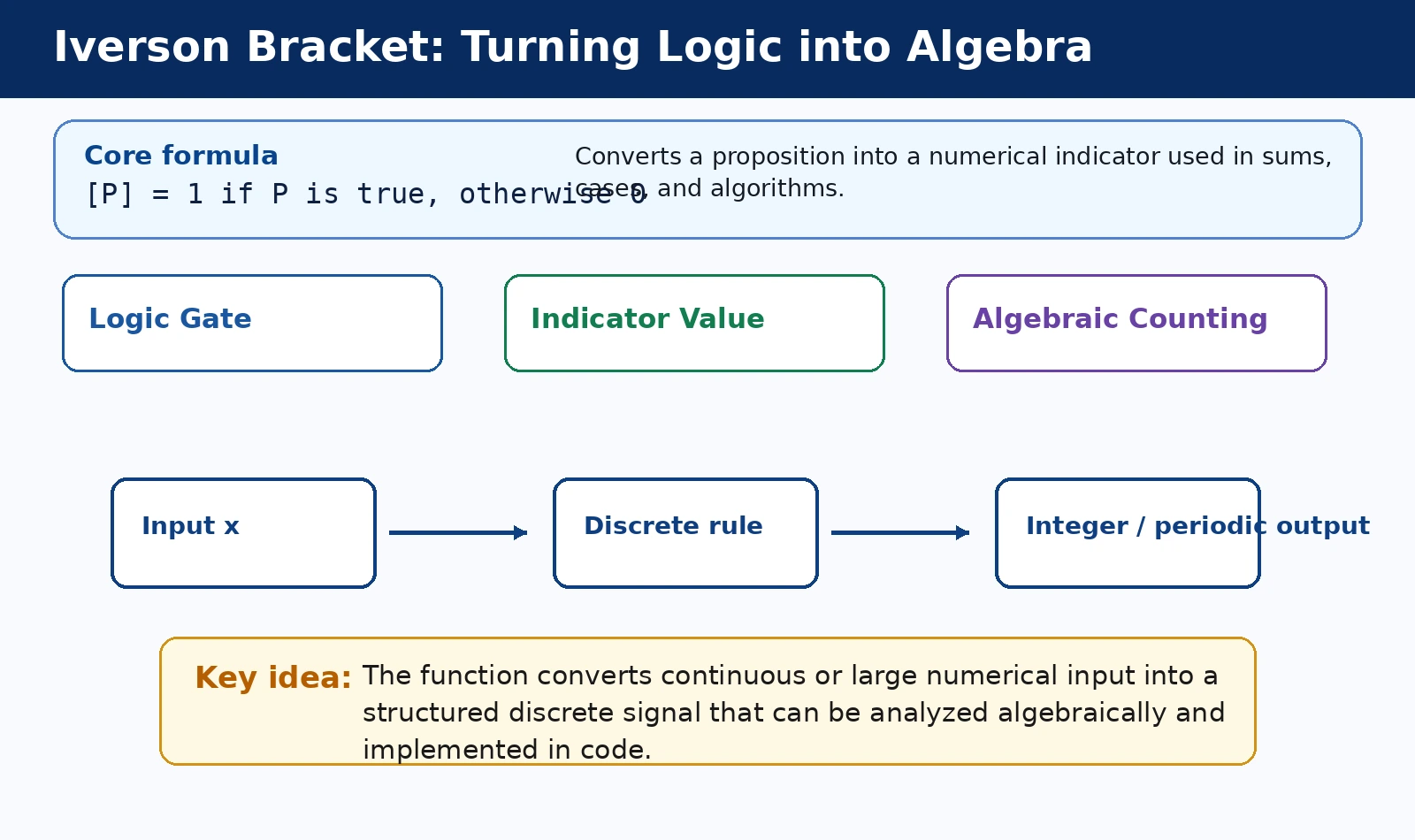
The formal definition of the Iverson bracket is straightforward but carries deep implications for symbolic manipulation. It is defined for any proposition ##P## that can be clearly identified as either being true or being false.
The mathematical representation is typically shown as:
This piecewise definition acts as the foundation for all further algebraic operations.
It is important to distinguish the Iverson bracket from the standard indicator function used in set theory. While the indicator function maps set membership, the Iverson bracket maps the truth value of any arbitrary logical statement.
By using this notation, mathematicians can avoid the use of the Kronecker delta in many contexts. The bracket is more general, as it can handle inequalities and complex logical conjunctions rather than just simple equality between two indices.
The syntax is intentionally minimal to ensure it does not clutter equations. This clarity is particularly beneficial when dealing with nested summations where multiple conditions must be satisfied simultaneously for a term to be included in the sum.
Basic Algebraic Properties
The Iverson bracket obeys several fundamental algebraic rules that make it highly versatile. For instance, the bracket of a conjunction of two independent propositions is equivalent to the product of their individual Iverson brackets in most cases.
This relationship is expressed as ##[P \text{ and } Q] = [P][Q]##. This property is vital when decomposing complex constraints into simpler, multiplicative components. It mirrors the behavior of logical "AND" operations within a numerical framework.
Similarly, the notation handles negation with ease. The bracket of the negation of a proposition ##P## is simply ##1 - [P]##. This allows for the straightforward conversion of "not" logic into a basic subtraction operation within an expression.
Linearity is another key feature, as the bracket can be distributed across sums of propositions if they are mutually exclusive. This property is frequently exploited when breaking down a large domain into smaller, non-overlapping intervals for easier analysis.
Finally, the Iverson bracket facilitates the transition from logic to arithmetic without losing information. It preserves the truth-functional nature of the underlying propositions while providing a numeric value that can be integrated, differentiated, or summed across ranges.
Representing Piecewise Functions Algebraically
One of the most significant advantages of the Iverson bracket is its ability to represent piecewise functions as a single algebraic sum. Traditionally, piecewise functions require large curly braces and multiple lines of conditional definitions for clarity.
With the Iverson bracket, a function defined differently over various intervals can be written on a single line. Each "piece" of the function is multiplied by a bracket that is true only within that specific interval's range.
This representation is not merely aesthetic; it allows for the application of standard algebraic techniques to the entire function at once. It eliminates the need to perform separate calculations for every sub-domain defined in the function.
In calculus, this notation simplifies the process of integrating step functions. By expressing the step function as a sum of brackets, the integral can be distributed across the terms, leading to a much more structured and less error-prone derivation.
Unified notation also benefits computer algebra systems. These systems can more easily manipulate expressions containing Iverson brackets than they can handle traditional piecewise definitions, which often require specialized and complex conditional logic to process correctly.
Modeling the Floor and Ceiling Functions
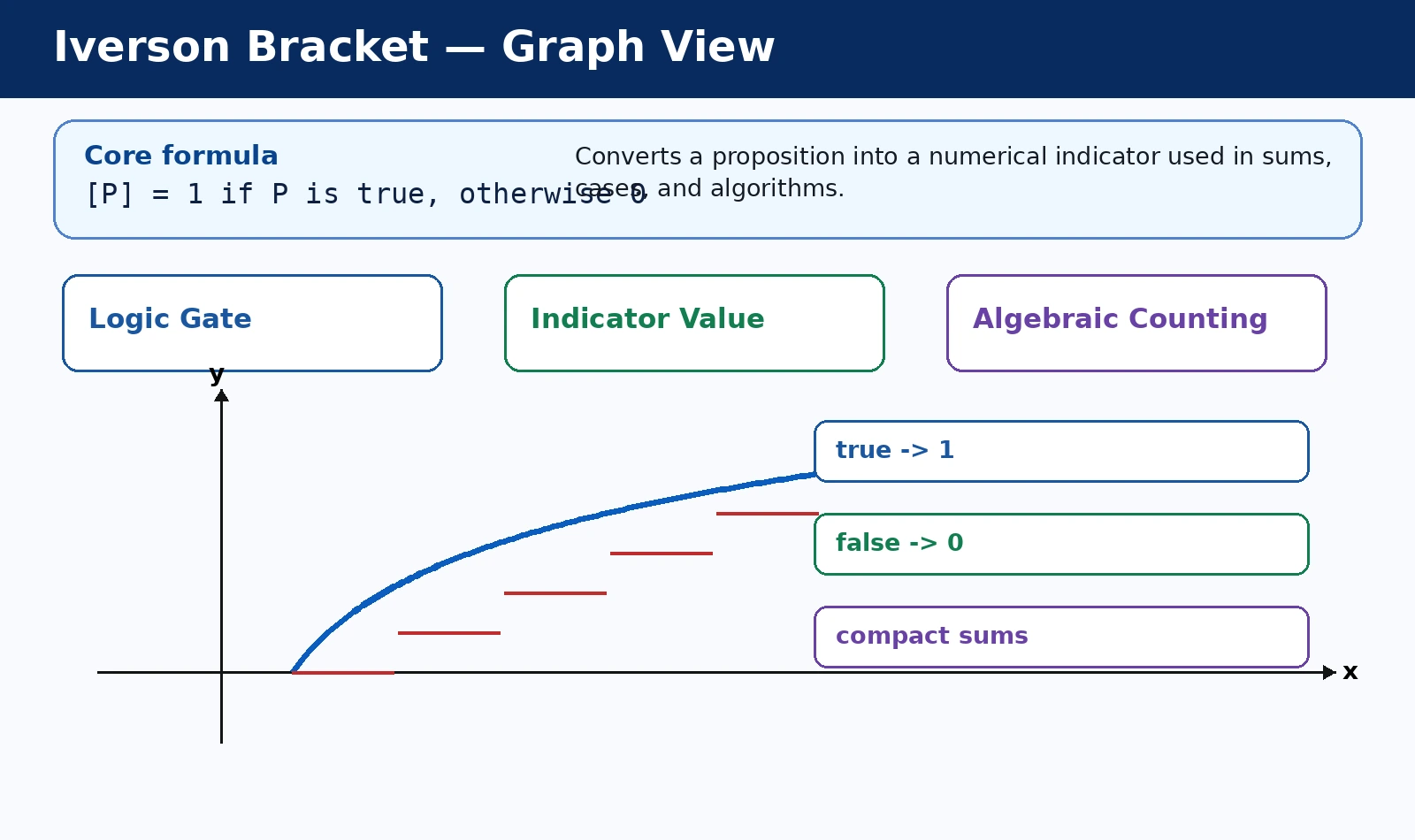
The floor function, which returns the greatest integer less than or equal to a value, is a classic example. Using the Iverson bracket, the floor of ##x## can be expressed as a summation of integer indicators.
Specifically, we can write the floor function as:
This representation treats the function as a count of integers satisfying a specific inequality.
While this might seem more complex than the standard notation, it is incredibly useful in number theory. It allows the floor function to be manipulated inside larger summations using the rules of index transformation and bracket algebra.
The ceiling function can be modeled in a similar fashion. By adjusting the inequalities within the brackets, we can precisely define the behavior of the function at integer boundaries, ensuring that the logic remains consistent and mathematically rigorous.
Using brackets to define these functions highlights the discrete nature of the floor and ceiling operations. It makes the "jumps" in the function values explicit through the binary nature of the bracket, providing better intuition for their behavior.
Handling Discontinuous Domains
Discontinuous domains often pose challenges in mathematical modeling. The Iverson bracket addresses this by allowing the explicit inclusion or exclusion of specific points or intervals through the use of logical propositions within the brackets themselves.
For a function that is zero everywhere except on a set of intervals, the bracket acts as a filter. We multiply the functional form by the bracket of the domain, effectively "turning on" the function only where needed.
This approach is particularly useful in physics and engineering when modeling impulse responses or periodic signals. The bracket can represent a pulse that is active only for a specific duration, simplifying the resulting differential equations and transforms.
Combining multiple conditions is also straightforward. If a function is active only when ##x## is between ##a## and ##b## AND ##y## is between ##c## and ##d##, we use the product of two Iverson brackets.
By eliminating conditional branching in the mathematical description, we create a more robust model. This model is easier to communicate and less likely to be misinterpreted by others who are analyzing the same technical or scientific data.
We Also Published
Applications in Summation and Combinatorics
In the realm of combinatorics, the Iverson bracket is indispensable for simplifying complex sums. It allows the constraints on the summation index to be moved from the bottom of the sigma notation into the summand itself.
By moving the condition into the summand, the limits of the summation can be extended to infinity. The Iverson bracket naturally "zeroes out" all terms that do not satisfy the original constraints, preserving the sum's total value.
This technique, often called "freeing the index," makes it much easier to swap the order of multiple summations. Since the limits are now independent of the variables, the summation signs can be rearranged without complex limit recalculations.
In combinatorial proofs, the bracket helps in counting subsets or permutations that meet specific criteria. Each valid configuration contributes a "1" to the sum via the bracket, while invalid ones contribute "0," effectively counting the valid set.
Furthermore, it simplifies the treatment of empty sums. If no index satisfies the condition within the bracket, the entire sum correctly evaluates to zero, which is the standard identity for addition over an empty set of elements.
Manipulating Summation Indices
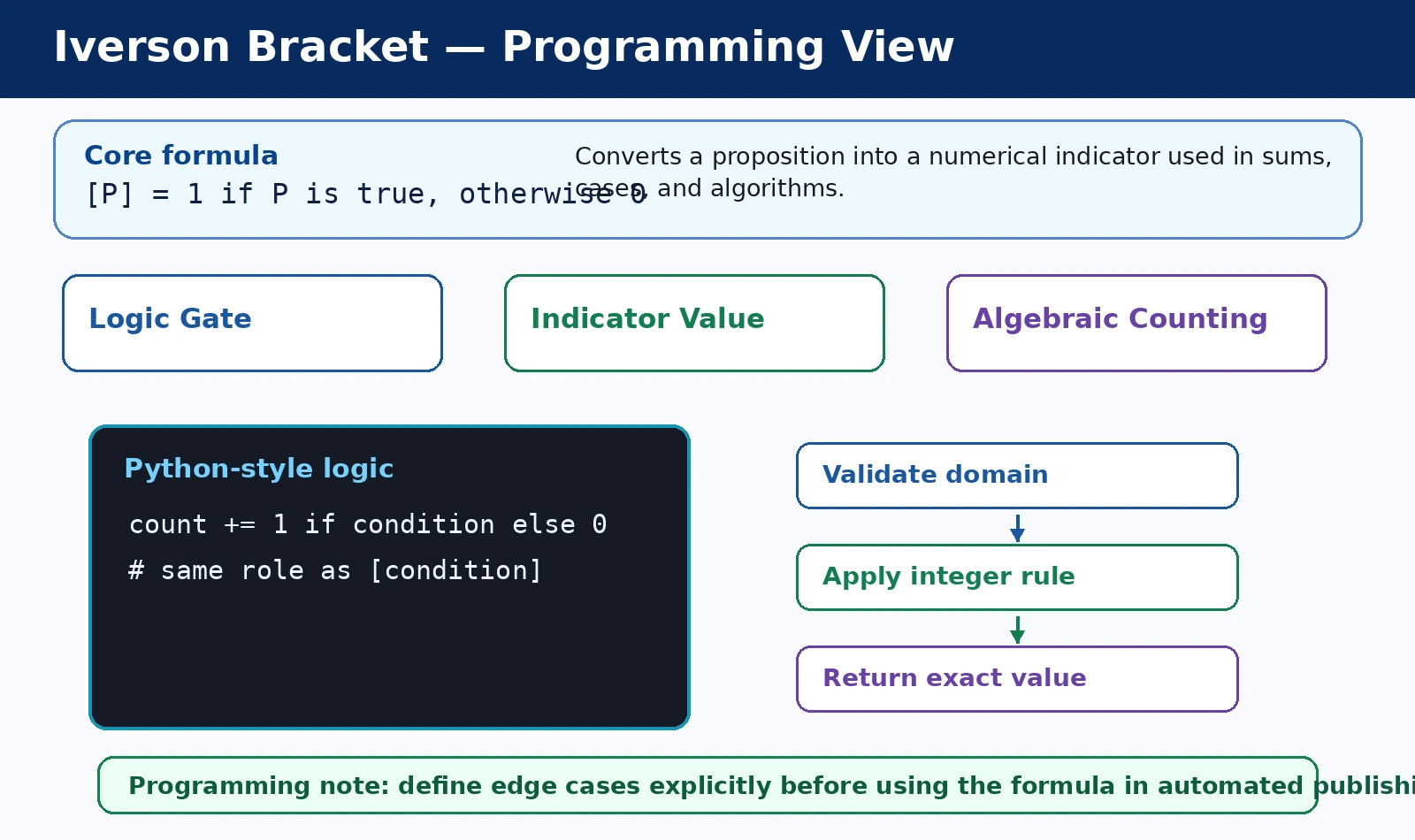
Index manipulation is a core skill in discrete mathematics. The Iverson bracket facilitates this by allowing for the substitution of variables within the proposition, which then dictates how the rest of the summand must be adjusted for consistency.
For example, when performing a change of variables in a sum, the bracket ensures that the new limits are correctly applied. The logic of the transformation is embedded directly within the algebraic structure of the expression being evaluated.
Filtering terms in a sequence becomes a matter of simple multiplication. If we only want to sum the even terms of a sequence, we multiply the general term by the bracket ##[n \text{ is even}]## before performing the summation.
This is also useful for sums involving prime numbers. Expressions like ##\sum_{p \le N} f(p)## can be rewritten as ##\sum_{n \le N} f(n) [n \in \text{Primes}]##, allowing for the application of general summation formulas to restricted subsets.
Ultimately, this leads to higher algorithmic efficiency in mathematical proofs. It reduces the cognitive load required to track shifting indices and boundary conditions, allowing the mathematician to focus on the higher-level logic of the problem at hand.
Kronecker Delta and Identity Relations
The Kronecker delta, denoted ##\delta_{ij}##, is actually a specific case of the Iverson bracket. It can be defined as ##[i = j]##, returning one if the indices are equal and zero otherwise, which is its standard definition.
Generalizing the delta function using Iverson brackets allows for more flexible identity relations. We can define generalized deltas for any relation, such as ##[i \equiv j \pmod m]##, which is useful in modular arithmetic and number theory.
Orthogonality applications in linear algebra also benefit from this notation. The condition for two vectors to be orthogonal or for a matrix to be identity-like can be expressed cleanly using brackets within the summation of components.
Identity transformations, such as the distributive law of multiplication over addition, interact perfectly with the bracket. This consistency ensures that the Iverson bracket does not introduce any anomalies into standard algebraic systems or computational frameworks.
Across various fields, from quantum mechanics to signal processing, the bracket provides a consistent language. It ensures that the definition of "identity" or "equality" remains mathematically rigorous while being easy to manipulate in a symbolic or numerical context.
Iverson Bracket in Algorithm Analysis
Algorithm analysis frequently requires counting the number of times a specific operation is performed. The Iverson bracket is the perfect tool for this, as it maps the execution of a conditional statement to a numerical count.
When analyzing the time complexity of a loop containing an 'if' statement, the total time can be expressed as a sum of Iverson brackets. Each iteration adds the cost of the operation multiplied by the bracket of the condition.
This approach is particularly helpful in average-case analysis. By taking the expected value of the Iverson bracket, which is simply the probability that the condition is true, we can calculate the expected running time of the algorithm.
Probabilistic algorithms also rely on this notation. It allows researchers to model the success or failure of randomized steps as a sequence of Bernoulli trials, which are then summed to find the total number of successful outcomes.
By mapping logic directly to data structures, the Iverson bracket enhances the clarity of technical papers. It provides a formal language for describing how algorithms branch and interact with different input sets without relying on informal descriptions.
Complexity Analysis and Counting
In Big O notation, the Iverson bracket helps in defining the bounds of a function more precisely. It can be used to isolate the behavior of an algorithm on specific subsets of the input space that drive complexity.
Counting distinct elements in a stream or a set is another area where the bracket shines. The count can be expressed as the sum of brackets that check if each element has appeared previously in the sequence.
Set membership and filtering operations in database theory can also be modeled this way. The result of a query is essentially the sum of the records in the database multiplied by the bracket of the query's predicate.
Efficiency in solving recurrences is often improved by using brackets to handle the base cases. Instead of defining a recurrence in multiple parts, one can use brackets to incorporate the base case into the general formula.
This quantitative logic modeling is essential for modern computer science. it allows for a rigorous mathematical treatment of software behavior, leading to better optimization and a deeper understanding of the fundamental limits of computation and data.
Implementation in Programming Logic
In practical programming, the concept of the Iverson bracket is often implemented via boolean-to-integer casting. Many languages, like C and Python, allow booleans to be treated as 1 or 0 in arithmetic expressions, mimicking the bracket.
Branchless programming techniques often leverage this behavior to improve performance. By replacing an 'if' statement with an arithmetic expression involving a boolean, programmers can avoid the performance penalty associated with CPU branch mispredictions in modern hardware.
Vectorization in languages like APL, NumPy, or R also utilizes the Iverson bracket concept. Operations are applied to entire arrays, and logical masks (which are essentially arrays of Iverson brackets) are used to filter the results efficiently.
However, performance considerations must be kept in mind. While branchless code can be faster, it can also lead to more computations if the "false" branch of the logic is computationally expensive, as both paths might be evaluated in some implementations.
The future of symbolic computation likely involves even deeper integration of the Iverson bracket. As compilers and math engines become more sophisticated, they will increasingly use these algebraic representations to optimize code and simplify complex logical structures automatically.
From our network :
- 98% of Global MBA Programs Now Prefer GRE Over GMAT Focus EditionExplore why 98% of global MBA programs now prefer the GRE over GMAT Focus. Learn about the shorter GRE format, verbal logic importance, and strategic versatility for students.
- Mastering DB2 LUW v12 Tables: A Comprehensive Technical GuideComprehensive guide on DB2 LUW v12 tables. Explore CREATE TABLE syntax, BLU Acceleration, range partitioning, data types, and security features for IBM DB2 LUW v12.
- EV 2.0: The Solid-State Battery Breakthrough and Global Factory ExpansionDiscover the impact of the Solid-State Battery Breakthrough on the EV market. Learn about CATL and BYD stock growth, global factory expansion in Europe, and the future of EV 2.0 technology.
- Trump Political Strategy How Geopolitical Stunts Serve As Media Diversions
- Mastering DB2 12.1 Instance Design: A Technical Deep Dive into Modern Database ArchitectureComprehensive guide to DB2 12.1 Instance Design. Explore architectural components, HADR setup, buffer pool tuning, and security policies for IBM DB2 12.1. Includes 10 functional SQL and Shell samples.
- Vite 6/7 'Cold Start' Regression in Massive Module GraphsIn-depth analysis of Vite 6/7 cold start regressions in massive module graphs. Learn about barrel file issues, pre-bundling optimizations, and how to improve Vite dev server performance.
- Analyzing Trump Deportation Numbers Insights Into The 2026 Immigration Crackdown
- AI-Powered 'Precision Diagnostic' Replaces Standard GRE Score ReportsDiscover the new GRE Precision Diagnostic. Learn how AI-powered behavioral analytics and time-to-solve tracking are replacing standard GRE score reports to empower students.
- 10 Physics Numerical Problems with Solutions for IIT JEEPrepare for IIT JEE with 10 physics numerical problems, complete with detailed solutions and conceptual explanations. Ideal for mastering kinematics, thermodynamics, electromagnetism, and optics.
RESOURCES
- Iverson bracket - Wikipedia
- Iverson Bracket -- from Wolfram MathWorld
- How widely known are Iverson brackets? - Math Stack Exchange
- A method of distinguishing Iverson from other brackets? - TeX
- Iverson Bracket - Ozaner's Notes
- The Iverson Bracket is a powerful generalization of the well-known ...
- Iverson brackets and SwiftUI modifiers - Distillations
- Iverson bracket and kronecker delta - Facebook
- Use of ternary operator in formal writing - MathOverflow
- MathType - The Iverson Bracket is a powerful generalization of the ...
- Activation functions and Iverson brackets
- The Iverson Bracket is a powerful generalization of the well-known ...
- Iverson bracket - OeisWiki
- Ken Iverson - APL Wiki
- What is the mathematical notation of a boolean to binary function? Is ...


0 Comments