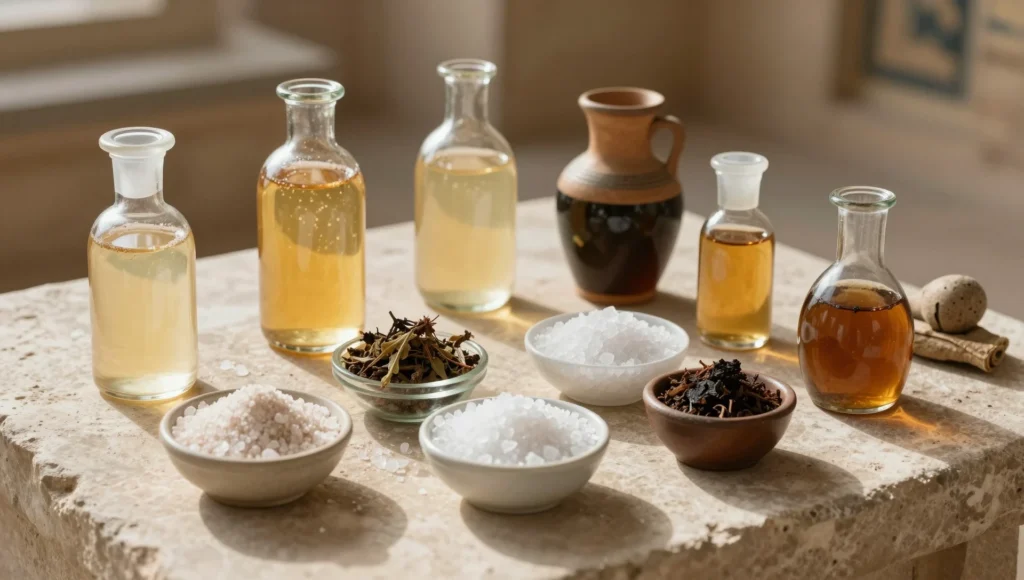
Ancient Egyptian mummification has long been imagined as a ritual shrouded in incense and mystery, yet the surviving hieroglyphic manuals are frustratingly incomplete. They name substances, prescribe sequences, and invoke divine protection, but the vocabulary of embalming is ancient and ambiguous, and many plant names resist secure translation into modern botanical categories. Into that gap steps a quiet revolution: analytical chemistry. By testing residues inside storage vessels, reading the molecular signatures trapped in linen wrappings, and comparing museum powders against historical recipes, researchers are reconstructing what embalmers actually handled, mixed, and applied. The results are rewriting assumptions about trade networks, ritual aesthetics, and even the strange afterlife of mummies as medicine.
A recent collaboration between Egyptologists and chemists at Marburg University in Germany illustrates how far this interdisciplinary method has travelled. Ricarda Gericke, an Egyptologist, and Raphael Reher, a chemist and pharmacist, joined forces to interrogate both the written record and the physical remains. Their work, published in the Proceedings of the National Academy of Sciences, examined embalming materials and medicinal powders drawn from storage jars and historical collections. What emerged was a portrait of Egyptian embalming as a sophisticated chemical craft, one that sourced exotic ingredients across vast distances and pursued a sensory outcome—a pleasant, godlike fragrance—as deliberately as it pursued preservation itself.
The findings matter beyond Egyptology. They clarify why some bodies survived millennia while ordinary burials vanished within decades, they expose a medieval medical market that mislabelled its products, and they demonstrate how modern instrumentation can resolve puzzles that texts alone cannot. Anne Austin, an Egyptologist at the University of Missouri-St. Louis who was not involved in the study, noted that identifying mummification materials is notoriously difficult precisely because ancient plant names may not correspond to modern species. The Marburg work shows that pairing textual scholarship with molecular analysis can close that gap, turning uncertain hieroglyphs into testable chemical hypotheses.
On This Page
The Chemistry Behind Millennia of Preservation
Ordinary organic matter buried in the Egyptian desert does not last three thousand years. Soft tissue decomposes within decades under the combined assault of bacteria, fungi, and endogenous enzymes, and even bone eventually yields to groundwater and salt. Mummification interrupted that trajectory through a deliberate sequence of chemical interventions: desiccation with natron salt, application of oils and resins, and wrapping in linen that physically excluded insects and moisture. The Marburg team's analytical work helps explain why this sequence worked so well, and why the resulting remains are now such valuable chemical archives rather than merely archaeological curiosities.
Desiccation, Oils, and the Godlike Scent
Embalmers began by cleansing the body and immersing it in salt, most likely natron, a naturally occurring mixture of sodium carbonate, sodium bicarbonate, sodium chloride, and sodium sulfate. This step drove moisture out of tissues and created an environment hostile to microbial growth. Only after desiccation did the embalmers apply oils, resins, and aromatic substances, which sealed the surface, deterred insects, and imparted the fragrance the Egyptians associated with divinity. The precise recipe behind that fragrance had remained uncertain, and the Marburg analyses of residues now offer a molecular window into which substances were actually used.
The preservation outcome can be framed in simple kinetic terms. Decomposition proceeds at a rate that depends on microbial activity and available water, so removing water suppresses the reaction dramatically. A useful way to express the principle is through the Arrhenius relationship, where the rate constant depends exponentially on temperature and, in practice, on the availability of water as a reaction medium:
In this expression, ##k## is the rate constant, ##A## the pre-exponential factor, ##E_a## the activation energy, ##R## the gas constant, and ##T## the absolute temperature. Desiccation does not change ##E_a## directly; instead it removes the aqueous medium in which hydrolysis and enzymatic catalysis occur, effectively collapsing the pre-exponential term for those pathways. That is why natron treatment, followed by oil and resin sealing, could arrest decay for millennia rather than merely delay it by a few seasons.
Reading Residues in Jars and Wrappings
Storage jars recovered from embalming workshops are chemical time capsules. Residues clinging to their interiors preserve lipids, resins, waxes, and plant extracts that were mixed, stored, and dispensed during the mummification process. The Marburg researchers tested powders from such jars alongside materials from historical collections, using chromatographic and mass spectrometric techniques capable of identifying individual molecular components. This approach moves beyond bulk description—"oil" or "resin"—toward specific compounds, allowing the team to distinguish, for example, conifer resins from plant oils and to detect unexpected additives that no surviving text records.
The same logic applies to the wrappings themselves. Linen is absorbent, and the substances applied to a body migrate into the fabric, where they survive as a stratified chemical record. By analysing the wrappings around a 3,000-year-old mummified head from ancient Egypt, the team identified aloe extracts, a genuinely surprising result. Aloe plants were not native to Egypt, so their presence implies long-distance trade and a supply chain reaching well beyond the Nile Valley. The discovery also offers a plausible reading for a hieroglyph whose translation had long been uncertain, illustrating how chemistry can inform philology as much as the reverse.
Trade Networks Written in Molecular Form
Every exotic compound identified in an embalming context is also a fragment of economic history. Egypt's embalmers depended on imports—resins from the Levant and Anatolia, aromatics from the Horn of Africa and beyond—and the demand generated by funerary practice helped sustain long-distance exchange. The detection of aloe in a 3,000-year-old wrapping is therefore more than a curiosity: it is physical evidence of a supply chain linking the Nile Valley to regions where aloe grew naturally. Such findings complement papyrological records of trade and tribute, filling gaps where documents are silent or ambiguous.
Aloe, Imported Aromatics, and Long-Distance Exchange
Aloe's absence from the native Egyptian flora makes its presence in mummy wrappings diagnostically significant. The plant had to arrive through trade, probably as dried extract, resin, or processed juice, and it had to be valuable enough to justify transport across considerable distances. The Marburg team's identification therefore supports a picture of embalming workshops as consumers within an international market, sensitive to the availability and prestige of imported materials. It also raises questions about how such substances were priced, adulterated, and substituted, questions that residue analysis is uniquely positioned to address.
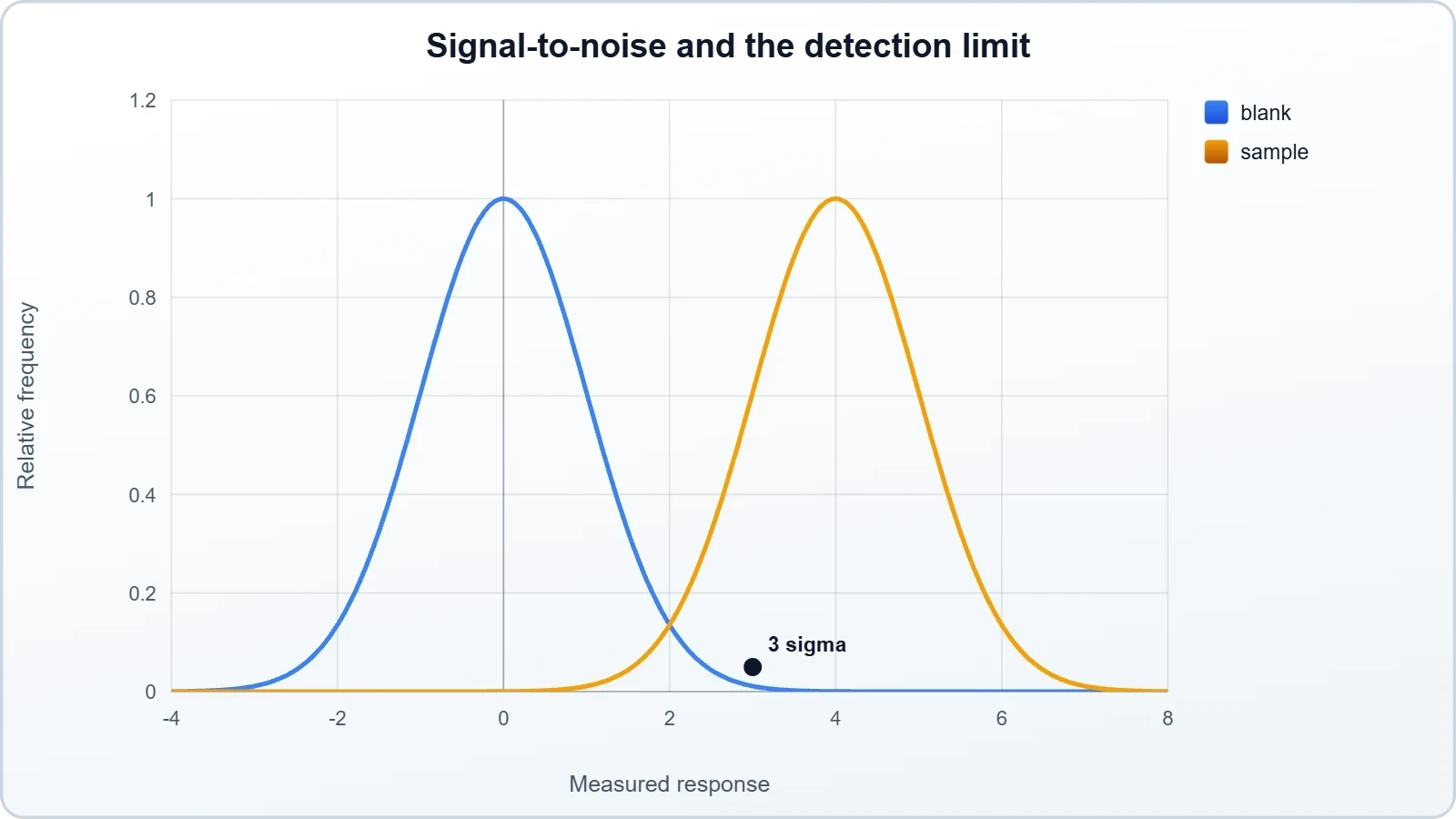
Trade reconstruction of this kind depends on secure chemical identification, which in turn depends on statistical confidence in the analytical signal. When a laboratory reports the presence of a compound, it is really reporting that the measured signal exceeds what noise alone would produce. A simple way to formalise that judgement is through the signal-to-noise ratio, which compares the strength of a putative peak to the variability of the baseline:
Here ##\mu_{\text{signal}}## is the mean response at the candidate peak, ##\mu_{\text{blank}}## the mean response of a blank sample, and ##\sigma_{\text{blank}}## the standard deviation of blank measurements. A ratio comfortably above three is conventionally treated as evidence of detection, while ratios near one indicate noise. For archaeological residues, where concentrations may be trace and contamination is a constant risk, rigorous blank subtraction and replicate measurements are essential before any claim about ancient trade can be sustained.
Why Provenance Claims Require Chemical Confidence
Provenance arguments are only as strong as the analytical chain supporting them. A compound identified in a jar might derive from the original contents, from later handling, from conservation treatments, or from the museum environment. Distinguishing these possibilities requires careful sampling, control materials, and awareness of how substances degrade over centuries. The Marburg team's approach—testing both workshop jars and historical collection powders—reflects this discipline, because comparing contexts helps separate ancient practice from modern contamination and from the commercial repackaging that occurred in later centuries.
The stakes are considerable. If aloe truly reached Egypt through long-distance trade and was used in embalming, then the ritual economy of mummification was entangled with international commerce in ways that textual sources only partially reveal. If, alternatively, a signal reflects contamination, an entire interpretive edifice collapses. This is why the field increasingly insists on multi-method confirmation, publishing raw data, and integrating archaeological context with instrumental results. Chemistry supplies the molecular evidence, but archaeology supplies the interpretive frame without which that evidence remains ambiguous.
The Strange Afterlife of Mummies as Medicine
For centuries, mummified human remains occupied an unlikely place in European pharmacies. Ground mummy, known as mumia, was prescribed for coughs, snakebites, and a range of other ailments, and it was valued partly as a cheaper substitute for bitumen, the petroleum-derived substance that physicians believed possessed curative power. The logic was associative rather than experimental: if bitumen healed, and mummies were thought to contain bitumen, then powdered mummy should heal as well. Demand grew sufficiently that merchants supplied the market through both genuine antiquities and manufactured substitutes, a trade that raises uncomfortable questions about the relationship between medicine, commerce, and the dead.
Mumia, Bitumen, and a Market in Substitutes
The Marburg team's testing of powders from storage jars and historical collections produced a striking negative result: the medicinal products examined did not contain bitumen. This finding undermines the assumption that mumia functioned as a bitumen substitute in any literal chemical sense. Whatever the powders contained, they were not the petroleum product that early modern pharmacology prized. The result invites a reassessment of how medicinal mummy was sourced, adulterated, and marketed, and it suggests that the material's reputation rested more on symbolism and commercial convenience than on any consistent chemical composition.

The economics of substitution are familiar from modern markets, where a premium product's reputation creates incentives to sell imitations. In the mumia trade, the premium attached to authentic Egyptian mummy, and the supply of genuine antiquities was finite and morally fraught. Sellers therefore had strong incentives to fabricate, dilute, or relabel. Chemical analysis can now distinguish these categories after the fact, revealing whether a given powder derives from human tissue, from bitumen, or from plant and mineral fillers. Such testing transforms a historical anecdote into a measurable pattern of commercial behaviour.
What Residue Analysis Says About Early Modern Pharmacies
Residue analysis of historical medicinal powders offers a rare empirical window into early modern pharmacy. Written formularies describe ingredients, but they cannot confirm what was actually sold, and they certainly cannot detect adulteration. Instrumental testing can. When the Marburg researchers found no bitumen in the tested products, they demonstrated that the documentary record and the material record diverge, and that the divergence is informative rather than merely confusing. It suggests that the mumia market operated with considerable latitude, and that consumers may have received materials quite different from what the label promised.
This line of inquiry also bears on the ethics of historical collections. Many museums hold human remains acquired during periods when such acquisition was routine and poorly regulated. Chemical analysis that reveals the composition of medicinal powders can inform repatriation discussions, conservation decisions, and public interpretation. Understanding what these substances were—and were not—helps institutions describe their holdings accurately and treat them with appropriate respect, while also illuminating the medical marketplace that created demand for them in the first place.
Hieroglyphs Meet the Mass Spectrometer
The most intellectually satisfying outcome of this research is methodological rather than merely descriptive. Egyptology has long depended on textual interpretation, and chemistry has long depended on controlled laboratory measurement, but the two disciplines rarely spoke to one another with precision. The Marburg collaboration demonstrates what becomes possible when they do. A hieroglyph whose meaning was uncertain can be tested against a residue whose identity is known, and the resulting correspondence can refine both the translation and the chemical interpretation. Neither discipline alone could have reached that conclusion.
Resolving an Uncertain Translation
Ancient Egyptian texts name plants using vocabulary that does not map neatly onto modern botanical taxonomy. A word translated as one species might refer to another, or to a preparation derived from several plants, or to a substance traded under a name that shifted with geography and time. When the Marburg team identified aloe in the wrappings of a 3,000-year-old head, they provided a concrete chemical anchor for a term that had resisted secure translation. The identification does not settle every philological question, but it narrows the range of plausible readings and gives future translators a firmer footing.
This is how interdisciplinary progress typically works: not through a single decisive breakthrough, but through the accumulation of constraints that progressively narrow the space of viable interpretations. Each confirmed residue eliminates some candidate translations and strengthens others. Over time, the textual and material records converge on a more reliable account of embalming practice. The approach also has a cautionary dimension, because a single identification can be over-interpreted, and responsible scholarship requires acknowledging uncertainty while still reporting what the evidence supports.
Building a Shared Vocabulary Across Disciplines
Effective collaboration requires a shared vocabulary, and building one is harder than it sounds. Chemists speak of biomarkers, retention times, and limits of detection; Egyptologists speak of determinatives, registers, and workshop records. Translating between these languages demands patience and mutual respect, and it demands that each side understand the limitations of the other's evidence. A chemist who ignores archaeological context may overstate provenance; an Egyptologist who ignores analytical uncertainty may overstate identification. The Marburg project's strength lies in refusing both errors.
The broader lesson extends well beyond mummies. Archaeology, conservation science, and museum studies all benefit when instrumental analysis is integrated with historical scholarship from the outset rather than appended as an afterthought. Funding agencies increasingly favour such collaborations, and training programmes are beginning to produce researchers comfortable in both laboratories and archives. If the Marburg work has a legacy, it may be this: a demonstration that the most interesting questions about the past are often answered at the boundary between disciplines, where neither text nor instrument alone suffices.
We Also Published
What the Evidence Can and Cannot Establish
Enthusiasm for interdisciplinary results should be tempered by a clear-eyed account of evidential limits. Residue analysis identifies molecules, not intentions; it can confirm that aloe was present in a wrapping without explaining why it was applied or what it signified to the embalmers. Similarly, the absence of bitumen in tested medicinal powders does not prove that no historical mumia ever contained bitumen, only that the specific samples examined did not. Responsible interpretation requires stating these boundaries explicitly, because overreach in one study can discredit an entire research programme.
Sampling, Contamination, and Degradation
Archaeological samples are rarely pristine. Residues in jars may have been altered by millennia of exposure, by cleaning, by conservation treatments, or by the storage conditions of the collecting institution. Degradation pathways can transform original compounds into derivatives that resist straightforward identification, and contamination can introduce molecules that were never part of the ancient material. Addressing these challenges requires rigorous protocols: sampling from protected interior surfaces, running blanks and reference materials, and interpreting results in light of known degradation chemistry rather than assuming a one-to-one match with fresh substances.
Statistical reasoning is indispensable here, because the question is rarely whether a signal exists but whether it is distinguishable from background. Replicate measurements, confidence intervals, and explicit detection limits allow researchers to state how strongly the data support a given identification. When these practices are followed, the resulting claims are appropriately hedged and genuinely informative. When they are skipped, the literature accumulates assertions that later prove unreproducible. The Marburg study's publication in a leading journal suggests that its analytical protocols met a high standard, but the broader field still benefits from a culture of transparent reporting.
From Laboratory Result to Historical Narrative
Translating a laboratory result into a historical narrative is an act of interpretation, and it should be conducted with appropriate humility. A confirmed residue can support a claim about trade, but the claim also depends on assumptions about supply chains, pricing, and demand that chemistry cannot verify. Historians and archaeologists therefore remain essential partners, supplying the contextual knowledge that turns a molecular signal into a meaningful statement about past behaviour. The most persuasive accounts are those in which chemical evidence and historical reasoning constrain one another, producing conclusions that neither could support alone.
This is ultimately why the Marburg collaboration matters. It does not merely add a few substances to a list of embalming ingredients; it models a way of working in which texts, objects, and instruments are treated as complementary sources of evidence. The ancient Egyptians pursued a pleasant, godlike smell through chemical means, and modern researchers are now recovering the traces of that pursuit with instruments their predecessors could not have imagined. The result is a richer, more precise, and more honest account of how mummification actually worked, and of how knowledge about the distant past is built.
Why This Research Resonates Beyond Egyptology
The Marburg study speaks to questions far larger than the contents of a few embalming jars. It demonstrates that the past is not a closed archive but an open problem, one that new instruments can reopen decades after a site was excavated. It shows that disciplines separated by institutional boundaries can produce insights neither could achieve alone. And it reminds us that ancient people were sophisticated chemical practitioners, selecting, importing, mixing, and applying materials with a technical competence that deserves recognition alongside their achievements in architecture, mathematics, and medicine.
Lessons for Interdisciplinary Science
For scientists working in any field that touches cultural heritage, several lessons stand out. First, involve domain experts early, because a question framed without historical knowledge may be analytically elegant but historically trivial. Second, publish methods and data transparently, since reproducibility is the foundation of trust in fields where samples are irreplaceable. Third, resist the temptation to over-claim, because a single dramatic identification can overshadow the careful work that supports it. These principles are not unique to archaeology, but they are especially consequential when the objects under study are finite, fragile, and often ethically charged.
There is also a lesson about public communication. Stories about mummies travel widely because they combine the exotic, the macabre, and the scientific, and that reach carries responsibility. Researchers who explain their methods clearly, acknowledge uncertainty, and resist sensational framing help build public trust in science generally. The Marburg team's findings were reported by major outlets precisely because they are genuinely interesting, not because they were exaggerated. That balance—accessible without being simplistic, exciting without being reckless—is worth emulating across scientific communication.
The Enduring Value of Chemical Archaeology
Chemical archaeology is still a young field, and its most significant discoveries may lie ahead. Improved instrumentation, better reference libraries, and growing collaboration between laboratories and museums are steadily expanding what can be detected in ancient materials. As these capabilities mature, researchers will be able to reconstruct not only what substances were used but how they were processed, where they originated, and how practices changed over centuries. The mummification workshops of Egypt are an ideal testing ground for these methods, because they generated abundant, well-preserved, and richly documented chemical residues.
What emerges from this work is a portrait of ancient Egypt that is more technical and more connected than popular imagination often allows. Embalmers were not merely ritual specialists reciting formulas; they were practitioners managing supply chains, evaluating materials, and achieving preservation outcomes that modern science is still working to explain. The pleasant, godlike smell they sought was the product of deliberate chemical choices, and the residues of those choices survive today as evidence. Chemistry has not stripped the mystery from mummification; it has replaced vague wonder with precise, testable, and far more interesting knowledge.
From our network :
- Analyzing Trump Deportation Numbers Insights Into The 2026 Immigration Crackdown
- 10 Physics Numerical Problems with Solutions for IIT JEEPrepare for IIT JEE with 10 physics numerical problems, complete with detailed solutions and conceptual explanations. Ideal for mastering kinematics, thermodynamics, electromagnetism, and optics.
- Mastering DB2 12.1 Instance Design: A Technical Deep Dive into Modern Database ArchitectureComprehensive guide to DB2 12.1 Instance Design. Explore architectural components, HADR setup, buffer pool tuning, and security policies for IBM DB2 12.1. Includes 10 functional SQL and Shell samples.
- Vite 6/7 'Cold Start' Regression in Massive Module GraphsIn-depth analysis of Vite 6/7 cold start regressions in massive module graphs. Learn about barrel file issues, pre-bundling optimizations, and how to improve Vite dev server performance.
- EV 2.0: The Solid-State Battery Breakthrough and Global Factory ExpansionDiscover the impact of the Solid-State Battery Breakthrough on the EV market. Learn about CATL and BYD stock growth, global factory expansion in Europe, and the future of EV 2.0 technology.
- Trump Political Strategy How Geopolitical Stunts Serve As Media Diversions
- 98% of Global MBA Programs Now Prefer GRE Over GMAT Focus EditionExplore why 98% of global MBA programs now prefer the GRE over GMAT Focus. Learn about the shorter GRE format, verbal logic importance, and strategic versatility for students.
- Mastering DB2 LUW v12 Tables: A Comprehensive Technical GuideComprehensive guide on DB2 LUW v12 tables. Explore CREATE TABLE syntax, BLU Acceleration, range partitioning, data types, and security features for IBM DB2 LUW v12.
- AI-Powered 'Precision Diagnostic' Replaces Standard GRE Score ReportsDiscover the new GRE Precision Diagnostic. Learn how AI-powered behavioral analytics and time-to-solve tracking are replacing standard GRE score reports to empower students.
RESOURCES
- The Chemistry of Mummification - Compound Interestcompoundchem.comOct 27, 2016 ... It's hygroscopic, meaning that it absorbs water easily, so it was used by the Ancient Egyptians as a drying agent…
- Ancient Egyptian Mummified Bodies: Cross-Disciplinary Analysis of ...pubs.acs.orgFeb 13, 2025 ... Clusters based on the chemical and olfactory profiles of the smells emerged, suggesting similarities based on the archeological period, ...
- Organic chemistry of embalming agents in Pharaonic and Graeco ...pubmed.ncbi.nlm.nih.govOct 25, 2001 ... Chemical treatments were an essential element of ancient Egyptian mummification. Although the inorganic salt natron is recognized as having ...
- Scientifically sniffing ancient Egyptian mummified bodiesacs.orgFeb 20, 2025 ... Have you ever wondered what a mummy smells like? According to research reported in the Journal of the American Chemical…
- Biomolecular characterization of 3500-year-old ancient Egyptian ...nature.comAug 31, 2023 ... In recognition of the chemical diversity of the biological components in many analyzed mummification balms, we draw upon a multi-analytical ...
- The chemistry behind ancient Egyptian mummificationpopsci.comFeb 1, 2023 ... Some ceramics contained blends of different chemicals. For example, one container had ricinoleic acid (a type of fatty acid used…
- Chemistry of Mummification: from Mummies to Modern Sciencesbibalex.orgMay 18, 2025 ... In ancient Egypt, for instance, mummification was an integral part of religious beliefs, as the Egyptians believed that preserving the…
- Organic chemistry of balms used in the preparation of pharaonic ...pnas.orgNov 18, 2013 ... Meat mummies are but one type of animal mummy produced by the Egyptians, the others including votives, pets to be…
- Unwrapping ancient Egyptian chemistry | Featurechemistryworld.comNov 21, 2022 ... From mummification to metallurgy, Rachel Brazil looks at the impressive chemistry used by this ancient civilisation.
- The significance of petroleum bitumen in ancient Egyptian mummiesroyalsocietypublishing.org... the importance of bitumen in ancient Egyptian mummification, our aim here ... Organic chemistry of balms used in the preparation of pharaonic meat…
- Archaeologists are using chemistry to learn more about mummiesnpr.org13 hours ago ... Ancient Egyptian mummy remains were once marketed as medicine. Research finds at least some of these products came from real…
- Egyptian mummy gives up embalming secrets - C&ENcen.acs.orgAug 15, 2018 ... A team of chemists and Egyptologists has now carried out the first chemical analysis of embalming compounds from an intact…
- Residues from embalming vessels cast new light on ancient ...chemistryworld.comFeb 1, 2023 ... ... the mummification process, according to results from a new chemical analysis of residues recovered from ancient Egyptian embalming vessels.
- Ancient Egyptian mummification 'recipe' revealed - BBCbbc.comAug 16, 2018 ... A battery of forensic chemical tests carried out on a mummy that dated from 3,700-3,500 BC revealed the recipe and…
- Ancient pots contain chemical secrets of mummification - C&ENcen.acs.orgFeb 1, 2023 ... Analytical chemistry reveals recipes from an ancient Egyptian embalming workshop. ... the secret recipes behind mummification. Credit: M ...