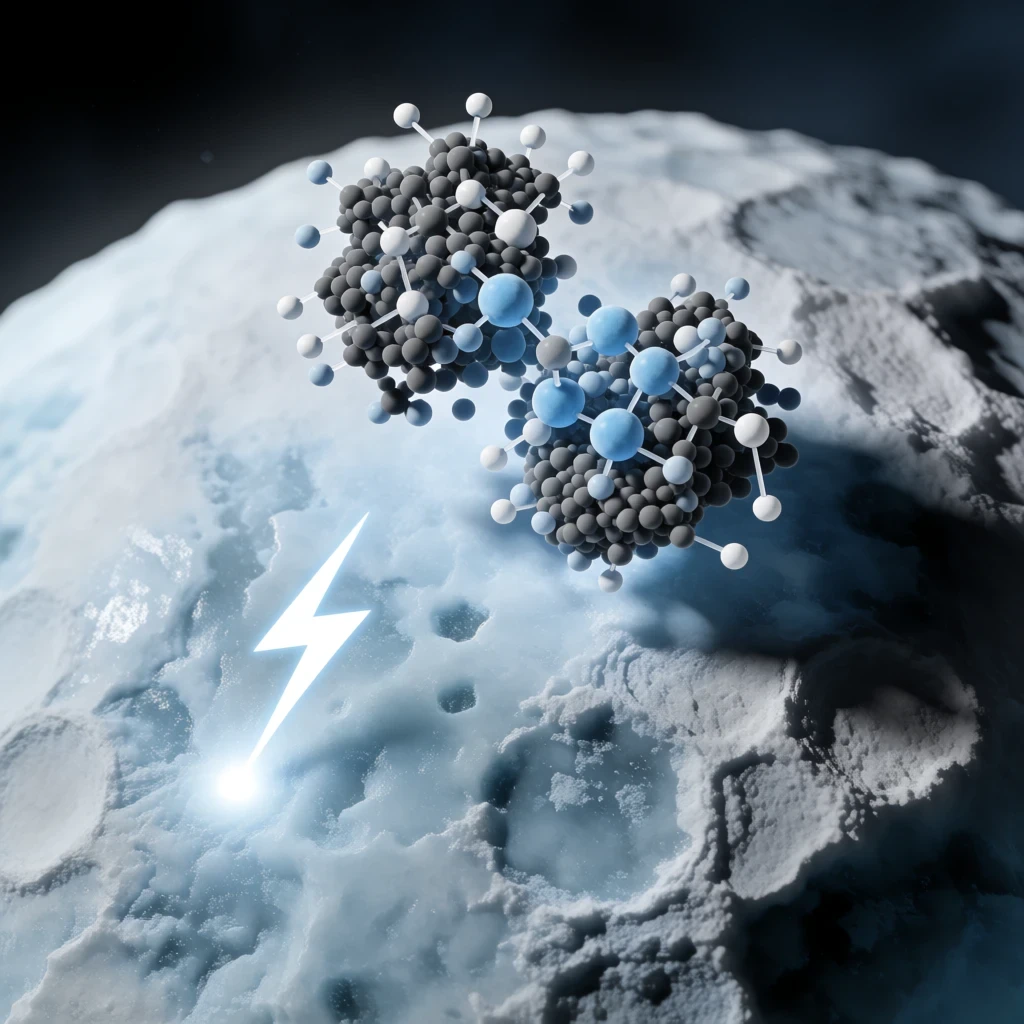
Icy moons are not inert snowballs drifting through the dark. Beneath their frozen shells, tidal heating and radiolysis conspire to drive chemistry that no terrestrial laboratory would easily replicate, and the resulting molecular inventory may hold the raw ingredients of habitability. Among the most consequential reactions is the forging of an oxygen–oxygen bond, the chemical signature that separates benign carbon dioxide and water from aggressive peroxides and reactive oxygen species. Recent cluster experiments reveal that ionized CO₂–H₂O aggregates, when struck by radiation, can assemble these bonds with surprising efficiency, offering a plausible route to prebiotic chemistry on Europa, Enceladus, and their kin.
The story matters because astrobiology has long struggled to explain how simple volatiles become chemically interesting on a frozen world. Water ice and carbon dioxide are abundant, yet both are thermodynamically comfortable and chemically sluggish. Radiation changes that calculus. When energetic particles or ultraviolet photons strike a mixed cluster, ionization cascades through the hydrogen-bonded network, and the resulting cation can steer oxygen atoms into new arrangements. The oxygen–oxygen linkage that emerges is the backbone of hydrogen peroxide, a molecule that reshapes surface chemistry and supplies oxidants to any subsurface ocean below.
This analysis unpacks the cluster science behind that claim, translates the quantum and thermodynamic reasoning into accessible terms, and connects laboratory findings to the instruments now orbiting the outer planets. We will examine how ionized clusters behave, why peroxide formation is a chemical turning point, and what it implies for the search for habitable environments beyond Earth. The thread running through every section is simple: a handful of water molecules, properly energized, can rewrite the chemistry of an entire alien surface.
On This Page
- The Physics of Ionized CO₂–H₂O Clusters Under Radiation
- Why the Oxygen–Oxygen Bond Is a Chemical Turning Point
- Quantum and Thermodynamic Reasoning Behind Cluster Reactivity
- Astrobiological Implications for Icy Moon Exploration
- Open Questions and the Future of Radiation-Driven Astrochemistry
- Synthesis: A Few Molecules, a Vast Chemical Frontier
The Physics of Ionized CO₂–H₂O Clusters Under Radiation
Cluster science occupies a fertile middle ground between gas-phase chemistry and condensed-matter physics. A cluster of a few water molecules bound to carbon dioxide is small enough for quantum effects to dominate yet large enough to mimic the hydrogen-bonded environment of an ice grain. When radiation deposits energy into such a system, the cluster becomes a microscopic reactor in which ionization, fragmentation, and recombination compete on femtosecond timescales.
How Ionization Seeds Reactive Chemistry
Ionization removes an electron from the cluster and leaves a hole that migrates through the hydrogen-bond network. This hole is not a passive spectator; it polarizes neighboring molecules and lowers the barriers to bond rearrangement. In mixed CO₂–H₂O clusters, the carbon dioxide unit often acts as the electron acceptor, while water molecules donate hydrogen bonds that stabilize the resulting cation.
The energy landscape of the ionized cluster is steep and unforgiving. Vertical ionization energies for water sit near ##[12.6\ \text{eV}]##, while carbon dioxide ionizes closer to ##[13.8\ \text{eV}]##, so the initial charge location depends sensitively on cluster geometry. Once formed, the cation can relax by proton transfer, producing a hydroxyl radical and a protonated partner that further destabilize the network.
Radiation chemistry is fundamentally a statistics problem layered onto quantum mechanics. The probability that a given cluster absorbs a photon or suffers an inelastic collision follows a cross-section that scales with molecular size and photon energy. For a cluster of ##[n]## water molecules, the absorption cross-section grows roughly linearly with ##[n]##, which means larger clusters harvest radiation more efficiently.
That linear scaling explains why cluster experiments are so revealing. A single water molecule rarely survives ionization intact, but a cluster distributes the energy across many degrees of freedom, buying time for chemistry to occur. The cluster becomes a buffer that converts a violent radiation event into a controlled sequence of bond-making steps.
Oxygen–Oxygen Bond Formation Pathways
The oxygen–oxygen bond is the prize. Forming it requires two oxygen atoms to overcome electrostatic repulsion and share electron density, a process that normally demands substantial activation energy. In an ionized cluster, the cation provides the driving force by withdrawing electron density from a neighboring water molecule and activating its oxygen lone pair.
Two pathways dominate the literature. In the first, a hydroxyl radical abstracts a hydrogen from a nearby water molecule, generating a second radical that couples with an oxygen-centered species. In the second, direct recombination of an oxygen atom with a water molecule produces hydrogen peroxide through a transient intermediate. Both routes require the cluster to hold the reactants in proximity long enough for the barrier to be crossed.
Density functional calculations place the barrier for the radical coupling step near ##[0.3\ \text{eV}]##, a modest hurdle that thermal fluctuations at icy-moon temperatures can occasionally surmount. The barrier drops further when the cluster carries excess charge, because the cation stabilizes the transition state through electrostatic attraction. This charge-assisted catalysis is the heart of the phenomenon.
The equation captures the essential physics: the activation energy ##[E_a]## falls as the charge ##[q]## and the separation ##[r]## between the reacting centers increase the electrostatic stabilization. In practical cluster terms, the ionized environment can lower the barrier by several tenths of an electron volt, enough to transform a rare event into a routine one.
We Also Published
Why the Oxygen–Oxygen Bond Is a Chemical Turning Point
Peroxide chemistry is the hinge on which icy-moon habitability may turn. Hydrogen peroxide is a potent oxidant that, once formed, can react with organic molecules, minerals, and dissolved gases in ways that neither water nor carbon dioxide could manage. The oxygen–oxygen bond is the structural feature that gives peroxide its reactivity, and its formation marks the transition from a passive ice surface to an active chemical environment.
Peroxides as Prebiotic Fuel
Prebiotic chemistry requires energy gradients, and peroxides supply them abundantly. When hydrogen peroxide decomposes, it releases energy that can drive the synthesis of more complex molecules, including amino acids and sugars. On an icy moon, this decomposition could occur at the interface between the frozen shell and the subsurface ocean, where temperature and pressure gradients are steep.
The oxidant also matters for metabolism. Terrestrial microbes exploit peroxide and related reactive oxygen species as electron acceptors, and hypothetical alien organisms could do the same. A surface enriched in peroxides is therefore a surface with chemical potential, a place where redox reactions can sustain biological energy flow if life ever emerged.
Radiation-driven peroxide synthesis also explains the observed colors of icy moons. Europa's reddish-brown streaks and Enceladus's faint discoloration have been attributed to sulfur compounds, but peroxides and their derivatives contribute to the spectral signature. The oxygen–oxygen bond is thus both a chemical and an observational clue.
The exothermic decomposition releases nearly one hundred kilojoules per mole, a substantial energy yield that can be harnessed by chemical networks. In a subsurface ocean, this energy could drive the reduction of carbon dioxide to organic carbon, closing a loop that begins with radiation and ends with biochemistry.
Connecting Laboratory Clusters to Icy Moon Surfaces
Laboratory clusters are not perfect analogues of icy surfaces, but they capture the essential physics. A cluster of a dozen water molecules with one carbon dioxide unit reproduces the hydrogen-bonded environment of an ice grain while remaining tractable for quantum calculation. The agreement between experiment and theory across cluster sizes gives confidence that the mechanism scales to planetary conditions.
Scaling from clusters to moons requires accounting for surface density, radiation flux, and temperature. Europa receives a charged-particle flux that can deposit ##[10^{12}\ \text{eV cm}^{-2}\text{s}^{-1}]## at the surface, enough to ionize a significant fraction of surface molecules over geological time. The cluster mechanism predicts that peroxide concentrations should track this flux, a prediction that spacecraft can test.
Temperature is the complicating variable. At the ##[100\ \text{K}]## typical of Europa's surface, thermal barriers are harder to cross, but radiation-induced ionization provides the energy that heat cannot. The cluster experiments show that the reaction proceeds even at cryogenic temperatures, which strengthens the case for active chemistry on cold moons.
Quantum and Thermodynamic Reasoning Behind Cluster Reactivity
Understanding why clusters react requires a tour through quantum chemistry and thermodynamics. The oxygen–oxygen bond does not form because the reactants are energetic; it forms because the ionized cluster provides a pathway that lowers the barrier and stabilizes the products. Quantum calculations reveal the electronic structure that makes this possible, while thermodynamics tells us whether the reaction is favorable.
Electronic Structure of the Ionized Cluster
When a cluster ionizes, the highest occupied molecular orbital loses an electron, leaving a hole that is delocalized across the hydrogen-bond network. This delocalization is crucial because it spreads the positive charge over several molecules, reducing the electrostatic penalty for bringing oxygen atoms together. The resulting electronic structure is a hybrid of water and carbon dioxide orbitals.
Computational studies using coupled-cluster methods show that the ionized cluster adopts a geometry in which the carbon dioxide unit bends and the water molecules rearrange to solvate the charge. This rearrangement costs energy, but it also creates a reactive configuration in which an oxygen atom from water sits close to an oxygen atom from carbon dioxide, poised for bond formation.
The electronic coupling between the two oxygen atoms can be quantified by the hopping integral ##[t]##, which measures the ease with which an electron transfers between them. Larger hopping integrals correlate with lower barriers, and cluster calculations show that ##[t]## increases as the cluster grows, explaining why larger clusters are more reactive.
The equation is the standard expression for the hopping integral in a two-orbital model, where ##[S]## is the overlap and ##[E]## the orbital energy. In practical terms, it tells us that the cluster's geometry controls its reactivity, and that small changes in hydrogen bonding can have large chemical consequences.
Thermodynamic Feasibility on Cold Surfaces
Thermodynamics asks whether the reaction can proceed spontaneously, and the answer depends on the free energy change. Peroxide formation from water and carbon dioxide is endothermic in isolation, but the ionized cluster changes the balance by stabilizing the products through electrostatic interactions. The free energy change becomes negative when the cluster is large enough to solvate the newly formed peroxide.
The relevant quantity is the Gibbs free energy ##[\Delta G = \Delta H - T\Delta S]##, and at icy-moon temperatures the entropy term is small. The reaction is therefore enthalpy-driven, and the enthalpy depends on the number of hydrogen bonds that stabilize the product. Cluster calculations show that ##[\Delta G]## becomes favorable for clusters with more than about six water molecules.
Kinetics complicates the picture. Even a favorable reaction can be slow if the barrier is high, and on a cold surface the barrier is the dominant obstacle. The ionized cluster lowers the barrier enough that the reaction proceeds on laboratory timescales, and extrapolation to geological timescales suggests that peroxide accumulation is inevitable.
The Arrhenius equation captures the temperature dependence, and at ##[100\ \text{K}]## the exponential factor is tiny for a barrier of ##[0.5\ \text{eV}]##. Lowering the barrier to ##[0.3\ \text{eV}]## through ionization increases the rate by many orders of magnitude, transforming a negligible process into a significant one.
Astrobiological Implications for Icy Moon Exploration
The cluster chemistry described here is not merely a laboratory curiosity; it has direct consequences for how we search for life beyond Earth. If radiation-driven peroxide synthesis is efficient on icy moons, then those moons are chemically active in ways that current mission architectures may not fully appreciate. The implications ripple through instrument design, sampling strategy, and the interpretation of remote sensing data.
Habitability and the Oxidant Supply
Habitability is often framed in terms of liquid water, energy, and nutrients, but oxidants are equally important. Life on Earth depends on redox gradients, and the same principle should apply elsewhere. A surface enriched in peroxides provides an oxidant reservoir that could mix into the subsurface ocean through tectonic activity or impact-driven transport.
The delivery mechanism matters. If peroxides remain trapped in the ice shell, they are inaccessible to any ocean-dwelling organisms. But Europa's chaotic terrain and Enceladus's plume activity suggest that surface material does reach the interior, carrying oxidants with it. The cluster mechanism therefore connects surface radiation to subsurface biology.
Quantifying the oxidant flux requires combining radiation models with ice dynamics. Estimates suggest that Europa's surface could deliver ##[10^{9}\ \text{mol yr}^{-1}]## of peroxide to the ocean, a supply that could sustain a substantial biosphere if the chemistry is favorable. The uncertainty is large, but the possibility is real.
The integral sums the peroxide production ##[P(z)]## over the depth ##[d]## of the ice shell, weighted by density ##[\rho(z)]##. It is a simple expression that captures a complex process, and it highlights the need for better measurements of ice density and radiation penetration.
Designing Instruments for the Next Generation of Missions
Future missions to icy moons will need instruments capable of detecting peroxides and related species at low concentrations. Mass spectrometers on flyby spacecraft can identify peroxide fragments in plume material, while landers could use Raman spectroscopy to map surface oxidants. The cluster experiments provide the spectral fingerprints that these instruments will search for.
Sample return is another option. A returned ice sample could be analyzed for oxygen–oxygen bonds using laboratory techniques that are far more sensitive than any flight instrument. The challenge is preserving the sample's chemical integrity during the journey, but the scientific payoff would be enormous.
Instrument design must also account for the radiation environment. A lander on Europa would be bombarded by the same particles that drive the chemistry, and its detectors must be shielded accordingly. The cluster mechanism is both a scientific target and an engineering constraint.
Open Questions and the Future of Radiation-Driven Astrochemistry
Every scientific advance opens new questions, and the cluster chemistry of ionized CO₂–H₂O systems is no exception. The laboratory results are compelling, but translating them into a predictive theory of icy-moon chemistry requires more data, better models, and new missions. The open questions span quantum chemistry, planetary science, and biology, and they define the research agenda for the coming decade.
Unresolved Mechanistic Details
The exact sequence of bond-making steps remains debated. Some studies favor a radical mechanism, while others invoke ionic intermediates that rearrange before forming the oxygen–oxygen bond. Distinguishing between these pathways requires time-resolved experiments that can capture the reaction on femtosecond timescales, a capability that is only now becoming available.
Cluster size effects add another layer of complexity. Small clusters behave differently from large ones, and the transition between the two regimes is not well understood. Future experiments should map the reactivity across a wide range of cluster sizes, from a handful of molecules to hundreds, to identify the threshold at which bulk-like behavior emerges.
Isotopic labeling offers a powerful tool for tracing reaction pathways. By substituting deuterium for hydrogen or oxygen-18 for oxygen-16, researchers can follow the fate of individual atoms and determine which bonds break and which form. Such experiments are already underway in several laboratories.
The isotope ratio ##[R]## provides a direct measure of the reaction pathway, and deviations from unity reveal which atoms participate in bond formation. This simple metric is a powerful diagnostic for disentangling competing mechanisms.
From Laboratory to Planetary Scale
Scaling laboratory results to planetary environments is a formidable challenge. Icy moons are not uniform; their surfaces vary in composition, temperature, and radiation exposure. A complete model must account for these variations and predict how peroxide concentrations differ across a moon's surface.
Remote sensing data provide the observational constraints. Spectra from Galileo, Cassini, and future missions can be compared with laboratory spectra to infer surface composition. The cluster experiments supply the reference spectra that make this comparison possible, and they will continue to guide interpretation as new data arrive.
The ultimate test will come from in situ measurements. A lander on Europa or Enceladus could directly sample surface ice and measure its peroxide content, providing ground truth for the models. Until then, the cluster chemistry remains the best available guide to what these alien surfaces are doing.
Synthesis: A Few Molecules, a Vast Chemical Frontier
The central lesson of this analysis is that scale does not determine significance. A cluster of a few water molecules and a carbon dioxide unit, energized by radiation, can forge an oxygen–oxygen bond that reshapes an entire planetary surface. The chemistry is subtle, the barriers are modest, and the consequences are profound. Icy moons are not passive archives of water ice; they are active chemical reactors driven by the same radiation that bathes the outer solar system.
This insight reframes the search for habitable environments. Instead of asking only whether liquid water exists, we must ask whether the chemistry that sustains life can be powered. Peroxides and reactive oxygen species are part of that answer, and the cluster mechanism shows how they can arise from the simplest of ingredients. The next generation of missions will test these ideas, and the results will shape our understanding of where life might exist beyond Earth.
The science is still young, and many questions remain unanswered. But the trajectory is clear: radiation-driven chemistry is a frontier that connects laboratory clusters to planetary surfaces, and the oxygen–oxygen bond is the thread that ties them together. A few molecules, properly energized, can change the chemistry of an alien world, and that realization is transforming astrobiology.
From our network :
- Trump Political Strategy How Geopolitical Stunts Serve As Media Diversions
- Vite 6/7 'Cold Start' Regression in Massive Module GraphsIn-depth analysis of Vite 6/7 cold start regressions in massive module graphs. Learn about barrel file issues, pre-bundling optimizations, and how to improve Vite dev server performance.
- Mastering DB2 LUW v12 Tables: A Comprehensive Technical GuideComprehensive guide on DB2 LUW v12 tables. Explore CREATE TABLE syntax, BLU Acceleration, range partitioning, data types, and security features for IBM DB2 LUW v12.
- Analyzing Trump Deportation Numbers Insights Into The 2026 Immigration Crackdown
- Mastering DB2 12.1 Instance Design: A Technical Deep Dive into Modern Database ArchitectureComprehensive guide to DB2 12.1 Instance Design. Explore architectural components, HADR setup, buffer pool tuning, and security policies for IBM DB2 12.1. Includes 10 functional SQL and Shell samples.
- EV 2.0: The Solid-State Battery Breakthrough and Global Factory ExpansionDiscover the impact of the Solid-State Battery Breakthrough on the EV market. Learn about CATL and BYD stock growth, global factory expansion in Europe, and the future of EV 2.0 technology.
- AI-Powered 'Precision Diagnostic' Replaces Standard GRE Score ReportsDiscover the new GRE Precision Diagnostic. Learn how AI-powered behavioral analytics and time-to-solve tracking are replacing standard GRE score reports to empower students.
- 10 Physics Numerical Problems with Solutions for IIT JEEPrepare for IIT JEE with 10 physics numerical problems, complete with detailed solutions and conceptual explanations. Ideal for mastering kinematics, thermodynamics, electromagnetism, and optics.
- 98% of Global MBA Programs Now Prefer GRE Over GMAT Focus EditionExplore why 98% of global MBA programs now prefer the GRE over GMAT Focus. Learn about the shorter GRE format, verbal logic importance, and strategic versatility for students.
RESOURCES
- Resources will be updated soon.

0 Comments