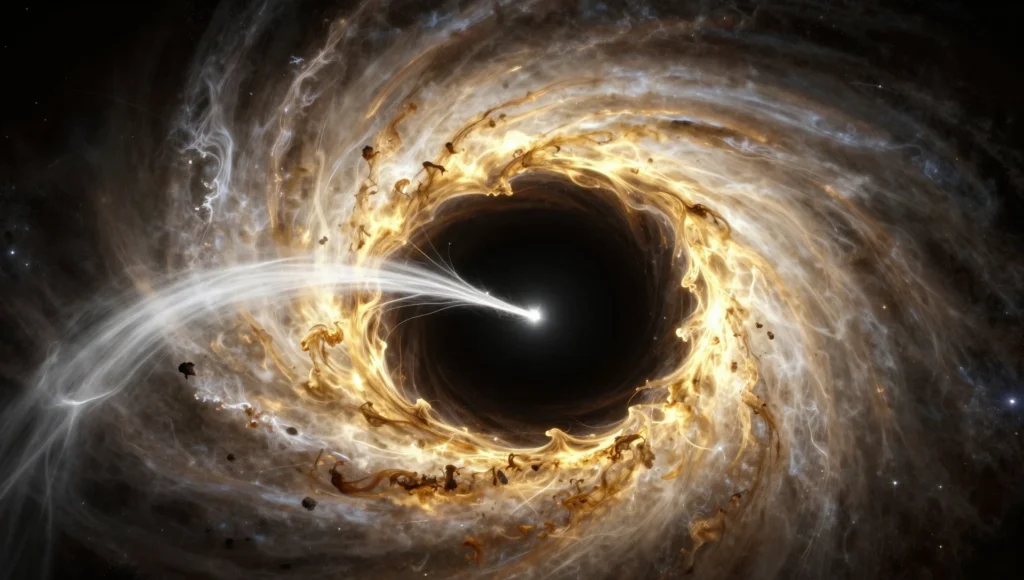
Public astronomy has always depended on more than telescopes and clear skies; it depends on the quiet craft of translation, the ability of a guide to convert a wall of physics into something a stranger can hold in their imagination. A former guide at the Sydney Observatory recently reflected on precisely this craft, recalling a night when a child's question forced him to rebuild his explanation of black holes from the ground up. His account, published in a "A job that changed me" series, is a small but revealing study in how scientific communication actually works: not as a broadcast of facts, but as a negotiation between an expert's mental model and a listener's curiosity.
The setting matters as much as the lesson. During the first year of his science degree, the guide led groups of roughly twenty visitors, shepherding them between telescopes, a 3D theatre, and a planetarium whenever Sydney's clouds refused to cooperate. One of his signature moments was the Hubble Ultra Deep Field, an image assembled from eleven days of accumulated light aimed at a patch of sky no larger than a grain of sand held at arm's length. He would explain that the spiky points were stars within our own galaxy, while nearly everything else was an entire galaxy, each one a city of billions of suns.
Then came the cloudy night that changed his teaching. With the telescopes idle, the group retreated to the 3D theatre and the conversation turned to black holes, where he described spaghettification: the stretching of an infalling object by the gradient of gravity, stronger at the feet than at the head. An eight-year-old girl raised her hand, and whatever she asked prompted a reckoning. The guide drew two lessons from the moment, that some questions are common while others are deceptively simple, and that the simplest questions often carry the most complex answers. This analysis examines what that exchange reveals about gravity, pedagogy, and the architecture of a good scientific question.
On This Page
- The Physics Behind Spaghettification and Tidal Gravity
- The Hubble Ultra Deep Field as a Teaching Instrument
- What a Child's Question Reveals About Scientific Communication
- Black Holes, Event Horizons, and the Limits of Analogy
- From Observatory Floor to Classroom: Transferable Lessons
- Measuring Understanding: A Worked Example in Tidal Physics
- Conclusion: The Question as the Unit of Learning
The Physics Behind Spaghettification and Tidal Gravity
Spaghettification is one of those phrases that sounds like a joke until the mathematics arrives, and the mathematics is unforgiving. The phenomenon arises because gravitational acceleration is not uniform across an extended body; it falls off with distance from the mass, so the end of an object nearer the black hole feels a stronger pull than the end farther away. That difference, called the tidal acceleration, is what stretches a falling astronaut along the radial direction while squeezing them laterally. The guide's spaghetti metaphor was accurate in spirit, but the underlying physics deserves the fuller treatment that a curious child's question implicitly demanded.
Quantifying the Tidal Stretch
The tidal acceleration across a body of length ##[L]## at distance ##[r]## from a mass ##[M]## follows directly from differentiating Newton's law of gravitation. For a small separation relative to the distance, the difference in acceleration between the near and far ends is proportional to the mass, the body length, and the inverse cube of the radius. This inverse-cube dependence is the crucial detail: tidal forces grow far more steeply than the gravitational pull itself as one approaches the horizon, which is why the stretching becomes catastrophic long before the object crosses the event horizon for stellar-mass black holes.
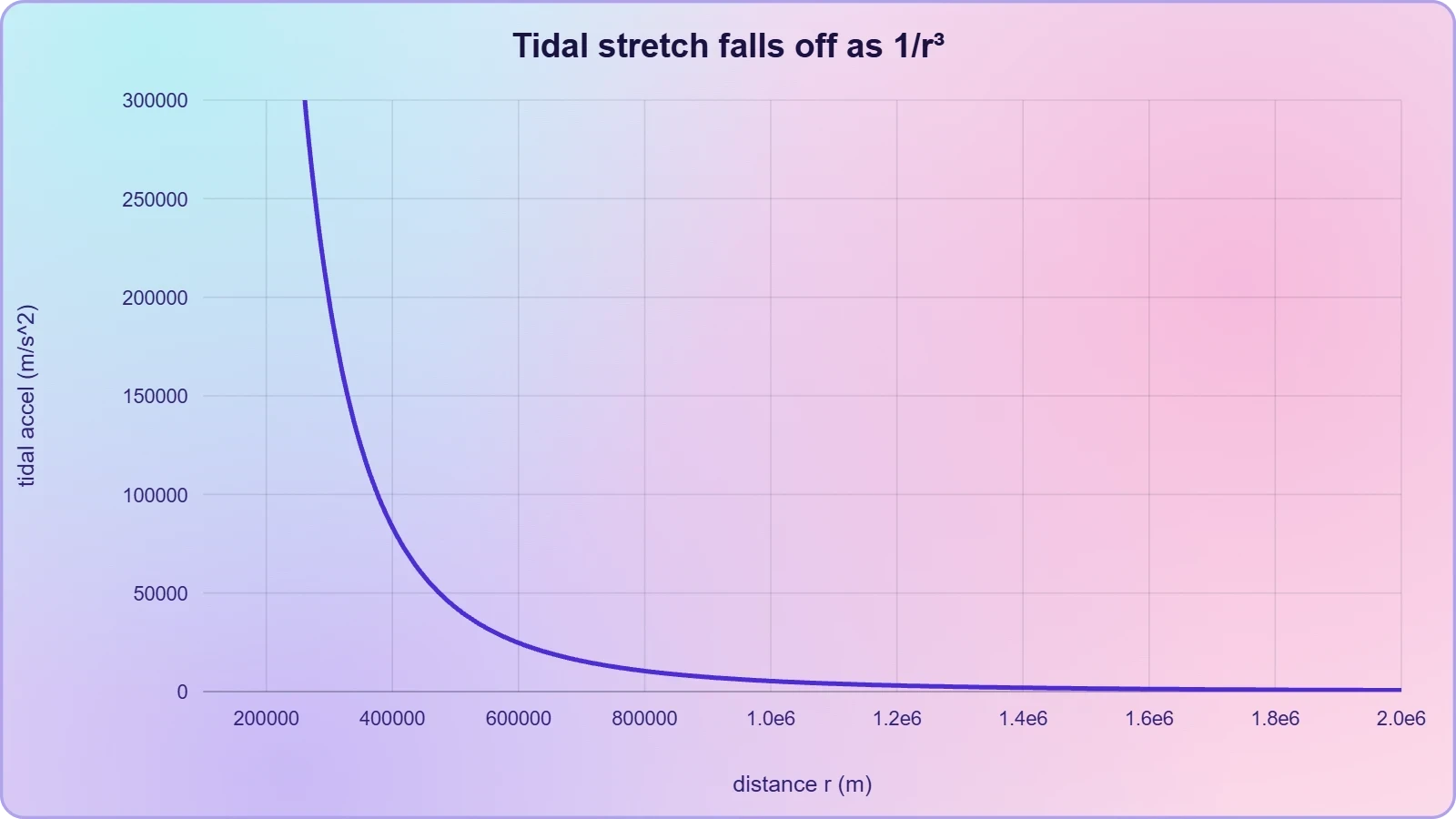
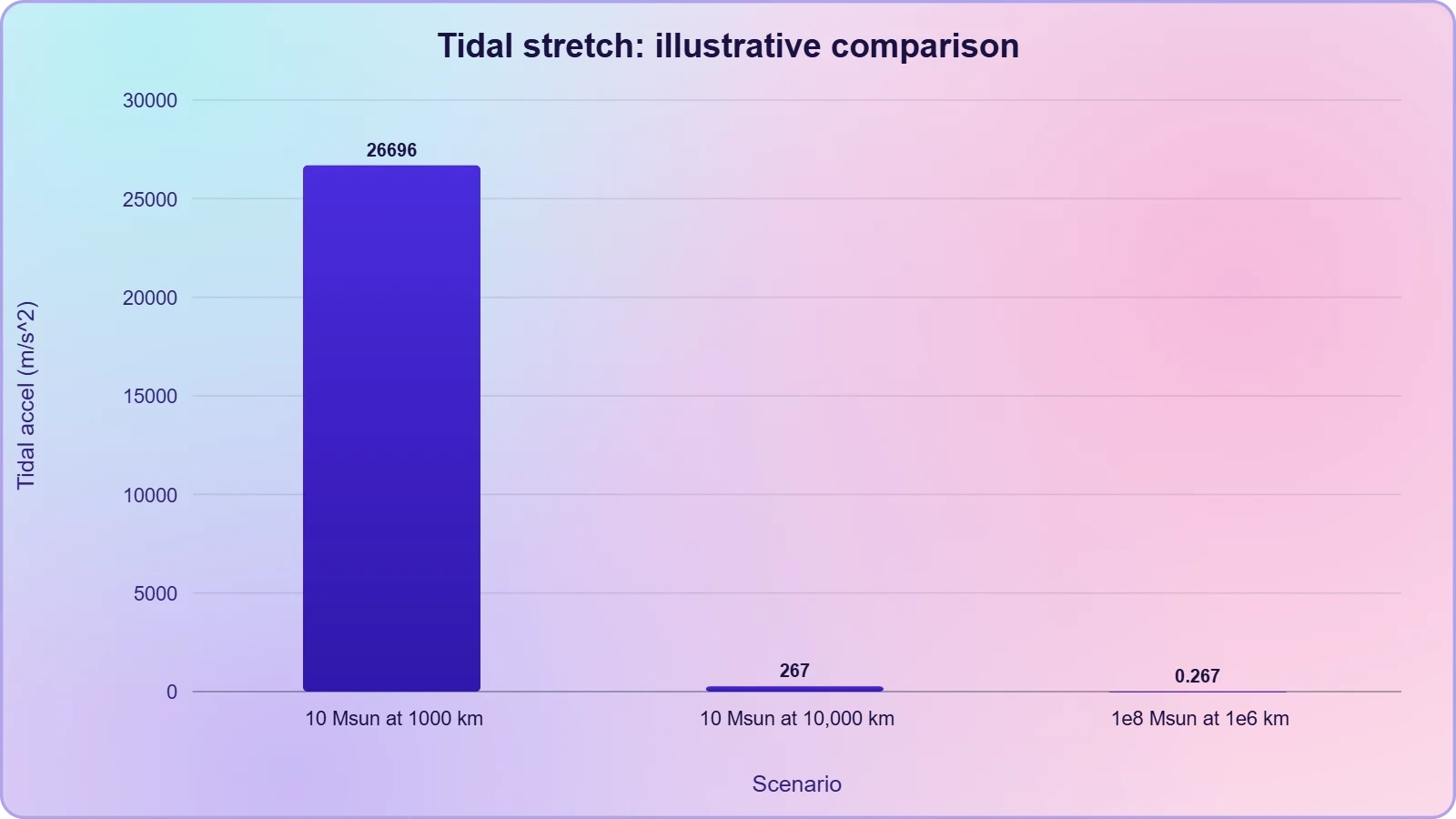
Consider a illustrative calculation for a stellar-mass black hole of ten solar masses, with an astronaut of height ##[L = 2\,\text{m}]## falling feet first. Substituting ##[G = 6.674\times10^{-11}\,\text{N·m}^2/\text{kg}^2]## and ##[M = 2\times10^{31}\,\text{kg}]##, the tidal acceleration at a distance of one thousand kilometres from the singularity works out to roughly ##[5.3\times10^{-4}\,\text{m/s}^2]##, a gentle tug. Move to one hundred kilometres and the same figure multiplies by a thousand, becoming a force comparable to a tenth of Earth's gravity across the body, enough to be deeply uncomfortable.
Why the Simplest Questions Resist Simple Answers
The girl's question, whatever its exact wording, exposed a gap between the guide's polished script and the listener's actual mental model. This is a recurring pattern in physics outreach: the explanations that feel most elegant to the expert are often the ones that smuggle in assumptions the audience does not share. A child asking "what happens if you fall in?" is not asking for a lecture on geodesics in curved spacetime; she is asking what it would feel like, and the honest answer requires distinguishing the observer's experience from the distant observer's view, a distinction that trips up even graduate students.
There is a deeper epistemological point here. The simplest questions tend to sit at the boundary between what a framework assumes and what it can explain, which is precisely where scientific progress happens. Einstein's childhood wondering about riding a beam of light, or Faraday's questions about invisible fields, were not sophisticated in their phrasing; they were sophisticated in their persistence. A guide who treats a simple question as a prompt to re-examine his own examples is doing the same work as a researcher who treats an anomaly as a clue rather than an inconvenience.
We Also Published
The Hubble Ultra Deep Field as a Teaching Instrument
Before the black hole conversation, the guide's most reliable showstopper was the Hubble Ultra Deep Field, and it deserves scrutiny as a piece of pedagogy in its own right. The image was produced by pointing the Hubble Space Telescope at a seemingly empty patch of sky in the constellation Fornax and integrating light for eleven days, a deliberate act of staring that revealed thousands of galaxies in a region a human could blot out with a fingertip. The guide's framing, a grain of sand at arm's length, is a masterstroke of scale translation because it converts an abstract angular measurement into a bodily gesture every visitor can perform.
Reading the Image Correctly
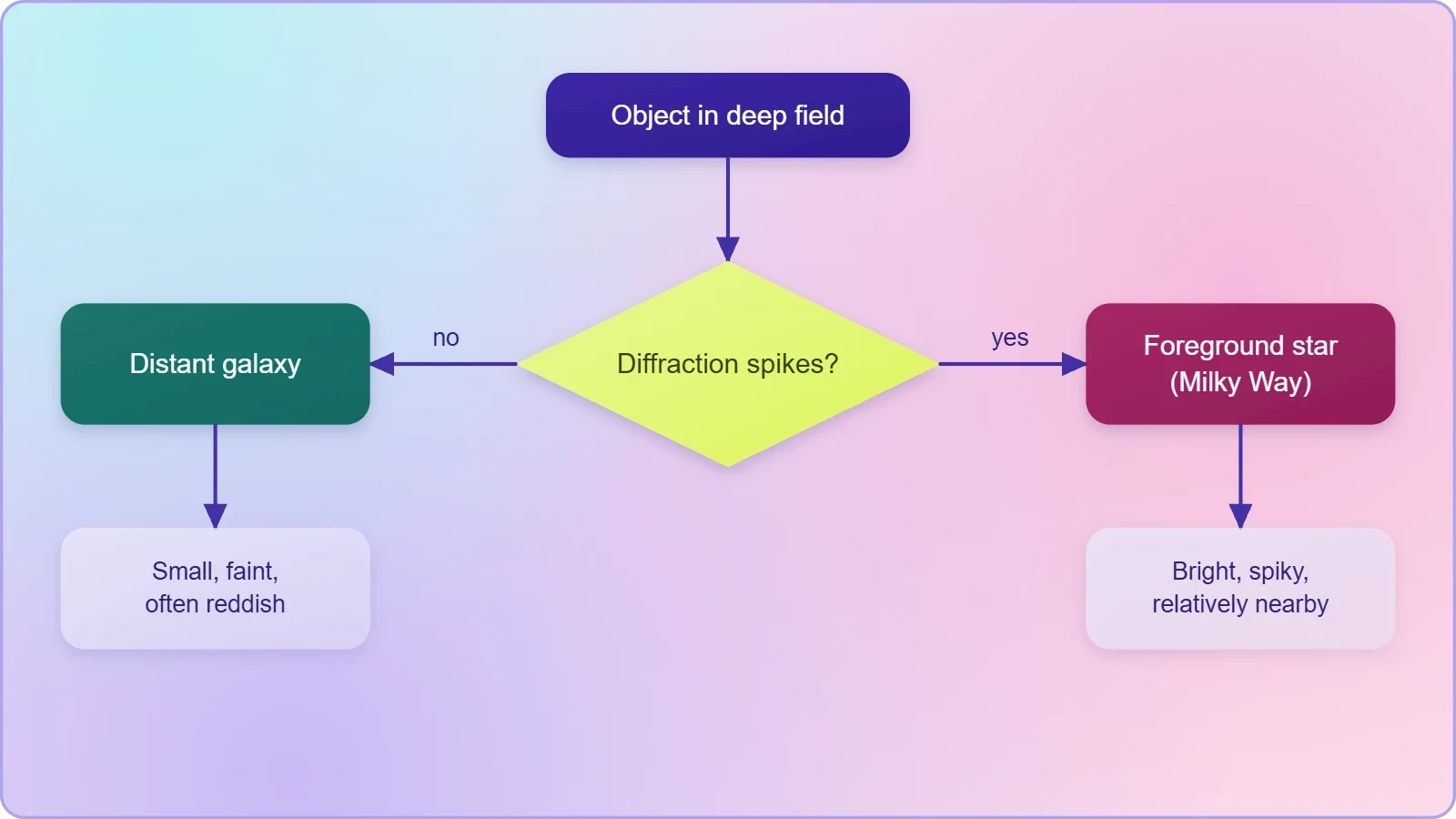
The distinction between foreground stars and background galaxies is the interpretive key to the image, and it is routinely misunderstood. The spiky objects, marked by diffraction spikes from the telescope's secondary mirror support struts, are stars within the Milky Way that happen to lie along the line of sight. Nearly everything else, including faint smudges and spirals, is a galaxy at cosmological distance, some of whose light left before Earth existed. Teaching visitors to make that distinction is teaching them to read depth in an image, a skill that transfers far beyond astronomy.
The eleven-day exposure also carries a lesson about signal and noise that resonates with anyone who has tried to photograph a faint object. Photons from distant galaxies arrive at a trickle, and the only way to build a detectable signal is to collect them patiently while subtracting the glow of foreground sources and instrumental artifacts. The guide's explanation, stripped of jargon, was really an introduction to integration time, the same principle behind long-exposure astrophotography and the deep surveys that now map the cosmic web.
Scale, Gesture, and the Grain of Sand
What makes the grain-of-sand analogy work is that it recruits proprioception, the sense of one's own body in space, rather than asking the listener to visualize an angle in degrees. A patch of sky the width of a grain of sand at arm's length subtends roughly one-tenth of a degree, comparable to the apparent size of a crater on the Moon. By anchoring the number to a physical gesture, the guide gave visitors a durable memory hook, one they could reproduce at home by holding up a finger against the night sky and wondering what hides behind it.
This is the same principle that underlies effective scientific writing: replace the abstract with the embodied. A light-year becomes a distance you could walk in a very long time; a billion years becomes a stack of calendars reaching past the dinosaurs. The guide's craft lay in choosing analogies that were not merely vivid but quantitatively honest, close enough to the real figures that a curious listener could later check the arithmetic and find it held up.
What a Child's Question Reveals About Scientific Communication
The guide's confession that a single question made him reconsider his examples is more than a charming anecdote; it is a case study in the limits of prepared explanation. Science communicators rehearse analogies because rehearsal produces fluency, but fluency can harden into dogma, and a script delivered too smoothly can leave the audience nodding without understanding. The eight-year-old's intervention worked because it came from outside the script, from a mind that had not yet learned which questions were supposed to be sophisticated and which were supposed to be naive.
The Difference Between Common and Simple Questions
The guide's distinction between common questions and simple questions is worth unpacking. A common question is one the guide has heard before and has a ready answer for, such as how far away a star is or why the Moon has phases. A simple question is one that sounds easy but cuts to the foundations of a theory, such as what time it is inside a black hole or whether the stretching hurts. Common questions test recall; simple questions test whether the explainer actually understands the framework well enough to defend it from an unexpected angle.
This taxonomy maps neatly onto the experience of teaching physics at any level. Students who ask common questions are usually seeking confirmation, while students who ask simple questions are often probing for the boundaries of the model. The guide's realization, that the simplest questions have surprisingly complex answers, is essentially a recognition that the foundations of a subject are where its hardest problems live, and that a good explainer must be willing to walk an audience to that edge rather than stopping at the comfortable middle.
Pedagogy, Humility, and the Unfinished Answer
There is a humility in admitting that a child's question exposed a weakness in one's teaching, and that humility is a professional asset rather than a liability. The best science communicators treat every explanation as provisional, subject to revision when a listener's confusion reveals a hidden assumption. The guide did not report feeling embarrassed; he reported feeling taught, which is the correct response for someone whose job is to keep learning in public. That stance is what separates a tour guide from a lecturer reading from notes.
The episode also illustrates why live, interactive formats matter in science education. A planetarium show or a 3D theatre presentation can be scripted, but the question-and-answer moment is where real understanding is tested and built. Institutions that invest in guides, docents, and explainers are investing in exactly this kind of improvisational pedagogy, and the return on that investment is measured not in attendance figures but in the number of visitors who leave with a sharper question than the one they arrived with.
Black Holes, Event Horizons, and the Limits of Analogy
Any explanation of black holes eventually collides with the event horizon, the boundary beyond which no signal can return, and it is here that analogies begin to strain. The spaghetti image works beautifully for the tidal stretching outside the horizon, but it says nothing about the strange geometry of the interior, where the roles of space and time effectively swap and the singularity becomes an inevitable future rather than a place. A guide who has thought carefully about this will know when to stop the metaphor and when to admit that the next step requires mathematics.
Where the Spaghetti Picture Breaks Down
The spaghetti analogy assumes a classical, Newtonian picture of gravity as a force, which is adequate for describing tidal stretching but misleading about the horizon itself. In general relativity, the horizon is not a surface you hit but a causal boundary, and a freely falling observer crosses it without noticing anything locally unusual, at least for a sufficiently large black hole. For a stellar-mass black hole, the tidal forces would indeed spaghettify an astronaut long before the horizon, but for a supermassive black hole the horizon crossing could be almost gentle, a distinction the simple analogy obscures.

This is precisely the kind of nuance a child's question can surface. If the girl asked whether the astronaut would feel the stretching, or what would happen to their feet versus their head, the honest answer requires separating the local experience from the global description, and acknowledging that the answer depends on the black hole's mass. A guide who can say "it depends, and here is why" is more valuable than one who delivers a confident but incomplete picture, because the former teaches the audience how scientific reasoning actually proceeds.
Relativity in the Planetarium
Planetarium presentations have become surprisingly good at visualizing relativity, using ray-tracing to show how the sky distorts near a black hole and how accretion disks appear warped by gravitational lensing. These visualizations can carry an audience further than words alone, but they also risk creating an illusion of understanding, since the imagery is so compelling that viewers may not realize how much physics is packed into each frame. The guide's willingness to step back and let a question redirect the conversation is a corrective to that risk.
The deeper lesson is that analogies are tools with domains of validity, and good communication names those domains explicitly. Spaghettification is a fine description of tidal gravity; it is a poor description of horizon crossing; it is silent on Hawking radiation and information. An audience that learns to ask "where does this analogy stop working?" has learned something more durable than any single fact about black holes, and that meta-skill is the real gift a skilled guide can offer.
From Observatory Floor to Classroom: Transferable Lessons
The Sydney Observatory anecdote travels well because its lessons are not specific to astronomy. Any professional who explains complex material to non-specialists, whether a doctor describing a diagnosis, an engineer walking a client through a design, or a teacher introducing a new topic, faces the same tension between accuracy and accessibility. The guide's experience suggests that the resolution lies not in choosing one over the other but in treating the explanation as a live experiment, subject to revision whenever the listener's response reveals a mismatch between the intended and received meaning.
Designing Explanations That Invite Questions
An explanation that invites questions is structured differently from one that delivers conclusions. It leaves visible seams, acknowledges uncertainty, and uses examples that are close enough to the listener's experience to be challenged. The guide's grain-of-sand analogy worked because it was concrete enough to be tested; a visitor could hold up a finger and compare. Explanations built on abstractions that cannot be tested tend to produce silence rather than questions, and silence is easily mistaken for understanding when it is often just polite confusion.
Practically, this means building in pauses, asking listeners what they think happens next, and being willing to say "I don't know, let's reason it out." These techniques are standard in good teaching but surprisingly rare in public science communication, where the pressure to appear authoritative can discourage admissions of uncertainty. The guide's willingness to be changed by a question is a model for resisting that pressure, and it costs nothing except the illusion of omniscience.
Institutional Support for Curious Guides
None of this happens without institutional backing. Observatories, museums, and science centres that want guides to engage deeply with visitors must give them time to prepare, freedom to deviate from scripts, and opportunities to debrief after unusual encounters. A guide who is rushed through back-to-back tours has no space to reflect on the question that did not fit the script, and the institution loses the chance to improve its own explanations. The Sydney Observatory's willingness to let a former guide publish this reflection is itself a small act of institutional learning.
The broader case for investing in science communication is straightforward: the public funds the research, and the public's understanding shapes the political and financial support that research depends on. A single well-handled question from an eight-year-old can produce a guide who explains better for decades, and a generation of visitors who carry a more accurate picture of the universe home with them. That is a modest return in any single instance, but compounded across thousands of tours and millions of visitors, it is one of the most efficient forms of science education available.
Measuring Understanding: A Worked Example in Tidal Physics
To see how a simple question can lead to a rigorous answer, it helps to work through the tidal calculation in full, because the arithmetic is where the spaghetti metaphor either earns its keep or falls apart. The goal is to estimate the difference in gravitational acceleration between an astronaut's head and feet at a given distance from a black hole, and then to compare that difference to the acceleration a human body can tolerate. The result tells us whether the stretching is a curiosity or a catastrophe, and at what distance the transition occurs.
Step-by-Step Derivation
Begin with Newton's law for the gravitational acceleration at radius ##[r]## from a mass ##[M]##, which gives ##[a = GM/r^2]##. Differentiate with respect to ##[r]## to obtain the rate at which acceleration changes with distance, then multiply by the body length ##[L]## to approximate the difference across the body. The negative sign indicates that the pull weakens with distance, so the nearer end is pulled more strongly, producing tension along the body. This is the tidal acceleration, and its inverse-cube dependence on radius is the key to understanding why proximity matters so much.
Now substitute numbers for a supermassive black hole of one hundred million solar masses, ##[M = 2\times10^{38}\,\text{kg}]##, with an astronaut of length ##[L = 2\,\text{m}]## at a distance of one million kilometres from the singularity. The tidal acceleration comes out to roughly ##[3.6\times10^{-5}\,\text{m/s}^2]##, which is about four thousandths of Earth's gravity, a difference the body would barely register. This is why horizon crossing for a supermassive black hole is often described as uneventful, and why the spaghetti picture, so vivid for stellar-mass holes, misleads when applied indiscriminately.
Interpreting the Result for a General Audience
The pedagogical value of this calculation lies in its transparency: every step can be followed by someone with high-school algebra, and the conclusion is not asserted but derived. A guide who walks an audience through even a simplified version of this derivation gives them a tool rather than a fact, and tools are what survive the trip home. The child's question, whatever it was, created the opening for exactly this kind of walk, and the guide's willingness to take it is the reason the anecdote is worth telling.
It also demonstrates why "it depends" is often the most honest and most useful answer in physics. The tidal acceleration depends on the black hole's mass, the astronaut's height, and the distance from the singularity, and each dependence can be explained in plain language. An audience that learns to ask "on what does it depend?" has acquired a habit of mind that will serve them in every scientific context they encounter, from climate reports to medical advice, and that habit is the real target of good science communication.
Conclusion: The Question as the Unit of Learning
The former Sydney Observatory guide's account is a reminder that the most valuable thing a science communicator can produce is not a perfect explanation but a space in which questions can be asked. His eleven-day Hubble exposure, his grain-of-sand gesture, and his spaghetti description of tidal stretching were all good tools, but the tool that mattered most was his willingness to let an eight-year-old's curiosity redirect the lesson. That willingness is not a personality trait; it is a professional discipline, and it can be taught, supported, and rewarded by the institutions that employ guides and explainers.
For readers who want to carry the lesson forward, the practical takeaway is to treat every explanation as a hypothesis about what the listener needs, and to watch for the moment when the hypothesis fails. That moment, whether it arrives as a raised hand in a darkened theatre or a puzzled silence in a classroom, is where learning actually happens. The guide who recognizes it and responds with curiosity rather than defensiveness is doing the work that makes public science worth funding, and the child who asked the question is doing the work that keeps science honest.
From our network :
- Vite 6/7 'Cold Start' Regression in Massive Module GraphsIn-depth analysis of Vite 6/7 cold start regressions in massive module graphs. Learn about barrel file issues, pre-bundling optimizations, and how to improve Vite dev server performance.
- Mastering DB2 12.1 Instance Design: A Technical Deep Dive into Modern Database ArchitectureComprehensive guide to DB2 12.1 Instance Design. Explore architectural components, HADR setup, buffer pool tuning, and security policies for IBM DB2 12.1. Includes 10 functional SQL and Shell samples.
- Mastering DB2 LUW v12 Tables: A Comprehensive Technical GuideComprehensive guide on DB2 LUW v12 tables. Explore CREATE TABLE syntax, BLU Acceleration, range partitioning, data types, and security features for IBM DB2 LUW v12.
- AI-Powered 'Precision Diagnostic' Replaces Standard GRE Score ReportsDiscover the new GRE Precision Diagnostic. Learn how AI-powered behavioral analytics and time-to-solve tracking are replacing standard GRE score reports to empower students.
- 10 Physics Numerical Problems with Solutions for IIT JEEPrepare for IIT JEE with 10 physics numerical problems, complete with detailed solutions and conceptual explanations. Ideal for mastering kinematics, thermodynamics, electromagnetism, and optics.
- Trump Political Strategy How Geopolitical Stunts Serve As Media Diversions
- EV 2.0: The Solid-State Battery Breakthrough and Global Factory ExpansionDiscover the impact of the Solid-State Battery Breakthrough on the EV market. Learn about CATL and BYD stock growth, global factory expansion in Europe, and the future of EV 2.0 technology.
- Analyzing Trump Deportation Numbers Insights Into The 2026 Immigration Crackdown
- 98% of Global MBA Programs Now Prefer GRE Over GMAT Focus EditionExplore why 98% of global MBA programs now prefer the GRE over GMAT Focus. Learn about the shorter GRE format, verbal logic importance, and strategic versatility for students.
RESOURCES
- What happens if you fall into a black hole?rmg.co.ukIn astrophysics, spaghettification is the tidal effect caused by strong gravitational fields. When falling towards a black hole, for example, an object is ...
- What exactly does Spaghettification mean? : r/askscience - Redditreddit.comMar 3, 2023 ... TIL that that black holes "spaghettify" any objects entering the black hole, stretching them out like spaghetti in a process…
- What Happens When Something Gets 'Too Close' to a Black Hole?science.nasa.govNov 26, 2021 ... Spaghettification and the "Point of No Return". Whether it's gas, dust, planets, stars, or a hypothetical wayward space traveler, black…
- Spaghettification - Wikipediaen.wikipedia.orgIt is caused by extreme tidal forces. In the most extreme cases, near a black hole, the stretching and compression are so powerful that…
- Black Hole Basics - NASA Sciencescience.nasa.govAug 12, 2026 ... Spaghettification. A real term that describes what happens when matter gets too close to a black hole. It's squeezed horizontally…
- What is Human Spaghettification? - Saving Grace Medical Academysavinggracemedical.comMay 7, 2024 ... Human spaghettification refers to what would happen to a person who gets too close to a black hole. Because a…
- "Spaghettification": How black holes stretch objects into oblivionbigthink.comJan 23, 2024 ... “Spaghettification” occurs when an object falls into a black hole and experiences varying gravitational pulls at its ends, stretching it ...
- Spaghettification: The Cosmic Pasta Maker - ScienceHolicscienceholic.orgJan 7, 2025 ... Although this sounds like science fiction, Spaghettification is an actual phenomenon that occurs in objects too close to a black…
- What would happen if you fell into a black hole? | BBC Earthbbcearth.comFrom general relativity to quantum physics and string theory, black holes offer experts a testing ground for fundamental theories that explain how the universe ...
- Spaghettification and the Conceptual Black Hole of Borderline ...tandfonline.comOct 6, 2025 ... Spaghettification, a term from astrophysics, is used as a metaphor to explain how a persons sense of self can fragment…
- SPAGHETTIFICATION Definition & Meaning - Dictionary.comdictionary.comthe theoretical stretching of an object as it encounters extreme differences in gravitational forces, especially those associated with a black hole. Other Word ...
- Black Holes, Explained - National Geographicnationalgeographic.com... spaghettification thanks to a sharp increase in the strength of gravity as you fall into the black hole. Black Holes, explained. As astrophysicist…
- Does spaghettification really happen with conditions found close to ...physics.stackexchange.comAug 28, 2015 ... This website tries to explain why the term spaghettification doesn't actually occur when something gets close to a black hole.…
- What Is a Black Hole? | NASA Space Placespaceplace.nasa.govA black hole is an area of such immense gravity that nothing -- not even ... The answer—spaghettification! That's the technical term, at least.…
- When do we talk about spaghettification or pancakification in black ...physics.stackexchange.comJun 14, 2024 ... ... explained purely Newtonian as well. ... Spaghettification inside a black hole? 76 · Do "almost black holes" exist? 1…