On This Page
Introduction to Gauss's Law
Historical Background

Gauss's Law, formulated by Carl Friedrich Gauss, is a pivotal concept in electromagnetism. It is part of Maxwell's equations, which form the foundation of classical electrodynamics. Understanding its origin helps appreciate how it describes the relationship between electric field and charge.
| Year | Event |
|---|---|
| 1777 | Carl Friedrich Gauss is born in Germany. |
| 1835 | Gauss's work on electromagnetism is published, contributing to what would become Gauss's Law. |
| 1860s | James Clerk Maxwell incorporates Gauss's Law into Maxwell's equations. |
The law's roots are traced back to the early 19th century, contributing to the comprehensive system explaining electromagnetic phenomena. Its historical significance lies in how it integrates with other laws, offering deep insights into the behavior of electric fields.
Understanding the Basic Principle
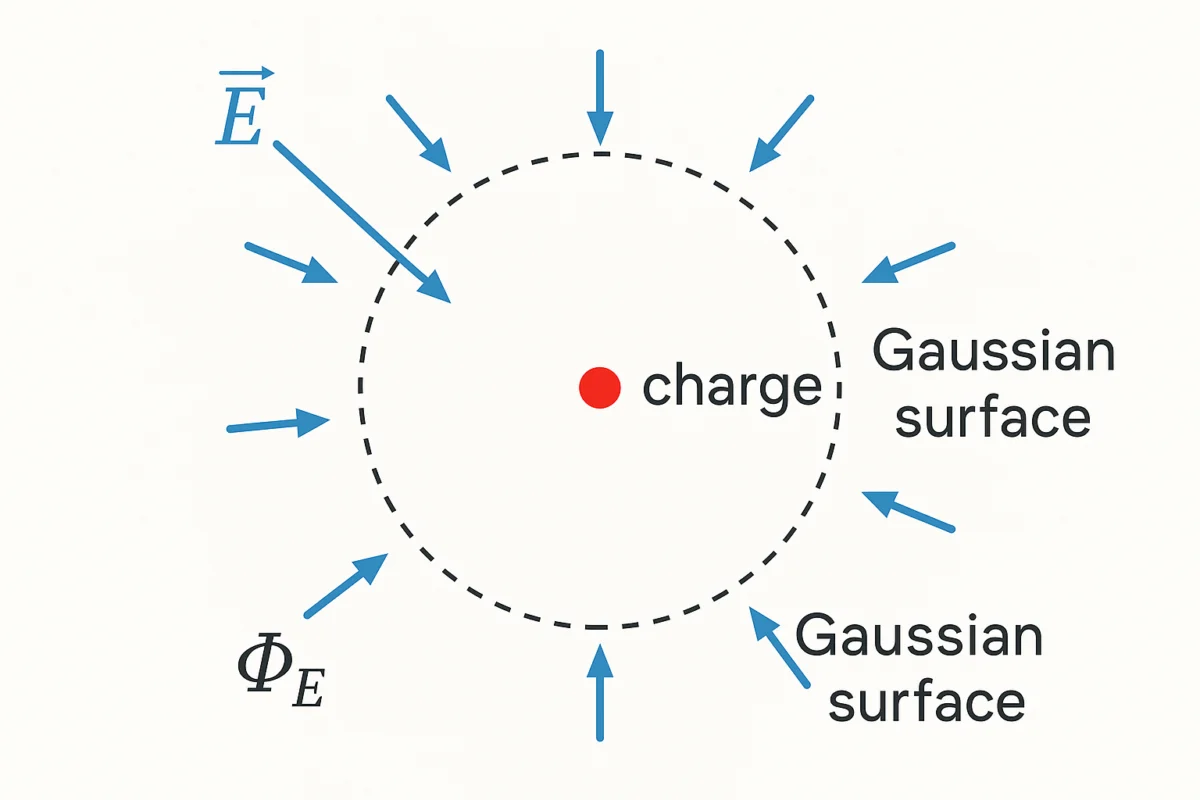
Gauss's Law asserts that the total electric flux through a closed surface is proportional to the charge enclosed. Mathematically, it relates the surface integral of the electric field to the enclosed charge. This concept is integral to investigating electrostatic forces.
Formally, Gauss's Law is expressed as:
where ## \\Phi ## is the flux, ## Q_{\\text{enc}} ## the enclosed charge, and ## \\varepsilon_0 ## the permittivity of free space. This concise equation links physical quantities in a precise manner.
Importance in Electromagnetism

Gauss's Law simplifies the calculation of electric fields, especially with symmetrical geometries like spheres or cylinders. It provides insight into field behaviors without directly integrating over every charge. This reduces complexity in solving electrostatic problems.
| Geometry | Example Application |
|---|---|
| Spherical | Earth's gravitational field approximation |
| Cylindrical | Capacitors in electronic circuits |
| Planar | Parallel plate capacitors |
Electric fields can be effortlessly deduced for systems with particular symmetry, underlining the law's utility in practical scenarios. Understanding Gauss’s Law is essential for physics students and engineers working with electric fields.
Mathematical Formulation of Gauss's Law
Surface Integrals in Gauss's Law
Surface integrals are central to Gauss's Law, representing the flux of vectors (electric field) through a given surface. These integrals consider how field lines penetrate surfaces without needing precise knowledge of each line's path.
In Gauss's Law, the mathematical formulation involves calculating the integral:
. This equation essentially evaluates the field across a closed surface.
Flux through Closed Surfaces
The flux of an electric field through a closed surface depends on the field strength and the orientation of the surface. It measures how much electric field passes through an area, crucial for understanding field interactions with charges.
Electric flux ## \\Phi ## is computed as
where ## \\theta ## is the angle between field and surface normal. This comprehension is vital for solving enclosed charge problems.
Charge and Field Relationship
In this framework, charge and electric field are intrinsically linked. The principle that charges create electric fields, and fields respond to charge distribution, is essential for evaluating enclosed charges using Gauss's Law.
It’s noteworthy how variations in charge lead to proportional changes in field strength, reinforcing the elegance of Gauss's principle. Such relationships are integral to advanced studies in electrostatics.
Applications in Electrostatics
Symmetrical Charge Distributions
One of Gauss's Law's most impressive features is its application to symmetrical charge distributions. Sphere and cylinder symmetries permit straightforward field calculations, aligning theoretical analysis with practical use.
For example, calculating the field of a uniformly charged sphere leverages the symmetry to simplify the integral into an easily solvable form. This symmetry is advantageous in engineering and academic contexts.
Point Charges and Electric Fields
Applying Gauss's Law to point charges uncovers simple expressions for electric fields. When a point charge is placed at the origin, the spherical symmetry allows the field calculation without extensive integration efforts.
| Point Charge Position | Electric Field Expression |
|---|---|
| Origin | E = \\(\\frac{Q}{4\\pi\\varepsilon_0 r^2}\\) |
| Distance r | E = \\(\\frac{kQ}{r^2}\\) |
For a single point charge:
demonstrates the inverse square law, important for understanding fundamental electrostatic principles. Such derivations illustrate the power of Gauss’s conceptual simplicity.
Non-Uniform Charge Distributions
While Gauss’s Law excels in symmetry, non-uniform charge distributions present challenges. Nevertheless, combining Gauss's principles with calculus helps tackle more complex field calculations where symmetry is absent.
Employing sophisticated methods to manage non-uniformity is crucial for realistic scenarios where charge distribution lacks regularity. This adaptability highlights the law’s robustness in various physical contexts.
Vector Fields and Electric Flux
Electric Field Vectors
The representation of electric fields as vectors enables precise analysis of field strength and direction. These vectors, aligned with Gauss's principles, illustrate how fields interact with both matter and surrounding space.
This vector analysis is foundational in physics, enabling deeper comprehension of field behaviors. Visualization through vectors also assists in solving complex multi-dimensional field problems.
Calculating Electric Flux
Electric flux quantifies the number of electric field lines penetrating a given surface. Gauss’s Law illustrates this concept through simple yet effective integrations, underpinning the flux relationship with enclosed charges.
The integral in Gauss's Law:
calculates the flux for closed surfaces, demonstrating its importance in field studies. Successfully evaluating such integrals is core to mastering electrostatics.
Practical Implications in Engineering
In engineering, Gauss's Law assists in designing devices like capacitors and shielding structures. Understanding electric flux and charge dynamics supports creating efficient, reliable electrical systems across industries.
Engineers often apply Gauss’s principles in fields where electric field manipulation is necessary, reflecting the law’s role in both theoretical and practical dimensions of electrical engineering.
Electrostatic Fields in Different Geometries
Spherical Fields
The spherical symmetry simplifies electric field analysis significantly. Gauss's Law is widely employed to compute fields for charged spherical objects, optimizing calculations for these common electrostatic systems.
For uniform charge distribution inside a sphere, the resulting field provides insight into field strength at various radii, essential for applications in physics and materials science.
Cylindrical Geometries
In cylindrical geometries, Gauss's Law assists in determining electric fields for uniformly charged cylinders. Such configurations frequently appear in telecommunications and industrial settings, making field evaluation techniques highly applicable.
These analyses leverage symmetry, simplifying integral setups and providing accessible solutions for practical scenarios demanding accuracy and efficiency in field predictions.
Planar Charge Distributions
Analyzing planar charge distributions using Gauss's Law enhances understanding of surface charge interactions. The law enables determining fields around sheets of charge, frequently occurring in electrostatic applications.
For infinite planes, the electric field is constant, independent of distance:
, where ## \\sigma ## is surface charge density. This result illustrates planes as unique in electrostatics.
Electric Fields and Conductors
Properties of Conductors
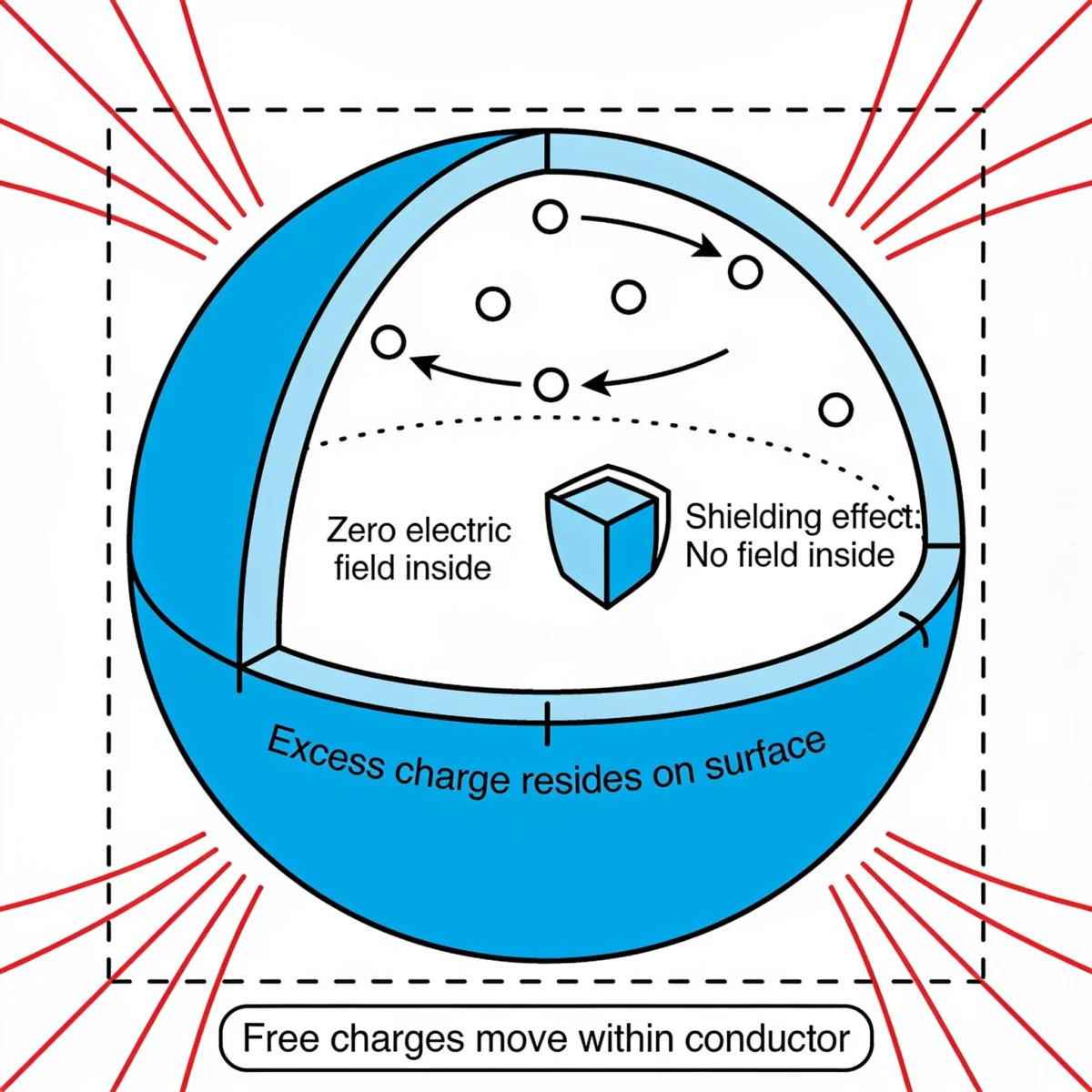
Gauss’s principles significantly impact the understanding of conductors. These materials host free-moving charges, leading to the field being zero inside, simplifying several electrostatic evaluations and ensuring shielding effects.
The law predicts that all excess charge resides on a conductor’s surface, reflecting practical phenomena such as conductor electrostatic interactions, key for electrical engineers and physicists.
Applications of Conductors
Important applications in electronics, like Faraday cages, exploit Gauss’s predictions on conductors. These devices utilize charges' natural distribution to block external electric fields, proving critical for sensitive electronic environments.
Understanding Gauss’s Law’s implications on conductors allows engineers to design efficient electrostatic shielding systems, influencing both consumer and industrial electronic products.
Charge Distribution on Conductors
The distribution of charges on conductors is governed by Gauss's Law, illustrating that fields inside must neutralize, forcing surface charge accumulation. Awareness of this distribution is essential for accurate electrostatic modeling.
This fundamental understanding aids in designing effective electrical control devices, helping circuit designs restrict undesirable field interactions given a conductor’s charge capacity and geometry.
Challenges and Misconceptions
Common Misunderstandings
Gauss's Law may cause confusion regarding its applicability to non-symmetrical systems. It’s critical for students to differentiate situations where the law simplifies calculations from those requiring more rigorous methods.
Recognizing valid versus impractical applications of Gauss's Law helps avert analytical errors in evaluating real-world electrostatic systems and strengthens comprehension for students and professionals alike.
Complex Calculations
Despite its elegance, Gauss's Law often demands proficiency in vector calculus, raising the complexity of its practical executions. Achieving mastery with vector operations is integral for engineers navigating intricate electrostatic environments.
Advanced courses often address these challenges, supporting students through extensive practice in quantifying intricate electric field configurations to build substantial foundational knowledge.
Improving Comprehension
To advance understanding, students benefit from focused exercises employing Gauss's Law, fostering familiarity with its scope and limitations. Interactive projects and hands-on learning enhance grasping this pivotal electrostatic principle.
Educators emphasize simplifying assumptions and integrating theoretical knowledge with applied problem-solving to amplify clarity and practical comprehension among physics and engineering students.
Concluding Thoughts on Gauss's Law
Summary of Key Concepts
Gauss's Law remains a cornerstone of electrostatics, providing profound insights into charge distributions and field dynamics. Its application spans theoretical investigation and practical engineering, highlighting its enduring importance.
The law's ability to condense complex physical interactions into accessible mathematical forms underscores its beauty and utility, continuing to enrich scientific inquiry and technological advancement.
Future Implications
Exploring Gauss's Law in cutting-edge technology will necessitate ongoing research. As electric field control becomes more crucial in innovation areas like quantum computing and nanoelectronics, the law's relevance grows, signifying ongoing exploration requirements.
Engaging with its concepts fortifies capabilities in theoretical and experimental physics, preparing researchers and engineers to sculpt the future landscape of science and technology meaningfully.
Final Thoughts
Gauss's Law's elegance and practicality transcend traditional sciences into versatile applications, from educational settings to pioneering research domains. It prevails as a fundamental tool for dissecting and mastering electrostatics.
Understanding Gauss’s Law equips scientists and engineers with indispensable skills for advancing foundational knowledge, promoting robust innovations across electromagnetism influenced fields, illustrating the law's remarkable versatility and significance.
We Also Published
Also Read
From our network :
RESOURCES




0 Comments