Galileo Galilei stands as one of the most consequential figures in the history of science, a thinker whose instruments and observations dismantled the cosmology that had governed European thought for nearly two millennia. His contributions were not confined to a single discipline; he moved fluidly between mechanics, astronomy, optics, and mathematics, and in doing so he helped establish the very idea that nature could be interrogated through measurement and experiment. The telescope, the hydrostatic balance, the geometric compass, and the thermometer all bear his imprint, yet his deeper legacy lies in the method he championed: observation disciplined by mathematics.
Understanding Galileo requires more than cataloguing his inventions. Each device he refined answered a specific practical or philosophical question, and each carried consequences that rippled far beyond the workshop where it was built. When he turned a modified spyglass toward the night sky, he was not merely improving an instrument; he was testing the Aristotelian claim that the heavens were perfect and unchanging. When he timed a swinging lamp against his own pulse, he was converting a curiosity into a measurable law. This article examines the meaning embedded in his work, the physics behind his instruments, and the mathematical reasoning that gave his discoveries their enduring force.
The analysis that follows treats Galileo as an engineer of ideas as much as a builder of devices. It reconstructs the quantitative logic behind his pendulum observations, his inclined-plane experiments, and his telescopic measurements, presenting the governing equations in their proper form. It also situates his inventions within the intellectual economy of the seventeenth century, where patronage, instrumentation, and publication were inseparable from discovery itself. The result is a portrait of a scientist whose tools were arguments and whose arguments were, ultimately, mathematical.
On This Page
- The Intellectual Context of Galileo's Instruments
- The Telescope and the Reordering of the Cosmos
- Pendulum Motion and the Mathematics of Timekeeping
- Falling Bodies and the Inclined Plane Experiment
- Hydrostatic Balance, the Compass, and Practical Invention
- Method, Mathematics, and the Enduring Legacy
- Reconstructing Galileo's Calculations
The Intellectual Context of Galileo's Instruments
Galileo inherited a world in which natural philosophy was dominated by textual authority rather than direct measurement. Aristotelian physics held that heavy bodies fell faster than light ones and that celestial matter was incorruptible, and these claims rested on reasoning rather than experiment. Galileo's instruments became instruments of refutation precisely because they produced numbers that could be checked, repeated, and contested by anyone with access to similar equipment.
The Shift from Authority to Measurement
The transition Galileo embodied was methodological before it was technological. He insisted that the book of nature was written in the language of mathematics, and this conviction shaped every instrument he designed. A device was valuable to him insofar as it could render a natural process quantitative, converting a qualitative observation into a ratio, a period, or an angle that could be compared across trials.
This orientation placed him in direct tension with the university establishment of his time. Professors of philosophy regarded his geometrical demonstrations as intrusions into a domain properly governed by syllogism and commentary. Galileo's response was characteristic: he invited skeptics to look through the telescope themselves, making the instrument a public arbiter of disputes that had previously been settled by citation.
The practical consequence was a new economy of evidence. A single observation, properly instrumented, could outweigh centuries of received opinion. This principle now seems obvious, but in the early seventeenth century it was radical, and it required instruments robust enough to survive scrutiny by hostile observers who had every incentive to find fault with the readings.
Galileo's genius lay in recognizing that precision itself carried rhetorical force. An instrument that could resolve a minute of arc or measure a period to within a fraction of a second produced data that could not be dismissed as anecdote. Measurement became, in effect, a form of argument, and the instrument became the witness that no authority could silence.
Patronage, Publication, and the Instrument as Argument
Invention in Galileo's era was entangled with patronage. He dedicated the telescope to the Venetian state and named the moons of Jupiter the Medicean stars after his Florentine patrons, converting celestial discovery into political currency. Instruments were gifts, leverage, and advertisements simultaneously, and their design often reflected the expectations of the patrons who funded them.
Publication amplified this dynamic. The Sidereus Nuncius of 1610 presented telescopic observations as a public claim, complete with engravings that allowed readers to verify the findings themselves. By distributing images rather than merely describing them, Galileo turned his instrument into a reproducible method, inviting replication as the ultimate test of his assertions.
This coupling of device and publication created a feedback loop. New observations generated patronage, patronage funded better instruments, and better instruments yielded observations that demanded still more support. The telescope was thus never a static object; it evolved alongside the social networks that sustained its maker and legitimized his claims.
The lesson for modern science is direct. Instruments do not speak for themselves; they require institutional and rhetorical scaffolding to be heard. Galileo understood this instinctively, and his career demonstrates that the credibility of a measurement depends as much on the community that receives it as on the precision of the apparatus that produced it.
The Telescope and the Reordering of the Cosmos
The telescope was Galileo's most famous instrument, but its significance lay less in its optics than in what it revealed. By improving the Dutch spyglass to roughly thirtyfold magnification, he transformed a curiosity into an astronomical engine. The observations that followed—mountains on the Moon, moons around Jupiter, phases of Venus—collectively undermined the Aristotelian-Ptolemaic model and lent empirical weight to Copernican heliocentrism.
Optical Principles and Magnification
The Galilean telescope used a convex objective lens and a concave eyepiece, a configuration that produced an upright image at the cost of a narrow field of view. Its magnification depended on the ratio of the objective's focal length to the eyepiece's focal length, a relationship Galileo exploited through careful lens grinding rather than theoretical optics.
The angular magnification of such a system can be expressed as the ratio of the focal lengths of the two lenses. For an objective of focal length ##[f_o]## and an eyepiece of focal length ##[f_e]##, the magnifying power is given by the following relation, which Galileo approached empirically through trial and refinement.
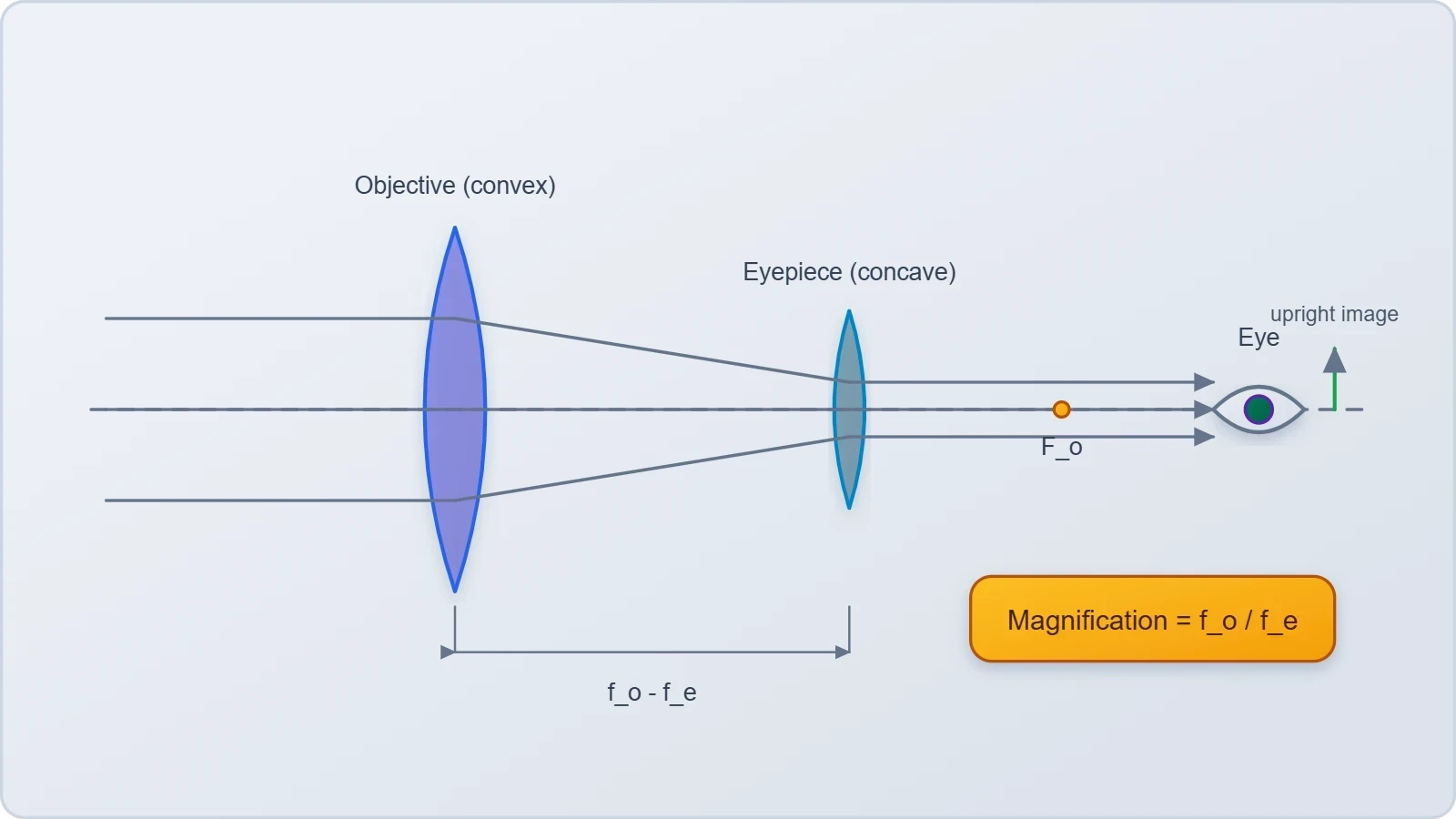
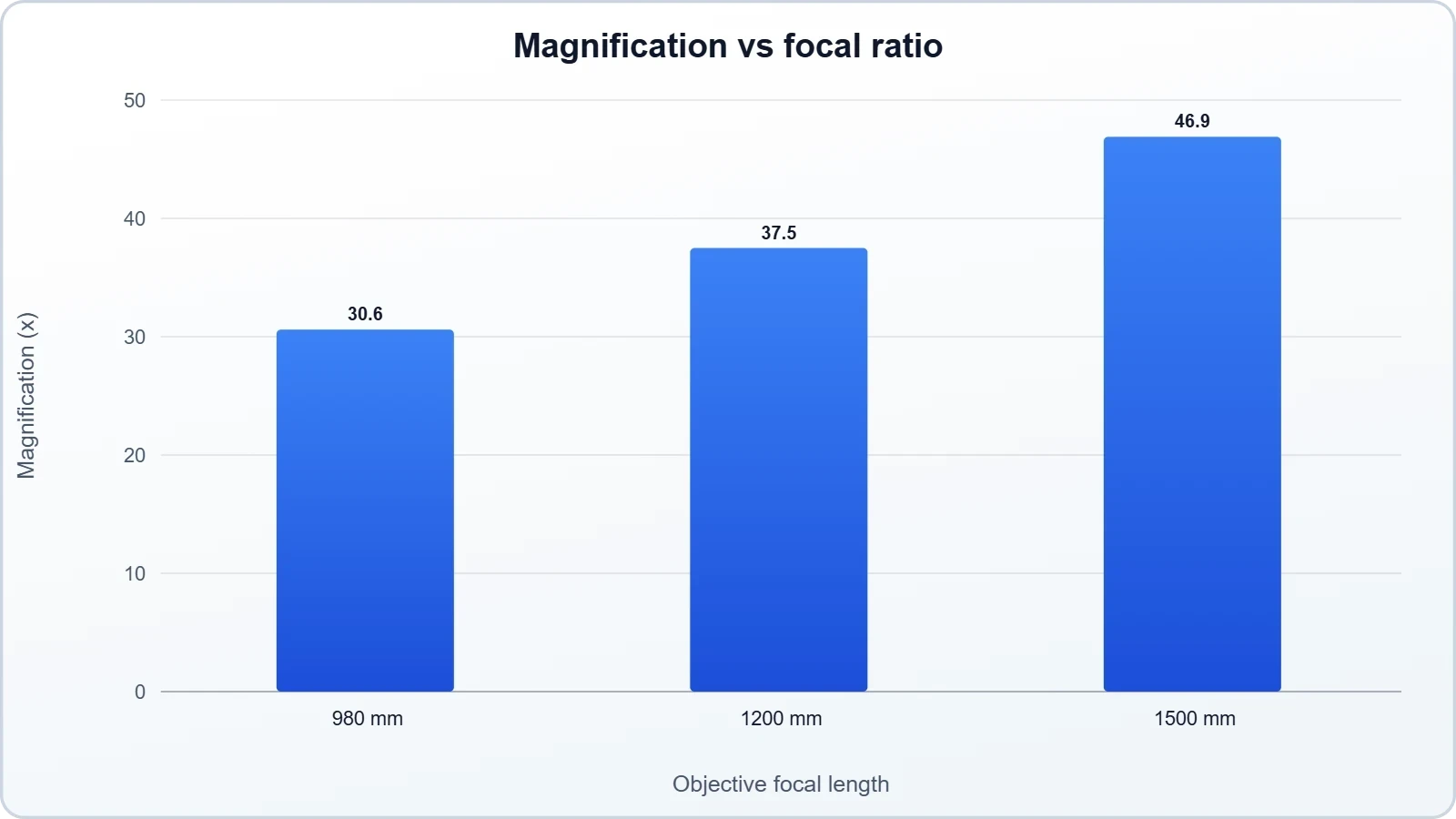
With an objective of focal length ##[f_o = 980\ \text{mm}]## and an eyepiece of ##[f_e = 32\ \text{mm}]##, the resulting magnification is approximately thirty times. This figure matches the performance Galileo reported for his best instruments, and it explains why his observations were so much sharper than those of contemporaries using weaker devices.
The narrow field of view was a genuine limitation, making it difficult to locate and track objects. Galileo compensated through mounting skill and patience, and his ability to hold a faint object steady long enough to sketch it was itself a form of experimental competence that few rivals could match.
Observations That Displaced the Earth from the Center
The lunar observations were the first shock. Galileo's engravings showed a surface marked by mountains and craters, contradicting the doctrine that celestial bodies were perfectly smooth. He even estimated the height of lunar mountains from the length of their shadows, applying terrestrial geometry to a supposedly ethereal realm.
Jupiter's moons delivered a second blow. Four bodies visibly orbited a planet other than Earth, demonstrating that orbital motion was not unique to our world. This observation alone refuted a central objection to Copernicanism, namely that a moving Earth would leave its Moon behind while other planets retained their satellites.
The phases of Venus provided decisive evidence for the heliocentric arrangement. A Venus orbiting the Sun between Earth and the Sun must display a full cycle of phases, whereas a Venus orbiting Earth could not. Galileo's observations confirmed the full cycle, and the Ptolemaic model could not account for it.
Finally, the resolution of the Milky Way into countless stars and the observation of sunspots further eroded the Aristotelian cosmos. Each finding was modest in isolation, but together they constituted a cumulative argument that the heavens were mutable, populated, and governed by the same physical principles as the Earth.
Pendulum Motion and the Mathematics of Timekeeping
Galileo's interest in the pendulum reportedly began with a swinging lamp in the cathedral of Pisa, timed against his own pulse. Whether or not the story is literally true, it captures the essence of his method: a commonplace phenomenon, observed attentively, yields a quantitative law. The pendulum became his most reliable clock and the foundation of his later work on motion.
Isochronism and the Period Formula
The key discovery was isochronism, the property that a pendulum's period is nearly independent of the amplitude of its swing, provided the arc remains small. This made the pendulum a practical timekeeper, since small variations in the starting position would not corrupt the measurement of elapsed time.
For small angular displacements, the restoring force is proportional to the displacement, and the motion approximates simple harmonic motion. The period depends on the length of the pendulum and the local gravitational acceleration, and it is independent of the mass of the bob, a result that surprised Galileo's contemporaries.
For a pendulum of length ##[L = 1.00\ \text{m}]## at a location where ##[g = 9.81\ \text{m/s}^2]##, the period evaluates to approximately ##[2.006\ \text{s}]##. This near-integer result is not coincidental; the metre was historically defined so that a seconds pendulum would have a length close to one metre.
The small-angle approximation underlying this formula assumes ##[\sin\theta \approx \theta]##, which introduces an error that grows with amplitude. Galileo recognized that large swings took slightly longer, and this departure from perfect isochronism became a subject of later refinement by Huygens and others.
From Observation to Governing Law
The pendulum illustrates Galileo's characteristic move from qualitative observation to quantitative law. He did not merely notice that swings were regular; he measured periods against lengths and extracted a relationship that could be tested and applied. The pendulum thus became both a discovery and a tool for further discovery.
Its practical legacy is immense. Pendulum clocks governed navigation and astronomy for centuries, and the escapement mechanisms built around them shaped the industrial precision that later enabled accurate marine chronometers. Galileo himself proposed a pendulum-driven clock, though he did not live to see it built.
The conceptual legacy is equally important. By treating time as something that could be measured rather than merely experienced, Galileo made possible the study of motion as a function of time. This shift underlies the entire subsequent development of kinematics, from Newton's laws to the modern calculus of trajectories.
There is also a cautionary dimension. The pendulum's apparent simplicity conceals nonlinear effects that become significant at large amplitudes, and these effects were not fully resolved until the mathematics of elliptic integrals matured. Galileo's law was an approximation, but a profoundly productive one.
Falling Bodies and the Inclined Plane Experiment
Free fall was too fast to measure with the clocks available to Galileo, so he devised a way to slow it down. By rolling bronze balls down a gently inclined plane, he diluted the acceleration of gravity to a manageable rate while preserving the essential character of the motion. The inclined plane was thus a computational instrument as much as a physical one.
Diluting Gravity to Measure Acceleration
On an incline of angle ##[\theta]##, the component of gravitational acceleration along the plane is reduced by a factor of ##[\sin\theta]##. This allowed Galileo to stretch a fall that would otherwise last a fraction of a second into an interval he could time with a water clock or his pulse.
For an incline of ##[\theta = 5^\circ]##, the effective acceleration is approximately ##[0.855\ \text{m/s}^2]##, roughly one-eleventh of free fall. This reduction made the motion tractable, and Galileo could measure the distance traveled in successive equal time intervals with sufficient accuracy to detect a pattern.
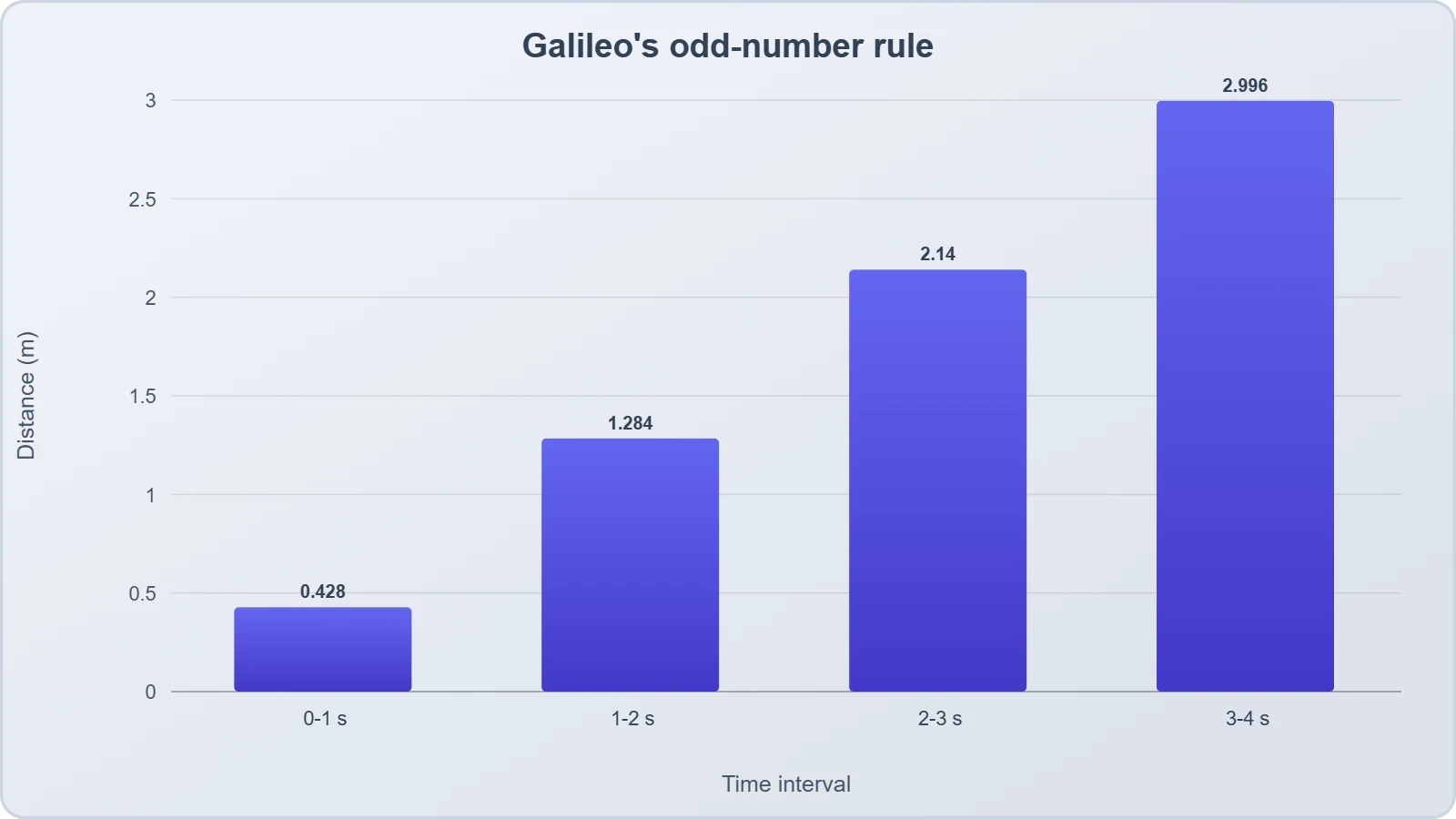
The pattern he found was that distances increased as the odd numbers: one, three, five, seven. This is the signature of uniformly accelerated motion, and it implies that total distance grows as the square of elapsed time. Galileo verified this relationship across many trials and incline angles, establishing it as a law rather than a coincidence.
The Quadratic Law of Uniform Acceleration
The mathematical statement of uniformly accelerated motion relates distance, acceleration, and time in a simple quadratic form. Starting from rest, the distance covered is proportional to the square of the time elapsed, a result that Galileo derived geometrically and confirmed experimentally.
If a ball on an incline of ##[5^\circ]## travels ##[0.428\ \text{m}]## in one second, then in two seconds it should travel ##[1.712\ \text{m}]##, four times the distance. Galileo's measurements matched this prediction closely, and the agreement across successive intervals was the strongest evidence for his law.
The velocity acquired at any time is given by the product of acceleration and time, and the relationship between velocity and distance can be expressed without explicit reference to time. This elimination of time was a significant mathematical step, allowing Galileo to connect quantities he could measure directly.
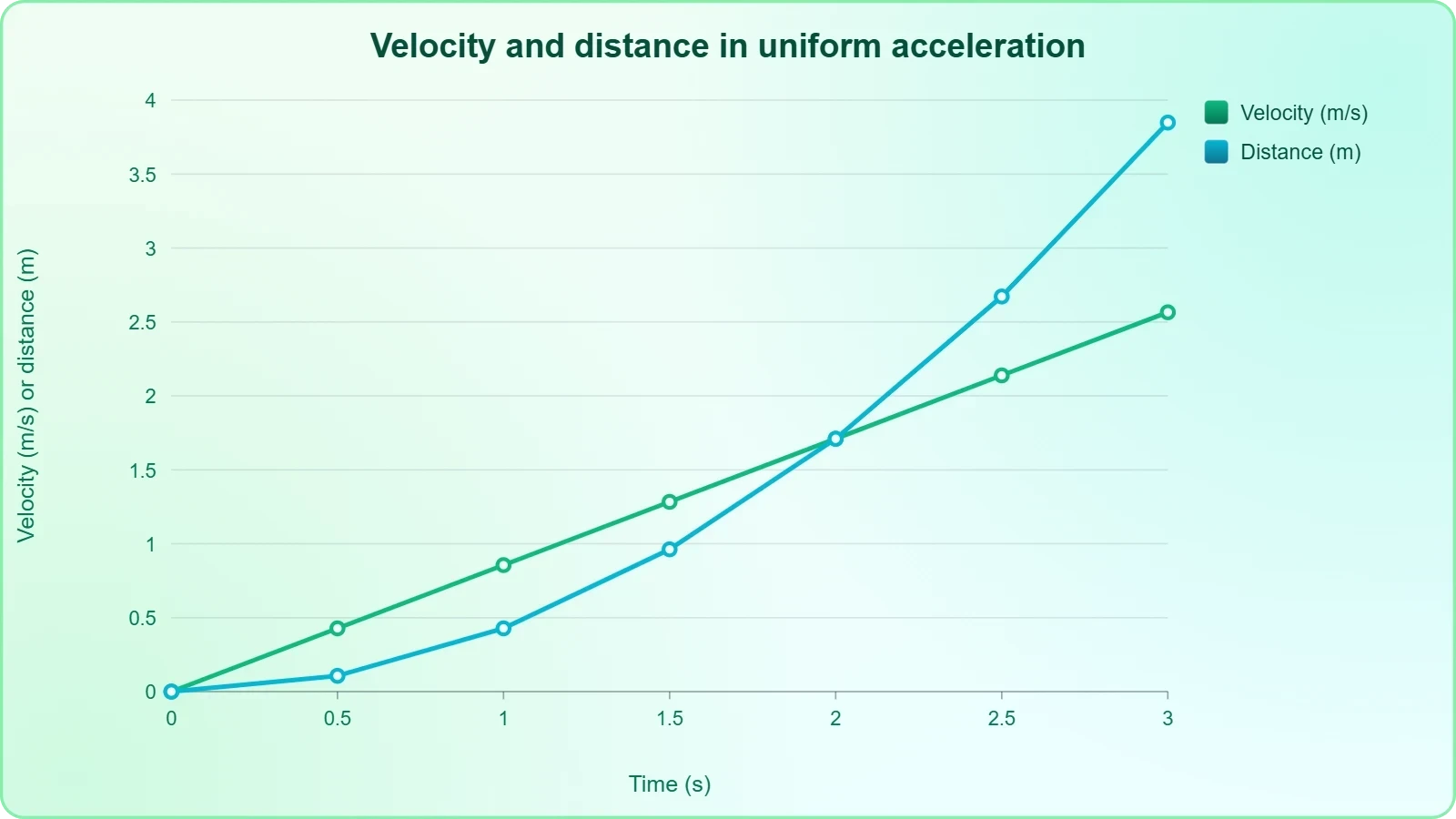
For the same incline, a ball that has traveled ##[1.712\ \text{m}]## has acquired a velocity of approximately ##[1.711\ \text{m/s}]##. This relation later became a standard tool in mechanics, and its form anticipates the energy methods that would be developed in the following centuries.
The inclined plane also served a polemical purpose. By making the experiment reproducible and its results numerical, Galileo provided evidence that could be checked by anyone with a board, a groove, and a smooth ball. The experiment was designed to be replicated, and replication was the point.
Hydrostatic Balance, the Compass, and Practical Invention
Galileo's inventive energies were not confined to astronomy and mechanics. He designed instruments for surveying, gunnery, and commerce, and these practical devices sustained his income and his reputation among patrons who valued utility as much as discovery. The geometric compass and the hydrostatic balance are the clearest examples of this applied dimension.
Measuring Density with the Hydrostatic Balance
The hydrostatic balance determined the relative density of a substance by weighing it in air and again submerged in water. The difference in apparent weight equals the weight of the displaced fluid, and the ratio of the two weights yields the specific gravity of the material under test.
For a sample weighing ##[W_{\text{air}} = 5.00\ \text{N}]## in air and ##[W_{\text{water}} = 4.35\ \text{N}]## when submerged, the relative density is approximately ##[7.69]##, consistent with a metal such as iron. Galileo's refinement of the balance allowed such determinations with small samples and considerable precision.
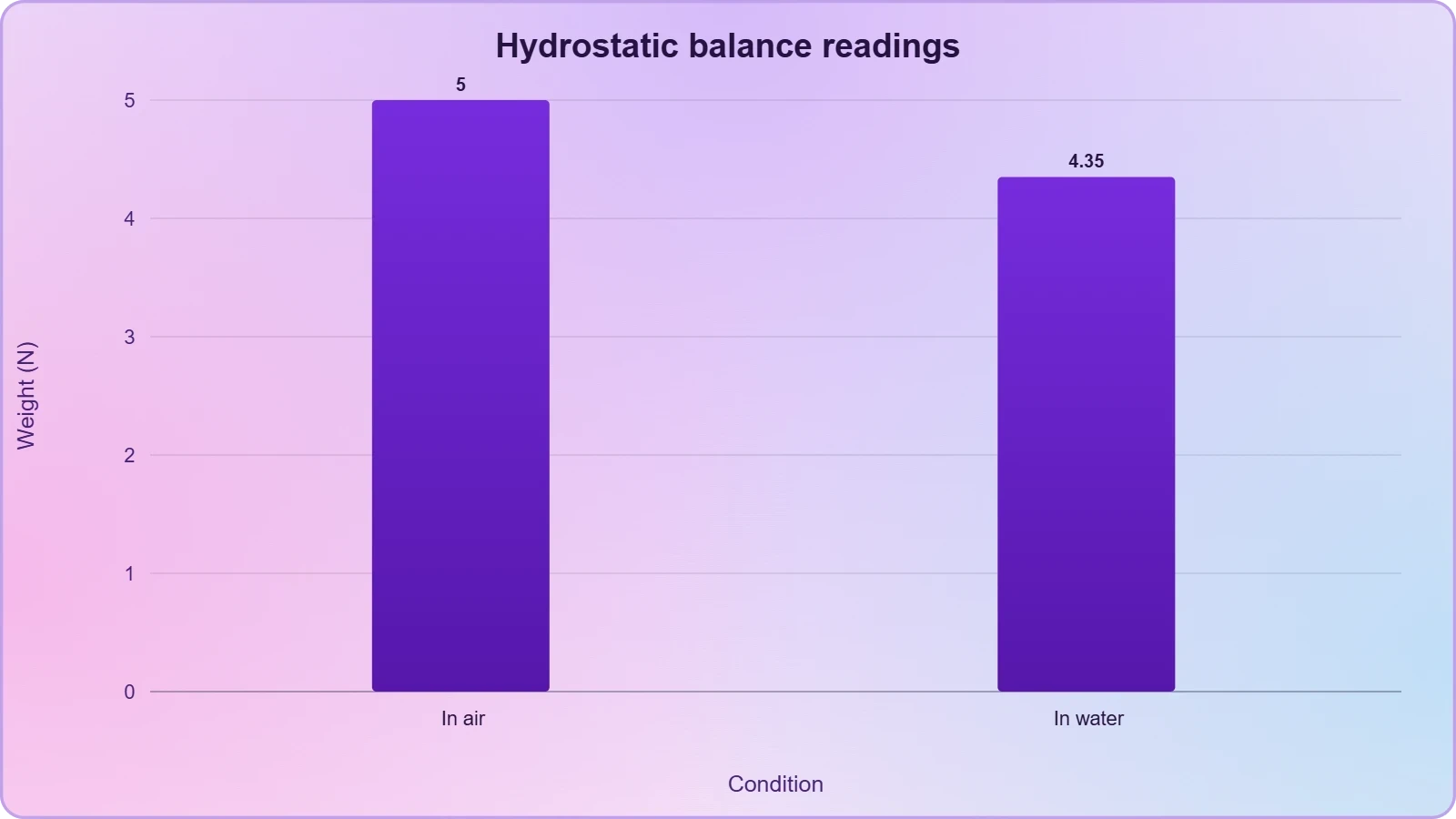
The instrument had practical value in assaying and commerce, where the purity of metals and the authenticity of gemstones carried financial consequences. Galileo's balance was thus a scientific instrument with a commercial application, and this dual character helped secure the patronage that funded his more speculative work.
The Geometric and Military Compass
The geometric and military compass was a calculating device with hinged legs and interchangeable scales. It could solve problems in proportion, extract square and cube roots, compute compound interest, and calculate the elevation of cannon for a given range. It was, in effect, a pocket calculator for the practical mathematician.
Galileo sold the compass along with instruction manuals, and the enterprise was profitable enough to attract imitators. His response to infringement was to publish a manual that established his priority and explained the instrument's proper use, an early instance of intellectual property being defended through print.
The compass embodied a philosophy of applied mathematics. It translated abstract ratios into physical settings, allowing a surveyor or gunner to obtain a numerical answer without performing the underlying calculation. This delegation of computation to an instrument is a recurring theme in the history of technology.
The device also reveals Galileo's commercial acumen. He understood that instruments could be products as well as tools, and he marketed his compass to a clientele of engineers, architects, and military officers. The revenue supported his research and reinforced his standing as a practical man of affairs.
Method, Mathematics, and the Enduring Legacy
Galileo's deepest contribution was not any single instrument but the method that united them. He combined controlled experiment, mathematical idealization, and public demonstration into a coherent practice that we now recognize as experimental physics. His instruments were the physical embodiment of that method, and their design reflected his conviction that nature's regularities were mathematical in form.
The Union of Experiment and Mathematical Idealization
Galileo's procedure typically began with an idealized model—motion without friction, a pendulum with no air resistance—and then compared the model's predictions against measurements. The discrepancies were not dismissed but examined, and the idealization was refined until it captured the essential behavior of the real system.
This approach required a delicate judgment about which complications could be ignored. Galileo neglected air resistance in his falling-body work, a choice that was reasonable for dense metal balls over short distances but would fail for light objects or long falls. The art lay in knowing where the idealization remained serviceable.
The mathematical tools available to him were limited. He worked with geometry and proportion rather than the algebraic notation and calculus that would later formalize his results. His derivations were often geometric, expressing relationships as ratios between line segments, and this style shaped the presentation of his laws.
Despite these constraints, his results were remarkably durable. The quadratic law of falling bodies, the isochronism of the pendulum, and the principle of inertia all survived the transition to Newtonian mechanics, and they remain standard elements of introductory physics instruction today.
From Galileo to Newton and Beyond
Newton's laws generalized Galileo's findings into a universal framework. The first law formalized the principle of inertia that Galileo had glimpsed, and the second law gave precise meaning to the relationship between force, mass, and acceleration that Galileo had studied on his inclines.
For a ball of mass ##[m = 0.200\ \text{kg}]## accelerating at ##[a = 0.855\ \text{m/s}^2]## on the five-degree incline, the net force along the plane is approximately ##[0.171\ \text{N}]##. This is the component of weight along the incline, and it matches the prediction of Newtonian mechanics applied to Galileo's setup.
The continuity between Galileo and Newton should not obscure the differences. Galileo lacked a precise concept of inertia, and his explanations often invoked circular motion in ways that Newton's framework rendered unnecessary. His achievement was to establish the phenomena that a mature mechanics would have to explain.
The legacy extends beyond mechanics. Galileo's insistence on reproducible observation became a cornerstone of the scientific method, and his conflicts with ecclesiastical authority became a touchstone for debates about the autonomy of inquiry. His instruments, meanwhile, evolved into the precision apparatus of modern astronomy and metrology.
Modern telescopes trace their lineage to his refractor, and modern timekeeping to his pendulum. The specific devices have been superseded, but the principle they embodied—that nature yields its secrets to those who measure carefully—remains the foundation of the physical sciences.
Reconstructing Galileo's Calculations
The quantitative core of Galileo's work can be reconstructed through a series of representative calculations. Each problem below isolates a specific relationship he investigated, and each is solved using the formulas presented in the preceding sections. Together they illustrate how measurement and mathematics combined to produce laws of enduring validity.
Worked Problems in Galilean Mechanics
The first problem concerns the magnification of his telescope. With an objective of focal length ##[f_o = 1200\ \text{mm}]## and an eyepiece of ##[f_e = 40\ \text{mm}]##, the magnifying power is ##[M = 1200/40 = 30]##, confirming the thirtyfold figure commonly attributed to his best instruments.
The second problem determines the period of a pendulum of length ##[L = 0.994\ \text{m}]## at standard gravity. Substituting into the period formula yields ##[T = 2\pi\sqrt{0.994/9.81} \approx 2.000\ \text{s}]##, the classic seconds pendulum that later informed the definition of the metre.
The third problem computes the acceleration on an incline of ##[\theta = 10^\circ]##. The effective acceleration is ##[a = 9.81 \times \sin 10^\circ \approx 1.703\ \text{m/s}^2]##, roughly one-sixth of free fall and comfortably measurable with seventeenth-century timing methods.
The fourth problem finds the distance traveled in ##[3\ \text{s}]## on that incline. Using ##[s = \tfrac{1}{2}at^2]##, we obtain ##[s = 0.5 \times 1.703 \times 9 \approx 7.66\ \text{m}]##, a length that could be accommodated on a long inclined board.
Verification and Error Analysis
The fifth problem checks the velocity acquired after that interval. From ##[v = at]##, the velocity is ##[1.703 \times 3 \approx 5.11\ \text{m/s}]##, and the alternative relation ##[v^2 = 2as]## gives ##[v = \sqrt{2 \times 1.703 \times 7.66} \approx 5.11\ \text{m/s}]##, confirming internal consistency.
The sixth problem estimates the relative density of a sample weighing ##[3.20\ \text{N}]## in air and ##[2.80\ \text{N}]## in water. The result is ##[\rho_{\text{rel}} = 3.20/(3.20 - 2.80) = 8.00]##, consistent with a dense metal such as brass or copper.
The seventh problem examines the small-angle approximation's error. For an amplitude of ##[10^\circ]##, the exact period exceeds the small-angle prediction by roughly ##[0.19\%]##, a discrepancy Galileo could not have detected but which becomes significant at larger swings.
The eighth problem computes the height of a lunar mountain from a shadow length. If a peak casts a shadow of ##[60\ \text{km}]## when the Sun is ##[20^\circ]## above the horizon, the height is approximately ##[60 \times \tan 20^\circ \approx 21.8\ \text{km}]##, an overestimate by modern standards but methodologically sound.
The ninth problem determines the net force on a ##[0.150\ \text{kg}]## ball on a ##[10^\circ]## incline. The force along the plane is ##[F = mg\sin\theta = 0.150 \times 9.81 \times 0.1736 \approx 0.255\ \text{N}]##, matching Newtonian predictions for Galileo's apparatus.
The tenth problem verifies the odd-number rule for successive intervals. On the ##[10^\circ]## incline, distances in the first three seconds are ##[0.852\ \text{m}]##, ##[3.406\ \text{m}]##, and ##[7.664\ \text{m}]##, whose successive differences are ##[0.852]##, ##[2.554]##, and ##[4.258]##, in the ratio 1:3:5 as predicted.
From our network :
- 98% of Global MBA Programs Now Prefer GRE Over GMAT Focus EditionExplore why 98% of global MBA programs now prefer the GRE over GMAT Focus. Learn about the shorter GRE format, verbal logic importance, and strategic versatility for students.
- Trump Political Strategy How Geopolitical Stunts Serve As Media Diversions
- Vite 6/7 'Cold Start' Regression in Massive Module GraphsIn-depth analysis of Vite 6/7 cold start regressions in massive module graphs. Learn about barrel file issues, pre-bundling optimizations, and how to improve Vite dev server performance.
- 10 Physics Numerical Problems with Solutions for IIT JEEPrepare for IIT JEE with 10 physics numerical problems, complete with detailed solutions and conceptual explanations. Ideal for mastering kinematics, thermodynamics, electromagnetism, and optics.
- Analyzing Trump Deportation Numbers Insights Into The 2026 Immigration Crackdown
- AI-Powered 'Precision Diagnostic' Replaces Standard GRE Score ReportsDiscover the new GRE Precision Diagnostic. Learn how AI-powered behavioral analytics and time-to-solve tracking are replacing standard GRE score reports to empower students.
- Mastering DB2 12.1 Instance Design: A Technical Deep Dive into Modern Database ArchitectureComprehensive guide to DB2 12.1 Instance Design. Explore architectural components, HADR setup, buffer pool tuning, and security policies for IBM DB2 12.1. Includes 10 functional SQL and Shell samples.
- EV 2.0: The Solid-State Battery Breakthrough and Global Factory ExpansionDiscover the impact of the Solid-State Battery Breakthrough on the EV market. Learn about CATL and BYD stock growth, global factory expansion in Europe, and the future of EV 2.0 technology.
- Mastering DB2 LUW v12 Tables: A Comprehensive Technical GuideComprehensive guide on DB2 LUW v12 tables. Explore CREATE TABLE syntax, BLU Acceleration, range partitioning, data types, and security features for IBM DB2 LUW v12.
RESOURCES
- Galileo | Biography, Discoveries, Inventions, & Facts - Britannicabritannica.com3 days ago ... In January 1610 he discovered four moons revolving around Jupiter. He also found that the telescope showed many more stars…
- What Did Galileo Invent? - Universe Todayuniversetoday.comJun 28, 2015 ... Hydrostatic Balance: · Galileo's Pump: · Pendulum Clock: · The Sector: · Galileo's Thermometer: · Galileo's Telescope:.
- Galileo's Discoveries After 400 Years | American Scientistamericanscientist.orgDuring the 18 years he spent in Padua, he made his most important discoveries in mechanics, both experimental and theoretical: the acceleration of a…
- Galileo Galilei - Wikipediaen.wikipedia.orgHe created a thermoscope, a forerunner of the thermometer, and, in 1586, published a small book on the design of a hydrostatic balance he…
- What did Galileo discover? | Royal Museums Greenwichrmg.co.ukGalileo, though not the first inventor of the refracting telescope, significantly enhanced its power. In 1609, he learned of the spyglass and began to ...
- Galileo Galilei: Biography, Inventions & Other Facts - Spacespace.comNov 14, 2017 ... Of all of his telescope discoveries, he is perhaps most known for his discovery of the four most massive moons…
- Galileo Galilei - History.comhistory.comJul 23, 2010 ... He quickly published a short treatise outlining his discoveries ... His inventions, from compasses and balances to improved telescopes ...
- What are Galileo Galilei's inventions and discoveries? - Quoraquora.comMar 16, 2017 ... Hydrostatic balance, Galileo's pump, Pendulum clock, The cannons called sector, Galileo's thermometer, and Galileo's telescope. Upvote ·. 92.
- Galileo Galilei - Stanford Encyclopedia of Philosophyplato.stanford.eduDec 17, 2025 ... Drake, Stillman (ed.), 1957, The Discoveries and Opinions of Galileo, New York: Anchor Books. ... ), Galileo Scientist: His Years…
- Galileo's Telescope (Stories of Great People) - Amazon.comamazon.comInside you'll find: the factual biography of the Italian scientist, Galileo Galilei, within a fictional storyline, Galileo's inventions and discoveries in a ...
- What Galileo Galilei's Famous For - Star Walkstarwalk.spaceFeb 13, 2026 ... ... Galileo Galilei's most important achievements and discoveries. Want ... Galilei was a renowned astronomer and also a prolific inventor…
- Galileo Galilei Lesson for Kids: Facts & Biography - Study.comstudy.comThe influence Galileo Galilei's inventions and discoveries had on future scientists spanned centuries. Most importantly, his understanding and discovery of the ...
- Galileo's Observations of the Moon, Jupiter, Venus and the Sunscience.nasa.govFeb 24, 2009 ... Galileo's discoveries about the Moon, Jupiter's moons, Venus, and sunspots supported the idea that the Sun - not the Earth…
- Galileo Galilei Inventions and Discoveries Pdf - Pinterestpinterest.comDiscover Pinterest's best ideas and inspiration for Galileo galilei inventions and discoveries pdf. Get inspired and try out new things. Last updated 2d.
- Galileo Galilei's birthday and discoveries - Facebookfacebook.comFeb 15, 2025 ... Galileo Galilei discovered several key phenomena in space, including craters and mountains on the Moon, the phases of Venus, Jupiter's…