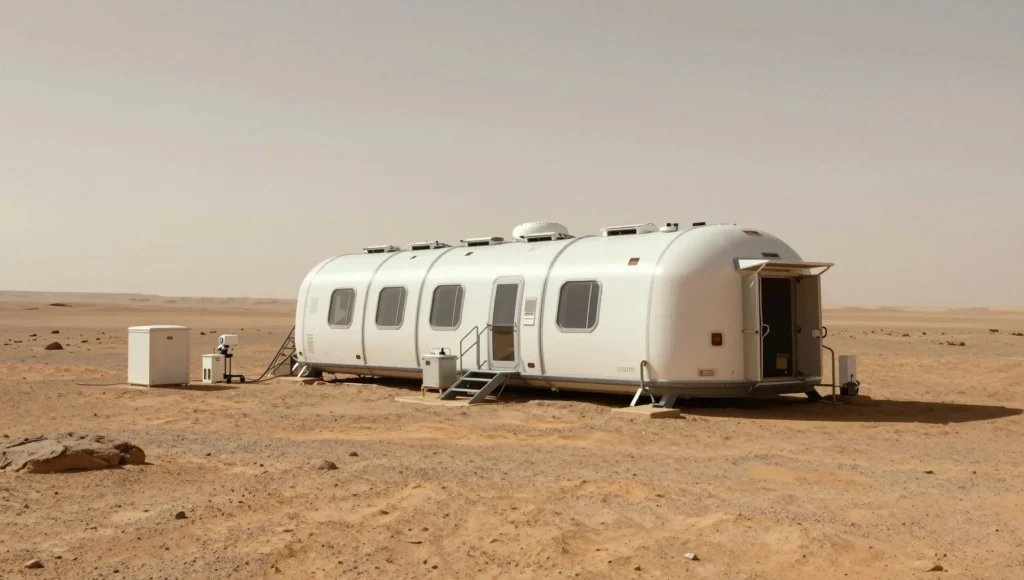
When four researchers stepped out of a sealed habitat at NASA's Johnson Space Center in Houston on a Saturday afternoon in July 2024, they had not felt fresh outdoor air, seen an unfiltered sky, or spoken to another human face-to-face for 378 days. Kelly Haston, Anca Selariu, Ross Brockwell, and Nathan Jones had spent more than a year inside a 3D-printed structure called Mars Dune Alpha, a 1,700-square-foot simulation of a Martian outpost. Their emergence marked the completion of CHAPEA, the Crew Health and Performance Exploration Analog, NASA's first year-long ground-based rehearsal for human life on Mars.
The experiment matters because the hardest part of a Mars mission may not be the rocket. A round trip to the Red Planet, including surface time, could consume roughly two to three years, and during that period a crew would be sealed inside a small volume with no resupply, no evacuation option, and a communication delay of up to 22 minutes each way. NASA designed CHAPEA to study precisely those pressures: how people eat, sleep, exercise, cooperate, and stay psychologically intact when Earth is a distant, laggy voice rather than a nearby refuge. The data gathered will shape everything from spacecraft architecture to crew selection.
This analysis examines what the 378-day mission actually involved, why isolation research sits at the center of deep-space planning, and how the findings feed into the broader engineering and human-factors science of interplanetary travel. It also considers the mathematical side of the problem, from the orbital mechanics that set mission duration to the statistical models used to interpret small-sample crew data. The story of four people leaving a building in Texas is, in reality, a story about the limits of human endurance and the discipline required to measure them.
On This Page
The Architecture of a Simulated Mars Mission
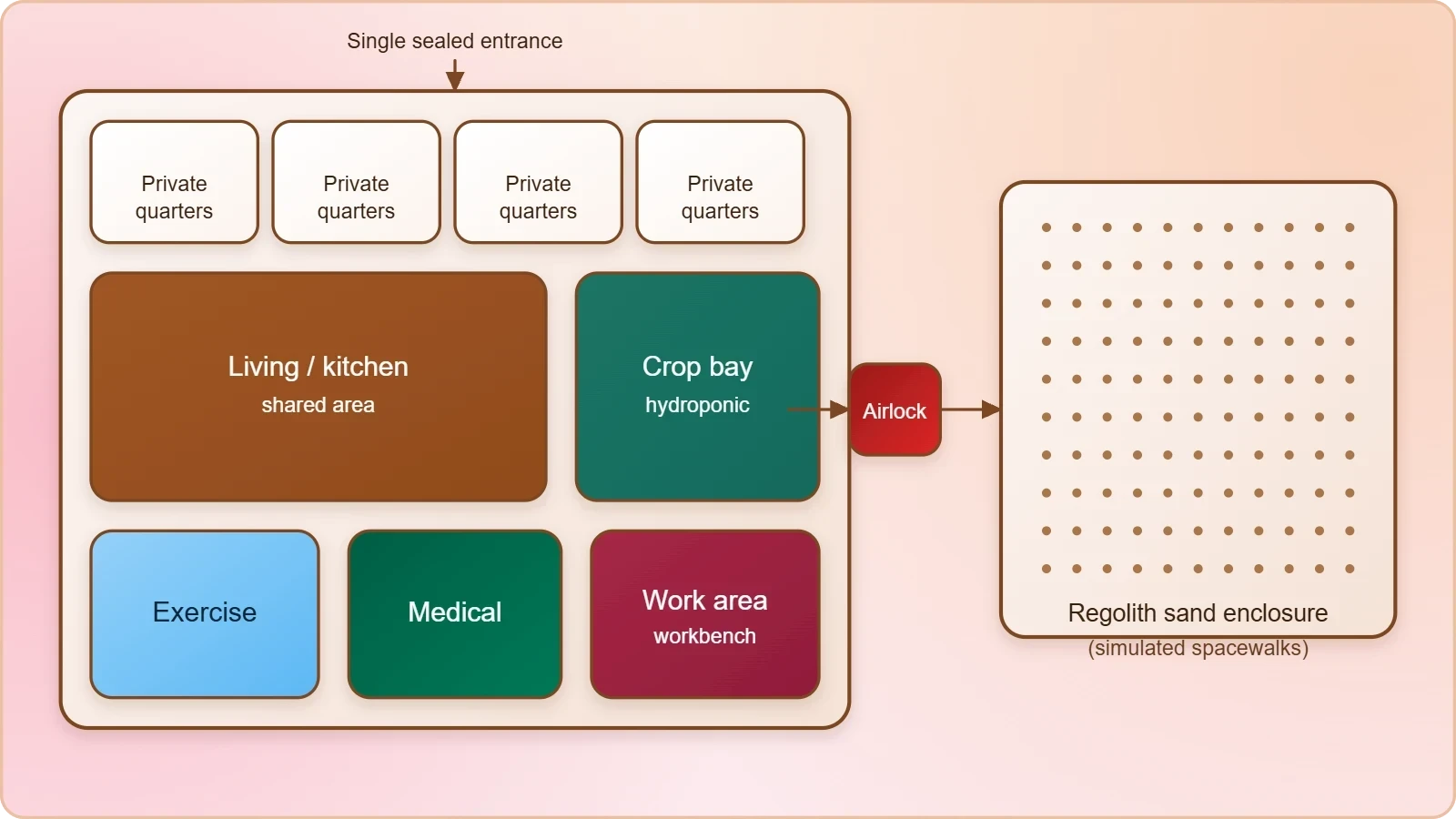
Mars Dune Alpha was not a tent with a red filter over the windows. The habitat, 3D-printed from a concrete-like material, was built to impose the same spatial and resource constraints a real Martian base would impose. Crew members lived in private quarters barely larger than a walk-in closet, shared a communal kitchen and work area, and operated under a fixed water and food budget. Every resource was tracked, every system had failure modes, and every day required deliberate maintenance of equipment that could not simply be replaced by a delivery from Earth.
The simulation also reproduced the operational texture of exploration. Crews conducted simulated spacewalks in a separate sand-filled enclosure meant to approximate Martian regolith, grew and harvested vegetables to supplement their shelf-stable diet, performed robotic operations, and responded to scripted emergencies injected by mission control. These were not theatrical exercises; they were structured experiments with instruments, logs, and protocols designed to convert human behavior into analyzable data. The habitat was, in effect, a laboratory whose subject was the crew itself.
Inside the Habitat: Daily Life Under Constraint
A typical day inside Mars Dune Alpha followed a rhythm imposed by biology and logistics rather than by clocks. Crew members woke on a schedule, exercised on treadmills and resistance equipment to counter the muscle and bone loss that microgravity and reduced activity would cause, ate meals built from a limited pantry, and rotated through maintenance, science, and habitat chores. Sleep quality, mood, and cognitive performance were logged regularly, because NASA needs to know when fatigue becomes a safety hazard rather than a personal inconvenience.
Food production served a dual purpose. Growing lettuce and other crops provided fresh produce and a psychological anchor, a small act of normalcy in an otherwise engineered existence. But it also tested whether a crew could reliably sustain a hydroponic system under time pressure and limited spare parts. The mundane details, from water recycling efficiency to the social friction of shared chores, are exactly the variables that determine whether a real mission succeeds or degrades into conflict and error.
The Crew and the Human Variables Under Study
The four participants were selected not as astronauts in training but as research subjects with relevant scientific and technical backgrounds. Kelly Haston, a research scientist, served as commander; Anca Selariu brought expertise in microbiology and the U.S. Navy; Ross Brockwell was a structural engineer and public works administrator; Nathan Jones was an emergency medicine physician. That mix was deliberate, mirroring the complementary skill sets a real Mars crew would need to handle medical, structural, and scientific contingencies without outside help.
What NASA measured in these individuals was less about heroism than about baseline human variability. Researchers tracked stress hormones, immune markers, sleep architecture, team cohesion, and performance on standardized tasks. Because a Mars crew will be small, the statistical challenge is severe: with only four subjects, distinguishing a genuine effect from individual idiosyncrasy requires careful design. The mission therefore generated dense longitudinal data, repeated measures across 378 days, rather than relying on a single snapshot of crew well-being.
Why Isolation Is the Central Engineering Problem
Spacecraft engineers can calculate thrust, shielding, and life-support margins with considerable confidence. Human behavior resists that kind of precision. A crew confined for years in a small volume faces stressors that accumulate slowly: monotony, loss of privacy, disrupted circadian rhythm, restricted social contact, and the persistent awareness that help is impossibly far away. NASA's interest in analog habitats stems from the recognition that these psychological and physiological factors are mission-critical variables, not soft concerns to be addressed after the hardware is finished.
The communication delay compounds every one of them. On the International Space Station, astronauts can hold near-real-time conversations with family and flight surgeons. On a Mars mission, a request for guidance may take 44 minutes to receive a reply. That lag transforms minor disagreements into unresolved tensions and routine medical questions into autonomous decisions. CHAPEA deliberately imposed the delay, forcing the crew to manage conflict, diagnose problems, and make judgment calls without the psychological safety net of immediate ground support.
Physiological Stress and the Confinement Response
Prolonged confinement produces measurable biological changes. Studies of Antarctic stations, submarines, and prior isolation experiments have documented immune dysregulation, altered cortisol rhythms, sleep fragmentation, and shifts in gut microbiome composition. NASA's CHAPEA protocols tracked these markers through blood, saliva, and wearable sensors, building a longitudinal picture of how a healthy adult body adapts to a sealed, low-stimulus environment over a full year. The goal is to identify early warning signs that could be monitored during a real transit to Mars.
Exercise served as both countermeasure and data source. Crew members followed structured routines to preserve bone density and cardiovascular capacity, mimicking the exercise regime astronauts use on the space station. Researchers then examined whether adherence held up over twelve months, because motivation decays in isolation even when the physiological need for exercise does not. A crew that stops exercising in month eight of a thirty-month mission arrives at Mars physically diminished, which is precisely the failure mode the simulation was designed to expose.
Team Dynamics, Conflict, and Cognitive Load
Small teams under confinement tend to develop predictable fault lines. Research from polar expeditions and undersea habitats shows that cohesion often peaks early, erodes during the middle third of a mission, and recovers as the end approaches. NASA structured CHAPEA to capture that arc, using periodic surveys, peer ratings, and behavioral observation to map how the four-person crew negotiated roles, resolved disagreements, and maintained morale across 378 days of unbroken proximity.
Cognitive load is the quieter variable. Every task in the habitat demanded more attention than its terrestrial equivalent because nothing could be taken for granted: water had to be conserved, tools repaired, schedules renegotiated. Over time, that constant low-grade vigilance depletes executive function, slowing decision-making and increasing error rates. Understanding how cognitive performance degrades under sustained load is essential for designing procedures that remain safe when the crew is tired, isolated, and months away from any possibility of resupply or rescue.
We Also Published
The Orbital Mechanics That Set Mission Duration
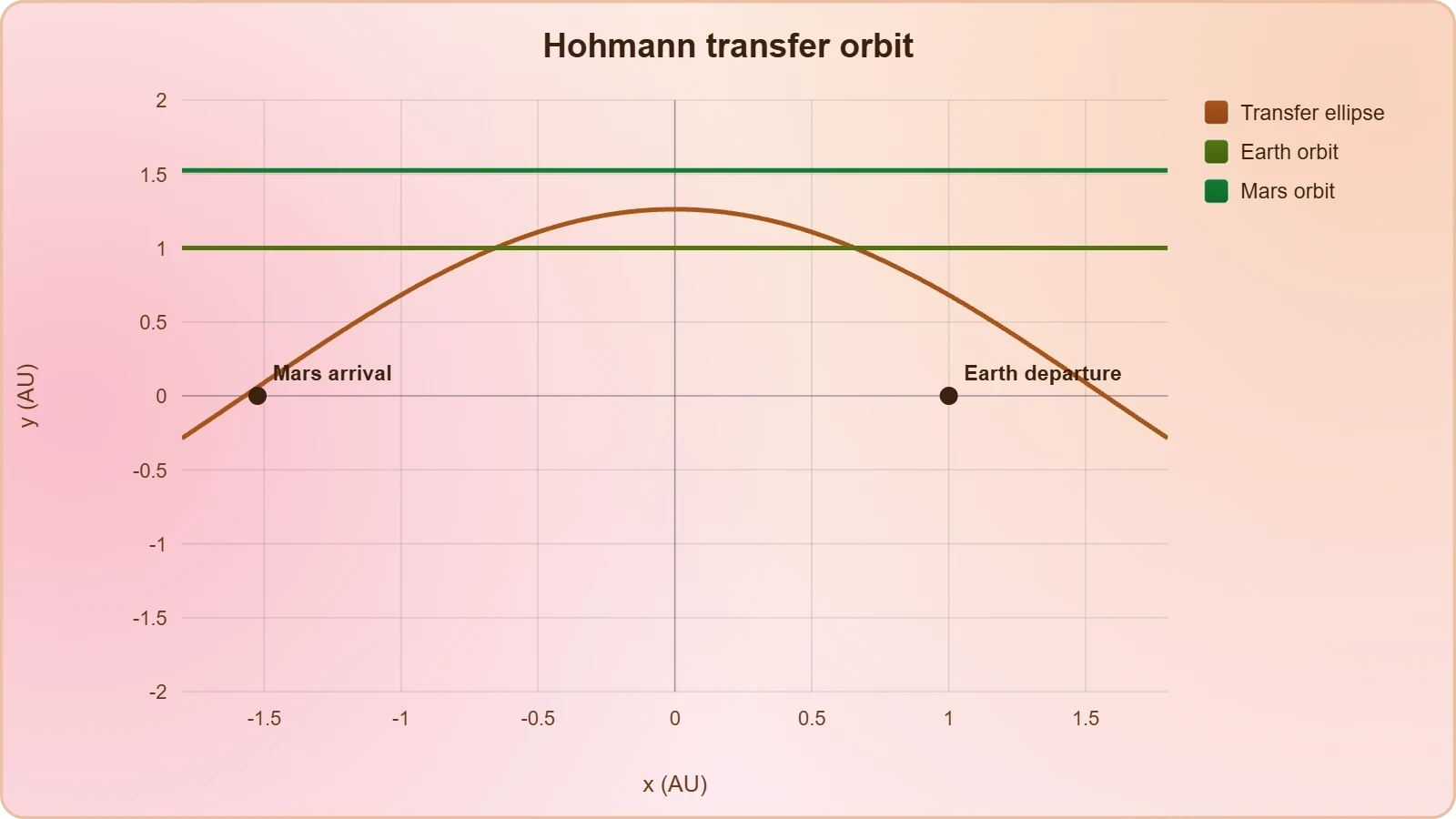
The 378-day figure is not arbitrary; it reflects the realities of interplanetary transfer. Earth and Mars orbit the Sun at different rates, and the geometry that permits an efficient transfer opens only periodically. The most economical trajectory, the Hohmann transfer, requires the spacecraft to depart when Mars is positioned roughly 44 degrees ahead of Earth in its orbit. Missing that window means waiting approximately 26 months for the next alignment, which is why mission planners treat launch opportunities as scarce and inflexible resources.
Once the trajectory is fixed, the transit times follow from orbital dynamics. A minimum-energy transfer to Mars takes roughly 259 days outbound, and the return leg is comparable. Adding surface stay time, which must itself respect planetary alignment, produces total mission durations in the range of 900 days for a conjunction-class mission. That arithmetic is the reason CHAPEA lasted more than a year: NASA needed a simulation long enough to capture the psychological midpoint of a real mission, not merely a brief stint in a sealed room.
Calculating Transfer Windows and Transit Times
The Hohmann transfer time depends on the semi-major axis of the transfer ellipse, which is the average of Earth's and Mars's orbital radii. Using ##[a_E = 1.00 \text{ AU}]## and ##[a_M = 1.524 \text{ AU}]##, the transfer ellipse has ##[a_T = \dfrac{a_E + a_M}{2} = 1.262 \text{ AU}]##. Kepler's third law then gives the full orbital period of the transfer ellipse, and half of that period is the one-way transit time.
Half of this period yields a one-way transit of approximately 0.709 years, or about 259 days. A full round trip with a short surface stay therefore approaches 520 days of pure transit, and a longer stay aligned with the next launch window pushes the total toward 900 days. These figures explain why NASA's analog missions are measured in hundreds of days rather than weeks, and why the psychological endurance of a crew becomes as decisive as the propellant budget.
Statistical Inference from a Four-Person Sample
Interpreting data from four subjects is a genuine statistical problem. With such a small sample, conventional hypothesis tests have limited power, and individual differences can masquerade as treatment effects. NASA's approach relies on within-subject designs, comparing each crew member against their own baseline across hundreds of repeated measurements, and on Bayesian methods that incorporate prior knowledge from earlier isolation studies. The result is a set of probabilistic statements about crew health rather than definitive claims.
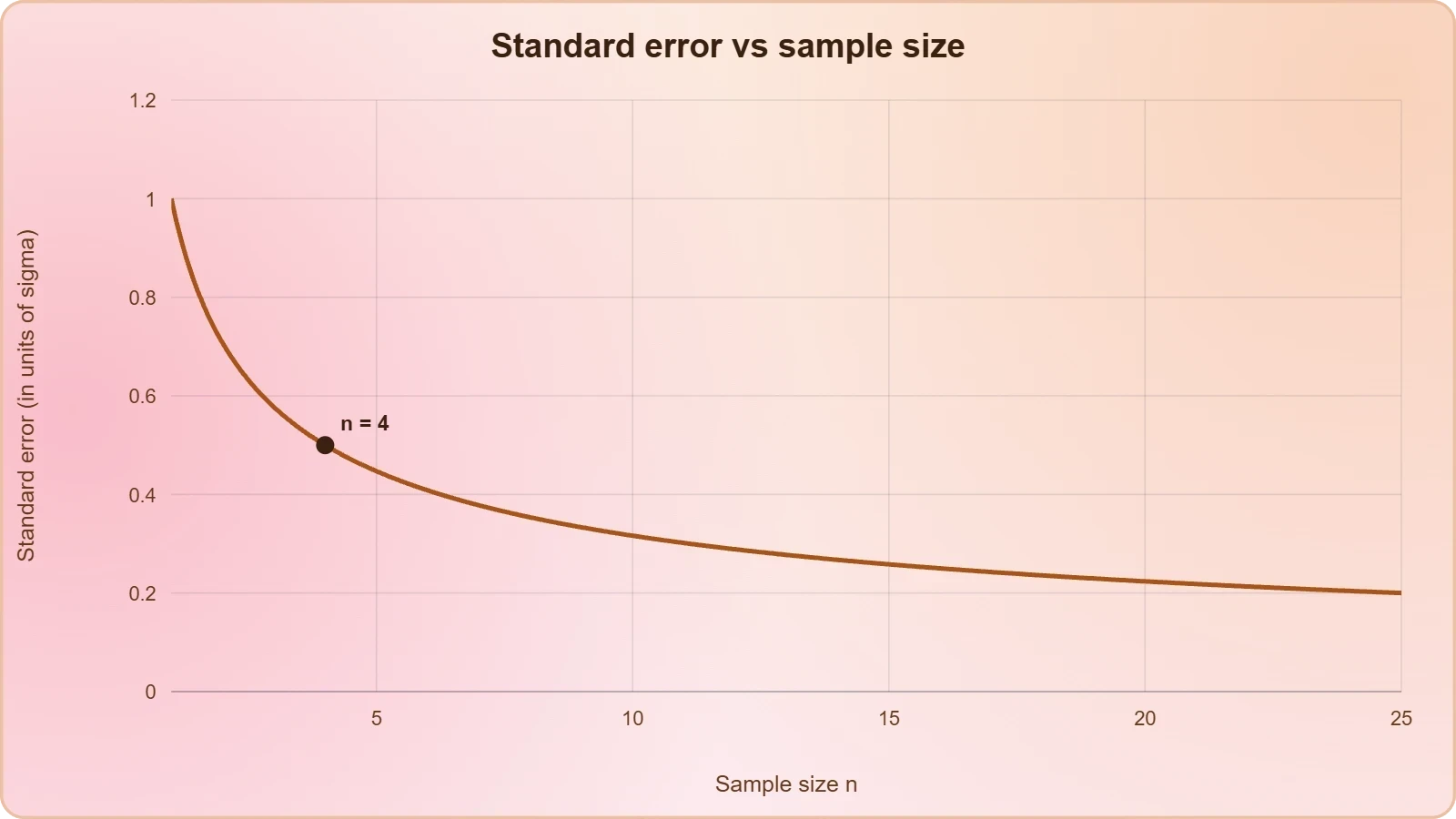
Consider a simplified model in which a crew member's stress score ##[S]## is assumed normally distributed with unknown mean ##[\mu]## and known variance ##[\sigma^2]##. The standard error of the mean for ##[n = 4]## observations is ##[\sigma/2]##, meaning the estimate is only half as precise as a single measurement would suggest. Detecting a modest shift in mean stress therefore requires either many repeated measures per subject or pooling across missions, which is precisely why NASA planned multiple CHAPEA analogs rather than treating one mission as conclusive.
From Analog Habitat to Deep-Space Operations
Analog missions occupy a specific niche in spaceflight research: they are cheaper than flight, safer than flight, and repeatable in ways that actual missions are not. NASA has used desert stations, undersea labs, and Antarctic outposts for decades to study human performance under isolation. CHAPEA added a crucial element, a purpose-built habitat with realistic resource constraints and a full year of continuous occupancy, producing data that shorter analogs could not. The mission's value lies less in any single finding than in the longitudinal record it created.
The operational lessons extend beyond psychology. Habitat maintenance under constrained resources informs the design of life-support systems that must run for years without resupply. Food production trials shape the agricultural payload of future missions. Even the crew's experience of the communication delay feeds directly into procedure design, telling planners which decisions can be delegated to the crew and which require ground consultation despite the lag. Each of these threads connects the Texas habitat to the engineering of an actual interplanetary spacecraft.
Design Lessons for Life-Support and Habitat Systems
Closed-loop life support is unforgiving. Water and air must be recycled at high efficiency, waste managed, and spare parts rationed, because the mass budget for a Mars mission leaves little room for redundancy. Crews in CHAPEA operated under those constraints and generated practical feedback on which systems were reliable, which failed in annoying ways, and which demanded more crew attention than designers had anticipated. That feedback is difficult to obtain from simulations alone, since real occupants interact with hardware in ways engineers rarely predict.
The habitat's physical layout also yielded lessons. Privacy, acoustic isolation, and the ability to retreat from teammates turn out to matter enormously over a year. Design choices that seem trivial on a drawing board, such as the placement of a door or the thickness of a wall, become significant when four people share a confined space for hundreds of days. NASA's data will inform the interior architecture of future habitats, where psychological comfort is treated as a functional requirement rather than a luxury.
What the Data Means for Future Crewed Mars Missions
The CHAPEA dataset is ultimately a planning instrument. It gives mission designers empirical grounding for crew selection criteria, exercise prescriptions, medical protocols, and conflict-resolution procedures. It also identifies gaps: areas where the simulation could not replicate reality, such as true microgravity, radiation exposure, or the psychological weight of knowing that Earth is genuinely unreachable. NASA has acknowledged these limits and structured follow-on missions to address them incrementally.
Two additional CHAPEA missions were planned, each lasting roughly a year, to build a larger sample and test variations in crew composition and mission profile. The agency has not committed to a specific launch date for a human Mars mission, but the research pipeline is clearly aimed at that goal. The four researchers who walked out of Mars Dune Alpha in July 2024 contributed a year of their lives to a problem that will define the next era of exploration, and the data they generated will outlast any single mission.
Broader Implications for Space Science and Society
The CHAPEA results ripple outward beyond NASA's mission planning. Isolation research informs terrestrial medicine, particularly the study of confinement stress in polar workers, submarine crews, and long-duration patients. It also shapes the design of remote workplaces and the understanding of how teams function without physical proximity, a question with obvious relevance to distributed organizations. The overlap between space psychology and everyday human factors is larger than it first appears, and the data generated in Houston has applications well beyond the launch pad.
There is also a strategic dimension. Human Mars exploration is a multi-decade undertaking that requires sustained public investment, international cooperation, and a workforce trained in the relevant disciplines. Analog missions serve as training grounds and as instruments of public engagement, demonstrating that the goal is being pursued methodically rather than rhetorically. The emergence of four researchers from a sealed habitat is a visible milestone in a program whose real progress is measured in datasets, procedures, and incremental engineering refinements.
Lessons for Terrestrial Isolation and Remote Work
Organizations that operate in extreme environments have long borrowed from space research, and the exchange now runs in both directions. The CHAPEA protocols for monitoring mood, sleep, and cognitive load resemble practices increasingly adopted in remote and high-stress workplaces. The finding that structured routines and clear role assignments buffer against isolation stress is directly transferable to distributed teams, offshore platforms, and research stations. Space agencies are, in effect, running long-duration experiments on human organizational behavior.
The communication-delay research is particularly instructive. When feedback loops stretch from seconds to tens of minutes, teams must develop autonomy, document decisions carefully, and pre-negotiate authority. These are the same principles that govern effective asynchronous collaboration in global organizations. NASA's data on how crews adapt to lagged communication offers a rigorous empirical basis for designing workflows that remain resilient when real-time coordination is impossible, a condition that is becoming more common rather than less.
The Road Ahead for Human Mars Exploration
No crewed Mars mission has been scheduled, and the technical, budgetary, and political obstacles remain formidable. Radiation shielding, in-space propulsion, and reliable life support all require further development, and the human factors research represented by CHAPEA is one strand among many. What the mission accomplished was to demonstrate that a year-long isolation study can be conducted rigorously, producing data that will inform design decisions for decades. That is a modest but genuine advance in a program that measures progress in years rather than months.
The next CHAPEA missions will expand the sample, test different crew configurations, and probe questions the first mission could not answer. Each will add to a growing body of evidence about how humans endure confinement, and each will refine the procedures that a real Mars crew will one day depend on. The four researchers who left Mars Dune Alpha in July 2024 returned to ordinary life, but the record of their year inside will shape the extraordinary journey that follows.
Reading the Mission in Context
Analog research is often misunderstood as rehearsal for a specific mission. In practice it is closer to basic science: a controlled setting in which hypotheses about human performance can be tested without the cost and risk of spaceflight. CHAPEA's contribution is a year-long record of four people living under constraints that approximate Mars, and the analytical work that record enables. The mission does not prove that humans can reach Mars, but it reduces one category of uncertainty in a program defined by many.
The public response to the crew's emergence focused on the human story, which is appropriate. Four people spent 378 days in a sealed building to advance a collective ambition, and their experience deserves attention. The scientific response will focus on the data, which is equally appropriate. Between those two responses lies the real significance of the mission: a demonstration that the human and technical dimensions of deep-space exploration can be studied together, rigorously and over long durations, in preparation for the day when the habitat is not in Texas.
From our network :
- Trump Political Strategy How Geopolitical Stunts Serve As Media Diversions
- Mastering DB2 LUW v12 Tables: A Comprehensive Technical GuideComprehensive guide on DB2 LUW v12 tables. Explore CREATE TABLE syntax, BLU Acceleration, range partitioning, data types, and security features for IBM DB2 LUW v12.
- Vite 6/7 'Cold Start' Regression in Massive Module GraphsIn-depth analysis of Vite 6/7 cold start regressions in massive module graphs. Learn about barrel file issues, pre-bundling optimizations, and how to improve Vite dev server performance.
- Mastering DB2 12.1 Instance Design: A Technical Deep Dive into Modern Database ArchitectureComprehensive guide to DB2 12.1 Instance Design. Explore architectural components, HADR setup, buffer pool tuning, and security policies for IBM DB2 12.1. Includes 10 functional SQL and Shell samples.
- 98% of Global MBA Programs Now Prefer GRE Over GMAT Focus EditionExplore why 98% of global MBA programs now prefer the GRE over GMAT Focus. Learn about the shorter GRE format, verbal logic importance, and strategic versatility for students.
- 10 Physics Numerical Problems with Solutions for IIT JEEPrepare for IIT JEE with 10 physics numerical problems, complete with detailed solutions and conceptual explanations. Ideal for mastering kinematics, thermodynamics, electromagnetism, and optics.
- EV 2.0: The Solid-State Battery Breakthrough and Global Factory ExpansionDiscover the impact of the Solid-State Battery Breakthrough on the EV market. Learn about CATL and BYD stock growth, global factory expansion in Europe, and the future of EV 2.0 technology.
- AI-Powered 'Precision Diagnostic' Replaces Standard GRE Score ReportsDiscover the new GRE Precision Diagnostic. Learn how AI-powered behavioral analytics and time-to-solve tracking are replacing standard GRE score reports to empower students.
- Analyzing Trump Deportation Numbers Insights Into The 2026 Immigration Crackdown
RESOURCES
- NASA Seeks Volunteers for Yearlong Simulated Mission to Moon ...nasa.govJul 1, 2026 ... ... isolated environment that mirrors deep‑space travel. They then will shift to the surface habitat phase, where researchers will study…
- Crew from NASA's simulated Mars mission emerges after 378 daysreuters.com2 days ago ... NASA CHAPEA mission aims to prepare for astronauts on Mars; Isolation habitat was at Johnson Space Center in Houston. Nov…
- First Mars Crew Completes Yearlong Simulated Red Planet NASA ...nasa.govJul 11, 2024 ... ... habitat such as resource limitations, isolation, and confinement. ... isolation research, including the Human Exploration Research Analog ...
- NASA's Simulated Mars Mission Marks 200 Days Inside Habitatreddit.comMay 8, 2026 ... extended isolation and confinement on a full crew of 4. The interpersonal and internal dynamics can be optimized to keep…
- Six scientists to spend 365 days in isolation for HI-SEAS simulated ...hawaii.eduJul 29, 2015 ... As with the previous two HI-SEAS missions in the NASA funded study, this mission will focus on crewmember cohesion and…
- What I Learned About Earth After a Year on "Mars" - Caltech Magazinemagazine.caltech.eduDec 19, 2024 ... The CHAPEA crew egress from their simulated Mars mission July 6, 2024, at NASA's Johnson Space ... We would explore,…
- NASA's CHAPEA mission simulates Mars habitat with NPS alumnusfacebook.comSep 17, 2025 ... NASA Seeks Volunteers for 1-Year Simulated Mars Habitat Study ... The yearlong ground-based study tests how humans respond to isolation ...
- NASA Analogs Recruitinganalogstudies.jsc.nasa.govNASA's Human Research Program (HRP) employs human analog missions in various environments to simulate aspects of human space exploration missions including ...
- Four research volunteers will soon participate in NASA - Facebookfacebook.comSep 5, 2025 ... NASA simulates 45-day Mars journey to study isolation effects. NASA's ... NASA Opens Simulated Mars Habitat to Media Ahead of…
- Mission Complete: Lee Spends 45 Days in NASA Simulated ...today.uconn.eduSep 5, 2024 ... ... study how future astronauts may react to isolation . ... habitat at Johnson Space Center, participating in a simulated…
- How would you like to spend a year pretending to be on Mars ...instagram.comJul 15, 2026 ... Four volunteers. A year inside a simulated Mars habitat. Earth is right outside. NASA's CHAPEA experiment studies how a crew…
- 4 Volunteers Will Spend 45 Days in a NASA-simulated Mars Habitatsciences.ucf.eduAug 8, 2024 ... The HERA studies are meant to explore how crew members will handle isolation, confinement, mental and physical health, and conditions…