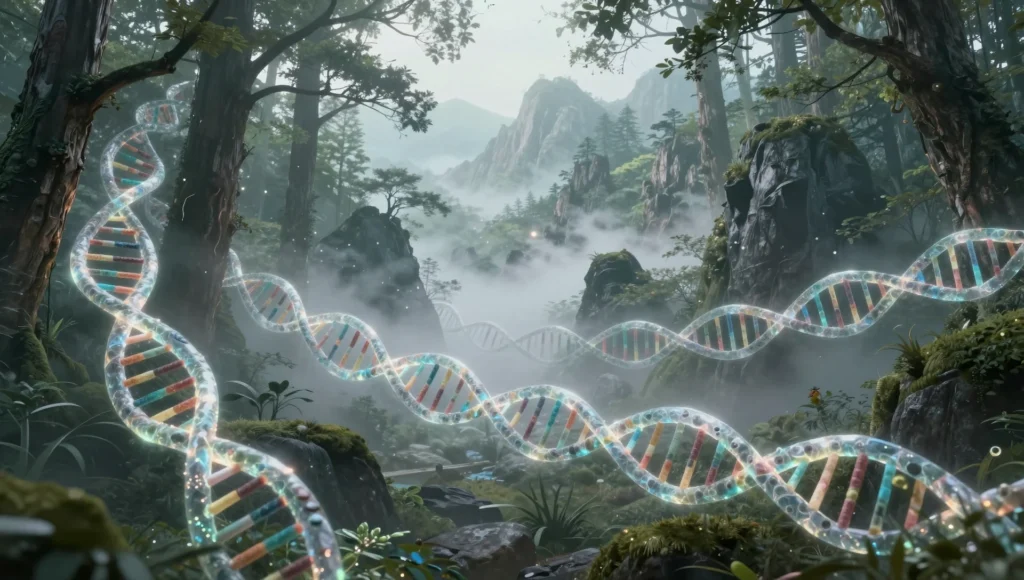
The study of ancient DNA has quietly become one of the most consequential instruments in modern anthropology, allowing researchers to read population history directly from the molecular record rather than inferring it solely from pottery, burial styles, or skeletal morphology. In Japan, this shift carries particular weight, because the origins of the Japanese people have long been debated through competing models of Jomon continuity, continental migration, and later admixture. A science programme from NHK WORLD-JAPAN brings this debate into focus through the remains known as Shiraho Skeleton No. 4, estimated at roughly 27,000 years old, with expert commentary from Hideaki Kanzawa of the National Museum of Nature and Science.
What makes the episode instructive is its pairing of two apparently unrelated frontiers. Alongside the paleoanthropological work, the programme examines deep-sea microbes and their potential role in anticipating future climate change, featuring marine microbiologist Kanae Kobayashi of JAMSTEC in an interview with reporter Safiya Quinley. The juxtaposition is deliberate: both segments concern organisms and environments that are difficult to observe, and both depend on sophisticated sampling technology to convert traces into evidence. Together they illustrate how publicly funded research in Japan moves between the distant human past and the planetary future.
The broader significance lies in methodology. Ancient DNA analysis does not simply confirm existing narratives; it imposes quantitative constraints on migration timing, population size, and divergence. Likewise, marine microbial ecology converts invisible communities into measurable indicators of ocean health and carbon cycling. This article examines the scientific content behind the broadcast, the statistical reasoning that underpins ancient genome work, and the way such programmes translate specialist research for a general audience.
On This Page
- The Scientific Context of the Shiraho Discovery
- Reading Ancient Genomes: Methods and Constraints
- Deep-Sea Microbes as Climate Indicators
- Public Broadcasting and the Translation of Research
- Quantifying Uncertainty in Ancient Chronologies
- Ocean Biogeochemistry and the Limits of Prediction
- What the Episode Reveals About Scientific Practice
The Scientific Context of the Shiraho Discovery
The Shiraho remains belong to a period when Japan was connected to the Asian mainland by land bridges and when human populations were expanding across northeastern Asia under conditions very different from today. Skeletal material of this antiquity is exceptionally rare, and each specimen carries disproportionate evidentiary weight. The programme's decision to foreground Shiraho Skeleton No. 4 reflects a broader recognition that Late Pleistocene human history in East Asia remains thinly documented compared with Europe, where cave sites have yielded a denser record of genomes and artefacts.
Why Late Pleistocene Remains Matter
Fossils from the Late Pleistocene offer the only direct window into the genetic composition of populations before the Neolithic transitions that reshaped so much of Eurasia. In the Japanese archipelago, the Jomon period is comparatively well studied, but the deeper chronology connecting earlier occupants to later communities is far less secure. A specimen dated to approximately 27,000 years before present sits near the boundary of what geneticists can reliably analyse, since DNA degrades predictably with temperature and time, and collagen or petrous bone must be preserved well enough to yield endogenous sequences rather than contamination.
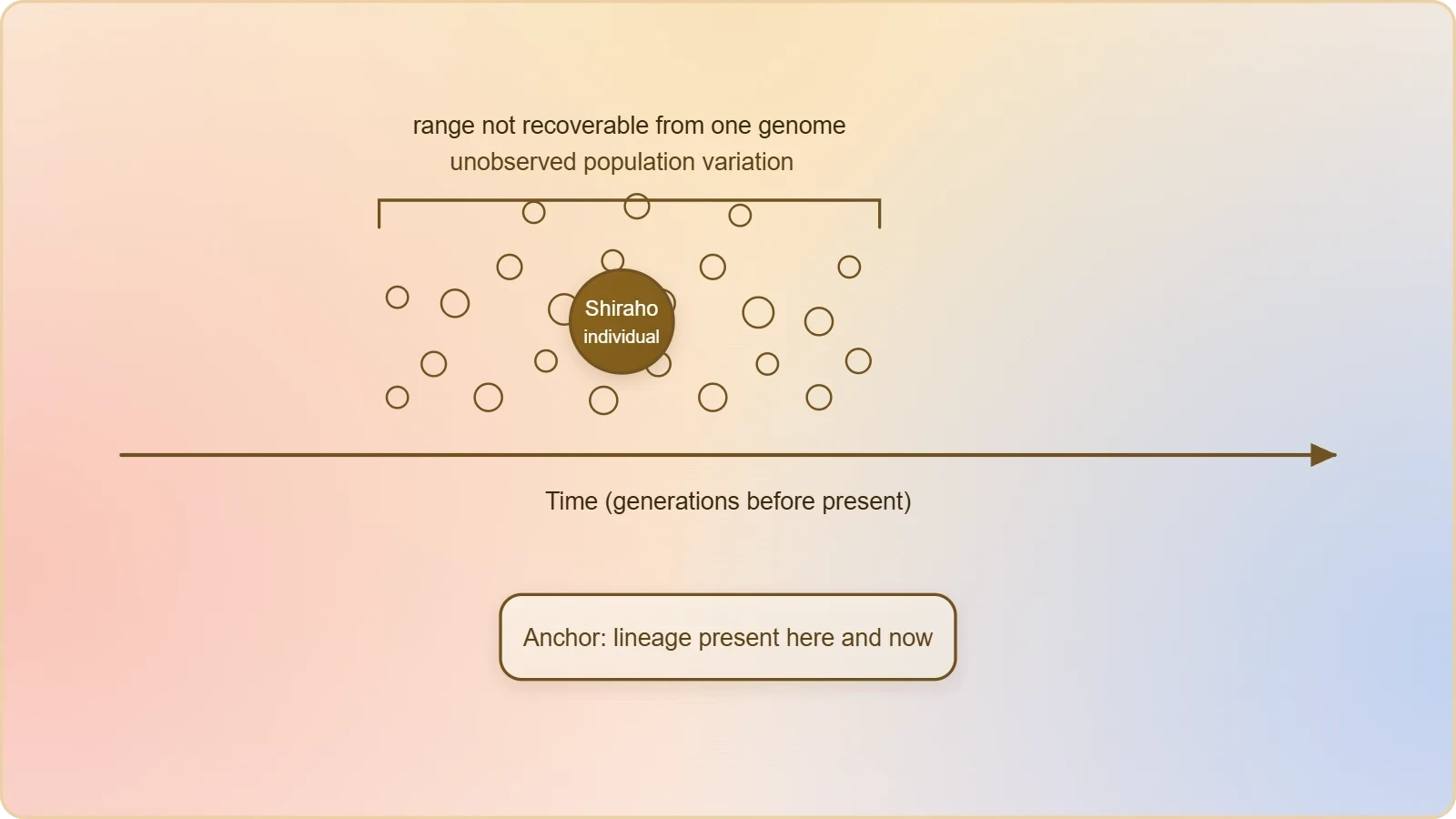
Researchers therefore treat such finds as anchors rather than conclusions. A single genome can establish that a particular lineage was present at a given place and time, but it cannot by itself describe the full range of variation in a population. The programme's framing, which places expert commentary alongside the specimen, appropriately signals that interpretation is ongoing and contested rather than settled. That caution is itself a form of scientific literacy, and it distinguishes serious coverage from sensational claims about discovering a lost people.
The Museum and Research Infrastructure
The involvement of the National Museum of Nature and Science situates the work within Japan's public research ecosystem, where national institutions curate specimens, coordinate international collaborations, and communicate findings to non-specialists. Hideaki Kanzawa's role in the Department of Paleontology and Anthropology reflects the interdisciplinary character of the field, which now requires competence in osteology, geochemistry, and computational biology. Museums are no longer passive repositories; they are active laboratories where destructive sampling must be balanced against long-term preservation obligations.
This institutional dimension matters for public understanding. When a broadcaster presents research from a national museum, it implicitly explains how scientific authority is organised: through peer review, through specimen curation, and through the slow accumulation of independent lines of evidence. Viewers learn not only what is known about early Japan but also who produces that knowledge and under what constraints. Such transparency is valuable in a media environment where claims about ancestry can carry political and cultural freight far beyond the laboratory.
Reading Ancient Genomes: Methods and Constraints
Ancient DNA research is fundamentally a problem of signal recovery. After an organism dies, its genome fragments into short pieces, undergoes chemical modification, and is progressively overwhelmed by microbial and environmental DNA. Recovering a usable sequence from a specimen tens of thousands of years old requires stringent laboratory protocols, clean-room facilities, and computational methods that can distinguish genuine endogenous fragments from contamination. The field has matured considerably, but the physical limits imposed by decay remain non-negotiable.
Degradation, Contamination, and Authentication
The dominant chemical lesion in ancient DNA is the deamination of cytosine to uracil, which appears most frequently near fragment ends and produces characteristic substitution patterns. Researchers exploit this damage rather than merely tolerating it, using the pattern as a signature of authenticity. A sample that lacks the expected damage profile is treated with suspicion, since modern contamination would not display it. This logic transforms a nuisance into a diagnostic tool, and it exemplifies how careful physical reasoning underpins reliable inference in the historical sciences.
Contamination control extends to the excavation and curation chain. Handling by excavators, museum storage conditions, and even the reagents used in preservation can introduce exogenous DNA. The programme's attention to a single named specimen is therefore scientifically apt: provenance documentation is as important as the sequencing itself. Without a trustworthy chain of custody, a genome becomes an anecdote rather than evidence, and the interpretive claims built upon it lose their foundation.
Statistical Inference from Sparse Data
Once sequences are authenticated, the analytical challenge becomes statistical. Population geneticists model the observed pattern of shared variants under competing demographic scenarios, comparing the likelihood of migration, isolation, and admixture models. With few ancient genomes, confidence intervals are wide, and conclusions must be stated with appropriate uncertainty. The mathematics is not decorative; it determines whether a result counts as support for a hypothesis or merely as compatibility with it.
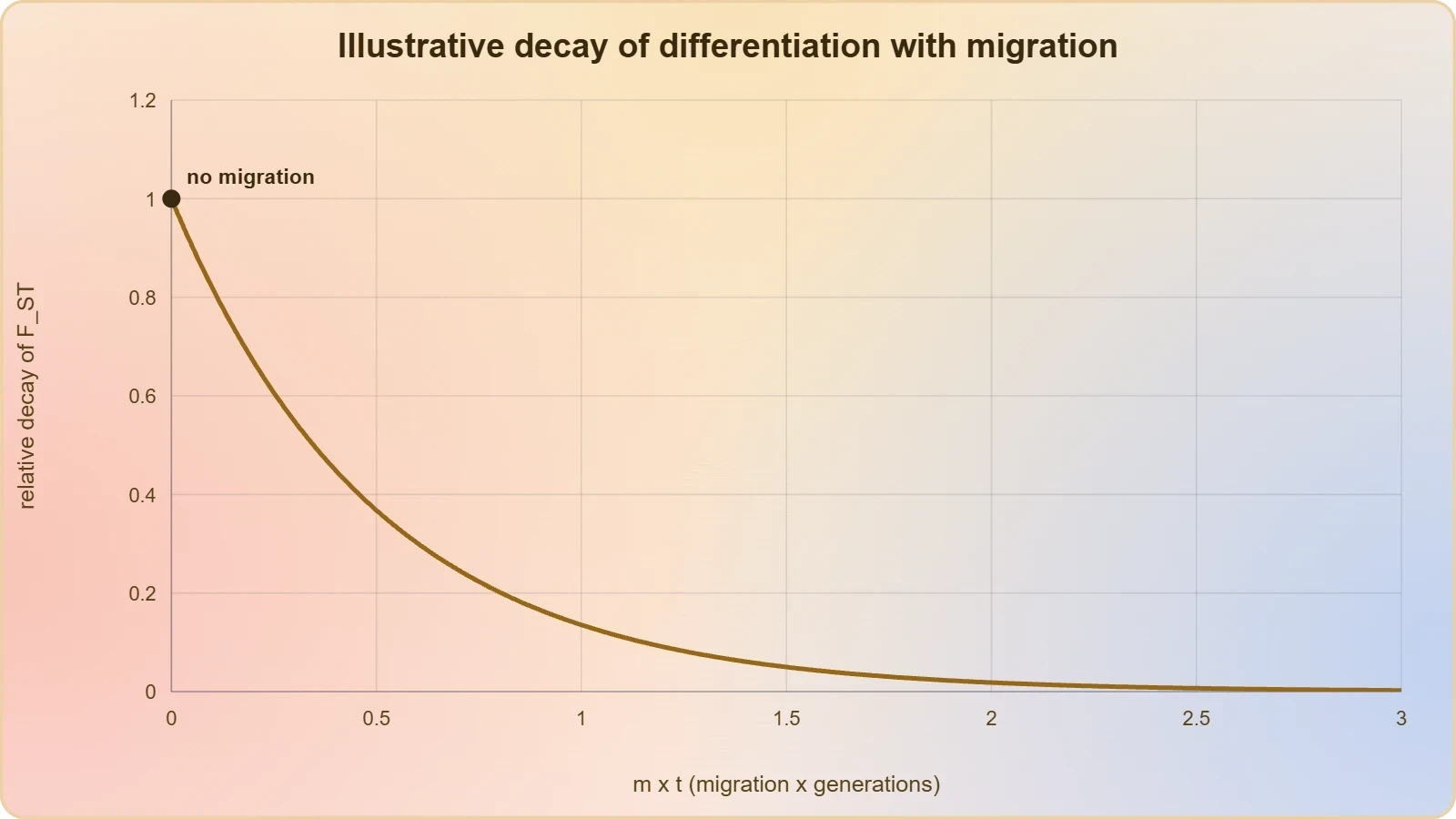
A simplified illustration clarifies the reasoning. If two populations diverged ##[t]## generations ago and exchanged migrants at rate ##[m]## per generation, the expected reduction in between-population differentiation can be approximated by a decay term. The following expression captures the intuition that migration erodes divergence exponentially over time:
Here ##[F_{ST}]## denotes the standardized measure of differentiation, ##[m]## the migration rate, and ##[t]## elapsed generations. The factor of two arises because migration affects both populations. Real inference requires far more elaborate models, but the exponential form illustrates why even modest gene flow, sustained over hundreds of generations, can substantially homogenise populations. For Japanese prehistory, this principle explains why distinguishing long-term continuity from recurrent admixture is genuinely difficult with limited ancient samples.
Deep-Sea Microbes as Climate Indicators
The second strand of the programme turns from human ancestry to microbial ecology in the deep ocean, where JAMSTEC researchers including Kanae Kobayashi investigate communities that thrive under extreme pressure, darkness, and scarcity. These organisms are not curiosities; they mediate global biogeochemical cycles, influencing carbon sequestration and the flux of nutrients between sediment and water column. Understanding them is therefore directly relevant to how the ocean will respond to warming, acidification, and changing circulation.
The JAMSTEC Research Programme
JAMSTEC, Japan's marine-earth science and technology agency, operates submersibles and sampling systems capable of reaching hadal depths. The interview with Kobayashi, conducted by reporter Safiya Quinley, highlights the technological dependence of this science: without reliable pressure-tolerant samplers and culture systems, deep-sea microbiology would remain speculative. The programme's inclusion of exploration technology alongside biological findings reflects how inseparable the two have become, and it gives viewers a realistic sense of why deep-ocean research is expensive and slow.
Marine microbiologists increasingly treat microbial community composition as an indicator of environmental state. Shifts in community structure can signal changes in oxygen availability, organic matter supply, or temperature regimes before larger ecological effects become visible. This proxy function is analogous to the use of ancient DNA as a proxy for past population structure: in both cases, a molecular signal stands in for a process that cannot be observed directly, and interpretation depends on calibrated models linking signal to cause.
From Observation to Prediction
The claim that deep-sea microbes might help predict future climate change deserves careful parsing. Microbes do not forecast; they respond. What researchers can do is characterise how microbial processes feed back into carbon cycling and then incorporate those relationships into Earth system models. The predictive value therefore depends on the fidelity of the underlying biogeochemical representation, not on the microbes themselves possessing any anticipatory capacity.
This distinction is important for public communication. Framing microbial research as climate prediction risks overstating what is known, yet understating it would obscure the genuine importance of ocean biogeochemistry in the climate system. The programme's pairing of the two segments implicitly makes a sophisticated point: whether the subject is human ancestry or planetary climate, the evidentiary chain runs from careful sampling through quantitative modelling to cautious interpretation.
We Also Published
Public Broadcasting and the Translation of Research
NHK WORLD-JAPAN occupies a distinctive position in science communication, presenting Japanese research to an international audience through programmes such as Science View. The format, which combines field footage, expert interviews, and studio explanation, is designed to make specialist work intelligible without oversimplifying it. This is a harder balance than it appears, since compression invites error and excessive caution produces tedium. The programme's choice to anchor each segment in a named researcher and a specific specimen or site is a sound editorial strategy.
The Role of Named Expertise
Attributing claims to identifiable specialists, whether Hideaki Kanzawa on paleoanthropology or Kanae Kobayashi on marine microbiology, gives viewers a means of assessing credibility. It also signals the institutional affiliations that underwrite the research, from the National Museum of Nature and Science to JAMSTEC. In an era of diffuse online claims about ancestry and climate, the simple act of naming sources and institutions performs a civic function, modelling how evidence-based assertions are properly attributed and how expertise is socially organised.
There is a limitation, however. A short segment cannot convey the uncertainty that pervades primary literature, and viewers may leave with a firmer impression than the evidence warrants. Responsible broadcasters mitigate this through framing language and by acknowledging debate, but the structural constraints of television remain. Recognising those constraints is part of media literacy, and it is why companion reading, such as the original research papers and museum documentation, remains essential for anyone seeking a precise understanding.
Why International Audiences Should Care
Japanese paleoanthropology and deep-sea science are not parochial concerns. The peopling of East Asia is central to understanding human dispersal more broadly, and the western Pacific hosts some of the deepest and least explored ocean terrain on Earth. Research conducted there informs global models of migration and biogeochemistry alike. Public broadcasting that circulates these findings internationally accelerates the diffusion of knowledge and creates opportunities for collaboration that purely domestic reporting would not.
There is also a cultural dimension. Questions of origins carry weight in national self-understanding, and scientific findings can unsettle comfortable narratives of continuity or purity. The mature response, which the programme appears to adopt, is to present ancestry as a history of movement and mixture rather than of singular descent. That framing is both empirically better supported and socially more constructive, and it demonstrates how careful science communication can inform public debate without inflaming it.
Quantifying Uncertainty in Ancient Chronologies
Radiocarbon dating underpins every claim about the age of Shiraho Skeleton No. 4, and its uncertainties propagate into every downstream genetic inference. A date of approximately 27,000 years before present is not a point value but a calibrated distribution, shaped by measurement error, calibration curve uncertainty, and sample integrity. Treating such dates as precise would misrepresent the evidence, and the programme's use of an approximate figure is appropriate for a general audience while concealing the analytical complexity beneath it.
Calibration and Error Propagation
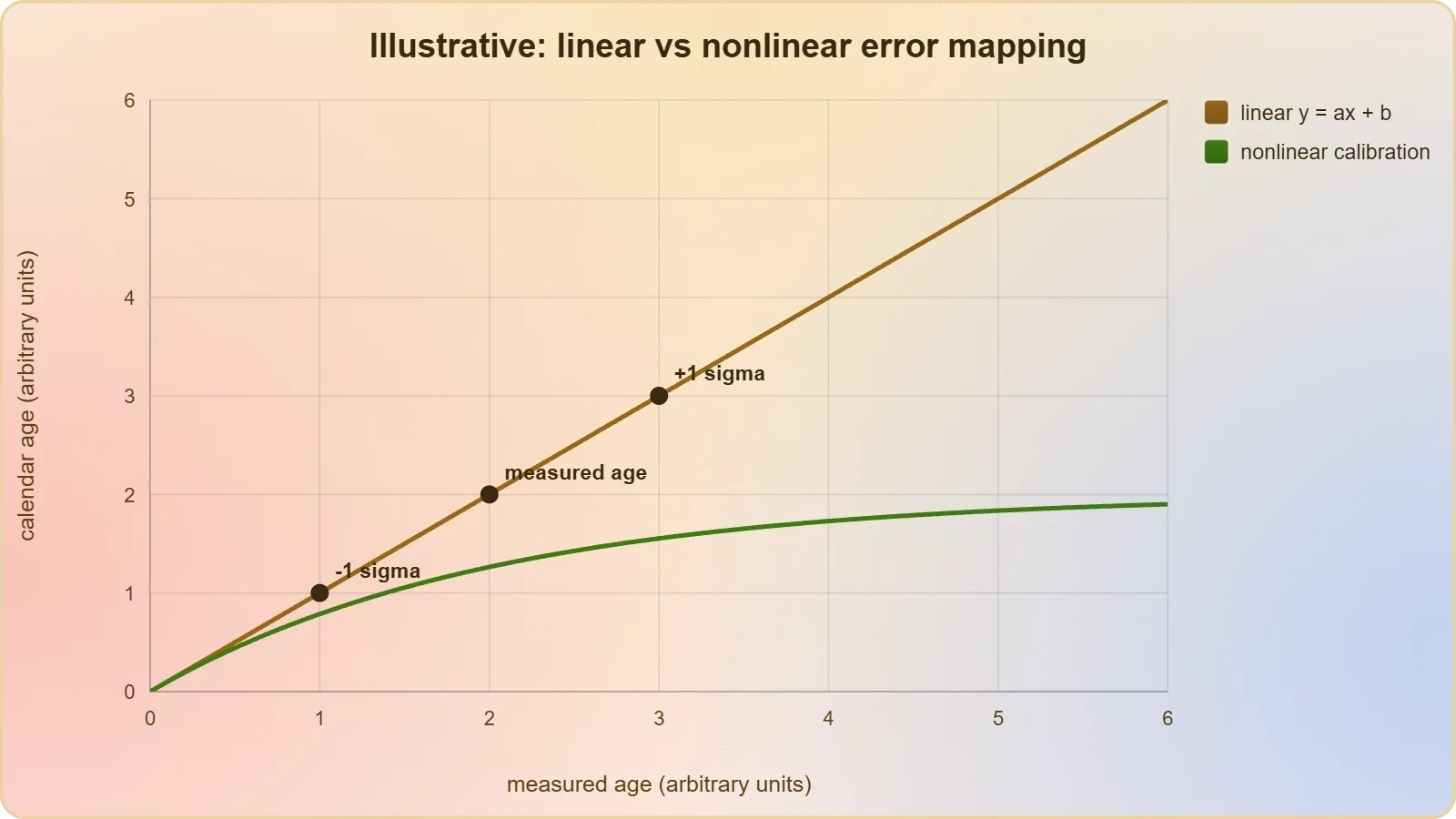
Radiocarbon ages must be converted to calendar ages using calibration curves derived from independently dated archives such as tree rings and speleothems. This conversion is nonlinear, so a symmetric laboratory error becomes an asymmetric calendar interval. When a specimen's age is then used to constrain a demographic model, the uncertainty compounds. Analysts therefore propagate distributions rather than point estimates, sampling many plausible ages and examining how conclusions vary across them.
A compact illustration of error propagation is instructive. If a derived quantity ##[y]## depends on a measured age ##[x]## through a linear relation ##[y = ax + b]##, the variance of ##[y]## follows directly from the variance of ##[x]##:
For nonlinear relations the first-order approximation replaces ##[a]## with the derivative ##[\dfrac{dy}{dx}]## evaluated at the mean, giving ##[\sigma_y^2 \approx \left(\dfrac{dy}{dx}\right)^2 \sigma_x^2]##. This is the delta method, and it explains why calibration and demographic inference are handled computationally rather than by hand. The practical consequence is that statements about when populations diverged carry intervals of centuries or millennia, and any narrative implying exact dates should be read with scepticism.
Interpreting Divergence Times
Molecular divergence estimates add a further layer of uncertainty, since they depend on assumed mutation rates and generation intervals. Rates calibrated in one context may not transfer cleanly to another, and generation length varies with social organisation. Consequently, genetic dates and archaeological dates are best treated as complementary constraints rather than as independent confirmations. When they agree, confidence rises; when they conflict, the disagreement itself becomes informative, pointing to gaps in sampling or to flawed assumptions.
This epistemic humility is not a weakness of the field but its defining discipline. The Japanese case, with its sparse Late Pleistocene record and rich later archaeology, illustrates the point vividly. Each new genome narrows the range of plausible histories, but the range remains wide. Public understanding improves when broadcasters convey that narrowing rather than presenting a finished story, and the Science View format, with its emphasis on working researchers, is well suited to that task.
Ocean Biogeochemistry and the Limits of Prediction
The deep ocean regulates climate over timescales from decades to millennia, storing carbon, moderating temperature, and mediating the exchange of gases with the atmosphere. Microbial communities drive much of this chemistry, catalysing transformations that would otherwise proceed imperceptibly slowly. When researchers propose that deep-sea microbes could aid climate prediction, they are really proposing that these microbial processes be represented more faithfully in Earth system models, which currently treat much of the subsurface ocean in coarse aggregate terms.
Carbon Cycling in the Deep Ocean
Organic matter produced at the surface sinks through the water column, and only a small fraction reaches the seafloor. Along the way, microbial respiration converts it back to dissolved inorganic carbon, consuming oxygen and shaping the chemistry of intermediate waters. The efficiency of this biological pump determines how much carbon is sequestered away from the atmosphere. Variations in microbial community function therefore have consequences that extend far beyond the local environment, influencing global atmospheric composition over long periods.
Measuring these processes requires instruments capable of operating under extreme pressure and returning samples without decompression artefacts. JAMSTEC's exploration technology addresses precisely this challenge, and the programme's attention to the hardware is scientifically justified. Without reliable in situ sampling, microbial rate measurements would be distorted by the very act of retrieval, and models built on such data would inherit systematic bias. The engineering and the biology are inseparable, a point often lost in popular accounts.
Modelling Feedback Loops
Climate prediction depends on representing feedbacks, and microbial processes participate in several. Warming may accelerate respiration, releasing carbon faster; altered stratification may change nutrient supply, shifting community composition; acidification may alter metabolic pathways. Each of these constitutes a potential feedback whose sign and magnitude remain uncertain. Incorporating them into models requires parameterisations grounded in observation, which is why deep-sea sampling campaigns have outsized scientific value relative to their cost.
The honest conclusion is that microbial research improves prediction by reducing structural uncertainty in models, not by offering forecasts of its own. Communicating this accurately is difficult, since audiences prefer concrete predictions to probabilistic refinements. Yet the distinction matters, because overpromising invites disillusionment when forecasts prove imperfect. The programme's decision to present the research as ongoing exploration, rather than as a solved predictive tool, is therefore both scientifically defensible and editorially wise.
What the Episode Reveals About Scientific Practice
Viewed as a whole, the programme is less a report on two discoveries than a portrait of how research actually proceeds. Both segments feature named specialists working within institutions, both depend on technologies that make the invisible measurable, and both confront the problem of inference from fragmentary evidence. The ancient genome and the deep-sea microbial community are, methodologically, cousins: each is a trace that must be authenticated, quantified, and interpreted against a background of uncertainty.
Technology as an Enabler of Discovery
Sequencing platforms capable of reading highly degraded fragments, and submersibles capable of sampling at hadal pressures, are not incidental conveniences. They define what questions can be asked. Before high-throughput sequencing, the peopling of Japan could be studied only through morphology and archaeology; before reliable deep-sea samplers, microbial ecology was largely confined to shallow waters. Technological capability therefore shapes the research agenda, and public investment in instrumentation has consequences that ripple through entire disciplines over decades.
This observation carries a policy implication. Funding agencies often favour projects with immediate applications, yet the transformative advances frequently come from capability-building that pays off unpredictably. The Japanese research ecosystem, with its national museums and marine science agency, illustrates how sustained institutional support enables work that no single investigator could undertake alone. Recognising this helps explain why science policy debates about infrastructure are, in substance, debates about which questions a society will be able to answer in the future.
Communicating Uncertainty Honestly
The most valuable lesson for audiences is that scientific claims come with calibrated confidence. A date of roughly 27,000 years, a genome from a single individual, a microbial community sampled at one site and time: each is a data point within a distribution, not a verdict. Broadcasters who convey this produce viewers better equipped to evaluate the next headline, whether about ancestry or climate. Those who omit it produce audiences vulnerable to overconfident claims from less scrupulous sources.
Honest communication also means resisting the temptation to resolve open questions prematurely. The origins of the Japanese people remain an active research area, and deep-sea microbial feedbacks remain imperfectly quantified. Presenting these as live inquiries, with named researchers and identifiable institutions, is more respectful of both the science and the audience than any tidy narrative. The episode's structure, moving between past and future, makes this point implicitly and, on reflection, rather elegantly.
The episode ultimately demonstrates that scientific understanding advances through the disciplined conversion of traces into evidence. A fragment of bone from a Late Pleistocene individual and a sample of sediment from the abyssal plain are both incomplete records, and both require sophisticated methods to yield reliable knowledge. The researchers named in the programme, from the National Museum of Nature and Science and from JAMSTEC, embody the institutional continuity that makes such work possible. Their findings will be revised, as all findings are, but the methods they employ will continue to shape inquiry.
For readers seeking to follow the science, the practical lesson is to attend to uncertainty and provenance. Ask how a specimen was dated, how contamination was excluded, how a model was parameterised, and what alternatives were considered. These questions are not sceptical obstruction; they are the ordinary grammar of evidence. Programmes such as Science View perform a genuine service when they make that grammar visible, and audiences repay the effort by becoming more discerning participants in debates that concern ancestry, climate, and the authority of expertise itself.
From our network :
- 10 Physics Numerical Problems with Solutions for IIT JEEPrepare for IIT JEE with 10 physics numerical problems, complete with detailed solutions and conceptual explanations. Ideal for mastering kinematics, thermodynamics, electromagnetism, and optics.
- Mastering DB2 12.1 Instance Design: A Technical Deep Dive into Modern Database ArchitectureComprehensive guide to DB2 12.1 Instance Design. Explore architectural components, HADR setup, buffer pool tuning, and security policies for IBM DB2 12.1. Includes 10 functional SQL and Shell samples.
- Mastering DB2 LUW v12 Tables: A Comprehensive Technical GuideComprehensive guide on DB2 LUW v12 tables. Explore CREATE TABLE syntax, BLU Acceleration, range partitioning, data types, and security features for IBM DB2 LUW v12.
- 98% of Global MBA Programs Now Prefer GRE Over GMAT Focus EditionExplore why 98% of global MBA programs now prefer the GRE over GMAT Focus. Learn about the shorter GRE format, verbal logic importance, and strategic versatility for students.
- EV 2.0: The Solid-State Battery Breakthrough and Global Factory ExpansionDiscover the impact of the Solid-State Battery Breakthrough on the EV market. Learn about CATL and BYD stock growth, global factory expansion in Europe, and the future of EV 2.0 technology.
- Trump Political Strategy How Geopolitical Stunts Serve As Media Diversions
- AI-Powered 'Precision Diagnostic' Replaces Standard GRE Score ReportsDiscover the new GRE Precision Diagnostic. Learn how AI-powered behavioral analytics and time-to-solve tracking are replacing standard GRE score reports to empower students.
- Vite 6/7 'Cold Start' Regression in Massive Module GraphsIn-depth analysis of Vite 6/7 cold start regressions in massive module graphs. Learn about barrel file issues, pre-bundling optimizations, and how to improve Vite dev server performance.
- Analyzing Trump Deportation Numbers Insights Into The 2026 Immigration Crackdown
RESOURCES
- Genetic and anthropometric studies on Japanese people - Wikipediaen.wikipedia.orgIn population genetics, extensive research has been done on the genetic origins of modern Japanese people. The Japanese archipelago connected to the Korean ...
- Who are the Japanese? Huge DNA discovery rewrites historysciencedaily.comMay 14, 2026 ... The newly identified ancestry appears linked to the ancient Emishi people of northeastern Japan. Researchers also uncovered inherited ...
- DNA study challenges thinking on ancestry of people in Japan | RIKENriken.jpAug 14, 2024 ... “We are interested in why ancient genomes are integrated and kept in modern human DNA sequences,” says Terao, who explains…
- Ancient genomics reveals tripartite origins of Japanese populationsscience.orgSep 17, 2021 ... The Kofun and modern Japanese individuals are almost indistinguishable from one another by this metric, implying some level of genetic ...
- Genetic legacy of ancient hunter-gatherer Jomon in Japanese ...nature.comNov 12, 2024 ... A long-standing model of the origin of Japanese populations is a dual-ancestral structure. This model states that modern Japanese people…
- Ancient DNA rewrites early Japanese history—modern ... - Phys.orgphys.orgSep 17, 2021 ... ... Japan from around 900 BC to 300 AD. But the 12 newly sequenced ancient Japanese genomes—which came from the…
- Ancient genomics reveals tripartite origins of Japanese populationspmc.ncbi.nlm.nih.govSep 17, 2021 ... ... Genetic characteristics of Yayoi people in Northwestern Kyushu. ... Matsumura H., A microevolutional history of the Japanese people from…
- Ancient DNA rewrites early Japanese history - Trinity College Dublintcd.ieSep 17, 2021 ... ... Japan from around 900 BC to 300 AD. But the 12 newly sequenced ancient Japanese genomes – which came…
- DNA Analysis Rewrites Ancient History of Japansmithsonianmag.comSep 21, 2021 ... ... Japanese people's ancestry comes from the newly identified Kofun period population. Shigeki Nakagome. The ancestors of modern Japanese ...
- Ancient DNA Reveals Tripartite Origins of Japanese People | Sci.Newssci.newsSep 21, 2021 ... “In short, we have an entirely new tripartite model of Japanese genomic origins — instead of the dual-ancestry model that…
- Ancient DNA solves mystery of Hungarian, Finnish language originsnews.harvard.eduJul 16, 2025 ... People from all other ethnolinguistic groups were found, by and large, to lack this distinct ancestry. Genetic ties to Yakutia…
- Ancient DNA Reveals Asian Ancestry Introduced to East Africa in ...hms.harvard.eduMar 29, 2023 ... ... Japan, the medieval peoples of the Swahili civilization on the ... people from outside Africa contributed to Swahili culture…
- Genomes Across Japan Reveal Traces of Neanderthal and ...discovermagazine.comMay 20, 2026 ... A genetic study found the ancestry of people in Japan today may not ... Read More: Ancient DNA Shows That…
- Molecular Genetic Analysis of Remains of a 2,000-Year-Old Human ...sciencedirect.com... origin of the Jomon/Yayoi people and, consequently, of human history in the Japanese archipelago. Acknowledgments. We gratefully acknowledge Dr. Kangxin Han ...
- Ancient DNA – The Journey of the Japanese People @ Nagoya City ...facebook.comAug 3, 2025 ... I finally met one of my ancient ancestors—Shiraho Genjin (the Shiraho Ancient Human), a Jomon skeleton discovered in Ishigaki Island,…