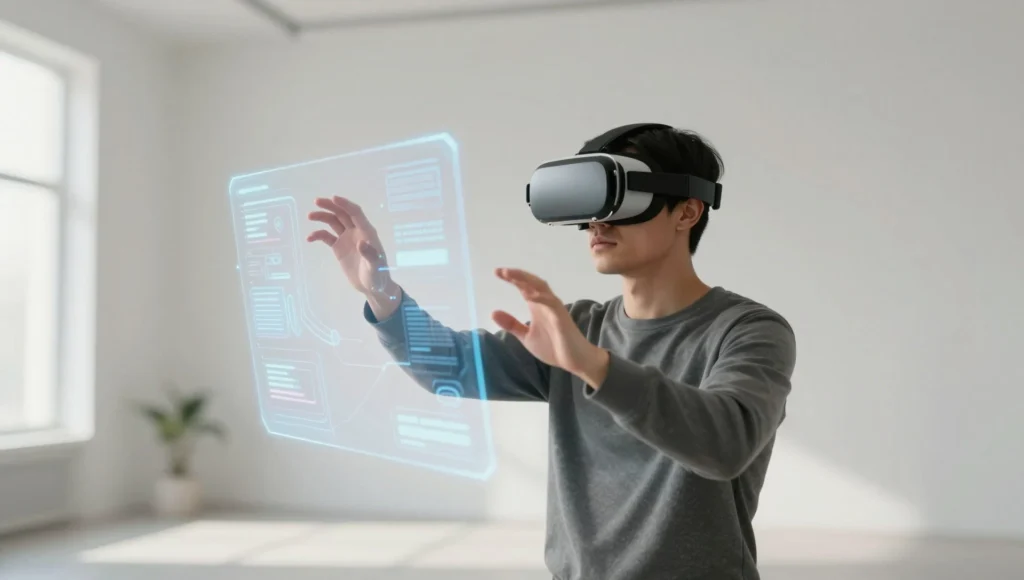
Learning has long been imagined as a quiet, cerebral act: a student seated at a desk, eyes fixed on a page, body held still so the mind can work. A striking new study from Florida Atlantic University and Brown University challenges that assumption by demonstrating that the body itself may be a powerful instrument of cognition. Using virtual reality, researchers asked participants to sort visually striped objects into categories while making either small, button-press movements or large, sweeping physical gestures. The gap in performance was not marginal but extraordinary, with large-movement learners outpacing their restrained counterparts by a factor of four to six. The finding invites a serious reconsideration of how we design instruction, training environments, and even rehabilitation programs.
The experiment sits at the intersection of cognitive science, motor control, and immersive technology, and its implications reach well beyond the laboratory. Virtual reality offered the researchers something a conventional classroom could not: precise control over how much of the body a learner uses while holding the cognitive task constant. By isolating movement magnitude as the single variable, the study produced unusually clean evidence that physical engagement can accelerate the acquisition of complex categorical knowledge. For educators, instructional designers, and technologists, the result is a prompt to think about learning as an embodied activity rather than a purely mental one, and to ask which tasks might benefit most from motion-rich delivery.
What follows examines the study's design, its measured outcomes, the physiological and computational reasoning that may explain the effect, and the practical questions it raises for anyone building learning experiences. The analysis also considers the limits of the evidence, because a dramatic result deserves equally rigorous scrutiny. Understanding why large movements helped, and under what conditions the advantage might vanish, is essential before the finding is translated into classrooms, corporate training, or clinical therapy. The body, it appears, is not merely a vehicle that carries the brain to the lesson; it may be part of the lesson itself.
On This Page
- The Experimental Architecture Behind the Movement Advantage
- Reading the Four-to-Six-Fold Speed Difference
- The Neuroscience Case for Embodied Cognition
- Designing Instruction Around the Body
- Mathematical Modeling of Learning Acceleration
- Open Questions, Limitations, and the Research Horizon
- Implications Across Education, Industry, and Therapy
- Frequently Asked Questions About Movement and Learning
The Experimental Architecture Behind the Movement Advantage
The Florida Atlantic and Brown collaboration was designed around a deceptively simple question: does the size of a learner's physical response change how quickly abstract categories are acquired? Participants donned virtual reality headsets and were presented with striped objects that varied along visual dimensions, then asked to sort them into groups according to an underlying rule. The critical manipulation was the response modality. One group registered answers through minimal finger movements, pressing buttons or tapping a controller, while another group answered with expansive gestures such as swinging a virtual lightsaber or punching a response box. Everything else about the task, including the visual stimuli and the categorical structure to be learned, remained constant.
This design is methodologically elegant because it separates the cognitive demand from the motor demand. In many educational studies, active learning confounds movement with attention, social interaction, or novelty. Here, both groups were equally attentive and equally immersed; only the amplitude of the bodily response differed. That isolation allows the researchers to attribute the learning gap to movement magnitude itself rather than to motivation or engagement. Luke Rosedahl, an assistant professor of biomedical engineering at Florida Atlantic University, described the resulting difference as dramatic, and the published findings support that characterization with a performance ratio that few educational interventions achieve.
Why Virtual Reality Was the Right Laboratory
Virtual reality provided the experimental control that a physical classroom could not. In a headset, researchers can render identical striped objects for every participant, standardize timing to the millisecond, and swap response mechanics without rebuilding the environment. Immersion also suppresses many external distractions that would otherwise contaminate a learning measurement. The technology effectively functions as a precision instrument for cognitive science, allowing the team to hold the perceptual world constant while varying only the body's role in it. This is a meaningful advance over observational studies that correlate activity with achievement but cannot establish which factor drives the other.
The choice of VR also matters for translation. If large movements accelerate learning inside a simulated environment, the same principle can be engineered directly into commercial training software, educational games, and therapeutic platforms. The medium is not incidental to the finding; it is the delivery channel through which the finding could eventually reach millions of learners. Researchers can now iterate on gesture design, haptic feedback, and task difficulty within a controllable digital space before committing to expensive physical infrastructure. The laboratory and the product roadmap, in this case, share the same hardware.
Defining "Complex Learning" Precisely
The categories participants learned were not simple labels attached to obvious features. They involved striped patterns whose grouping rules required integrating multiple visual dimensions, a task that resembles real-world classification problems in diagnostics, materials inspection, and pattern recognition. This is what the researchers mean by complex learning: knowledge that cannot be acquired through a single exposure or a simple association but demands repeated, structured interaction with examples. The four-to-six-fold speed advantage therefore applies to a genuinely demanding cognitive task, not to trivial memorization, which makes the result more relevant to serious training contexts.
It is equally important to note what the study does not claim. The finding concerns a specific class of categorical learning under specific conditions, and it does not establish that all subjects, from poetry to proof-writing, benefit equally from bodily movement. Nor does it prove that movement replaces instruction or practice. What it does show is that when the learning task involves sorting and classifying perceptual patterns, the scale of the learner's physical response can materially change the rate of acquisition. That is a bounded but consequential claim, and it should be read with the same precision with which it was tested.
Reading the Four-to-Six-Fold Speed Difference
The headline number is arresting: learners who made large movements acquired the categorization rule four to six times faster than those confined to small responses. To appreciate what that means, consider a training module that normally requires six hours of practice to reach competence. Under the large-movement condition, comparable mastery might arrive in roughly one to one and a half hours. At organizational scale, where onboarding and safety certification consume enormous budgets, a multiplier of that size would reshape cost models and instructional timelines. The figure is not a marginal efficiency gain but a categorical shift in how quickly a specific kind of knowledge can be built.
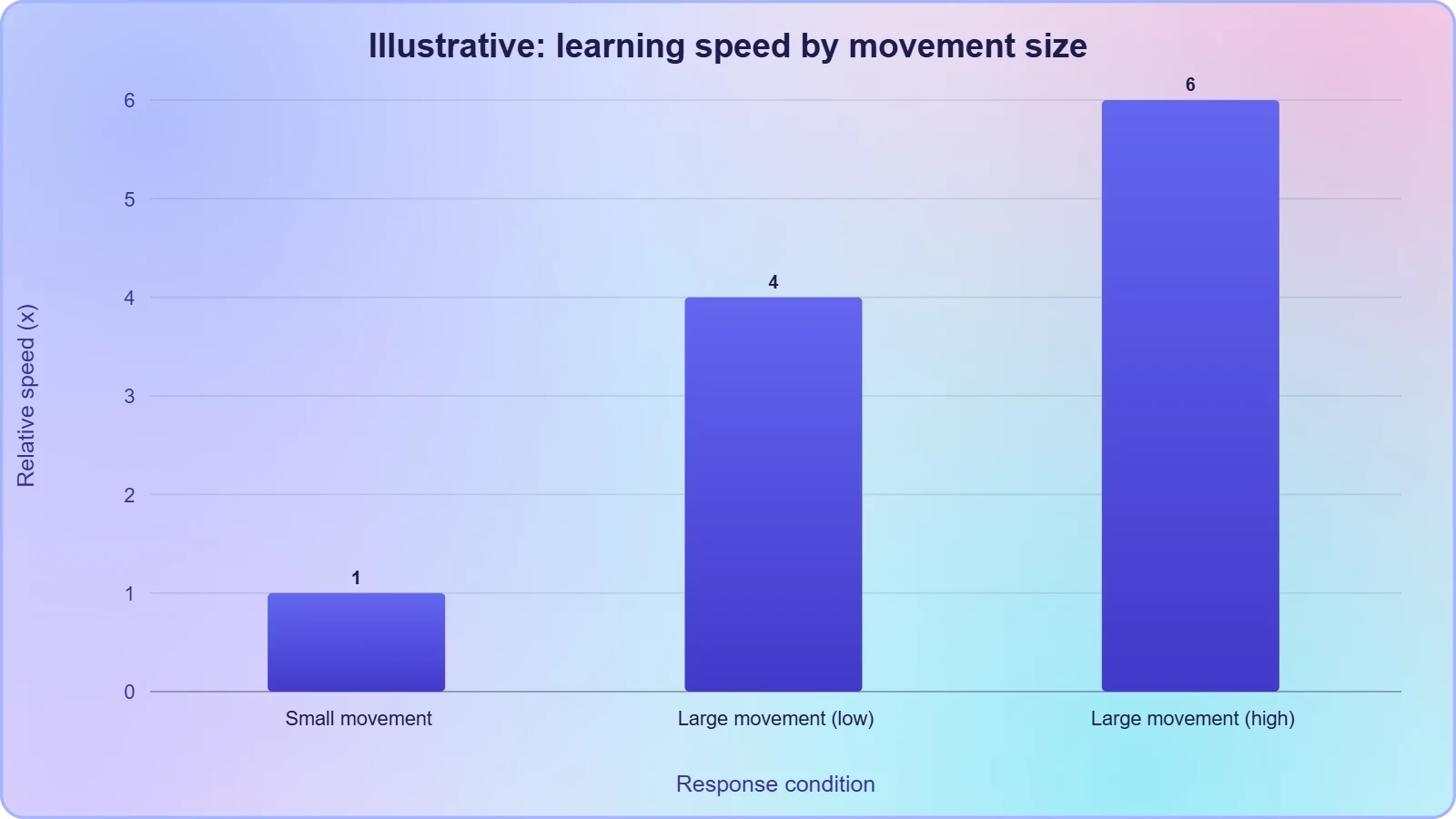
Speed, however, is only one dimension of learning quality. A faster learner might retain less, generalize poorly, or fail under transfer conditions. The study's framing emphasizes acquisition rate, and the researchers describe the difference as dramatic rather than merely statistically significant, which suggests the effect size was large relative to typical educational interventions. Still, responsible interpretation requires asking whether the advantage persists after the headset comes off. The most valuable follow-up work will measure retention over days and weeks, test transfer to unpracticed examples, and examine whether the movement advantage holds when learners are tired, distracted, or older.
What a Multiplier Means in Practice
Educational research rarely produces multipliers of this magnitude. Most instructional reforms yield modest improvements, often measured in percentage points of assessment scores. A four-to-six-fold acceleration in time-to-criterion is a different order of result, and it invites both excitement and caution. Excitement because the intervention is cheap in principle: it requires no new curriculum, only a redesign of how learners physically respond. Caution because dramatic laboratory effects sometimes shrink when moved into messy real-world settings where motivation, prior knowledge, and environmental constraints vary widely. The honest position is that the finding is highly promising and not yet proven at scale.
For designers, the practical translation is to treat movement amplitude as a tunable parameter rather than a fixed property of an interface. A sorting exercise could be built with gesture thresholds that scale with task difficulty, allowing learners to engage larger muscle groups when the conceptual load is highest. The multiplier also reframes the economics of simulation: if a VR module can compress weeks of pattern-recognition training into days, the capital cost of headsets and content development becomes easier to justify. The number, in other words, is not just a scientific curiosity; it is a design brief.
Separating Enthusiasm From Evidence
Every striking result carries an obligation to interrogate its boundaries. The study examined a particular population, a particular task, and a particular technology, and its conclusions should be scoped accordingly. Movement may help most when the learning content is spatial or categorical, and may help less when the content is verbal or symbolic. There is also the question of novelty: large gestures in VR are inherently more engaging, and some of the advantage could reflect heightened arousal rather than embodied cognition per se. Distinguishing these mechanisms is the next scientific frontier, and it matters because the mechanisms determine which learners and which subjects stand to benefit.
None of this diminishes the core finding. It simply places it where good science belongs: as a robust signal that demands replication and refinement. The appropriate response from educators and technologists is neither to dismiss the result as a laboratory artifact nor to market it as a universal law of learning. It is to design careful pilots, measure retention honestly, and let the evidence accumulate. The body's role in learning has been understudied for decades; a result this large should redirect attention, and it should do so with disciplined skepticism rather than hype.
The Neuroscience Case for Embodied Cognition
Why would swinging a virtual lightsaber teach someone faster than pressing a button? The most persuasive explanations draw on embodied cognition, the view that mental processes are shaped by the body's interactions with the world. Large movements recruit more motor cortex, more proprioceptive feedback, and more vestibular input, creating a richer multisensory trace around each learning episode. That richer trace may make categorical boundaries easier to encode and retrieve, because the brain has more contextual hooks from which to reconstruct the relevant distinction. Movement, on this account, is not decoration around the lesson; it is additional encoding.
There is also a plausible computational story. Learning a category requires mapping perceptual inputs to abstract labels, and the brain may exploit motor states as auxiliary variables that help separate otherwise confusable examples. When a learner makes a distinct, effortful gesture for each category, the motor system supplies a second, orthogonal signal that disambiguates the visual one. This resembles the way humans use gesture spontaneously when explaining difficult ideas: the hands externalize structure that speech alone struggles to convey. The VR experiment may simply have engineered that natural tendency into the task itself, amplifying a mechanism we already use intuitively.
Motor Cortex, Proprioception, and Memory Traces
Proprioception, the sense of body position and movement, feeds continuously into cortical and cerebellar circuits that support motor learning. When movements are large, this stream is denser and more distinctive, and it co-occurs with the cognitive decision being made. Over repeated trials, the pairing of a specific bodily state with a specific categorical judgment creates an association that can later be reinstated, even partially, to aid recall. This is the same principle behind the well-documented benefits of enacting material physically, from children learning letters by tracing them to adults memorizing procedures through rehearsal. The study scales that principle up and measures its effect with unusual precision.
Neuroimaging would be needed to confirm which circuits drive the advantage, but the behavioral pattern is consistent with established findings on multisensory encoding. The brain tends to remember what it does more vividly than what it merely sees, and effortful action appears to tag experiences as important. Large gestures are effortful in a way that button presses are not, and that effort may trigger neuromodulatory signals that prioritize the associated content for consolidation. If this account holds, the effect should be strongest for tasks that require discriminating among similar categories, exactly the kind of striped-object sorting the researchers employed.
Attention, Arousal, and the Novelty Confound
A competing explanation deserves equal weight: large movements may simply be more fun, and fun may improve attention. Participants swinging lightsabers are likely more aroused, more engaged, and less prone to mind-wandering than participants tapping buttons. If so, the mechanism is motivational rather than embodied, and the practical implication shifts from "make learners move more" to "make learning more engaging." The two explanations are not mutually exclusive, and disentangling them would require designs that equate enjoyment across conditions, for example by gamifying the small-movement task until arousal matches. Until such studies exist, the mechanism remains an open and important question.
This ambiguity does not undermine the applied value of the finding. Whether the advantage flows from richer encoding, heightened attention, or both, the design lesson is the same: physical engagement is a lever that can be pulled to accelerate certain kinds of learning. What changes is the confidence with which we can explain why. Good applied science often proceeds with a working mechanism while the underlying theory is still being refined, and the responsible course is to build on the effect while continuing to test its causes. The distinction matters most for generalization, since a motivational account predicts benefits across many tasks while an embodied account predicts narrower ones.
Designing Instruction Around the Body
If movement magnitude can accelerate categorical learning, instructional designers inherit a concrete new variable to optimize. The most immediate application is in simulation and VR training, where gesture design is already a core concern. A medical trainee learning to classify tissue samples, an inspector learning to sort defects on a production line, or a pilot learning to categorize instrument states could all be asked to make large, distinct gestures for each category rather than tapping a screen. The redesign is inexpensive relative to building new content, and it can be layered onto existing modules as an interaction update rather than a curriculum overhaul.
Beyond VR, the principle suggests rethinking physical classrooms as well. Activities that require students to move through space, arrange objects, or physically sort materials may confer advantages over seated worksheets, particularly for content involving classification and pattern discrimination. This aligns with long-standing traditions in Montessori and laboratory-based science education, which have always insisted that hands and bodies belong in the learning process. The new contribution is a quantified rationale: movement is not merely pleasant or motivating but potentially a rate-limiting factor in how fast certain knowledge is acquired. That reframing gives embodied methods a stronger evidentiary footing.
Gesture, Simulation, and Training Environments
Corporate and industrial training stands to benefit disproportionately because so much of it involves pattern recognition under time pressure. Safety inspectors, quality-control technicians, and equipment operators all learn to classify situations rapidly, and their training often occurs in simulated environments where gesture design is fully controllable. Embedding large, category-specific movements into these simulations could compress certification timelines and reduce the cost of repeated practice. The design challenge is to ensure that the gestures remain semantically meaningful rather than arbitrary, since a movement that maps naturally onto a category is more likely to reinforce the distinction than one chosen merely for its size.
There is also a caution about physical accessibility. Not every learner can make large movements, and a design philosophy that privileges vigorous gesture risks excluding people with motor impairments or limited mobility. The responsible approach is to treat movement amplitude as one option among several and to investigate whether equivalent benefits can be achieved through other forms of rich sensorimotor engagement, such as haptic feedback or spatial audio. Inclusion should be a design constraint from the outset, not a retrofit. The goal is to exploit the body's contribution to cognition without making bodily capacity a gatekeeper to learning.
From Laboratory Finding to Classroom Practice
Translating a laboratory result into practice requires intermediate steps that the original study did not attempt. Teachers need ready-made activities, not experimental protocols; administrators need evidence of retention, not just acquisition speed. The most useful next phase would be classroom-based trials that embed large-movement sorting tasks into existing curricula and measure outcomes over a full term. Such trials should track not only test scores but also engagement, fatigue, and equity of access, because an intervention that accelerates some learners while exhausting others is not a clear win. Pragmatic evidence of this kind is what ultimately determines whether a finding changes practice.
Professional development matters as well. Educators are often skeptical of new cognitive claims, and rightly so, given the history of learning-styles theories that failed to replicate. The movement finding will earn trust only if it is presented with its boundaries intact: this is a result about categorical learning in immersive environments, not a universal prescription to make every lesson physical. Teachers who understand the specific conditions under which the effect was observed are better positioned to adapt it intelligently. The message should be that the body is a legitimate part of the instructional toolkit, to be used deliberately and evaluated honestly.
Mathematical Modeling of Learning Acceleration
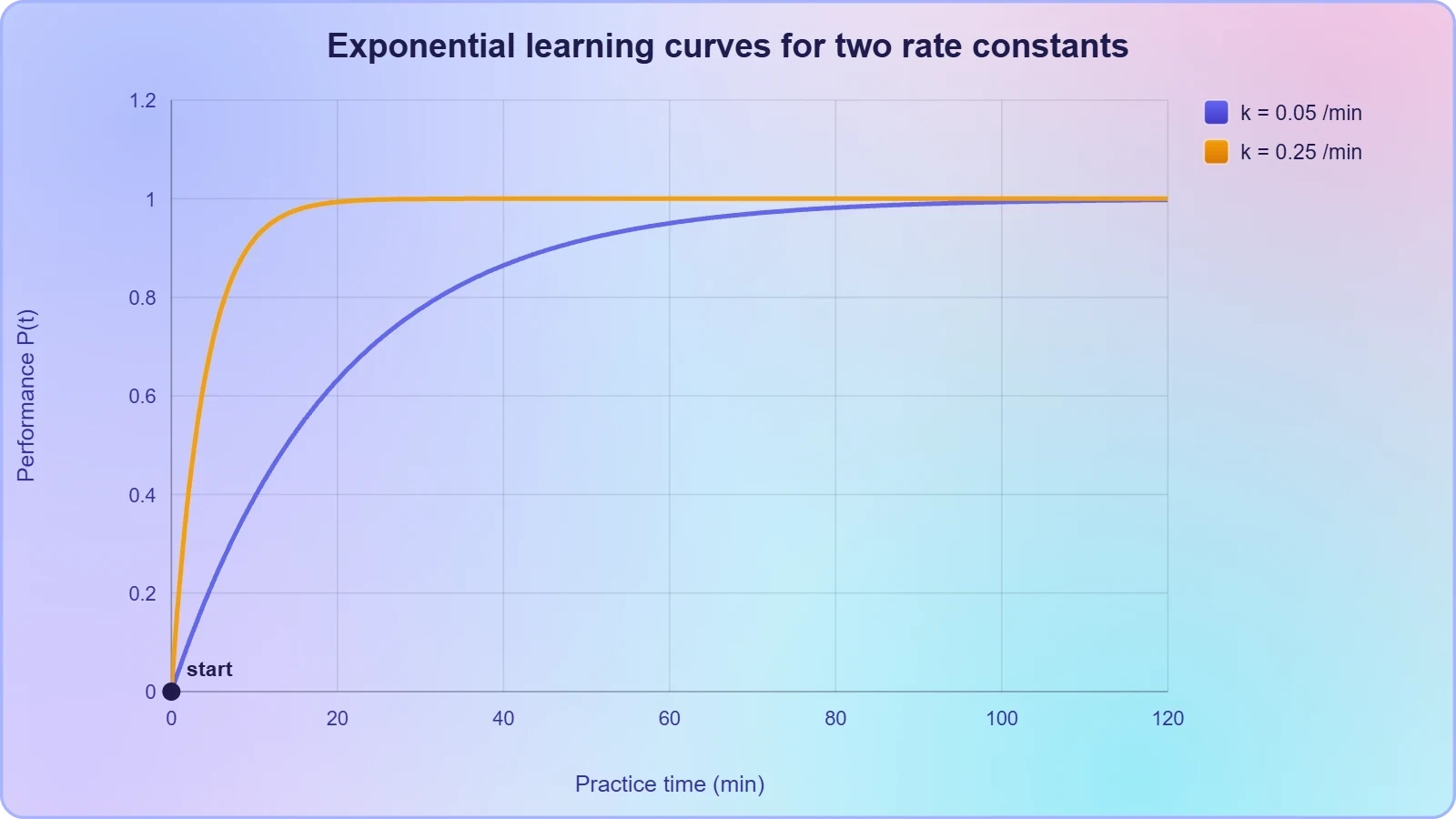
Cognitive scientists often describe learning with exponential or power-law curves, in which performance improves rapidly at first and then asymptotes as mastery approaches. The movement finding can be expressed in these terms, and doing so clarifies what a four-to-six-fold speed advantage actually implies. If learning follows an exponential approach to a performance ceiling, the rate constant determines how quickly a learner traverses the curve. A larger rate constant means the same amount of practice produces more learning, or equivalently, the same learning is achieved in less time. The ratio of rate constants is precisely the speed multiplier the researchers observed.
Formalizing the result also exposes assumptions that informal descriptions hide. The exponential model assumes a fixed ceiling and a constant rate, neither of which is guaranteed in real learning. It also assumes that the two groups differ only in rate, not in final attainment, which the study's design supports but does not fully establish. Working through the mathematics is therefore not an exercise in decoration; it is a way to state the claim precisely and to identify which additional measurements would strengthen it. The derivations below translate the headline multiplier into a rate constant and then into a time-to-criterion calculation.
Deriving the Rate Constant From the Speed Multiplier
Suppose performance ##[P(t)]## approaches a ceiling ##[P_{\max}]## according to an exponential learning curve, where ##[t]## is practice time and ##[k]## is the rate constant. The standard form is ##[P(t) = P_{\max}\left(1 - e^{-kt}\right)]##. If the large-movement group learns four to six times faster, its rate constant is correspondingly larger, so that ##[k_{\text{large}} = m\,k_{\text{small}}]## with ##[m \in [4,6]]##. The ratio of rate constants is the formal definition of the speed advantage, and it is this quantity, not the raw score difference, that the study's timing data estimate.
To see the consequence, solve for the time required to reach a fixed criterion ##[P_c]##. Setting ##[P(t_c) = P_c]## and rearranging gives ##[t_c = -\dfrac{1}{k}\ln\left(1 - \dfrac{P_c}{P_{\max}}\right)]##. Because the logarithmic factor is identical for both groups, the ratio of criterion times is simply the inverse ratio of rate constants: ##[\dfrac{t_{\text{small}}}{t_{\text{large}}} = \dfrac{k_{\text{large}}}{k_{\text{small}}} = m]##. A learner who moves largely therefore reaches the same criterion in one-fourth to one-sixth of the practice time, which is exactly the dramatic difference the researchers reported.
Worked Example: Time-to-Criterion in a Training Module
Consider a simulation module in which the small-movement rate constant is ##[k_{\text{small}} = 0.05\ \text{min}^{-1}]## and the performance ceiling is ##[P_{\max} = 1]##. Suppose the certification criterion is ##[P_c = 0.9]##. For the small-movement group, the criterion time is ##[t_c = -\dfrac{1}{0.05}\ln(0.1) \approx 46.1]## minutes. For the large-movement group with ##[m = 5]##, the rate constant becomes ##[k_{\text{large}} = 0.25\ \text{min}^{-1}]##, and the criterion time falls to ##[t_c \approx 9.2]## minutes. The module compresses from roughly three-quarters of an hour to under ten minutes.
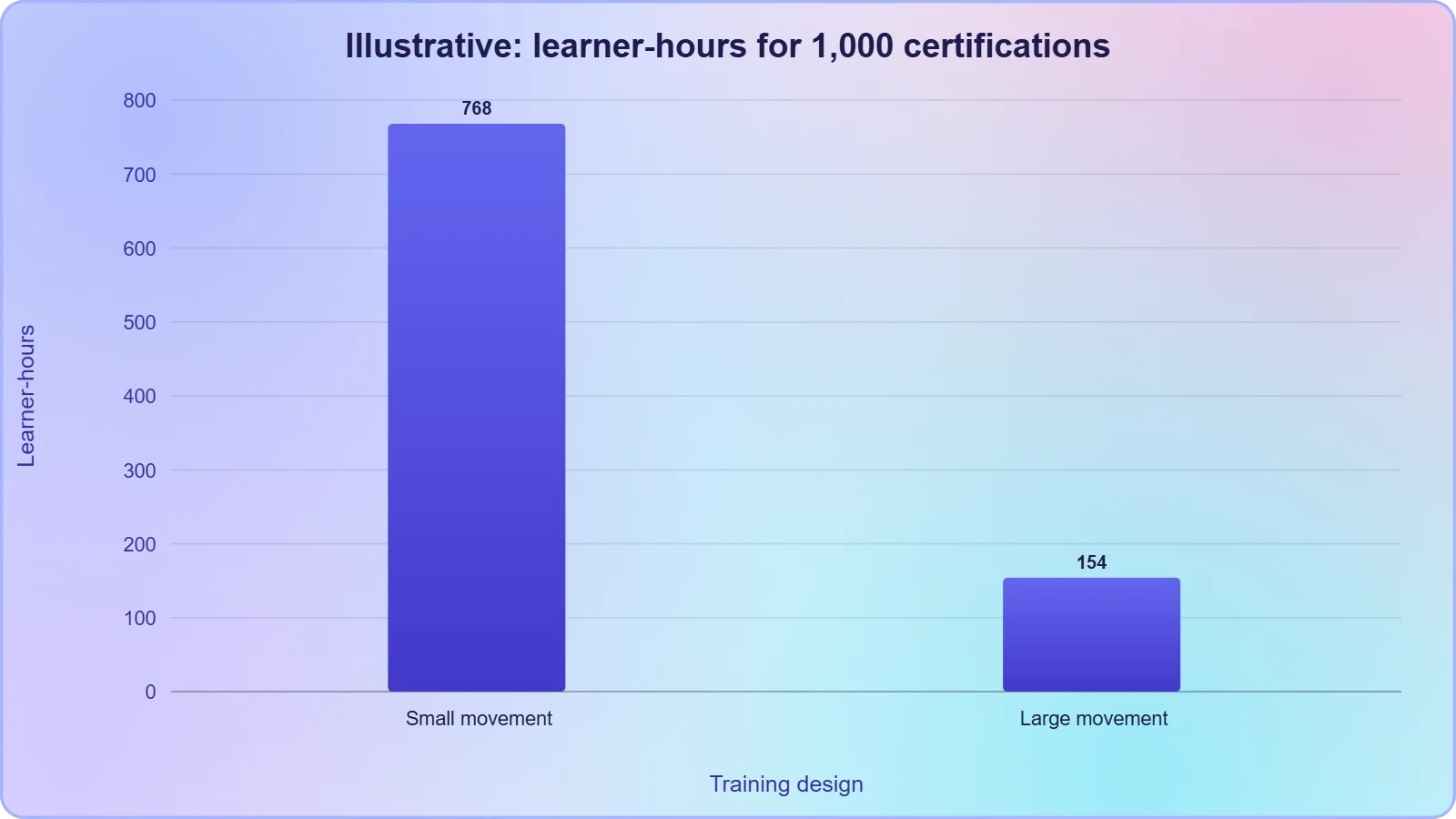
Scaling this example to an organization clarifies the stakes. If a thousand employees each require certification, the small-movement design consumes roughly 768 learner-hours, while the large-movement design consumes about 153. The saving exceeds six hundred hours per training cycle, before accounting for instructor time and facility costs. These figures are illustrative rather than measured, but they show why the multiplier matters commercially as well as scientifically. They also show why retention data are essential: a compressed module that produces fragile knowledge would simply defer the cost to refresher training, so the economic case depends on durable learning.
We Also Published
Open Questions, Limitations, and the Research Horizon
The study answers a narrow question convincingly and leaves a wide field of adjacent questions untouched. Chief among them is retention: does the large-movement advantage persist after a week, a month, or a year, or does it merely accelerate a process that would have converged anyway? A second is transfer: can learners who acquired a category through vigorous gesture apply it to new examples presented without movement? A third is population: do children, older adults, and individuals with motor impairments show the same benefit? Each of these questions is empirically tractable, and each determines whether the finding becomes a durable educational principle or a laboratory curiosity.
There is also the matter of dose and fatigue. Large movements are physically demanding, and a training session that accelerates learning might also exhaust learners faster, reducing total practice time and eroding the net advantage. Optimal gesture design likely involves a trade-off between movement amplitude and sustainability, and that trade-off may vary with task duration. A twenty-minute module can tolerate vigorous gesture; a two-hour session may not. Finding the sweet spot requires parametric studies that vary amplitude systematically and measure both learning rate and fatigue, a research program that the current study has made both plausible and urgent.
Retention, Transfer, and the Durability Test
Educational interventions are frequently judged by their durability rather than their speed. A method that produces rapid initial gains but steep forgetting is less valuable than one that builds slowly but solidly. The movement finding must therefore be tested with delayed post-tests that measure how much categorical knowledge survives without practice. If the advantage persists, the case for embodied instruction becomes far stronger; if it fades, the finding still matters for time-critical training but not for long-term education. Either outcome is scientifically informative, which is why retention studies should be the immediate priority for the research community.
Transfer testing is equally important and somewhat more demanding. Learners in the original study practiced categorization within a specific VR environment with specific gestures. Real-world competence requires applying the learned rule to novel stimuli, different contexts, and perhaps without any movement at all. A robust embodied account predicts that the underlying category knowledge, once formed, should transfer normally, with the movement serving only as an acquisition aid. A weaker account predicts that knowledge remains tied to the motor context in which it was learned. Distinguishing these predictions would clarify both the theory and the practical scope of the intervention.
What Responsible Translation Looks Like
Translating this research responsibly means resisting two temptations. The first is hype: declaring that all learning should become physical, or that VR with vigorous gesture is a universal solution. The second is dismissal: treating a large, well-controlled effect as irrelevant because it has not yet been replicated at scale. The mature position is to treat the finding as a strong hypothesis with clear applied potential, to pilot it in contexts where categorical learning is central, and to measure outcomes with the same rigor the original researchers applied. Institutions that adopt this posture will learn quickly whether the effect survives contact with real learners.
For researchers, the agenda is rich: parametric studies of movement amplitude, neuroimaging of the encoding process, longitudinal retention trials, and cross-population comparisons. For practitioners, the agenda is pragmatic: redesign a few high-stakes sorting tasks, compare them against current practice, and share the results. For learners, the implication is quietly liberating: the body is not an obstacle to thought but a partner in it. A study that began with striped objects in a virtual headset may end up changing how we design the places and practices in which people learn.
Implications Across Education, Industry, and Therapy
The reach of this finding extends well beyond the lecture hall. In rehabilitation, therapists already use task-specific movement to rebuild cognitive and motor function after injury, and a quantified movement advantage could sharpen those protocols. In industry, where pattern recognition underpins quality control and safety inspection, gesture-rich simulation could shorten certification and reduce error rates. In early education, where classification skills are foundational, physical sorting activities may deserve more curriculum time than they currently receive. Each domain would need its own evidence, but the underlying principle, that the body can accelerate certain kinds of learning, travels across all of them.
There is a broader cultural implication as well. Modern education has increasingly moved learning onto screens, where interaction is typically reduced to taps and swipes. If movement magnitude genuinely matters, then the convenience of touchscreen learning may carry a hidden cognitive cost for certain tasks. This does not argue for abandoning digital tools, which remain indispensable for access and scale, but it does argue for designing them to recruit the body more fully. Gesture-based interfaces, spatial computing, and haptic feedback become not luxuries but potential learning accelerators, provided the evidence continues to support their use.
Rehabilitation and Clinical Applications
Clinical settings may be among the most promising beneficiaries. Cognitive rehabilitation after stroke or traumatic brain injury often involves relearning categorization and discrimination tasks, and patients frequently practice these while seated and still. If large movements accelerate acquisition, therapists could incorporate them into existing exercises, potentially shortening recovery timelines. The same logic applies to age-related cognitive decline, where engaging multiple sensory and motor systems may help compensate for reduced neural efficiency. These applications require careful clinical trials, since patient populations differ substantially from the healthy volunteers in the original study, but the rationale is strong enough to justify investigation.
Virtual reality is already used in clinical rehabilitation for pain management, phobia treatment, and motor recovery, so the infrastructure exists. Adding movement-amplitude considerations to those programs is a modest extension rather than a new field. The key clinical question is safety: patients with balance issues or cardiovascular limitations cannot always make vigorous gestures, and therapists would need graded alternatives. A thoughtful clinical translation would treat movement amplitude as a continuum, prescribing the largest sustainable gesture for each patient rather than a single standard. That individualized approach aligns with how rehabilitation already operates.
The Future of Embodied Learning Technology
Looking forward, the convergence of affordable VR hardware, motion tracking, and adaptive software makes embodied learning increasingly practical. Systems could monitor gesture amplitude in real time and adjust task difficulty accordingly, ensuring that learners remain in the productive zone where movement is large enough to help but not so large as to cause fatigue. Machine learning could personalize gesture design to individual bodies and learning histories. The technology is no longer the bottleneck; the evidence base and the instructional design expertise are. The Florida Atlantic and Brown study provides a compelling reason to invest in both.
Ultimately, the significance of this research lies in what it reveals about the relationship between mind and body. For decades, cognitive science treated the body as an output device, a way to report what the mind had already decided. The movement finding suggests the body is also an input device, shaping what the mind can learn and how quickly. That reframing has consequences for how we build schools, design software, and think about human capability. The striped objects in the virtual headset were simple, but the lesson they carry is profound: to learn well, we may need to move.
Frequently Asked Questions About Movement and Learning
Readers encountering this research for the first time tend to raise a consistent set of questions, and addressing them directly is useful. The most common concerns whether the finding applies to all learning, whether VR is required, and whether the effect is simply a novelty artifact. Each has a defensible answer grounded in the study's design and in broader cognitive science. The questions below summarize those answers, while acknowledging where the evidence remains incomplete. They are intended as a practical orientation for educators, technologists, and curious readers rather than a substitute for the published research itself.
Does This Mean All Learning Should Involve Movement?
No. The study examined categorical learning of visual patterns, a task that draws heavily on perceptual discrimination and spatial reasoning. There is no evidence that vigorous movement accelerates the memorization of vocabulary, the comprehension of a novel, or the derivation of a mathematical proof. The reasonable conclusion is that movement is a valuable tool for specific kinds of learning, particularly those involving classification and pattern recognition, and that its use should be matched to the task. Blanket prescriptions to make all instruction physical would overreach the data and risk exhausting learners for no cognitive benefit.
Is Virtual Reality Essential to the Effect?
Virtual reality was the experimental medium, not necessarily the active ingredient. The researchers needed precise control over stimuli and response mechanics, which VR provides, but the underlying principle, that larger movements may enrich encoding, should apply in physical environments as well. A classroom activity in which students physically sort objects across a room could plausibly produce similar benefits, though this remains to be tested. The practical advantage of VR is scalability and standardization, not exclusivity. Educators without headsets should not conclude that the finding is irrelevant to them.
Could the Effect Simply Be Novelty?
Novelty is a genuine confound and deserves serious investigation. Participants swinging lightsabers were almost certainly more engaged than those pressing buttons, and engagement alone can improve learning. The strongest version of the embodied account would predict that the advantage persists even when enjoyment is equated, while a pure novelty account would predict that it fades as the gesture becomes routine. Until studies test this directly, the honest answer is that both mechanisms may contribute. The applied implication, however, remains: physical engagement is a lever worth pulling, even if we do not yet know exactly why it works.
What Should Institutions Do Now?
Institutions should pilot rather than commit wholesale. Identify training programs centered on classification or pattern recognition, redesign a portion of them to incorporate larger gestures, and measure both acquisition speed and retention against current practice. Keep the pilots small enough to be ethical and large enough to be informative. Share the results, whether positive or negative, so the field can accumulate evidence. The cost of such pilots is modest, and the potential payoff, if the effect replicates, is substantial. Prudence and curiosity can coexist, and this finding rewards both.
From our network :
- Trump Political Strategy How Geopolitical Stunts Serve As Media Diversions
- 98% of Global MBA Programs Now Prefer GRE Over GMAT Focus EditionExplore why 98% of global MBA programs now prefer the GRE over GMAT Focus. Learn about the shorter GRE format, verbal logic importance, and strategic versatility for students.
- AI-Powered 'Precision Diagnostic' Replaces Standard GRE Score ReportsDiscover the new GRE Precision Diagnostic. Learn how AI-powered behavioral analytics and time-to-solve tracking are replacing standard GRE score reports to empower students.
- Analyzing Trump Deportation Numbers Insights Into The 2026 Immigration Crackdown
- Mastering DB2 12.1 Instance Design: A Technical Deep Dive into Modern Database ArchitectureComprehensive guide to DB2 12.1 Instance Design. Explore architectural components, HADR setup, buffer pool tuning, and security policies for IBM DB2 12.1. Includes 10 functional SQL and Shell samples.
- EV 2.0: The Solid-State Battery Breakthrough and Global Factory ExpansionDiscover the impact of the Solid-State Battery Breakthrough on the EV market. Learn about CATL and BYD stock growth, global factory expansion in Europe, and the future of EV 2.0 technology.
- Vite 6/7 'Cold Start' Regression in Massive Module GraphsIn-depth analysis of Vite 6/7 cold start regressions in massive module graphs. Learn about barrel file issues, pre-bundling optimizations, and how to improve Vite dev server performance.
- 10 Physics Numerical Problems with Solutions for IIT JEEPrepare for IIT JEE with 10 physics numerical problems, complete with detailed solutions and conceptual explanations. Ideal for mastering kinematics, thermodynamics, electromagnetism, and optics.
- Mastering DB2 LUW v12 Tables: A Comprehensive Technical GuideComprehensive guide on DB2 LUW v12 tables. Explore CREATE TABLE syntax, BLU Acceleration, range partitioning, data types, and security features for IBM DB2 LUW v12.
RESOURCES
- Training in virtual reality enables learning of a complex sports ...link.springer.comJul 22, 2022 ... In consultation with karate experts, a scoring system was developed to determine the movements' quality divided, into upper- and lower…
- FAU Study Reveals How Movement Boosts Complex Learningfau.eduOct 23, 2026 ... ... virtual reality to investigate whether physical movement influences how people learn to categorize information. Participants learned to ...
- Could virtual reality speed up learning? : Short Wave - NPRnpr.org1 day ago ... A new study from Florida Atlantic University and Brown University found that movement dramatically helps with certain kinds of complex…
- Virtual reality for gait training: can it induce motor learning ... - PubMedpubmed.ncbi.nlm.nih.govNov 24, 2010 ... ... physical performance, gait during complex challenging conditions, and even certain aspects of cognitive function. These finding …
- Learning and transfer of complex motor skills in virtual reality - PMCpmc.ncbi.nlm.nih.govOct 18, 2019 ... Comparison of grasping movements made by healthy subjects in a 3-dimensional immersive virtual versus physical environment. Magdalon EC, ...
- Effects of virtual body-representation on motor skill learning - Naturenature.comSep 10, 2022 ... Although these studies have suggested the importance of visual feedback according to movement, it is difficult to confirm how the…
- Interfacing a haptic robotic system with complex virtual environments ...pmc.ncbi.nlm.nih.govRobotic interfaces allow multiple methods to shape movement patterns including the physical ... Sensorimotor training in virtual reality: A review.
- A virtual reality study on teachers' movement patterns and noticingsciencedirect.comPreservice teachers taught in an immersive virtual reality (IVR) classroom. •. Body and eye movements were recorded during their instructions. •. Three body ...
- Immersive Virtual Reality Field Trips Facilitate Learning About ...frontiersin.orgVR allows doctors to move within a space that imitates their physical ... ). A model for understanding how virtual reality aids complex conceptual…
- FAU College of Engineering and Computer Science - Facebookfacebook.comOct 26, 2026 ... edu/newsdesk/articles/movement-complex-learning. php #FAUEngineering #BiomedicalEngineering #VirtualReality #Research # ...
- The Complex Interaction Between the Sense of Presence ... - MDPImdpi.comAug 7, 2025 ... ... Movement Features, and Performance in a Virtual Reality Spatial Task: A Preliminary Study ... VR headset, even in a…
- Immersive Virtual Reality for Pain Relief in Upper Limb Complex ...innovationscns.comWon et al14 conducted a pilot study on pediatric patients with CRPS, wherein participants controlled a virtual balloon popping simulation through movements of ...
- A Hybrid Perspective for Complex Visuomotor Tasks in VRdl.acm.org... Virtual Reality Training can exceed traditional physical training for ... Learning About Movements in Desktop and Immersive Virtual Reality Environments.
- Virtual Reality Can Be Used to Reduce the Simple and Complex ...mdpi.comDec 5, 2025 ... ... body movements [4]. Active video ... VR-based interventions may serve as a complementary tool alongside traditional physical education ...
- Axon Virtual Realityaxon.comTrain for the reality of today — and tomorrow Axon VR Training empowers officers to respond more confidently in the field.