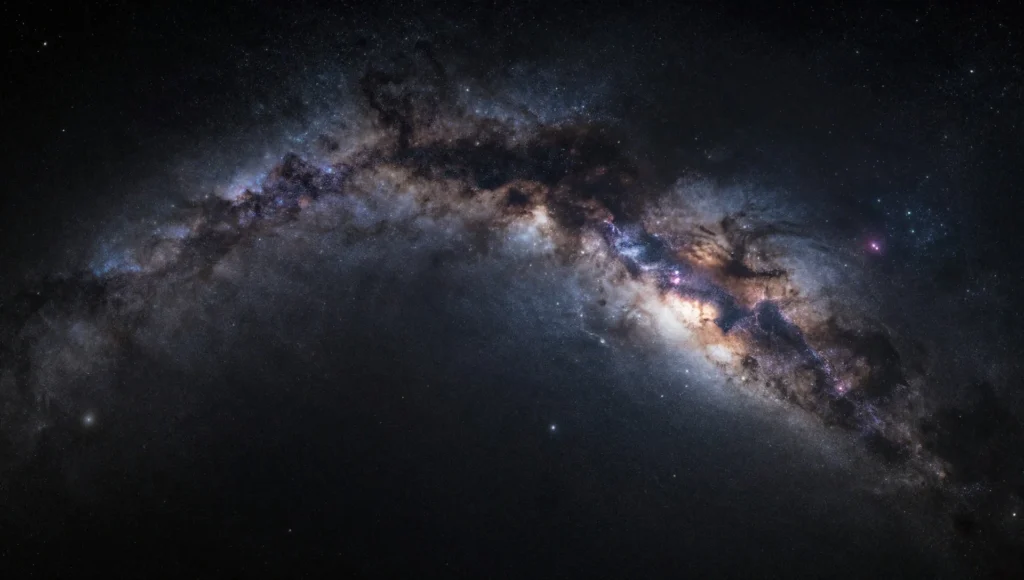
The Milky Way is not a static, self-contained island of stars but a living archive of cosmic collisions, and the science of reading that archive has matured into one of the most compelling pursuits in modern astrophysics. Over billions of years, our galaxy has repeatedly captured and torn apart smaller stellar systems, and the debris from those encounters still drifts through the galactic halo as long, faint streams and compact clusters of "ghost stars." These stellar remnants preserve the chemical fingerprints, orbital paths, and ages of the galaxies they once belonged to, offering astronomers a forensic record of the Milky Way's assembly. The story is not merely historical: the Small and Large Magellanic Clouds are being drawn inward right now, providing a live demonstration of the same gravitational dismantling that shaped our galaxy long before the Sun existed.
What makes this field so intellectually rich is the way it fuses dynamics, chemistry, and chronology into a single investigative framework. When a dwarf galaxy plunges into the Milky Way, the larger galaxy's tidal forces stretch and shred it, scattering its stars onto orbits that no longer resemble their original paths. Those stars retain distinctive chemical abundances and ages that betray their common origin, allowing researchers to group them into coherent populations even after billions of years of mixing. Astronomers call this approach galactic archaeology, and it has become the principal method for reconstructing the Milky Way's history across nearly twelve billion years, reaching back to the epoch when the galaxy was little more than a loose collection of merging fragments.
Recent observational advances have transformed this detective work from a coarse sketch into a precision discipline. New survey missions are delivering larger stellar samples with far finer measurements of motion, composition, and age, enabling researchers to detect subtle differences between populations that were previously indistinguishable. This article examines the mechanics of galactic cannibalism, the diagnostic signatures that betray absorbed galaxies, the role of the Magellanic Clouds as ongoing case studies, and the mathematical tools astronomers use to date and classify stellar debris. It also considers what the next generation of surveys promises for completing the Milky Way's biography.
On This Page
The Mechanics of Galactic Absorption
Galactic absorption is fundamentally a gravitational process governed by the disparity in mass between the two bodies involved. When a smaller galaxy approaches a larger one, the larger system's gravitational field exerts unequal forces across the smaller galaxy's extent, a phenomenon known as a tidal field. Because the near side experiences a stronger pull than the far side, the smaller galaxy is stretched along the axis connecting the two centers. Over successive orbits, this stretching intensifies until the dwarf galaxy can no longer hold itself together, and its stars are stripped away in long tidal tails that eventually wrap around the host galaxy.
Tidal Forces and the Roche Criterion
The threshold at which a satellite galaxy begins to lose stars is described by the tidal, or Roche, radius, the distance within which the satellite's own gravity can still retain material against the host's pull. For a satellite of mass ##[m]## orbiting at distance ##[R]## from a host of mass ##[M]##, the tidal radius scales approximately as ##[r_t \approx R\left(\dfrac{m}{3M}\right)^{1/3}]##. This relationship explains why low-mass dwarfs are shredded efficiently while massive satellites survive longer, and why the Milky Way's halo is littered with the remains of small systems that crossed this threshold billions of years ago.
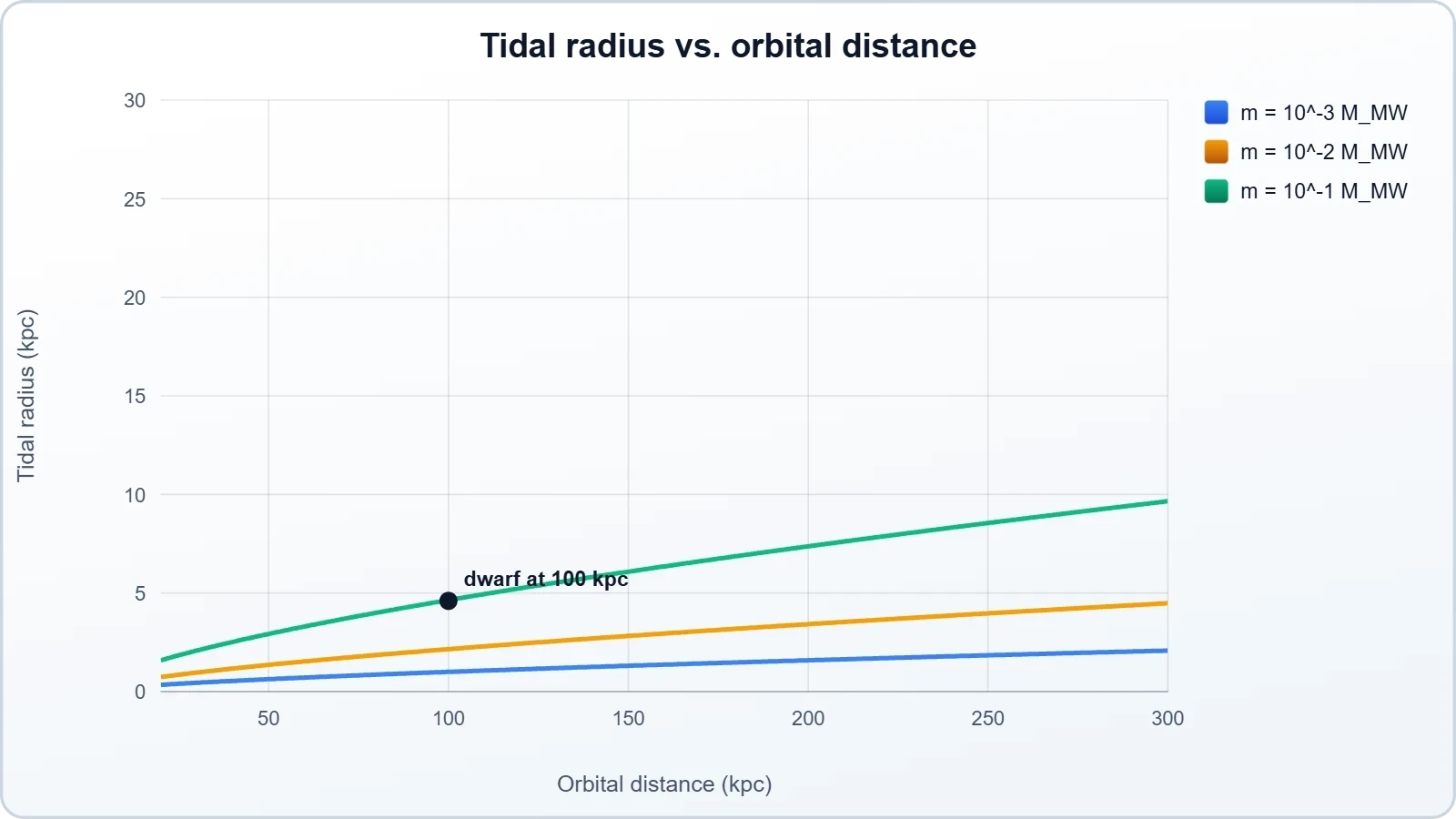
The cube-root dependence carries important consequences for the survival of satellites. A dwarf galaxy with one-thousandth the mass of the Milky Way, orbiting at a hundred kiloparsecs, has a tidal radius of only a few kiloparsecs, meaning its outer regions are stripped almost immediately upon approach. The inner core may persist for many orbits, gradually losing mass until it dissolves entirely. This staged disruption produces the characteristic morphology of stellar streams: dense remnants near the orbital path and diffuse tails extending far beyond, a structure that encodes the timing and geometry of the encounter.
Orbital Dynamics and Stream Formation
Once stripped, stars follow orbits determined by the host galaxy's gravitational potential, and because the potential is not perfectly smooth, the stream gradually spreads in space and velocity. The rate of spreading depends on the local gradient of the potential and on the velocity dispersion imparted during disruption. Astronomers model these streams as ensembles of test particles, integrating their trajectories through a realistic Milky Way potential to match observed positions and velocities. The match between simulation and observation constrains both the mass distribution of the galaxy and the properties of the progenitor satellite.
Stream dynamics also reveal the presence of dark matter, whose gravitational influence shapes the potential at large radii. The observed widths and velocity dispersions of streams often exceed predictions from visible matter alone, implying that unseen mass dominates the halo. By fitting stream models to survey data, researchers can map the distribution of dark matter in the Milky Way's outskirts, a region otherwise inaccessible to direct observation. This dual role, as both historical record and gravitational probe, makes stellar streams uniquely valuable to modern astrophysics.
We Also Published
Chemical Fingerprints of Absorbed Galaxies
Chemistry is the most reliable identifier of a star's birth environment, because the abundance ratios of elements preserve the conditions under which the star formed. Stars born in a small, slowly evolving dwarf galaxy typically show lower metallicities and distinctive patterns of alpha-element enhancement compared with stars born in the Milky Way's disk. When such a galaxy is absorbed, its stars carry these signatures into the halo, where they can be distinguished from native halo stars by their anomalous abundance patterns. This chemical tagging transforms a chaotic swarm of halo stars into a set of identifiable populations, each tracing back to a specific progenitor.
Abundance Ratios as Population Tracers
The ratio of alpha elements such as magnesium and silicon to iron is particularly diagnostic, because it reflects the relative rates of core-collapse and Type Ia supernovae in the birth environment. Dwarf galaxies with low star formation rates retain high alpha-to-iron ratios for longer, producing a distinctive plateau that differs from the Milky Way's trend. Spectroscopic surveys measuring these ratios across millions of stars have revealed multiple chemically distinct halo populations, each consistent with a separate accretion event. The diversity of these signatures implies that the Milky Way's halo was assembled from many small systems rather than a single massive merger.
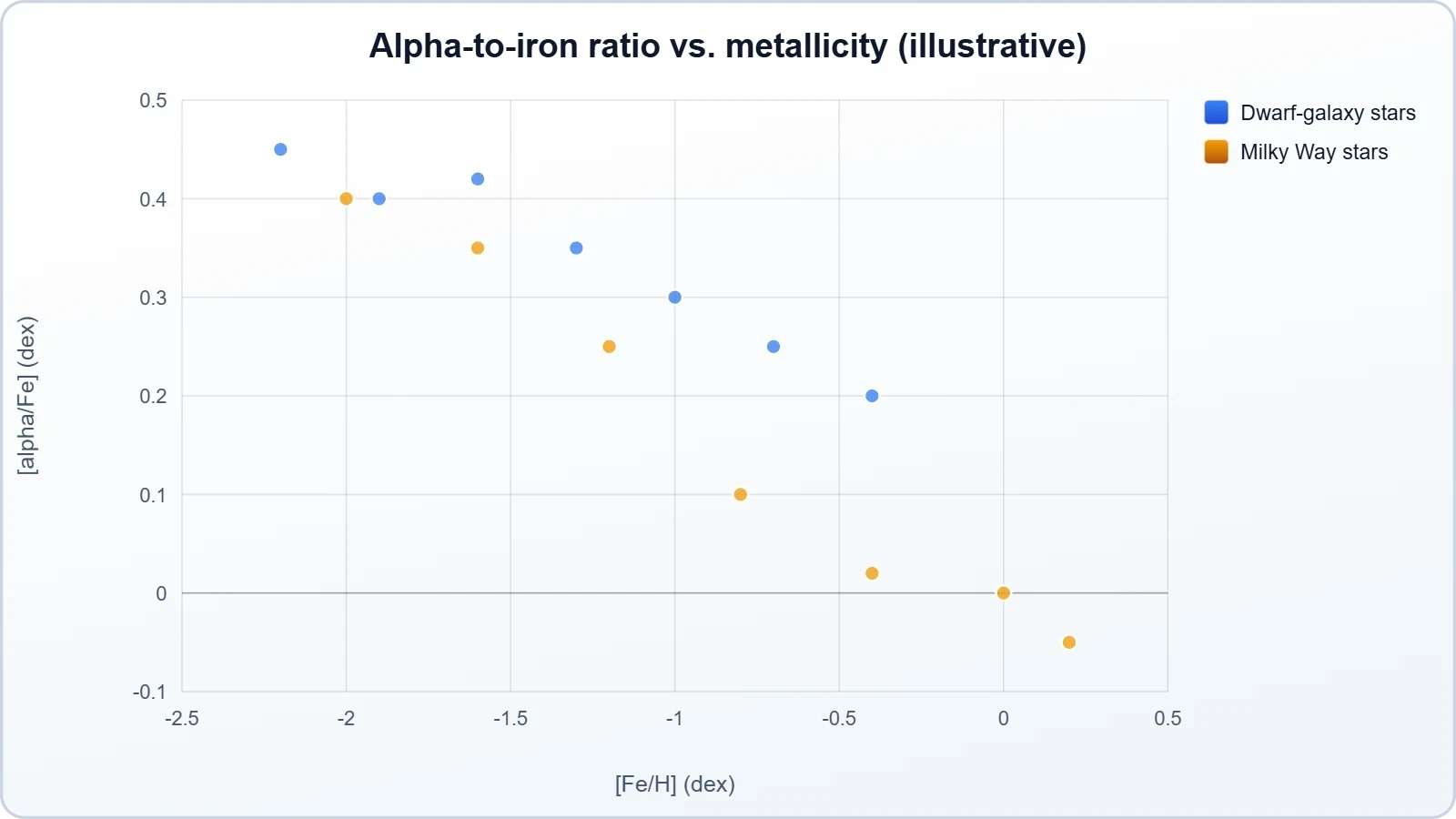
Chemical tagging also provides a clock. Because heavy elements accumulate over time through successive stellar generations, the abundance pattern of a star encodes the chemical enrichment history of its birth galaxy up to the moment of formation. By comparing observed patterns with models of galactic chemical evolution, astronomers can estimate when a population formed and how quickly its progenitor enriched itself. Populations with rapid enrichment suggest more massive progenitors, while slow enrichment points to low-mass dwarfs, allowing researchers to reconstruct the mass spectrum of absorbed galaxies from chemistry alone.
Age Dating and Chronology
Stellar ages provide the temporal backbone of galactic archaeology, but measuring them precisely is notoriously difficult. For individual stars, ages are inferred from properties such as surface temperature, luminosity, and rotation, calibrated against stellar evolution models. For populations, the turnoff point on the color-magnitude diagram offers a robust age indicator, since more massive stars leave the main sequence earlier. Combining these techniques with chemical data allows astronomers to assign ages to stream populations and to order accretion events chronologically, building a timeline of the Milky Way's growth.
The resulting chronology reveals that the Milky Way experienced a major early merger, often associated with the Gaia-Enceladus event, roughly ten billion years ago, followed by numerous smaller accretions. Later events, including the ongoing infall of the Magellanic Clouds, continue to add material. This layered history explains the halo's complex structure and demonstrates that galaxy formation is an incremental, ongoing process rather than a single dramatic event. Age dating thus converts the static snapshot of today's galaxy into a dynamic narrative spanning most of cosmic time.
The Magellanic Clouds as a Live Laboratory
The Small and Large Magellanic Clouds offer an unprecedented opportunity to observe galactic absorption as it happens, rather than inferring it from ancient debris. These two irregular satellites, visible to the naked eye from the southern hemisphere, are being drawn toward the Milky Way and already show signs of tidal disturbance. Their gas envelopes are being stripped, and a vast stream of neutral hydrogen, known as the Magellanic Stream, trails behind them across the sky. Studying this system in real time allows astronomers to test models of tidal disruption against direct observations of an ongoing encounter.
Structure and Dynamics of the Clouds
The Large Magellanic Cloud is a barred irregular galaxy with a mass roughly a tenth that of the Milky Way, while its smaller companion is less massive still. Both are gas-rich and actively forming stars, distinguishing them from the quiescent dwarf spheroidals that dominate the Milky Way's satellite population. Their proximity, at roughly fifty kiloparsecs, makes them ideal targets for detailed study of star formation, structure, and interaction. Recent measurements suggest the Clouds may be on their first passage around the Milky Way, which would imply a shorter history of interaction than previously assumed.
The interaction between the two Clouds themselves complicates the picture, as their mutual gravity produces bridges of gas and stars and distorts their shapes. This interplay, combined with the Milky Way's tidal pull, creates a complex dynamical environment that challenges simple models. High-resolution simulations that include all three bodies are beginning to reproduce the observed structures, offering insight into how satellite systems evolve as they fall into a massive host. The Clouds thus serve as a testing ground for theories of galaxy interaction on multiple scales.
Future Accretion Scenarios
Over the coming billions of years, the Magellanic Clouds are expected to merge with the Milky Way, contributing their stars and gas to the halo and possibly triggering a burst of star formation. The timing and outcome depend on their orbital parameters and on the distribution of dark matter in the Milky Way's outer regions. Some models predict that the Clouds will be fully disrupted within a few billion years, leaving behind long-lived streams and a diffuse population of halo stars. Others suggest that a compact remnant may survive for longer, depending on the details of the encounter.
These scenarios matter beyond the Clouds themselves, because they inform our understanding of how galaxies like the Milky Way assemble their mass. If the Clouds are on first infall, the Milky Way's recent accretion history is quieter than once thought, with implications for the galaxy's star formation and chemical evolution. Future surveys will refine the orbital solutions and clarify the fate of the Clouds, turning this nearby pair into a Rosetta stone for interpreting the ancient debris scattered throughout the halo.
Observational Techniques and Survey Missions
Detecting the faint debris of absorbed galaxies requires instruments capable of measuring the positions, motions, and compositions of millions of stars with extraordinary precision. The European Space Agency's Gaia mission has been pivotal, delivering astrometry for over a billion stars and enabling the discovery of numerous stellar streams. Ground-based spectroscopic surveys complement Gaia by measuring radial velocities and chemical abundances, while photometric surveys provide the deep imaging needed to identify faint structures. Together, these datasets form the foundation of modern galactic archaeology.
Astrometry and Spectroscopy
Astrometry provides the three-dimensional positions and proper motions of stars, which reveal their orbital paths through the galaxy. Spectroscopy adds radial velocities and chemical abundances, completing the six-dimensional phase-space information needed to identify coherent stellar groups. Stars that formed together share similar velocities and chemistry, so clustering in this combined space is a powerful way to isolate stream members from the background. Machine-learning techniques are increasingly used to identify such clusters in the enormous datasets now available, automating what was once a painstaking manual process.
The precision of these measurements determines the smallest structures that can be detected. Gaia's astrometric accuracy of tens of microarcseconds allows proper motions to be measured for stars across the halo, while high-resolution spectrographs on large telescopes deliver abundances accurate to a few hundredths of a dex. Combining these capabilities enables the identification of streams with as few as a handful of member stars, opening a window onto the smallest and faintest accretion events. Future facilities promise further gains in both sensitivity and survey speed.
Upcoming Facilities and Data Volumes
The next generation of observatories, including the Rubin Observatory and the European Extremely Large Telescope, will dramatically expand the available data. Rubin's Legacy Survey of Space and Time will image the entire southern sky repeatedly, detecting faint streams and variable stars with unprecedented depth. The ELT will provide high-resolution spectra for faint halo stars, enabling detailed chemical analysis of the smallest debris systems. These facilities will transform galactic archaeology from a field limited by sample size to one limited only by theoretical modeling.
Handling these data volumes requires sophisticated computational infrastructure and statistical methods. Bayesian inference, hierarchical modeling, and simulation-based techniques are becoming standard tools for extracting astrophysical parameters from large datasets. The integration of machine learning with physical models is accelerating discovery, allowing researchers to identify subtle patterns that would escape traditional analysis. As data volumes grow, the discipline is increasingly shaped by advances in computational science as much as by telescope technology.
Mathematical Modeling of Stellar Streams
Turning observations into a coherent history requires mathematical models that connect the present-day distribution of debris to the properties of its progenitor. The core problem is an inverse one: given the positions and velocities of stream stars, infer the mass, orbit, and disruption time of the original satellite. Solving it demands both forward simulations, which predict observable structures from assumed parameters, and statistical inference, which compares predictions with data. The mathematics draws on orbital mechanics, potential theory, and Bayesian statistics, forming a rich interdisciplinary toolkit.
Orbital Integrations and Potential Models
The trajectory of a stream is governed by the gravitational potential of the Milky Way, which is typically modeled as a sum of contributions from the bulge, disk, and dark matter halo. A common choice for the halo is a Navarro-Frenk-White profile, whose density falls off as ##[\rho(r) \propto \dfrac{1}{r(1+r/r_s)^2}]##, where ##[r_s]## is a scale radius. Integrating test-particle orbits through such a potential yields the stream's path, and comparing the predicted path with observations constrains the potential's parameters, including the total mass of the galaxy.
Numerical integration is performed using symplectic or adaptive-step algorithms that conserve energy and angular momentum over long timescales. The accuracy of these integrators is critical, because small errors accumulate over billions of years and can distort the predicted stream. Researchers validate their codes against analytic solutions for simple potentials before applying them to realistic galaxy models. The resulting simulations provide the forward model needed for statistical inference, linking theoretical parameters to observable quantities.
Statistical Inference and Parameter Estimation
Bayesian inference provides the framework for extracting progenitor properties from stream data. The likelihood function compares observed stellar positions and velocities with model predictions, while priors encode physical constraints such as positive masses and plausible orbits. Markov chain Monte Carlo methods sample the posterior distribution, yielding estimates and uncertainties for each parameter. This approach naturally handles the small sample sizes typical of faint streams and allows multiple data sets to be combined coherently.
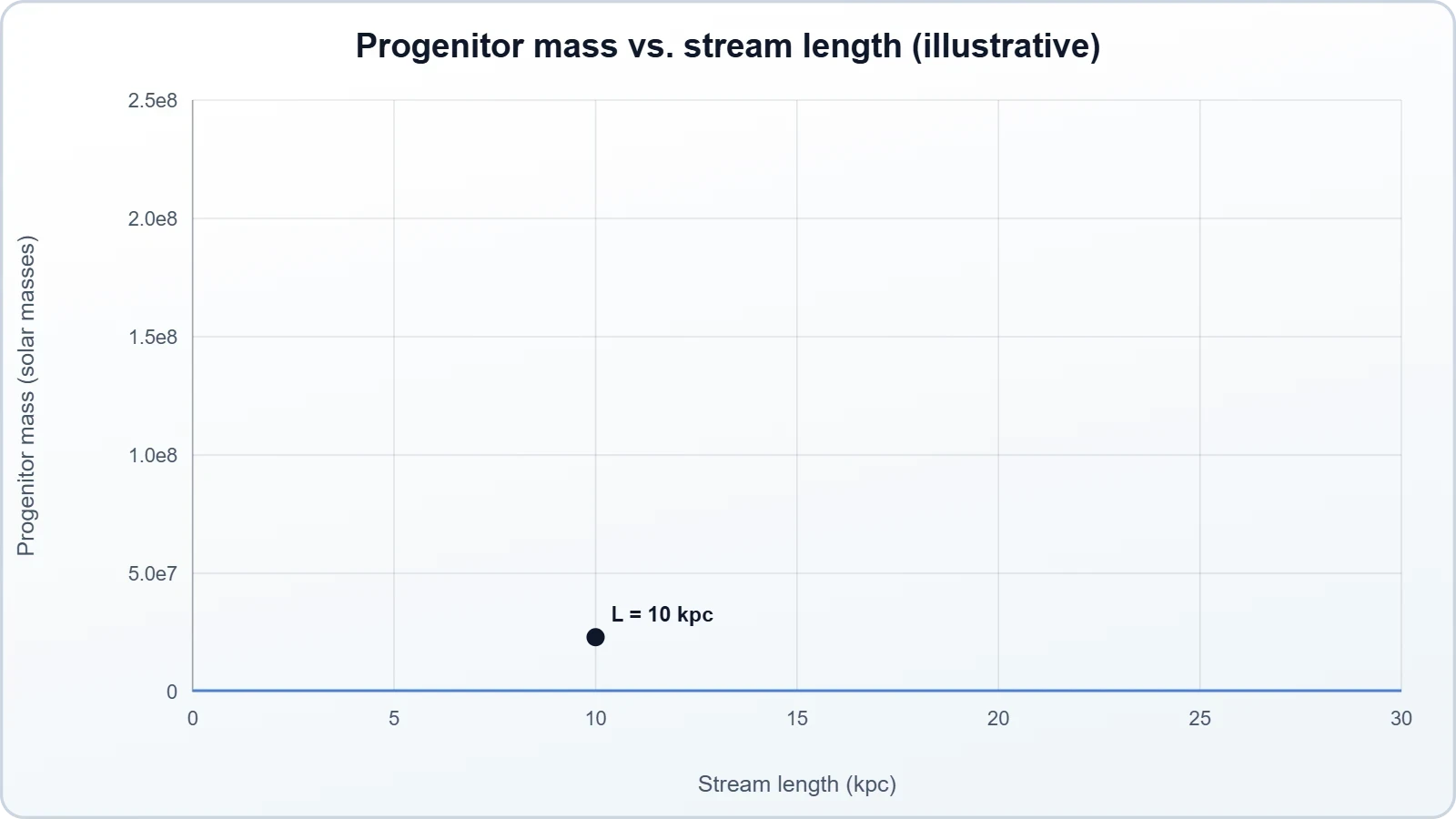
A representative calculation illustrates the scale of the problem. For a stream with velocity dispersion ##[\sigma_v]## and length ##[L]##, the progenitor mass can be estimated from the relation ##[M \approx \dfrac{\sigma_v^2 L}{G}]##, where ##[G]## is the gravitational constant. Inserting ##[\sigma_v = 5\ \text{km/s}]## and ##[L = 10\ \text{kpc}]## gives ##[M \approx 5.7 \times 10^{8}\ M_\odot]##, consistent with a dwarf galaxy progenitor. Such estimates, refined with full dynamical modeling, anchor the mass spectrum of absorbed galaxies.
Implications for the Milky Way's History
The accumulated evidence from stellar archaeology paints a picture of the Milky Way as a galaxy built through successive mergers, each contributing stars, gas, and dark matter to the growing halo. The largest known event, the Gaia-Enceladus merger, appears to have occurred around ten billion years ago and may have shaped the galaxy's early structure, possibly even influencing the formation of its thick disk. Smaller accretions continued thereafter, and the process is still underway with the Magellanic Clouds. This incremental assembly is consistent with the broader cosmological picture in which galaxies grow hierarchically.
Reconstructing the Accretion Timeline
By combining chemical, kinematic, and age data, astronomers have begun to assemble a timeline of accretion events spanning nearly twelve billion years. Each event is characterized by the mass of the progenitor, the time of disruption, and the orbital properties of the debris. The timeline reveals that accretion was more intense in the distant past, consistent with the expectation that merger rates decline over cosmic time. It also shows that the Milky Way's halo is a composite structure, with distinct populations reflecting different epochs and progenitors.
The timeline is far from complete, and many questions remain. The relative contributions of in situ star formation and accreted material to the halo are still debated, as is the role of the largest mergers in shaping the galaxy's morphology. Future surveys will fill in gaps by discovering fainter streams and measuring their properties more precisely. Each new stream adds a chapter to the galaxy's biography, and the cumulative record will eventually allow a detailed reconstruction of the Milky Way's formation history.
Broader Implications for Galaxy Formation
The lessons learned from the Milky Way extend to galaxies throughout the universe, because the processes of hierarchical assembly are universal. The techniques of galactic archaeology, refined on our own galaxy, can be applied to nearby systems such as Andromeda, where similar streams have been detected. Comparing the accretion histories of different galaxies tests models of galaxy formation and reveals how environment and mass influence the merger process. The Milky Way thus serves as a benchmark for understanding galaxy evolution more broadly.
These studies also inform our understanding of dark matter, since the distribution of accreted debris traces the gravitational potential of the host. The presence of numerous low-mass satellites and streams constrains the properties of dark matter particles, particularly the suppression of small-scale structure predicted by warm dark matter models. Galactic archaeology therefore connects the smallest observable structures to fundamental physics, making it a uniquely powerful probe of the cosmos.
From our network :
- 10 Physics Numerical Problems with Solutions for IIT JEEPrepare for IIT JEE with 10 physics numerical problems, complete with detailed solutions and conceptual explanations. Ideal for mastering kinematics, thermodynamics, electromagnetism, and optics.
- Vite 6/7 'Cold Start' Regression in Massive Module GraphsIn-depth analysis of Vite 6/7 cold start regressions in massive module graphs. Learn about barrel file issues, pre-bundling optimizations, and how to improve Vite dev server performance.
- Analyzing Trump Deportation Numbers Insights Into The 2026 Immigration Crackdown
- AI-Powered 'Precision Diagnostic' Replaces Standard GRE Score ReportsDiscover the new GRE Precision Diagnostic. Learn how AI-powered behavioral analytics and time-to-solve tracking are replacing standard GRE score reports to empower students.
- 98% of Global MBA Programs Now Prefer GRE Over GMAT Focus EditionExplore why 98% of global MBA programs now prefer the GRE over GMAT Focus. Learn about the shorter GRE format, verbal logic importance, and strategic versatility for students.
- EV 2.0: The Solid-State Battery Breakthrough and Global Factory ExpansionDiscover the impact of the Solid-State Battery Breakthrough on the EV market. Learn about CATL and BYD stock growth, global factory expansion in Europe, and the future of EV 2.0 technology.
- Mastering DB2 12.1 Instance Design: A Technical Deep Dive into Modern Database ArchitectureComprehensive guide to DB2 12.1 Instance Design. Explore architectural components, HADR setup, buffer pool tuning, and security policies for IBM DB2 12.1. Includes 10 functional SQL and Shell samples.
- Trump Political Strategy How Geopolitical Stunts Serve As Media Diversions
- Mastering DB2 LUW v12 Tables: A Comprehensive Technical GuideComprehensive guide on DB2 LUW v12 tables. Explore CREATE TABLE syntax, BLU Acceleration, range partitioning, data types, and security features for IBM DB2 LUW v12.
RESOURCES
- Stellar streams in the Gaia era - ScienceDirect.comsciencedirect.comAs such, streams serve as direct evidence of hierarchical structure formation, fossil records of star and galaxy formation in the early universe, and luminous ...
- Galactic Archaeology of the Sagittarius Stream - Astrobitesastrobites.orgJun 20, 2017 ... Small satellite galaxies and star clusters orbiting the Milky Way are often torn apart by its gravitational potential, leaving behind…
- Galactic Archaeology with Gaia - arXivarxiv.orgFeb 19, 2024 ... (1999) discover a stellar stream from a small dwarf galaxy passing near the Sun, in a clear example of what…
- Astronomers discover 87 stellar stream candidates in the Milky Wayphys.orgMar 23, 2026 ... Stellar streams are trails of stars that astronomers can study to solve mysteries about the history of our Milky Way…
- On the mass assembly history of the Milky Way: clues from its stellar ...arxiv.orgApr 25, 2024 ... ... Galactic archaeology: “How did the Milky Way form? ... Stellar Streams around Milky Way-mass Galaxies in the FIRE Cosmological…
- Gaia unravels the ancient threads of the Milky Way - ESAesa.intMar 21, 2024 ... ESA's Gaia space telescope has further disentangled the history of our galaxy, discovering two surprising streams of stars that formed…
- Ása Skúladóttir University of Florence - Eso.orgeso.orgDec 3, 2024 ... < Hierarchical build-up of the Milky Way environment. < Chemical evolution. STELLAR ARCHAEOLOGY / GALACTIC ARCHAEOLOGY. Page 11. AGB stars…
- Stellar Streams Are Revealing Their Secrets - Sky & Telescopeskyandtelescope.orgJan 12, 2022 ... An artist's representation shows dozens of stellar streams surrounding our Milky Way Galaxy. ... Galactic archaeology may reveal the ...
- Galaxy archaeology for wet mergers: Globular cluster age ...aanda.org... Milky Way and nearby galaxies. Lucas M. Valenzuela1, Rhea-Silvia ... stellar streams are generally the remains of a tidally disrupted satellite galaxy.
- Galaxy Evolution and Cosmology Initiative (GECO) - UVA Astronomyastronomy.as.virginia.eduKaia Atzberger's research focuses on near-field cosmology and stellar archaeology ... stellar populations to study ultra-faint dwarf galaxies and stellar streams.
- Accelerating Galactic Archaeology | GREATDIGINTHESKY | Projectcordis.europa.euMay 20, 2025 ... Stellar streams, remnants of smaller galaxies that have been torn ... streams in the Milky Way. This project aims to…
- Streams of stars reveal the galaxy's violent history—and perhaps its ...science.orgOct 4, 2018 ... ... Milky Way's halo, the study of stellar streams is entering a golden age. Even before Gaia, astronomers were finding…
- NASA Telescope to Help Untangle Galaxy Growth, Dark Matter ...roman.ipac.caltech.eduJun 14, 2022 ... Studying them transforms astronomers into galactic archaeologists. ... Astronomers are also looking forward to studying stellar streams in several ...
- The Global Dynamical Atlas of the Milky Way Mergers - IOP Scienceiopscience.iop.orgFeb 17, 2022 ... Here, we uncover the Milky Way mergers by detecting groupings of globular clusters, stellar streams, and satellite galaxies in action…
- Galactic archaeology - Research School of Astronomy & Astrophysicsrsaa.anu.edu.ausearching for satellite galaxies of the Milky Way; mapping the structure of the galaxy, including stellar streams and substructure formed during the accretion ...