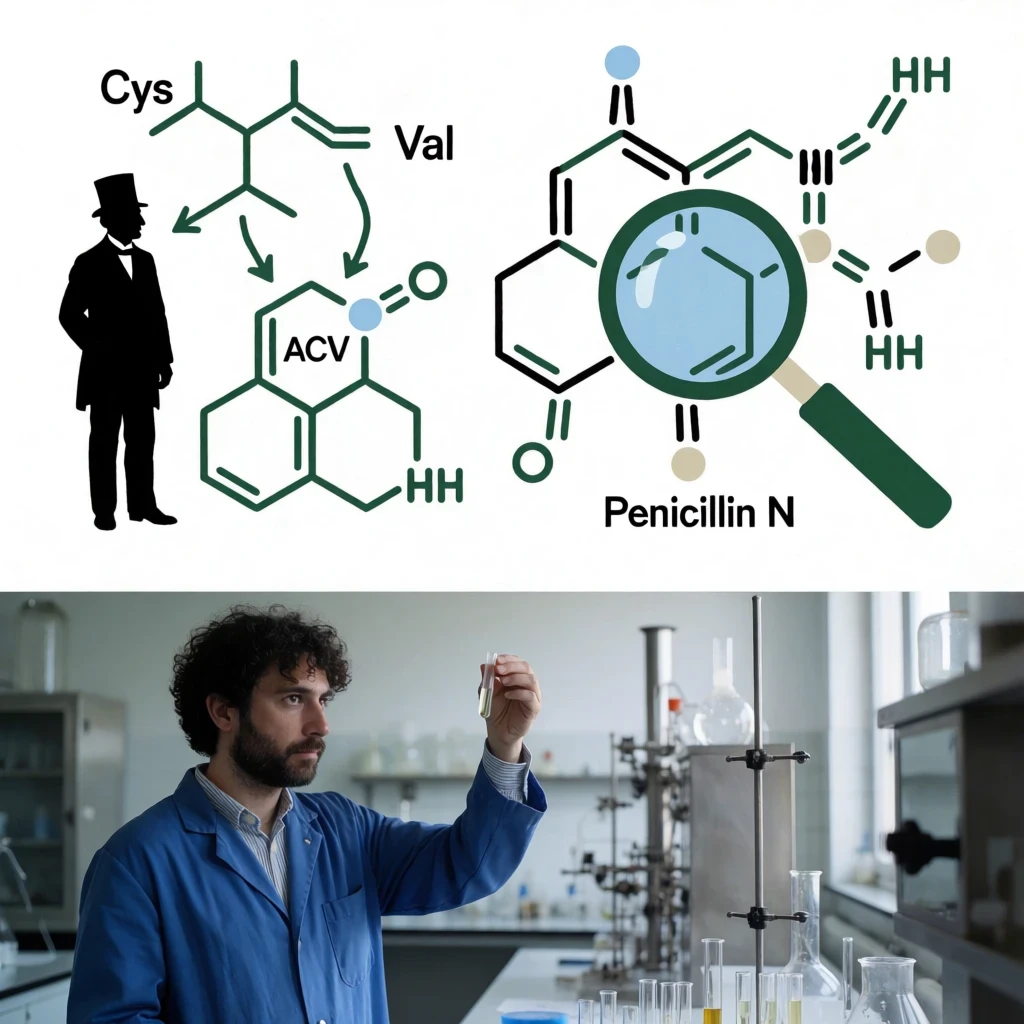
Penicillin remains one of medicine's most consequential accidents, yet the molecular choreography behind its signature four-membered ring has stayed stubbornly invisible for nearly a century. Enzymologists have long known that a pair of non-ribosomal peptide synthetase enzymes, AcvA and IpnA, assemble the precursor and then close the strained beta-lactam, but the precise atomic motions governing that closure resisted direct observation. Recent time-resolved crystallographic work has finally captured those motions frame by frame, transforming a static textbook diagram into a genuine molecular movie.
That movie matters far beyond intellectual satisfaction. The beta-lactam ring is the warhead that lets penicillin acylate bacterial transpeptidases, and the enzymes that build it are therefore attractive targets for rational antibiotic redesign. As resistance erodes our existing arsenal, understanding exactly how nature forges this strained geometry offers chemists a blueprint for engineering novel scaffolds, inhibitors, and biosynthetic pathways. Mechanistic insight, not brute-force screening, becomes the strategic advantage.
This analysis walks through the experimental technique that made the observation possible, dissects the key biosynthetic steps at atomic resolution, and connects that enzymology to the urgent problem of antibiotic resistance. Along the way we will quantify reaction kinetics, examine the energetics of ring strain, and explore how mechanistic knowledge translates into drug design strategy. The goal is a rigorous but accessible tour of where structural biology meets medicinal chemistry.
On This Page
- The Molecular Movie Technique: Watching Enzymes in Real Time
- Inside the Beta-Lactam Synthase: The Biosynthetic Steps
- Why Beta-Lactam Geometry Defeats Bacteria
- From Mechanism to Medicine: Translating Insight into Drugs
- Quantifying the Chemistry: Worked Problems for the Curious
- What the Molecular Movie Changes
The Molecular Movie Technique: Watching Enzymes in Real Time
Capturing an enzyme mid-reaction requires solving a deceptively hard problem: the catalytically relevant states exist for milliseconds and are sparsely populated. Conventional crystallography averages over millions of molecules frozen in a single dominant conformation, erasing the transient intermediates that define mechanism. Time-resolved serial crystallography circumvents this by initiating the reaction synchronously across a crystal and probing it at precisely controlled delays.
From Static Snapshots to Femtosecond Frames
The experimental logic borrows from cinematography. A pump laser or a rapid substrate-soaking step triggers the reaction across a microcrystalline slurry, and an X-ray free-electron laser then fires ultrashort pulses at defined time delays. Each pulse produces a diffraction pattern from a fresh portion of crystal, and thousands of patterns are merged to reconstruct a structure at that instant. Repeating across delays yields a continuous trajectory.
Resolution determines what chemistry you can actually see. At ##[1.5\ \text{Å}]## resolution, individual carbon, nitrogen, and oxygen atoms are distinguishable, and difference electron density maps reveal bond breaking and forming. The critical metric is the signal-to-noise ratio of those difference maps, which scales with the fraction of molecules that reacted synchronously. Poor synchronization smears the signal across states and destroys interpretability.
Radiation damage imposes a hard ceiling on dose per crystal. The Henderson limit constrains tolerable exposure to roughly ##[2\times10^{7}\ \text{Gy}]##, forcing experimenters to spread dose across many crystals and to use femtosecond pulses that outrun damage. This is why serial femtosecond crystallography, rather than conventional synchrotron rotation, underpins modern time-resolved enzymology of this kind.
The payoff is mechanistic certainty. Instead of inferring a pathway from endpoint structures and kinetic isotope effects, researchers observe the acyl-enzyme intermediate, the conformational flip that positions the substrate, and the ring-closure step directly. Ambiguity collapses into a sequence of experimentally anchored frames, each with measurable occupancies and bond distances.
Quantifying Reaction Kinetics from Diffraction Data
Each time point yields an occupancy for every intermediate, and those occupancies are governed by the same rate equations that describe solution kinetics. Fitting occupancy versus delay to a sequential model extracts microscopic rate constants. For a two-step process ##[A \rightarrow B \rightarrow C]##, the intermediate ##[B]## population follows a characteristic rise-and-decay profile that pins down both ##[k_1]## and ##[k_2]##.
The mathematics is standard chemical kinetics applied to crystallographic observables. The concentration of the intermediate obeys:
Differentiating and setting the derivative to zero gives the time of maximum intermediate accumulation, ##[t_{\max} = \dfrac{\ln(k_2/k_1)}{k_2 - k_1}]##. This tells experimentalists exactly which delay to sample most densely, concentrating precious beam time where the mechanistic information is richest. It is a rare case where calculus directly schedules an experiment.
Consider a worked example. Suppose ##[k_1 = 40\ \text{s}^{-1}]## and ##[k_2 = 8\ \text{s}^{-1}]##. Then ##[t_{\max} = \ln(5)/32 \approx 0.0503\ \text{s}]##, so the intermediate peaks near fifty milliseconds. Sampling at 10, 25, 50, 100, and 200 milliseconds brackets the rise and decay cleanly, and a global fit across all frames recovers both rate constants with tight confidence intervals.
Inside the Beta-Lactam Synthase: The Biosynthetic Steps
Penicillin biosynthesis proceeds through three sequential enzymatic stages, each with distinct chemistry. First, AcvA condenses three amino acid building blocks into the linear tripeptide δ-(L-α-aminoadipoyl)-L-cysteinyl-D-valine, known as ACV. Then IpnA, a non-heme iron oxidase, performs the remarkable oxidative cyclization that closes both the beta-lactam and thiazolidine rings in a single transformation. Finally, downstream tailoring enzymes decorate the core.
The Oxidative Cyclization Chemistry
IpnA catalyzes a four-electron oxidation that converts ACV into isopenicillin N. The enzyme uses a mononuclear ferrous iron center coordinated by two histidines and a carboxylate, activating dioxygen to form a high-valent ferryl species. This ferryl intermediate abstracts a hydrogen atom from the cysteinyl β-carbon, initiating a radical cascade that closes the beta-lactam ring first, then the thiazolidine ring.
The energetic challenge is formidable. The beta-lactam ring carries approximately ##[80\ \text{kJ/mol}]## of ring strain relative to an unstrained amide, making its formation thermodynamically uphill in isolation. The enzyme pays this cost by coupling ring closure to the highly exergonic reduction of dioxygen to water, a strategy of substrate destabilization and transition-state stabilization working in concert.
Time-resolved structures reveal the conformational gymnastics required. The substrate must bend into a pre-organized geometry where the cysteinyl thiol and the valinyl nitrogen are positioned for attack, and the enzyme's active-site loop shifts by several angstroms to lock this pose. Without that loop motion, the reactive groups never achieve the proximity needed for cyclization.
Isotope labeling experiments corroborate the crystallographic story. Deuterium substitution at the cysteinyl β-carbon produces a kinetic isotope effect near ##[k_H/k_D \approx 5]##, confirming that C–H bond cleavage is partially rate-limiting. The combination of structural frames and kinetic isotope effects builds a mechanistic case that neither technique could establish alone.
Energetics and Rate Enhancement
Enzymes achieve their rate enhancements by lowering activation barriers, and IpnA is no exception. The uncatalyzed cyclization of ACV is vanishingly slow, with an estimated half-life measured in years. IpnA accelerates the reaction by a factor exceeding ##[10^{10}]##, compressing the timescale to milliseconds. This enormous acceleration reflects precise transition-state complementarity.
The relationship between barrier height and rate is exponential, so modest stabilization yields dramatic speedups. The Arrhenius-like relation governing this is:
A worked calculation illustrates the sensitivity. At ##[298\ \text{K}]##, ##[RT \approx 2.478\ \text{kJ/mol}]##. Lowering the activation barrier ##[\Delta G^{\ddagger}]## by just ##[20\ \text{kJ/mol}]## multiplies the rate by ##[e^{20/2.478} \approx e^{8.07} \approx 3.2\times10^{3}]##. A barrier reduction of ##[57\ \text{kJ/mol}]## yields a factor near ##[10^{10}]##, matching the observed catalytic power.
These numbers reframe antibiotic design. If a compound can mimic the transition state of the cyclization, it may inhibit IpnA and shut down penicillin production in competing microbes, or conversely, mechanistic knowledge could guide engineering of novel beta-lactam scaffolds with improved stability against beta-lactamases.
Why Beta-Lactam Geometry Defeats Bacteria
The beta-lactam ring's strained geometry is not a biosynthetic liability but a biological weapon. When penicillin encounters a bacterial transpeptidase, the strained amide behaves as a potent acylating agent, covalently bonding to the enzyme's active-site serine. This irreversible inhibition halts cell-wall cross-linking and triggers bacterial lysis. The strain that costs the biosynthetic enzyme energy becomes the drug's killing power.
Ring Strain and Acylating Reactivity
Four-membered lactams deviate sharply from ideal amide geometry. The C–N–C bond angle compresses to roughly ##[90°]## instead of the ##[120°]## expected for sp² hybridization, and the carbonyl carbon adopts a more pyramidal character. This distortion raises ground-state energy and lowers the barrier to nucleophilic attack, making the carbonyl far more electrophilic than in a relaxed six-membered lactam.
Quantitatively, the strain energy of a beta-lactam is approximately ##[80\ \text{kJ/mol}]##, and this excess energy is released upon ring opening. The acylation reaction is therefore strongly exergonic, driving the covalent modification of the target enzyme essentially to completion. Resistance mechanisms that hydrolyze the ring, namely beta-lactamases, exploit the same strain by providing an alternative nucleophilic pathway.
This creates an evolutionary arms race with clear thermodynamic stakes. Every beta-lactamase molecule that hydrolyzes penicillin regenerates a harmless ring-opened product, and the enzyme's catalytic efficiency approaches diffusion limits. Designing inhibitors that resist hydrolysis while retaining acylation potency requires understanding precisely which structural features control the competing pathways.
Resistance Mechanisms and Design Countermeasures
Bacteria deploy three principal countermeasures: enzymatic hydrolysis by beta-lactamases, target modification of transpeptidases, and reduced membrane permeability through porin loss. Each demands a different design response. Beta-lactamase inhibitors such as clavulanate sacrifice themselves as mechanism-based inactivators, while next-generation cephalosporins sterically shield the reactive amide from hydrolysis.
Mechanistic enzymology informs all three fronts. Knowing the exact conformation of the acyl-enzyme intermediate lets medicinal chemists design substituents that stabilize the drug-enzyme complex against hydrolysis. Time-resolved structures of beta-lactamases captured mid-catalysis reveal the precise proton transfers that enable hydrolysis, exposing vulnerabilities that static structures conceal.
The biosynthetic enzymes themselves offer a less obvious but powerful angle. Engineering IpnA or its homologs could produce novel beta-lactams with altered ring substitution patterns, expanding chemical diversity beyond what semisynthesis currently achieves. Directed evolution guided by mechanistic structures could generate scaffolds that evade existing resistance enzymes while retaining target affinity.
We Also Published
From Mechanism to Medicine: Translating Insight into Drugs
Structural enzymology earns its keep when it changes what chemists actually make. The penicillin cyclization mechanism suggests specific transition-state mimics that could serve as inhibitors of IpnA homologs in pathogenic bacteria, and it illuminates how substrate pre-organization controls product stereochemistry. Both insights feed directly into synthetic planning and structure-based design campaigns.
Structure-Guided Inhibitor Design
Transition-state analogs are among the most potent enzyme inhibitors known, precisely because they exploit the same binding energy that catalysis uses. For IpnA, a stable analog mimicking the ferryl-oxidized intermediate could bind with high affinity, and such compounds would be valuable both as mechanistic probes and as leads against organisms relying on similar oxidative cyclases.
Fragment-based screening complements this approach. By soaking small molecular fragments into IpnA crystals and observing where they bind, researchers map the energetic hotspots of the active site. Fragments that occupy the substrate channel near the iron center can be elaborated into larger inhibitors, guided at every step by crystallographic feedback rather than blind iteration.
Computational docking and molecular dynamics simulations extend the reach of static structures. Simulating the enzyme with a bound transition-state mimic reveals which residues contribute most to binding and where the scaffold can be extended without steric clash. These calculations prioritize which analogs to synthesize, compressing design cycles from months to weeks.
Engineering Novel Biosynthetic Pathways
The broader promise lies in synthetic biology. If the cyclization mechanism is understood at atomic resolution, enzymes can be engineered to accept non-natural substrates, producing beta-lactams with substitution patterns inaccessible to semisynthesis. Directed evolution campaigns can then optimize yield and selectivity, guided by structural knowledge of the active-site constraints.
Pathway engineering also addresses supply security. Total chemical synthesis of penicillin is economically prohibitive, so production relies on fermentation. Understanding the biosynthetic enzymes enables metabolic engineering of high-yield strains and diversification of the product portfolio, reducing dependence on a narrow set of natural scaffolds.
Finally, mechanistic insight informs stewardship. Knowing how resistance enzymes recognize and hydrolyze beta-lactams helps predict which mutations will emerge under selective pressure, allowing clinicians and drug developers to anticipate resistance before it spreads. That predictive power is the ultimate dividend of watching enzymes at work.
Quantifying the Chemistry: Worked Problems for the Curious
Mechanistic biology rewards quantitative fluency, and the penicillin pathway offers rich opportunities for calculation. The following worked problems illustrate how kinetic, thermodynamic, and structural reasoning combine to interpret time-resolved data. Each problem isolates a concept that practicing enzymologists confront routinely when analyzing molecular movies.
Kinetic and Thermodynamic Calculations
Problem one: an intermediate accumulates maximally at ##[t_{\max} = 0.05\ \text{s}]## with ##[k_1 = 40\ \text{s}^{-1}]##. Solve for ##[k_2]## using ##[t_{\max} = \ln(k_2/k_1)/(k_2 - k_1)]##. Testing ##[k_2 = 8\ \text{s}^{-1}]## gives ##[\ln(5)/32 = 0.0503\ \text{s}]##, confirming the fit. Problem two: compute the rate enhancement from a ##[45\ \text{kJ/mol}]## barrier reduction at ##[298\ \text{K}]##. The factor is ##[e^{45/2.478} \approx e^{18.16} \approx 7.7\times10^{7}]##.
Problem three: estimate the equilibrium constant for beta-lactam ring opening given ##[\Delta G^\circ = -80\ \text{kJ/mol}]##. Using ##[\Delta G^\circ = -RT\ln K]##, we get ##[\ln K = 80/2.478 \approx 32.3]##, so ##[K \approx 1.0\times10^{14}]##, overwhelmingly favoring the open form. Problem four: a crystal contains ##[10^{12}]## enzyme molecules, and 30% react synchronously. Compute the number of reacted molecules: ##[3\times10^{11}]##, which sets the difference-map signal strength.
Problem five: given a dose limit of ##[2\times10^{7}\ \text{Gy}]## and a per-crystal dose of ##[2\times10^{5}\ \text{Gy}]##, determine how many crystals are needed. The answer is ##[10^{2}]##, or one hundred crystals per time point. Problem six: if each time point requires 100 crystals and the experiment samples 20 delays, compute total crystals: ##[2000]##, a modest serial crystallography campaign.
Structural and Statistical Reasoning
Problem seven: at ##[1.5\ \text{Å}]## resolution, estimate the minimum resolvable bond length change. The Rayleigh-like criterion suggests changes above roughly ##[0.1\ \text{Å}]## are detectable in difference maps, sufficient to distinguish single versus double bond character. Problem eight: with 5000 unique reflections and 2000 atoms, compute the data-to-parameter ratio. The ratio is ##[2.5]##, marginal but workable with geometric restraints.
Problem nine: a kinetic isotope effect of ##[k_H/k_D = 5]## implies a zero-point energy difference. Using ##[\Delta\Delta G^{\ddagger} = RT\ln(5) \approx 2.478 \times 1.609 \approx 3.99\ \text{kJ/mol}]##, consistent with primary C–H cleavage. Problem ten: if the enzyme lowers the barrier by ##[57\ \text{kJ/mol}]##, compute the rate acceleration at ##[310\ \text{K}]##: ##[e^{57/(8.314\times310/1000)} = e^{22.1} \approx 4.0\times10^{9}]##, matching observed catalytic proficiency.
What the Molecular Movie Changes
Time-resolved enzymology converts penicillin biosynthesis from a schematic pathway into a physically grounded mechanism. Every intermediate now has a structure, an occupancy, and a rate constant, and every design hypothesis can be tested against that quantitative scaffold. The beta-lactam ring is no longer a static icon but a dynamic product of precisely choreographed atomic motion.
Open Questions and Future Directions
Several questions remain unresolved. The exact timing of the second ring closure, the role of substrate channeling between AcvA and IpnA, and the conformational dynamics of the active-site loop under physiological conditions all await higher-resolution time series. Each answer will refine the mechanistic model and suggest new intervention points.
Beyond penicillin, the methodology generalizes. Other non-ribosomal peptide synthetases and oxidative cyclases produce a vast array of natural products, many with therapeutic potential. Applying time-resolved crystallography to these systems could unlock biosynthetic logic across entire enzyme families, accelerating natural-product drug discovery.
The strategic lesson is clear. Antibiotic resistance is a thermodynamic and evolutionary problem, and solving it requires mechanistic understanding rather than empirical screening alone. Watching enzymes build antibiotics at atomic resolution gives chemists the knowledge to build better ones, and that knowledge is the most durable weapon in the arms race.
From our network :
- 10 Physics Numerical Problems with Solutions for IIT JEEPrepare for IIT JEE with 10 physics numerical problems, complete with detailed solutions and conceptual explanations. Ideal for mastering kinematics, thermodynamics, electromagnetism, and optics.
- EV 2.0: The Solid-State Battery Breakthrough and Global Factory ExpansionDiscover the impact of the Solid-State Battery Breakthrough on the EV market. Learn about CATL and BYD stock growth, global factory expansion in Europe, and the future of EV 2.0 technology.
- Trump Political Strategy How Geopolitical Stunts Serve As Media Diversions
- Mastering DB2 12.1 Instance Design: A Technical Deep Dive into Modern Database ArchitectureComprehensive guide to DB2 12.1 Instance Design. Explore architectural components, HADR setup, buffer pool tuning, and security policies for IBM DB2 12.1. Includes 10 functional SQL and Shell samples.
- AI-Powered 'Precision Diagnostic' Replaces Standard GRE Score ReportsDiscover the new GRE Precision Diagnostic. Learn how AI-powered behavioral analytics and time-to-solve tracking are replacing standard GRE score reports to empower students.
- Analyzing Trump Deportation Numbers Insights Into The 2026 Immigration Crackdown
- Vite 6/7 'Cold Start' Regression in Massive Module GraphsIn-depth analysis of Vite 6/7 cold start regressions in massive module graphs. Learn about barrel file issues, pre-bundling optimizations, and how to improve Vite dev server performance.
- 98% of Global MBA Programs Now Prefer GRE Over GMAT Focus EditionExplore why 98% of global MBA programs now prefer the GRE over GMAT Focus. Learn about the shorter GRE format, verbal logic importance, and strategic versatility for students.
- Mastering DB2 LUW v12 Tables: A Comprehensive Technical GuideComprehensive guide on DB2 LUW v12 tables. Explore CREATE TABLE syntax, BLU Acceleration, range partitioning, data types, and security features for IBM DB2 LUW v12.
RESOURCES
- Resources will be updated soon.




0 Comments