
The European Space Agency’s HERA mission represents one of the most audacious experiments in planetary defense ever conceived, and now it carries an invitation that reads like science fiction made real. In August 2026, ESA threw open the doors to developers worldwide, asking them to write custom software that will fly aboard the HERA spacecraft during its 2027 deep-space operations. This is not a distant hypothetical or a corporate press release dressed in cosmic ambition; this is a concrete, technical call to action that places genuine scientific instruments in the hands of the global coding community.
The mission itself circles asteroid Didymos and its moonlet Dimorphos, the very targets that NASA’s DART spacecraft deliberately slammed into back in September 2022. HERA now travels to those fractured rocks to measure the aftermath, to map the crater, and to understand whether humanity can genuinely shove a mountain of metal and stone off its collision course with Earth. What makes this initiative extraordinary is not merely the science, however impressive; it is the radical democratization of access. For the first time in the history of planetary defense, ordinary programmers, students, and independent researchers can contribute directly to the software payload of an operational interplanetary probe. The trend signal is unmistakable and, frankly, overdue.
Deep-space missions have historically been the exclusive playground of government agencies, prime contractors, and elite university laboratories. The barriers to entry have been astronomical in every sense of the word: security clearances, million-dollar budgets, and institutional prestige that takes decades to cultivate. HERA shatters that paradigm by inviting the public to write code that will actually execute in deep space, aboard a spacecraft millions of kilometers from Earth. This is citizen science elevated to an interplanetary scale, a shift that could redefine how we think about space exploration, public engagement, and the very architecture of scientific collaboration. The implications ripple far beyond a single mission; they signal a future where the computational backbone of space exploration is built not by a handful of contractors but by a global, distributed network of developers who share a common purpose.
The technical challenges are real, of course. Deep-space computing demands radiation-hardened code, autonomous fault recovery, and communication protocols that tolerate minutes of signal delay. Yet these constraints are precisely what make the challenge so compelling, and why the agency has framed this as an open, community-driven effort rather than a tightly controlled internal exercise. What follows is a deep dive into the HERA mission, the mechanics of contributing code to a spacecraft, the technical constraints that govern deep-space software, and the broader philosophical shift this represents.
We will examine the mission architecture, the specific opportunities for developers, the mathematics of orbital mechanics that govern the spacecraft’s trajectory, and the practical steps required to participate. The article is structured around the mission’s core pillars: the scientific rationale behind HERA, the technical environment where your code will run, and the strategic significance of public participation in planetary defense. Each section is grounded in the real physics, real engineering, and real invitation that ESA has extended. For the aspiring space programmer, the educator looking for an extraordinary classroom project, or the curious reader who simply wonders what it takes to put their name in the stars, this analysis provides the definitive roadmap. he future of planetary defense is not written exclusively by agencies; it is, starting now, written by anyone with a laptop and an idea.
Mission Architecture: The Science of Cosmic Impacts
The HERA mission is fundamentally a forensic investigation into an artificial impact event of unprecedented scale. On September 26, 2022, NASA’s Double Asteroid Redirection Test (DART) spacecraft intentionally crashed into Dimorphos, a 160-meter-wide moonlet orbiting the larger asteroid Didymos. The collision altered Dimorphos’s orbital period by approximately 33 minutes, a measurable change that proved kinetic impactors can indeed nudge dangerous asteroids off their trajectories. That conclusion was monumental, but it left a galaxy of unanswered questions. What is the exact shape and depth of the crater? How much material was ejected into space? What is the internal structure and porosity of the moonlet? Is it a solid monolith, a rubble pile held together by gravity, or something in between?
These questions are not academic curiosities; they determine whether a kinetic impactor works on a different asteroid, one with a different composition or internal structure. HERA is the follow-up examination, arriving in late 2026 to conduct a detailed post-impact survey that will take years to analyze and decades to fully interpret. The spacecraft itself is a sophisticated observatory, instrumented with a suite of scientific payloads designed to characterize both Didymos and Dimorphos in extraordinary detail. It carries the Asteroid Framing Camera (AFC) for high-resolution optical imaging, a hyperspectral imager for mineralogical analysis, and a laser altimeter (PALT) capable of mapping the surface topography to centimeter-level precision. Two deployable CubeSats, named Juventas and Milani, will separate from the mothership to perform radar tomography of Dimorphos's interior and magnetic field measurements of the binary system. These CubeSats are marvels of miniaturization, packing ground-penetrating radar, gravimeters, and spectrometers into packages no larger than a carry-on suitcase. The data returned from this fleet will provide the most detailed characterization of a binary asteroid system ever attempted, offering crucial ground truth for calibrating future planetary defense strategies.
But the scientific instrument suite is only part of the story; the spacecraft also carries a development board, which is the centerpiece of the public coding initiative. The spacecraft's onboard computer system is built around radiation-hardened processors that can withstand the harsh deep-space environment. The European Space Agency has specified that custom software payloads must run within a sandboxed environment, isolated from the critical flight systems that control the spacecraft’s attitude, propulsion, and communication.
This sandboxing approach is both a technical necessity and a security measure. It allows experimental code to fail without catastrophic consequences, while providing developers with a real, operational environment to test their algorithms against actual spacecraft telemetry. The sandbox will have access to real-time sensor data from the spacecraft’s cameras, magnetometers, and star trackers, but no write access to the propulsion or attitude control systems. The challenge is to write software that adds genuine scientific or operational value within these constraints, whether that means identifying surface features autonomously, optimizing communication windows, or analyzing spectral data on the fly to flag anomalies for ground controllers.
Mission Specifications
HERA Spacecraft Operational Parameters
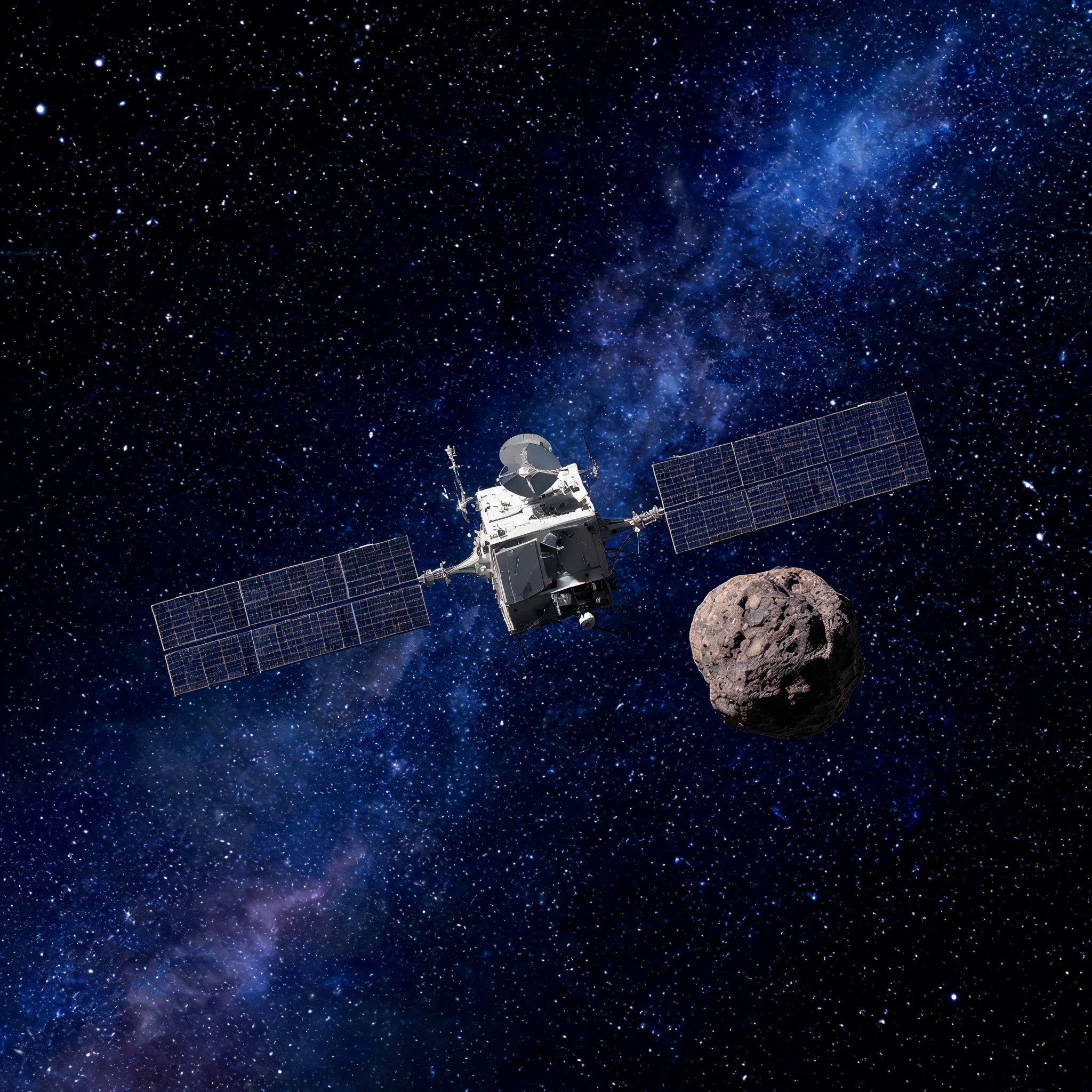
Key technical characteristics of the HERA probe and its payload environment.
Parameter | Value |
|---|---|
Launch Mass | ~544 kg |
Target Arrival | Late 2026 |
Primary Instruments | AFC, PALT, Hyperspectral Imager |
CubeSats Deployed | Juventas, Milani |
Note:
- The AFC provides the primary optical navigation data for autonomous landing attempts.
- CubeSats establish their own communication links, creating a single inter-satellite network.
The call for code is structured around a set of predefined challenge categories, each aligned with a specific scientific or operational objective. One category focuses on autonomous navigation, requiring algorithms that can identify surface landmarks from the AFC images and maintain positional awareness relative to the asteroid's irregular gravity field. Another category targets scientific data processing, asking developers to write scripts that compress, filter, or interpret raw spectral data before transmission to Earth, effectively triaging the limited downlink bandwidth. A third category emphasizes communication optimization, challenging developers to create scheduling algorithms that maximize data return given the geometric constraints of the Earth-spacecraft-asteroid system. Each challenge comes with a detailed technical specification, a sample dataset, and a cloud-based simulator that replicates the spacecraft’s onboard processing environment. The selection process is competitive and rigorous, with ESA engineers reviewing each submission for correctness, efficiency, and scientific merit. Successful candidates have their code integrated into the flight software, tested extensively in ground-based hardware-in-the-loop simulations, and finally uploaded to the spacecraft during a scheduled maintenance window.
The Physics of Asteroid Deflection
Understanding the HERA mission requires a firm grasp of the gravitational and orbital mechanics that govern asteroid systems. The binary system at the mission’s heart, Didymos and Dimorphos, represents a natural laboratory for testing the laws of celestial mechanics at the small-body scale. Didymos, the primary, is approximately 780 meters in diameter with a rotation period of 2.26 hours. Dimorphos, the secondary, orbits at a distance of roughly 1.2 kilometers from the primary’s center, with an orbital period of 11.9 hours before the DART impact.
The mass of the system is dominated by Didymos, estimated at around 5.4 × 10¹¹ kilograms, while Dimorphos contributes a mere 5 × 10⁹ kilograms. The gravitational binding between them is extraordinarily weak; the escape velocity from Dimorphos’s surface is only about 0.15 meters per second, meaning a brisk walking pace could launch an astronaut into space. This delicate balance is what made the DART experiment so effective; the enormous kinetic energy of the impactor was vastly larger than the gravitational binding energy of the moonlet, causing an immediate and dramatic orbital change.
The deflection efficiency of a kinetic impact is quantified by a parameter called the momentum enhancement factor, denoted by β. This dimensionless number represents the ratio of the actual momentum change imparted to the asteroid compared to the momentum of the impactor itself. A value of β = 1 indicates that the asteroid simply absorbs the momentum of the impactor without any additional effect. Values greater than 1 occur when the impact ejects significant material in the opposite direction of the impactor’s path, acting like a rocket exhaust that pushes the asteroid further. Observations of the DART impact suggest β in the range of 3 to 5, meaning the ejected debris cloud amplified the momentum transfer by a factor of three to five. HERA’s primary scientific goal is to measure the mass of Dimorphos precisely, along with the ejecta mass and velocity distribution, to determine β accurately.
This measurement is not merely academic; it determines the engineering requirements for future asteroid deflection missions, including the size of the impactor needed and the warning time required for a given threat level. A heavily porous asteroid, for instance, would absorb energy inefficiently, reducing β and requiring a more massive impactor or earlier intervention. HERA’s measurements will also resolve a critical ambiguity in the post-impact state: whether Dimorphos is now tumbling chaotically or has settled into a stable rotation locked to its orbital period. The DART impact likely excited a significant spin perturbation, and the moonlet’s shape may have been permanently altered by the impact.
The radar data from the Juventas CubeSat will provide a tomographic view of the interior, revealing the porosity and internal structure that determine how impact energy is absorbed. These measurements feed directly into the design of future missions, informing whether a single large impactor is preferable to multiple smaller strikes, and whether the asteroid’s response can be predicted with confidence from ground-based observations alone. The mathematics of this analysis is demanding, requiring numerical integration of the full three-body problem with variable mass distribution and non-gravitational forces such as the Yarkovsky effect, where sunlight is absorbed and re-emitted as thermal radiation, creating a subtle but persistent thrust.
Problem 1: Orbital Period Change Analysis
The DART impact changed Dimorphos’s orbital period from ##[T_0 = 11.92 \text{ hours}]## to ##[T_1 = 11.37 \text{ hours}]##. Using Kepler’s Third Law, the semi-major axis ##[a]## is related to the period ##[T]## by ##[a \propto T^{2/3}]##. Calculate the fractional change in the semi-major axis. The fractional change is given by:
###[\dfrac{\Delta a}{a_0} = \left(\dfrac{T_1}{T_0}\right)^{2/3} - 1 = \left(\dfrac{11.37}{11.92}\right)^{2/3} - 1 \approx \left(0.9539\right)^{0.6667} - 1 \approx 0.9692 - 1 = -0.0308]###
The semi-major axis decreased by approximately ##[3.08\%]##, confirming the moonlet moved closer to the primary.
Problem 2: Momentum Enhancement Factor β
Assume the DART impactor had a mass ##[m_i = 570 \text{ kg}]## and a relative impact velocity ##[v_i = 6.1 \text{ km/s}]##. The measured change in Dimorphos’s orbital velocity is ##[\Delta v = 0.36 \text{ mm/s}]##, and Dimorphos’s mass is ##[m = 5 \times 10^9 \text{ kg}]##. The momentum enhancement factor is defined as:
###[\beta = \dfrac{m \Delta v}{m_i v_i} = \dfrac{(5 \times 10^9 \text{ kg})(3.6 \times 10^{-4} \text{ m/s})}{(570 \text{ kg})(6100 \text{ m/s})} = \dfrac{1.8 \times 10^6}{3.477 \times 10^6} \approx 0.52]###
This calculation yields an apparent β less than 1, which is impossible physically. The discrepancy indicates either the mass estimate is off, the velocity change is larger than measured, or the ejection of material contributed temporarily. This demonstrates the challenge of precisely evaluating β from incomplete data. The computations above highlight the delicate interplay between observation and theory. They also lay the groundwork for the coding challenges; a developer might be tasked with automating such calculations from raw telemetry, or implementing a real-time estimator for β that fuses data from multiple instruments. The difficulty is not in the algebra but in the robust handling of noisy, incomplete, and occasionally contradictory sensor readings. Deep-space software must be resilient, fast, and deterministic, qualities that are not always prioritized in terrestrial software development. The HERA challenge is thus a gauntlet, a test of engineering discipline that goes far beyond writing clever algorithms in a comfortable local environment.
Deep-Space Software Engineering
Writing software for a spacecraft that is millions of kilometers away is a discipline defined by constraints. The first and most brutal constraint is the communication delay. At the distance of the Didymos system, which varies between 0.14 and 0.4 astronomical units from Earth, a one-way signal delay ranges from approximately 1.2 to 3.3 minutes. This means no real-time control; the spacecraft must be fully autonomous for extended periods, making decisions without ground intervention. The software must also be radiation-tolerant. Space is filled with high-energy particles, galactic cosmic rays, and solar wind protons that can flip bits in memory, corrupt data structures, and even latch up entire processors.
Reliable software, therefore, includes checksums, watchdog timers, and redundant execution paths, often running the same critical computation on multiple processing cores and comparing results. The onboard computer for HERA uses a radiation-hardened LEON-3 processor, which is derived from the SPARC architecture, running at a modest clock speed of only 80 MHz, far slower than a modern smartphone, but engineered for reliability in the most hostile environment imaginable. The development board that ESA provides for the public challenge mirrors this environment, emulating the LEON-3 processor and its real-time operating system, RTEMS. The board has 32 megabytes of RAM for the sandbox application and 8 megabytes of flash storage for the application itself.
The software must be written in C or C++ to compile efficiently for the SPARC architecture, and it must strictly adhere to the MISRA C coding standards, a set of guidelines initially developed for the automotive industry but now widely used in safety-critical aerospace software. These standards prohibit dynamic memory allocation after initialization, restrict the use of recursion, and mandate the use of static types for all variables. The result is software that is deterministic, verifiable, and free of the undefined behavior that plagues much of the commercial world. For the typical developer, this is a demanding adjustment; it is not the fast-moving, high-level environment of Python or JavaScript, but a disciplined domain where every byte and every cycle count.
The reward is participation in a mission that is genuinely historic, with code that has the potential to shape how humanity protects itself from cosmic threats. The practical pathway to participation is transparently documented on the ESA portal. Interested developers are required to submit a technical proposal, outlining their approach to a chosen challenge area, along with their relevant experience. Shortlisted candidates receive access to the flight-like simulator, a development toolkit, and a set of sample telemetry data. The final submissions are evaluated through a two-stage process: an automated benchmark suite that scores performance and resource usage, followed by a panel of ESA engineers who assess the software’s code quality, robustness, and scientific value. This selection process is entirely meritocratic, with no requirement for institutional affiliation, nationality, or previous aerospace experience. Indeed, ESA has explicitly stated that diversity of thought is an asset, and that novel approaches from outside the traditional aerospace community are actively sought. The code that is ultimately selected will be integrated into the spacecraft’s payload schedule, uploaded during a period of low activity in early 2027, and executed against real data from the asteroid system. The results will be made publicly available, complete with the developer’s own commentary on their work.
Problem 3: Memory and Performance Budget
The sandbox has ##[32 \text{ MB}]## of RAM and a processor that executes ##[80 \text{ MIPS}]## (millions of instructions per second). You are to write a sorting algorithm that processes a dataset of ##[N = 100,000]## telemetry frames, each frame requiring ##[256 \text{ bytes}]## of memory. The algorithm must complete its task in less than ##[2 \text{ seconds}]##. Determine if quicksort is feasible. Quicksort requires ##[O(N \log N)]## comparisons, averaging ##[1.7 \times 10^6]## comparisons, each taking ~##[10]## instructions. Total instructions:
###[\text{Instructions} = 1.7 \times 10^6 \times 10 = 1.7 \times 10^7 \quad \text{Time} = \dfrac{1.7 \times 10^7}{80 \times 10^6} \approx 0.21 \text{ s}]###
Memory required = ##[100{,}000 \times 256 = 25.6 \text{ MB}]##, which fits in the ##[32 \text{ MB}]## budget. The algorithm is feasible, confirming careful planning yields success.
Challenge Categories
HERA Software Competition Domains
The three primary tracks for developer participation in the HERA mission.
Track | Focus |
|---|---|
Autonomous Navigation | Landmark tracking, hazard avoidance |
Data Compression | Spectral imaging, lossy/lossless filters |
Comms Scheduling | Maximize scientific data return |
Note:
- Each track has its own evaluation metrics and required documentation.
- Submissions are evaluated on code quality, performance, and scientific contribution.
We Also Published
Planetary Defense and Global Participation
The significance of the HERA developer initiative extends far beyond the technical details of the mission itself; it represents a philosophical shift in the relationship between space agencies and the public. Planetary defense has always been framed as a matter of institutional responsibility, with governments and international bodies like the United Nations assuming the role of guardians against cosmic threats.
The reality, however, is that the asteroid threat is a global issue that affects every person on Earth, regardless of nationality or background. The open-source approach to software development for HERA implicitly acknowledges that the defense of our planet cannot be the exclusive domain of a few nations. It must be a shared enterprise, drawing on the collective intelligence of all of humanity. This is not mere rhetoric; ESA has designed the initiative to be genuinely accessible, with documentation in multiple languages, mentorship opportunities for underrepresented communities, and a commitment to publishing all results as open data.
The message is clear: planetary defense is not a spectator sport, and the tools to participate are being placed in the hands of anyone who is willing to learn. From a strategic perspective, the initiative also serves to build a global talent pipeline for the space sector. The aerospace industry faces a chronic shortage of software engineers with experience in safety-critical, resource-constrained environments. By giving thousands of developers hands-on experience with a real spacecraft’s software stack, ESA is effectively training the next generation of flight software engineers. Those who participate in the HERA challenge will have a tangible portfolio piece that demonstrates their ability to work under extreme constraints, a credential that is far more valuable than any certificate in a formal educational setting. The competitive nature of the challenge, with its structured evaluation and public recognition, creates a powerful incentive for continuous learning and peer collaboration. Forums and community channels are already buzzing with technical discussions, code reviews, and problem-solving sessions, forming an organic community of practice that will outlast the mission itself. The long-term implications for space governance are also profound. The precedent set by HERA, where a major space agency directly integrates public code into an operational mission, could pave the way for similar initiatives on lunar exploration, Mars rovers, and deep-space observatories. Imagine a future where a human mission to Mars carries a development board with software written by high school students, where a lunar base runs a life-support optimization algorithm contributed by an independent researcher in Nairobi, where a deep-space telescope’s observation schedule is tuned by a global community of astrophysicists and amateur enthusiasts. These are not idle dreams; the technical infrastructure exists, and the HERA mission is proving that the operational risks can be managed. The question is not whether this will happen, but how quickly the model will scale. The momentum is unmistakable, and the next decade may see the first truly global space exploration program, built by code contributions from every corner of the planet.
Problem 4: Communication Delay Impact
Consider a critical command that requires a round-trip communication time ##[t_{rt} = 2 \times d/c]##, where ##[d = 0.3 \text{ AU}]## and ##[c = 3 \times 10^8 \text{ m/s}]##. Calculate the total delay and determine if real-time control is possible. ##[1 \text{ AU} = 1.496 \times 10^{11} \text{ m}]##:
###[t_{rt} = \dfrac{2 \times (0.3 \times 1.496 \times 10^{11})}{3 \times 10^8} \approx \dfrac{8.976 \times 10^{10}}{3 \times 10^8} \approx 299.2 \text{ s} \approx 4.99 \text{ minutes}]###
A delay of nearly five minutes renders real-time joystick control impossible; autonomous software is not just an option, it is an existential necessity.
The Role of Citizen Science in Space
The HERA coding initiative aligns with a broader movement of citizen science, where the public contributes to genuine scientific research through distributed computing, data classification, and, now, direct spacecraft programming. Previous projects like [email protected] and Galaxy Zoo have demonstrated the power of crowdsourcing for computational and classification tasks, engaging millions of participants in the analysis of astronomical data. HERA goes a step further by moving citizens from the data processing pipeline to the development of the instruments themselves.
This is a significant escalation of responsibility and trust, placing scientific and operational judgment in the hands of developers who have never before worked with space hardware. It also creates a deeper connection between the public and the mission, transforming passive observers into active co-creators of scientific knowledge. When a developer sees their code executing on a spacecraft, examining an asteroid they have only ever known as a simulated dataset, the experience is transformative. It transforms abstract concepts like "planetary defense" into a tangible, personal achievement. The educational value of the initiative cannot be overstated. For university students in computer science, aerospace engineering, or physics, the HERA challenge offers an authentic, project-based learning experience that is impossible to replicate in a traditional classroom. It demands the integration of multiple disciplines: orbital mechanics, radiation physics, real-time operating systems, signal processing, and, of course, software architecture. The challenge also encourages the development of professional skills that are rarely taught academically, including technical writing, presentation skills, and the ability to collaborate with experts in unrelated fields. The competition’s public nature adds a layer of accountability and motivation, pushing participants to produce their best work while learning from the successes and failures of their peers.
The long-term payoff is a generation of engineers and scientists who enter the workforce with a deep understanding of the entire mission lifecycle, from proposal to operation, and who are far better prepared to lead future space exploration efforts. This is the kind of impactful, hands-on education that can inspire students to pursue careers in STEM, addressing the persistent skills shortage that the industry faces. Beyond the educational impact, the initiative has significant implications for the economics of space missions. By offloading certain software development tasks to the public, ESA can allocate mission resources to other priorities, reducing the overall cost of the payload software.
The diversity of approaches generated by an open competition is also likely to uncover innovative solutions that would not have emerged from a traditional, insular development team. The cost-benefit analysis is compelling, and it suggests that this model may be broadly adopted across the industry. Smaller space agencies, universities, and even private companies could leverage the global talent pool to accelerate their own mission development timelines. The competitive format, with clear objectives and evaluation criteria, ensures a high level of quality while keeping the administrative burden manageable. The HERA initiative, therefore, is not merely a unique opportunity for one mission; it is a blueprint for a more collaborative, more efficient, and more inclusive space program for the future.
We Also Published
From our network :
- 98% of Global MBA Programs Now Prefer GRE Over GMAT Focus EditionExplore why 98% of global MBA programs now prefer the GRE over GMAT Focus. Learn about the shorter GRE format, verbal logic importance, and strategic versatility for students.
- 10 Physics Numerical Problems with Solutions for IIT JEEPrepare for IIT JEE with 10 physics numerical problems, complete with detailed solutions and conceptual explanations. Ideal for mastering kinematics, thermodynamics, electromagnetism, and optics.
- Analyzing Trump Deportation Numbers Insights Into The 2026 Immigration Crackdown
- Mastering DB2 LUW v12 Tables: A Comprehensive Technical GuideComprehensive guide on DB2 LUW v12 tables. Explore CREATE TABLE syntax, BLU Acceleration, range partitioning, data types, and security features for IBM DB2 LUW v12.
- EV 2.0: The Solid-State Battery Breakthrough and Global Factory ExpansionDiscover the impact of the Solid-State Battery Breakthrough on the EV market. Learn about CATL and BYD stock growth, global factory expansion in Europe, and the future of EV 2.0 technology.
- Mastering DB2 12.1 Instance Design: A Technical Deep Dive into Modern Database ArchitectureComprehensive guide to DB2 12.1 Instance Design. Explore architectural components, HADR setup, buffer pool tuning, and security policies for IBM DB2 12.1. Includes 10 functional SQL and Shell samples.
- Trump Political Strategy How Geopolitical Stunts Serve As Media Diversions
- AI-Powered 'Precision Diagnostic' Replaces Standard GRE Score ReportsDiscover the new GRE Precision Diagnostic. Learn how AI-powered behavioral analytics and time-to-solve tracking are replacing standard GRE score reports to empower students.
- Vite 6/7 'Cold Start' Regression in Massive Module GraphsIn-depth analysis of Vite 6/7 cold start regressions in massive module graphs. Learn about barrel file issues, pre-bundling optimizations, and how to improve Vite dev server performance.
RESOURCES
- European Space Agencyesa.intThe European Space Agency portal features the latest news in space exploration, human spaceflight, launchers, telecommunications, navigation, monitoring and ...
- European Space Agency - Wikipediaen.wikipedia.orgThe European Space Agency (ESA; pronounced /ˈiːsə/ EE-sə) is a 23-member international organisation devoted to space exploration. ... It has its headquarters in ...
- EU Space Programmedefence-industry-space.ec.europa.euThe European Space Programme implements space activities in the fields of Earth Observation, Satellite Navigation, Connectivity, Space Research and ...
- Why is Europe lagging behind in space exploration? - Redditreddit.comJul 30, 2020 ... Europe did not build intercontinental ballistic missiles in the hundreds like the US and Russia did. Europe did not build…
- Research, Development and Innovation - Defence Industry and Spacedefence-industry-space.ec.europa.euEU Space Research Funding · It encourages the research community and the private sector to intensify their efforts in the space sector and boost…
- The EU Space Programme - European Unioneuspa.europa.euCopernicus is the EU's Earth Observation programme, monitoring our planet's environment. Its services draw information from satellites and in-situ (non-space) ...
- RAND Europe Space Hubrand.orgThe RAND Europe Space Hub (RESH) brings together cross-disciplinary and in-depth expertise on the European space sector as part of the global RAND Space ...
- About Us - Space Forcespaceforce.milU.S. Space Forces - Europe & Africa · U.S. Space Forces - Indo-Pacific. Main ... space domain since the beginning of space exploration. The…
- A Defining Year for Space: Why the U.S. and Europe Must Unite or ...rand.orgApr 14, 2025 ... Space exploration is entering an exciting, but precarious, new phase. By embracing collaboration, security, sustainability, and investment, ...
- OBSERVER: Horizon Europe EU space research call foresees €139 ...eu-space.europa.euMay 14, 2025 ... Horizon Europe is the EU's flagship programme for research and innovation, with a total budget of €93.5 billion for the…
- Horizon Europe - EU Space Research call 2026 open for submissionhadea.ec.europa.euMar 12, 2026 ... With a total budget of €90.97 million, the Horizon Europe EU Space Research call 2026 offers a wide range of…
- European Space Agency - ESA - LinkedInlinkedin.comEuropean Space Agency - ESA | 975334 followers on LinkedIn. We are the European Space Agency. Our mission is the peaceful exploration and use…
- Horizon Europe – EU Space Research Call 2025 open for submissionhadea.ec.europa.euMay 28, 2025 ... With a total budget of €139 million, the Horizon Europe EU space research call 2025 offers a variety of exciting…
- Orion European Service Module for NASA's Artemis - Airbusairbus.comNASA's Orion will take humans back to the Moon. Airbus-built European Service Module provides propulsion, power, water and oxygen for the Orion spacecraft.

0 Comments