
On This Page
Fundamentals of the Least Integer Function
The least integer function represents a mapping from the set of real numbers to the set of integers. It specifically identifies the smallest integer that is not less than the input value ##x##.
In technical literature, this operation is frequently called the ceiling function. It serves as a primary tool for rounding up values in various mathematical and engineering contexts.
The function is defined for every real number, regardless of whether the input is positive, negative, or zero. It ensures that the output is always an integer value.
Mathematically, the ceiling function is denoted using specific brackets. These brackets only have top horizontal bars, visually suggesting the concept of a ceiling or an upper bound.
Understanding this function is essential for students of calculus and discrete mathematics. It provides the logical basis for managing continuous data within discrete frameworks and systems.
Mathematical Definition and Notation
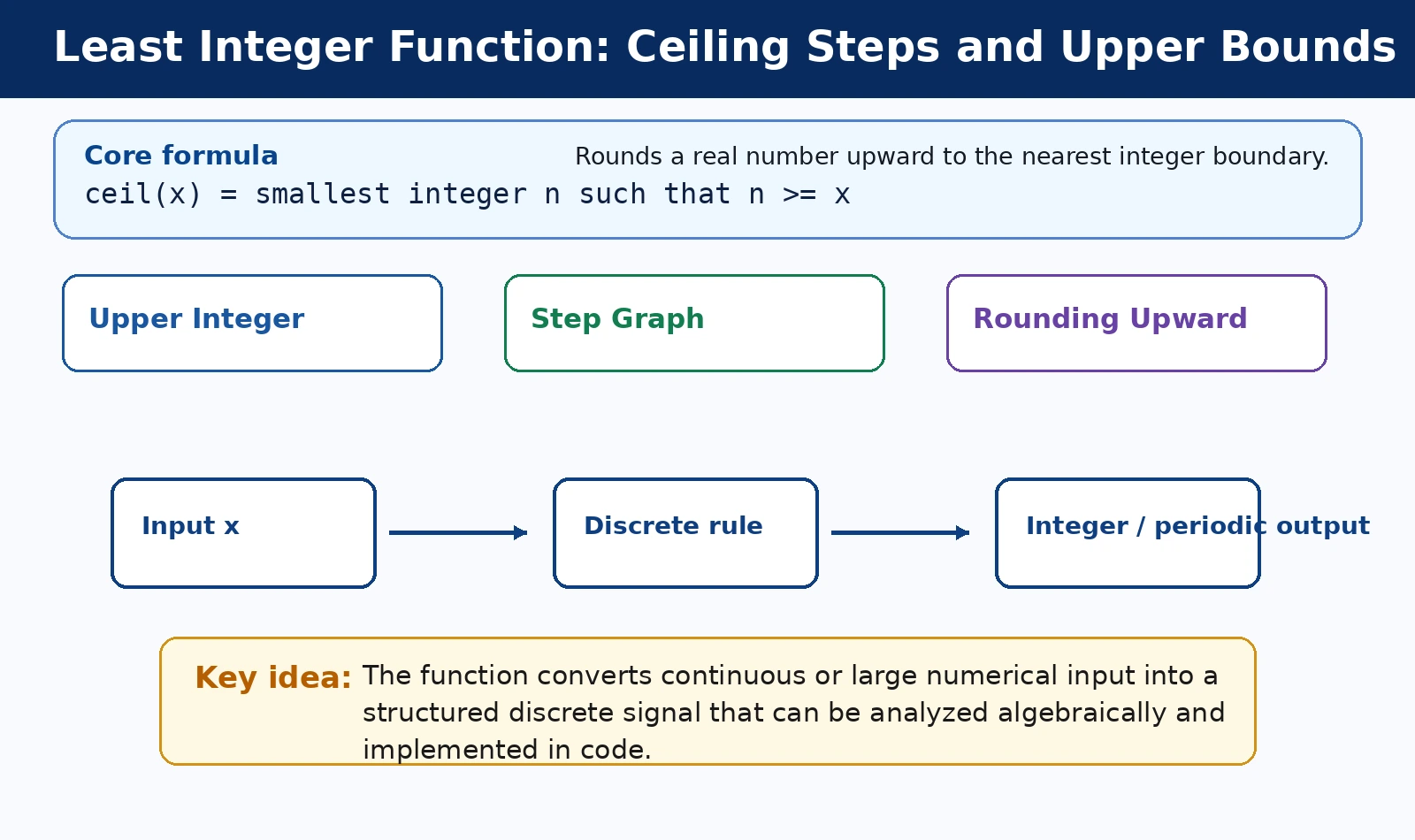
The formal definition of the least integer function is expressed through set theory. It is the minimum element of the set of integers greater than or equal to ##x##.
This relationship can be written as
. This expression ensures that the resulting integer is the closest neighbor on the right.
If the input ##x## is already an integer, the function returns the value itself. For example, if ##x = 5##, then ##\lceil 5 \rceil = 5## without change.
However, if ##x## has a fractional component, the function "jumps" to the next higher integer. This occurs even if the fractional part is extremely small or negligible.
The notation ##\lceil x \rceil## was popularized by Kenneth E. Iverson. It has since become the standard symbol used in programming languages and formal mathematical proofs globally.
Comparison with the Floor Function
The least integer function is the mathematical dual of the floor function. While the ceiling function rounds up, the floor function rounds down to the nearest integer.
The floor function is denoted by ##\lfloor x \rfloor## and represents the greatest integer less than or equal to ##x##. They are mirror images across the number line.
An interesting relationship exists between these two functions involving negation. Specifically, the ceiling of ##x## can be expressed as the negative floor of negative ##x##.
This identity is written as
. This property is particularly useful when implementing these functions in software that only supports one type.
While the floor function identifies the "lower" integer, the ceiling function identifies the "upper" integer. Together, they bound any non-integer real number between two consecutive integers.
Graphical Representation and Properties
When plotted on a Cartesian plane, the least integer function creates a distinct visual pattern. This pattern is characterized by a series of horizontal steps and jumps.
The graph is a classic example of a step function, also known as a piecewise constant function. It remains flat between integers and jumps at every integer value.
Each step in the graph is half-open, meaning it includes one endpoint but not the other. This reflects the function's behavior at exact integer input values.
The graphical representation helps students visualize how the function handles continuous intervals. It demonstrates the abrupt transitions that occur as the input crosses integer boundaries.
In technical analysis, the jumps in the graph represent points of discontinuity. These points are critical when studying the limits and derivatives of the ceiling function.
Visualizing the Step Function
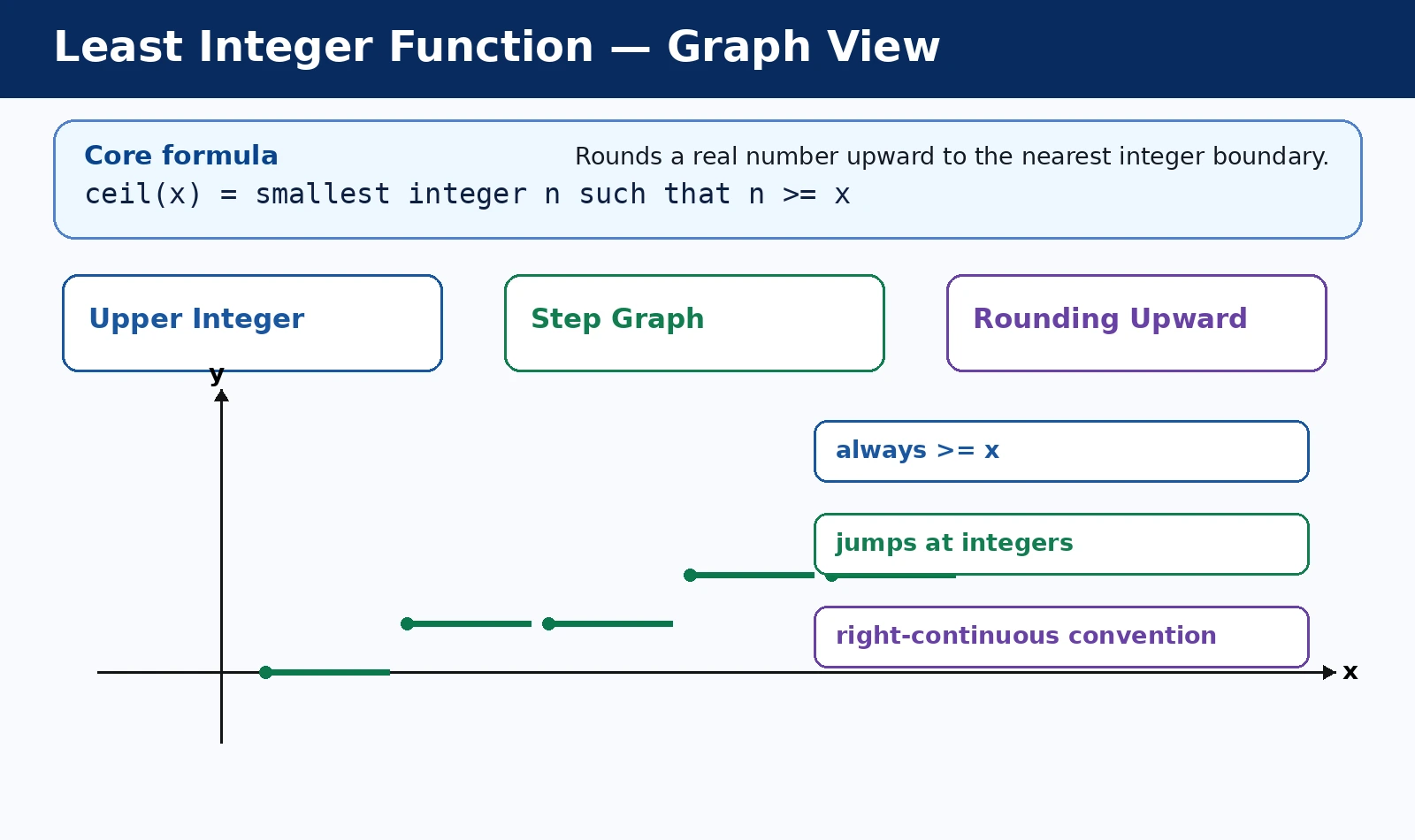
The graph of ##f(x) = \lceil x \rceil## consists of segments that are constant between integers. Each segment is located at a height equal to the next integer.
For any interval ##(n-1, n]##, the function value is exactly ##n##. This creates a "staircase" effect that ascends as the input value increases along the x-axis.
On the graph, the right endpoint of each step is a closed circle. This indicates that the function includes the integer value at the end of the interval.
Conversely, the left endpoint of each step is typically represented by an open circle. This shows that the function does not take that value at the transition point.
The visual "jump" at each integer is exactly one unit high. This consistent vertical displacement is a defining characteristic of the least integer function's geometric profile.
Key Algebraic Properties
The ceiling function possesses several unique algebraic properties that simplify complex expressions. One primary property is the addition of integers inside the function brackets.
For any real number ##x## and any integer ##n##, the property holds that ##\lceil x + n \rceil = \lceil x \rceil + n##. The integer can be moved outside.
Another important property relates to the bounds of the function. For any real number ##x##, the ceiling value satisfies the inequality
.
We Also Published
This inequality is fundamental for proving various theorems in number theory. it establishes the precise range in which the original real number must reside.
Additionally, the function is idempotent, meaning that applying the function multiple times yields the same result. Mathematically, this is expressed as ##\lceil \lceil x \rceil \rceil = \lceil x \rceil##.
Computational and Analytical Applications
In the realm of computer science, the least integer function is indispensable. It is used to determine memory requirements, array sizes, and data packet distributions.
When a process requires a specific number of bytes, the system often allocates memory in blocks. The ceiling function calculates how many blocks are needed to fit the data.
It also plays a role in graphics rendering and pixel calculations. Ensuring that objects align with discrete screen coordinates often requires rounding up using the ceiling operation.
In networking, the function helps determine the number of packets required to transmit a file. If a file size isn't a multiple of packet size, an extra packet is needed.
The function's logic is embedded in almost every modern programming language. Functions like ceil() in C++, Python, and Java provide direct access to this mathematical tool.
Role in Computer Science Algorithms
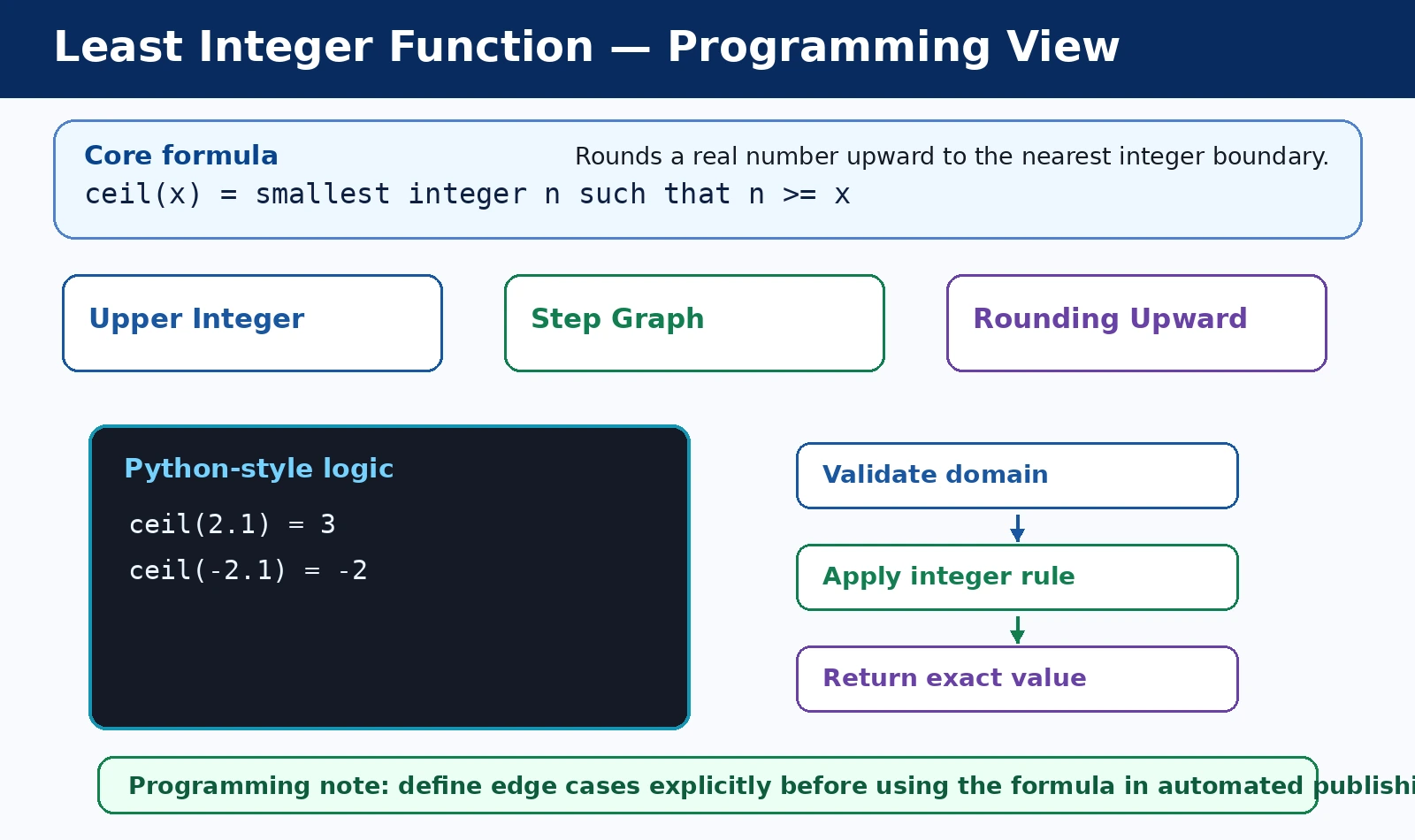
Algorithms involving division often rely on the ceiling function to handle remainders. This is common in binary search variations and load balancing across multiple server nodes.
When dividing tasks among processors, the ceiling function ensures no task is left behind. It calculates the maximum load any single processor might need to handle.
In data structures like heaps or balanced trees, the ceiling function determines heights and levels. It helps maintain the structural integrity of the discrete data arrangement.
Computational geometry also utilizes the ceiling function for grid-based calculations. It maps continuous spatial coordinates to discrete grid cells for efficient collision detection or pathfinding.
Without the least integer function, many automated systems would struggle with rounding errors. It provides a deterministic way to ensure sufficient resources are always allocated.
Discrete Mathematics and Combinatorics
In discrete mathematics, the ceiling function is frequently used in counting problems. It helps define the Pigeonhole Principle in a more generalized and rigorous mathematical form.
If ##n## items are put into ##m## containers, then at least one container must hold at least ##\lceil n/m \rceil## items. This is a powerful proof technique.
Combinatorial designs also utilize the function to determine the minimum number of elements required. It sets the lower bounds for various arrangements and selection processes.
In graph theory, the ceiling function appears in formulas for chromatic numbers and degrees. It helps describe the structural limits of nodes and edges in a network.
The function is also vital in the study of sequences and series. It allows mathematicians to index terms that are derived from continuous growth or decay models.
Practical Examples and Problem Solving
To master the least integer function, one must practice with both positive and negative numbers. The behavior with negative values is often a source of initial confusion.
For positive decimals like 2.3, the smallest integer greater than or equal to the value is 3. The logic is straightforward: we simply move to the next integer.
When dealing with negative decimals like -2.3, the logic remains the same. The integers greater than -2.3 are -2, -1, 0, etc. The smallest is -2.
Therefore, ##\lceil -2.3 \rceil = -2##. Notice that this is different from simply removing the decimal or rounding towards zero, which would result in a different value.
Practicing these calculations ensures that the user understands the directional movement on the number line. The ceiling function always moves to the right or stays put.
Real-World Resource Allocation
Consider a scenario where a teacher needs to transport 32 students in vans that hold 10 people. The calculation ##32 / 10## gives 3.2, which is not feasible.
Applying the ceiling function, ##\lceil 3.2 \rceil = 4##, tells the teacher that four vans are necessary. Three vans would leave two students behind without transportation.
This logic applies to manufacturing where raw materials are sold in fixed quantities. If a project requires 7.5 liters, and paint is sold in 1-liter cans, 8 cans are needed.
Financial systems use the ceiling function for calculating interest payments or service fees. It ensures that fractional cents are rounded up to the nearest whole currency unit.
In scheduling, if a task takes 4.1 hours and must be billed in hour increments, the ceiling function dictates 5 hours. This protects the service provider's time.
Common Pitfalls and Calculation Errors
The most common error occurs when users confuse the ceiling function with standard rounding. Standard rounding would take 2.3 to 2, but the ceiling takes it to 3.
Another pitfall is the incorrect handling of negative numbers. Many mistakenly believe ##\lceil -2.3 \rceil## should be -3 because they associate "ceiling" with a higher magnitude.
On the number line, -2 is greater than -3. Since the function seeks the smallest integer *greater* than the input, -2 is the mathematically correct output.
Programmers sometimes encounter issues when using integer division instead of floating-point division. Integer division may truncate the result before the ceiling function can be applied.
To avoid these errors, always verify the data type of the input. Ensure that the division preserves the fractional part so the ceiling function can operate correctly.
From our network :
- Mastering DB2 LUW v12 Tables: A Comprehensive Technical Guide
- EV 2.0: The Solid-State Battery Breakthrough and Global Factory Expansion
- Vite 6/7 'Cold Start' Regression in Massive Module Graphs
- 98% of Global MBA Programs Now Prefer GRE Over GMAT Focus Edition
- AI-Powered 'Precision Diagnostic' Replaces Standard GRE Score Reports
- Mastering DB2 12.1 Instance Design: A Technical Deep Dive into Modern Database Architecture
- https://www.themagpost.com/post/analyzing-trump-deportation-numbers-insights-into-the-2026-immigration-crackdown
- https://www.themagpost.com/post/trump-political-strategy-how-geopolitical-stunts-serve-as-media-diversions
- 10 Physics Numerical Problems with Solutions for IIT JEE
RESOURCES
- Floor and ceiling functions - Wikipedia
- Ceiling Function Definition - BYJU'S
- Greatest Integer, Least Integer functions : r/learnmath - Reddit
- What is the least integer function? - CK-12
- Greatest and Least Integer Functions | PDF - Scribd
- Finding the least integer n for a function Big-O of another function?
- least integer - Desmos
- Greatest Integer Functions and Smallest Integer Functions
- Greatest Integer, Least Integer functions - Math Stack Exchange
- Python: finding lowest integer - Stack Overflow
- Least Integer Function | Mathematical lexicon - Netmath
- Ceiling Function | Brilliant Math & Science Wiki
- Ceiling Function — Definition, Formula & Examples - Mathwords
- How to integrate the least integer function and the greatest ... - Quora
- Least integer function_Baiduwiki

0 Comments