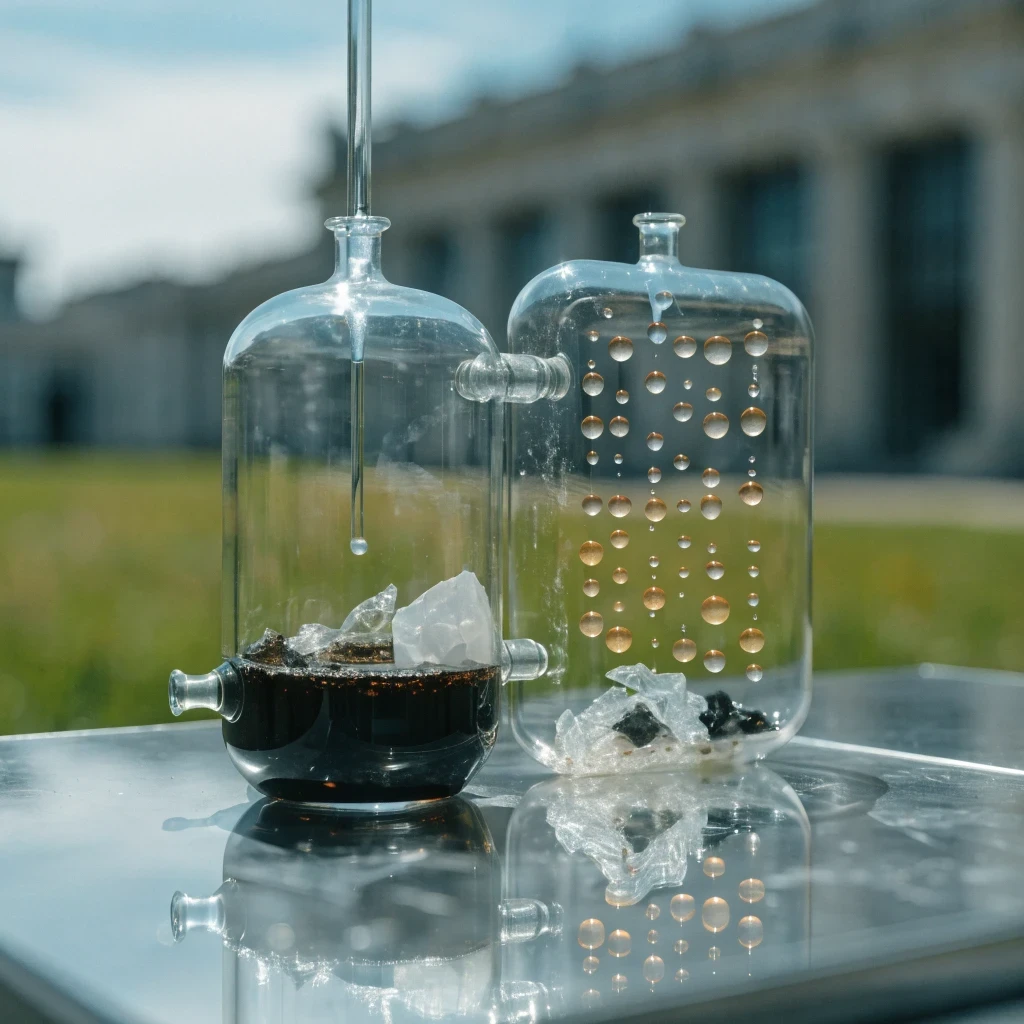
Plastic waste is often called chemically stubborn because its carbon–carbon backbones resist water, enzymes, and ordinary biological decomposition. Yet a striking principle from modern reaction science challenges that assumption: the size of the reaction environment can alter what chemistry is possible. In microscopic water droplets, molecules encounter one another under unusual concentration, interfacial, acidity, and transport conditions—turning an apparently inert waste stream into a source of useful organic acids.
The significance extends far beyond a clever recycling trick. Droplet chemistry offers a way to steer polymer breakdown toward selected molecular building blocks rather than destroying plastic through uncontrolled heating or producing low-value mixtures. The central message is decisive: shrinking the reaction space can reshape reaction pathways. Water is not merely a solvent in this picture; confined water becomes a reactive microenvironment capable of redirecting difficult plastic chemistry toward potentially valuable feedstocks.
On This Page
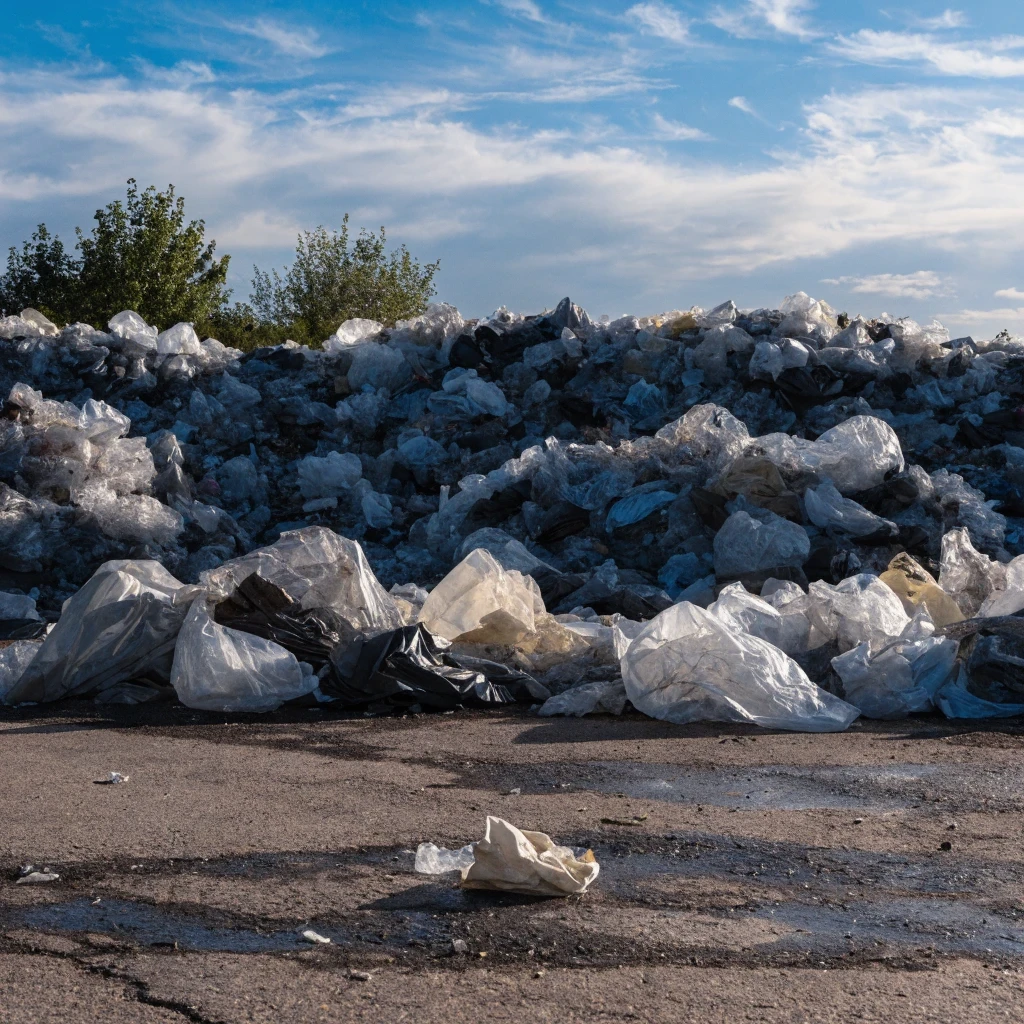
Why Conventional Plastics Resist Chemical Recycling
Most commodity plastics were engineered for durability, not molecular reversibility. Polyethylene and polypropylene, for example, contain long hydrocarbon chains dominated by strong carbon–carbon and carbon–hydrogen bonds. Their hydrophobic surfaces repel water, while their high molecular masses and crystallinity limit penetration by catalysts or reactive molecules. A recycling process must therefore overcome both thermodynamic stability and physical inaccessibility before useful chemistry can begin.
That resistance explains why mechanical recycling remains the default for relatively clean, well-sorted waste. Once plastic is mixed, contaminated, pigmented, multilayered, or repeatedly heated, its quality declines. Melting can preserve material volume but rarely restores the original molecular structure. Chemical recycling promises more flexibility, yet conventional bulk reactors often require high temperatures, aggressive reagents, or substantial energy inputs. The problem is not simply breaking plastic; it is breaking it selectively.
The molecular armour of polymer chains
A polymer is not a single giant molecule in the practical sense of reaction control; it is a population of chains with different lengths, branching patterns, additives, and defect sites. The average number of repeat units is described by the degree of polymerization, ##X_n##. As ##X_n## rises, the number of chain ends per unit mass falls, making end-selective breakdown increasingly ineffective.
For a simplified hydrocarbon chain, oxidation must create a chemically activated site before fragmentation becomes probable. The overall rate may be represented by ##r=k[ P ][O]##, where ##P## denotes an accessible polymer site and ##O## a reactive oxidizing species. In a dense hydrophobic matrix, both terms are effectively restricted: the reagent cannot easily reach the chain, and the chain cannot easily reorganize around it.
Acid formation requires still greater control. Random chain scission can produce aldehydes, ketones, alcohols, short hydrocarbons, and partially oxidized fragments. If oxidation proceeds too far, carbon may end as carbon dioxide rather than a recoverable feedstock. If it proceeds too little, the fragments remain chemically unsuitable. The winning strategy is therefore a controlled sequence: access, activation, cleavage, and termination at a useful acid.
Why bulk reactors often lose selectivity
Bulk processing treats the reaction vessel as a relatively uniform environment, but plastic waste is anything but uniform. Solid particles, liquid reagents, gas bubbles, catalyst surfaces, and heat gradients coexist on different length scales. A reagent may be abundant in the liquid phase while remaining scarce precisely where the polymer bonds need activation. Increasing temperature accelerates many reactions at once, including unwanted degradation.
The selectivity challenge can be expressed through competing pathways. If a desired acid forms at rate ##r_d## and undesired products form at rate ##r_u##, a simple selectivity measure is ##S=\dfrac{r_d}{r_d+r_u}##. Raising the temperature may increase both rates, but unless the desired pathway has a stronger temperature dependence, selectivity can stagnate or collapse. Faster chemistry is not automatically better chemistry.
Bulk reactors also conceal the importance of interfaces. A plastic particle’s outer surface may be chemically active while its interior remains untouched. Agitation improves contact, but it cannot abolish diffusion barriers within hydrophobic solids. This is why the droplet approach is conceptually powerful: rather than merely adding more reagent, it redesigns where molecules meet, how far they travel, and which local conditions dominate the reaction.
Calculation 1 — concentration and selectivity. Suppose ##k_d=4## and ##k_u=1## in consistent units, while the local oxidant concentration is ##[O]=2##. Then ##S=\dfrac{4}{4+1(2)}=\dfrac{4}{6}\approx0.667##. If confinement lowers the local oxidant concentration to ##1## while maintaining access to the polymer, ##S=\dfrac{4}{4+1} =0.80##. The lesson is not numerical magic; controlling local concentrations can favour one pathway.

How Water Droplets Create a New Reaction Environment
Microscopic droplets behave differently from a large beaker of water because their interfaces dominate their total volume. As droplet diameter decreases, surface area rises sharply relative to the amount of liquid enclosed. Hydrophobic polymer fragments, dissolved oxidants, catalysts, and water can therefore experience a much larger proportion of their reaction time near boundaries. These boundaries are chemically active zones, not passive walls.
Confinement also changes transport. Molecules travel shorter distances before reaching an interface or another reagent, and concentration gradients can become steep. Evaporation may increase local solute concentration; surface charge may organize ions; pH can differ near an interface from the bulk value. Such effects are familiar in atmospheric aerosol chemistry, cloud droplets, electrochemistry, and biological compartments. Applying them to plastic recycling is an audacious but scientifically grounded extension.
Surface area, curvature, and molecular contact
For a spherical droplet with radius ##r##, surface area is ##A=4\pi r^2## and volume is ##V=\dfrac{4}{3}\pi r^3##. Their ratio is therefore ##\dfrac{A}{V}=\dfrac{3}{r}##. Halving the radius doubles the interfacial area available per unit liquid volume. This geometric relationship is simple, but its practical implication is profound: smaller droplets amplify the influence of the boundary.
Assume a droplet radius falls from ##100\ \mu\text{m}## to ##10\ \mu\text{m}##. The area-to-volume ratio changes from ##\dfrac{3}{100}## to ##\dfrac{3}{10}## in inverse-micrometre units. The ratio of these values is ##\dfrac{3/10}{3/100}=10##. A tenfold increase in interfacial density can substantially alter how polymer surfaces encounter water, reactive oxygen, acids, or catalytic species.
Curvature matters as well. At a highly curved interface, molecules have fewer neighbouring molecules than they would in a flat bulk phase, and their orientations are less constrained. This can change adsorption, proton transfer, and radical reactions. The droplet does not violate chemical laws; it changes the local statistical environment in which those laws operate, making previously minor reaction channels chemically competitive.
Diffusion becomes a controllable variable
Diffusion time scales approximately as ##t_d\sim\dfrac{L^2}{D}##, where ##L## is a characteristic travel distance and ##D## is the diffusion coefficient. Because the distance enters quadratically, reducing the relevant length scale produces a disproportionately rapid transport response. Droplets, thin films, emulsions, and porous particles exploit this principle by bringing reactive species close to the material they must transform.
Calculation 2 — diffusion-time reduction. Let ##D=1\times10^{-9}\ \text{m}^2\text{s}^{-1}##. For a reagent travelling ##L=100\ \mu\text{m}=1\times10^{-4}\ \text{m}##, ##t_d\sim\dfrac{(1\times10^{-4})^2}{1\times10^{-9}}=10\ \text{s}##. At ##L=10\ \mu\text{m}##, ##t_d\sim\dfrac{(1\times10^{-5})^2}{1\times10^{-9}}=0.1\ \text{s}##. The tenfold distance reduction yields a hundredfold reduction in diffusion time.
This advantage can help synchronize transport with reaction. If a reactive intermediate forms briefly, it is more likely to reach a polymer surface before disappearing. Conversely, the droplet may protect a desired intermediate from dilution or redirect it toward protonated acid products. The key design question becomes measurable: how should droplet size, composition, and lifetime be chosen to match the timescales of transport and bond transformation?
From Stubborn Plastic to Valuable Organic Acids
The phrase “useful acids” signals a change in recycling philosophy. The objective is not merely to reduce plastic into smaller pieces, nor to burn it for energy. Organic acids can serve as chemical intermediates, solvents, preservatives, polymer precursors, or starting materials for further synthesis. Their value depends on identity, purity, concentration, separation cost, and compatibility with existing manufacturing routes.
Plastic conversion therefore demands product discipline. A process that generates a complex acidic soup may technically oxidize waste but still fail economically. The strongest research aims to control carbon fate: maximize the fraction entering targeted acids, minimize carbon dioxide and toxic by-products, and create a stream that can be separated without excessive energy. Droplet chemistry is promising because it may influence both reaction rate and product distribution.
We Also Published
Oxidation, cleavage, and acid termination
For a resistant hydrocarbon polymer, a plausible pathway begins with hydrogen abstraction or another activation event. The resulting radical can react with oxygen, form a peroxide, and undergo rearrangements that generate alcohols, carbonyl compounds, and chain scissions. Subsequent oxidation may produce carboxylic acids. Each step competes with recombination, uncontrolled fragmentation, and complete mineralization, so the reaction environment must be carefully managed.
The chemistry can be viewed as a carbon-balance problem. Let ##n_C## be the number of carbon atoms entering the process and ##n_A## the number recovered in the desired acid. A simplified carbon yield is ##Y_C=\dfrac{n_A}{n_C}\times100\%##. High mass conversion with low ##Y_C## is a hollow victory: the polymer disappeared, but its carbon value was squandered as gas, tar, or unseparated by-products.
Water droplets may support acid formation through local proton activity, interfacial oxygen transfer, and rapid removal of polar products from hydrophobic regions. They can also expose weak points created by oxidation. The outcome is not guaranteed by small size alone. Droplets are a reaction-engineering tool whose performance depends on chemistry, mixing, energy input, and the precise polymer being processed.
Selectivity is the real measure of success
Plastic recycling headlines often emphasize conversion percentage, but conversion answers only one question: how much starting material changed? Selectivity asks a harder question: what did it become? Yield combines both. If conversion is ##X## and selectivity to the desired acid is ##S##, then an idealized product yield is ##Y=X\times S##, with both quantities expressed as fractions rather than percentages.
Calculation 3 — conversion, selectivity, and yield. Consider a process with ##X=0.75## conversion and ##S=0.60## selectivity. The desired-acid yield is ##Y=0.75\times0.60=0.45##, or ##45\%## of the starting polymer’s theoretical target. If droplet processing raises selectivity to ##0.80## at the same conversion, ##Y=0.75\times0.80=0.60##, a substantial increase to ##60\%## without converting more plastic.
This distinction should govern future claims. A process that converts 95 percent of plastic but directs only 10 percent of its carbon into recoverable acids may be less attractive than one converting 70 percent with 75 percent selectivity. Researchers must report carbon balances, product distributions, toxicity, energy consumption, water demand, and separation requirements. Green chemistry is not defined by the presence of water; it is defined by the whole process.
Which plastics benefit most?
Not every polymer will respond identically. Condensation polymers containing ester or amide bonds may be more amenable to hydrolysis than polyolefins, whose saturated carbon backbones are exceptionally resistant. Additives, dyes, fillers, multilayer structures, and contamination can alter wetting and reaction kinetics. A droplet process that performs impressively on a clean laboratory polymer may behave differently on post-consumer material.
That does not weaken the concept; it clarifies the research agenda. Plastic streams should be classified by bond chemistry, morphology, additive load, and surface behaviour. The best application may not be universal mixed-waste treatment. It may be a targeted process for a difficult, high-volume stream whose current disposal route is environmentally damaging and whose products have a reliable downstream market.
Acid products can also become analytical fingerprints. By measuring which acids appear, and in what proportions, scientists can infer which bonds were activated and whether oxidation is proceeding through surface-limited or bulk-limited routes. Product analysis thus becomes more than quality control. It becomes a window into the microscopic mechanism, allowing droplet composition and operating conditions to be optimized rationally rather than by trial and error.
What This Means for Green Chemistry and Industrial Scale-Up
Droplet-enabled recycling fits a broader movement in chemistry: replace brute-force conditions with precise control over microenvironments. Microreactors, emulsions, aerosol reactors, porous catalysts, mechanochemistry, and electrochemical systems all challenge the assumption that reactions must occur in large, homogeneous vessels. Their common promise is intensified chemistry—more productive contact, better heat and mass transfer, and tighter control over competing pathways.
Yet laboratory elegance is not industrial proof. A useful process must generate droplets continuously, maintain their size distribution, recover acids, recycle water, tolerate feed variability, and operate safely. Energy used to atomize or emulsify the liquid must be counted. Materials must withstand oxidants and acidity. The system must also prevent workers and ecosystems from encountering persistent intermediates or concentrated contaminants released from the plastic.
Energy, separation, and process economics
The economics of chemical recycling are governed by more than reaction yield. A simplified net benefit can be represented as ##B=V_P-C_E-C_R-C_S-C_W##, where ##V_P## is product value and the remaining terms represent energy, reagents, separation, and waste-management costs. Droplets can raise ##V_P## by improving acid selectivity, but they may also increase ##C_E## if generating and stabilizing them requires intensive equipment.
Calculation 4 — a simplified process balance. Suppose acid products provide ##V_P=\$1{,}000## per tonne of feed. Let energy cost be ##C_E=\$180##, reagents ##C_R=\$220##, separation ##C_S=\$260##, and waste treatment ##C_W=\$90##. Then ##B=1000-180-220-260-90=\$250## per tonne. If improved selectivity cuts separation cost to ##\$160##, the balance rises to ##\$350## per tonne, showing why product purity can matter as much as conversion.
Separation is frequently the hidden bottleneck. Dilute acids dissolved in water may require extraction, crystallization, membranes, distillation, or ion-exchange operations. Each introduces capital cost and energy demand. The most persuasive droplet process will design reaction and separation together—for example, producing acids at concentrations and phases that permit direct recovery. “Useful” must mean usable, separable, and economically defensible.
Scaling from droplets to manufacturing plants
Scaling a droplet process by simply enlarging the vessel can destroy the very physics that makes it work. Industrial designers may instead increase throughput by numbering up many small channels, nozzles, membranes, or mixing zones. This preserves transport distances and interfacial area while allowing parallel operation. Such architectures are common in process intensification, but they demand precise control of clogging, pressure, fouling, and residence-time distribution.
Droplet size is never perfectly uniform. A real reactor contains a distribution described by a mean radius, variance, and sometimes multiple populations. Because surface-to-volume ratio scales as ##1/r##, the smallest droplets may dominate reactivity even when they represent a modest fraction of total volume. Monitoring size distribution, interfacial area, temperature, pH, and dissolved oxygen is therefore essential for reproducibility.
Scale-up also requires robust feed preparation. Shredding, washing, drying, sorting, and particle-size control can consume significant resources before chemistry begins. A successful plant should tolerate realistic contamination rather than depend on pristine laboratory feedstock. The strongest industrial pathway will combine mechanical preprocessing with selective droplet conversion, reserving high-purity streams for conventional recycling and directing chemically unsuitable material toward controlled molecular recovery.
Calculation 5 — mass-based target yield. Assume ##m_{\text{plastic}}=100\ \text{g}##, a measured acid product mass of ##m_{\text{acid}}=30\ \text{g}##, target-acid molar mass ##M_{\text{target}}=60##, and polymer repeat-unit molar mass ##M_{\text{repeat unit}}=42##. A simplified normalized yield estimate is ##\eta=0.30\times\dfrac{60}{42}\approx0.429##, or about ##42.9\%## on this idealized basis. Real studies must correct for stoichiometry and carbon balance.
The calculation illustrates why reporting conventions matter. Mass yield, molar yield, carbon yield, conversion, and selectivity answer different questions. Without a clear denominator, impressive percentages can mislead. Transparent reporting should specify the polymer’s repeat-unit composition, product purity, recovered fraction, analytical method, water and energy inputs, and whether acids are isolated or merely detected in solution.
The environmental case must be tested, not assumed
Water-based processing sounds inherently sustainable, but environmental performance depends on the complete life cycle. Droplet generation, oxidant manufacture, heating, pumping, wastewater treatment, and product purification all contribute to the footprint. A process can avoid incineration yet remain resource-intensive. Life-cycle assessment should compare it with mechanical recycling, pyrolysis, landfilling, incineration, and production of equivalent virgin chemicals.
There are also chemical-safety questions. Oxidizing plastic may release volatile compounds, persistent additives, heavy metals, or biologically active fragments. Acidic products can be useful, but uncontrolled acidity can corrode equipment and complicate wastewater management. Closed-loop water handling, inline monitoring, secondary containment, and product purification are not optional extras; they are the infrastructure that turns promising laboratory chemistry into responsible technology.
Still, the environmental opportunity is substantial. Converting waste carbon into feedstocks can reduce demand for fossil-derived raw materials, especially when the process operates at moderate temperatures and produces concentrated, recoverable products. The most credible promise is not that droplets make plastic harmless. It is that carefully engineered microenvironments may make selective molecular recovery more practical than the blunt, energy-heavy methods currently available.
The broader scientific lesson is even more valuable than the immediate recycling application. Reaction conditions are not exhausted by temperature, pressure, solvent identity, and catalyst choice. Geometry, confinement, interfacial area, transport distance, and local concentration can be equally decisive. Droplets reveal chemistry as a spatial discipline: where molecules react may determine what they become.
That insight could influence the treatment of other resistant materials, including biomass residues, contaminated oils, composite waste, and persistent organic compounds. It may also improve pharmaceutical synthesis, atmospheric chemistry, and catalytic manufacturing. The governing principle is transferable: when a reaction refuses to proceed selectively in bulk, redesign the environment before escalating the severity.
Water droplets will not solve the plastic crisis alone. Collection, reduction, reuse, product redesign, producer responsibility, and reliable recycling markets remain indispensable. But the research direction deserves serious attention because it attacks a genuine weakness in current systems: the inability to convert chemically complex waste into clean, valuable molecules. If the science survives scale-up, droplets could become miniature reactors for a more circular carbon economy.
From our network :
- Mastering DB2 12.1 Instance Design: A Technical Deep Dive into Modern Database ArchitectureComprehensive guide to DB2 12.1 Instance Design. Explore architectural components, HADR setup, buffer pool tuning, and security policies for IBM DB2 12.1. Includes 10 functional SQL and Shell samples.
- Analyzing Trump Deportation Numbers Insights Into The 2026 Immigration Crackdown
- Vite 6/7 'Cold Start' Regression in Massive Module GraphsIn-depth analysis of Vite 6/7 cold start regressions in massive module graphs. Learn about barrel file issues, pre-bundling optimizations, and how to improve Vite dev server performance.
- 10 Physics Numerical Problems with Solutions for IIT JEEPrepare for IIT JEE with 10 physics numerical problems, complete with detailed solutions and conceptual explanations. Ideal for mastering kinematics, thermodynamics, electromagnetism, and optics.
- EV 2.0: The Solid-State Battery Breakthrough and Global Factory ExpansionDiscover the impact of the Solid-State Battery Breakthrough on the EV market. Learn about CATL and BYD stock growth, global factory expansion in Europe, and the future of EV 2.0 technology.
- Mastering DB2 LUW v12 Tables: A Comprehensive Technical GuideComprehensive guide on DB2 LUW v12 tables. Explore CREATE TABLE syntax, BLU Acceleration, range partitioning, data types, and security features for IBM DB2 LUW v12.
- AI-Powered 'Precision Diagnostic' Replaces Standard GRE Score ReportsDiscover the new GRE Precision Diagnostic. Learn how AI-powered behavioral analytics and time-to-solve tracking are replacing standard GRE score reports to empower students.
- 98% of Global MBA Programs Now Prefer GRE Over GMAT Focus EditionExplore why 98% of global MBA programs now prefer the GRE over GMAT Focus. Learn about the shorter GRE format, verbal logic importance, and strategic versatility for students.
- Trump Political Strategy How Geopolitical Stunts Serve As Media Diversions
RESOURCES
- Tiny water droplets convert stubborn plastic waste into ... - Phys.orgphys.org1 day ago ... These acids are essential chemical building blocks ... environmental barriers to the industrial adoption of chemical plastic recycling.
- Chapter 3: Green and Sustainable Chemistry for a Circular Economybooks.rsc.orgApr 2, 2026 ... ... sustainable plastics and materials.96 Considering ... plastic waste that can be recycled by various chemical recycling methods.
- Beyond biodegradation: Chemical upcycling of poly(lactic acid ...sciencedirect.com[2] Plastic waste has a long lifespan and a high resistance to degradation in the environment.[3] Recycling plastic waste not only prevents environmental damage ...
- Recycling PLA Plastic using Green Chemistry | Lesson Plansciencebuddies.orgStudent Objectives. Students will: Learn about renewable "corn" plastic is made from polylactic acid; Recycle the polylactic acid cup into a new product: ...
- Degradation Rates of Plastics in the Environment - ACS Publicationspubs.acs.orgFeb 3, 2020 ... The potential environmental hazards associated ... Insights into Chemical Recycling and Upgrading Strategies for Polyolefin-Based Plastics.
- Catalyst-free, microdroplet-mediated waste plastic conversion to ...nature.com2 days ago ... Environmental and Economic Assessment of Plastic Waste Recycling: A Comparison of Mechanical, Physical, Chemical Recycling and Energy ...
- Can mixed plastics be recycled and upcycled without separation?pubs.rsc.orgNov 11, 2025 ... In this review, we examine the possibility of using mixed and/or contaminated plastic feedstock for chemical recycling, upcycling and formation ...
- Industrial and Laboratory Technologies for the Chemical Recycling ...pmc.ncbi.nlm.nih.gov... chemical recycling to provide a more sustainable strategy for plastic waste management. ... Degradation of plastic materials into terephthalic acid (TPA) ...
- Thermodynamically leveraged solventless aerobic deconstruction of ...pubs.rsc.orgFeb 3, 2025 ... ... plastic waste challenge while inspiring chemists to develop alternative solutions for sustainable plastic recycling. Introduction. Plastics ...
- Project: Recycling PLAgreenchemistry.yale.eduStudents will be introduced to the concepts of Green Chemistry by comparing PLA to traditional plastics, and through recycling PLA into an anti- microbial ...


0 Comments